
Most advice about a data monetization platform starts with pricing, market size, or the fastest route to selling a dataset. That order is backwards. Before a buyer pays, someone must find the data, verify the rights, prepare it, deliver it, measure usage, and handle what happens when the source changes.
That makes monetization an operating-model and architecture problem first. A dataset sold once is a transaction. A governed data product is a service with ownership, interfaces, quality expectations, access rules, and commercial feedback. The difference matters whether you're licensing enterprise records, exposing an API, or running an MCP-style catalog for AI IDE developers.
Table of Contents
- Why Data Monetization Is an Operating Problem First
- Core Architecture of a Data Monetization Platform
- Monetization Models and How to Pick One
- Integration Patterns That Make Platforms Work
- How SourceX Can Help
- Governance, Security, and Privacy as Runtime Controls
- A Worked Example for AI IDEs and MCP Integrations
- Choosing and Pricing a Platform
- Measuring Monetization Readiness Next Quarter
Why Data Monetization Is an Operating Problem First
The market opportunity is real, but market forecasts don't tell an engineering team what to build. One estimate places global data monetization revenue at approximately USD 2.9 billion in 2022, projecting USD 7.3 billion by 2027, while another estimates USD 3.9 billion in 2025 and projects USD 17.6 billion by 2033. The same source explains that definitions vary across software, services, marketplaces, analytics, and data products, so the figures are directional rather than a single definitive market value. (MarketsandMarkets market overview)
The practical question comes earlier: can your organization operate a reliable data product? MIT CISR describes friction across finding, permissioning, provisioning, and preparing data, which means a willing buyer can still be blocked by internal access work. A separate survey cited in the same verified research reports that 67% of organizations increasing data-management spending considered data volume and growth a significant challenge, while 69% identified security and compliance as a top obstacle. (MIT CISR analysis of data access and management)
A shared folder can support a pilot. It can't reliably answer who owns the product, which version a buyer received, whether use is permitted, or how to revoke access. A marketplace listing solves discovery, but not provisioning, quality, metering, or contract enforcement.
The operating model behind repeatable monetization
Treat each commercial dataset as a versioned product, not as an export. Give it an accountable owner, a schema, a freshness expectation, quality thresholds, permitted uses, retention rules, delivery interface, and pricing unit.
The distinction looks like this:
| Dimension | One-off dataset sale | Platform-operated data product |
|---|---|---|
| Ownership | A project team prepares an export | A named owner maintains the product |
| Delivery | Manual file transfer | API, controlled share, or repeatable pipeline |
| Quality | Checked before delivery | Monitored against defined thresholds |
| Permissions | Agreed in a contract or email | Enforced at request time |
| Change handling | Buyer discovers changes later | Versions, notices, and compatibility rules |
| Commercial measurement | Invoice after delivery | Metered consumption and auditable billing |
A platform becomes necessary when the same data must support repeatable internal or external use. It gives engineering, legal, product, and finance one control plane instead of forcing each team to reconstruct the process for every buyer.
Practical rule: If you can't describe how a product is discovered, approved, delivered, monitored, and withdrawn, you don't yet have a monetization model. You have a promising dataset.
The rest of the design follows from that test. Catalogs must expose enough metadata for qualification. APIs must deliver consistently. Governance must run in the access path. Metering must turn consumption into an auditable event. Revenue is the result of those capabilities working together, not a substitute for them.
Core Architecture of a Data Monetization Platform
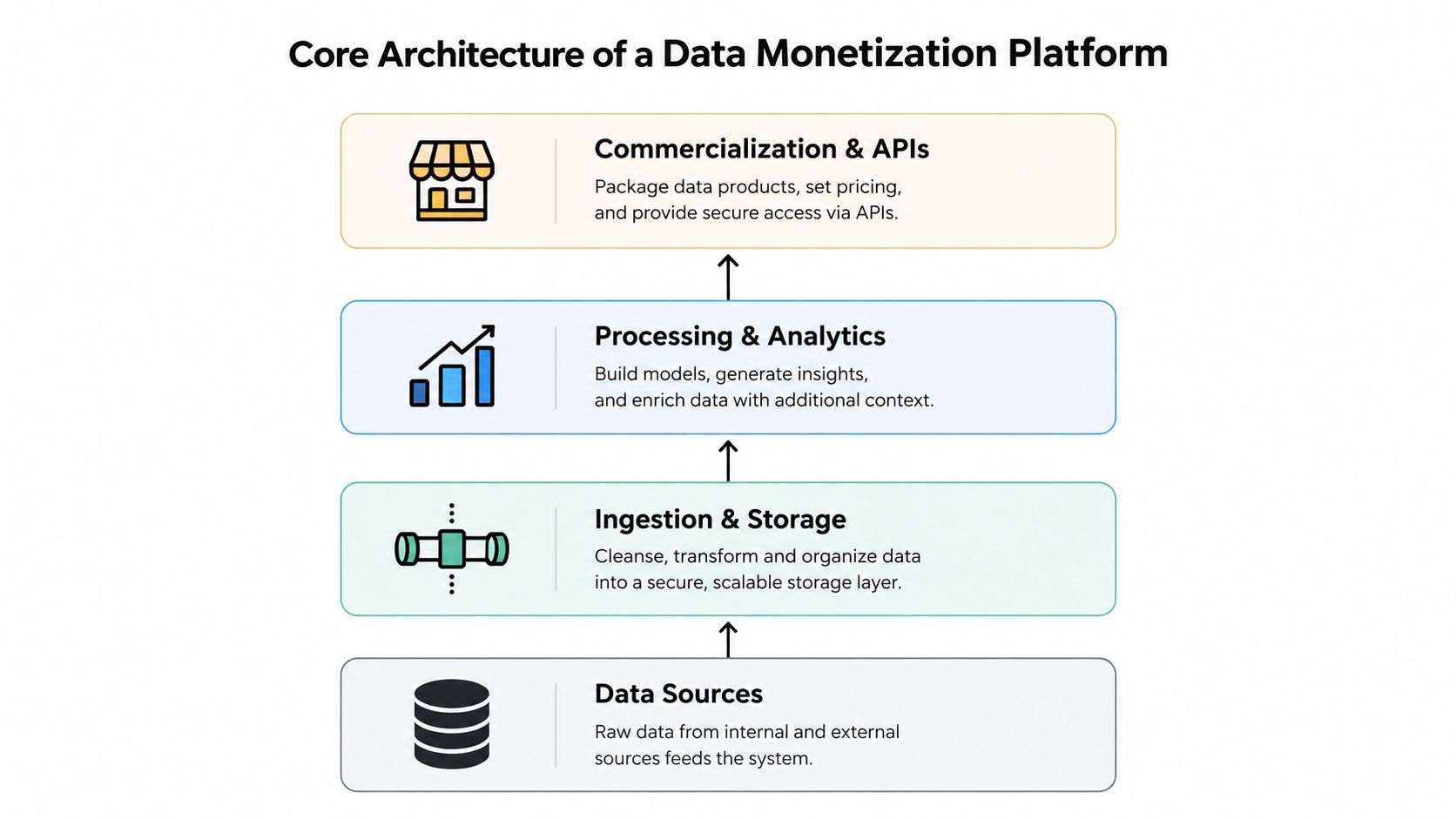
A useful architecture resembles a small product-delivery system. Raw sources enter at the bottom, processing creates a trustworthy representation, and commercial interfaces sit at the top. The stack doesn't need one vendor, but every responsibility must exist somewhere.
Start with sources, ingestion, and storage
The ingestion layer is the loading dock. It receives database extracts, SaaS exports, event streams, partner feeds, and operational APIs. Connectors need to preserve source identity, timestamps, schema versions, and lineage rather than flattening everything into anonymous files.
Storage and processing then provide the working material. The system may cleanse records, normalize fields, join sources, enrich entities, and create aggregates. Keep raw inputs available for audit and correction, while publishing curated outputs through separate product boundaries.
Turn processed data into a discoverable product
The catalog is the storefront window. It should expose a human-readable description and machine-readable metadata, including:
- Ownership: The team or person accountable for quality and support.
- Schema: Fields, types, relationships, and compatibility expectations.
- Freshness: How often the product updates and how delays are communicated.
- Preview: A safe sample or representative profile that helps buyers qualify it.
- Rights: Permitted purposes, restrictions, retention, and geographic conditions.
- Delivery: API, file, warehouse share, webhook, or another supported interface.
- Validation: Current quality, lineage, and compatibility status.
An MCP catalog serves as a useful engineering analogy in this context. A directory such as Agentpedia Codes' MCP resource catalog can be treated as a discovery surface, but a monetization-ready entry needs operational fields, not only a name and installation command.
Put commercial and governance controls in the request path
The value-assessment and pricing layer decides what a product costs and how consumption is measured. Possible units include requests, rows, bytes, seats, subscriptions, or outcomes. The right unit reflects the buyer's value and the platform's ability to measure it consistently.
The governance layer is the security guard, but it must be a runtime component. Authentication identifies the caller. Authorization checks tenant, role, product, field, contract, and purpose. Classification drives masking or filtering. An audit trail records the decision and the data delivered.
Finally, an API gateway or controlled-sharing service delivers the product. Observability tracks availability, errors, freshness, access decisions, usage, billing events, and customer feedback. The architecture guidance for governed data products emphasizes this connected stack, including ingestion, cataloging, pricing, secure delivery, metering, and auditability.
The common mistake is treating governance as a policy document stored beside the platform. A policy that isn't evaluated during a request can't prevent an unauthorized field from leaving the system.
Monetization Models and How to Pick One
Pricing should follow the shape of the product and the buyer's workflow. A continuously queried API behaves differently from a curated research dataset. An embedded insight may create value without exposing the underlying records at all.
Four models with different operating demands
Direct data sales fit a buyer who wants a defined extract, warehouse load, or licensed historical package. The commercial unit may be a fixed product or negotiated scope, but the platform still needs provenance, rights, versioning, and delivery records.
API monetization suits machine-to-machine consumption. It works when buyers need current answers, enrichment, scoring, or lookup services rather than a static copy. Metering must distinguish successful billable requests from retries, errors, and internal calls.
Marketplace or exchange listings emphasize discovery and comparison. A marketplace can generate demand for multiple suppliers, but its catalog quality, entitlement model, and supplier controls determine whether buyers trust what they find.
Embedded insights place the value inside another application. The buyer receives a benchmark, recommendation, alert, or decision rather than raw data. This can protect sensitive source material, although it makes attribution and outcome measurement more important.
| Model | Best fit | Pricing unit | Buyer relationship |
|---|---|---|---|
| Direct sale | Defined extracts or licensed packages | Product, delivery, or contract scope | Periodic procurement |
| API | Repeated machine access | Request, row, byte, or subscription | Technical integration |
| Marketplace | Multiple products and suppliers | Listing, transaction, subscription, or commission | Self-service discovery |
| Embedded insight | Decisions inside another workflow | Seat, subscription, or outcome | Product partnership |
Ask the buyer question first
For direct sales, ask: “What exact artifact can the buyer legally retain and use?”
For an API, ask: “What action does each request enable, and does request volume represent value?”
For a marketplace, ask: “Can a buyer compare products without a sales engineer?”
For embedded insights, ask: “Would exposing the raw data create risk without improving the buyer's decision?”
The most common pricing mistake is choosing a unit because it's easy to count. Charging by row can be misleading when buyers run long analytical jobs, while charging by request can be unfair when one request returns a tiny answer and another triggers substantial processing. Define the commercial event before publishing a price.
A mature platform may support several models at once. Start with the interface that matches the buyer's workflow, then add alternatives only when the platform can meter and govern them without creating contradictory entitlements.
Integration Patterns That Make Platforms Work
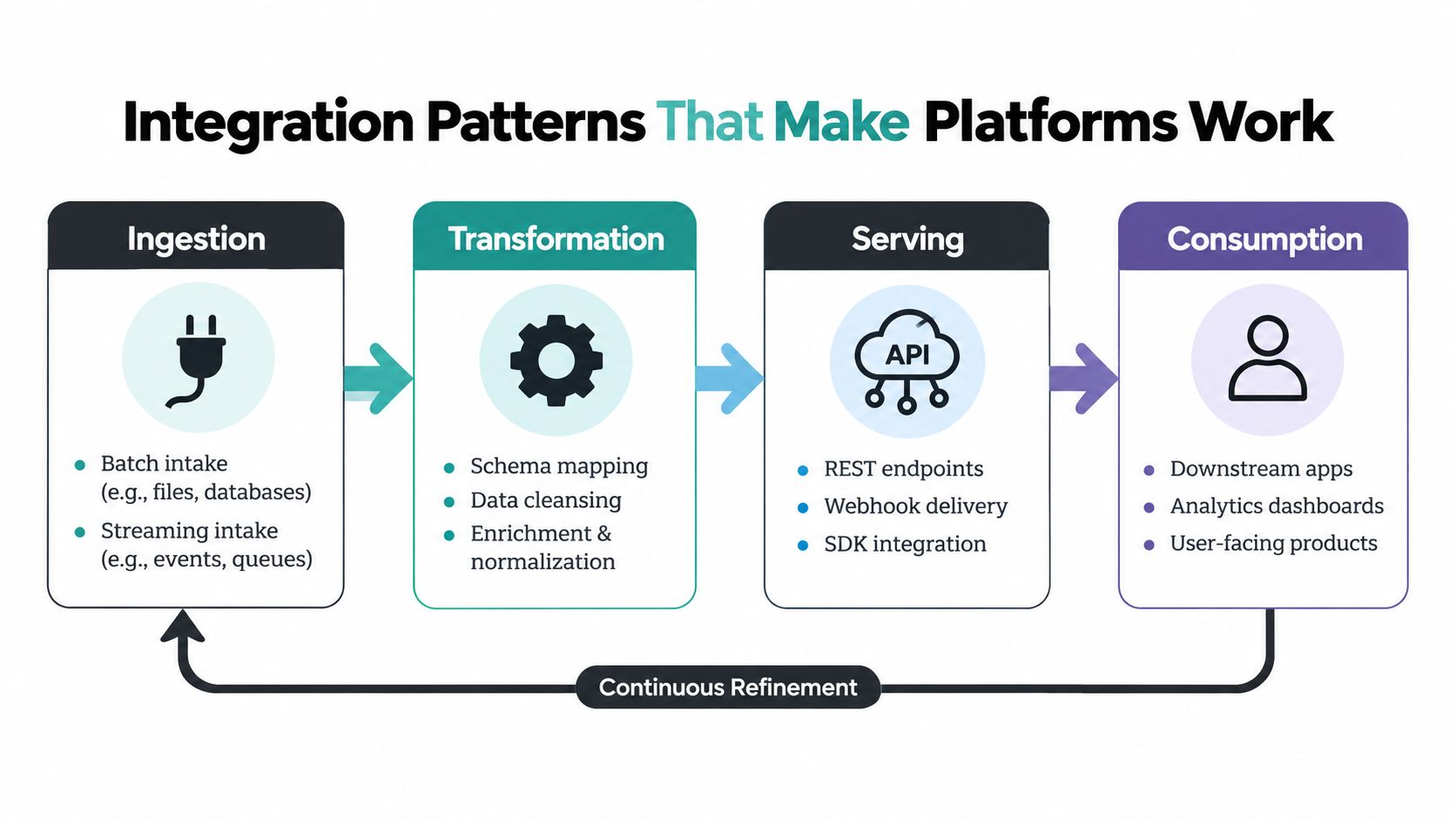
A developer-tools company called ForgeKit wants to create products from usage telemetry generated by its IDE plugins. The data includes tool calls, error categories, workspace context, and anonymized execution outcomes. No single integration pattern serves every use case.
Batch pipelines for controlled products
ForgeKit might use scheduled ETL to load daily plugin telemetry into a warehouse. Batch processing is a good fit for trend reports, historical benchmarks, and curated datasets where immediate delivery isn't part of the promise.
The pipeline validates schemas, removes or transforms sensitive fields, joins product metadata, and publishes a versioned table. Its weakness is delay. A buyer expecting current operational signals won't accept a product designed around periodic refreshes.
Streaming for event-shaped value
A broker such as Apache Kafka can carry plugin events as they occur. A stream processor can normalize event types, aggregate usage, and publish a near-current API or alert feed. Streaming adds operational complexity, including ordering, retries, late events, and reconciliation, so it belongs where freshness changes the product's value.
ForgeKit could expose an API that answers, “How often does this tool fail for a given environment?” The platform would need to capture the request, apply entitlement rules, return the result, and record the billable event without leaking raw workspace identifiers.
Reverse ETL for operational activation
Some products aren't sold to analysts. ForgeKit might deliver scored signals into a customer's CRM, support system, or internal dashboard. Reverse ETL moves curated outputs from analytical storage into operational destinations, where a customer can act on them.
That pattern requires destination-specific controls. A field safe for aggregate reporting might be inappropriate for a support workflow. The delivery contract must define what is transferred, to whom, and for what purpose.
MCP-style connectors for tool-oriented consumption
An MCP-style connector can wrap a tool or service behind a standardized interface. The catalog describes available capabilities, inputs, outputs, compatibility, and access requirements. An AI IDE then discovers and invokes the connector instead of learning a bespoke integration for each provider.
The integration surface is not automatically a monetization product. ForgeKit still needs identity propagation, authorization, usage events, rate controls, versioning, and support ownership. A workflow that creates a Stripe Checkout payment flow with webhooks illustrates the broader principle: integration workflows need explicit event and state handling, not only a connection between two endpoints.
Different data products can share a platform while using different transport patterns. Forcing every product into file delivery or real-time streaming creates technical debt and commercial blind spots.
How SourceX Can Help
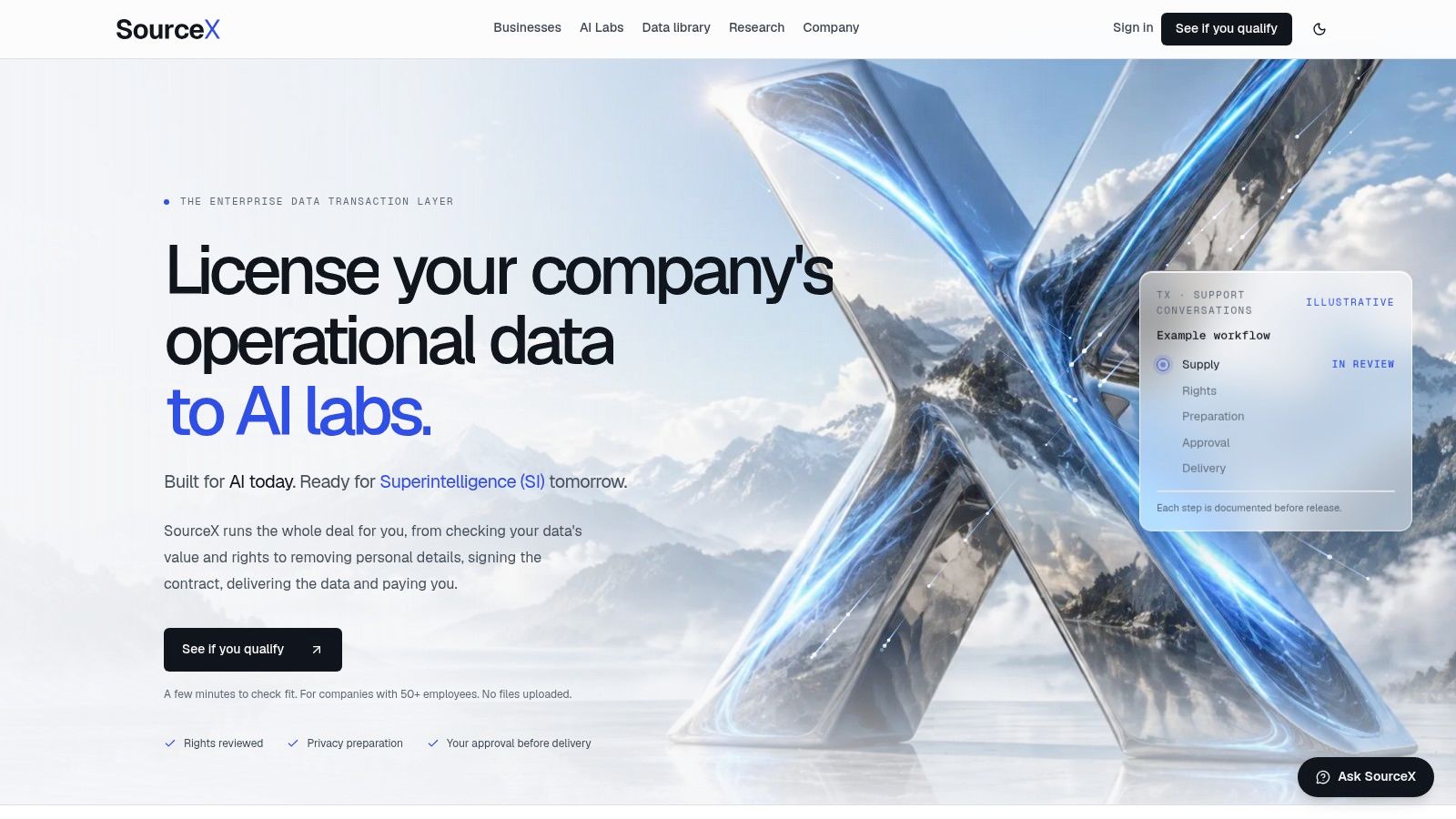
Some organizations don't want to build a public marketplace. They want a controlled way to license operational datasets to AI labs and other data buyers, while keeping the supplier in charge of every release decision. SourceX addresses that narrower problem as an enterprise data transaction layer.
Its workflow covers fit assessment, data mapping, private inventory creation, rights review, deidentification, contracting, buyer evaluation, delivery, and payment. Inventory can summarize data from systems such as Zendesk, Salesforce, GitHub, Jira, SharePoint, and Google Workspace without presenting the raw material before the supplier authorizes access.
Where the service fits
SourceX is a strong fit when your main obstacle is rights-cleared licensing, not API infrastructure. Its process creates an evidence packet covering the system of origin, supplier permissions, defined purpose, and usage constraints before release. Dataset-specific deidentification records the preparation work, while suppliers confirm lawful collection and approve the permitted scope.
The commercial process can include fixed-fee payments, exclusivity windows, selection periods, and invoicing terms such as Net 60 after written selection, as described in the supplied service details. Suppliers retain ownership of original data, while the agreement defines ownership and confidentiality for prepared datasets.
The standout feature is supplier control by design. Nothing is shared until explicit authorization, and sourcing, rights, preparation, contracts, and delivery remain within one managed relationship. That reduces coordination across intermediaries, but it doesn't remove the supplier's responsibility to validate lawful collection, intellectual property, privacy, and internal approvals.
For a closer look at that model, SourceX's data monetization platform is most relevant when you need a managed licensing path rather than a self-built catalog.
Choose it when the buyer needs real-world operational records for model training, the data is fragmented across enterprise systems, and legal provenance is more important than instant self-service checkout. Choose a conventional data platform instead when your primary need is a continuously queried API, internal data mesh, or developer-facing marketplace that your team will operate directly.
Governance, Security, and Privacy as Runtime Controls
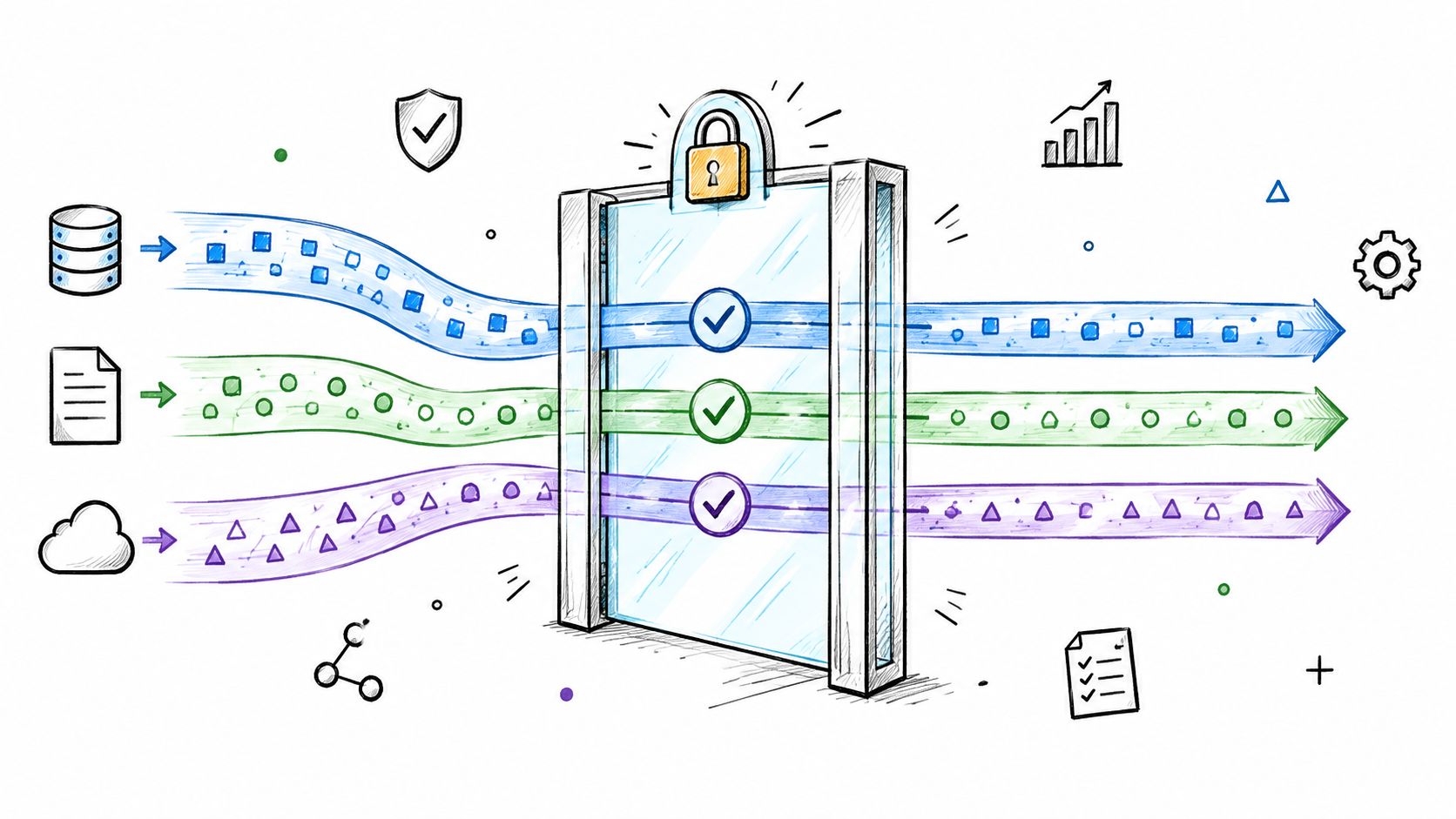
A contract can describe permitted use, but the delivery system must enforce it. If an API returns restricted fields because an engineer forgot to apply a filter, the policy was never a control.
Turn policy into executable decisions
A governed request should evaluate several distinct questions:
- Authentication: Who is calling, and which organization or service owns the identity?
- Authorization: Is this principal entitled to this product, field, operation, and environment?
- Classification: Does the requested data contain personal, confidential, regulated, or commercially restricted material?
- Purpose: Does the declared use match the licensed purpose?
- Residency: May the data be processed or delivered in the requested region?
- Masking: Which values should be removed, generalized, tokenized, or redacted?
- Audit: Can the platform show the decision, policy version, records delivered, and operator involved?
These controls should be configuration that engineers can test. A policy change should produce a predictable access decision, not a manual instruction sent to several teams.
A worked MCP access decision
Suppose an AI IDE requests an MCP server that searches support records. The catalog entry identifies the owner, supported operations, data classification, version, and permitted audience. The platform then performs the following sequence:
- The IDE presents a user or workspace identity.
- The gateway resolves the tenant and checks the subscription or license.
- The policy engine confirms that search is allowed for the declared purpose.
- The server applies field-level masking before returning results.
- The meter records the operation, product version, tenant, result status, and billable unit.
- The audit service stores the policy decision and trace identifier.
Revocation must work at runtime. When a contract ends, a purpose changes, or a source becomes legally unusable, the platform should disable the entitlement, invalidate delivery credentials, block cached access where possible, and preserve an audit record of the change. Deleting a row from a billing database isn't revocation.
Privacy also needs separate ownership. Consent management determines whether collection and use are permitted. Residency controls determine where processing occurs. Purpose limitation determines whether a buyer's requested use fits the agreement. A single “compliant” label hides these different failure modes.
A Worked Example for AI IDEs and MCP Integrations
An MCP server catalog is a compact version of a data monetization platform. Each server is a product. Its README is only the human-facing description, while the machine-readable entry carries the operational contract that lets an AI IDE decide whether and how to use it.
A monetization-ready entry should expose:
- Identity and ownership: Server name, maintainer, support path, and accountable organization.
- Compatibility: Supported clients, protocol version, runtime assumptions, and dependency requirements.
- Capabilities: Tools, resources, input schemas, output schemas, and side effects.
- Operational state: Update timestamp, current version, validation status, and known limitations.
- Quality signals: Test coverage or validation result, availability history, error categories, and user feedback.
- Commercial fields: Entitlement class, rate-plan reference, allowed usage, and metering unit.
- Safety metadata: Required credentials, data classification, scopes, retention behavior, and destructive-operation warnings.
The buyer is an AI IDE such as Cursor, Windsurf, Antigravity, or Claude Code. It doesn't need a sales brochure. It needs to know whether the server is compatible, what it can do, what it may access, and what happens when the call is made.
The request lifecycle
An IDE searches the catalog for a repository-management server. It filters by compatibility and validation status, reads the input schema, and requests access. The gateway checks the workspace entitlement, forwards the call to the MCP server, and records the outcome.
That usage signal can support operational decisions before it supports revenue. A high error rate may indicate a broken release. Repeat use may justify deeper documentation. Low adoption may show that metadata or setup instructions are unclear. Only after those signals are trustworthy should a team consider sponsored placement or premium catalog features.
The catalog itself should remain useful without turning every result into an advertisement. Clear labels, ranking transparency, and separation between validation status and paid placement protect user trust.
Build or buy decisions
| Option | Choose it when | Main tradeoff |
|---|---|---|
| Build in-house | Your access rules and product behavior are highly specific | You own reliability, billing, and policy maintenance |
| Buy a platform | Standard catalog, entitlement, metering, and delivery functions cover the need | Vendor fit and migration constraints matter |
| Extend an existing registry | Discovery is the primary problem and delivery remains with suppliers | Commercial controls may need to be added |
| Use a managed licensing service | Rights review, deidentification, and buyer negotiation are the bottleneck | It isn't a replacement for a developer API platform |
The key design move is to treat every catalog entry as a contract. A server that has an owner, schema, version, compatibility declaration, validation state, and usage record is much easier to operate than a static directory page.
Choosing and Pricing a Platform
The buy decision should start with operating constraints, not a feature checklist. A platform that supports catalogs but can't enforce field-level access is a poor fit for sensitive data. A platform with excellent billing but no lineage will create disputes that finance can't resolve.
Evaluate the deployment shape
Cloud deployment usually reduces infrastructure work and makes elastic delivery easier. On-premises or hybrid deployment may be necessary when source systems, residency rules, latency, or internal control requirements limit where data can run.
The current market contains both patterns. On-premises installations held 59.76% of the market in 2025, while cloud deployment is forecast to grow at a 19.66% CAGR through 2031, according to Mordor Intelligence's data monetization market analysis. Those figures describe market direction, not a universal architecture recommendation.
Ask vendors how they handle tenant isolation, private networking, key management, regional processing, disaster recovery, schema evolution, and export of audit records. Then model the total cost of ownership across engineering operations, storage, compute, support, compliance reviews, and migration.
Compare commercial terms carefully
Platform pricing may use seats, usage, revenue share, product count, transaction fees, or outcome tiers. Your own data products may use different units, so separate the platform bill from the buyer-facing price. Otherwise, a change in vendor pricing can destroy product margins.
The following matrix helps narrow candidates:
| Criterion | What to ask | Why it matters |
|---|---|---|
| Governance | Can policies run at request time and at field level? | Prevents unauthorized delivery |
| Catalog | Are metadata and schemas available by API? | Enables self-service discovery and automation |
| Delivery | Does it support APIs, shares, files, and webhooks? | Matches different product shapes |
| Metering | Can it measure the selected billing unit consistently? | Makes invoices defensible |
| Deployment | Does it support cloud, hybrid, or on-premises needs? | Aligns with residency and control requirements |
| Observability | Can teams trace quality, access, usage, and failures? | Reduces disputes and operational blind spots |
| Commercial fit | Are fees predictable under growth and experimentation? | Protects unit economics |
| Ecosystem | Does it integrate with identity, billing, warehouses, and developer tools? | Reduces custom glue code |
If your platform will charge for agent actions or automated payments, compare its commercial assumptions with agent payment protocol approaches. The payment mechanism should fit the product's trust model, not dictate the entire architecture.
Measuring Monetization Readiness Next Quarter
Revenue is a lagging and noisy signal. A team can close a deal while provisioning remains manual, quality remains unmeasured, and every renewal depends on one engineer's memory. Operational metrics show whether the platform can support the next product without repeating the same work.
Measure the path from source to customer
Time to provision a product measures how long it takes to move from approved source to usable buyer access. Track the stages separately, including mapping, rights review, quality checks, approval, credential creation, and first successful delivery. A shorter path usually indicates that the operating model is becoming repeatable.
Owner coverage measures the share of cataloged products with an accountable owner. A product without an owner has no reliable escalation path when freshness falls or a schema changes.
Freshness and error rates reveal whether the product meets its stated contract. Record them by product and version, not only as a platform-wide average. A healthy aggregate can hide one critical product that fails regularly.
Approval cycle time shows how long entitlement and legal decisions take. If approvals remain entirely manual, the platform may have good technical delivery but poor organizational throughput.
Cost per delivered product includes engineering work, compute, storage, support, compliance, and buyer-specific preparation. This metric prevents teams from mistaking gross revenue for a viable product.
Repeat usage indicates whether a buyer or internal consumer returns after the initial evaluation. Repeat use is more informative than catalog views because it shows that the product fits an actual workflow.
The connection between maturity and demand appears in marketplace research. The 451 Research Data & Analytics, Data Platforms 2022 survey reported that 38% of respondents completely agreed data marketplaces would be among their organization's top five strategic priorities over the following three years, rising to 48% among organizations where nearly all strategic decisions were data-driven. (S&P Global Market Intelligence summary) The implication is operational: mature data users value reliable shared infrastructure because it reduces duplicated integration work.
A 30, 60, and 90 day readiness check
First 30 days: Inventory candidate products, assign owners, document source systems, classify data, and record current delivery methods. Select one product whose value and rights are clear enough for a controlled pilot.
By 60 days: Publish the product contract, including schema, freshness expectation, quality checks, permitted use, retention, delivery interface, and pricing unit. Add request-level authorization, audit events, and a basic usage record.
By 90 days: Run a buyer or internal-consumer pilot. Reconcile delivered records against source data, test revocation, measure approval and provisioning time, review errors, and calculate delivery cost. Use the results to decide whether to improve the product, change the interface, or stop the experiment.
A useful readiness dashboard should answer five questions:
- Can a new consumer discover the product without a private briefing?
- Can the platform approve or reject access consistently?
- Can engineering prove what version was delivered?
- Can finance explain how usage became a billable event?
- Can the owner withdraw access without a manual hunt across systems?
If the answers are weak, adding more datasets won't solve the problem. Improve the operating model first, then expand the inventory.
If you're building an MCP catalog, developer-facing API, or enterprise data product, start with one governed product rather than a broad marketplace launch. Define its owner, schema, rights, delivery path, quality checks, and usage event, then use the patterns and workflows at Agentpedia Codes to structure compatible MCP resources, AI rules, and engineering integrations for your team.