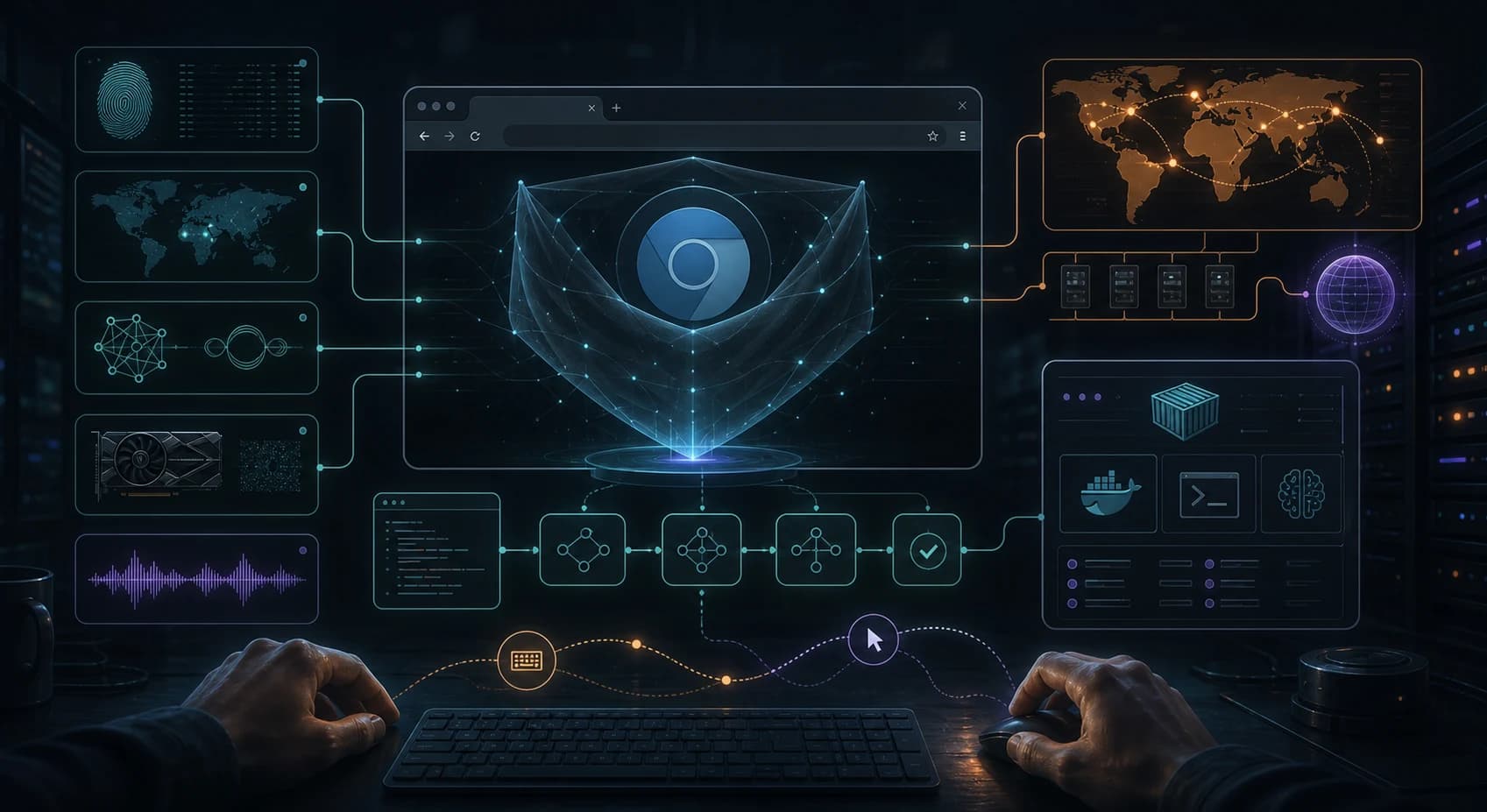
The useful reading is nuanced: CloakBrowser is more serious than a `navigator.webdriver = false` script, but it is not a universal CAPTCHA solver. Recent issues show target-specific failures, Docker/Xvfb fingerprint mismatches, Chrome-version freshness concerns, and platform differences.
Get the latest on AI, LLMs & developer tools
New MCP servers, model updates, and guides like this one — delivered weekly.
Editorial note
The official website and the GitHub README did not fully agree at research time. The site still described older v145/32-patch language, while README, changelog, package registries, and release assets described v0.3.31 with v146 Linux/Windows and 58 patches. This article treats GitHub release/changelog/package metadata as fresher.
1. CloakBrowser in One Sentence
CloakBrowser is an MIT-licensed wrapper plus separately licensed patched Chromium binary that lets Python and JavaScript users launch a source-level stealth Chromium through familiar Playwright and Puppeteer APIs.
| Area | Detail | Why it matters |
|---|---|---|
| Repository | CloakHQ/CloakBrowser | https://github.com/CloakHQ/CloakBrowser |
| Primary language | Python | Primary GitHub language at research time. |
| License | MIT wrapper license; separate binary license | Check bundled or binary licenses separately where relevant. |
| Created | February 22, 2026 | Packages checked at v0.3.31; latest binary release checked: chromium-v146.0.7680.177.5. |
2. Why It Matters
Browser automation detection is no longer only about one JavaScript property. Modern systems compare canvas, WebGL, audio, fonts, GPU, screen, WebRTC, timing, TLS, CDP behavior, proxy reputation, timezone, locale, and interaction patterns.
CloakBrowser's core claim is that patching Chromium source is harder to detect than injecting JavaScript or layering config flags over stock browsers. The wrapper then exposes those patches through familiar Playwright/Puppeteer launch calls.
The project matters for QA, scraping, research, and AI-agent browser workflows, but it also has obvious dual-use risk. Any production use should respect site terms, laws, rate limits, privacy constraints, and permission boundaries.
3. Architecture and Mental Model
The architecture is wrapper plus binary: user code calls Python or TypeScript APIs, the wrapper resolves/downloads a platform binary, builds stealth/proxy/locale/WebRTC args, and launches Chromium with optional humanized input, persistent profiles, Docker/CDP serving, and a Manager UI.
| Area | Detail | Why it matters |
|---|---|---|
| Python wrapper | cloakbrowser/browser.py | Launch APIs, proxy/GeoIP/WebRTC args, persistent context handling. |
| JS wrapper | js/src/playwright.ts and peers | Playwright and Puppeteer-compatible JavaScript surface. |
| Binary resolver | download.py and config.py | Downloads, verifies, caches, and updates the patched Chromium binary. |
| Stealth layer | Chromium source patches | Fingerprint behavior is compiled into the binary rather than only injected at runtime. |
| Behavior layer | `humanize=True` | Mouse, keyboard, scroll timing, and actionability checks. |
| Serving layer | cloakserve and Docker | CDP multiplexer and containerized runtime for remote automation. |
4. Smallest End-to-End Setup
The commands below are copied from the repository documentation and checked against the current research snapshot. Treat them as a starting point, then read the linked README before installing into a production environment.
# Python
pip install cloakbrowser
pip install cloakbrowser[geoip]

# JavaScript / Node.js
npm install cloakbrowser playwright-core
npm install cloakbrowser puppeteer-core

# Docker smoke test
docker run --rm cloakhq/cloakbrowser cloaktest

# Binary management
python -m cloakbrowser install
python -m cloakbrowser info
python -m cloakbrowser update
A small first task should prove the integration before you attach it to critical data or large workspaces.
from cloakbrowser import launch

browser = launch()
page = browser.new_page()
page.goto("https://example.com")
browser.close()

# Higher-risk sites usually need coherent identity, not only a patched binary.
browser = launch(
    proxy="http://user:pass@residential-proxy:port",
    geoip=True,
    headless=False,
    humanize=True,
)
5. Technical Deep Dive
5.1 Source-level stealth is the key differentiator
Most older stealth tools patch JavaScript-visible properties or browser launch flags. CloakBrowser's README says its fingerprints are modified at the Chromium C++ source level, covering canvas, WebGL, audio, fonts, GPU, screen, WebRTC, network timing, automation signals, and CDP input behavior.
That does not make detection impossible. It changes the layer where detection has to happen. Detectors can still use IP reputation, impossible platform combinations, stale Chrome versions, storage quota, fonts, VM artifacts, and behavior.
5.2 Launch APIs preserve the Playwright mental model
The basic Python example returns a standard Playwright `Browser` object. JavaScript users can call a similar `launch()` API and keep most of their existing browser automation code.
That matters because the switching cost is low. The project is not asking teams to learn a new browser automation model; it asks them to replace the browser backend and supply better identity configuration.
5.3 Proxy, GeoIP, and WebRTC need to agree
`geoip=True` is meant to align timezone and locale to the proxy exit IP, and the WebRTC auto flag can spoof ICE candidates to the proxy's exit IP. This solves one class of mismatch but not all of them.
Open issues show that Docker Desktop, Xvfb, platform spoofing, GPU selection, and proxy reputation can still create contradictory signals. In high-risk flows, coherent presets may matter more than simply adding more spoofing.
Coherent identity checklist:
proxy IP reputation
  -> timezone and locale
  -> WebRTC candidate IP
  -> UA and UA-CH version
  -> platform and GPU
  -> fonts and screen/window
  -> headed behavior and humanized input
5.4 Persistent profiles are powerful but detectable
`launch_persistent_context()` keeps cookies, cache, and localStorage across sessions. That is useful for warm sessions and profile reuse, but it introduces storage-quota and incognito/private-mode tradeoffs.
Several issues revolve around persistent context behavior: Google suspicious-activity reports, FingerprintJS storage quota tradeoffs, Widevine hints, and profile-specific detection. Persistent does not automatically mean more human; it means more state.
5.5 Docker and Manager are operational surfaces
The Docker image and Manager UI make CloakBrowser easier to run as infrastructure. `cloakserve` exposes CDP, and the Manager provides browser profiles with noVNC access.
The same surface creates security responsibilities. CDP gives deep browser control. If you expose it beyond localhost, you need authentication, TLS, firewalling, and careful origin controls.
6. Real-World Wrong vs Right Patterns
| Wrong | Right | Reason |
|---|---|---|
| Assume CloakBrowser solves every CAPTCHA. | Treat it as challenge reduction plus coherent identity work. | Recent issues report target-specific Turnstile and reCAPTCHA failures. |
| Use datacenter proxies and blame the browser. | Test with reputable residential/mobile exits where allowed. | Many blocks are IP reputation, not browser fingerprint. |
| Spoof Windows from Docker/Xvfb without checking signals. | Validate platform, GPU, fonts, screen, timezone, and VM flags together. | FingerprintJS can catch inconsistent environment signals. |
| Expose CDP/Manager on the public internet. | Bind locally or put it behind auth/TLS/reverse proxy controls. | CDP is a high-control remote interface. |
7. Common Mistakes and Current Issues
The issue tracker matters because these are young, fast-moving repos. The article uses issues as risk signals, not as proof that a project is unusable.
| Area | Detail | Why it matters |
|---|---|---|
| CAPTCHA expectations | Issue #343 reports Cloudflare Turnstile failure despite recommended flags. | Marketing claims need target-specific validation. |
| Broad randomness | Issue #341 asks for safer UA, GPU, screen, and preset pools. | Random fingerprints can become incoherent. |
| Chrome version freshness | Issue #332 flags hardcoded Chrome 146 version concerns. | Anti-bot systems evolve with current browser releases. |
| Docker/Xvfb signals | Issues #327 and #336 report VM, timezone, and OS mismatch detection. | Container infrastructure can leak. |
| License split | Wrapper code is MIT; the binary has a separate license. | Redistribution and commercial packaging need review. |
8. Performance, Scaling, and Cost Notes
The README says first launch downloads an approximately 200 MB binary, cached under `~/.cloakbrowser`. GeoIP support adds a large database cache and network lookups for proxy-derived locale/timezone behavior.
`humanize=True` can improve behavioral realism, but it also slows actions. Persistent profiles reduce repeated login friction but increase disk and state management. Running many identities through `cloakserve` means multiple Chrome processes and growing memory use.
The tool itself is free/open-source at the wrapper layer, but real deployments pay for proxies, compute, storage, monitoring, legal review, and ongoing updates when target detection changes.
9. Who It Is For
| Use it if | Skip it if |
|---|---|
| You already use Playwright or Puppeteer and need a lower-detectability Chromium backend. | You need a guaranteed CAPTCHA bypass service. |
| You can test target sites ethically and tune identity coherently. | You expect one default launch config to work everywhere. |
| You need local, Docker, or CDP server deployment options. | You cannot safely operate browser infrastructure. |
| You understand the wrapper/binary license split. | You need unrestricted redistribution of the Chromium binary. |
10. Community Signal
X/Twitter mostly amplifies CloakBrowser as a fast-growing repo and a free alternative to commercial profile managers. That is useful discovery signal, but not enough to prove production reliability.
Reddit and GitHub issues are more critical. Users ask for tougher target tests, report platform mismatch problems, and question whether it works against real survey, social, and commerce properties.
The open issue surface is a healthy warning sign: this category is an arms race. A passing test table from April or May 2026 does not guarantee the same target passes in June 2026.
11. The Verdict: Is It Worth Using?
Our Take
Use CloakBrowser when you need a serious Playwright/Puppeteer-compatible stealth Chromium and you are prepared to validate every target, proxy, platform, and profile. Skip it if your plan depends on guaranteed CAPTCHA bypass, careless scraping, or exposing browser control infrastructure without security controls.
12. The Bigger Picture
CloakBrowser shows that browser automation is moving below JavaScript shims. Source-level browser builds, identity coherence, proxy alignment, behavioral input, and profile management are converging into one operational stack.
The hard truth is that anti-bot systems also adapt. The durable skill is not memorizing one launch flag. It is building a responsible test matrix: target, jurisdiction, proxy type, browser version, profile mode, platform, fonts, GPU, and behavior.
13. Frequently Asked Questions
Q: Is CloakBrowser a Playwright replacement?
It is a drop-in-style browser backend and wrapper for Playwright and Puppeteer workflows. Most code still uses familiar browser/page/context APIs.
Q: Does CloakBrowser solve CAPTCHAs?
No. It aims to reduce detection and challenge frequency. The README explicitly frames CAPTCHA solving as outside the tool, and current issues show target-specific failures.
Q: Which package version was checked?
Research checked PyPI/npm version 0.3.31 and binary release chromium-v146.0.7680.177.5.
Q: Why does the website conflict with the README?
At research time, the website still described older v145/32-patch state. The README, changelog, release assets, and package registries were fresher.
Q: When should I use persistent context?
Use it when you need cookies, cache, and localStorage across sessions. Validate storage quota, incognito detection, Widevine, and profile signals for your target.
Q: Is the binary MIT licensed?
The wrapper repository is MIT. The compiled Chromium binary has a separate binary license, so redistribution and packaging need separate review.
Q: Why can Docker still be detected?
A patched browser cannot hide every environment signal. Xvfb, VM traits, fonts, GPU, OS, timezone, and proxy network behavior can still disagree.
14. Glossary
| Area | Detail | Why it matters |
|---|---|---|
| CDP | Chrome DevTools Protocol | Remote-control channel for Chromium. |
| Fingerprint seed | Repeatable input for identity values. | Used to generate consistent browser traits. |
| GeoIP | Mapping IP to locale/timezone. | Used to align proxy identity. |
| WebRTC ICE | Network candidates exposed by WebRTC. | Can leak local or proxy IP signals. |
| Persistent context | Browser profile with saved cookies/cache/localStorage. | Useful but detectable if inconsistent. |
| Xvfb | Virtual X server for headed Linux browsers. | Common in Docker. |
| UA-CH | User-Agent Client Hints. | Must align with UA and browser version. |
15. All Sources and Links
Primary Sources
Issues and PRs
Community and Web
Internal Links
16. Source Attribution Table
| Area | Detail | Why it matters |
|---|---|---|
| README and changelog | Install, API, test claims, version notes. | Primary source. |
| Source files | Wrapper, proxy, GeoIP, download, Docker, and CDP architecture. | Primary source. |
| Package registries | Current package version and availability. | Freshness source. |
| Issues | Turnstile, DataDome, Docker, persistent profile, Chrome-version caveats. | Critical signal. |
| Community posts | Adoption hype and skeptical target-test requests. | Secondary signal. |
Stay ahead on AI, LLMs & agent skills
Join 5,000+ developers getting the weekly rundown of agent skills, MCP servers and AI coding releases.
Related Guides
Humanizer Skill Guide
blader/humanizer: 29 AI-writing patterns, voice calibration, and a two-pass audit, all in one Claude Code skill.
Guides & FeaturesMastering Agent Skills
The open standard for portable AI agent expertise.
Guides & FeaturesAntigravity Workflows Guide
Create automation recipes with Turbo Mode and AgentKit 2.0.
Guides & FeaturesHow to Change Antigravity Themes
Customize themes, dark mode, icons, and color schemes.
Guides & FeaturesHow to Change Language
Switch Antigravity to Spanish, German, Japanese, and more.
Guides & FeaturesAntigravity Security Guide
Known vulnerabilities, safe settings, and hardening steps.