Get the latest on AI, LLMs & developer tools
New MCP servers, model updates, and guides like this one — delivered weekly.
What Google Launched
DiffusionGemma is Google's experimental open text diffusion model for faster generation. The official Google post frames it as a new path inside the Gemma family: use diffusion-style refinement, generate many tokens in parallel, and target speed-critical local and low-concurrency workloads.
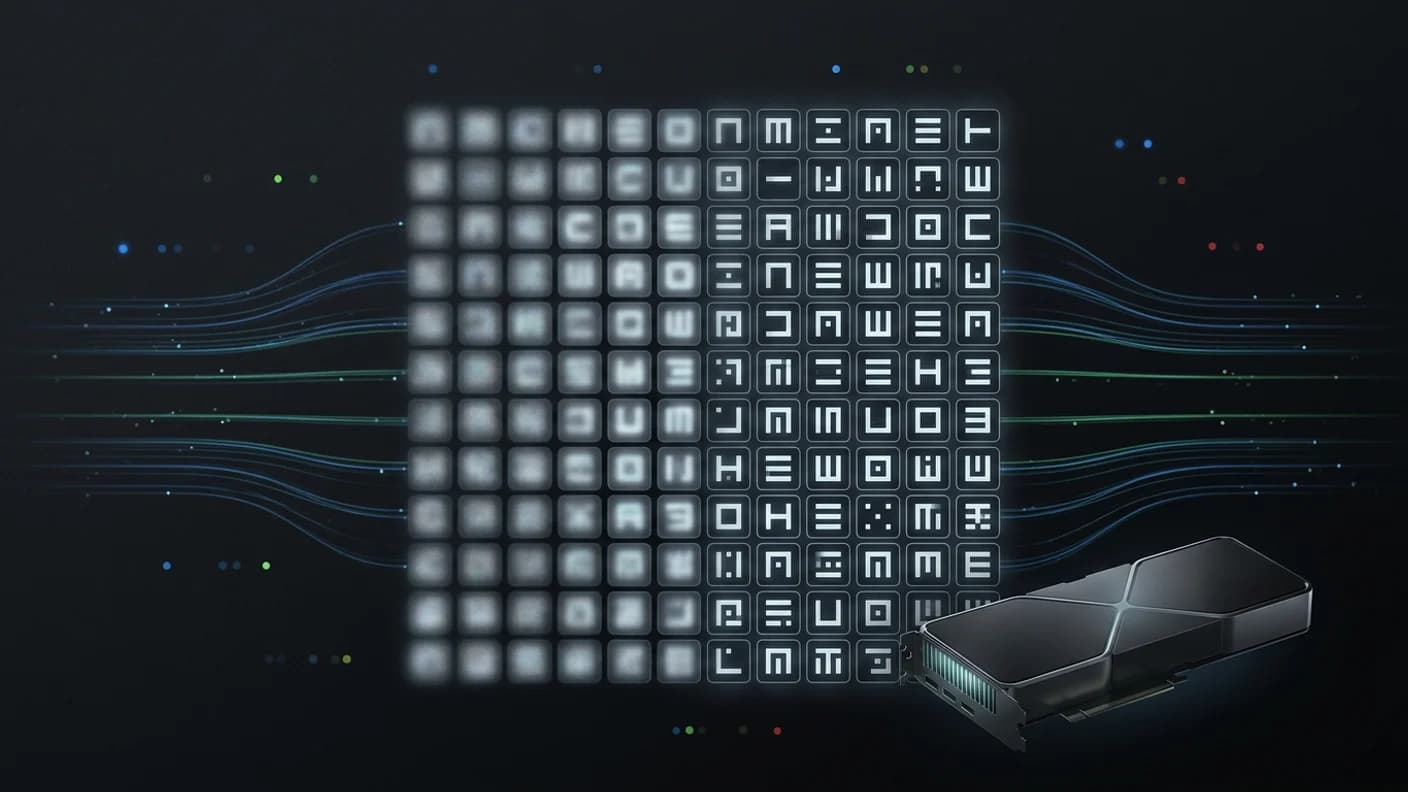
The biggest idea is simple to describe and technically important. Autoregressive language models usually generate one token after another. DiffusionGemma starts from noisy placeholder tokens, denoises multiple positions over several passes, and can produce up to 256 tokens in parallel during a forward pass.
Model
DiffusionGemma
Publisher
Release type
Experimental open model
License
Apache 2.0
Architecture
26B mixture-of-experts model
Active parameters
3.8B active parameters per step
Generation style
Text diffusion with bidirectional attention
Parallel output
Up to 256 tokens per forward pass
Source policy
Official Google and Gemma sources only
Official Snapshot
Google positions DiffusionGemma as an experiment for developers who care about generation speed, local inference, code-like structures, and model research. It is not presented as a blanket replacement for every Gemma workload.
| Area | Official detail |
|---|---|
| Family | Google says DiffusionGemma builds on the Gemma 4 family and techniques from Gemini Diffusion. |
| Model type | It is a 26B mixture-of-experts model with 3.8B active parameters. |
| License | The official launch says Apache 2.0. |
| Best-fit goal | Speed-first text generation on dedicated GPUs, especially for local and low-concurrency workloads. |
| Quality caveat | Google says standard autoregressive Gemma 4 remains the better fit when maximum quality is required. |
How Text Diffusion Works
In Google's explanation, DiffusionGemma borrows the broad logic of diffusion image models and applies it to text. It begins with random placeholder tokens across the target output, then repeatedly refines them. Tokens the model is more confident about get locked in while the rest keep improving.
Autoregressive generation:
prompt -> token 1 -> token 2 -> token 3 -> token 4

DiffusionGemma generation:
prompt -> noisy token grid
       -> refine many positions in parallel
       -> lock confident tokens
       -> polish the remaining positions
       -> final text
This matters because next-token decoding can be memory-bandwidth-bound. Google says DiffusionGemma shifts more of the work toward compute, which is where dedicated GPUs can shine. The result is a different performance profile, not just a smaller or quantized version of the same decoding loop.
Performance Claims
The headline speed number is up to 4x faster token output than autoregressive models of similar quality on dedicated GPUs. Google also gives concrete hardware examples for H100 and RTX 5090.
| Metric | Official detail | Practical meaning |
|---|---|---|
| Relative GPU speed | Google says DiffusionGemma can deliver up to 4x faster token output than autoregressive models of similar quality on dedicated GPUs. | The biggest promise is lower-latency local generation and faster interactive loops. |
| H100 throughput | Google reports more than 1000 tokens per second on NVIDIA H100. | The model is aimed at serious accelerator hardware as well as local developer machines. |
| RTX 5090 throughput | Google reports more than 700 tokens per second on RTX 5090. | Consumer-class high-end GPUs are part of the launch story, especially for local inference. |
| Parallel window | DiffusionGemma can generate up to 256 tokens in parallel within one forward pass. | It is built to reduce the step-by-step bottleneck of next-token generation. |
The important caveat is workload shape. Google says the speed advantage is strongest in local and low-to-medium batch settings. At very high QPS, serving costs and batching behavior can reduce the practical advantage.
Hardware Notes
DiffusionGemma is not only a research announcement. Google spends a lot of the launch explaining where it should run and where developers should be more cautious about expectations.
| Hardware or runtime | Official note |
|---|---|
| High-end NVIDIA GPUs | Google highlights H100 and RTX 5090 throughput, plus NVIDIA-optimized paths for Hopper, Blackwell, RTX PRO, DGX Spark, and DGX Station. |
| Consumer GPU memory | Google says the model fits within 18GB VRAM limits of high-end dedicated consumer GPUs when quantized. |
| Quantization | The launch post points to NVFP4 quantization and optimized support through NVIDIA channels. |
| Apple Silicon | Google says the speedup is less pronounced on unified-memory architectures because decoding can remain memory-bandwidth-bound. |
| Cloud serving | Google says the advantage is strongest at low-to-medium batch sizes and can diminish at very high QPS. |
For developers, that means the same model can feel very different depending on the machine. A dedicated GPU with the right quantized runtime is the launch's strongest path. A unified-memory laptop may still be useful, but Google is explicit that the speedup will not look the same everywhere.
Best Workflows
Google's examples point toward tasks where bidirectional refinement and fast token throughput matter: local assistants, inline editing, code infilling, structured text, mathematical structures, protein or amino-acid sequence-style outputs, and complex markdown or code formatting.
| Workflow | Why it fits | Watch for |
|---|---|---|
| Local coding assistant | The model targets fast local generation, which matters when a developer is waiting on inline edits or explanations. | Google still recommends standard Gemma 4 models when maximum quality is the priority. |
| Code infilling | Bidirectional attention lets the model condition on both the prefix and suffix around a gap. | Treat it as an experimental path until your benchmark covers your real language and repository style. |
| Markdown and structured text | Google calls out non-linear structures such as closing tags, code blocks, and complex markdown. | Always validate rendered output, especially when text includes nested code fences or tables. |
| Rapid draft loops | Generating many tokens in parallel can make short iterative drafts feel less blocked by sequential decoding. | For polished final copy, compare quality against an autoregressive Gemma 4 model. |
The coding use case is especially interesting because code edits are often not purely left-to-right. A model that can look at both sides of a gap may be useful for infill, repairs, and formats where the closing structure is as important as the opening structure.
Trade-offs to Know
The official article is careful about quality. It says DiffusionGemma lags the autoregressive Gemma 4 model on some benchmarks and that standard Gemma 4 should remain the choice when maximum output quality is more important than raw speed.
Use DiffusionGemma when:
- speed is a primary constraint
- local GPU generation matters
- the task benefits from bidirectional context
- you are testing code infill or structured text generation
- lower latency is worth a quality check

Use standard Gemma 4 when:
- maximum quality is the priority
- production reliability matters more than speed
- your workload does not benefit from parallel token refinement
That makes DiffusionGemma a strong research and engineering signal rather than a simple "new best model" story. The model is valuable because it changes the generation shape.
Getting Started
Google lists a practical developer stack around the launch. The official post points to weights, local runtimes, fine-tuning paths, NVIDIA deployment options, and upcoming support in additional inference tools.
| Need | Officially named option |
|---|---|
| Weights | Google says weights are available through Hugging Face. |
| Local and Apple tooling | Google names MLX as part of the developer support story. |
| Serving | Google names vLLM and Transformers support. |
| Fine-tuning | Google names Unsloth and NVIDIA NeMo tooling. |
| C++ runtime | Google says llama.cpp support is coming soon. |
| Research UI | Google names Hackable Diffusion as a playground for exploring the diffusion process. |
A sensible first benchmark is narrow: pick one local task, compare DiffusionGemma with your current Gemma 4 or other local model path, and measure latency, output quality, edit distance, and failure modes. The launch is about a different speed profile, so your own workload should decide whether that profile helps.
FAQ
What is DiffusionGemma?
DiffusionGemma is Google's experimental open text diffusion model in the Gemma family. Instead of generating text one token at a time, it starts from noisy placeholder tokens and refines many positions in parallel.
Is DiffusionGemma open source?
Google calls DiffusionGemma an open model and says it is released under the Apache 2.0 license.
How big is DiffusionGemma?
Google describes DiffusionGemma as a 26B mixture-of-experts model with 3.8B active parameters.
How fast is DiffusionGemma?
Google reports up to 4x faster token output than autoregressive models of similar quality on dedicated GPUs, with more than 1000 tokens per second on H100 and more than 700 tokens per second on RTX 5090.
Should developers replace Gemma 4 with DiffusionGemma?
Not automatically. Google says standard autoregressive Gemma 4 remains the better choice when maximum quality is the priority. DiffusionGemma is more compelling when speed and parallel generation matter.
Does DiffusionGemma help on every machine?
No. Google says the acceleration is strongest on dedicated GPUs and less pronounced on unified-memory architectures, where generation can still be limited by memory bandwidth.
Sources
This post intentionally uses the two official sources provided for the article. No third-party reporting, forums, or unofficial benchmark claims were used.
- Google Blog: DiffusionGemma brings faster text generation to developers
- Google Gemma official X announcement for DiffusionGemma
Get practical AI model notes
Join the Agentpedia Codes newsletter for hands-on guides to model releases, local inference, coding agents, and production workflows.