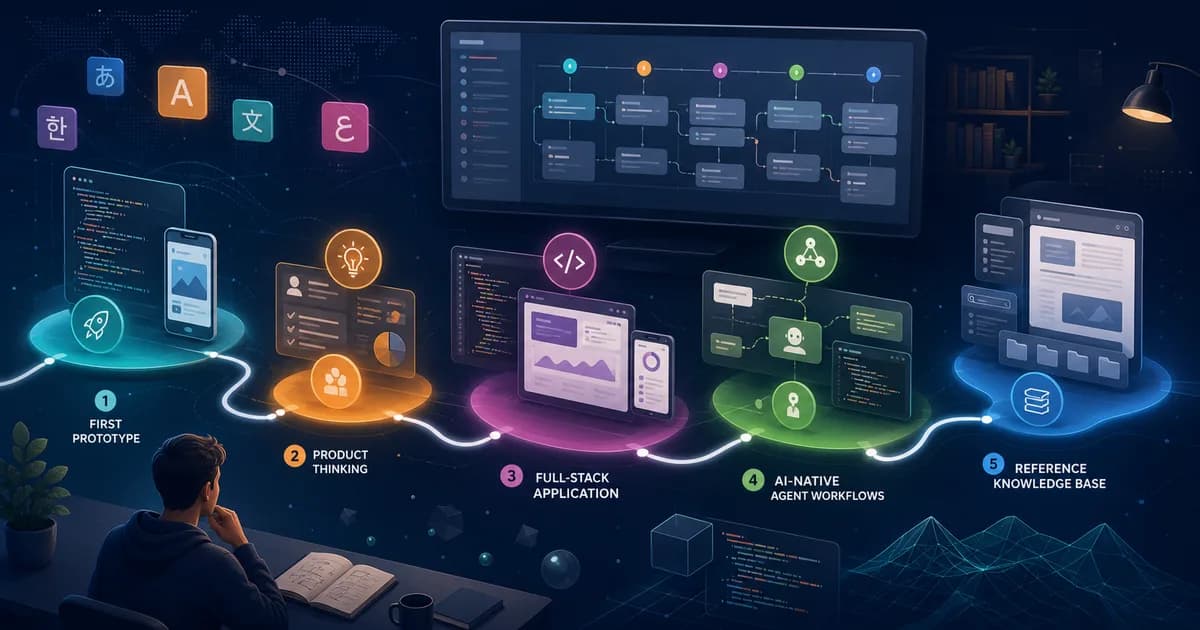
This is not a library you import into an app. It is a course repository and static docs site. Its thesis is simple: in the AI era, programming starts by describing what you want, but turning that into a reliable product still requires product thinking, tool literacy, debugging, deployment, payment systems, and engineering habits.
Get the latest on AI, LLMs & developer tools
New MCP servers, model updates, and guides like this one — delivered weekly.
Editorial note
This article is based on the GitHub repo, README, package metadata, VitePress config, theme files, deploy workflow, Dockerfile, scripts, tags, issues, and PRs researched on June 3, 2026. The licensing section is intentionally precise because GitHub metadata and repo files were not fully aligned.
1. easy-vibe in One Sentence
Easy-Vibe is a JavaScript/VitePress course site for AI-assisted application building, organized into beginner, full-stack, advanced AI-native, cross-platform, and appendix tracks across multiple languages.
| Area | Detail | Why it matters |
|---|---|---|
| Repository | datawhalechina/easy-vibe | https://github.com/datawhalechina/easy-vibe |
| Primary language | JavaScript | Primary GitHub language at research time. |
| License | CC BY-NC-SA 4.0 in README/package metadata; GitHub license metadata unavailable at research time | Check bundled or binary licenses separately where relevant. |
| Created | December 28, 2025 | No GitHub Releases found; latest checked tag was v0.3.0 from March 26, 2026, while main had newer commits through June 2026. |
2. Why It Matters
The project matters because vibe coding has a beginner problem. It is easy to generate a demo and hard to learn what happened, how to debug it, how to ship it, and how to work with AI tools without becoming dependent on vague prompts.
Easy-Vibe's structure is useful because it gives different readers different paths: complete beginners can get a fast first win, founders can prototype and validate ideas, junior developers can learn full-stack delivery, and advanced developers can study Claude Code, MCP, skills, agent teams, and spec coding.
The repo also treats multilingual maintenance as a first-class product. The README says stages 1 through 3 are available across supported locales, and recent issues/PRs are heavily about translation completeness, broken links, dark-mode readability, and localized learning maps.
3. Architecture and Mental Model
Easy-Vibe is a static documentation product built with VitePress, custom Vue components, scripts for sitemap/build behavior, GitHub Pages deployment, and localized README/docs trees. The core repo is content plus site infrastructure rather than a runtime library.
| Area | Detail | Why it matters |
|---|---|---|
| Docs source | `docs/` | VitePress Markdown content for learning paths, stages, appendices, and project tutorials. |
| Site config | `docs/.vitepress/config.mjs` | Locales, SEO, base URL behavior, hreflang alternates, and structured data. |
| Theme | `docs/.vitepress/theme/index.js` | Registers custom Vue interactive lesson components. |
| Localized READMEs | `docs-readme/` | README variants for supported languages. |
| Build scripts | `scripts/build.mjs`, `scripts/generate-sitemap.mjs` | Work around VitePress build behavior and generate multilingual sitemap. |
| Deployment | GitHub Pages workflow | Builds VitePress on pushes to main using Node 20. |
| Container | Dockerfile | Multi-stage Node build served through Nginx on port 7860. |
4. Smallest End-to-End Setup
The commands below are copied from the repository documentation and checked against the current research snapshot. Treat them as a starting point, then read the linked README before installing into a production environment.
git clone https://github.com/datawhalechina/easy-vibe.git
cd easy-vibe
npm install
npm run dev

# Open the local VitePress site
# http://localhost:3000
A small first task should prove the integration before you attach it to critical data or large workspaces.
# Useful repo scripts from package metadata
npm run build
npm run preview
npm run sitemap
npm run lint
npm run format
npm run test

# Note: verify references bash scripts/verify.sh,
# but that script was not visible on main during research.
5. Technical Deep Dive
5.1 The curriculum is path-based, not chapter-only
The README does not ask everyone to start at page one. It offers learning paths: fast first win, product prototype, full-stack products, advanced AI-native workflows, and appendix fundamentals.
That is the right shape for an AI coding course because the audience is heterogeneous. A founder validating a landing page, a beginner building a first app, and a senior developer learning agent teams do not need the same path.
5.2 Stage 3 turns vibe coding into agent workflow literacy
The advanced path includes Claude Code basics, MCP, skills, long-running tasks, agent teams, superpowers, workflow best practices, mobile development, Agent SDK, and spec coding.
That matters because mature AI-assisted development is not only prompt writing. It is context management, repeatable workflows, tool permissions, testing, decomposition, and knowing when to ask an agent to stop improvising and follow a spec.
5.3 VitePress plus custom components makes the site interactive
The repo uses VitePress for Markdown-driven docs, but the theme registers many custom Vue components. That is how a course can include interactive demos, maps, visual components, and specialized appendix material rather than only static prose.
The tradeoff is maintenance. Custom homepage/theme components caused dark-mode contrast work, and large component files increase the cost of keeping the site accessible and stable across locales.
5.4 Localization is a product feature and a maintenance burden
The README advertises wide multilingual coverage for stages 1 through 3. Recent issues and PRs include Korean translation assets, Vietnamese learning-map support, broken links, typo fixes, and localization of advanced sections.
The editorial challenge is consistency. Once a course has many locales, every chapter update creates a translation queue, every link can break in multiple paths, and examples must be culturally and technically clear across audiences.
5.5 The license story needs careful wording
GitHub `licenseInfo` returned null during research, but the README and package metadata indicate Creative Commons Attribution-NonCommercial-ShareAlike 4.0. An open PR proposes adding a LICENSE and CONTRIBUTING file, with a different license suggestion.
For readers, the safest statement is that Easy-Vibe is course content under the README/package licensing frame at research time, not a permissive software library. Anyone reusing content commercially should inspect the current LICENSE state first.
6. Real-World Wrong vs Right Patterns
| Wrong | Right | Reason |
|---|---|---|
| Treat Easy-Vibe as an npm package or app framework. | Treat it as a course/docs site with examples and interactive learning content. | The repo is VitePress content, not a reusable runtime library. |
| Jump straight to advanced Claude Code agent teams as a beginner. | Start with Stage 1 or the fast-first-win path, then move upward. | The course is intentionally staged. |
| Assume all license questions are settled because README has a badge. | Check README, package metadata, current LICENSE file state, and related PRs. | GitHub metadata and repo discussions were not fully aligned. |
| Update one locale and forget the others. | Treat translations, sidebar links, sitemap, and hreflang as part of the same change. | Multilingual docs break through small path mismatches. |
7. Common Mistakes and Current Issues
The issue tracker matters because these are young, fast-moving repos. The article uses issues as risk signals, not as proof that a project is unusable.
| Area | Detail | Why it matters |
|---|---|---|
| License ambiguity | GitHub metadata returned no license while README/package say CC BY-NC-SA 4.0. | Open PR #104 discusses adding license/contribution files. |
| Verification script | `npm run verify` references `scripts/verify.sh`, not visible on main during research. | Run script checks before relying on contributor docs. |
| VitePress alpha | Package metadata uses VitePress 2 alpha. | Build behavior may need wrapper scripts and memory tuning. |
| Translation drift | Issues/PRs discuss Korean, Vietnamese, and locale completeness. | Content updates need localization workflow discipline. |
| Custom component debt | Dark-mode contrast issue involved custom homepage components. | The site is not pure Markdown. |
| No formal releases | Tags exist but GitHub Releases are absent. | Do not describe tags as stable packaged releases. |
8. Performance, Scaling, and Cost Notes
For readers, Easy-Vibe's performance is mostly learning performance: can a beginner get from idea to prototype without skipping fundamentals? The staged curriculum is a good answer to that problem.
For maintainers, performance is static-site build performance. The package scripts raise Node memory for builds and run sitemap generation, which suggests a large docs tree with enough content to care about build reliability.
For search and AI citation, the multilingual sitemap, hreflang alternates, and JSON-LD configuration matter. Course content is only discoverable if the generated site and locale links stay coherent.
9. Who It Is For
| Use it if | Skip it if |
|---|---|
| You are a beginner, founder, student, or junior developer learning AI-assisted app building. | You want a production library, SDK, or starter template. |
| You want a structured path from first prompt to full-stack and advanced agent workflows. | You already know the stack and only need concise API reference. |
| You contribute docs, translations, or tutorials for AI coding education. | You need a single-language curriculum with minimal maintenance surface. |
| You want Claude Code, MCP, skills, and spec-coding lessons in a broader learning map. | You want only one tool's official documentation. |
10. Community Signal
Recent issues are education-shaped rather than library-shaped: users ask for AI design tutorials, language support, translation workflows, dark-mode readability, broken links, and whether the site is still updating.
Recent PRs show active content maintenance: context-window definition fixes, MiniMax-M3 mention updates, typo corrections, advanced OpenCode configuration, and broken link repairs.
That is a healthy signal for a course repo. The open questions are not only technical correctness; they are curriculum scope, localization process, and contribution governance.
11. The Verdict: Is It Worth Using?
Our Take
Use Easy-Vibe if you want a broad, staged, multilingual course for learning AI-assisted product building and agent-native development. Skip it if you need a software package, a narrowly scoped official tool manual, or commercially reusable content without reviewing the current license.
12. The Bigger Picture
Easy-Vibe reflects a shift in developer education: the first contact with programming may now be conversational, visual, and product-led rather than syntax-first.
The best version of vibe coding education does not stop at prompting. It teaches product judgment, debugging, version control, deployment, payment flows, security, evaluation, and when to move from vibes to specifications.
13. Frequently Asked Questions
Q: Is Easy-Vibe a library?
No. It is a VitePress course/docs site for learning AI-assisted coding, product prototyping, full-stack delivery, and advanced agent workflows.
Q: Who should start with Stage 1?
Complete beginners, product managers, founders, and anyone who wants a guided first prototype should start with Stage 1 or the fast-first-win path.
Q: How do I run it locally?
Clone the repo, run `npm install`, then `npm run dev` and open the local VitePress site on port 3000.
Q: What license applies?
At research time, README/package metadata pointed to CC BY-NC-SA 4.0 while GitHub license metadata returned null. Check the current repo before reuse, especially for commercial reuse.
Q: Does it support multiple languages?
Yes. The README advertises broad multilingual coverage for stages 1 through 3, and recent issues/PRs show ongoing translation work.
Q: Why are there tags but no GitHub Releases?
The repo has tags such as v0.3.0 but no formal GitHub Releases were visible during research, so treat tags as project history rather than packaged releases.
Q: Can contributors add translations or new topics?
Issues and PRs show translation and topic proposals are active, but contributors should check current contribution guidance and build verification first.
14. Glossary
| Area | Detail | Why it matters |
|---|---|---|
| Vibe coding | Building software by describing intent to AI tools and iterating. | The course's central theme. |
| VitePress | Vue-powered static documentation framework. | Easy-Vibe's site engine. |
| Stage 1 | Beginner and product prototype path. | Good entry point for non-programmers. |
| Stage 2 | Junior/full-stack path. | Frontend, backend, deployment, billing, and projects. |
| Stage 3 | Advanced AI-native path. | Claude Code, MCP, skills, agent teams, and spec coding. |
| Hreflang | SEO metadata for localized page variants. | Important for multilingual docs. |
| CC BY-NC-SA | Creative Commons noncommercial share-alike license family. | Referenced by README/package metadata. |
15. All Sources and Links
Primary Sources
Issues and PRs
Internal Links
16. Source Attribution Table
| Area | Detail | Why it matters |
|---|---|---|
| README | Course positioning, paths, multilingual claims, news, and target audiences. | Primary source. |
| package.json | Scripts, Node requirement, license metadata, dependencies. | Primary source. |
| VitePress config/theme | Site architecture, locales, SEO, custom components. | Architecture source. |
| Issues/PRs | Translation, license, dark mode, broken links, and topic requests. | Freshness signal. |
| Deploy workflow/Dockerfile | Build and serving behavior. | Operational source. |
Get the AI Coding Briefing
One email a week: MCP servers, agent skills, rules and model news for Antigravity, Cursor, Claude Code and Copilot.
Related Guides
Humanizer Skill Guide
blader/humanizer: 29 AI-writing patterns, voice calibration, and a two-pass audit, all in one Claude Code skill.
Guides & FeaturesMastering Agent Skills
The open standard for portable AI agent expertise.
Guides & FeaturesAntigravity Workflows Guide
Create automation recipes with Turbo Mode and AgentKit 2.0.
Guides & FeaturesHow to Change Antigravity Themes
Customize themes, dark mode, icons, and color schemes.
Guides & FeaturesHow to Change Language
Switch Antigravity to Spanish, German, Japanese, and more.
Guides & FeaturesAntigravity Security Guide
Known vulnerabilities, safe settings, and hardening steps.