If you build MCP servers, the practical question is which of these four you should adopt this quarter and which can wait. If you only use Claude, the question is what changes on your plan. Both answers are below. @ClaudeDevs announced the release as a four-post thread on November 24, 2026, and the posts are embedded here in thread order before we get into the details.
MCP turns two! What started as a protocol for connecting AI apps to tools and data is evolving to standardize how agents communicate and orchestrate work. We’re bringing more of these agentic capabilities to Claude with Skills over MCP and Tasks.
— @ClaudeDevs November 24, 2026
With Skills over MCP (beta), servers can publish skills alongside their tools. Skills give Claude a playbook for multi-step work, beyond tool names and descriptions. Skills load only when needed, update with the server, and can be tailored to each user's account or organization.
— @ClaudeDevs November 24, 2026
With Tasks (GA), servers can run long operations or full agent loops while Claude keeps working and picks up the result when it's ready. File Uploads is also rolling out soon. Claude will be able to send PDFs, spreadsheets, and images to a server without passing them through the context window.
— @ClaudeDevs November 24, 2026
Today's launches build on recent updates that make MCP in Claude more token efficient, easier to authorize, and more interactive. Thanks to the community, Claude now has over 10,000 MCP connectors. Read more: https://claude.com/blog/skills-over-mcp-tasks-and-more
— @ClaudeDevs November 24, 2026

Short answer
Anthropic says Skills over MCP is in public beta, Tasks and Elicitation are generally available, and File Uploads is rolling out soon, all in Claude and Claude Code. They are features of the open MCP spec and its extensions, so a server that supports them should work in any compatible client.
- Skills over MCP (beta): a server publishes SKILL.md-based skills beside its tools. Claude loads one only when needed. Pro, Max and Ultra have it on by default; Team needs an admin to enable it; Enterprise is “coming soon”.
- Tasks (GA): a server returns a task handle instead of blocking, and Claude keeps working. Pro, Max and Ultra now; rolling out to Team and Enterprise.
- Elicitation (GA): a server pauses mid-call to ask the user through a form or a link. Same plans as Tasks.
- File Uploads (soon): Claude sends PDFs, spreadsheets and images to a server out of band. No date is given, and Claude’s developer docs call it beta on an experimental extension.
This post is a reading of Anthropic’s announcement, the MCP project’s documentation, Claude’s developer docs and press coverage. We did not run any of these features ourselves, so nothing here comes from hands-on testing. Where a number is Anthropic’s own, we label it vendor-reported. Where two sources disagree, we say so. Claude Ship is a separate Anthropic launch and has its own write-up in our Claude Ship guide.
What changed today
Anthropic’s announcement, MCP servers can now ship skills, run tasks, and more with Claude, frames the update as making Claude work with a server “more like it works with another agent: learning from it, delegating to it, and exchanging input and files along the way.” Tool names and descriptions tell Claude what a server can do, the article says, but do not cover how to handle specific use cases. The four features are the answer to that gap.
Status needs care here, because Claude’s label and the MCP project’s label for the same feature are not always the same word. “GA” in Claude describes the product feature. The extension’s own maturity stage is tracked separately on modelcontextprotocol.io. The table puts both side by side.
| Feature | Status in Claude (Anthropic) | Plans (Anthropic) | MCP extension stage (MCP docs) | Spec doc |
|---|---|---|---|---|
| Skills over MCP | Public beta in Claude and Claude Code | On by default for Pro, Max, Ultra; Team once an admin enables it; Enterprise coming soon | Skills overview says SEP-2640 is Final; the extensions overview table lists it as Beta with destination not yet stated | io.modelcontextprotocol/skills (modelcontextprotocol.io/extensions/skills/overview) |
| Tasks | Generally available in Claude and Claude Code | Pro, Max, Ultra; rolling out to Team and Enterprise | Beta, intended destination Core (extensions overview). SEP-2663 is Final | io.modelcontextprotocol/tasks (modelcontextprotocol.io/extensions/tasks/overview) |
| Elicitation | Generally available in Claude and Claude Code | Pro, Max, Ultra; rolling out to Team and Enterprise | Part of the core spec (form and URL modes in the 2025-11-25 revision) | modelcontextprotocol.io/specification/2025-11-25/client/elicitation |
| File Uploads | Rolling out soon; Claude’s docs call file transfers beta | Pro, Max, Ultra, and eligible Team and Enterprise plans | Listed as experimental-ext-file-uploads in the extensions overview; Claude’s docs: experimental extension, expect breaking changes | io.modelcontextprotocol/files (claude.com/docs/connectors/building/files) |
Two points in that table deserve a closer read. First, the Skills extension’s own overview page says SEP-2640 is Final, while the extensions overview table, which is the page that defines the three lifecycle stages, lists Skills over MCP as Beta. We could not tell from the pages we read whether one is simply behind the other. Treat the stage as “published, still being implemented”; the Skills page itself says SDK and host support is still being implemented. Second, “GA in Claude” for Tasks does not mean the MCP project has declared the Tasks extension Stable. SEP-2663, the proposal that created it, says it is intended to be promoted into the core protocol once it has stabilized and achieved broad adoption.
Two years of MCP: timeline
The anniversary framing is Anthropic’s: the announcement says it launched MCP two years ago as a standard for connecting AI agents to the systems where data lives. The dates below are the ones we could tie to a source. Where a source gives only a month, we say so.
| Date | What happened | Source |
|---|---|---|
| Nov 2024 | Anthropic introduces MCP as an open standard for connecting AI assistants to business tools, development environments and data sources | The Decoder |
| Mar 2025 and May 2025 | OpenAI announces it will adopt MCP across its products (March) and upgrades its Responses API with remote MCP servers (May) | The Decoder |
| Nov 25, 2025 | Spec revision 2025-11-25, which carries form and URL mode elicitation and an experimental tasks feature | MCP elicitation spec page; SEP-2663 |
| Dec 2025 | Anthropic donates MCP to the Linux Foundation’s Agentic AI Foundation (AAIF); reported as “last December” | The New Stack |
| Jul 28, 2026 | Spec revision 2026-07-28: stateless core, Multi Round-Trip Requests, header routing, cacheable lists, a formal extensions framework; Tasks move into an extension | MCP blog |
| Sep 2026 | Skills over MCP becomes an official extension; a GitHub issue says SEP-2640 went Final on September 13 | The New Stack; GitHub issue #1160 (user-reported date) |
| Oct 22–23, 2026 | Tasks announced for Claude Code at AGNTCon + MCPCon North America (Oct 22); ClaudeDevs says Tasks and Elicitations are in the Claude Code CLI (Oct 23) | Upstash (third-party write-up) |
| Nov 24, 2026 | Skills over MCP public beta, Tasks and Elicitation GA, File Uploads announced as coming soon | Anthropic announcement; The New Stack; The Decoder |
Read as a sequence, the shape is clear. The first year, according to David Soria Parra quoted by The New Stack, was mostly about adoption. The 2026-07-28 spec then removed sessions so servers could run behind a standard load balancer. The features announced now, long-running work, mid-call questions, per-user instructions and file handoff, are the agent-oriented layer that went on top. Soria Parra told The New Stack that MCP “never tries to predict where the future goes, but tries to pick up people where they currently are,” which is why the protocol launched with tools and resources and no agentic primitives.
Skills over MCP: what it is and why descriptions are not enough
A tool in MCP comes with a name, a description and an input schema. That is enough to call a tool. It is not enough to know that, for example, a store-design task should start by reading the merchant’s theme, then validate a change, then publish. Anthropic’s announcement puts it plainly: tool names and descriptions tell Claude what a server can do, but not how to handle specific use cases. A skill is the answer. It is a directory with a SKILL.md file and optional supporting files, following the Agent Skills format, and the extension defines how a server exposes them and how a client discovers and reads them.
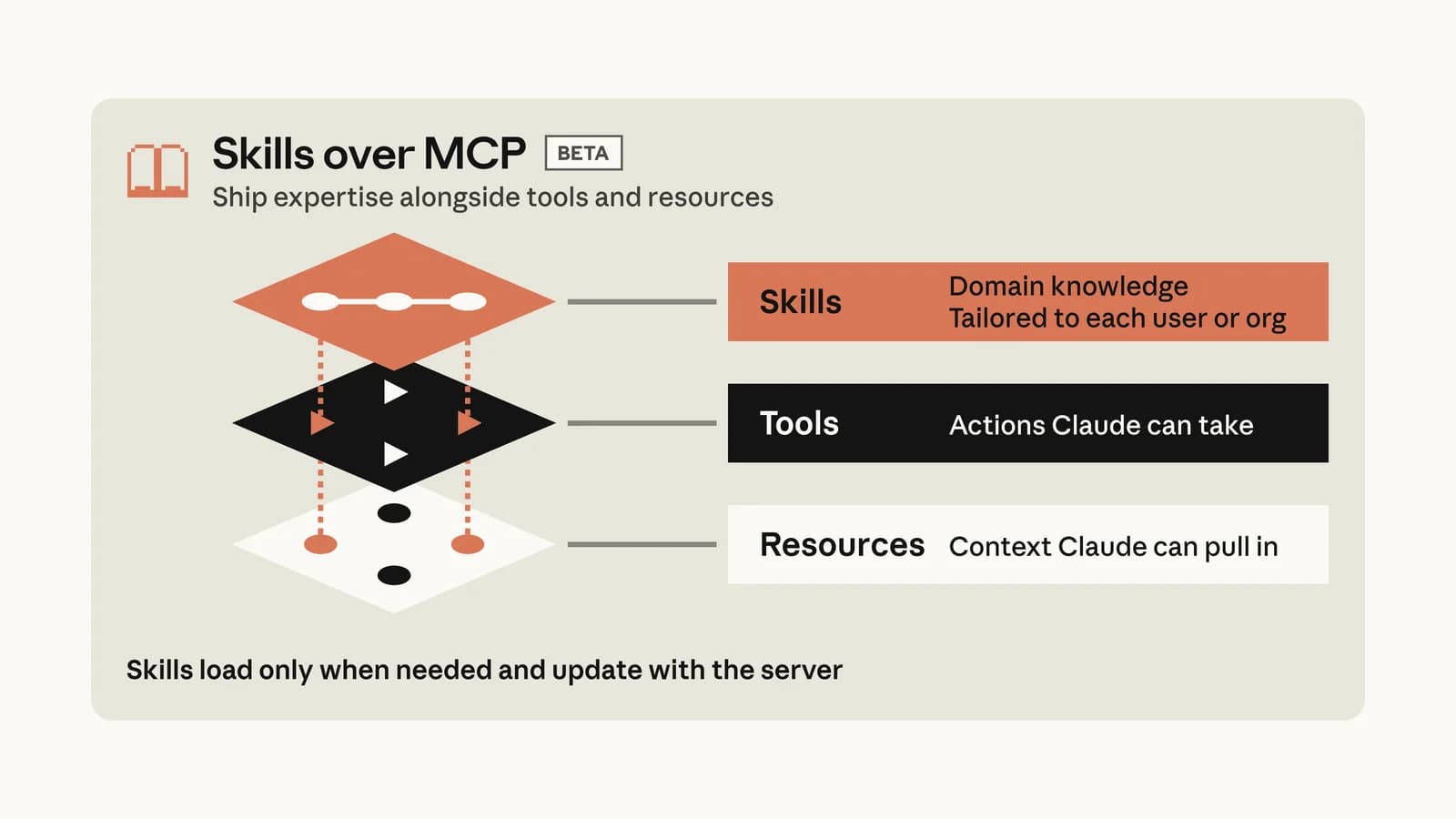
Anthropic lists four properties. Claude loads a skill only when it is needed, which keeps context use low. Skills update with the server, so a developer can ship tools and guidance together. Users have nothing separate to install. And skills can cover best practices, step-by-step workflows, or playbooks tailored to a user’s account or organization. The graphic above puts the same idea in a stack: skills carry domain knowledge, tools are actions Claude can take, resources are context Claude can pull in.
The MCP docs say the same from the protocol side. Skills are useful for reusable workflows that combine several tools or require supporting references, such as code review or document processing. Serving them over MCP “keeps those instructions with the service they describe,” and clients can discover workflows from metadata and load instructions and supporting files only when needed.
Partner examples, as Anthropic describes them
- Shopify: helps Claude design and update a merchant’s online store end to end. The New Stack adds that Shopify’s skills walk Claude through building and updating a store.
- HubSpot: onboards customers and gets them set up in Claude.
- Atlassian: helps Claude draw on deep organizational context for insights and work analysis.
- Carta: will help Claude draft and issue equity from an uploaded document. Anthropic marks this one “coming soon”, and it depends on File Uploads.
Those are Anthropic’s descriptions. We have not seen the skills themselves and cannot say how long or how detailed they are. The New Stack quotes Soria Parra on what he finds interesting: because many MCP servers already require a login, they can serve skills personalized to a user or organization, which “a plugin can’t do.” His hypothetical was a Figma server offering one skill for designers and another for engineers, and he was careful to say he does not know whether Figma does that.
He also named the hard part. Adding skills to a server is easy; supporting them in a client is harder, because “skills are text that steers the model, and that comes with security and approval implications.” That sentence explains most of the MUST requirements in the spec, covered next.
Skills over MCP on the wire
The extension identifier is io.modelcontextprotocol/skills. The mechanics come from the extension’s documentation page, which uses protocol revision 2026-07-28 or later in its examples. The design reuses the existing Resources primitive rather than adding a new content channel.
1. Declare the capability
A server that supports Skills must declare both the resources capability and the skills extension in its server/discover response. The optional directoryRead setting says the server supports resources/directory/read; it defaults to false, and an empty extension object means support without directory reading. Clients issue skills/list and skills/get only after they have seen this declaration.
{
  "capabilities": {
    "resources": {},
    "extensions": {
      "io.modelcontextprotocol/skills": {
        "directoryRead": true
      }
    }
  }
}
2. List skills
A client sends skills/list, which supports pagination and caching. Each entry carries the skill’s uri, its YAML frontmatter unchanged, and a resources manifest with every file’s URI, SHA-256 digest and byte size (or the string "dynamic" for generated content). List and get results must include resultType: "complete", ttlMs and cacheScope. This is the docs’ own example response:
{
  "jsonrpc": "2.0",
  "id": 1,
  "result": {
    "resultType": "complete",
    "skills": [
      {
        "uri": "skill://code-review/SKILL.md",
        "frontmatter": {
          "name": "code-review",
          "description": "Review code using the team's checklist."
        },
        "resources": [
          {
            "uri": "skill://code-review/SKILL.md",
            "digest": "sha256:d2489d6c182e8df9c178563ff9f2eac7998a0c1bb1278c52a7fd5306e4259160",
            "size": 149
          },
          {
            "uri": "skill://code-review/references/checklist.md",
            "digest": "sha256:dbab2de7bf7db9cc95cb6ce681c3690b26184db39f75b958a0287ca6d9e24e20",
            "size": 65
          }
        ]
      }
    ],
    "ttlMs": 300000,
    "cacheScope": "public"
  }
}
Servers may return empty or partial listings, but must answer skills/get for every skill they serve, and hosts must support loading by URI even for skills that do not appear in a listing. Skill identity is the pair of the originating server and the skill URI. Names are labels and are not guaranteed to be unique, so hosts must keep both server identity and URI in registries, approvals and caches. Servers should use the skill:// scheme but may use another, and a host must not identify a resource as a skill by its URI scheme alone.
3. Read the skill
Content arrives through an ordinary resources/read call. A SKILL.md must begin with YAML frontmatter containing name and description, and the last segment of its parent directory path must match name. The docs’ example file is:
---
name: code-review
description: Review code using the team's checklist.
---

# Code review

Read `references/checklist.md`, then review the diff.
Relative references resolve against the skill root, so references/checklist.md becomes skill://code-review/references/checklist.md and is fetched from the same server. Hosts must not retrieve files ahead of need, including on connection, listing or approval. An optional resources/directory/read call lists a directory’s direct children, but a client must not call it unless the server declared directoryRead: true.
4. Verify before use
This is where the security stance shows. Reading SKILL.md through resources/read does not by itself activate a skill; the host routes the read through its skill-loading path, which verifies the content and applies any required user approval. For skills with a manifest, hosts must restrict file reads to URIs in the retained manifest, verify each file’s byte size and SHA-256 digest before use, and compare the parsed frontmatter field by field with the listing entry. Content that fails verification must not be used. Persisted approval binds to the complete set of file URIs and digests, so a changed, added or removed file revokes it and the host must ask again.
The docs are explicit that digests establish consistency with the server’s manifest, not trust in its content. Skill content is to be treated as untrusted input. Host-side code execution and permission grants such as allowed-tools require explicit per-skill approval, and cross-server reads require per-call approval naming both servers. Loaded content is tagged with its originating server. Servers should not exceed 512 files or 16 MiB per skill, and hosts must support skills up to those limits.
One practical limitation shows up in a GitHub issue on Anthropic’s claude-ai-mcp tracker. On October 19, 2026 a user reported that Claude Code, Codex and ChatGPT desktop discovered and loaded skills from their gateway, but Claude chat (claude.ai and Claude Desktop) and Cowork could not, offering only the skill index as an attachment. The issue was still open when we fetched it, with its last activity on October 24. Anthropic’s November 24 announcement says Skills over MCP is now in public beta in Claude and Claude Code; whether that closes the gap the issue describes for every Claude surface is not something the announcement spells out. If you serve skills, test on each surface you care about.
Skills over MCP versus local skills and plugins
Claude’s docs already draw a line between three customization mechanisms: connectors give Claude access to a tool or data source, skills teach it how you do a task, and plugins package skills, connectors, commands and agents as one install. Skills over MCP puts the second item inside the first. If you want the background on the local format, see our Agent Skills guide.
| Local or account skill | Skills over MCP | Plugin | |
|---|---|---|---|
| What it is | Written instructions, optionally with scripts and reference files, that Claude loads when a task calls for them (Claude docs) | A skill published by an MCP server and discovered through skills/list, skills/get and resources/read (MCP docs) | An installable package of skills, MCP connectors, commands and agents (Claude docs) |
| Who maintains it | You or your team | The server’s developer, shipped with the tools (Anthropic) | Whoever publishes the plugin |
| Install step | You add it from the Customize page (Claude docs) | None separate from connecting the server (Anthropic) | You install it once and can share it (Claude docs) |
| Updates | When you change the skill | With the server (Anthropic) | When the plugin is updated; not detailed in our sources |
| Per-user tailoring | Not described in our sources | Yes, a server that knows the user can serve user- or org-specific playbooks (Anthropic; Soria Parra via The New Stack) | Soria Parra says a plugin cannot do this |
| Trust model | Your own content | Untrusted input by spec: digest checks, per-skill approval, origin tagging (MCP docs) | Not detailed in our sources |
The comparison is not either-or. The Skills Over MCP working group’s charter lists “plugin/bundle packaging” as out of scope, noting that installable bundles of skills, servers, subagents and configuration are a broader packaging effort. A plugin can still contain a connector whose server also publishes skills.
Tasks: hand off long-running work
Anthropic’s explanation is short. Tool calls used to have to finish before Claude could move on. With Tasks, servers can run operations that take time, or full agent loops, while Claude keeps working and picks up the result when it is ready. Its one customer example is ZoomInfo, which runs deeper account and contact research that previously took several prompts.
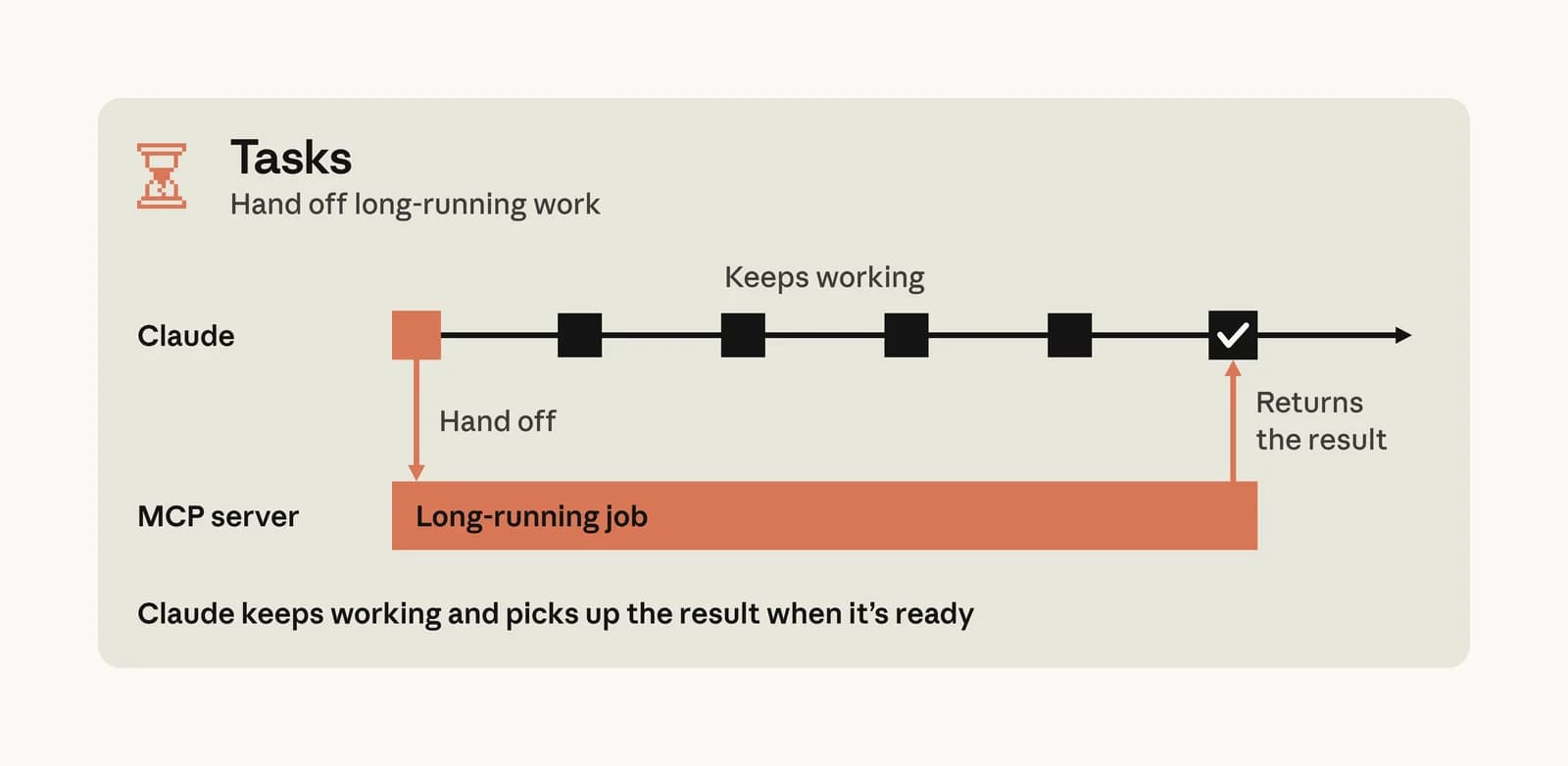
The New Stack gives a developer-shaped example from Soria Parra: you ask an MCP server in Claude Code to investigate a failing CI run, the agent on the other side works on it for a few hours, and the chat session pops back open with the answer. He also said quite a few companies already use Tasks internally where they control their own harnesses, and he expects usage to rise now that Claude supports it. The “full agent loops” wording in Anthropic’s announcement matches his remark that people use MCP servers to “expose full-on agents”, not only single-action tools.
Why not just block?
The Tasks docs answer this directly. A held-open connection is impractical beyond a few seconds because many clients and transport intermediaries impose timeouts. A task ID is a durable handle, so a client that disconnects or restarts can resume polling with the same ID. Tasks carry status metadata and optional status messages for progress visibility. A task that needs input moves to input_required, and the client answers through tasks/update with no second connection and no unsolicited server-to-client message. And task creation is server-directed: the server decides per request whether to create a task, and the client opts in once via the extension capability.
Lifecycle
| Status | Meaning (MCP docs) | Terminal? |
|---|---|---|
| working | The operation is in progress | No |
| input_required | The server needs client input before continuing; tasks/get returns an inputRequests map and the client replies through tasks/update with inputResponses | No |
| completed | The operation finished; the result field holds what the original request would have returned. This includes tool calls that returned isError: true | Yes |
| failed | A JSON-RPC error occurred during execution; the error field has details | Yes |
| cancelled | The operation was cancelled, which is not always honored | Yes |
The flow has six steps in the docs. The client includes io.modelcontextprotocol/tasks in its per-request capabilities, and the server advertises the same extension in server/discover. In response to a supported request, the server returns a CreateTaskResult identified by resultType: "task", with a task ID, initial status, TTL and suggested polling interval. The client calls tasks/get and honors pollIntervalMs. On input_required it fulfills the outstanding requests via tasks/update. On completed it reads result; on failed it reads error. It may send tasks/cancel at any time.
{
  "params": {
    "_meta": {
      "io.modelcontextprotocol/clientCapabilities": {
        "extensions": {
          "io.modelcontextprotocol/tasks": {}
        }
      }
    }
  }
}
This is the spec’s example of a server answering a tools/call with a task:
{
  "jsonrpc": "2.0",
  "id": 2,
  "result": {
    "resultType": "task",
    "taskId": "786512e2-9e0d-44bd-8f29-789f320fe840",
    "status": "working",
    "createdAt": "2025-11-25T10:30:00Z",
    "lastUpdatedAt": "2025-11-25T10:50:00Z",
    "ttlMs": 3600000,
    "pollIntervalMs": 5000
  }
}
Several details matter for implementers. Only tools/call currently supports task-augmented execution. A server must not return a CreateTaskResult to a client that did not include the extension capability on that request, and if it cannot serve such a client without a task it must return error -32021, Missing Required Client Capability. The server must create the task durably before it responds, so that a tasks/get for the returned ID would resolve. Cancellation is cooperative: the server must acknowledge tasks/cancel but is not obliged to stop, and the task may finish with another terminal status. TTL is a backstop; a server may mark a task failed after it elapses and delete it. Servers may also push notifications/tasks to clients that subscribe through subscriptions/listen, but polling is the default. For HTTP, tasks/get, tasks/update and tasks/cancel must set the Mcp-Name header to the task ID so intermediaries can route to the instance holding the state.
What Claude Code does with them, per a third party
Upstash published a write-up on October 23, 2026, before the general availability announcement, describing how Claude Code behaved against a Tasks server they built. We treat it as a third-party observation, not Anthropic’s documentation. It reports that Claude Code declared the Tasks extension in its client capabilities, received a task with pollIntervalMs of 2,000, and polled tasks/get every two seconds until completion. It also reports that, at that date, Tasks worked in interactive terminal sessions, Agent SDK sessions and GitHub Actions runs, but that calls from subagents, one-shot claude -p runs, the VS Code extension and the desktop app stayed plain tool calls. Anthropic’s November announcement says Tasks is now GA in Claude and Claude Code and rolling out to Team and Enterprise; it does not repeat that surface-by-surface list, so confirm current behavior on the surface you use.
The same write-up notes that Claude Code moves a main-conversation MCP tool call that is still running after two minutes to the background without any server change, and that this does not help with serverless time limits because the server still has to keep the request open. We did not find that two-minute behavior in the Claude Code MCP page we cached, so it stays attributed to Upstash.
Elicitation: ask the user mid-call
Anthropic’s framing: some actions need a user’s sign-off, such as spending money or deleting data. With Elicitation, a server can pause to ask for input through a form or a link, then continue where it left off. The examples are all guardrails. Supabase confirms costs before creating a paid project and before running destructive SQL. Railway asks before potentially destructive changes such as removing a service. GitHub has users enter a repository’s name before an agent deletes it. The New Stack adds that servers will mostly use Elicitation to get approval before something that costs money or cannot easily be undone.
Elicitation is part of the core spec, unlike the other three, which are extensions. The spec page we used is the 2025-11-25 revision. It defines two modes.
| Form mode | URL mode | |
|---|---|---|
| What it does | Collects structured data through the MCP client, with an optional JSON schema to validate responses | Directs the user to an external URL for interactions that must not pass through the client |
| Data visibility | Exposed to the client | Data other than the URL itself is not exposed to the client |
| Schema | requestedSchema: a flat object of primitives (string, number, boolean, single or multi-select enum); nested objects and arrays of objects are intentionally unsupported | No schema; url and elicitationId parameters |
| Use for | Structured input such as confirmations and choices, collected in the client | Auth flows, payments, API keys and other sensitive or secure operations |
| Must not be used for | Passwords, API keys, access tokens, payment credentials | Authorizing the MCP client’s own access to the server, which MCP authorization handles |
The spec’s trust-and-safety rules are blunt. Servers must not use form mode to request sensitive information such as passwords, API keys, access tokens or payment credentials, and must use URL mode for those. Clients must show which server is requesting information, provide clear decline and cancel options, let users review and modify form responses before sending, and, for URL mode, show the target domain and gather consent before navigating. Clients that support elicitation declare the elicitation capability, and servers must not send modes the client did not declare. An empty capability object is treated as form mode only, for backwards compatibility.
This is the spec’s URL-mode request, which could point at an API-key page, an OAuth flow or a payment flow:
{
  "jsonrpc": "2.0",
  "id": 3,
  "method": "elicitation/create",
  "params": {
    "mode": "url",
    "elicitationId": "550e8400-e29b-41d4-a716-446655440000",
    "url": "https://mcp.example.com/ui/set_api_key",
    "message": "Please provide your API key to continue."
  }
}
Responses use a three-action model, shown here with the spec’s generic form-mode shape. accept means the user approved and submitted; in form mode content holds the data matching the schema, and in URL mode it is omitted. decline means an explicit no. cancel means the user dismissed the request without choosing. In URL mode, accept means the user consented to the interaction, not that it finished; the server may send notifications/elicitation/complete afterwards, and a server can return error -32042 to say a URL elicitation is required before a request can be retried.
{
  "jsonrpc": "2.0",
  "id": 1,
  "result": {
    "action": "accept",
    "content": {
      "propertyName": "value",
      "anotherProperty": 42
    }
  }
}
What changed in 2026-07-28
The 2026-07-28 spec did not remove Elicitation, it changed the plumbing. The MCP blog says Multi Round-Trip Requests (MRTR, SEP-2322) replace the server-initiated elicitation/create, sampling/createMessage and roots/list requests that needed a held-open stream. The server returns resultType: "input_required" with the requests it needs answered, and the client retries the original call with the answers in inputResponses. Upstash’s Claude Code write-up describes the same behavior: Claude Code repeats the tool call with the user’s answer in inputResponses, and the server does not block on the first request. Supabase’s head of product is quoted in the MCP blog saying support for elicitation had been hard because Supabase MCP runs statelessly, and that MRTR changes that. Inside a task, input requests travel through tasks/get and tasks/update instead, as described in the Tasks section above.
One server-side rule from the elicitation spec is easy to miss. Most practical uses need the server to remember what it has collected, and that state must not be tied to session IDs alone. For remote servers, user identity should come from credentials acquired via MCP authorization, for example the sub claim, and the spec says user identification must be derived from credentials acquired via MCP authorization where possible. That fits the 2026-07-28 direction away from protocol sessions: keep the state in your own store, keyed to the authenticated user.
File Uploads: what is coming
This is the least finished of the four, and the sources agree on that. Anthropic’s announcement says Claude will be able to pass files to MCP servers, not just text, and that the File Uploads extension sends PDFs, spreadsheets and images to a server without passing them through the context window. It is rolling out soon in Claude and Claude Code to Pro, Max, Ultra, and eligible Team and Enterprise plans. The New Stack reports that at first it will work only with MCP servers from Intuit and Dropbox, and that the MCP extension itself is still a draft, first published earlier in November by Den Delimarsky and Google’s Wil St. Charles. The extensions overview lists it as experimental-ext-file-uploads, for “moving files between a client and a tool out of band.”
The design rationale, per Delimarsky in The New Stack, is that sending a file before was “a little hacky”: you base64-encode it into a tool call, and that does not work for large audio and video. “I can’t rely on base64 and loading a 1.2 gigabyte file,” he said. With the extension the file never passes through model context. The server provides an upload target, typically a pre-signed URL, and the client sends the file there over HTTPS. The protocol sets no file size limits, though servers can; “we inherently did not bake any limits because we don’t know,” he said.
How an upload works in Claude, per Claude’s developer docs
Claude’s docs page for building connectors that support file transfers is detailed, and it is already live even though the feature rollout is “soon.” It describes file transfers as beta, on an experimental extension, io.modelcontextprotocol/files, with breaking changes expected. An upload is two tool calls with a storage hop between them:
- Claude calls the tool with the file’s name, type, size and digest, and no bytes.
- The server checks permissions, quota, type and size, and responds with
resultType: "upload_required"and one upload target per file. - Anthropic’s servers send the bytes to the target.
- Claude calls the tool again with the same arguments plus
requestState, and the server verifies and runs the tool.
The tool marks its file argument with an x-mcp-file schema keyword, and the server advertises the extension in server/discover, with { "upload": {} } if it takes uploads. Each tools/call of revision 2026-07-28 declares in _meta whether the client supports upload, download, both or neither, and the server reads that on every call. If an upload is needed and not declared, the docs say to return error -32021 and not run the tool.
{
  "supportedVersions": ["2026-07-28"],
  "capabilities": {
    "extensions": {
      "io.modelcontextprotocol/files": { "upload": {} }
    }
  }
}
{
"result": {
"resultType": "upload_required",
"uploads": [
{
"fileId": "file-1",
"url": "https://upload.example.com/u/01JD3V7K2M?sig=...",
"headers": { "Content-Type": "application/pdf" },
"credentials": "omit"
}
],
"requestState": "..."
}
}The docs list requirements that go beyond protocol work. These are the ones a server team should read before planning:
- Directory listing. Claude transfers files for connectors people add from the Connectors Directory, and the address they connect to must exactly match an address on the listing. A URL-added connector gets no files, and the server receives no error.
- Single server URL. Your listing needs one URL every user connects to, or a fixed set. If each customer enters their own URL, Claude does not transfer files.
- Protocol revision and SDK. Serve revision 2026-07-28 over Streamable HTTP. To receive uploads, the library must let a tool return the
upload_requiredresult type. The docs say@modelcontextprotocol/sdk1.32.2 supports neither uploads nor downloads, and that in PythonMCPServerinmcp2.3.0 andFastMCPinfastmcp4.0.10 turn an upload request into an ordinary result, so Claude sends no file. Their samples use the low-levelServerin the TypeScript or Python SDK. - Storage. It must accept a whole file in one PUT or POST. Targets must be HTTPS on port 443, with a public certificate and TLS 1.3 or a specified TLS 1.2 suite, and the URL must carry its own authorization, for example a short-lived signature. A redirect fails the transfer.
- Approved hosts. Anthropic must approve the hosts that store a connector’s files, requested by email to [email protected]. Claude refuses a URL on any other host, on an IP address, or on another company’s shared storage or CDN host.
- Plan settings. On Team and Enterprise, an Owner must switch on the “File uploads to connectors” toggle, the “File downloads from connectors” toggle, or both, under Organization settings > Connectors. The docs say some organizations cannot use file transfers, such as those with HIPAA settings, zero data retention, customer-managed encryption keys, an IP allowlist, or a default workspace that keeps data outside the US.
The docs also set limits, which are worth knowing because they shape what the feature is for. A single upload call can carry up to 10 files, and Claude Code sends up to 8. Each call must be answered within 60 seconds, and in a Claude chat both calls of an upload and all their files have about 200 seconds. Responses that finish an upload, ask for a file or return a file must stay under 1,000,000 bytes; the bytes at a target do not count. Upload URLs should stay valid for at least 20 minutes, or 75 minutes when several targets are returned. Our reading is that this is a design for documents, spreadsheets and images moving to a storage target, and that the roughly 200-second chat window is the limit to plan around. The docs table we read does not list a file-size cap.
The announcement’s heading reads “Send and receive files”, but its text and the thread only describe Claude sending files to a server. Claude’s developer docs cover downloads too, with a tool returning a file as a download target. We treat download behavior as documented but not part of the announcement’s headline claim.
The foundation work behind the launch
The last paragraph of Anthropic’s thread says these launches build on recent updates that make MCP in Claude more token efficient, easier to authorize and more interactive. The announcement lists four, and each has its own source.
- Token efficiency: tool search. Tool search loads tool definitions only when needed, which Anthropic says can cut the context they use by over 85 percent in multi-server setups. That is a vendor figure and we have not measured it. Claude Code’s MCP docs say tool search is on by default for supported models, and document an
ENABLE_TOOL_SEARCHvariable plus analwaysLoadserver setting for tools that should always be visible. Tool-description limits are 4,096 characters for server instructions and tools loaded upfront and 16,384 for tools loaded through tool search, so put critical wording early. - Scale: a stateless spec. The 2026-07-28 revision removed the initialize handshake and the
Mcp-Session-Idheader, so any request can land on any instance behind a round-robin load balancer. Anthropic says the latest spec is supported across Claude products. Our earlier coverage is in the MCP 2026 spec guide. - Authorization: Enterprise Managed Auth. The extension lets admins authorize supported servers once so users connect automatically. Claude’s docs call this auto-connect, available on Team and Enterprise, where Claude presents an identity assertion (a signed JWT) to the server’s authorization server instead of sending each user through an OAuth consent screen. DCR is not supported with it.
- Interactivity: MCP Apps. The MCP Apps extension brings full interfaces into Claude, beside the conversation or full screen. The extensions overview lists it as Stable, and The New Stack quotes Soria Parra saying Apps will always remain an extension because not every client, a terminal for example, can render HTML.
# Use a custom 5% threshold
ENABLE_TOOL_SEARCH=auto:5 claude

# Disable tool search entirely
ENABLE_TOOL_SEARCH=false claude
The commands above are the docs’ own examples. For the broader field of servers you might connect, see our lists of the top MCP servers and the best MCP servers for Claude Code.
For server builders: an adoption checklist
Anthropic’s announcement says to add support through the docs for Skills over MCP, Tasks, Elicitation and File Uploads. The steps below are our ordering of what those docs require. They are suggestions, not an Anthropic-published rollout guide.
- Decide what is worth the work. Tasks fit CI pipelines, batch jobs and wrappers over APIs that already return job IDs. Elicitation fits any action that spends money or deletes data. Skills fit workflows that need several tools or reference files. File Uploads fit tools that ingest documents, and only if you can meet the host-approval requirements.
- Move to the 2026-07-28 revision first. Per-request capabilities,
server/discoverand_metaare how all three extension docs negotiate support. Claude’s file transfer page requires this revision explicitly, and Claude Code’s docs describe using the newer revision with servers that support it. - Negotiate per request, never assume. For Tasks, check that the request’s
io.modelcontextprotocol/clientCapabilitiesincludes the extension before returning a task, because a server must not return one to a client that did not declare it. For File Uploads, read the declaration on everytools/call. For elicitation, only send modes the client declared. - Design a fallback for clients without the capability. The specs forbid sending a task or an unsupported elicitation mode to a client that did not declare support, and give
-32021as the error for a missing capability. A reasonable pattern, our suggestion, is to keep a blocking path for short work and require an explicit confirmation argument where a client cannot elicit. Upstash’s toolkit takes a related approach: a client that declares Tasks gets a native task, and any other client gets a task ID in a normal result plus status and cancel tools. - Publish skills as a manifest. Write SKILL.md with
nameanddescriptionfrontmatter, keep the directory name equal toname, compute SHA-256 digests and byte sizes from the bytes you actually serve, stay under 512 files and 16 MiB, and implementskills/list,skills/getand the Resources basics. If skills are generated per user, mark them"dynamic"and expect hosts to decline them or to refuse to carry approval forward. - Make tasks durable. Create the task before responding, store IDs so a different instance can answer
tasks/get, set a TTL you can honor, honorpollIntervalMsin your rate limits, treat cancellation as best effort and deliverinput_requiredrequests with unique keys for the life of the task. - Treat elicitation as a security surface. Use URL mode for credentials and payments, never put secrets or pre-authenticated links in a URL elicitation, handle accept, decline and cancel separately, and bind the elicitation to the authenticated user instead of a session.
- For File Uploads, start the paperwork early. Get on the Connectors Directory, request host approval by email before building on a host, use one stable server URL, serve 2026-07-28, and use an SDK version that can return
upload_required. Plan the requestState handling and the second call verification the docs describe. - Test in Claude Code. Claude’s file-transfer docs give a test procedure that starts with curl against your own server and then runs the connector from the directory listing inside Claude Code. For skills and tasks, the Claude Code MCP docs are the place to check how tool descriptions and server instructions are truncated and loaded.
- Pin down what you do not know. The file-transfer extension is experimental, and Claude’s docs say to expect breaking changes. Do not put it on the critical path of a product feature yet.
For Claude users and admins: what to turn on
| Plan | Skills over MCP (beta) | Tasks and Elicitation (GA) | File Uploads (soon) |
|---|---|---|---|
| Pro, Max, Ultra | On by default | Generally available | Rolling out soon |
| Team | Available once an admin enables it; where the setting lives is not stated in the announcement | Rolling out | Rolling out soon to eligible Team plans; an Owner must enable the transfer toggles per Claude’s docs |
| Enterprise | “Coming soon”; no date | Rolling out | Rolling out soon to eligible Enterprise plans; an Owner must enable the transfer toggles per Claude’s docs |
| Free | Not mentioned | Not mentioned | Not mentioned |
The practical advice for each audience follows from the sources, with the caveat that these are our reading.
- Individual users on Pro, Max or Ultra: skills from servers you have already connected should appear without anything separate to install, and long tool calls and approval prompts should behave as described. Since these are server-side features, what you see depends on whether the specific server has adopted them. Anthropic’s named examples are Shopify, HubSpot, Atlassian, ZoomInfo, Supabase, Railway and GitHub.
- Team admins: Skills over MCP is off until an admin enables it. Anthropic does not say where. Because skills are text that steers the model, the spec’s approval and origin rules are the reason to review which servers your organization connects before turning it on.
- Enterprise admins: Tasks and Elicitation are rolling out, Skills over MCP is not yet available, and File Uploads depends on eligibility. Organizations with HIPAA settings, zero data retention, customer-managed keys, an IP allowlist or a default workspace outside the US are listed in Claude’s docs as unable to use file transfers. Enterprise Managed Auth, covered in our foundation section, is separate and is how admins pre-authorize servers.
- Anyone using Claude Code: the MCP docs cover tool search controls, description length limits and server instructions. Elicitation questions inside a task reach you only in an interactive session, according to Upstash’s October write-up.
Numbers and adoption
Two numbers are in Anthropic’s announcement: over 700 million monthly SDK downloads and over 10,000 MCP connectors for Claude. The Decoder repeats both as Anthropic’s figures. The New Stack adds context: the 700 million is up from the 400 million Anthropic reported in July. The MCP project’s own July 28 blog said close to half a billion monthly downloads across Tier 1 SDKs, and that the TypeScript and Python SDKs had each crossed one billion total downloads. These measure different things, SDK installs and connectors, and none says how many servers use the new features. The 85 percent reduction from tool search is likewise vendor-reported and scoped to multi-server setups.
The more informative adoption signal is who is named. The July 2026 spec blog quotes AWS saying Tasks is one of the first official MCP extensions and was contributed by AWS, and quotes Supabase on elicitation via MRTR. The Skills Over MCP working group charter lists leads and participants from Nordstrom, Bloomberg, Google, Databricks, AWS, Stacklok, Arcade.dev and others, and The New Stack says the core maintainers work at Anthropic, Microsoft, Google, OpenAI and Amazon. The file uploads group was led by Delimarsky and two Google engineers, with participants from Microsoft and Dropbox. The New Stack also notes that Microsoft’s Foundry offers Skills over MCP in preview. This is open-standard work with several vendors in it, though the announcement concerns Claude’s support only.
Governance context: the announcement says MCP is hosted by the Agentic AI Foundation. Soria Parra told The New Stack that little has changed in how the project is steered since the donation, but that neutral governance has helped adoption. The New Stack also relays his view that “adding things is easy, removing them is very hard,” which is why these arrive as optional extensions first. Sampling is his example of a feature that did not land: the July spec deprecated it, and it will keep working for at least another 12 months.
Open questions: not announced or not stated
| Question | Status as of November 24, 2026 |
|---|---|
| Enterprise availability date for Skills over MCP | “Coming soon”; no date given |
| File Uploads rollout date | “Rolling out soon”; no date. The New Stack says launch partners are Intuit and Dropbox |
| Where Team admins enable Skills over MCP | Not stated in the announcement |
| Skills over MCP coverage across Claude surfaces (chat, Desktop, Cowork, mobile) | Announcement names Claude and Claude Code; an October GitHub issue reported gaps in chat, Desktop and Cowork and was still open when we checked |
| General availability of Skills over MCP | Described as public beta; no end-of-beta date |
| Support in clients other than Claude | Anthropic says any compatible client works; The New Stack says it remains to be seen how quickly other clients adopt the extensions |
| Surfaces where Tasks run (subagents, claude -p, VS Code, desktop) | Upstash reported limits in October; Anthropic’s announcement does not list surfaces |
| Pricing or usage charges for these features | Not stated in the sources we read |
| Stage of the Skills extension (Final or Beta) | MCP docs disagree between the Skills page and the extensions overview |
| Future features | Soria Parra mentions streaming, voice and other modalities, and better support for programmatic tool calling; no dates. Events extension is described as slow to finalize |
Verdict
This update is less a new feature than a change in what an MCP server is allowed to be. Until now a server was a bag of tools that a model called one at a time and waited for. With skills, a server can teach the model how to use itself. With tasks, it can run an agent loop for hours and report back. With elicitation, it can stop and ask a human before doing something expensive or irreversible. With file uploads, it can take documents without the model reading them. Those four together are what Anthropic means by treating a server like another agent.
For server builders, the clear first moves are Elicitation, because it protects your users and is part of the core spec (the revision we read is 2025-11-25), and Tasks, if you already wrap job-based APIs. Skills over MCP is worth a pilot if you have a multi-step workflow that tool descriptions do not capture, but plan for the approval friction the spec requires and for uneven client behavior while it is in beta. File Uploads is worth following, not building against, until Anthropic gives dates and the extension leaves experimental status. The host-approval email and the SDK version limits in Claude’s docs show how much groundwork it needs.
For Claude users, the near-term effect is modest and depends on the servers you use. The caution is the same as with any beta: skills are text that steers the model, the spec treats them as untrusted input, and your protection is the approval step. Read what a server wants to load before you accept it, and keep the 85 percent and 700 million figures in mind as Anthropic’s numbers, not independent measurements.
FAQ
What did Anthropic announce for MCP’s second anniversary?
On November 24, 2026 Anthropic said Skills over MCP is in public beta in Claude and Claude Code, Tasks and Elicitation are generally available, and File Uploads is rolling out soon. All four sit in the open MCP spec and its extensions, so a server that supports them should work in any compatible client, not just Claude.
Which Claude plans get these features?
Per Anthropic: Skills over MCP is on by default for Pro, Max and Ultra, available to Team once an admin enables it, and coming soon to Enterprise. Tasks and Elicitation are generally available on Pro, Max and Ultra and rolling out to Team and Enterprise. File Uploads is rolling out soon to Pro, Max, Ultra and eligible Team and Enterprise plans. No dates were given for the Enterprise and File Uploads rollouts.
What is Skills over MCP and how is it different from a local skill?
It is an MCP extension (io.modelcontextprotocol/skills) that lets a server publish Agent Skills, meaning a SKILL.md plus supporting files, next to its tools. The client lists them with skills/list, fetches them with skills/get and reads the files with resources/read. A local skill lives on your machine or in your account. A server-published skill ships with the service, updates when the server updates and can be generated per user or organization.
Does a task make my tool run faster?
No. A task changes how the result is delivered, not how long the work takes. The server returns a task handle immediately and the client polls tasks/get until the task reaches completed, failed or cancelled. The benefit is that the client is not blocked on one open request and can keep working or resume after a disconnect.
What is the difference between form mode and URL mode elicitation?
Form mode collects structured data through the client using a restricted, flat JSON schema, and the data is visible to the client. URL mode sends the user to an external URL for interactions that must not pass through the client. The spec says servers must not request passwords, API keys, access tokens or payment credentials in form mode, and must use URL mode for those.
What can File Uploads send, and where do the files go?
Anthropic says Claude will send PDFs, spreadsheets and images to a server without passing them through the context window. In Claude’s developer docs the server returns an upload target, typically a signed URL on an approved host, and Anthropic’s servers send the bytes there directly. The docs describe the feature as beta and built on an experimental extension, so breaking changes are expected.
Do I need Anthropic’s approval to use File Uploads as a server builder?
According to Claude’s docs, yes for the Claude connector path. Files only move for connectors added from the Connectors Directory whose listing URL matches, and Anthropic must approve the hosts that store the files. The request goes by email to [email protected]. Team and Enterprise owners must also switch on the file transfer toggles in Organization settings.
Does any of this require the 2026-07-28 MCP spec?
Tasks and Skills as documented on modelcontextprotocol.io use per-request capabilities and server/discover, which belong to the 2026-07-28 revision. Claude’s file transfer docs say to serve revision 2026-07-28 over Streamable HTTP. Elicitation is documented in the core spec at revision 2025-11-25, with form and URL modes; in 2026-07-28 the server-to-client request flow was redesigned around Multi Round-Trip Requests.
Will these features work in ChatGPT, Cursor or other clients?
Anthropic says a server that supports them works in any compatible client. Actual client support is a separate matter. The Skills docs point to a client matrix and say SDK and host support is still being implemented. Anthropic and The New Stack both stop short of promising when other clients will adopt the extensions.
Are the usage numbers independent?
No. The 700 million monthly SDK downloads and the 10,000 connectors for Claude are Anthropic’s figures, repeated by The Decoder and The New Stack. The 85 percent context reduction from tool search is also Anthropic’s claim, and it applies to multi-server setups, not every configuration.
Sources
Sources checked November 24, 2026. We did not run the features; claims come from the pages below. Official sources first, then press and third-party write-ups.
- MCP servers can now ship skills, run tasks, and more with Claude: Claude / Anthropic, Nov 24, 2026 (announcement)
- X posts: @ClaudeDevs, post 2, post 3 and post 4, Nov 24, 2026
- Skills extension overview: modelcontextprotocol.io (capabilities, messages, integrity, security)
- Skills Over MCP Working Group charter: modelcontextprotocol.io
- Tasks extension overview and SEP-2663: modelcontextprotocol.io (lifecycle, negotiation, method details)
- Elicitation, spec revision 2025-11-25: modelcontextprotocol.io
- Extensions overview: modelcontextprotocol.io (lifecycle stages and extension table)
- The 2026-07-28 Specification: MCP blog, Jul 28, 2026 (stateless core, MRTR, deprecations)
- Support file uploads and downloads: Claude developer docs (requirements, flow, limits, testing)
- Enterprise Managed Auth for connectors: Claude developer docs
- Connect Claude Code to tools via MCP: Claude Code docs (tool search, description limits)
- Connectors, skills, and plugins: Claude developer docs
- anthropics/claude-ai-mcp issue #1160: GitHub, opened Oct 19, 2026 (client support gap report)
- As MCP turns two, Claude gets Skills over MCP and better support for long-running tasks: The New Stack, Frederic Lardinois, Nov 24, 2026
- Anthropic tops 700 million monthly MCP SDK downloads: The Decoder, Matthias Bastian, Nov 24, 2026
- MCP Tasks and Elicitations in Claude Code: Upstash blog, Cahid Arda Oz, Oct 23, 2026 (third-party implementation write-up)