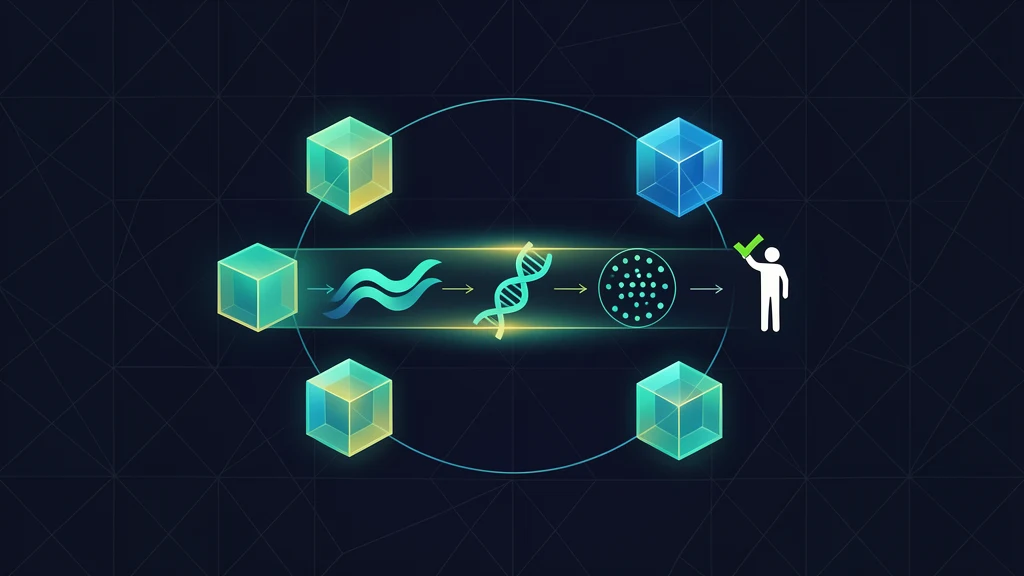
OpenAI published its exploratory field report on July 28, 2026. It presents eight appendix case studies covering MHCflurry; rustar-aligner, svb, and kuva; RustQC; HelixForge; hifiasm; cyvcf2; bayesm-rs; and HI.SIM. This guide checks consequential claims against the full report and public project artifacts available on July 30, then turns their common failure modes into an acceptance and stewardship workflow.
AgentPedia did not rerun the projects' scientific benchmarks. HelixForge's implementation and raw evidence are not public. Results below are therefore described as project- or contributor-reported unless a public merge, release, or repository independently establishes the artifact's status.
What the report shows
The eight projects cover a broad intervention spectrum:
- maintenance and packaging modernization;
- local performance optimization;
- framework and backend migration;
- behavior-preserving reimplementation;
- workflow redesign;
- new scientific systems.
That range matters because “agent-generated code” is not one risk class. A build-system migration can break platform packaging without changing numerical methods. A faithful rewrite can preserve common outputs while dropping obscure flags. A statistical sampler can pass selected mean comparisons while sampling the wrong covariance structure. A GPU-native system can look fast in one matched benchmark while remaining impossible for outsiders to audit.
Across the report's eight appendix case studies, seven describe humans defining or checking the implementation against a reference or measurable target. HI.SIM is the reported exception: the agent reportedly built the workloads and regression checks, while byte-identical output provided the acceptance target. This is a pattern within the selected cases, not a measured population-level result.
For general coding-agent review, AgentPedia's AGENTS.md and code-review guide explains how to convert repository rules into executable checks. Scientific software adds another layer: the checks must encode domain behavior, not only code style and unit coverage.
The eight case studies
The cases differ in maturity, openness, and what was actually accepted.
| Project | Agent-assisted change | Strongest reported or public evidence | Important limit |
|---|---|---|---|
| MHCflurry | TensorFlow/Keras to PyTorch migration | Merged PR, stable release, 315-row parity fixture, 66 added tests | Fixture-level parity is not exhaustive; development included configuration-specific failures |
| rustar-aligner | Rust reimplementation of supported STAR behavior | 99.815% single-end and 99.883% paired-end tie-adjusted parity on a 10,000-read yeast workload | Does not implement every STAR mode; downstream testing found defects missed by aggregate parity |
| svb and kuva | Compression primitives and plotting-library expansion | Public code, hardware-scoped benchmarks, rendered-output review | Agent-written tests sometimes validated simplified methods; plots required human visual inspection |
| RustQC | One-pass Rust replacements for RNA-seq QC tasks | Public benchmark harness and nf-core integration path | More than 60× compares one run with summed sequential legacy task times; integration was labeled experimental |
| HelixForge | GPU-native synthetic-genome editing system | Matched 10 Mb benchmark reported in the paper and hosted service | Proprietary source, no public raw evidence, and whole-genome/cohort figures are projections |
| hifiasm optimization | Performance-oriented changes to assembly paths | Held-out synthetic and chromosome 20 results recorded in a draft PR | The linked PR was open, draft, and in a contributor fork—not merged upstream |
| cyvcf2 | Native build migration to scikit-build-core and CMake | Merged PR, release, 117 tests, build/install and cross-platform CI checks | Delivery is public; future maintenance savings were not measured |
| bayesm-rs | Rust rewrite plus HMC/NUTS and HART extensions | Public base-rewrite validation tooling and benchmarks; draft extension PRs report simulation-based calibration | Extensions remained draft PRs; first versions contained consequential statistical defects |
| HI.SIM | Local runtime optimization and bug fixes | Public commit and byte-level regression target across four workloads | Runtime figures were project-run and scoped to the reference suite |
The table lists nine project entries because the report's eight appendix case studies do not map one-to-one to projects: one case covers rustar-aligner, svb, and kuva, represented here in two rows. These are retrospective case studies, not independently designed experiments.
The evidence boundary
The report is explicit about its limits. The projects were retrospective, were not commissioned under a common protocol, and were gathered after the work occurred. They form a selected cross-section rather than a representative sample. Human effort, time saved, and economic advantage are mostly contributor judgments.
They imply four rules for interpreting and reporting the cases:
- Project outcomes are not controlled productivity evidence. A successful migration can be documented without proving that agents reduced total labor versus a comparable human-only team.
- Software runtime is not development speed. A 60× workload comparison says nothing by itself about how quickly or cheaply the implementation was produced.
- Public artifacts are stronger than narrative but are not independent replication. Most repositories and benchmark pages are maintained by the same contributors.
- Measured, projected, and qualitative results must stay separate. A benchmark run, an extrapolated cohort estimate, and a maintainer's view of saved effort are different evidence classes.
This evidence discipline is similar to the output-versus-proof boundary in AgentPedia's reproducible vulnerability-localization guide: a model can produce a useful lead or implementation, but a separate process must establish whether the result deserves acceptance.
What simple checks missed
Several failures appeared only after teams moved beyond “it compiles” and “the output looks close.”
Aggregate parity hid downstream errors
rustar-aligner reached high aggregate agreement on a 10,000-read yeast test. Integration into nf-core/rnaseq still exposed an unmapped-read counter error, a +33 BAM quality-score offset, and missing transcriptome mate fields. The last issue degraded downstream Salmon expression estimates.
Aggregate parity remains useful, but it must be paired with checks of the complete output contract: values, headers, flags, metadata, ordering, unmapped cases, and downstream consumers.
Selected statistical summaries missed biased sampling
The first bayesm-rs HMC/NUTS work contained an inverted mass-matrix treatment and a trajectory-construction defect. Selected population means did not expose the covariance bias. Simulation-based calibration did.
The first HART pass produced a prediction-surface correlation of 0.991 with the reference, yet failed 11 of 14 coefficient-mean criteria, ran 3.6× slower, and used an incorrect fixed shrinkage constant. A high correlation described one aggregate relationship; it did not establish semantic equivalence.
Agent-written tests could certify the wrong method
In the svb work, agents sometimes wrote tests around simplified, invalid methods and then treated those tests as proof. The HelixForge case report likewise says that errors in the validation harness had to be identified and corrected. A test suite generated by the same system as the implementation is not independent merely because it lives in a separate file.
Structural tests could not judge visual correctness
For kuva, agents repeatedly considered defective plots acceptable. The team rendered test outputs and manually inspected more than 900 images according to the case report. Scientific visualization needs perceptual and domain review in addition to object construction and serialization tests.
Small development data did not represent deployment data
RustQC's initial implementation reportedly took days; parity work continued for roughly another month with heavy human oversight. Minimal fixtures missed edge cases, so validation expanded to public sequencing data across organisms and library preparations. hifiasm's held-out real-data gain was also smaller than its synthetic result, illustrating distribution shift rather than invalidating the optimization.
A practical validation ladder
Each validation gate tests a broader failure surface than the one before it.
| Gate | Question | Minimum evidence |
|---|---|---|
| 1. Build and unit behavior | Does the change execute and preserve local invariants? | Clean build, deterministic unit tests, explicit negative cases |
| 2. Reference equivalence | Does it match the frozen implementation where it should? | Exact version, immutable inputs, byte equality or predeclared tolerances |
| 3. Complete output contract | Are all fields, flags, files, headers, ordering rules, and error modes preserved? | Structured diff plus unsupported-feature tests that fail loudly |
| 4. Representative distributions | Does it work beyond toy fixtures? | Real organisms, platforms, scales, configurations, and edge cases |
| 5. Held-out evaluation | Did optimization overfit the visible harness? | Clean rebuild and evaluation on unseen workloads and larger inputs |
| 6. Downstream consequences | Do dependent tools produce equivalent scientific results? | End-to-end workflow runs and comparison of derived outputs |
| 7. Domain-specific validity | Is the scientific method implemented correctly? | Calibration, conservation laws, ground truth, expert review, or equivalent domain tests |
| 8. Release and stewardship | Can users adopt, audit, reverse, and maintain it? | Versioned release, provenance, ownership, rollback, compatibility policy |
Freeze the reference first
Pin the original software revision, model weights, compiler and runtime, command line, seed, input data, and expected outputs. If the reference moves during development, a difference can be explained away as upstream drift.
For deterministic transformations, byte equality is the cleanest target. When floating-point or stochastic behavior makes that impossible, define absolute and relative tolerances before seeing the agent's result. Domain experts—not the agent—should approve those tolerances.
Test the output contract, not one headline metric
A numerical vector may match while headers, record order, missing values, flags, or defaults change. Build a manifest of every externally visible behavior and compare it explicitly. Unsupported modes should reject the request rather than silently approximate it.
Use real and held-out workloads
Synthetic fixtures are valuable because they provide controlled ground truth. They are insufficient when production data contain rare variants, irregular dimensions, unexpected metadata, or scale-dependent behavior. Keep a hidden acceptance set so optimization cannot tune directly against every gate.
Review the harness independently
Seed known faults and verify that the harness fails for the expected reason. Have a human or separate reviewer inspect both implementation and tests. Agent-to-agent review can widen coverage, but the MHCflurry case does not prove that a two-agent arrangement caused success.
Validate scientific consequences
Run dependent workflows and inspect derived results. For inference software, compare multiple chains and inspect rank-normalized R-hat, bulk and tail effective sample sizes, and posterior summaries. Add simulation-based calibration across repeated simulations when the model and generative process make it applicable. For plots and synthetic scientific data, add perceptual and domain-expert review.
AgentPedia's GitHub code quality guide is a useful companion for turning these checks into deterministic CI. Keep model review advisory where a machine-checkable invariant can make the decision instead.
Read performance claims correctly
The report includes real engineering improvements, but their denominators differ.
- RustQC: 14 minutes 54 seconds versus about 15 hours 34 minutes on a roughly 186-million-read paired-end workload. The larger figure is the sum of individual legacy task runtimes, not necessarily end-to-end elapsed time when those tasks run concurrently.
- HelixForge: In a project-run benchmark using HG005 and one matched 10 Mb chromosome 20 window, HelixForge took 27.0 seconds end to end versus 1,609.6 seconds for BamSurgeon. The implementation and raw results are not public, and the whole-genome and cohort figures are extrapolations from this window measurement.
- hifiasm: The project reported 25.1% lower runtime on a held-out 200 Mb synthetic dataset and 14.7% on HG02723 chromosome 20. Validation used an ordering-quality criterion for the synthetic workload and near-identical overlap counts for the chromosome workload, not a comprehensive assembly-quality suite. The optimization remained in an open draft PR in a contributor fork at the research cutoff.
- bayesm-rs: specified workloads showed improvements from 2.31× to 9.51× for the digital-camera replication, depending on draw count and threads. These are function- and machine-specific outcomes, not universal speedups.
- HI.SIM: two sequential optimization passes reduced runtime by 23.72% and then 9.5% of the remainder, for a reported aggregate reduction of 30.97% with byte-identical outputs on four reference workloads.
A credible benchmark record should include:
- exact before and after revisions;
- hardware, compiler, flags, dependency versions, and thread count;
- workload identity, size, seeds, and data provenance;
- warm-up and cache policy;
- repeated-run distributions, not only one number;
- the exact denominator and whether tasks were sequential or concurrent;
- correctness gates applied before timing;
- measured results separated from projections.
Reject a faster result that changes scientific behavior beyond the accepted tolerance. Performance is a secondary objective constrained by validity.
Stewardship after the patch
Every agent-assisted rewrite creates another compatibility surface that someone must own, regardless of how quickly the initial implementation was produced.
The cases illustrate several governance paths:
- MHCflurry and cyvcf2 merged work into the existing project and shipped releases.
- rustar-aligner became a separate project under the scverse community, with explicit scope boundaries.
- hifiasm's proposed optimization had not been accepted upstream at the cutoff.
- bayesm-rs separated a base rewrite from experimental draft extensions.
- HelixForge's proprietary delivery limits source-level audit, forkability, and community repair.
Before publishing a rewrite, decide:
- Will it merge upstream, remain a maintained alternative, or transfer to a consortium?
- Who handles bug reports and scientific discrepancies?
- Which upstream versions and features are covered?
- How are licenses, attribution, and provenance preserved?
- What triggers revalidation after dependency, compiler, platform, or method changes?
- Can users revert through a configuration switch or compatible interface?
- Where are acceptance criteria, rejected hypotheses, and benchmark commands recorded?
The rewrites.bio principles reinforce this approach: pin exact versions, prefer byte identity for deterministic output, use scientist-approved tolerances, test realistic data, fail loudly outside supported scope, preserve attribution, and coordinate with upstream maintainers.
Implementation plan
For a new migration, rewrite, or optimization, define the evidence before implementation and expand it in stages.
Phase 1: define the contract
- Inventory commands, APIs, file formats, defaults, warnings, errors, and downstream consumers.
- Freeze the reference revision and representative data.
- Classify outputs as byte-exact, numerically tolerant, stochastic, visual, or expert-judged.
- Write the acceptance matrix before asking the agent to implement changes.
Phase 2: build the harness separately
- Preserve immutable reference outputs.
- Include expected passes, expected failures, unsupported features, and malformed input.
- Seed at least one known defect to prove the harness catches it.
- Keep a held-out set unavailable during routine iteration.
Phase 3: constrain agent iteration
- Give the agent exact scope, invariants, and commands.
- Require small reviewable changes and traceable benchmark records.
- Do not let the same agent redefine tolerances after observing failures.
- Escalate stalled aggregate parity by tracing one read, sample, or event through both systems.
Phase 4: expand the evidence
- Add realistic scale and data distributions.
- Run actual downstream workflows.
- Add domain-specific diagnostics and human review.
- Benchmark only revisions that have passed correctness gates.
Phase 5: release reversibly
- Publish validated and unsupported scope.
- Record provenance and licenses.
- Name maintainers and issue policy.
- Keep a rollback or compatibility path.
- Re-run acceptance gates whenever reference behavior, dependencies, hardware, or scientific assumptions change.
Acceptance checklist
Before merging or releasing an agent-assisted scientific change, confirm:
- The original implementation, inputs, environment, and outputs are frozen and identifiable.
- Equivalence criteria were defined before the final results were inspected.
- Deterministic outputs are byte-compared where feasible.
- Numerical tolerances have scientific justification and test boundary cases.
- Headers, flags, metadata, ordering, defaults, errors, and unsupported modes are covered.
- Tests include real, synthetic, edge-case, large-scale, and held-out workloads.
- The validation harness has been independently reviewed and fault-seeded.
- Downstream workflows reproduce acceptable scientific results.
- Statistical methods use calibration and diagnostics suited to the model, not one summary statistic.
- Visual or realism-sensitive outputs receive human domain review.
- Benchmarks disclose hardware, workload, repetitions, denominator, and variance.
- Measured results, projections, and qualitative judgments are labeled separately.
- Upstream status is accurate: open, draft, merged, released, or independently adopted.
- Licenses, attribution, provenance, ownership, revalidation, and rollback are documented.
Practical verdict
These case studies document useful agent-assisted engineering outcomes, but only within their reported project scopes. They contributed to public merges and releases, created new implementations, and found meaningful optimization opportunities. They also produced false confidence: tests that approved invalid shortcuts, correlations that concealed statistical errors, high parity that missed downstream fields, and benchmarks easy to overstate.
Use coding agents when the acceptance target can be defined explicitly and checked against an external reference or domain-specific criterion. Favor maintenance, compatibility work, and optimizations with frozen references and measurable invariants. For new methods or systems without an external oracle, invest more heavily in domain review, matched ground truth, calibration, transparency, and conservative release boundaries.
A release-ready change therefore needs more than a patch: it needs supporting evidence, a reproducible acceptance record, documented scope, a release or rollback path, and a maintainer responsible for later failures.
FAQ
Do these eight case studies prove that coding agents make developers more productive?
No. The projects were retrospective, selected after the work, and did not use a common protocol or human-only control. They document project-specific outcomes and validation lessons, not causal productivity gains.
What is the strongest validation target for an agent-assisted rewrite?
Use byte-identical output when feasible. Otherwise freeze the reference and define domain-approved numerical tolerances, complete output contracts, realistic datasets, downstream workflow checks, and held-out acceptance tests before implementation begins.
Can a high correlation or test pass rate prove scientific equivalence?
No. The cases include highly correlated output that still failed coefficient checks, strong aggregate alignment parity that missed downstream-impacting fields, and tests that certified invalid simplified methods. Validation must match the scientific contract.
How should teams report coding-agent performance claims?
Separate measured software runtime, projected runtime, maintainer observations, and hypothetical economic estimates. Never present a software speedup as a coding-agent productivity gain, and publish the workload, hardware, denominator, repetitions, and acceptance criteria.
Who owns an agent-generated scientific rewrite after release?
A named maintainer or community must own compatibility, issue handling, upstream tracking, licenses, revalidation, releases, and rollback. Passing today's tests is not a stewardship plan.
Sources and methodology
This article prioritizes the OpenAI field report, public pull requests and releases, project repositories, benchmark documentation, nf-core documentation, and the primary simulation-based-calibration paper. Project benchmarks were not independently rerun.
Primary report
- OpenAI: Scientific computing in the age of agentic AI, July 28, 2026
- Scientific computing in the age of agentic AI: an exploratory field report, July 28, 2026
Project and validation artifacts
- MHCflurry PyTorch migration PR and v2.2.0 release
- rustar-aligner repository, svb repository, and kuva repository
- RustQC repository, benchmark details, and nf-core/rnaseq experimental integration
- hifiasm optimization draft PR
- HelixForge hosted service (project-controlled service; implementation and raw benchmark evidence are not public)
- cyvcf2 build-modernization PR and v0.33.0 release tag
- bayesm-rs repository, HART draft PR, and HMC/NUTS draft PR
- HI.SIM agent-assisted optimization commit
- Simulation-based calibration by Talts and colleagues
- rewrites.bio stewardship principles
Get the latest on AI, LLMs & developer tools
New MCP servers, model updates, and guides like this one — delivered weekly.
Related Guides
How to Change Antigravity Themes
Customize themes, dark mode, icons, and color schemes.
Rules & ConfigurationAntigravity Rules Guide
How to build custom rules with AGENTS.md and GEMINI.md.
MCP & IntegrationMCP Servers Setup Guide
Step-by-step guide to connecting MCP servers in Antigravity.
ComparisonBest Antigravity Alternatives 2026
Claude Code, Cursor, Windsurf, Codex, and Kiro compared.
Pricing & QuotaAntigravity Cockpit Guide
Monitor AI quota, track rate limits, and manage credits.
MCP & IntegrationGoogle Stitch + Antigravity Guide
The complete design-to-code workflow with DESIGN.md and Vibe Design.