
Google released Gemini 3.6 Flash, Gemini 3.5 Flash-Lite, and Gemini 3.5 Flash Cyber on July 21, 2026. This guide focuses on the developer decision: which model to call, what it costs, which launch claims survive a methodology check, and what to test before changing production traffic.
The research cutoff is July 21, 2026. Product status, pricing, and model capabilities below come from Google's live API documentation, release notes, model cards, evaluation methodology, and launch posts; GitHub's Copilot rollout is sourced separately from GitHub. No paid Gemini endpoint or gated Flash Cyber system was run for this article.
Gemini 3.6 Flash builds directly on feedback from 3.5 Flash. Watch how it compares on quality and token usage.
— @GoogleDeepMind July 21, 2026
What Google launched
This is a three-model announcement, but only two models are generally available through the Gemini Developer API.
| Model | Exact public API ID | Launch status | Best initial fit |
|---|---|---|---|
| Gemini 3.6 Flash | gemini-3.6-flash | Stable and generally available | Coding loops, knowledge work, multimodal analysis, computer-use, and tool-heavy agents |
| Gemini 3.5 Flash-Lite | gemini-3.5-flash-lite | Stable and generally available | High-volume extraction, classification, search, translation, and lower-cost subagent work |
| Gemini 3.5 Flash Cyber | No public ID documented | Limited-access CodeMender pilot coming soon | Authorized vulnerability finding, validation, and patching for approved governments and trusted partners |
Both public models accept text, image, video, audio, and PDF input and produce text. Their dedicated model pages list a 1,048,576-token input limit, a 65,536-token output limit, and a March 2026 knowledge cutoff. They support thinking, caching, code execution, file search, function calling, Google Search and Maps grounding, structured output, URL context, Batch, Flex, and Priority inference. The main capability difference in the live model tables is Computer Use: 3.6 Flash lists it as Preview, while the Flash-Lite model page lists it as unsupported. A separate documentation conflict is covered below.
Google describes Gemini 3.6 Flash as building on 3.5 Flash; it does not disclose a new architecture. The 3.6 model card carries forward the earlier model's architecture and training-data description. What changed is behavior, efficiency, price, evaluation results, and the newer March 2026 knowledge cutoff.
What changed from Gemini 3.5 Flash
For migration work, compare the production assumptions that changed.
| Area | Gemini 3.5 Flash | Gemini 3.6 Flash | Migration implication |
|---|---|---|---|
| Stable API ID | gemini-3.5-flash | gemini-3.6-flash | Pin the new ID behind a feature flag; do not rely on an alias moving silently |
| Input / output limit | 1,048,576 / 65,536 tokens | 1,048,576 / 65,536 tokens | No context-window rewrite is required |
| Standard paid pricing | $1.50 input / $9 output | $1.50 input / $7.50 output | Input price is unchanged; output price is 16.7% lower |
| Default thinking | medium | medium | Existing quality and latency assumptions still need regression tests, but the default label did not change |
| Supported thinking levels | minimal, low, medium, high | minimal, low, medium, high | Keep the level explicit in evals so a default cannot blur the comparison |
| Computer Use | Preview | Preview | The integration pattern remains client-side execution in a sandbox |
| Knowledge cutoff | January 2025 | March 2026 | Current-event answers still need Search grounding |
| Sampling controls | Previously accepted | temperature, top_p, and top_k deprecated on July 21 | Remove these controls rather than assuming they still shape output |
Google says 3.6 makes fewer unwanted code edits, needs fewer reasoning steps and tool calls, and is less verbose. These are launch claims, not guarantees for an arbitrary repository. The stable interface, tool surface, and context limits make an A/B rollout relatively straightforward; the changed behavior is exactly why a blind model-string replacement is risky.
There is a meaningful cost effect even before input caching or tool charges. Google's launch chart cites roughly 17% fewer output tokens on the Artificial Analysis Intelligence Index, while the standard output price falls from $9 to $7.50 per million tokens. If a workload reproduced that token reduction, its output-charge ratio would be:
0.83 × ($7.50 / $9.00) ≈ 0.69
That is an illustrative 31% reduction in output charges, not a total-task savings guarantee. Input tokens, cached context, reasoning behavior, Search queries, tool calls, retries, and response-quality failures still affect the bill.
For the full history of the predecessor's thinking levels and Interactions migration, read the Gemini 3.5 Flash developer guide. The sections below concentrate on the July 21 delta.
Pricing and availability
The following prices are the Gemini Developer API list prices as of July 21, 2026. Amounts are USD per million tokens; output prices include thinking tokens. Google lists separate charges for tools such as Search grounding, so these values do not describe the full cost of every agent run.
| Model and inference tier | Input | Output | Context-cache input | Availability note |
|---|---|---|---|---|
| Gemini 3.6 Flash, Standard | $1.50 | $7.50 | $0.15 | Free-tier token usage is also listed, with lower limits and different data-use terms |
| Gemini 3.6 Flash, Batch or Flex | $0.75 | $3.75 | $0.075 | Asynchronous or flexible-latency workloads |
| Gemini 3.5 Flash, Standard | $1.50 | $9.00 | $0.15 | Predecessor reference point |
| Gemini 3.5 Flash-Lite, Standard | $0.30 | $2.50 | $0.03 | Lowest standard price in this launch |
| Gemini 3.5 Flash-Lite, Batch or Flex | $0.15 | $1.25 | $0.02 | High-volume non-interactive work |
| Gemini 3.5 Flash Cyber | Not published | Not published | Not published | No public API availability at launch |
Google also lists storage charges for cached content and higher Priority-inference rates. Recheck the live pricing page before setting a budget or publishing a customer-facing cost calculator.
Product availability is not one global switch:
| Surface | Gemini 3.6 Flash | Gemini 3.5 Flash-Lite | Rollout qualifier |
|---|---|---|---|
| Gemini API / Google AI Studio | Available | Available | Stable GA model IDs |
| Gemini app | Rolling out | Rolling out | Consumer product routing is controlled by Google |
| Android Studio | Announced | Announced | Launch post names developer access through Android Studio |
| Google Antigravity | Available | Not announced | The launch specifically names 3.6 Flash in Antigravity |
| Gemini Enterprise Agent Platform | Available | Available | Enterprise terms and controls apply |
| Gemini Enterprise app | Available | Not listed in the Flash-Lite model card | Do not infer parity between enterprise surfaces |
| Google Search | Not announced in this release | Rolling out | Product use does not create public API access |
| GitHub Copilot | Gradual rollout | Not announced | Separate GitHub plan and administrator controls apply |
What the benchmark results do and do not show
Google's headline results consistently favor 3.6 over 3.5 Flash, but the configurations are not identical across every row. The table keeps only results whose values and method can be mapped to Google's launch chart and July 2026 evaluation methodology.
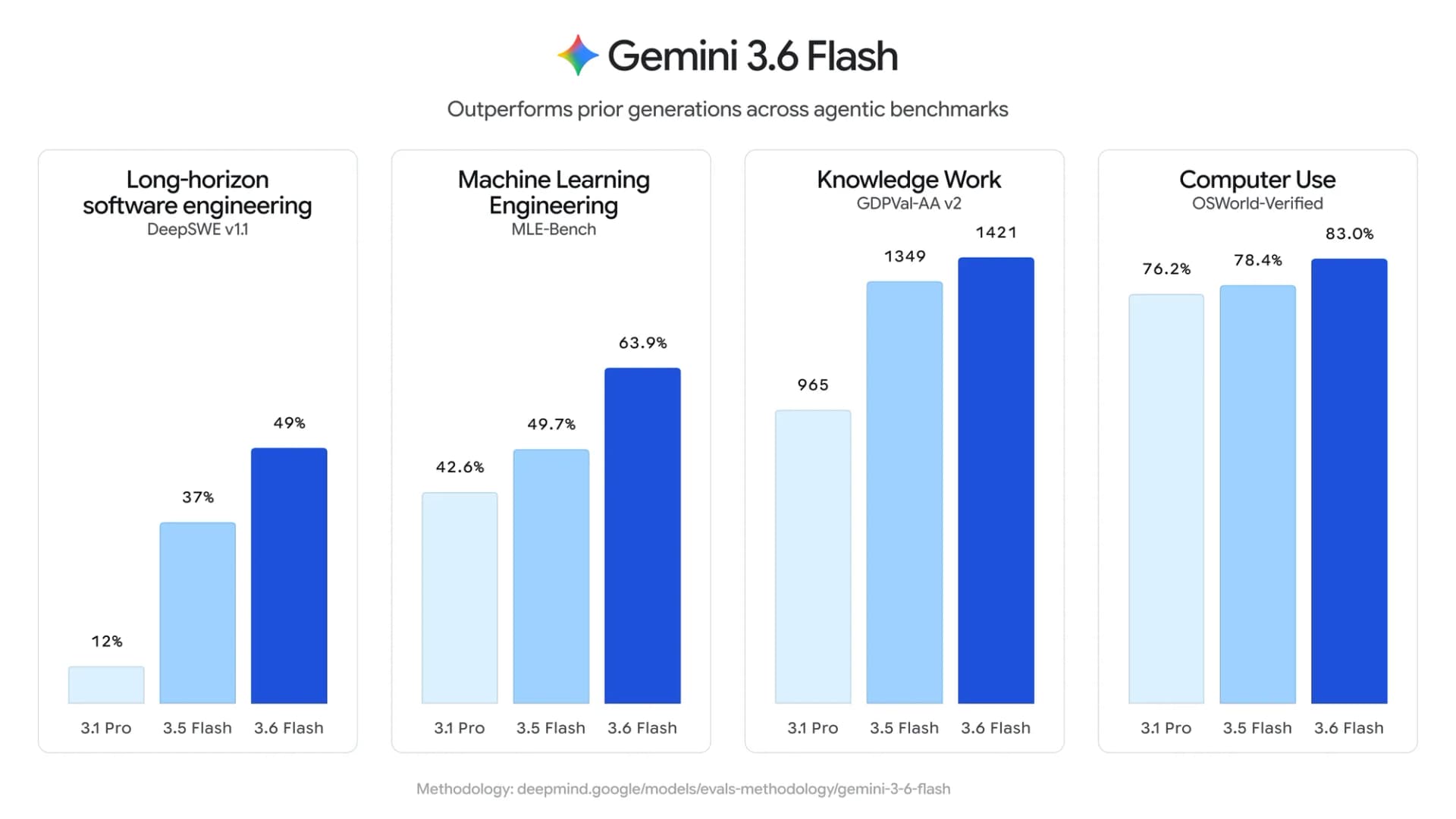
| Benchmark | 3.6 Flash | 3.5 Flash | Configuration and source | What it does not prove |
|---|---|---|---|---|
| DeepSWE v1.1 | 49% | 37% | Public DataCurve leaderboard; highest listed thinking level for each model: high for 3.6, medium for 3.5 | The delta is not a controlled same-reasoning-level model comparison |
| MLE-Bench Partial 30 | 63.9% | 49.7% | Google self-computed Average Position Score, two independent runs per problem; Bash harness, 1M context, H100, internet, up to 256 tool calls | It does not measure ordinary application latency or cost, and it covers the Partial 30 subset |
| GDPval-AA v2 | 1421 | 1349 | Values sourced by Google from the public Artificial Analysis leaderboard | It does not isolate the base model from the leaderboard's harness and scoring choices |
| OSWorld-Verified | 83.0% | 78.4% | Google self-computed; average of five single-attempt runs, 1080p, maximum 100 steps, pyautogui, UI-specific functions | It does not guarantee safe or reliable execution on an unseen desktop workflow |
All Gemini results are pass@1 unless Google notes otherwise. The methodology says smaller benchmarks may be averaged over multiple trials. Non-Gemini numbers in the broader model card are often provider self-reports, which is why this guide does not build a cross-vendor ranking from the launch table.
Token efficiency deserves its own artifact because a shorter answer can be either efficient or incomplete.
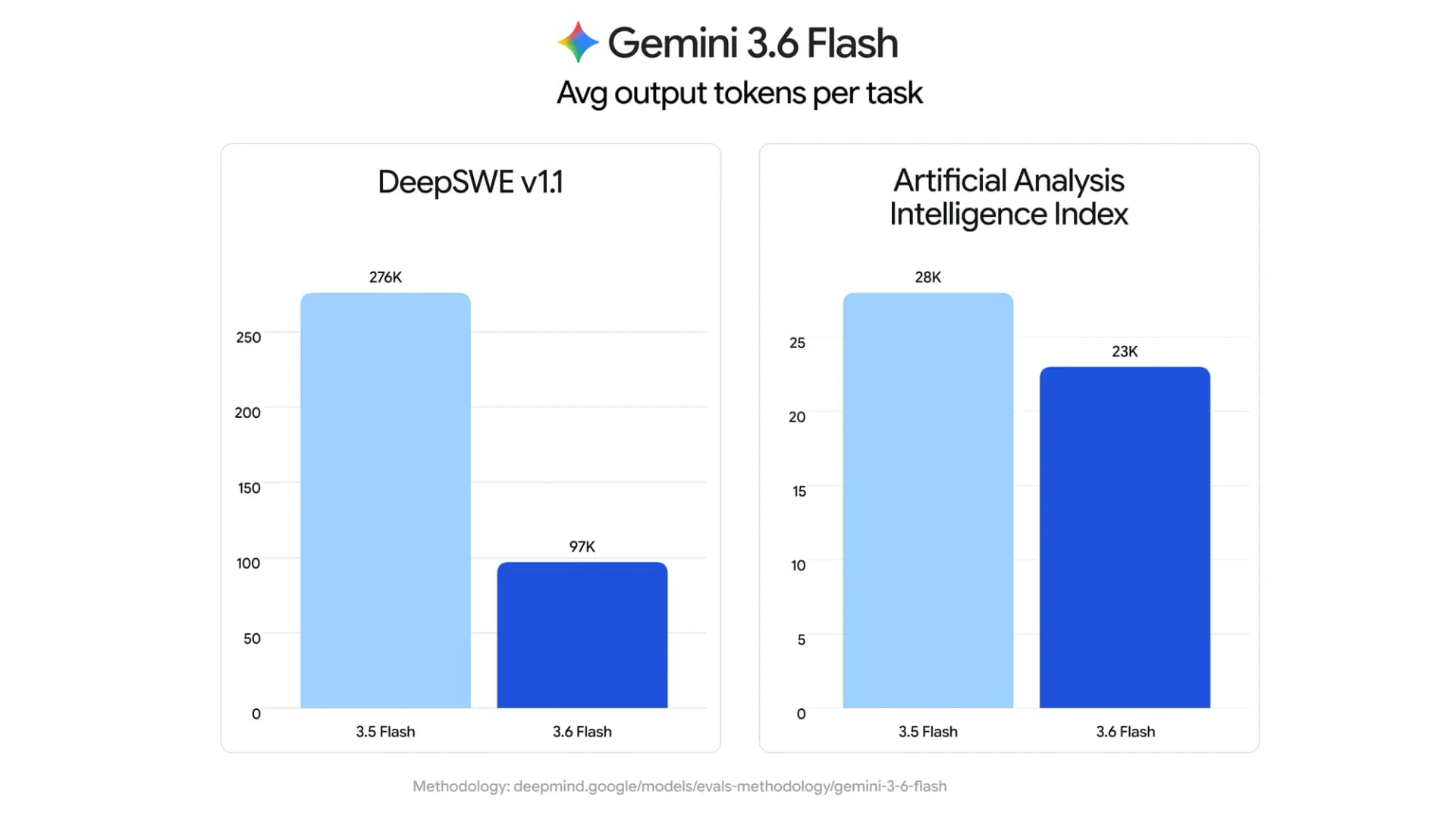
| Workload | 3.6 output tokens | 3.5 output tokens | Reported reduction | Required caveat |
|---|---|---|---|---|
| DeepSWE v1.1 | 97K | 276K | About 65% | 3.6 used high reasoning while 3.5 used medium on the cited leaderboard |
| Artificial Analysis Intelligence Index | 23K | 28K | About 18%; Google summarizes it as 17% | Third-party index measurement cited in Google's launch material |
The right local question is not “Does 3.6 use fewer tokens?” It is “Does 3.6 pass the same acceptance tests with fewer total billed tokens, retries, and tool calls?” The smoke-test plan below measures that outcome.
Where Gemini 3.5 Flash-Lite fits
Flash-Lite is not a cheaper 3.6 setting. It is a separate stable model based on Gemini 3.1 Flash-Lite, with a lower standard price and a default minimal thinking level. Google positions it for low-latency, high-throughput jobs such as document parsing, classification, search, translation, and subagent execution.
Google cites Artificial Analysis at 350 output tokens per second. That is a third-party speed measurement surfaced in the official launch post, not a latency guarantee for your region, prompt length, concurrency, or tool stack.
The launch chart reports the following two Flash-Lite comparisons. Google's methodology says Gemini 3.5 Flash-Lite results use gemini-3.5-flash-lite with high thinking and default sampling unless a row says otherwise.
| Benchmark | 3.5 Flash-Lite | 3.1 Flash-Lite | Configuration note |
|---|---|---|---|
| Terminal-Bench 2.1 | 54.0% | 31.0% | Default Terminus 2 harness; Gemini values are Google self-computed |
| GDPval-AA v2 | 1140 | 642 | Values sourced by Google from the Artificial Analysis public leaderboard |
The price comparison has a tradeoff: 3.5 Flash-Lite's $0.30 input and $2.50 output rates are higher than 3.1 Flash-Lite's $0.25 and $1.50 standard rates. Test whether fewer failures and shorter workflows offset that increase. For simple deterministic extraction, the older model may still win on unit economics; for more capable subagent work, the newer model may need fewer escalations to 3.6.
Start Flash-Lite at minimal for classification and extraction, then raise it to low only when an acceptance test shows a quality gap. Do not copy the launch benchmark's high thinking setting into every high-volume request.
What Gemini 3.5 Flash Cyber is
Gemini 3.5 Flash Cyber is a security-specialized model built on 3.5 Flash and used inside CodeMender. Google says CodeMender can invoke multiple Flash Cyber agents and combine them into one report. On CyberGym, its launch configuration allows up to five Flash Cyber calls per final report, so that result represents a model-plus-agent system rather than one raw model response.
The dedicated Flash Cyber announcement provides one result that can be transcribed without reading values from an unlabeled chart:
| V8 JavaScript Engine evaluation | Unique confirmed issues found | Configuration caveat |
|---|---|---|
| Gemini 3.5 Flash Cyber | 55 | Fixed number of invocations, but Google does not publish that number in the article |
| Gemini 3.5 Flash | 47 | Same first-party evaluation description |
| Claude Opus 4.6 | 36 | Competitor comparison reported by Google |
Google says ten of the Flash Cyber issues were not found by the other two tested models. This remains a first-party, non-public evaluation; it does not establish an independently reproduced vulnerability-discovery rate or safe autonomous patching.
The deployment boundary matters more than the score. Flash Cyber was not released through the public Gemini API. Google plans to offer it soon through CodeMender only to governments and trusted partners in a limited pilot because vulnerability discovery is dual-use. There is no documented public model ID, price, self-service signup, or general release date.
Interactions API quickstart
Google now recommends the generally available Interactions API for new Gemini projects. It supports both launch model IDs and adds optional server-side conversation state, observable execution steps, and background tasks. The older generateContent API remains supported.
The current SDK documentation requires google-genai 2.3.0 or later for Interactions API support:
python -m pip install -U "google-genai>=2.3.0"
export GEMINI_API_KEY="replace-with-a-project-key"
This Python sample is adapted from Google's current Interactions and thinking examples. It was reviewed against the documentation but not executed against a billed endpoint for this article.
from google import genai

client = genai.Client()

task = """
Review this proposed API migration. Return:
1. the three highest-risk regressions,
2. one focused test for each regression,
3. a go/no-go recommendation.

Migration diff:
[paste a small, non-secret diff here]
"""

tests = [
    ("gemini-3.6-flash", "medium"),
    ("gemini-3.5-flash", "medium"),
    ("gemini-3.5-flash-lite", "minimal"),
]

for model, thinking_level in tests:
    interaction = client.interactions.create(
        model=model,
        input=task,
        store=False,
        generation_config={"thinking_level": thinking_level},
    )
    print(f"\n--- {model} / {thinking_level} ---")
    print(interaction.output_text)
store=False avoids retaining the interaction for server-side state, but it also prevents previous_interaction_id continuation and background execution. With the default stored mode, Google documents a 55-day paid-tier retention period and a one-day free-tier period, with shorter paid retention options configurable in AI Studio. Choose the state mode deliberately instead of copying a sample into a sensitive workflow.
For multi-turn agents, remember that previous_interaction_id preserves conversation history, not interaction-scoped parameters. Resend tools, system instructions, and generation configuration on every new interaction where they must apply.
What changes inside Google Antigravity
Google says Gemini 3.6 Flash is available in Antigravity on launch day. That makes it a practical candidate for iterative coding and agent teams, but the announcement does not say it is the universal default, that every account receives identical quotas, or that every existing 3.5 session is automatically upgraded.
A safe Antigravity adoption path is:
- Select 3.6 explicitly in a disposable branch or project.
- Re-run a task that previously caused excessive edits, repeated tool loops, or verbose output.
- Compare accepted diff size, test pass rate, tool-call count, elapsed time, and credits consumed.
- Repeat at
mediumandlowthinking rather than changing both model and reasoning level at once. - Keep the prior model available as a rollback until the same repository-level tests pass.
The Antigravity 2.0 launch guide explains the broader desktop, CLI, SDK, and multi-agent surfaces. For budget behavior that is separate from raw Gemini API pricing, use the Antigravity credits and pricing guide. Those product credits should not be converted into API-token claims without current account-specific documentation.
GitHub Copilot rollout
GitHub announced a gradual Gemini 3.6 Flash rollout on July 21. It covers Copilot Pro, Pro+, Max, Business, and Enterprise across VS Code, Visual Studio, Copilot CLI, the GitHub Copilot cloud agent and app, JetBrains, Xcode, and Eclipse.
“Available” needs three qualifiers here:
- Rollout is gradual, so an eligible account may not see the model immediately.
- Business and Enterprise administrators must enable the Gemini 3.6 Flash Preview policy before organization members can select it.
- GitHub says the model is billed at provider list pricing under usage-based billing; the actual Copilot meter and entitlements belong to GitHub's billing documentation, not the Gemini API table above.
The Gemini API model can be GA while a specific Copilot integration uses a Preview policy. Those labels refer to different layers. Copilot also supplies its own system prompt, tools, context assembly, and agent harness, so a Gemini API benchmark should not be treated as a Copilot task-completion promise.
Migration checklist
Use this checklist for a controlled move from 3.5 Flash to 3.6 Flash:
- Pin
gemini-3.6-flashin a feature flag or environment-specific configuration. - Keep
gemini-3.5-flashas the rollback during evaluation. - Remove deprecated
temperature,top_p, andtop_kcontrols; Google's July 21 release notes mark all three deprecated. - Make
thinking_levelexplicit. Start atmediumfor 3.6 andminimalfor Flash-Lite, then tune from measured failures. - Do not send both the legacy
thinking_budgetandthinking_levelin one request. - Recheck tool schemas, structured-output validation, and multi-turn state. Resend interaction-scoped tools and generation settings after
previous_interaction_id. - Decide whether stored interactions are acceptable; use stateless requests where retention or data classification requires it.
- For Computer Use, run the client-side action handler in a sandbox, preserve confirmation gates, and test prompt-injection stops.
- Recalculate budget from input, cached input, output plus thinking, tool charges, retries, and failed tasks—not token list prices alone.
- Inspect the active model ID in logs. The July 21 release notes document the exact new stable ID but do not document a
gemini-flash-latestalias change, so do not assume the alias has moved.
A smoke test that produces a decision
Run the same frozen corpus against 3.5 Flash, 3.6 Flash, and the relevant Flash-Lite thinking level. A useful first pass needs enough structure to reject an attractive but wrong answer.
| Workload | Minimum corpus | Acceptance checks | Operational metrics |
|---|---|---|---|
| Structured extraction | 50 representative documents with known fields | Schema validity, exact-field F1, citation or page accuracy | Input/output tokens, p50/p95 latency, retries |
| Repository patch | 20 closed issues with hidden tests | Tests passed, accepted diff lines, unrelated edits, reviewer corrections | Tool calls, wall time, tokens, cost per accepted patch |
| Long-context retrieval | 20 documents with planted facts and distractors | Correct fact, source location, abstention on missing evidence | Cache hits, input tokens, timeouts |
| Computer Use | 20 harmless sandbox tasks | Completion, confirmation compliance, prompt-injection stop, recovery | Steps, human interventions, elapsed time |
| High-volume subagent task | 200 classification or routing cases | Precision/recall, invalid outputs, escalation rate to 3.6 | Throughput, cost per accepted item, rate-limit errors |
Pre-register a pass threshold before looking at model names. For example: no regression in hidden-test pass rate, fewer unrelated diff lines, and at least 15% lower cost per accepted task. Keep raw failures, not just averages; one destructive computer-use action outweighs a small mean-score gain.
Then roll out in stages:
- offline corpus;
- shadow traffic with outputs hidden from users;
- small internal cohort;
- capped production percentage with automatic rollback;
- full traffic only after cost, safety, and quality remain within thresholds.
Google's Gemini 3.6 Flash model card lists hallucinations and occasional slowness or timeouts as known limitations. Its reported safety results are Google-run automated evaluations, not independent production assurance. Keep output validation, timeout and retry budgets, source checks, and human confirmation for consequential actions even when local evaluations pass.
Use it or skip it
Use Gemini 3.6 Flash as the first evaluation candidate when 3.5 Flash already fits your application and output verbosity, coding loops, computer-use reliability, or per-task cost are the main constraints. Its stable ID, unchanged context limits, same input price, lower output price, and current tool support make the migration testable without an architectural rewrite.
Use Gemini 3.5 Flash-Lite for large volumes of bounded work where a smaller quality loss is acceptable and escalation is cheap. It is especially plausible for classification, extraction, routing, translation, and subagent fan-out. Verify the Computer Use documentation conflict before assigning it action-taking work.
Keep 3.5 Flash temporarily when you have a validated prompt-and-tool stack and no time to rerun acceptance tests. Stable does not mean behaviorally identical. A rollback model is cheaper than debugging a fleet-wide change without comparison data.
Skip Flash Cyber unless you are admitted to the pilot. There is no public API contract to integrate. Teams outside the limited program should evaluate generally available defensive tools rather than build against an undocumented future endpoint.
For adjacent model-selection context, compare the Gemini 3.1 Pro and Claude Opus workflow guide. For a different Gemini API shape involving generated media rather than text agents, see the Gemini Omni Flash developer guide.
FAQ
What is the Gemini 3.6 Flash API model ID?
The stable Gemini Developer API model ID is gemini-3.6-flash. Google lists a 1,048,576-token input limit, a 65,536-token output limit, multimodal input, text output, and a March 2026 knowledge cutoff.
Is Gemini 3.6 Flash generally available?
Yes. Google released Gemini 3.6 Flash as a stable, generally available Gemini API model on July 21, 2026. GitHub Copilot's separate integration is a gradual rollout and uses a Preview policy for organization-level enablement.
How much does Gemini 3.6 Flash cost?
As of July 21, 2026, standard paid Gemini Developer API pricing is $1.50 per million input tokens and $7.50 per million output tokens, including thinking tokens. Batch and Flex list $0.75 input and $3.75 output. Tool charges can apply separately.
Should I replace Gemini 3.5 Flash with Gemini 3.6 Flash?
Run an evaluation first, but 3.6 is the stronger default candidate for coding, computer-use, and multi-step agent workloads. It keeps the same standard input price and lowers the output price while Google reports better task completion and token efficiency.
Does Gemini 3.5 Flash-Lite support Computer Use?
Google's documentation was inconsistent at the July 21 cutoff. The launch announcement and Computer Use guide listed Flash-Lite support, while the dedicated Flash-Lite model page said Computer Use was not supported. Do not depend on it until a live capability check and current model documentation agree.
Can developers call Gemini 3.5 Flash Cyber through the public API?
No public API model ID or price was documented at launch. Google said Flash Cyber would become available soon only to governments and trusted partners through CodeMender as part of a limited-access pilot.
Where is Gemini 3.6 Flash available in GitHub Copilot?
GitHub announced a gradual rollout to Copilot Pro, Pro+, Max, Business, and Enterprise across VS Code, Visual Studio, Copilot CLI, its cloud agent and app, JetBrains, Xcode, and Eclipse. Business and Enterprise administrators must enable the Gemini 3.6 Flash Preview policy.
Get the latest on AI, LLMs & developer tools
New MCP servers, model updates, and guides like this one — delivered weekly.
Official sources and further reading
Launch, API, and pricing
- Google's Gemini 3.6 Flash, 3.5 Flash-Lite, and Flash Cyber launch
- Gemini 3.6 Flash model specification
- Gemini 3.5 Flash-Lite model specification
- Gemini Developer API pricing
- Gemini API release notes
- Interactions API overview
- Thinking levels and thought handling
- Computer Use implementation and safety guidance
Evaluation and safety
- Gemini 3.6 Flash model card
- Gemini 3.6 Flash evaluation methodology
- Gemini 3.5 Flash-Lite model card
- Gemini 3.5 Flash-Lite evaluation methodology
- Gemini 3.5 Flash Cyber technical launch
Product rollout and official social
Related AgentPedia guides
- Gemini 3.5 Flash developer guide
- Google Antigravity 2.0 launch guide
- Gemini Omni Flash developer guide
Related Guides
How to Change Antigravity Themes
Customize themes, dark mode, icons, and color schemes.
Rules & ConfigurationAntigravity Rules Guide
How to build custom rules with AGENTS.md and GEMINI.md.
MCP & IntegrationMCP Servers Setup Guide
Step-by-step guide to connecting MCP servers in Antigravity.
ComparisonBest Antigravity Alternatives 2026
Claude Code, Cursor, Windsurf, Codex, and Kiro compared.
Pricing & QuotaAntigravity Cockpit Guide
Monitor AI quota, track rate limits, and manage credits.
MCP & IntegrationGoogle Stitch + Antigravity Guide
The complete design-to-code workflow with DESIGN.md and Vibe Design.