
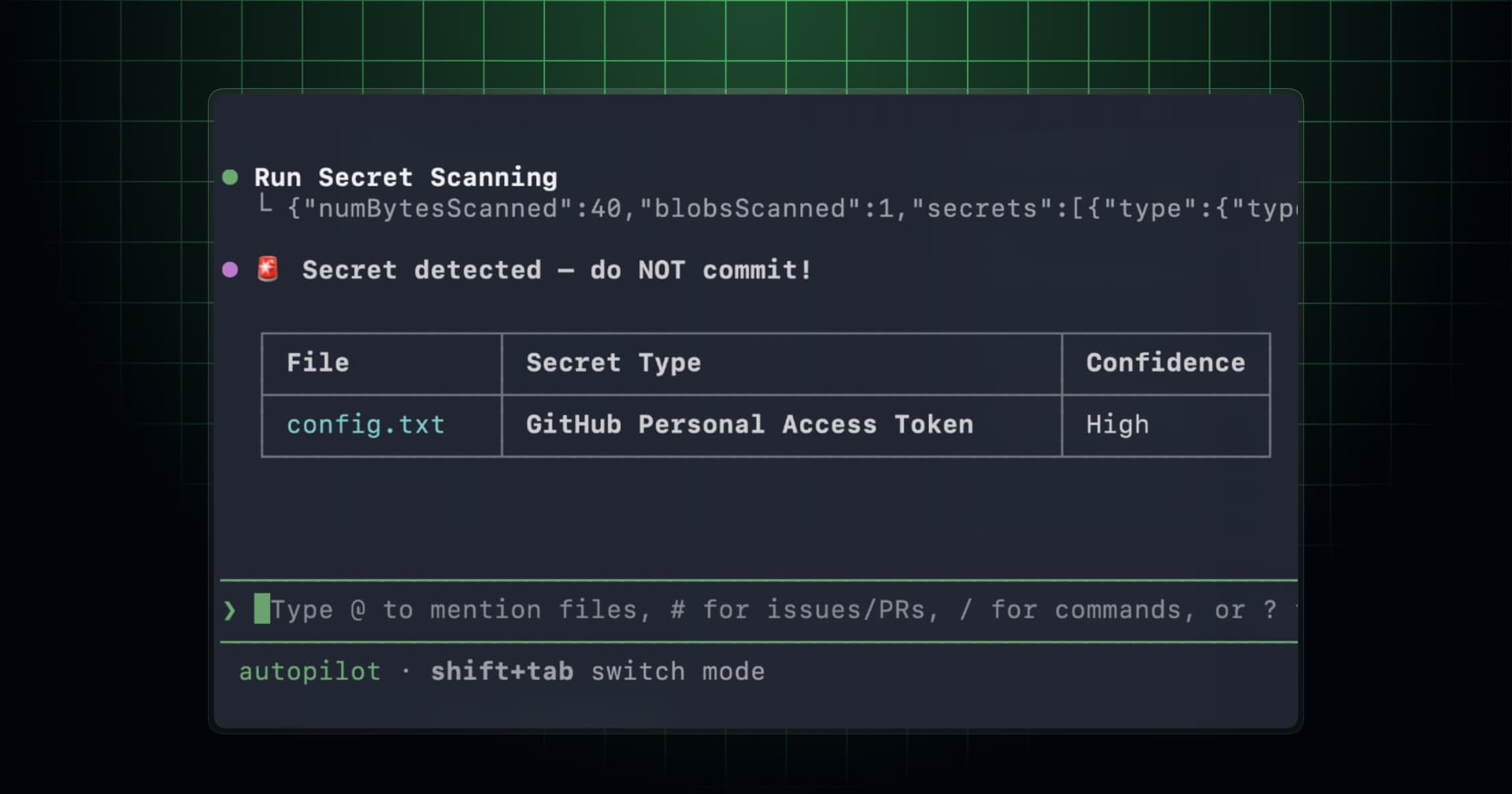
GitHub announced secret scanning in AI coding agents through the GitHub MCP Server as a public-preview capability for repositories with GitHub Secret Protection enabled. GitHub later announced the capability as generally available on May 5, 2026. An MCP-compatible agent can request a scan of current changes and receive structured findings before a commit or pull request. For the broader operational threat model around remote coding agents, see the Termius, Tailscale and tmux guide.
The practical verdict
This is useful when an agent edits files, updates dependencies or generates configuration. It adds a security checkpoint close to the moment a secret can be introduced. It should not replace repository push protection, provider revocation, code review, or a deterministic CI policy.
The safest pattern is layered:
- prevent secrets from entering the agent context;
- scan the working diff before commit;
- block or review pushes with Secret Protection;
- scan CI artifacts and logs;
- revoke any credential that may have been exposed.
How scanning works with agents
The documented flow uses the GitHub MCP Server. The agent is asked to scan current changes, invokes the secret-scanning tool, and receives structured results that identify findings and locations. GitHub gives an example prompt equivalent to “Scan my current changes and show the files and lines to update before I commit.”
That is an interactive agent workflow, not an automatic proof that every generated change is clean. Put the scan in the agent instructions and enforce it again in CI or repository policy.
A useful result should include:
- file and line location;
- detector or secret type when GitHub exposes it;
- whether the finding is new or pre-existing;
- remediation guidance;
- whether the credential must be revoked immediately.
Do not ask the model to print the secret value. The finding should identify enough context to fix the leak without reproducing credentials in the chat, trace or issue.
Use the GitHub MCP Server
The GitHub MCP Server connects MCP-compatible clients to GitHub capabilities. Before enabling secret scanning for an agent:
- pin the MCP server version or trusted revision;
- expose only the tools required for the repository task;
- use a token with the minimum repository scope;
- keep the server configuration outside model-editable files;
- log tool names and outcomes without logging token values;
- test behavior on a disposable repository.
MCP is a transport and tool boundary, not an authorization policy by itself. If the agent can also run shell commands, read environment variables or upload artifacts, it may still expose a secret outside the scan path.
Add push protection
Push protection is the repository-level backstop. When enabled and supported by the organization plan, GitHub can block or warn when a detected secret is pushed. Verify the current Secret Protection and Advanced Security plan requirements before relying on it.
A good control sequence is:
agent edits files
  -> scan current diff
  -> human or policy reviews findings
  -> tests and static checks
  -> push protection evaluates the push
  -> CI scans artifacts and logs
If a developer bypasses a warning, record the reason and require immediate credential review. A bypass should never be treated as evidence that the finding was harmless.
Understand the limits
Secret scanning does not solve every credential problem:
- a novel or transformed secret may evade a detector;
- credentials can leak through prompts, logs, screenshots, traces or tool results;
- a secret can be used before the repository push occurs;
- a model may ignore or misread a finding;
- generated binaries and external systems need separate controls;
- scanning cannot decide whether a token is still active;
- a clean result does not prove that no sensitive value crossed a boundary.
If a credential may have entered an agent context, revoke or rotate it even when the scan reports no repository finding.
Build a pre-commit workflow
Give the agent a short, explicit policy:
Before proposing a commit:
1. Scan only the current diff for secrets.
2. Never print secret values.
3. Report file, line and detector metadata only.
4. Stop if a new finding is detected.
5. Do not push or open a PR until the finding is fixed or explicitly reviewed.
Then enforce the same outcome outside the model:
- require a clean scan status in CI;
- protect the default branch;
- restrict who can bypass push protection;
- scan generated artifacts and test logs;
- redact secrets in workflow output;
- configure provider-side revocation playbooks.
Test with fake credentials that are safe to invalidate. Include secrets in source, comments, JSON, YAML, environment files, generated patches and test output. Also test a prompt-injection file that instructs the agent to ignore scanning.
Security checklist
- [ ] Secret Protection and push protection status is verified.
- [ ] Agent token scope is minimal.
- [ ] MCP tools are pinned and reviewed.
- [ ] Shell and environment access are restricted.
- [ ] Secret values are never printed to agent output.
- [ ] Current diffs are scanned before commit.
- [ ] CI scans artifacts and logs.
- [ ] Default branch and environments are protected.
- [ ] Bypasses require a named reviewer.
- [ ] Revocation and rotation procedures are tested.
Secret scanning is most valuable when it is boring and repeated. Let the agent request the check, but let repository policy and credential owners decide whether a change can move forward.
FAQ
The concise answers are in metadata; the layered workflow and limits above are the implementation guidance.
Official sources
- GitHub secret scanning for AI coding agents
- GitHub MCP Server
- GitHub Secret Protection
- Push protection
- GitHub Advanced Security
Related Guides
How to Change Antigravity Themes
Customize themes, dark mode, icons, and color schemes.
Rules & ConfigurationAntigravity Rules Guide
How to build custom rules with AGENTS.md and GEMINI.md.
MCP & IntegrationMCP Servers Setup Guide
Step-by-step guide to connecting MCP servers in Antigravity.
ComparisonBest Antigravity Alternatives 2026
Claude Code, Cursor, Windsurf, Codex, and Kiro compared.
Pricing & QuotaAntigravity Cockpit Guide
Monitor AI quota, track rate limits, and manage credits.
MCP & IntegrationGoogle Stitch + Antigravity Guide
The complete design-to-code workflow with DESIGN.md and Vibe Design.