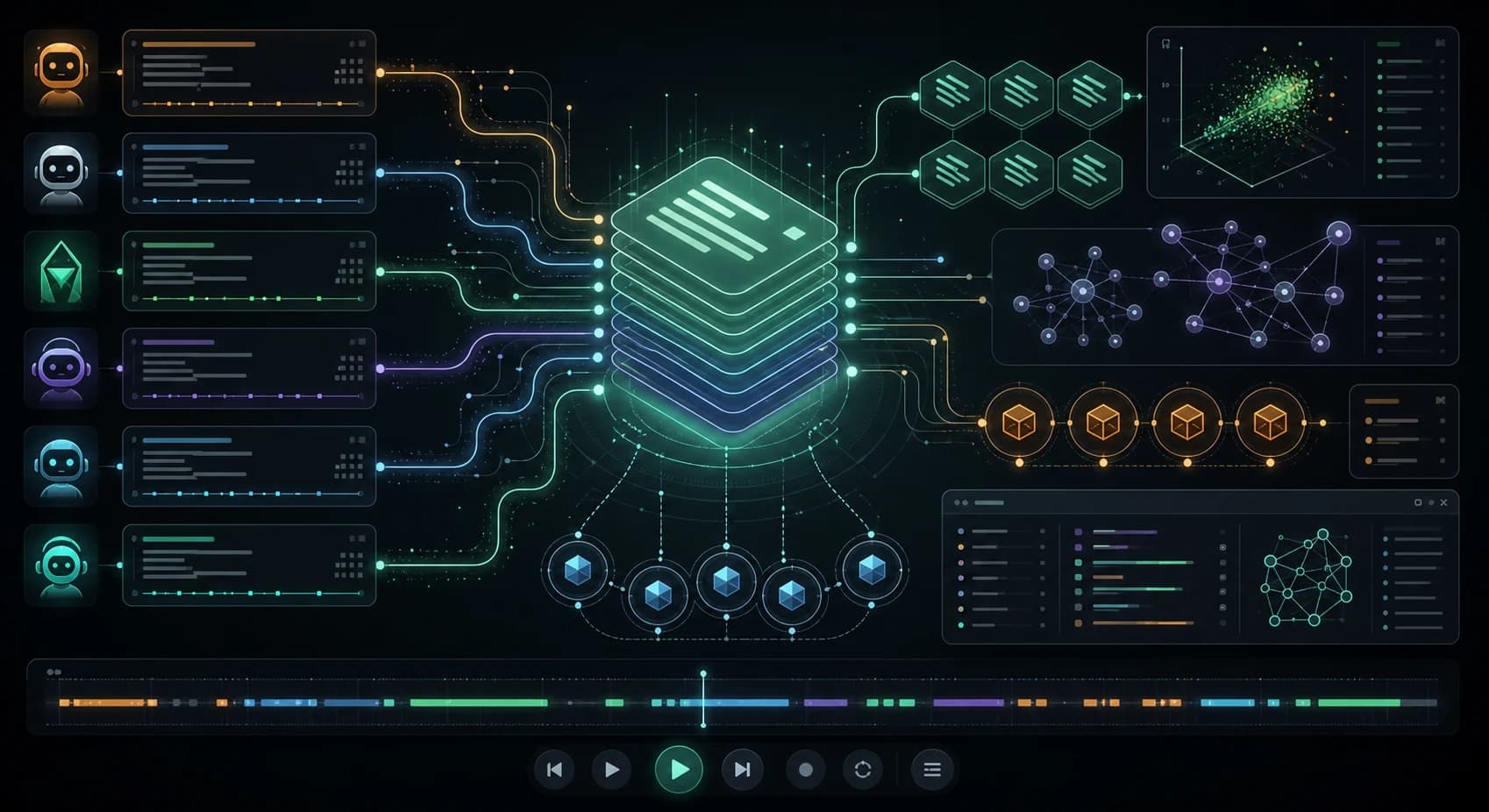
The useful framing is not `vector database for agents`. Agentmemory is closer to a local black box recorder plus search engine plus context injector. It records what agents did, turns that into searchable memory, and tries to prevent every new session from rediscovering the same project facts.
Get the latest on AI, LLMs & developer tools
New MCP servers, model updates, and guides like this one — delivered weekly.
Editorial note
This article uses the README, npm package, release/changelog, benchmark docs, source files, current issues/PRs, X posts, and Reddit criticism gathered on June 2, 2026. Benchmark numbers are first-party retrieval benchmarks, not independent full-task QA results.
1. agentmemory in One Sentence
Agentmemory is an Apache-2.0 local memory server for AI coding agents that captures observations, indexes them with BM25/vector/graph search, and exposes memory through MCP, REST, hooks, and a web viewer.
| Area | Detail | Why it matters |
|---|---|---|
| Repository | rohitg00/agentmemory | https://github.com/rohitg00/agentmemory |
| Primary language | TypeScript | Primary GitHub language at research time. |
| License | Apache-2.0 | Check bundled or binary licenses separately where relevant. |
| Created | February 25, 2026 | Latest release checked: v0.9.24, published May 29, 2026. |
2. Why It Matters
AI coding agents forget session context by default. They relearn architecture, bug history, user preferences, tool behavior, and prior decisions every time the context window resets.
Static files such as `CLAUDE.md`, `AGENTS.md`, and `.cursorrules` help, but they are manual, limited, and easy to let go stale. Agentmemory tries to make memory automatic: observe the session, compress the important parts, and retrieve only relevant context later.
The hard problem is not storage. It is lifecycle: stale memories, contradictory facts, retrieval precision, token budget, project identity, privacy, and whether the agent actually uses the injected evidence.
3. Architecture and Mental Model
Agentmemory runs as a local iii-engine worker with REST, MCP, state, queues, streams, viewer, and observability. Agents write observations; the worker stores raw and compressed observations, indexes search, builds context, and serves memory back.
| Area | Detail | Why it matters |
|---|---|---|
| Runtime | iii engine | Provides HTTP triggers, state, queues, streams, cron, and observability. |
| Capture | Hooks, MCP, REST | Records tool use, prompts, file changes, sessions, and explicit memories. |
| Storage | KV scopes and local state | Stores sessions, observations, memories, summaries, graph nodes, and indexes. |
| Search | BM25, vector, graph, RRF | Fuses lexical, semantic, and graph signals. |
| Context | `/agentmemory/context` and MCP tools | Returns bounded context blocks to agents. |
| Viewer | localhost web UI | Shows sessions, memories, graph, replay, and live events. |
4. Smallest End-to-End Setup
The commands below are copied from the repository documentation and checked against the current research snapshot. Treat them as a starting point, then read the linked README before installing into a production environment.
npm install -g @agentmemory/agentmemory
agentmemory
agentmemory demo
agentmemory connect claude-code
npx skills add rohitg00/agentmemory -y

# No-install path
npx -y @agentmemory/agentmemory@latest
A small first task should prove the integration before you attach it to critical data or large workspaces.
# Terminal 1: start local memory server
npx -y @agentmemory/agentmemory@latest

# Terminal 2: seed sample sessions and prove recall
npx -y @agentmemory/agentmemory@latest demo

# Browser viewer
open http://localhost:3113
5. Technical Deep Dive
5.1 Observations are the raw material
Agentmemory captures session events: prompts, tool calls, tool results, files, project paths, errors, and responses. The `observe` path sanitizes, deduplicates, stores raw observations, and streams live updates to the viewer.
This is the black-box-recorder layer. Even if higher-level summarization is disabled, the local server can still record structured evidence about what happened.
5.2 Compression can be synthetic or LLM-backed
The current README/source say the default LLM provider is no-op unless a provider key is configured or the Claude subscription fallback is explicitly enabled. That means basic capture can work without an API key, but richer LLM-backed compression and summarization need configuration.
This distinction matters because setup confusion appears in community threads. Users should not assume every feature is free just because the server starts locally.
5.3 Hybrid search fuses different retrieval signals
The search layer combines BM25 keyword matching, vector similarity, and graph/context signals with reciprocal-rank fusion. The goal is to retrieve the memory that matters under a token budget, not to dump everything into every prompt.
BM25 catches exact names and error messages. Vector search catches semantic similarity. Graph search can connect project entities. RRF keeps one retrieval mode from dominating every query.
Query: "database performance optimization"
  -> BM25 finds N+1 and query terms
  -> vector search finds semantic session summaries
  -> graph search adds linked files/concepts
  -> RRF merges ranked lists
  -> context builder trims to budget
5.4 Context injection is bounded by design
The context function builds bounded `<agentmemory-context>` blocks from slots, project profile, lessons, summaries, and important observations. This is a critical design point: persistent memory is useful only if it does not consume the whole prompt.
The open research question is reader behavior. Even when retrieval finds the right evidence, the agent may ignore it, bury it, or answer from stale assumptions. Some current issues propose metrics for this exact failure mode.
5.5 The viewer is part debugger, part product
The web viewer shows sessions, replay, memory graph, live events, and status. For a memory system, this is not decorative. If users cannot inspect what the agent remembered, they cannot trust the memory layer.
Current large-graph issues show why viewer scale matters. A graph tab that works on demos but fails on a large corpus can make users think memory is broken even when storage exists.
6. Real-World Wrong vs Right Patterns
| Wrong | Right | Reason |
|---|---|---|
| Assume no API key is needed for every feature. | Separate local capture from LLM-backed summarization and consolidation. | No-op provider is default unless configured otherwise. |
| Treat memory as a permanent truth database. | Plan for decay, contradiction handling, deletion, and source inspection. | Old procedural memories can become wrong. |
| Run many local instances on default ports. | Override ports or share one server intentionally. | Default ports 3111/3113 can collide. |
| Trust benchmark recall as full-task accuracy. | Measure whether your agent uses retrieved memory correctly. | Retrieval and reader behavior are different failure modes. |
7. Common Mistakes and Current Issues
The issue tracker matters because these are young, fast-moving repos. The article uses issues as risk signals, not as proof that a project is unusable.
| Area | Detail | Why it matters |
|---|---|---|
| Agent SDK fallback | Issue #781 reports a recursion guard race with concurrent summarization chunks. | Use real provider keys or lower concurrency until fixes land. |
| Summary parsing | Issue #783 reports XML parser failures on markdown fences and extra text. | LLM structured output needs robust parsing/retry. |
| Fallback providers | Issue #778 says fallback providers inherit the primary model name. | Cross-provider failover can 404 if model namespaces differ. |
| Import JSONL | Issue #775/PRs track existing-session key problems. | Bulk import paths need validation on real transcript trees. |
| Large graph viewer | Issue #753 reports blank graph tab on large corpora. | Viewer scale is still a live concern. |
8. Performance, Scaling, and Cost Notes
First-party benchmarks report LongMemEval-S retrieval results around high R@5/R@10 with local embeddings, and a small coding-agent-life corpus with 100% top-5 hit rate and low p50 latency. Those are retrieval benchmarks, not end-to-end coding task success rates.
The cost story depends heavily on configuration. Local embeddings are cheap. Synthetic compression is cheap. LLM-backed compression, summarization, graph extraction, and consolidation add token spend in the background.
Scaling pressure appears in search snapshot persistence, large graph endpoints, viewer rendering, and session import. For small and medium personal projects, this may be fine. For months of multi-agent history, test with your real corpus before relying on it.
9. Who It Is For
| Use it if | Skip it if |
|---|---|
| You run coding agents daily and repeat project explanations often. | Your sessions are short and disposable. |
| You want one local memory layer shared across Claude Code, Codex, Cursor, Gemini, and MCP clients. | You only use a single tool with sufficient built-in memory. |
| You can inspect and prune memory when it gets stale. | You need a zero-maintenance truth store. |
| You accept a young, fast-moving TypeScript/iii stack. | You need proven large-corpus reliability today. |
10. Community Signal
X/Twitter mostly frames agentmemory as a fast-growing missing memory layer for coding agents. That is a useful adoption signal, but many posts are short amplification rather than deep evaluation.
Reddit criticism is more useful: users ask how the system handles contradictions, stale procedural memory, storage growth, benchmark design, token overhead, and whether memory remains reliable after months of sessions.
The current GitHub issue tracker is active and technical. Several issues include root-cause-level analysis and PRs, which is a good maintenance signal but also a reminder that the system is still maturing.
11. The Verdict: Is It Worth Using?
Our Take
Use agentmemory if your coding agents keep rediscovering the same project facts and you want a local, inspectable, cross-agent memory layer. Skip or sandbox it if you need proven long-term memory governance, large-graph scale, and zero-configuration summarization today.
12. The Bigger Picture
Agentmemory sits between static instruction files and full agent runtimes. It does not replace `AGENTS.md`; it complements it by remembering what happened after the file was written.
The bigger movement is toward externalized agent state. Agents need tools, memory, project graphs, eval traces, and replayable histories that survive a single context window. The next hard part is not remembering everything. It is remembering the right thing, forgetting stale things, and proving why a memory was injected.
13. Frequently Asked Questions
Q: Does agentmemory work without an API key?
Basic local capture and synthetic memory behavior can work without a provider key. LLM-backed summarization, compression, and consolidation need an explicit provider or opted-in agent-sdk fallback.
Q: Where does it store data?
It runs locally and stores sessions, observations, memories, summaries, and indexes through iii-engine state/KV scopes under the local runtime.
Q: How is it different from `CLAUDE.md`?
`CLAUDE.md` is a static instruction file. Agentmemory records session events and retrieves relevant prior context dynamically.
Q: What do BM25, vector, and graph search each add?
BM25 catches exact terms, vector search catches semantic similarity, and graph search adds relationship context. RRF merges the ranked results.
Q: Which agents does it support?
The README lists Claude Code, Codex CLI, Cursor, Gemini CLI, GitHub Copilot CLI, Hermes, OpenClaw, OpenCode, and generic MCP clients.
Q: What breaks at large scale?
Open issues mention large graph endpoints, index persistence, viewer behavior, and import paths. Test on your real history before assuming large-corpus readiness.
Q: How do I reduce token cost?
Use local embeddings, keep LLM-backed compression off unless needed, choose cheaper summarization models, and keep injected context bounded.
14. Glossary
| Area | Detail | Why it matters |
|---|---|---|
| MCP | Model Context Protocol | How many agents call external tools. |
| BM25 | Lexical keyword ranking. | Good for exact identifiers and errors. |
| Vector search | Semantic similarity over embeddings. | Good for meaning-based lookup. |
| RRF | Reciprocal-rank fusion. | Combines multiple ranked lists. |
| Observation | Captured agent event. | Raw material for memory. |
| Compression | Converting raw events into structured memory. | May be synthetic or LLM-backed. |
| Consolidation | Turning sessions into higher-level memory. | Requires enough data and often an LLM. |
15. All Sources and Links
Primary Sources
Issues and PRs
Community and Web
Internal Links
16. Source Attribution Table
| Area | Detail | Why it matters |
|---|---|---|
| README and npm | Install, supported agents, ports, benchmark claims, config shape. | Primary source. |
| Source files | Observe, search, context, summarize, MCP, API architecture. | Primary source. |
| Benchmarks | Retrieval R@5/R@10 and coding-agent-life claims. | First-party benchmark source. |
| Issues/PRs | Parser, concurrency, fallback, import, graph-scale caveats. | Critical signal. |
| Community discussion | Adoption hype plus stale-memory and governance questions. | Secondary signal. |
Get the Ultimate Antigravity Cheat Sheet
Join 5,000+ developers and get our exclusive PDF guide to mastering Gemini 3 shortcuts and agent workflows.
Related Guides
Humanizer Skill Guide
blader/humanizer: 29 AI-writing patterns, voice calibration, and a two-pass audit, all in one Claude Code skill.
Guides & FeaturesMastering Agent Skills
The open standard for portable AI agent expertise.
Guides & FeaturesAntigravity Workflows Guide
Create automation recipes with Turbo Mode and AgentKit 2.0.
Guides & FeaturesHow to Change Antigravity Themes
Customize themes, dark mode, icons, and color schemes.
Guides & FeaturesHow to Change Language
Switch Antigravity to Spanish, German, Japanese, and more.
Guides & FeaturesAntigravity Security Guide
Known vulnerabilities, safe settings, and hardening steps.