Get the latest on AI, LLMs & developer tools
New MCP servers, model updates, and guides like this one — delivered weekly.
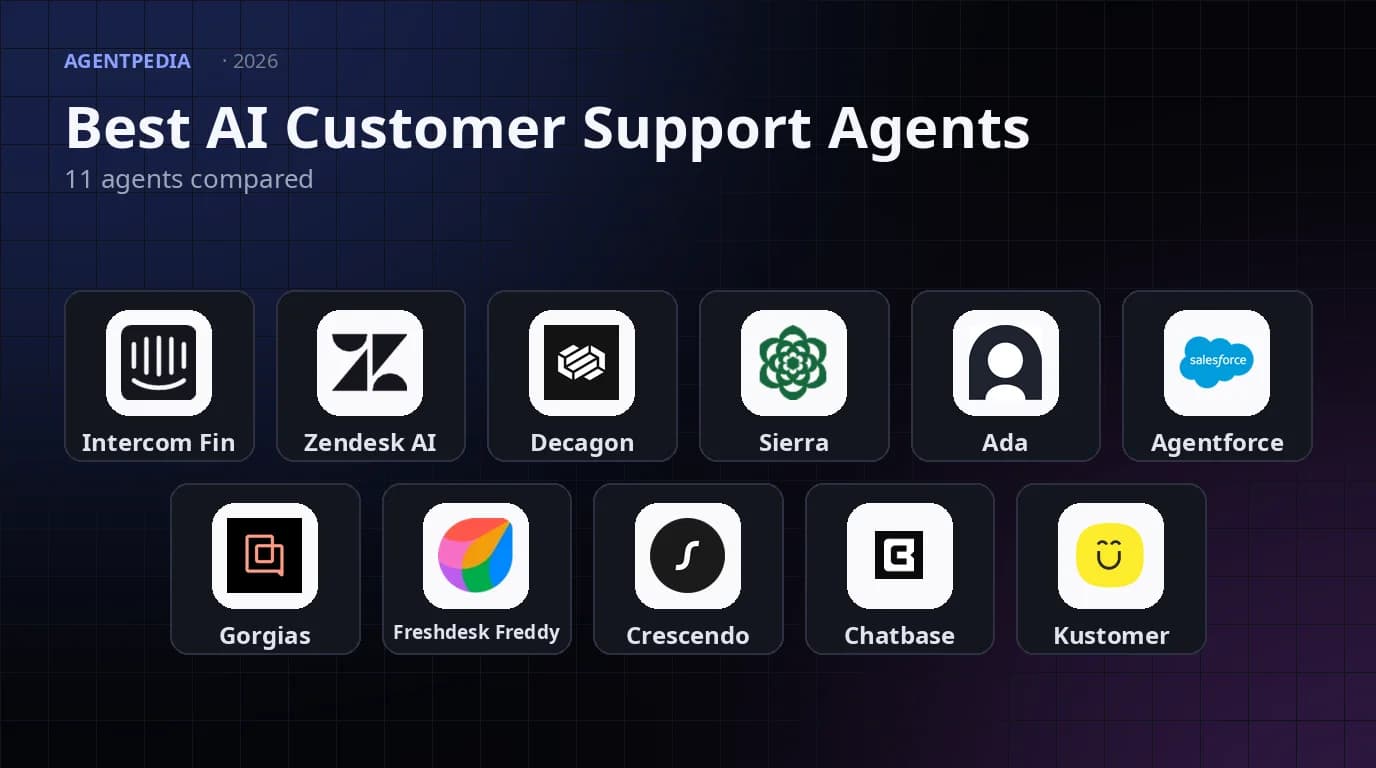
If you want a published per-resolution price and a pilot on top of your existing helpdesk, start with Intercom Fin at $0.99 per outcome. If you live inside Zendesk, Salesforce, Freshdesk or Gorgias, the native agent is the lowest-friction choice. If you need a negotiated enterprise deployment, Decagon and Sierra are the sales-led options. If you have a small team and a fixed budget, Chatbase is the self-serve route.
The hard part of buying an AI support agent is not the demo. Every vendor shows a smooth conversation. The hard part is that pricing models differ (per resolution, per session, per action, per seat), resolution rates are vendor-reported and defined differently, and several vendors publish no price at all. This guide lines them up on the same axes so you can compare cost per resolved ticket rather than a headline. All prices are as of Nov 11, 2026 and were read from vendor pages.
Official overview video from Fin (formerly Intercom), the vendor with the clearest per-outcome price.
Quick Picks
| If you need | Pick |
|---|---|
| Best published per-resolution price | Intercom Fin ($0.99 per outcome) |
| Best if you already run Zendesk | Zendesk AI agents (note $1.50 to $2.00 per resolution on top of seats) |
| Best if you already run Salesforce | Agentforce Service (Flex Credits), with Fin now also part of Salesforce |
| Best for Shopify merchants | Gorgias AI Agent |
| Best low-cost pilot on Freshdesk | Freshdesk Freddy AI (500 free sessions) |
| Best self-serve and fixed budget | Chatbase ($32 to $400 per month) |
| Best for complex enterprise workflows | Decagon or Sierra (both sales-led) |
| Best for replacing the whole stack | Crescendo |
Master Comparison Table
Each cell below comes from the vendor pages listed in Sources, read on Nov 11, 2026. Resolution numbers are vendor-reported and are not comparable with one another, which the section on resolution claims explains. None of these products is open source.
| Platform | Pricing model (as of Nov 11, 2026) | Channels | Resolution claim | Setup effort |
|---|---|---|---|---|
| Intercom Fin | $0.99 per outcome; seats optional ($19 to $132) | Chat, email, voice, Slack, social | 76% avg (vendor-reported) | Under 1 hour (vendor claim) |
| Zendesk AI agents | Seat + $1.50 committed / $2.00 PAYG per resolution | Messaging, email, voice, social | 50% to 80% per customer | No complex setup (vendor claim), 14-day trial |
| Decagon | Contact sales (per conversation or per resolution) | Chat, email, voice (SMS reported) | 70% in customer stories | Sales-led, AOPs in natural language |
| Sierra | Outcome-based, contact sales | Chat, SMS, WhatsApp, email, voice, ChatGPT | None published | Sales-led |
| Ada | Contact sales | Messaging, voice, email | 84% headline, undefined | Sales-led |
| Agentforce Service | $500 per 100k Flex Credits ($0.10 per standard action) | Chat, email, voice (credit-priced) | 63% to 85% depending on source | Salesforce implementation |
| Gorgias AI Agent | $0.90 annual / $1.00 monthly per automated interaction | Email, chat, SMS, social | No first-party figure | Shopify connect, no timeline published |
| Freshdesk Freddy | $49 per 100 sessions (~$0.49); 500 free once | Email (others mentioned) | 82% FCR for one customer | Minutes (vendor claim) |
| Crescendo | Contact sales | Voice, chat, email, text | 70% day one, undefined | Platform replacement |
| Chatbase | $32 / $120 / $400 per month (yearly billing) | Web, voice, email, WhatsApp, Slack | Per-customer only | Minutes (vendor claim) |
| Kustomer | Contact sales | Chat, email, text, voice, Slack, forms | 70% of chat automated (vendor) | May need SOW |

Per Resolution vs Seat Pricing
Five pricing models appear in this market. They distribute risk differently, so pick the one whose fine print you can live with.
| Model | Who uses it | What to watch |
|---|---|---|
| Per resolution or outcome | Fin, Zendesk, Gorgias, Sierra (outcome-based) | You pay for results; cost tracks success; the definition of a resolution is the fine print. |
| Per session or conversation | Freddy, Decagon (one option) | Cheaper per unit, but you pay even when the issue is not resolved. |
| Per action / credit | Agentforce Service | Cost tracks work done, so a complex case costs more even if it resolves. |
| Seat or flat subscription | Chatbase, helpdesk seats at Zendesk, Gorgias, Freshdesk | Predictable budget; poor fit if volume swings. |
| Contact sales | Decagon, Sierra, Ada, Crescendo, Kustomer | Negotiated, often with platform fees; ask for a per-resolution quote. |
Two notes on the fine print. First, Fin counts an outcome when the customer confirms resolution, when they stop asking after Fin responds, or when Fin completes a workflow including handoffs, while Zendesk counts a resolution only when the AI agent resolves without escalating. Those are different bars. Second, Gorgias bills each automated interaction and also counts it as a helpdesk ticket, so automation volume raises both lines of your bill.
Sierra's co-founder discussing outcome-based pricing for agents (interview published by Stripe).
1. Intercom Fin
Fin is the AI agent from the company that used to be called Intercom. The company rebranded to Fin in 2026, and on June 15, 2026 Salesforce signed a definitive agreement to acquire it for about $3.6 billion. Salesforce announced on September 10, 2026 that the acquisition was complete, with Fin sitting inside Salesforce AI Labs and continuing to serve existing customers. Fin's own site still describes the product as working with other helpdesks, and names Salesforce, Zendesk, HubSpot and Freshdesk alongside its own Intercom helpdesk.
The commercial model is the clearest in the category. Fin charges per outcome, and the pricing page defines an outcome as a conversation where the customer confirms the issue is resolved, where the customer stops asking for help after Fin responds, or where Fin completes a workflow, including handoffs. Each conversation is charged once. That definition matters: a handoff that Fin completes can count, so read your contract for how escalations are treated before you forecast spend.
Fin's site lists voice, chat, email, Slack and social as channels, and the Salesforce press release names chat, email, WhatsApp, SMS, phone and Slack. The vendor says it can go live with any helpdesk in less than one hour. Treat that as a best case for a clean knowledge base, since the time that actually matters is spent writing procedures and testing edge cases.
Pricing: $0.99 per outcome, no seat costs, with a minimum monthly commitment (the pricing FAQ uses 50 outcomes as an example) and no setup, integration or platform fees, as of Nov 11, 2026. If you also want the Intercom helpdesk, seats are $19 (Essential, struck-through $29), $85 (Advanced, 20 free Lite seats) or $132 (Expert, 50 free Lite seats) per seat per month, and the Copilot add-on is $29 per agent per month.
Strengths
- Simple, published per-outcome price with no platform fee.
- Works on top of other helpdesks, so you can adopt it without migrating off Zendesk or Salesforce.
- Largest stated production footprint: 76% average resolution across 12,000+ customers and 2 million resolutions per week (vendor-reported).
Weaknesses
- The acquisition by Salesforce adds roadmap uncertainty for customers on competing CRMs, although the vendor says it keeps serving existing customers.
- The outcome definition includes customers who simply stop asking, which can flatter the count.
- Phone is usage-based and not priced on the page.
Best for: Teams that want a published per-resolution price and a fast pilot on top of an existing helpdesk.
2. Zendesk AI Agents
Zendesk sells its AI agents as an add-on to the seat-based helpdesk it already runs for most support teams. Billing is per automated resolution, and the pricing page says a resolution only counts when the AI agent resolves the request without escalating to a human. Each plan includes a small allowance of resolutions per agent per month, after which you buy committed volume or pay as you go.
The AI agent product page says agents act through APIs, MCP and authorized integrations, so they can read and update records in Zendesk, CRMs and order management systems. The FAQ lists social, web, mobile, voice and email, and the pricing page states 80+ languages. One detail from the FAQ is worth knowing: standalone AI agents, meaning agents deployed outside the Zendesk helpdesk, are currently available through Forethought by Zendesk.
Zendesk also warns that voice needs Zendesk Voice and that messaging on the Support Team plan needs the messaging add-on. QA for AI agents is a separate add-on on all three plans. Those line items change the real bill more than the headline seat price does.
Pricing: Seats per agent per month: Support Team $19 annual ($25 monthly), Suite Team $55 ($69), Suite Professional $115 ($149), Suite Enterprise plus Copilot via sales, as of Nov 11, 2026. Automated resolutions: 5 included per agent per month on Support Team and Suite Team, 10 on Suite Professional; then $1.50 each committed or $2.00 each pay as you go.
Strengths
- Native to the helpdesk most teams already use, so tickets, macros and reporting stay in one place.
- Public per-resolution rates on the pricing page.
- Broad language coverage (80+) and a 14-day free trial.
Weaknesses
- Highest published per-resolution rate in this list ($1.50 to $2.00) on top of seat costs.
- Voice, messaging and QA each carry add-on requirements.
- Customer-reported resolution numbers on the product page range from 50%+ to 80% with no single platform-wide figure.
Best for: Zendesk shops that want AI resolution without changing helpdesk, and can absorb seat plus resolution costs.
3. Decagon
Decagon builds enterprise concierge agents. Its product overview describes voice, chat and email on one shared intelligence layer, and reports from search results quoting the product page add SMS and custom surfaces through an API. Agent logic is written as Agent Operating Procedures (AOPs) in natural language, with an assistant called Duet that suggests best practices while you write them. Non-technical teams can edit procedures, while technical teams keep control of guardrails, integrations and versioning.
Integrations are described generically: ticketing platforms, CRMs, knowledge bases, CCaaS providers and custom tools, with a separate integrations page for pre-built connectors. Decagon's own writing on pricing describes two models, a per-conversation rate and a higher per-resolution rate, with no charge for escalations, and says larger commitments lower the rate. It does not publish dollar figures.
Third-party reviews put the per-conversation rate near $0.99 and a negotiated per-resolution rate near $0.50, and cite an annual platform fee of about $50,000 and median contracts above $400,000. Those numbers come from competitors and resellers, conflict with each other, and are not verified. Use them only to sanity-check a quote.
Pricing: Contact sales. Decagon does not publish prices. Per-conversation and per-resolution models are described, with figures reported only by third parties (unverified).
Strengths
- AOPs give non-engineers a way to author and revise complex workflows in natural language.
- Voice, chat and email share one agent logic layer.
- Customer-story figures of 70% resolution on chat and voice are listed on the vendor's site (vendor-reported, per-customer).
Weaknesses
- No public pricing and, by most accounts, enterprise-sized contracts.
- Headline numbers on different pages mix resolution, deflection and cost reduction, which are different metrics.
Best for: Large support organizations with complex, policy-heavy workflows and budget for a sales-led deal.
4. Sierra
Sierra sells agents for large consumer brands. Its homepage lists a single agent deployable across chat, SMS, WhatsApp, email, voice and ChatGPT, and shows about 30 customer logos including Rocket Mortgage, Gap Inc., SiriusXM, Wayfair and Discord. Sierra's founder Bret Taylor has discussed outcome-based pricing publicly (see the video in the pricing section below).
The homepage states that pricing is outcome-based and shows no dollar amounts. It also makes no resolution-rate claim: the only number on the page is an illustrative dashboard image, which Sierra does not present as a verified result. That restraint is honest, but it leaves you to extract the numbers in a sales cycle.
Pricing: Outcome-based, contact sales. No public figures as of Nov 11, 2026.
Strengths
- Widest channel list on a vendor page, including SMS, WhatsApp and ChatGPT.
- Strong enterprise logo set across financial services, retail, healthcare and telecom.
- Outcome-based pricing aligns vendor revenue with delivered results.
Weaknesses
- No public price, no public resolution-rate claim and little integration detail beyond cloud and data-platform logos.
- Not a self-serve product; expect a long evaluation.
Best for: Enterprise consumer brands that want a vendor to own agent quality end to end.
5. Ada
Ada's homepage lists Messaging, Voice and Email as its channels. The site claims 350+ global businesses in 85+ countries, with named customers including Pinterest, monday.com, Sky, Grab and Barnes & Noble.
Ada does not publish pricing or its pricing model. The pricing page says the team builds a business case and ROI model from your volume during the demo. The headline claim is an 84% automated resolution rate with no stated methodology or period. Customer-specific figures are more informative: Dott moved from 32% to 77%, Betsson reports 45% of interactions resolved, and Cebu Pacific reports 34%+ higher automated resolution with generative AI.
Pricing: Contact sales. Pricing model not disclosed on the pricing page as of Nov 11, 2026.
Strengths
- Long list of named consumer brands across messaging, voice and email.
- Before-and-after customer figures (Dott 32% to 77%) are more useful than a bare headline rate.
Weaknesses
- Headline 84% has no definition, period or sample.
- No named integrations on the pages we fetched and no published price.
Best for: Mid-market and enterprise consumer brands that want a multi-channel agent and will negotiate a quote.
6. Agentforce Service
Agentforce Service is Salesforce's support agent, sold on top of Service Cloud and priced in Flex Credits. Salesforce defines Flex Credits as a unit of payment for actions an agent executes, such as updating a record, summarizing a case or answering a product question with knowledge. The pricing page says Flex Credits are $500 per 100,000 credits.
The pricing page works through examples. A standard action costs 20 Flex Credits, which is $0.10. A Service case-management example uses 60 credits per use case, or $0.30. An Agentforce Voice example uses 4 actions per call at 30 credits each, which is $0.15 per action. So the cost of one customer conversation depends on how many actions the agent runs, not on whether the issue ended up resolved. The page also says there is no overage penalty: excess usage is billed monthly in arrears at your contracted rate, and Flex Credits are offered with pay-as-you-go and pre-commit models.
Salesforce's own help site is the showcase deployment. Salesforce-related case studies cite figures from nearly 80% to above 85% resolution on its help site, and a later analysis cites 2.6 million conversations at 63%. These come from different periods and definitions, so they are not directly comparable (vendor-reported). The Fin acquisition adds a second, packaged support agent to Salesforce's portfolio, and how the two products overlap is not yet documented on pages we could fetch.
Pricing: Flex Credits: $500 per 100,000 credits, 20 credits ($0.10) per standard action, as of Nov 11, 2026. Conversation-based pricing and editions are separate and require sales.
Strengths
- Deep access to CRM data and workflows if you already run Salesforce.
- Action-based pricing makes cost scale with work performed, with a public credit price.
- Voice is priced on the same credit system.
Weaknesses
- Cost per conversation is hard to predict until you know how many actions your agent runs.
- Setup is a Salesforce implementation project, not a one-hour install.
- Salesforce's own customer-service overview page gave no resolution figure for the product.
Best for: Companies with Service Cloud and a Salesforce admin team that want agents inside the CRM.
7. Gorgias AI Agent
Gorgias is an ecommerce helpdesk, and its AI Agent plays two roles: a support agent for post-purchase issues such as returns, order tracking and cancellations, and a shopping assistant for pre-purchase questions. Gorgias documentation says you get one AI Agent per connected Shopify store, that it can take actions such as canceling an order, and that handover triggers include low confidence, sensitive topics and detected frustration. Actions are opt-in.
Supported channels are email, chat, SMS and social, including Instagram DMs, Facebook Messenger and WhatsApp. Responses are shorter on chat, SMS and social and fuller on email. The pricing page also lists voice as a helpdesk add-on.
Pricing combines helpdesk tickets and AI interactions. Each automated interaction is billed and also counts as one helpdesk ticket, so heavy automation raises both lines. The pricing page and a separate product data block on the same page disagree on the monthly plan prices, so verify the number at checkout.
Pricing: AI Agent: $0.90 per automated interaction on annual contracts or $1.00 monthly, $1.50 overage above the plan allowance, as of Nov 11, 2026. Helpdesk: Starter $10 (50 tickets), Basic $50 annual or $60 monthly (300 tickets), Pro $300 or $360 (2,000), Advanced $750 or $900 (5,000), Enterprise custom.
Strengths
- Built for Shopify support: orders, returns and cancellations are first-class actions.
- Low entry price and a published per-interaction rate on every plan.
- Also acts as a shopping assistant before purchase.
Weaknesses
- Ecommerce-centric; a third-party guide says it supports Shopify only, which we could not confirm on a first-party page.
- Each interaction also consumes a ticket, so volume pricing needs modeling.
- No first-party resolution rate. A G2 scripted evaluation reports 74% automation on live storefronts, a single test setup.
Best for: Shopify merchants who want an AI agent inside their existing Gorgias helpdesk.
8. Freshdesk Freddy AI
Freddy AI Agent is Freshworks' agent for Freshdesk. Billing is per session, which the pricing page defines as a unique interaction between an end user and the AI agent. For email, a session is a 72-hour window from the customer's first email, and every AI reply in that window counts as one session. Session packs expire at the end of your payment cycle.
The pricing page names email explicitly. The product page mentions a customer, Hobbycraft, using Freddy across social media, email and voice, and says deployment drops from weeks to minutes. It does not name languages beyond calling the product multilingual. The only Freddy-specific resolution figure on the page is Hobbycraft's 82% of tickets resolved at first contact, which is a single customer's result.
One structural difference: sessions are billed whether or not the issue is resolved. That makes Freddy cheaper per interaction than the per-resolution vendors, but it shifts the risk of low resolution onto you.
Pricing: Growth, Pro and Enterprise each include 500 free sessions (once per account), then $49 per 100 sessions, or about $0.49 per session (our arithmetic), as of Nov 11, 2026. Seats are $19, $55 and $89 per agent per month billed annually.
Strengths
- Low per-session price (about $0.49) compared with the per-resolution rates above.
- Free session allowance lets you pilot without a commitment.
- Fits teams already on Freshdesk.
Weaknesses
- Session billing means you pay even when the issue is not resolved.
- Channel and language detail is thin on the pages we fetched.
- The page's meta description says Freshdesk starts at $15 while the lowest listed plan is $19.
Best for: Freshdesk teams that want to test AI on email at a low, predictable unit cost.
9. Crescendo
Crescendo positions itself as an AI-native CX platform that replaces the chatbot, contact-center software, ticketing, QA and knowledge tools together. Its Concierge Agent resolves across voice, chat, email and text, and routes unresolved cases to a person with the full thread. Companion agents handle quality scoring across all conversations, agent assist, insights, integrations and knowledge gaps.
The homepage lists 70% for resolution from day one, with no definition of resolution and no sample. The Concierge description also says high resolution within 30 days without giving a number. Crescendo does not describe a pricing model on the pricing page; it offers a demo.
Pricing: Contact sales. No pricing model published as of Nov 11, 2026.
Strengths
- Covers voice, chat, email and text from one agent, plus QA on every conversation.
- Aims to replace several tools, which can simplify the stack if you are starting fresh.
Weaknesses
- Replacing your helpdesk and contact center is a larger migration than adding an agent to it.
- Resolution figure is undefined; no public pricing.
Best for: Teams willing to replace the whole support stack with one AI-native platform.
10. Chatbase
Chatbase is the self-serve option. You connect knowledge sources, define the agent's role and guardrails, and publish to a website widget, voice, email, WhatsApp or Slack without code. Agents can look up orders, create tickets and trigger workflows, and the helpdesk view hands the full context to a human when needed. The vendor says setup takes minutes and publishing is instant.
Pricing is flat and public, based on message credits rather than resolutions. Yearly billing takes 20% off. The Basic plan adds voice, telephony, outbound campaigns and integrations such as Zendesk, Salesforce, HubSpot and Stripe. Enterprise adds SSO, HIPAA-eligible setup, audit logs and SLAs. Chatbase lists GDPR, SOC 2 Type II and HIPAA compliance and says customer data is not used to train models.
Results on the site are customer-reported without methodology: Jumia handling 50% of support volume, Sandbox VR at 93% resolution accuracy with 1,000+ questions resolved per week, and Aplazo at a 2.2x lift in closed-won rate. Note that 93% is accuracy, not resolution rate.
Pricing: Yearly billing per month: Hobby $32 (700 message credits), Basic $120 (4,000), Business $400 (15,000), Enterprise custom, with a 7-day trial on paid plans, as of Nov 11, 2026. Extra credits are $40 per 1,000 and do not expire.
Strengths
- Predictable flat pricing and a very fast start.
- Voice, email, WhatsApp and Slack on one product, with compliance listed.
- Good fit for small teams that cannot afford enterprise contracts.
Weaknesses
- Message-credit billing does not map to resolutions, so cost per resolved ticket is yours to calculate.
- Limits on actions and procedures per agent (5 to 12) constrain complex workflows.
- Fewer enterprise controls below the Enterprise plan.
Best for: Startups and small support teams that want a working agent today on a fixed budget.
11. Kustomer
Kustomer is a CRM-style helpdesk with AI built in. Its AI page describes custom AI agents, Kustomer Concierge and Architect (an assistant that helps teams design, build, test and optimize AI experiences), and an MCP server. The pricing page lists omnichannel messaging across chat, email, text, voice, Slack and online forms, plus Facebook, Instagram, WhatsApp and TikTok Shop, and notes that some configuration may require a statement of work and implementation fee.
Kustomer says it does not post one-size-fits-all pricing. It offers a two-minute ROI assessment and then a sales conversation. Vendor-reported figures on the AI page include 70% of chat conversations fully automated and 98% of WhatsApp conversations AI-powered. The second figure measures AI involvement, not resolution.
Pricing: Contact sales; the pricing page offers an ROI estimate instead of prices, as of Nov 11, 2026.
Strengths
- Unified customer timeline across chat, email, voice and social.
- MCP server and 2,000 RPM API rate limit listed for integrations.
Weaknesses
- No public price, and implementation may need a statement of work.
- The headline stats mix automation and AI involvement.
Best for: Ecommerce and consumer brands that want a unified customer timeline with AI on top.
Worked Cost Model
To show how pricing models diverge, here is an illustrative month for a team with 5,000 AI-handled conversations and an assumed 60% resolution rate, which gives 3,000 resolutions. These are our assumptions, not vendor figures, and they ignore seats, minimums, add-ons and discounts, so use them to compare shapes rather than to budget.
| Platform | Arithmetic | Monthly AI fees | Caveat |
|---|---|---|---|
| Intercom Fin | 3,000 outcomes x $0.99 | $2,970 | Ignores the monthly minimum and seats. |
| Zendesk AI agents | 3,000 x $1.50 committed ($2.00 PAYG) | $4,500 ($6,000) | Before included resolutions and seats. |
| Gorgias AI Agent | 3,000 x $0.90 annual | $2,700 | Each interaction also uses a ticket. |
| Freshdesk Freddy | 5,000 sessions x ~$0.49 | $2,450 | Billed on sessions, not resolutions; ignores free 500. |
| Agentforce Service | 5,000 x 3 actions x $0.10 | $1,500 | Assumes 3 standard actions per conversation. |
| Chatbase Business | Flat $400, 15,000 credits | $400 | Credit use per message is not stated per resolution. |
The ordering is less important than the shape. Per-resolution vendors cost more as your resolution rate improves, session vendors cost the same whether or not the agent resolves, and action-based pricing depends on how many steps each conversation takes. A good agent that resolves 80% costs a per-resolution buyer 33% more than one that resolves 60%, while it saves more human time. Model both numbers.
Resolution Rate Claims
No neutral, cross-vendor benchmark of support-agent resolution exists as of Nov 11, 2026. Every figure on the vendor pages is vendor-reported, and the definitions differ.
- Fin reports a 76% average across 12,000+ customers and says it rises about 1% per month. The Salesforce acquisition release repeats the 76% figure and attributes it to Fin's website.
- Ada's homepage shows 84% automated resolution with no method or period, while its customer examples are more modest: Betsson 45%, Dott 32% to 77%.
- Zendesk lists customer results from 50%+ to 80% rather than a platform average.
- Decagon's site shows 70% in customer stories; reviewers note that deflection, resolution and cost reduction are mixed together.
- Salesforce's own help site is reported at figures from 63% to above 85% depending on the source and period.
- Gorgias has no first-party average. A G2 scripted evaluation reports 74% automation on live storefronts, a single setup.
- Kustomer's 98% on WhatsApp measures AI involvement, not resolution.
Resolution, deflection, containment and automation are four different measurements. A deflection counts a customer who left, and a containment counts a conversation that stayed with the bot, while neither proves the customer got an answer. Ask every vendor for the definition and for the share of conversations that were reopened within seven days.
How to Choose
| Your situation | Shortlist | Why |
|---|---|---|
| Already on Zendesk | Zendesk AI agents, Fin | Native fit, or Fin on top with a per-outcome price |
| Already on Salesforce Service Cloud | Agentforce Service, Fin | CRM data access; compare Flex Credits to per-outcome |
| Shopify store, Gorgias helpdesk | Gorgias AI Agent | Order actions and shopping assistant included |
| Freshdesk, low volume | Freddy AI | 500 free sessions and low session price |
| No helpdesk lock-in, want published price | Fin | $0.99 per outcome, works with other helpdesks |
| Enterprise, voice-heavy, complex policies | Decagon, Sierra, Ada | Sales-led, multi-channel, custom workflows |
| Replacing the entire stack | Crescendo, Kustomer | Unified platform vs CRM-style timeline |
| Startup, fixed budget, no engineers | Chatbase | Flat price, no code, fast start |
If your agent will take actions, such as refunds or order edits, look at how it connects to your systems. Several vendors now expose MCP, and our guide to top MCP servers explains what that interface gives an agent. If voice is a priority, read our sibling comparison of voice AI agent platforms and the walkthrough on building an AI phone calling agent. If you are building your own agent instead of buying one, the retrieval layer matters, see best vector databases for AI agents, and to monitor answer quality see LLM observability and eval tools. For workflow glue around a helpdesk, compare n8n, Zapier and Make.
How to Run a Pilot
- Export 500 recent tickets per intent category you want to automate, and strip personal data.
- Connect a clean, current knowledge base. Most vendors say connecting it takes minutes; fixing it takes longer.
- Write procedures for your top five intents, including when to hand off to a human.
- Route a small share of live traffic, or replay historical tickets, for two weeks.
- Score the results with the same formulas for every vendor, then ask for the contract definition of a resolution.
# Pilot scorecard (run on the same 500 real tickets per vendor)
resolution_rate      = ai_resolved_without_human / ai_conversations
escalation_rate      = handed_to_human / ai_conversations
reopen_rate_7d       = reopened_within_7_days / ai_resolved
wrong_answer_rate    = wrong_in_sampled_audit / audited_conversations
cost_per_resolution  = (ai_fees + seat_fees + addons) / ai_resolved_without_human
Ask each vendor for a written definition of what counts as billable, how escalations and reopened tickets are treated, and what happens to cost if the resolution rate drops after a model or policy change.
How We Evaluated
We read each vendor's pricing page, product page and documentation on Nov 11, 2026, and recorded prices, channels, integrations and claims exactly as published. Where a vendor publishes no price, we say contact sales and do not guess. Figures from third parties are labeled as such and kept out of the comparison table. Resolution numbers are labeled vendor-reported. We did not run hands-on tests of every product, so setup effort reflects vendor statements and our judgment about the work involved. There is no paid placement, affiliate link or sponsored label in this ranking, and the order of sections is not a ranking of quality. Pricing pages change often; check the source before you sign.
FAQ
What is the best AI customer support agent in 2026?
It depends on your helpdesk and budget. Intercom Fin has the clearest published per-outcome price at $0.99 and works on top of other helpdesks. Zendesk AI agents suit Zendesk shops, Agentforce Service suits Salesforce shops, Gorgias suits Shopify merchants, and Chatbase suits small teams on a fixed budget. Decagon and Sierra are the sales-led choices for complex enterprise work.
Is per-resolution pricing better than per-seat pricing?
Per-resolution pricing ties cost to results, which is attractive when you are unsure the agent will work. It becomes expensive at high volume, as Zendesk's $1.50 to $2.00 per resolution shows, and the definition of a resolution is the part to read closely. Seat pricing is predictable but charges you for people who may no longer handle the volume.
What does Intercom Fin cost?
As of Nov 11, 2026, Fin costs $0.99 per outcome with no seat costs, a minimum monthly commitment and no setup fees. Helpdesk seats are optional at $19, $85 or $132 per seat per month depending on the plan.
How much does Decagon cost?
Decagon does not publish prices. Its own writing describes a per-conversation model and a higher per-resolution model with no charge for escalations. Dollar figures you see online come from third parties and are unverified, so ask for a written per-resolution quote.
Which AI support agents handle voice?
Fin, Decagon, Sierra, Ada, Crescendo, Chatbase, Kustomer and Agentforce list voice. Zendesk voice requires Zendesk Voice, and Gorgias lists voice as a helpdesk add-on. For deeper voice work see our comparison of voice AI agent platforms.
Can I trust vendor resolution-rate claims?
Treat them as upper bounds. Fin reports a 76% average, Ada an 84% headline, and Salesforce's own help site figures range from 63% to above 85% depending on the source. Definitions differ (resolution, deflection, automation, containment), and no neutral benchmark exists, so measure your own on a pilot.
How long does setup take?
Vendors claim under one hour (Fin), minutes (Chatbase, Freddy) or no complex setup (Zendesk). In practice, connecting a knowledge base is quick, but writing procedures, wiring order lookups and testing edge cases takes days to weeks. Agentforce and Kustomer can involve implementation work.
Did Salesforce buy Intercom?
Yes. Intercom rebranded as Fin in 2026. Salesforce signed a definitive agreement on June 15, 2026 to acquire Fin for about $3.6 billion and announced completion on September 10, 2026. Fin continues to serve existing customers and remains compatible with other helpdesks according to its site.
What should I measure in a pilot?
Measure resolution on the same ticket types you would automate, the share of conversations escalated, CSAT on AI-handled conversations, wrong-answer rate on a sampled audit, and cost per resolved conversation including seats and add-ons.
Sources
All pages accessed November 11, 2026.
- Fin pricing
- Fin product site
- Salesforce press release: agreement to acquire Fin (June 15, 2026)
- Salesforce press release: completes acquisition of Fin (September 10, 2026)
- Zendesk pricing
- Zendesk AI agents
- Decagon product overview
- Decagon pricing article
- Sierra
- Ada
- Ada pricing
- Salesforce Agentforce pricing
- Gorgias pricing
- Gorgias AI Agent docs
- Freshworks Freshdesk pricing
- Freshworks Freddy AI Agent
- Crescendo
- Chatbase
- Chatbase pricing
- Kustomer pricing
- Kustomer AI agents
- G2 evaluation of Gorgias AI Agent (third party)
- Tableau case study: Agentforce on Salesforce Help (vendor)