Get the latest on AI, LLMs & developer tools
New MCP servers, model updates, and guides like this one — delivered weekly.
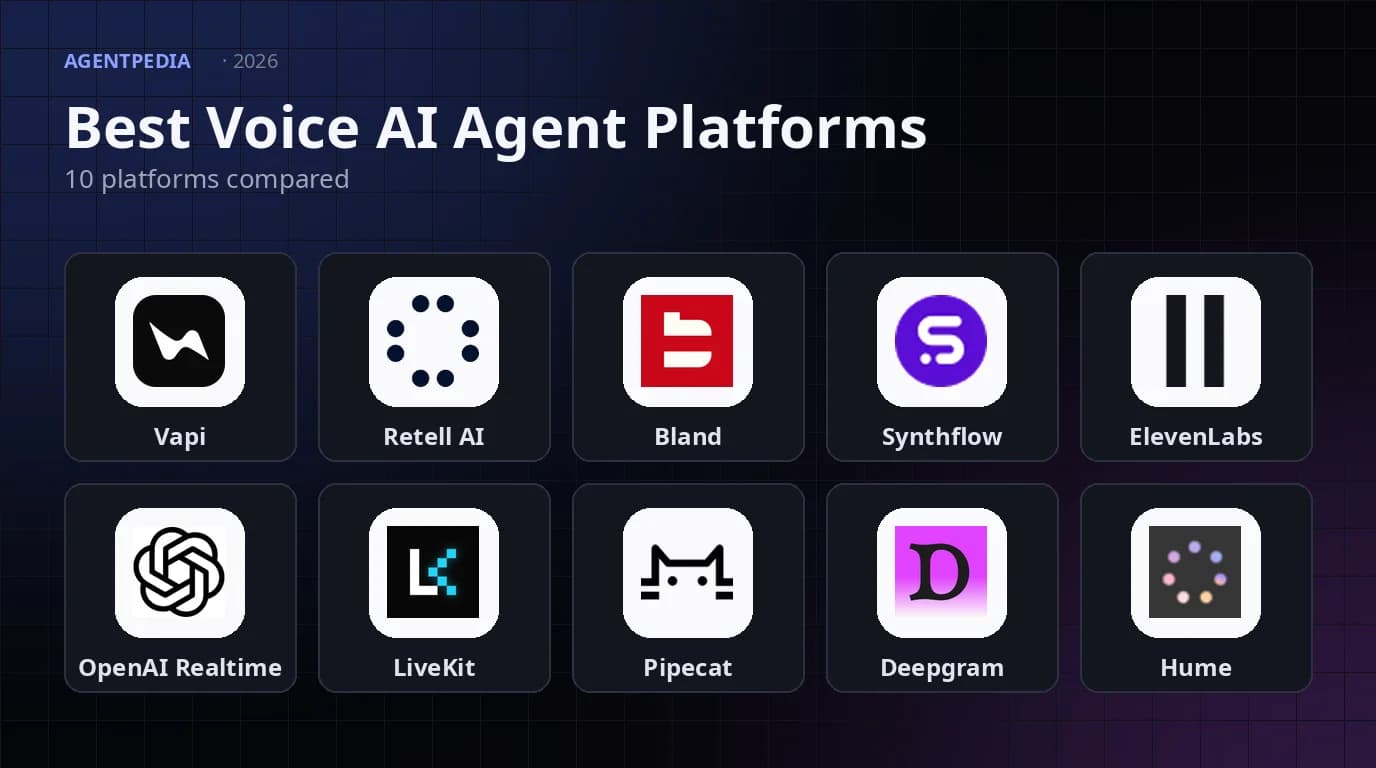
You want an AI that answers the phone, books the appointment, or qualifies the lead, and you have ten vendors telling you theirs is the fastest, cheapest, and most human. The price pages do not line up: one charges per minute all-in, one charges a platform fee plus pass-through models, one hides the number behind a sales call, and one is a free framework you host yourself.
This guide puts them side by side using each vendor's own pricing and docs pages, fetched on November 11, 2026. The short version: pick Retell AI or Vapi to ship a phone agent this week, LiveKit Agents or Pipecat if you want code you can own, Deepgram if per-minute cost is the constraint, and Bland or Synthflow if you are a regulated enterprise buying a managed outcome. Details and caveats follow.
An independent creator comparison (Jonas Massie) of ElevenLabs, LiveKit, Vapi, Retell, Synthflow, and GoHighLevel Voice AI, scored on pricing, maturity, developer friendliness, and support. Opinions in the video are the creator's, not ours.
The Short Answer
There is no single best platform, because “voice AI agent platform” covers three different products. Managed phone-agent platforms (Retell, Vapi, Bland, Synthflow, ElevenLabs Agents) give you a dashboard, a phone number, and a per-minute bill. Developer frameworks and clouds (LiveKit Agents, Pipecat, Pipecat Cloud) give you code and hosting. Model and API vendors (OpenAI Realtime API, Deepgram Voice Agent API) give you the speech pipeline and leave telephony, tools, and operations to you.
Three findings shaped our ranking. First, the headline per-minute price is rarely the whole bill: Vapi's $0.05 is hosting only, ElevenLabs bills the LLM on top of $0.08, and Bland and Deepgram are the two that bundle models into one rate. Second, latency numbers are all vendor-reported, and none of the ten publishes a neutral benchmark. Third, Hume, a name that used to be on every shortlist for expressive voice, is shutting down EVI on November 13, 2026, so it sits at the bottom of this list as a warning rather than a recommendation.
Quick Picks
| Category | Pick | Why |
|---|---|---|
| Best overall for developers | LiveKit Agents | Apache-2.0 framework plus a hosted cloud, telephony, and a $0 plan; you can leave the cloud without rewriting the agent. |
| Best managed platform for phone calls | Retell AI | Pay-as-you-go with a published component price list, 20 free concurrent calls, and no platform fee. |
| Best for fast prototypes and flexibility | Vapi | Pick any STT, LLM, and TTS provider; $0.05 per minute hosting plus provider cost at no markup. |
| Best budget at scale | Deepgram Voice Agent API | One rate from $0.075 per minute, dropping to $0.050 if you bring your own LLM and TTS. |
| Best open source | Pipecat | BSD-2-Clause Python framework with 80+ provider integrations and a managed Pipecat Cloud. |
| Best voice quality and languages | ElevenLabs Agents | Built on its own voice models, 90+ languages, $0.08 per extra minute with LLM billed on top. |
| Best for regulated enterprise calls | Bland AI | One bundled per-minute rate on its own models, with BAA, SSO, and on-prem or VPC options on Enterprise. |
| Best for contact centers and BPOs | Synthflow | Annual enterprise contract, native telephony and SIP, white-label workspaces; no public rate. |
| Best for lowest-latency research builds | OpenAI Realtime API | Speech-to-speech models over WebRTC, WebSocket, and SIP; you build the rest. |
| Do not start new builds on | Hume EVI | Hume says EVI and its TTS API stop working on November 13, 2026. |
Master Comparison: Pricing (as of Nov 11, 2026)
Every cell below comes from the vendor's live pricing page. Prices are in US dollars and exclude tax. Read the second column carefully: some are all-in, some are platform-only, and the OpenAI figure is per token because OpenAI does not publish a per-minute rate.
| Platform | Per-minute price | Free tier | Plans and limits |
|---|---|---|---|
| Vapi | $0.05/min hosting (pre-paid), providers at cost. Example: 1,000 min = $82 to $129/mo | $5 credit, 4 concurrent, 1 inbound number | Core $29/mo, Pro from $999/mo, Premier custom |
| Retell AI | $0.07 to $0.31/min. Default estimate $0.11/min (infra $0.055 + LLM $0.04 + TTS $0.015) | 20 concurrent calls free, no platform fee | $8 per extra concurrent call per month; Enterprise custom |
| Bland AI | $0.14/min (Start), $0.12/min (Build, $299/mo platform fee), LLM + STT + TTS included | 2 credits and an inbound number, no card | Enterprise custom, on-prem or VPC available |
| Synthflow | No public rate. Annual enterprise agreement scoped to volume | No free plan or trial | Enterprise contract only |
| ElevenLabs Agents | $0.08/min beyond included minutes ($0.16 burst), LLM billed separately | Free plan: 15 minutes, 4 concurrent | Plans include 75 to 12,375 minutes (Starter to Business) |
| OpenAI Realtime API | Per token: gpt-realtime-2.1 audio $32 in / $64 out per 1M; mini $10 / $20 | None listed on the pricing page | Pay as you go; no per-minute price published |
| LiveKit Agents | Cloud: $0.01/min agent session; default phone estimate $0.0479/min all-in | Build plan $0: 1,000 session minutes, 5 concurrent, 1 free number | Ship $50/mo, Scale $500/mo, Enterprise custom |
| Pipecat Cloud | agent-1x $0.01/min active; PSTN $0.018/min; providers billed to you | Framework is free; Krisp VIVA free to 10k min/mo | Unlimited concurrency; enterprise volume pricing |
| Deepgram Voice Agent | $0.075/min Standard; $0.050/min with BYO LLM and TTS; Advanced $0.163/min | $200 credit, about 43,000 STT minutes | Growth from $4,000/yr (up to 20% off); Enterprise custom |
| Hume EVI | Sunsetting. Access ends Nov 13, 2026 | n/a | n/a |
Master Comparison: Capabilities
The second table covers what you can build with: no-code or code, which models you can swap, how calls reach the phone network, whether the core is open source, and what each vendor claims about latency. Function calling (tool use) is available on all ten platforms in some form, so it is not a column; the differences are in how tools are defined and how reliably they run.
| Platform | No-code or code | BYO LLM / TTS / STT | Telephony | Open source | Latency claim |
|---|---|---|---|---|---|
| Vapi | Code/API plus no-code dashboard | Yes: dozens of STT, LLM, and TTS providers | Vapi numbers (inbound free), or import Twilio, Telnyx, DIDWW; SIP | No | Sub-600ms (vendor-reported) |
| Retell AI | No-code builder plus API | Pick from a LLM and TTS price list; speech-to-speech options | Retell numbers ($2/mo), Twilio/Telnyx, custom SIP at no charge | No | ~600ms (vendor-reported) |
| Bland AI | No-code Pathways plus API | No: runs on its own models | Bland numbers, your Twilio, or SIP trunks | No | None found |
| Synthflow | No-code plus API | Not documented on the pages fetched | Native telephony, SIP trunking, Zoom Phone | No | Under 0.5s on a customer deployment (vendor-reported) |
| ElevenLabs Agents | No-code builder plus SDKs | LLMs from several vendors; ElevenLabs voices | Twilio or SIP trunk, billed by the carrier | No (SDKs are open) | 'Ultra-low latency' (no number) |
| OpenAI Realtime API | Code only | Speech-to-speech model; you bring the rest | SIP and WebRTC; Twilio via WebSocket | No (SDKs are open) | None published |
| LiveKit Agents | Code (Python, Node.js) | Yes: any STT, LLM, TTS, or realtime model | Built-in SIP telephony; 1 free number on Build | Yes (Apache-2.0) | None published |
| Pipecat | Code (Python) | Yes: 80+ providers | Daily SIP/PSTN, Twilio, other transports | Yes (BSD-2-Clause) | None published |
| Deepgram Voice Agent | Code (WebSocket API) | Yes: bring your own LLM and/or TTS | Via your own telephony and the WebSocket | No (STT/TTS containers self-host on Enterprise) | None found on the pages fetched |
| Hume EVI | Code | Custom LLM supported | n/a | No | n/a |
If you are weighing the speech layer on its own, our sibling guides to the best text-to-speech APIs and the best speech-to-text APIs go deeper on the voices and transcribers that every platform here plugs in.
Three Ways to Build a Voice Agent
LiveKit described the landscape well in an October 2026 post: voice agents get built three ways. A cascaded pipeline chains speech-to-text, an LLM, and text-to-speech. A turn-based speech-to-speech model takes audio in and returns audio out, one turn at a time. A full-duplex model listens and talks at the same time. The platforms in this list support different mixes of the three.
LiveKit: voice agents get built three ways, cascaded (STT, LLM, TTS), turn-based speech-to-speech, and full-duplex, where the model listens and talks at the same time. All three now run on LiveKit Inference, including GPT-Live and GPT Realtime from OpenAI and Grok Voice Think Fast from xAI.
— @livekit October 15, 2026
Cascaded is the default for phone work. You can pick the best transcriber, the cheapest adequate LLM, and a voice that matches your brand, and you can debug each stage by reading a transcript. The cost is latency from three hops, which is why vendors fight over turn detection and streaming. Speech-to-speech models skip the transcript and can sound more natural, but you lose some control, and prices per minute are higher: Retell lists GPT Realtime 2.1 at $0.38 per minute, against its $0.11 default cascaded estimate. Full-duplex is the newest and the least settled, so treat it as something to test rather than build a call center on.
Vapi
Vapi calls itself the developer platform for voice AI agents. Every assistant combines a transcriber, a language model, and a voice, and you choose each from a long provider list that includes OpenAI, Anthropic, Google, Gladia, Deepgram, and ElevenLabs. It offers two building blocks: Assistants, a single prompt plus tools and structured outputs, and Squads, which chain specialist assistants with context-preserving transfers for cases like medical triage or order handling.
Pricing (as of Nov 11, 2026). The usage-only tier costs $0 to start with $5 in free credits, then $0.05 per minute of Vapi hosting, pre-paid, with model providers passed through at cost. That tier includes 2 organizations, 1 inbound Vapi number, 4 concurrent calls, and 14 days of raw data retention. Core is $29 per month (10 concurrent calls, 5 numbers, ZDR, a 2-business-day email SLA). Pro is 10% of the hosting fee with a $999 per month minimum (30 concurrent calls, 180 days retention, RBAC, a Slack channel, a 99% uptime SLA). Premier is sales-led, with a 99.9% uptime SLA and dedicated SIP. Vapi's own example at 1,000 minutes a month adds a $50 hosting fee, about $10 of Deepgram transcription, $8 to $45 of OpenAI, and $15 to $24 of ElevenLabs voice, for $82 to $129 in total.
Telephony. Free Vapi numbers take inbound calls only. For outbound you import a number from Twilio, Telnyx, or DIDWW. Vapi lists its own telephony and SIP transport fee as $0, and Premier customers can get dedicated SIP. Latency. The docs claim sub-600ms response times with natural turn-taking, which is a vendor-reported figure.
Strengths. The widest model choice among the managed platforms, a clear pass-through pricing story, a dashboard that lets a non-engineer build a first agent in minutes, an API for everything else, and SOC 2, HIPAA, and PCI claims on its site. Weaknesses. The bill has five moving parts (hosting, transcriber, LLM, voice, telephony), so the sticker price understates the total, and the useful support tiers start at the $29 and $999 packages. Best for: teams that want to prototype fast, swap providers freely, and graduate to enterprise features without changing platforms.
Retell AI
Retell positions itself as a voice agent platform for contact centers and says it is in production at more than 4,000 businesses. Its pitch is operational: agentic warm transfers that brief the human before connecting the caller, IVR navigation that can press through phone trees and enter extensions, and a mix of deterministic flows with generative replies so a script step does not depend on the model improvising.
Pricing (as of Nov 11, 2026). Retell is pay as you go with no platform fee and no feature gating. The page quotes $0.07 to $0.31 per minute depending on choices, and its calculator's default lands at $0.11 per minute: voice infrastructure $0.055, LLM $0.04, TTS $0.015, and $0 for telephony when you bring custom telephony. Component prices are public. Platform voices, Minimax, Fish, Cartesia, OpenAI, and Inworld voices are $0.015 per minute, while ElevenLabs Flash is $0.04 and ElevenLabs v3 or v4 is $0.08 to $0.10. LLMs range from $0.0016 per minute for the smallest models to $0.16 for GPT 5.5 or Claude 5 Opus (higher on fast tiers, up to $0.384), and speech-to-speech options include GPT Realtime 2.1 at $0.38 per minute and the mini at $0.07. Retell numbers via Twilio or Telnyx add $0.015 per minute, and SIP trunking or custom telephony carries no charge. Add-ons include knowledge base lookup at $0.005 per minute, PII removal at $0.01, and safety guardrails at $0.005. Twenty concurrent calls are free; extra capacity costs $8 per concurrent call per month.
Billing details matter here: calls are metered to the second, silence and hold time are billed because speech-to-text keeps listening, only connected calls are charged, and the AI fee stops when a call is transferred to a human while the telephony fee continues.
Strengths. The most transparent price sheet of the managed platforms, a generous 20 free concurrent calls, and features built for real call centers. Weaknesses. The model list changes often and the cost swings widely with the LLM and voice you pick, so the $0.07 to $0.31 range is wide; the site's about 600ms latency figure is vendor-reported. Best for: teams that want a managed phone agent with predictable component pricing and transfers to humans. Retell's pricing page also includes a built-in estimator, which is worth using before you shortlist.
Bland AI
Bland aims at the calls that cannot go wrong: healthcare, insurance, and financial services. Its distinguishing claim is that it is “the only voice AI that runs entirely on its own models,” so listening, thinking, and talking all run on Bland's stack instead of a mix of third-party vendors. It says more than 230 regulated companies use it, supports 40+ languages natively, and deploys across phone, SMS, and web.
Pricing (as of Nov 11, 2026). Bland bundles the LLM, speech-to-text, and text-to-speech into one per-minute number, with no token charges. Start is $0.14 per minute with no platform fee and no card, with 10 concurrent calls, 100 calls per day, and transfers at $0.05 per minute. Build is $0.12 per minute plus a $299 per month platform fee, with 50 concurrent calls, 2,000 calls per day, and transfers at $0.04. Enterprise is custom: dedicated infrastructure, on-prem or VPC deployment, a forward-deployed engineer, BAA, SSO, and data residency. Telephony is billed separately, on your own Twilio, a SIP trunk, or Bland's at pass-through cost. Warm and live transfers, guardrails, and SMS appear only on Enterprise in the plan table.
Bland's FAQ compares itself to Vapi and Retell and says typical production stacks on those land at roughly $0.13 to $0.30 and $0.11 to $0.25 per minute. That is Bland's own claim, so treat it as marketing; our cost section below uses each vendor's published numbers instead. It also lists SOC 2 Type I and II, HIPAA with a BAA, GDPR, ISO 27001, and FedRAMP 20x Class A, with documentation under NDA on Enterprise, and describes a 28-day enterprise rollout.
Strengths. One simple number, an end-to-end stack with a single owner to call when something breaks, and the strongest compliance story here. Weaknesses. You cannot swap the LLM or voice vendor, the features regulated buyers care about (BAA, SSO, warm transfer) sit behind Enterprise, and the self-serve plans have daily call caps. Best for: regulated enterprises that want one accountable vendor and are comfortable with a closed stack.
Synthflow
Synthflow sells AI voice agents that sit inside an existing phone system. Its customer story is Batteries Plus, which runs a Synthflow agent called Edison inside Zoom Phone across more than 700 US locations, with five weeks from kick-off to pilot and an agent response time the page puts under 0.5 seconds on warm transfers (vendor-reported). The site claims more than 1 million calls a day, 99.99% uptime, and 100+ enterprise customers, and shows CRM updates during the call.
Pricing (as of Nov 11, 2026). There is no public rate. Synthflow is sold as an annual enterprise agreement scoped to call volume, telephony, integrations, security, and launch support, with no free plan, no trial, and no per-minute price. The contract can cover Synthflow Native Telephony, SIP trunking, or approved enterprise telephony, and white-label workspaces for BPOs and software platforms are available. Its Trust Center lists SOC 2 Type 2, ISO/IEC 27001, GDPR, HIPAA (self-attested), and PCI DSS v4.0.1, with ISO/IEC 42001, DORA, and the EU AI Act shown as in progress.
Strengths. Deep contact-center integration, forward-deployed engineers, white-label, and a credible enterprise customer list. Weaknesses. You cannot try it without a sales conversation, you cannot compare cost per minute, and the pages we fetched do not say whether you can bring your own LLM or voice. Best for: mid-market and enterprise contact centers, retail chains, and BPOs that want a managed deployment and are happy to negotiate.
ElevenLabs Agents
ElevenLabs entered voice agents from the voice side. Its Agents product (marketed as ElevenAgents) configures, deploys, and monitors agents in 90+ languages across voice, chat, and email, and the company says it handles more than 10 million conversations a week. Its pitch is quality: it builds its own voice models in-house and combines them with speech recognition, turn-taking, and reasoning models from multiple vendors.

Pricing (as of Nov 11, 2026). Agents are billed by call minutes, not from the shared credit pool. Plans include: Free 15 minutes and 4 concurrent calls; Starter 75 and 6; Creator 275 and 10; Pro 1,238 and 20; Scale 3,738 and 30; Business 12,375 and 40. Extra minutes cost $0.08, doubling to $0.16 as burst pricing when you exceed your concurrency limit, and text messages cost $0.003 each. LLM usage is billed separately on top. ElevenLabs does not charge extra for telephony, but a connected Twilio account or SIP trunk bills you directly. Because the LLM is separate, the real per-minute figure is the $0.08 plus whatever model you choose, which makes it comparable to Retell's component model more than to Bland's bundle.
Strengths. Voice quality and language coverage are the reason to pick it, tool calling is part of the agent configuration, and the free plan makes testing easy. Weaknesses. The minute allowance on each plan is modest at the low end, burst pricing doubles the rate when you spike, and the site states “ultra-low latency” with no number. Best for: customer-facing agents where the voice itself is the product, such as branded assistants, multilingual support, and storytelling or character agents.
OpenAI Realtime API
OpenAI is the model-and-API option. The Realtime API gives you speech-to-speech models that take audio in and return audio out in one hop, with sessions that connect over WebRTC in the browser, WebSocket on the server, or SIP for phone calls. In WebRTC and SIP connections the server manages an output audio buffer, so it knows how much audio was actually played and truncates the rest when a caller interrupts. The docs also show streaming audio to a phone call through Twilio. There is no no-code builder: you write the agent, the tools, and the call flow.
Pricing (as of Nov 11, 2026). OpenAI prices per token and publishes no per-minute figure for the classic Realtime models. gpt-realtime-2.1 audio is $32 per million input tokens and $64 per million output tokens ($0.40 cached input), text is $4 in and $24 out. gpt-realtime-2.1-mini audio is $10 in and $20 out, text $0.60 in and $2.40 out. gpt-realtime-2, gpt-realtime-1.5, and gpt-realtime keep the $32 and $64 audio rates. A separate GPT-Live line lists gpt-live-1 at $0.05 per minute, billed per second, with backend model and tool usage charged separately. Third parties convert these to minutes for you: Retell lists GPT Realtime 2.1 at $0.38 per minute and the mini at $0.07, and LiveKit lists $0.0676 per minute for GPT Realtime 2.1 and $0.0216 for the mini on its inference plan. The gap between those two conversions is large, so check which rate applies to your provider and your conversation pattern before budgeting.
One more date matters if you were planning to pair OpenAI's separate text-to-speech endpoint with another stack: the docs say tts-1, tts-1-hd, and gpt-4o-mini-tts are deprecated and shut down on January 6, 2027, with a migration path to gpt-realtime-2.1-mini through the Realtime API.
Strengths. The tightest integration between model and voice, strong models, and an easy first demo. Weaknesses. You own everything else (telephony wiring, tool plumbing, monitoring, retries), token pricing is hard to turn into a per-call budget, and OpenAI publishes no neutral latency number. Best for:engineering teams that want speech-to-speech quality and will build their own call layer, often through LiveKit or Pipecat, both of which wrap OpenAI's realtime models.
LiveKit Agents
LiveKit Agents is an open-source framework (Apache-2.0, about 15,191 GitHub stars on Nov 12, 2026) for building voice, video, and multimodal agents in Python or Node.js, paired with LiveKit Cloud for deployment, telephony, and inference. You write a session that wires STT, LLM, and TTS (or a single realtime model), and LiveKit handles the WebRTC transport, turn detection, and scaling. LiveKit Inference lets you call models from many providers through one account and one bill instead of managing a key per vendor.
# LiveKit Agents (Python): a cascaded STT -> LLM -> TTS session
# Excerpt adapted from the LiveKit docs quickstart; imports omitted.
server = AgentServer()

@server.rtc_session(agent_name="my-agent")
async def my_agent(ctx: agents.JobContext):
    session = AgentSession(
        stt=inference.STT(model="assemblyai/universal-3-6-pro", language="en"),
        llm=inference.LLM(model="google/gemma-4-31b-it"),
        tts=inference.TTS(
            model="fishaudio/s2.1-pro",
            voice="fa4c9eb3dccc4806b382b40d61c6b10a",
        ),
        turn_handling=TurnHandlingOptions(
            turn_detection=inference.TurnDetector(),
        ),
    )
    await session.start(room=ctx.room, agent=Assistant())
Swapping to a speech-to-speech model is a small change in the same framework:
# Same framework, speech-to-speech instead of three stages
# Excerpt adapted from the LiveKit docs; imports omitted.
session = AgentSession(
    llm=inference.RealtimeModel(
        model="openai/gpt-realtime-2.1",
        voice="marin",
    ),
)
Pricing (as of Nov 11, 2026). The Build plan is $0 per month and includes 1,000 agent session minutes, 5 concurrent sessions, one free telephony number, observability, and simulations. Ship is from $50 per month (5,000 minutes included, then $0.01 per minute, 20 concurrent sessions, custom voices, rollback). Scale is from $500 per month (50,000 minutes included, up to 600 concurrent sessions, region pinning, private links, HIPAA reports, inference discounts). Enterprise adds volume pricing, SSO, and an SLA. LiveKit's calculator estimates $0.0479 per minute for a phone agent on the default models: $0.01 for the agent session, $0.01 for telephony, $0.0014 for the LLM, and $0.0075 to $0.01 for each of STT and TTS. Model prices are listed per minute, from DeepSeek-V4.1 Flash at $0.0011 up to Gemini 4 Argon at $0.0155 and OpenAI's realtime models above that.
LiveKit's own posts show the product moving quickly. In September the company announced agent deployments with staging next to production on LiveKit Cloud:
LiveKit: agent deployments are live on LiveKit Cloud. Run a staging deployment next to production with the same image, project, and secrets, test a change on real infrastructure, then promote that exact build.
— @livekit September 2, 2026
Strengths. The lowest per-minute estimate in this list, open source with a real exit path, built-in SIP telephony, strong testing and deployment tooling, and the broadest model menu through Inference. Weaknesses. It is code-first with no visual builder, you operate more of the system than on a managed platform, and the many moving parts (framework, cloud, inference, telephony) take real learning. Best for: engineering teams building a voice product and wanting both control and a managed option. Our LiveKit Agents vs Pipecat comparison goes further, and the build an AI phone calling agent guide walks through a working build end to end.
Pipecat and Pipecat Cloud
Pipecat is an open-source Python framework for voice and multimodal agents (BSD-2-Clause, about 17,214 GitHub stars on Nov 12, 2026) from the team at Daily. It models an agent as a pipeline of services that pass frames, and it connects to more than 80 providers for LLM, STT, and TTS, including Anthropic, Cartesia, Deepgram, ElevenLabs, Google, and OpenAI. Transports include Daily WebRTC, WebSockets, and Twilio Media Streams for dial-in and dial-out. Function calling is part of the framework, so the LLM can request lookups and actions during a conversation.
Pricing (as of Nov 11, 2026). The framework is free. Pipecat Cloud, the managed hosting, charges per active minute by agent profile: agent-1x (0.5 vCPU, 1 GB) $0.01, agent-2x $0.02, agent-3x $0.03, with reserved always-on rates of $0.0005, $0.0010, and $0.0015 per minute. Concurrency is unlimited. Daily WebRTC voice for 1:1 sessions is free on Pipecat Cloud, SIP dial-in and dial-out runs $0.003 to $0.02 per minute, PSTN is $0.018 per minute, Twilio is billed to the provider, and a SIP REFER transfer costs $0.20 per event. Krisp VIVA noise filtering is free up to 10,000 active minutes a month and $0.0015 after. Recording is $0.005 per minute for audio. LLM, STT, and TTS bills come from the providers you choose.
Strengths. A permissive license, the largest provider menu, a very hackable pipeline model, and a simple hosting price. Weaknesses. Python only, no visual builder, and you assemble and bill each provider yourself unless you arrange enterprise billing through Daily. Best for: Python teams that want maximum flexibility and the option to self-host. If you run it on your own servers, our guide to the best GPU clouds for AI covers where to put self-hosted models, and the LiveKit vs Pipecat comparison covers the trade-off.
Deepgram Voice Agent API
Deepgram started as a speech-to-text company and now offers a single WebSocket API that bundles speech recognition, a managed language model, and text-to-speech. You can swap in your own LLM or TTS to lower the price. The API supports function calling so the agent can call outside services mid-conversation.
Pricing (as of Nov 11, 2026). Billing is per minute of WebSocket connection time, one rate covering STT, a managed LLM, and TTS. Pay as you go: Standard $0.075 per minute, Standard with BYO TTS $0.065, Custom with BYO LLM $0.065, Custom with BYO LLM and TTS $0.050, Advanced $0.163, and Advanced with BYO TTS $0.122. Growth (from $4,000 a year in pre-paid credits, up to 20% off) lowers these to $0.068, $0.051, $0.059, $0.041, $0.146, and $0.110. New accounts get $200 in free credit with no card, which Deepgram says covers about 43,000 minutes of Nova-3 transcription. Voice Agent concurrency on Growth is up to 60 in North America and 45 in Europe, Australia, and India. Compliance includes SOC 2 Type 1 and 2, HIPAA with a BAA for Enterprise, GDPR with an EU endpoint, and PCI, and Enterprise customers can run self-hosted containers on their own NVIDIA GPUs.
Strengths. The lowest published all-in managed rate in this comparison, a bundled price that is easy to forecast, and strong STT and TTS under the hood (see our speech-to-text roundup). Weaknesses. It is an API, not a phone-call product: you bring telephony, the call flow, and your own observability, and we found no latency figure on the pages we fetched. Best for: teams optimizing cost per minute that are comfortable building the surrounding system.
Hume EVI
Hume's Empathic Voice Interface was a real-time speech-to-speech API that adapted its tone to how the caller sounded, with interruption handling, tool calls, and support for custom language models. It was a favorite for expressive voice demos. It is also going away.
Status (as of Nov 11, 2026). Hume is sunsetting its EVI and Octave text-to-speech APIs. They stop answering at 12:01 a.m. EST on November 13, 2026, they stay fully supported until then, and Hume permanently deletes the data in the account afterward. One caveat on sourcing: Hume's old documentation URLs now redirect to the Audio Decisions API page, so we could not load Hume's own notice. The date comes from Cartesia's migration guide, which cites Hume's developer docs as archived on October 3, 2026. If you have an EVI integration, export your configs, prompts, logs, and the source recordings behind any cloned voices, and move before the cutoff.
What Hume does now. Its current product is the Audio Decisions API, a decision model for audio: you send an MP3 or WAV file (1 second to 5 minutes) plus plain-language questions and get probabilities back, such as whether an agent talks over the caller or how natural it sounds on a five-point scale. That is not a voice agent platform, but it is a useful way to score the calls your agent makes. Hume's homepage includes a leaderboard in which gemini-3.1-flash-live (3.76) and gpt-realtime-2 (3.74) lead, with an ElevenLabs agent at 3.45; those are Hume's own ratings, so read them as one vendor's view. Best for: evaluating a voice agent. Do not use EVI for anything new.
What 10,000 Minutes Costs
Per-minute prices are easier to compare when you turn them into a monthly bill. This is a back-of-envelope example for 10,000 call minutes a month, built only from the published numbers above. It excludes phone-number rental, taxes, and concurrency add-ons, and it assumes the cheapest published model options noted in each row, so your real total will be higher with a premium LLM or voice.
| Platform | How we computed it | Approx. monthly |
|---|---|---|
| Deepgram (BYO LLM and TTS) | 10,000 x $0.050, excludes your LLM and TTS | $500 plus providers |
| Deepgram (Standard) | 10,000 x $0.075, all-in | $750 |
| LiveKit (Ship) | $50 plan + 5,000 extra session minutes x $0.01; telephony and models extra | about $100 plus models and telephony |
| Retell (default estimate) | 10,000 x $0.11 | $1,100 |
| Vapi (usage only) | 10,000 x $0.05 hosting, plus providers (its 1,000-minute example implies about $0.033 to $0.079 per minute for providers) | $500 plus roughly $330 to $790 of providers |
| Bland (Build) | $299 + 10,000 x $0.12, telephony extra | $1,499 |
| ElevenLabs Agents | 10,000 x $0.08 minus included minutes, LLM extra | about $800 minus the plan allowance, plus LLM |
| Synthflow | No public price | Contact sales |
The pattern is clear. The frameworks and the bundled API are cheapest on paper, the managed platforms add a layer of convenience at roughly 2x to 3x the per-minute cost once providers are included, and an enterprise-contract vendor keeps its price private. Whether the premium is worth it depends on how much engineering time you would spend building the call layer yourself. Self-hosting the agent on a rented server changes the math again; see our browser infrastructure roundup for how other agent infrastructure categories price hosting.
Latency: What Is Actually Known
Every vendor says its agents are fast. Here is what we could find as of November 11, 2026, with the source of each number. None of these is an independent benchmark.
- Vapi: “sub-600ms response times with natural turn-taking” (Vapi docs, vendor-reported).
- Retell AI: about 600ms (Retell site, vendor-reported).
- Synthflow: under 0.5 seconds agent response time on a Batteries Plus deployment (Synthflow site, vendor-reported).
- ElevenLabs Agents: “ultra-low latency” with no figure.
- OpenAI, LiveKit, Pipecat, Deepgram, Bland: no end-to-end latency number found on the pages fetched.
- Hume: its homepage shows a worked example of a 910 millisecond gap that makes an agent miss a caller's urgency, which is an illustration, not a benchmark.
The practical takeaway is that a human conversation feels natural at turn gaps of a few hundred milliseconds, and a cascaded stack can reach the 600ms range with a fast LLM and streaming TTS, but the figure moves with your model, your voice, your phone carrier, and your region. Measure time to first audio on your own calls, at your expected concurrency, and with the LLM you will actually ship.
How to Choose
| If you... | Choose | Because |
|---|---|---|
| Need a working phone agent this week and have no voice engineer | Retell AI or Vapi | Dashboards, templates, numbers, and published pricing. |
| Want to own the code and avoid lock-in | LiveKit Agents or Pipecat | Apache-2.0 and BSD-2-Clause cores; hosted clouds are optional. |
| Are driven by cost per minute at volume | Deepgram Voice Agent API, or a framework with cheap models | $0.050 per minute with BYO LLM and TTS; frameworks start near $0.01. |
| Need the best voice and many languages | ElevenLabs Agents | In-house voice models, 90+ languages. |
| Are a regulated healthcare or finance enterprise | Bland AI or Synthflow | BAA, SOC 2, forward-deployed engineers, single accountable vendor. |
| Want speech-to-speech and will build the call layer | OpenAI Realtime API via LiveKit or Pipecat | Best model-to-voice integration, plus a transport you do not write. |
| Run a BPO or agency with many clients | Synthflow or Retell | White-label workspaces (Synthflow) or per-minute resale math (Retell). |
| Already use EVI | Migrate now | EVI stops on November 13, 2026. |
Two practical rules apply whatever you pick. First, run a trial on your own numbers: place 30 scripted calls, including interruptions and a transfer to a human, and compare time to first word and task completion. Second, model the full bill, including telephony and the LLM, before you sign anything. If your agent will also act in other systems, see how it can reach them over MCP in our best MCP servers guide, and for an example of a voice interface in a coding workflow, read the Antigravity voice mode CLI guide.
How We Evaluated
We fetched each vendor's live pricing page, documentation, and homepage on November 11, 2026, plus the GitHub repositories for LiveKit Agents and Pipecat on November 12. Every price, limit, and plan name in this article comes from those pages. Where a vendor hides a price (Synthflow, Premier and Enterprise tiers) or publishes only per-token rates (OpenAI), we say so rather than estimate. We did not run call tests ourselves, so latency numbers are vendor-reported and labeled that way. Vendor claims about other vendors, such as Bland's comparison with Vapi and Retell, are noted as claims. Ranking is editorial, there is no paid placement, and we use no affiliate links. Prices change often; confirm on the vendor page before you buy.
FAQ
What is the best voice AI agent platform in 2026?
It depends on who builds and who operates. For developers who want control and an exit path, LiveKit Agents (Apache-2.0) or Pipecat (BSD-2-Clause) are the strongest picks. For a managed phone-agent platform with transparent pricing, Retell AI and Vapi are the usual shortlist. For regulated enterprise calls with a bundled rate, look at Bland AI. For the lowest per-minute component cost, Deepgram's Voice Agent API starts at $0.075 per minute. All prices are as of Nov 11, 2026.
How much does a voice AI agent cost per minute?
The all-in figure depends on the stack. Published rates as of Nov 11, 2026: Deepgram Voice Agent $0.075 per minute (or $0.050 with your own LLM and TTS), Bland $0.14 or $0.12, ElevenLabs Agents $0.08 for extra minutes with the LLM billed separately, Retell's default estimate $0.11, Vapi $0.05 hosting plus providers (about $0.082 to $0.129 in its own 1,000-minute example), and LiveKit's default estimate $0.0479. Telephony is often billed separately, so compare like for like.
Vapi vs Retell AI: which should I pick?
Both are managed platforms that sit on top of third-party STT, LLM, and TTS. Vapi lists $0.05 per minute for hosting with providers passed through at cost, plus Core and Pro packages for support and concurrency. Retell lists a flat component price sheet (voice infrastructure $0.055 per minute, TTS from $0.015, LLMs per model) with 20 concurrent calls free and no platform fee. Retell leans into contact-center features such as warm transfers and IVR navigation; Vapi leans into assistants, squads, and API flexibility. Run the same scripted call on both before you commit.
Can I bring my own LLM, TTS, and STT?
On Vapi, LiveKit, Pipecat, and Deepgram, yes. Deepgram prices it explicitly: $0.065 per minute with your own LLM and $0.050 with your own LLM and TTS. Retell lets you choose from a published list of LLMs and TTS voices. ElevenLabs Agents works with LLMs from several vendors but keeps its own voices. Bland states it runs entirely on its own models, so it is the opposite choice by design. Synthflow's pages we fetched do not document the option.
Which voice agent platforms are open source?
LiveKit Agents is Apache-2.0 and Pipecat is BSD-2-Clause, both verified on GitHub on Nov 12, 2026 (about 15,191 and 17,214 stars). The hosted services around them (LiveKit Cloud, Pipecat Cloud) are paid. Vapi, Retell, Bland, Synthflow, ElevenLabs, and Deepgram's agent API are closed platforms, although several publish open SDKs.
Do these platforms work with Twilio and SIP?
Yes, with differences. Vapi imports numbers from Twilio, Telnyx, or DIDWW and lists a $0 Vapi SIP transport fee. Retell offers Twilio and Telnyx numbers at $0.015 per minute and charges nothing for custom SIP trunking. Bland works with your Twilio account or SIP trunks. ElevenLabs does not charge extra for telephony but a connected Twilio or SIP provider bills you directly. LiveKit has built-in telephony with one free number. Pipecat Cloud offers Daily SIP and PSTN as well as Twilio. OpenAI's Realtime API supports SIP and WebRTC connections.
Is the sub-600ms latency real?
It is a vendor-reported number and should be treated as a best case. Vapi's docs say sub-600ms response times and Retell's site says about 600ms. Synthflow reports under 0.5 seconds on a named customer deployment. We found no neutral, repeatable benchmark comparing these platforms end to end, so test on your own phone numbers, your own prompts, and your own LLM before trusting any figure.
What happened to Hume EVI?
Hume is sunsetting its EVI and Octave text-to-speech APIs. They stop answering at 12:01 a.m. EST on November 13, 2026, and Hume deletes account data afterward. We could not load Hume's own notice (the old docs URLs redirect to the Audio Decisions API), so the date comes from Cartesia's migration guide, which cites Hume's docs as archived on October 3, 2026. Hume's current product focus is the Audio Decisions API for evaluating voice AI. Do not start a new build on EVI.
No-code platform or code framework: which should I choose?
Choose a no-code or API platform (Retell, Vapi, Bland, Synthflow, ElevenLabs) when speed to a working phone agent and non-engineer editing matter most. Choose a framework (LiveKit Agents, Pipecat) when you need custom turn-taking, unusual tools, self-hosting, or a lower bill at volume. Many teams prototype on a platform, then move the hot path to a framework once the call flow is stable.
How should I test a voice agent before launch?
Script 20 to 30 real calls that include interruptions, accents, background noise, a transfer, and an angry caller. Measure time to first word, how often the agent talks over the caller, and task completion. Vapi, Retell, and LiveKit all ship simulation or testing features, and Hume's Audio Decisions API can score recordings for naturalness. Re-run the same set after every prompt or model change.
Sources
All pages fetched November 11 to 12, 2026.
- Vapi: pricing and success packages; Vapi docs: introduction
- Retell AI: pricing; Retell AI: homepage
- Bland AI: pricing; Bland AI: homepage
- Synthflow: pricing; Synthflow: homepage
- ElevenLabs: pricing; ElevenLabs Agents
- OpenAI: API pricing; OpenAI: Realtime API guide
- LiveKit: pricing; LiveKit Agents docs; livekit/agents on GitHub
- Pipecat Cloud: pricing; Pipecat docs; pipecat-ai/pipecat on GitHub
- Deepgram: pricing; Deepgram Voice Agent docs
- Hume AI: homepage; Hume developer docs: Audio Decisions API; EVI sunset date via Cartesia's Hume migration guide (third-party, citing Hume's docs archived October 3, 2026)
- Jonas Massie on YouTube: I Tested 6 AI Voice Agent Platforms
- LiveKit on X, October 15, 2026; LiveKit on X, September 2, 2026