Get the latest on AI, LLMs & developer tools
New MCP servers, model updates, and guides like this one — delivered weekly.
For an AI agent, the Bright Data vs Oxylabs question is mostly a tooling question, not an IP-count question. Both sell a premium residential network, both screen customers, and both now ship MCP servers. The difference is what sits on top: Bright Data lists 30 tools and 1,200+ pre-built scrapers, Oxylabs lists 10 tools including AI Studio's prompt-driven browser agent. Decodo (the rebranded Smartproxy) undercuts both on entry price for scraping API requests, while SOAX and IPRoyal are proxy-first vendors whose MCP servers, according to a third-party report, only search documentation.
This page compares those five vendors head to head and adds five alternatives: Webshare, DataImpulse, Apify, Firecrawl and Zyte. It focuses on what an agent actually buys: MCP servers, scraping APIs, browser APIs and unblockers. If you only need proxy bandwidth, our residential proxy roundup goes deeper on per-GB prices, sourcing and customer screening. For the API side, see our guides to web scraping APIs and web search APIs for agents.
Third-party comparison from the Favourable Outcome channel covering the same five vendors (title and channel verified through YouTube oEmbed on Nov 24, 2026). We have not checked its claims, and it is a proxy review, not an agent review.
Quick Picks
These are editorial calls, not paid placements. Every price is a list price shown on the vendor page on Nov 24, 2026, before tax, and some pages showed promo codes. We read vendor pages, repositories and a few third-party reports. We did not run hands-on success-rate tests, so nothing below says one vendor unblocks more pages than another.
| Need | Pick | Why |
|---|---|---|
| The widest agent toolbox from one vendor | Bright Data | Hosted and local MCP server with 30 tools, 1,200+ pre-built scrapers, Web Unlocker and a remote browser, plus 5,000 free MCP requests a month with no card. Residential access goes through a KYC review and the PAYG residential list price of $8/GB is the highest here. |
| An agent that has to click, fill forms and browse by prompt | Oxylabs | Its MCP server pairs Web Scraper API tools with AI Studio tools (ai_browser_agent, ai_crawler, ai_search), and Agent Browser is billed per GB. You need two credentials for the full set and self-service purchases are non-refundable. |
| The cheapest scraping API entry point with an MCP server | Decodo | Standard Web Data API requests start at $0.15 per 1K, plans run from a free tier to $999 a month, and the MCP server has modular toolsets. The MCP repo is young (42 stars) and shows no license on GitHub. |
| Team seats and one balance for residential and mobile | SOAX | Credit plans from $200 to $3,000 a month, 60-day credit rollover, and one rate across residential and mobile. Its only MCP server is a documentation server, so it cannot fetch pages for your agent. |
| Proxy bandwidth that never expires | IPRoyal or DataImpulse | IPRoyal says residential traffic never expires and DataImpulse sells at $1 per GB with no expiry. We found no data-fetching MCP server from either. |
| A plain self-serve price ladder | Webshare | Residential from $3.50 for 1 GB down to $1.40/GB at 3,000 GB, plus a free plan with 10 shared proxies and 1 GB a month. No unblocker or MCP server in the pages we read. |
| Long-tail sites through one MCP connection | Apify | One hosted MCP server exposes thousands of Actors from Apify Store. The server repo had 17,617 GitHub stars on Nov 24, 2026. Cost depends on each Actor. |
| Clean Markdown for RAG and the biggest open-source footprint | Firecrawl | Credit plans from $0 to $749 a month, a keyless hosted MCP tier for scrape, search and parse, and a main repo with 208,001 stars under AGPL-3.0. |
| Pay per successful response, priced by site difficulty | Zyte | Five difficulty tiers from $0.13 to $1.27 per 1K on pay as you go, falling to $0.06 to $0.61 at a $500 commitment, with $5 free credit. |
The Four Layers an Agent Buys
Vendor comparisons often put a proxy network, a scraping API and an MCP server in one table as if they were the same product. They are not, and picking the wrong layer is the most common budgeting mistake we see in agent projects. There are four layers, and most vendors here sell more than one.
| Layer | What you get | Who sells it here |
|---|---|---|
| Proxy network | You get an IP and bandwidth. Your agent still runs its own HTTP client or browser, handles retries, and decides what to do when a page blocks it. | Bright Data, Oxylabs, Decodo, SOAX, IPRoyal, Webshare, DataImpulse |
| Unblocker or scraping API | You send a URL and get a response back. The vendor handles IP rotation, headers and often rendering. Priced per request, per 1K results or per GB. | Bright Data Web Unlocker, Oxylabs /Scrape and Web Unblocker, Decodo Web Data API, Zyte API, Firecrawl |
| Browser API | A remote browser you drive with Playwright, Puppeteer or CDP, or one an AI drives by prompt. Priced per GB in most cases. | Bright Data Browser API, Oxylabs Agent Browser, Oxylabs ai_browser_agent |
| Agent-facing MCP server | A tool server an LLM client calls directly. It hides the layers above behind named tools like search, scrape_as_markdown or run_scraper. | Bright Data, Oxylabs, Decodo, Apify, Firecrawl |
A rule of thumb: if your agent already has a browser, buy bandwidth. If your agent just needs the page content, buy an unblocker or scraping API. If you want the model itself to choose when to search and scrape, add an MCP server, and keep its tool list short, because each tool description is context the model reads every turn. Bright Data's README documents groups and tools parameters for exactly that reason.
What Changed This Month
Several vendors shipped agent-relevant changes in November 2026. These are first-party posts, each verified through the X syndication endpoint on the date above.
Set limits on every Oxylabs product instance. Cap each workload by usage or by spend in the new Oxylabs Dashboard, whichever fits it best.
— @Oxylabs_io November 9, 2026
Residential Proxies now support geohash targeting. Add a short code to your request and get proxies from that specific area. Built for tracking local prices, listings and ads.
— @Oxylabs_io November 12, 2026
Plug fresh web data into your n8n workflows. Connect Web API through direct API calls or AI agents with MCP, or just describe your workflow to the n8n assistant. Every run pulls fresh data from any public page.
— @Oxylabs_io November 16, 2026
Introducing Firecrawl Local. We rebuilt the Firecrawl repo so agents can scrape locally. 37x faster rust based scrape primitive (vs self-hosted), 230x less memory (11 MB idle), 100% open source. Compatible out of the box with all of our MCP and SDKs.
— @firecrawl November 18, 2026
Meet four creators building useful tools for the Apify community. From business research and product sourcing to football data and Reddit monitoring, their Actors tackle very different challenges. All four are now Server Actors.
— @apify November 20, 2026
The 37x and 230x figures in the Firecrawl post are the vendor's own and compare against its self-hosted build, so treat them as marketing until you measure them. The Oxylabs usage and spend limits matter more for agents than the headline suggests: an agent in a retry loop is the classic way to burn a monthly proxy budget in an afternoon. Bright Data's MCP README describes a similar control, a spend cap in the control panel for pay-as-you-go usage.
On the Decodo side, the rebrand is old news rather than new. Decodo's own announcement is dated by its last-updated line, Apr 22, 2025, and says Smartproxy officially introduced the new name Decodo. The research notes behind this article also mentioned an affiliate terms update dated 2026-11-19. We could not find that on any Decodo page we read, so we are not reporting it as fact.
Master Comparison
One row per vendor, ordered the way the sections below run. Prices are the entry or headline figures that the sections explain in full.
| Vendor | What it sells | Headline prices | MCP server | Customer screening | Best for |
|---|---|---|---|---|---|
 Bright Data | Proxies, Web Unlocker, Browser API, Web Scraper API, MCP | Residential $8/GB PAYG; Unlocker $1.50/1K; Browser API $8/GB | Yes, 30 tools; 5,000 free requests a month | KYC review for residential | One vendor for network, unblocking and browser |
 Oxylabs | Proxies, /Scrape API, Web Unblocker, Agent Browser, AI Studio, MCP | Residential $5 to $2/GB; /Scrape from $0.50/1K; Agent Browser $8 to $4/GB | Yes, 10 tools; two credentials | KYC questionnaire for every customer | Prompt-driven browser and crawler tools |
 Decodo | Proxies, Web Data API, MCP | Residential $4/GB PAYG; API from $0.15/1K | Yes, five toolsets | Not found in pages we read | Cost-aware scraping with Markdown or JSON output |
 SOAX | Residential and mobile proxies, credit plans | Tier 1 $5.00 down to $0.85/GB by plan | Docs-only server (3 tools) | Background KYC, deeper checks if abuse is suspected | Shared team accounts with seats |
 IPRoyal | Residential, ISP, datacenter, mobile proxies | Residential $7.00/GB at 1 GB down to $1.75/GB at 10 TB | Docs-only server (third-party report) | Not stated in text we fetched | Proxy-only buyers who want non-expiring traffic |
 Webshare | Datacenter, ISP and residential proxies | Residential $3.50 for 1 GB; $1.40/GB at 3,000 GB | None found | Brief KYC for some targets | Self-serve buyers who want a plain ladder |
 DataImpulse | Residential, mobile and datacenter proxies | Residential from $1/GB PAYG | None found | Not stated in text we fetched | Bursty, cost-sensitive jobs |
 Apify | Actor marketplace, proxies, platform | Plans $0, $19, $199, $999 a month plus per-Actor charges | Yes, hosted at mcp.apify.com | Platform terms | Site-specific scrapers on demand |
 Firecrawl | Scrape, crawl, search, interact APIs | Plans $0, $19, $99, $399, $749 a month | Yes, 34 tools; keyless tier for 3 | Platform terms | RAG and LLM pipelines |
 Zyte | Zyte API | From $0.06 per 1K successful responses | Not confirmed | Platform terms | Pay-per-success extraction at scale |
1. Bright Data: the widest agent toolbox, with the heaviest compliance gate
Bright Data sells a proxy network and stacks products on top of it: Web Unlocker API for single-request unblocking, Browser API for a remote browser you drive with Puppeteer, Playwright or Selenium, Web Scraper API for structured data, and an MCP server that wraps them for LLM clients. For an agent builder the MCP server is the front door. The official repository says it exposes 30 tools covering web search, page scraping to Markdown, browser automation, structured data from 1,200+ pre-built scrapers (Amazon, LinkedIn, Instagram, TikTok, YouTube, X, Reddit, Facebook, Crunchbase, Zillow, npm, PyPI and more), and prompts sent to ChatGPT or Perplexity with the answer returned as Markdown.
You can connect to the hosted endpoint with your API token in the URL, or run it locally with npx. A groups parameter (for example scrapers,browser) and a tools parameter limit what the model sees, which matters because every tool description costs context on every turn. The README lists a free tier of 5,000 requests per month with no credit card, then pay as you go at $1.50 per 1K results for search and scrape and $8/GB for browser navigation, and it says you can set a spend cap in the control panel.
| Network | 400M+ monthly rotating residential IPs in 195 countries; country, state, city and ZIP targeting listed as free (vendor pricing page) |
| Residential pricing | Pay as you go $8/GB list. Monthly plans of $499 (141 GB), $999 (332 GB) and $1,999 (798 GB) are shown. The page displayed a 50% off code (RESIGB50, 3 months) and a first-deposit match up to $500 on Nov 24, 2026, so check what checkout charges |
| Web Unlocker API | 5K free requests a month; pay as you go $1.50 per 1K requests; $499 a month includes 383K requests then $1.30 per 1K additional; pay only for success |
| Browser API | Free tier listed; pay as you go $8/GB; $499 a month includes 71 GB |
| Web Scraper API | 5K free monthly credits; pay as you go $1.50 per 1K records; $499 a month includes 384,000 records then $1.30 per 1K additional |
| MCP server | 30 tools; hosted URL or npx; MIT license; 2,734 GitHub stars and a last push on Nov 23, 2026 (GitHub API, checked Nov 24, 2026) |
| Customer screening | FAQ: a KYC process that may include a short intro video call and verification of your company or person |
- The most complete agent stack from one vendor: network, unblocker, browser, scrapers and MCP
- Free tiers on the MCP server, Web Unlocker, Web Scraper API and Browser API let you test before paying
- You pay only for successful Web Unlocker requests, which softens agent retry loops
- Tool groups and a tool allowlist keep the MCP tool list short
- A spend cap for pay-as-you-go usage is documented in the MCP README
- The $8/GB residential PAYG list price is the highest in this guide, and the page leans on a promo code
- KYC and a compliance review slow a first test of residential access
- Browser API is billed per GB, so a media-heavy agent run costs more than a page count suggests
- Vendor claims about success rates are not independently tested here
Benefits for an agent builder.
- One token gives a Claude, Cursor or LangChain agent search, Markdown scraping and a remote browser without wiring three vendors together.
- The pre-built scrapers return structured JSON for common targets, which saves the model from parsing HTML.
- Per-success Unlocker billing means you pay when a page comes back, not each time your agent retries.
Standout use case. Price and competitor monitoring where the agent searches, opens a protected product page and pulls structured fields in one session, using the hosted MCP server with the scrapers group.
Skip it if your targets are mostly unprotected pages and a $0.15 per 1K API would do, or you cannot pass a residential KYC review.
Bright Data's own Web Unlocker API video (channel and title verified through YouTube oEmbed). A vendor video, so read it as a product overview, not an evaluation.
A Bright Data MCP configuration (local and hosted)
This is the local configuration shown in the vendor README. The hosted URL form accepts a groups parameter (for example scrapers,browser) that limits the tool list. Keep the token in an environment variable or a secrets store in real use.
// Claude Desktop config: run the Bright Data MCP server locally (pattern from the vendor README).
// Replace the placeholder token and never commit a real one.
{
  "mcpServers": {
    "Bright Data": {
      "command": "npx",
      "args": ["@brightdata/mcp"],
      "env": {
        "API_TOKEN": "<your-api-token-here>"
      }
    }
  }
}

// Hosted alternative from the same README: add a custom connector with the URL
// https://mcp.brightdata.com/mcp?token=YOUR_API_TOKEN
// and optionally append &groups=scrapers,browser to limit the tool list.
2. Oxylabs: AI Studio tools and an agent browser behind one credit balance
Oxylabs moved self-service buyers to credit-based billing: you buy one plan, it funds a shared credit balance, and that balance pays for Residential Proxies, /Scrape (its Web Scraper API), Web Unblocker and Agent Browser. Its MCP server lists 10 tools in two sets. The Web Scraper API set has universal_scraper, google_search_scraper, amazon_search_scraper and amazon_product_scraper. The AI Studio set has ai_scraper, ai_crawler, ai_browser_agent, ai_search, ai_map and generate_schema.
Credentials are the catch. The Web Scraper API tools need an API token (or a username and password) and the AI Studio tools need a separate AI Studio key. The README says a one-week Web Scraper API trial and 1,000 free AI Studio credits are available. Plan for two sign-ups before the full tool set works.
Agent Browser is the product to read if your agent clicks and fills forms. The vendor page says it runs on Oxylabs infrastructure on top of its 175M+ residential network, works with Puppeteer, Playwright and CDP-based tools, and supports MCP for Claude and Cursor. We did not run it.
| Plans and credits | $5 welcome credits toward any product; monthly plans of $15, $100 and $500, and enterprise plans from $2,500 a month. Unused credits expire at the end of the billing cycle unless they carry over as part of an upgrade |
| Refunds | Self-service purchases are non-refundable (pricing page FAQ) |
| Residential rates | $5/GB up to 3 GB, $4/GB up to 25 GB, $3.50/GB up to 142 GB, $2/GB at 1,250+ GB; the rate depends on your plan |
| /Scrape (Web Scraper API) | From $0.50 per 1K results, falling to $0.25 at 10M+ results; Google with JavaScript from $1.35 per 1K results |
| Web Unblocker | $7.20/GB up to 2 GB, $6 up to 16 GB, $4.80 up to 104 GB, $3 at 833+ GB; per-GB billing |
| Agent Browser | $8/GB up to 2 GB, $7.50 up to 13 GB, $5.50 up to 90 GB, $4 at 625+ GB |
| MCP server | 10 tools; MIT license; 105 GitHub stars; last push Nov 10, 2026 (GitHub API, Nov 24, 2026) |
| Pool size | 177M+ on the Web Unblocker page and 175M+ on the Agent Browser page (vendor pages differ) |
| Customer screening | Every customer answers a KYC questionnaire and Oxylabs reserves the right to refuse service (KYC policy page) |
- One credit balance across proxies, scraper API, unblocker and agent browser
- AI Studio tools give an LLM a prompt-driven scraper, crawler, browser agent, search and URL mapper
- Per-product usage and spend limits were announced on X on Nov 9, 2026, which targets runaway agent bills
- Geohash targeting on residential proxies was announced Nov 12, 2026
- Web API integrations announced for Zapier (Nov 11) and n8n with MCP (Nov 16)
- Two sets of credentials for the full MCP tool set
- Credits expire at the end of the billing cycle and self-service purchases are non-refundable
- Rates depend on plan tier, so there is no single price per GB to quote
- The MCP repo is small (105 stars) next to Bright Data, Apify and Firecrawl
Benefits for an agent builder.
- A Claude or Cursor user can hand a multi-step browse task to ai_browser_agent without writing Playwright.
- A per-product spend cap addresses the failure mode where an agent loops and burns bandwidth.
- One account buys the agent browser and residential bandwidth, which simplifies access control and invoices.
Standout use case. Agents that must navigate multi-step sites, using ai_browser_agent or Agent Browser over MCP, with a usage cap on the product instance.
Skip it if you want the cheapest simple page fetch (Decodo and Zyte list lower entry rates) or you do not want two API credentials.
3. Decodo (formerly Smartproxy): simple per-GB plans and the lowest scraping API entry price
Decodo is Smartproxy under a new name. Decodo's own post, last updated Apr 22, 2025, says Smartproxy officially introduced the new name Decodo and that the commitment stays the same, and its footer reads decodo.com (formerly smartproxy.com). If you are comparing smartproxy vs decodo, they are the same company. The brief for this article mentioned an affiliate terms update on Nov 19, 2026; we found no such change on the pages we read, so we do not report one.
The agent-relevant products are the Web Data API (scrape, map, crawl and search from one credential, with HTML, JSON or Markdown output) and an MCP server. The MCP README describes modular toolsets (web, search, ecommerce, social_media and ai) so you enable only what you need.
| Residential pricing | Pay as you go $4/GB. Monthly plans from $11.25 for 3 GB ($3.75/GB) to $275 for 100 GB ($2.75/GB), down to $2/GB at 1,000 GB; enterprise plans start from $2.50/GB |
| Trial and refund | 3-day free trial with 100 MB; a 14-day money-back option that does not apply to free trial usage |
| Pool | 115M+ residential IPs on the pricing pages |
| Web Data API | Standard requests start at $0.15 per 1K and you pay only for successful results. Plans: $19 (10 req/s, up to 19K crawls or 38K pages), $49 (25 req/s, up to 65K crawls or 122K pages), $99, $249 (100 req/s, up to 383K crawls or 1.2M pages), $499 and $999 (200 req/s, up to 1.8M crawls or 6.2M pages), plus a free plan |
| MCP server | Modular toolsets; no license shown on GitHub; 42 stars; last push Nov 23, 2026 (GitHub API, Nov 24, 2026) |
| Rebrand | Smartproxy became Decodo (vendor post, last updated Apr 22, 2025) |
- The lowest published entry price for standard scraping API requests in this guide, $0.15 per 1K
- Clear per-plan ceilings for pages and crawls, from a free plan to $999 a month
- Markdown and JSON output suit LLM and RAG workflows
- Modular toolsets keep the MCP tool list short
- A 3-day trial and a 14-day refund option reduce entry risk
- The 100 MB trial is thin for a browser agent
- The MCP repo is small and shows no license, so check the terms before shipping it inside a product
- We found no KYC wording in the pages we read, so do not assume the same screening depth as Bright Data or Oxylabs
- Success-rate and uptime figures (99.99%) are vendor claims we did not test
Benefits for an agent builder.
- A $19 or $49 plan is enough to prototype an agent that searches and scrapes without a sales call.
- One credential covers scrape, map, crawl and search, so the agent does not juggle separate APIs.
- Prebuilt targets for search engines, ecommerce and social sites cut per-site scraper code.
Standout use case. A research agent that runs a search, maps a site and scrapes the pages it needs to Markdown, all through one API key and the web and search toolsets.
Skip it if your legal team needs a published KYC and sourcing review, or you need the broadest catalogue of structured scrapers.
4. SOAX: seats, rollover credits and one rate, but no data-fetching MCP server
SOAX is a credit-based residential and mobile proxy network built around team accounts. The pricing page lists a free Sandbox plan and four paid plans: Builder at $200 a month, Team at $500, Scale at $1,500 and Enterprise at $3,000, all plus VAT. Included credits are 200, 500, 1,500 and 3,000, credits roll over for 60 days, and the page says one rate covers residential and mobile. Team members run 1, 2, 3, 5 and 10 across the plans.
Network usage is priced per GB by geo tier. Tier 1 is $5.00/GB on Sandbox, $3.00 on Builder, $2.20 on Team, $1.50 on Scale and $0.85 on Enterprise. Sandbox Tier 2 is $3.75/GB and Tier 3 is $2.00/GB, so what you pay depends on which countries your agent exits from. The page also shows a calculator example of $300 total for 100 GB on Builder, an effective $3/GB.
The vendor's own pages disagree on the entry price. A SOAX help page says to choose a monthly plan starting from $90 per month, while the pricing page lists Builder at $200. We cite both and suggest checking the checkout.
On MCP, SOAX is narrower than the marketing language around AI suggests. A third-party roundup (SmartDataCollective) says SOAX publishes a documentation MCP server, open without sign-in, with three tools (search_soax, query_docs_filesystem_soax and submit_feedback), and that it does not manage proxies or accounts. A probe listing from knowngood.sh dated Oct 2, 2026 reports the same three tools. When we requested soax.com/mcp and soax.com/ai-data-scraper on Nov 24, 2026, both returned HTTP 404. We found no first-party SOAX MCP server that fetches web data.
| Plans | Sandbox free; Builder $200/mo; Team $500/mo; Scale $1,500/mo; Enterprise $3,000/mo (VAT extra). Credits 200, 500, 1,500 and 3,000; 60-day rollover on paid plans |
| Tier 1 per GB | Sandbox $5.00; Builder $3.00; Team $2.20; Scale $1.50; Enterprise $0.85 (first 5 TB) |
| Other tiers (Sandbox) | Tier 2 $3.75/GB; Tier 3 $2.00/GB |
| Team members | Sandbox 1, Builder 2, Team 3, Scale 5, Enterprise 10 |
| Customer screening | Most KYC checks happen in the background, with more detailed verification when abuse is suspected (SOAX page) |
| MCP | Documentation server with three tools (third-party report and probe listing); no first-party data MCP found |
- Team seats are part of the plan, which helps shared access control
- Credits roll over for 60 days on paid plans
- One rate across residential and mobile
- Geo-tier pricing lets you spend less on cheaper countries
- A free Sandbox plan for low-risk testing
- No first-party MCP server that fetches data or manages proxies
- Entry price differs between the pricing page ($200) and a help page ($90)
- Our pages did not state a pool size, so ask before you buy
- Cost per GB depends on a country mix you have to estimate
Benefits for an agent builder.
- A team running several agents can assign seats instead of sharing one login.
- Rollover credits soften month-to-month swings for experimental agents.
- The docs MCP server helps a coding assistant write correct SOAX API calls, even though it does not fetch pages itself.
Standout use case. A multi-person data team running several agents across geo tiers, where seats and rollover credits matter more than a model-facing MCP server.
Skip it if you want an agent to call a vendor MCP server and get a page back, or you need a published pool size.
5. IPRoyal: traffic that does not expire, and no data MCP server
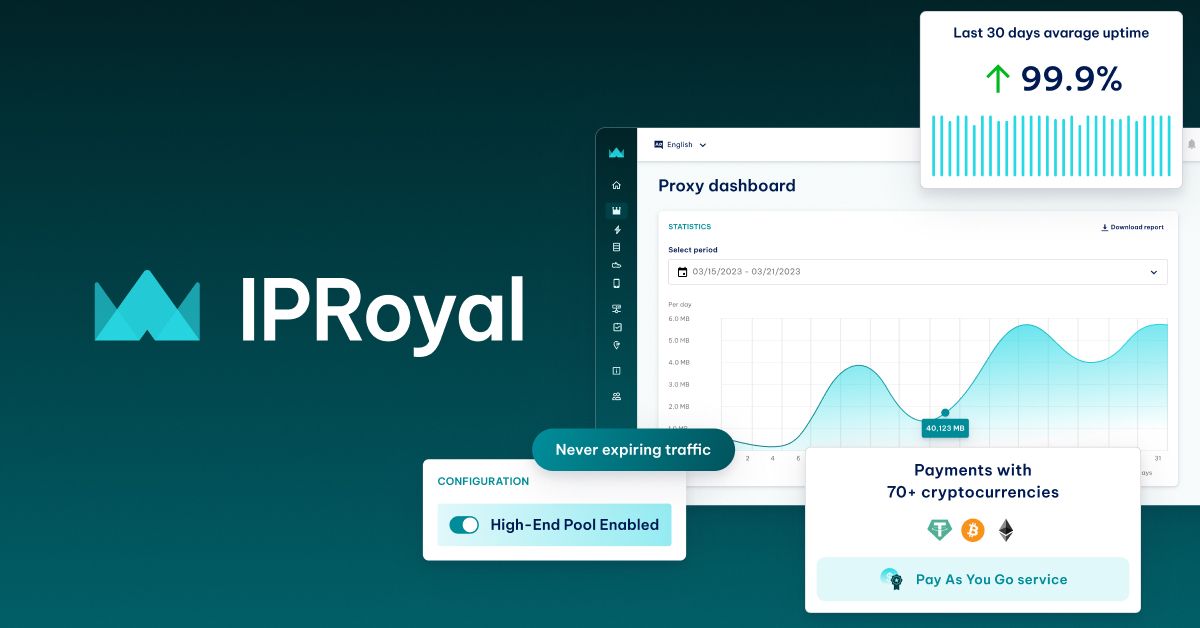
IPRoyal is a proxy-first vendor. Its residential page lists a 64M+ pool, says residential traffic is billed per GB and never expires, and says it allows sticky sessions of up to 7 days. The price ladder is $7.00/GB for 1 GB, $5.95/GB for 2 GB and $5.25/GB for 10 GB, with $1.75/GB available from 10 TB. The page also shows a second price list ($7.35/GB at 1 GB, $6.25 at 2 GB and $1.84 from 10 TB) and the text we fetched did not say which toggle controls it, so we quote the first list.
For agents, IPRoyal is a pipe, not a toolkit. The SmartDataCollective roundup says IPRoyal and SOAX publish MCP servers that search documentation without touching a proxy account. We found no scraping API, unblocker or agent browser in the pages we read, so you bring your own fetcher and browser (see the Playwright example below).
ISP proxies (static residential) are billed per IP rather than per GB, with leases of 1, 30, 60 or 90 days, which suits a logged-in agent that needs one identity for weeks. Our residential proxy guide compares proxy-only vendors in more depth.
| Residential pricing | $7.00/GB at 1 GB; $5.95/GB at 2 GB; $5.25/GB at 10 GB; $1.75/GB from 10 TB (first price list shown) |
| Second price list | $7.35/GB at 1 GB, $6.25/GB at 2 GB, $1.84/GB from 10 TB; the toggle was not explained in the fetched text |
| Pool and sessions | 64M+ IPs (vendor); sticky sessions up to 7 days |
| Traffic expiry | Residential traffic never expires (vendor page) |
| ISP proxies | Billed per IP with 1, 30, 60 or 90 day leases |
| MCP | Documentation-search server (third-party report); no data-fetching MCP found |
- Non-expiring traffic suits bursty agents that run in spurts
- Sticky sessions up to 7 days for long-lived identities
- ISP proxies with day-based leases
- A simple per-GB model with no credits to decode
- No scraping API, unblocker or agent browser in the pages we read
- No data-fetching MCP server confirmed
- $7/GB at 1 GB is high before volume discounts
- Two price lists on one page with no explanation in the fetched text
- KYC and sourcing details were not stated in the text we fetched
Benefits for an agent builder.
- You can buy bandwidth once and use it over months, which is friendly to prototype agents.
- Plain proxy credentials plug into Playwright, Puppeteer or any HTTP client an agent already uses.
- Day-lease ISP proxies cover cases where residential rotation would break a session.
Standout use case. A self-built Playwright agent that needs proxy bandwidth in bursts and does its own unblocking.
Skip it if you want the vendor to unblock, render and parse pages for you, or you want an MCP server that returns page content.
Head-to-Head Matchups
These are the pairings people search for. Each one summarizes the sections above, with the same dated figures, and ends with a pick rule instead of a winner.
Bright Data vs Oxylabs
Both sit at the premium end, both screen customers, and both ship MCP servers. Bright Data's server lists more tools (30 against 10) and 1,200+ pre-built scrapers, and its APIs have free tiers. Oxylabs offers one credit balance across products, AI Studio tools for prompt-driven crawling and browsing, and per-product usage limits it announced on Nov 9, 2026.
On price the picture depends on the plan. Bright Data residential is $8/GB at pay as you go and the monthly plans show $499 for 141 GB, while Oxylabs lists $5/GB for small volumes and $2/GB at 1,250+ GB. Browser traffic is $8/GB at entry on both, with Oxylabs falling to $4/GB at 625+ GB. Bright Data bills Web Unlocker per request ($1.50 per 1K) while Oxylabs bills Web Unblocker per GB ($7.20 at entry down to $3).
Pick Bright Data if you want the larger toolbox and per-request billing. Pick Oxylabs if you want one credit balance and AI Studio's browser agent. Either way, expect a KYC step and test both on your own targets, because we did not.
Oxylabs vs Decodo (and Smartproxy vs Decodo)
Decodo is cheaper at the entry: standard Web Data API requests from $0.15 per 1K against Oxylabs /Scrape from $0.50 per 1K, and residential at $4/GB pay as you go against $5/GB for Oxylabs' smallest tier. Oxylabs offers more AI-oriented tooling (Agent Browser, AI Studio) and a published KYC policy. Decodo's MCP server is smaller but has modular toolsets and Markdown output.
Smartproxy and Decodo are the same company. Decodo's own post, last updated Apr 22, 2025, announces the new name, so older Smartproxy reviews describe the same product line, though prices have since moved.
Decodo vs IPRoyal
These overlap on residential proxies, where Decodo lists $4/GB at pay as you go and $2.75/GB at 100 GB, while IPRoyal lists $5.25/GB at 10 GB and reaches $1.75/GB only from 10 TB. The difference is the layer above: Decodo adds a scraping API and an MCP server that fetches pages, and IPRoyal does not (its MCP server, per a third-party report, searches documentation).
IPRoyal's edge is traffic that never expires, sticky sessions up to 7 days and ISP proxies with day-based leases. Decodo's edge is that you can skip writing a fetcher.
Bright Data vs Apify
Both give an agent one MCP connection to many targets. Bright Data's scrapers are first-party and billed per record ($1.50 per 1K records at pay as you go) with the network included. Apify's Actors come from many authors and are billed per Actor, with proxy traffic at $7 to $8/GB depending on the plan. Apify's MCP repo has 17,617 stars against 2,734 for Bright Data's, which tells you about developer attention and nothing about success rates.
Choose Bright Data when one vendor must own the unblocking. Choose Apify for long-tail sites when you are willing to vet Actors.
Bright Data vs Firecrawl
Firecrawl is a Markdown-first API with no network product of its own, while Bright Data is a network with APIs on top. Firecrawl Standard at $99 covers 100,000 pages scraped, and Bright Data's $499 Web Unlocker plan includes 383K requests. Firecrawl has a keyless MCP tier and an open-source core, while Bright Data's strength on protected sites is a vendor claim we did not test.
A common pairing is Firecrawl for friendly sites and an unblocker from Bright Data, Oxylabs or Zyte for hard ones.
Other Alternatives Worth Considering
Five more products belong in this decision, either because they are the cheapest way to buy bandwidth (Webshare, DataImpulse) or because they sit at a different layer (Apify, Firecrawl, Zyte). Sections are shorter, but each has the same pros, cons and benefits structure.
Webshare: a self-serve ladder from a free plan to $1.40/GB
Webshare sells datacenter, ISP and rotating residential proxies through a self-serve dashboard. Its residential page lists 80M+ IPs and a monthly ladder that starts at 1 GB for $3.50 and falls to $1.40/GB at 3,000 GB. The free plan includes 10 shared proxies and 1 GB of monthly bandwidth with HTTP and SOCKS5 support. Some targets unlock only after a brief KYC procedure, and refunds are limited to cancellations within 2 days of the original payment under stated conditions.
| Rotating residential | 1 GB $3.50; 10 GB $27.50; 25 GB $65; 50 GB $122.50; 100 GB $225; 250 GB $500; 500 GB $875; 1,000 GB $1,500; 3,000 GB $4,200 per month |
| Datacenter | Plans from $2.99 a month for 100 proxies |
| Free plan | 10 shared proxies and 1 GB a month |
| Pool | 80M+ residential IPs (vendor) |
- A transparent monthly ladder with every step listed
- A free plan for experiments
- Datacenter, ISP and residential in one dashboard
- No unblocker, scraping API or MCP server in the pages we read
- Some targets require KYC
- Refund window is 2 days
Benefits for an agent builder.
- Cheap to test a fetch pipeline before you move to a managed API.
Standout use case. Prototype pipelines where the agent drives its own browser and you want a low monthly cost.
Skip it if you need managed unblocking or an agent-facing toolset.
DataImpulse: $1 per GB, no subscription
DataImpulse sells residential proxies at $1 per GB pay as you go with no subscription and no monthly minimum, and you can start with $5. Its page claims a first-party pool of 90M+ ethically sourced IPs in 195 countries, free country targeting and 500,000+ customers. These are vendor claims we did not verify. We found no unblocker, scraping API or MCP server in the pages we read, so it competes with IPRoyal and Webshare rather than with Bright Data or Apify.
| Residential | From $1/GB pay as you go; start with $5; traffic never expires (vendor page title) |
| Pool | 90M+ IPs, 195 countries (vendor) |
- The lowest published entry price per GB in this guide
- No subscription or monthly minimum
- A $5 starting deposit
- No managed unblocker or MCP server found
- Sourcing and success rates are vendor claims
- KYC details were not stated in the text we fetched
Benefits for an agent builder.
- Good for volume jobs where the agent does its own retrying and pages need little unblocking.
Standout use case. Bulk SERP or product checks where bandwidth cost dominates.
Skip it if you need compliance documentation or a tool your agent can call directly.
Apify: an Actor marketplace behind one MCP connection
Apify is a platform where developers publish Actors (scrapers, crawlers and automations) and users run them. The official Apify MCP server lets an agent find Actors in Apify Store, run them and read structured results, so you do not install one MCP server per website. The hosted endpoint is mcp.apify.com, the repo is MIT licensed, and it had 17,617 GitHub stars on Nov 24, 2026.
Pricing mixes a platform plan with per-Actor charges. Plans are Free ($0 with $5 of usage), Starter ($19), Scale ($199) and Business ($999). Most Actors use pay-per-event pricing listed on the Actor's page; the pricing page gives Instagram Scraper at $2.30 per 1,000 results as an example, so 10,000 results cost $23. Cost per run varies by Actor, so read the Actor page before you let an agent loose.
| Plans | Free $0 (with $5 of usage); Starter $19; Scale $199; Business $999 per month |
| Compute | $0.20 per CU on Free and Starter; $0.16 on Scale; $0.13 on Business |
| Residential proxy | $8/GB Free and Starter; $7.50 Scale; $7 Business |
| Unblocker | $1.50 per 1,000 requests on Free and Starter; $1.25 Scale; $1 Business |
| SERP proxy | $2.50 per 1,000 SERPs on Free and Starter; $2 Scale; $1.70 Business |
| MCP | Hosted at mcp.apify.com or local; thousands of Actors; MIT; 17,617 stars (GitHub API, Nov 24, 2026) |
- Thousands of site-specific Actors reachable from one MCP connection
- A free plan with $5 of usage
- An open-source MCP server with a large community
- Cost depends on each Actor's pricing model
- Quality varies across community Actors
- More moving parts than a single unblocker API
Benefits for an agent builder.
- Saves writing scrapers for niche sites such as maps, social networks or marketplaces.
Standout use case. An agent that needs data from many different sites without custom scraper code.
Skip it if you only need a generic fetch-and-unblock endpoint.
Firecrawl: Markdown out, open source in, and a keyless MCP tier
Firecrawl is a scrape, crawl, search and interact API aimed at LLM pipelines. Plans are Free ($0, 1,000 credits a month), Hobby ($19, 5,000), Standard ($99, 100,000), Growth ($399, 500,000) and Scale ($749, 1,000,000), with lower effective prices when billed annually. The pricing page converts credits as follows: Free is 500 searches or 1,000 pages scraped, Standard is 50,000 searches or 100,000 pages, and Scale is 500,000 searches or 1,000,000 pages.
Its MCP server lists 34 tools in the full profile and a hosted endpoint at mcp.firecrawl.dev. On the keyless free tier, scrape, search and parse work without an API key (rate limited), while crawl, map and agent still need a key. The server repo had 7,896 stars and the main Firecrawl repo had 208,001 stars on Nov 24, 2026. The main repo is AGPL-3.0, so read that license before self-hosting inside a commercial product. On Nov 18, 2026 Firecrawl announced Firecrawl Local, a rebuilt repo for local scraping that it says is 100% open source (see the post below).
| Plans | Free $0 (1,000 credits); Hobby $19 (5,000); Standard $99 (100,000); Growth $399 (500,000); Scale $749 (1,000,000) per month |
| Concurrency | 2, 5, 25, 50 and 100 concurrent requests from Free to Scale |
| MCP | 34 tools in the full profile; hosted keyless endpoint exposes 3 tools; MIT; 7,896 stars |
| Open source | Main repo AGPL-3.0, 208,001 stars (GitHub API, Nov 24, 2026) |
- LLM-ready Markdown output
- A keyless MCP tier for quick tests
- A self-host option
- Search, scrape, crawl and interact in one API
- No proxy network product to buy on its own
- Credit math differs by feature
- AGPL license on the main repo
Benefits for an agent builder.
- The fastest route to clean text for RAG without managing proxies yourself.
Standout use case. RAG ingestion and research agents that need clean Markdown from public pages.
Skip it if you need a residential proxy network or site-specific structured datasets.

Zyte: pay per successful response, priced by site difficulty
Zyte API prices by response and by how hard the site is. Its pricing page advertises from $0.06 per 1,000 successful responses and $5 of free credit with 30 days to try it, no commitment. On pay as you go, HTTP response body prices run through five tiers: $0.13 (simple), $0.23 (easy), $0.44 (moderate), $0.70 (complex) and $1.27 (advanced) per 1K. At a $500 commitment the same tiers cost $0.06, $0.11, $0.21, $0.34 and $0.61. We found no official Zyte MCP server in the pages we read. Zyte replaces NetNut in this guide, for the reason explained in the dropped-vendors section.
| Pay as you go | $0.13 to $1.27 per 1K by tier (HTTP response body) |
| $500 commitment | $0.06 to $0.61 per 1K by tier |
| Trial | $5 free credit; 30 days; no commitment (vendor page) |
- Pay per success with difficulty tiers
- Free credit to test
- Volume commitments cut the per-1K price
- No official MCP server confirmed
- The tier depends on the target site, so a quote needs a URL
- Browser-rendered requests are priced higher
Benefits for an agent builder.
- Predictable cost per page for scraping fleets that do not need a proxy product.
Standout use case. Large-scale extraction where you want to pay only when a response succeeds.
Skip it if you need an MCP server out of the box or a residential proxy product.
Who We Dropped and Why
The research notes for this article listed NetNut as the sixth item. We dropped it. Krebs on Security reported on July 2, 2026 that the FBI said it worked with industry partners to seize hundreds of domains associated with NetNut, a residential proxy service operated by the Israeli company Alarum Technologies, and that security firms had connected the network to the Popa botnet, which Krebs describes as at least two million compromised devices. The NetNut homepage we fetched on Nov 24, 2026 still shows a seizure banner from the Federal Bureau of Investigation. Alarum told Krebs it was aware of the seizure and cooperating with law enforcement. We replaced NetNut with Zyte, which sells a different layer but is a real, current product with public pricing.
We also left out vendors that belong to adjacent guides. Search APIs such as Exa and Tavily appear in autocomplete for these queries, but they return search results rather than unblock pages, so they live in our web search API guide. Hosted browsers such as Browserbase are covered in browser infrastructure for AI agents. Other proxy vendors, including Geonode, Rayobyte and Infatica, are in the residential proxy guide.
Compliance and Sourcing
Proxy vendors differ in how they screen customers and how they source IPs, and the NetNut seizure shows why a buyer should care. Bright Data's FAQ says the KYC process may include a quick intro video call and some verification of your company or personal information. Oxylabs says every customer has to answer a KYC questionnaire and that it may refuse service if a use case looks inappropriate, suspicious or unethical. SOAX says most KYC checks happen in the background, with more detailed verification when addressing potential abuse. Webshare says certain targets can be unblocked after a brief KYC procedure. We found no KYC wording on the Decodo, IPRoyal or DataImpulse pages we read, which does not mean none exists.
On sourcing, DataImpulse says its pool is first-party and ethically sourced, and Decodo and Oxylabs both describe their pools as ethically sourced. All of these are vendor claims and none is independently audited in this article. A buyer with a compliance team should ask for the sourcing policy in writing, ask whether any traffic is resold from another network, and ask what happens when a user withdraws consent. Our residential proxy guide spends more space on this question.
A practical point for agent builders: the more autonomy you give an agent, the more the customer screening of your vendor becomes your problem too, because the agent decides which sites to hit. Keep an allowlist of domains where you can, log every URL the agent requests, and set the vendor spend or usage cap before you give an agent credentials.
Pricing Table
List prices as of Nov 24, 2026. Where a page showed a promo code or a plan-dependent rate, the cell gives the range. None of these figures include tax.
| Vendor | Residential or proxy | API or unblocker | Browser | Free tier, trial or entry |
|---|---|---|---|---|
| Bright Data | PAYG $8/GB; $499/mo for 141 GB; $999 for 332 GB; $1,999 for 798 GB | Web Unlocker $1.50 per 1K; $499/mo includes 383K then $1.30 per 1K | Browser API $8/GB; $499/mo includes 71 GB | Free: 5K MCP requests, 5K unlocker requests, 5K scraper credits |
| Oxylabs | $5/GB (to 3 GB), $4 (to 25 GB), $3.50 (to 142 GB), $2 (1,250+ GB) | /Scrape from $0.50 per 1K; Web Unblocker $7.20 to $3/GB | Agent Browser $8 to $4/GB | $5 welcome credits; plans $15, $100, $500, from $2,500 |
| Decodo | PAYG $4/GB; $11.25 for 3 GB to $2/GB at 1,000 GB | Web Data API from $0.15 per 1K; plans from free to $999/mo | No separate browser product in text we read | Free API plan; 3-day 100 MB residential trial |
| SOAX | Tier 1 $5.00 to $0.85/GB by plan; plans $200 to $3,000/mo | None in text we read | None in text we read | Free Sandbox; 60-day credit rollover |
| IPRoyal | $7.00/GB (1 GB) to $1.75/GB (10 TB) | None in text we read | None in text we read | Traffic never expires |
| Webshare | $3.50 for 1 GB; $225 for 100 GB; $4,200 for 3,000 GB per month | None found | None found | Free: 10 shared proxies, 1 GB a month |
| DataImpulse | $1/GB PAYG; start with $5 | None found | None found | No subscription or minimum |
| Apify | Proxy $8/GB (Free, Starter) to $7/GB (Business) | Unblocker $1.50 to $1 per 1K; Actors priced individually | Via Actors | Free plan with $5 of usage; $19, $199, $999 plans |
| Firecrawl | No proxy product | $19 (5,000 credits) to $749 (1,000,000 credits) per month | Concurrency 2 to 100 | Free: 1,000 credits a month |
| Zyte | No proxy product | $0.13 to $1.27 per 1K (PAYG); $0.06 to $0.61 at $500 | Browser-rendered priced higher | $5 free credit, 30 days |
Worked Cost Examples
These are arithmetic on the list prices above, not quotes. Rates that depend on a plan tier are marked, and we leave a cell blank when we could not read the number. Real bills will differ with retries, page weight and the target sites.
| Workload | Arithmetic from list prices |
|---|---|
| 100 GB of residential bandwidth | DataImpulse about $100 at $1/GB. Webshare $225 for the 100 GB monthly step. Decodo $275 for the 100 GB plan. SOAX Builder shows $300 total for 100 GB on its calculator. Oxylabs: the $3.50/GB tier covers up to 142 GB, so roughly $350 of credits, but which plan unlocks that rate is not stated in the text we read. Bright Data: $800 at the $8/GB PAYG list rate, or $499 for the 141 GB monthly plan. IPRoyal: the 100 GB step was not in the text we fetched, so no figure. |
| 1 million simple page fetches through an API | Zyte tier 1 PAYG about $130 (1,000 x $0.13). Oxylabs /Scrape about $350 at the $0.35 per 1K band (up to 1.43M results), plan fee not included. Decodo: the $249 plan lists up to 1.2M pages scraped. Firecrawl: the $749 Scale plan covers 1,000,000 pages scraped. Bright Data Web Unlocker: $1,301.10 on the $499 plan ($499 for 383K plus 617K at $1.30 per 1K) or $1,500 at PAYG. |
| 1 million hard-site fetches | Zyte tier 5 PAYG about $1,270 (1,000 x $1.27). Oxylabs Google with JavaScript about $1,350 at the entry band of $1.35 per 1K, falling at higher volumes. Bright Data lists a flat $1.50 per 1K for Web Unlocker on the pages we read, so compare it against Zyte's tiers on your own hard targets. |
| 10 GB of agent browser traffic | Bright Data Browser API $80 at $8/GB PAYG. Oxylabs Agent Browser $75 of credits at the $7.50/GB band (up to 13 GB), plan fee extra. |
Agent Tasks Mapped to Layers
Vendor feature lists do not tell you which product an agent needs on a Tuesday afternoon. Here is how common agent tasks map onto the layers above. These are our reading of the vendor documentation, not measured results.
Live search and grounding. An agent that answers questions with fresh web results wants a search call and a page fetch, ideally returned as Markdown. Bright Data's MCP lists web search and scrape-to-Markdown tools, Oxylabs has google_search_scraper and ai_search, Decodo has a search toolset, and Firecrawl has search and scrape on its keyless hosted tier. If this is your only task, a Markdown-first API is simpler than a proxy network.
Price and catalogue monitoring. The agent revisits the same product pages on a schedule. Structured scrapers help here because the model does not have to parse HTML. Bright Data's README lists pre-built scrapers for Amazon, Zillow, Crunchbase and other sites, Oxylabs has amazon_search_scraper and amazon_product_scraper, Decodo lists an ecommerce toolset, and Apify has Actors for many marketplaces. Check the per-record price, because a monitoring job multiplies it by every product and every run.
Multi-step browsing. Logging in, paginating, filling forms or clicking through a checkout is where a plain fetch fails. Bright Data's README groups 14 scraping_browser tools for interactive sites, Oxylabs lists ai_browser_agent and sells Agent Browser, and Firecrawl lists an interact capability. These are billed per GB or per credit, so budget for page weight.
Social and platform data. Scrapers for TikTok, Instagram, Reddit or YouTube change often. Apify's marketplace model and Bright Data's 1,200+ scrapers both put the maintenance burden on the vendor or the Actor author, which is the point. Decodo lists a social_media toolset as well. Ask how quickly each vendor repairs a scraper after a site change, because that is not on any pricing page.
Geo-specific results. Local prices, local search results and ads depend on where the request exits. Bright Data lists free country, state, city and ZIP code targeting on residential, Oxylabs announced geohash targeting on Nov 12, 2026, Webshare lists country, city, state, ZIP and ASN targeting, and SOAX lists Country, Region, City and ISP targeting.
Bulk crawling for RAG. Large crawls care about cost per thousand pages, concurrency and clean output. Firecrawl's credit plans and Decodo's page ceilings are written in pages, Zyte prices by tier, and DataImpulse or Webshare make sense only if you already have a fetcher that handles retries.
MCP Server Scoreboard
GitHub stars, licenses and last-push dates come from the GitHub API on Nov 24, 2026. Tool counts come from each README. Stars measure attention, not quality or uptime.
| Vendor | What the agent can do | How it connects | Free access | License | Stars |
|---|---|---|---|---|---|
| Bright Data | 30 tools: search, scrape to Markdown, browser, structured scrapers, LLM prompts | Hosted URL with token, or npx | 5,000 requests a month, no card | MIT | 2,734 |
| Oxylabs | 10 tools in two sets: Web Scraper API and AI Studio | npx or hosted, API token plus AI Studio key | 1-week trial; 1,000 AI Studio credits (README) | MIT | 105 |
| Decodo | Modular toolsets: web, search, ecommerce, social_media, ai | Local config with Decodo credentials | Free Web Data API plan | None shown | 42 |
| SOAX | Documentation search only, 3 tools (third party) | Hosted docs endpoint, no sign-in | Not applicable | Not checked | Not checked |
| IPRoyal | Documentation search only (third party) | Hosted docs endpoint, no sign-in | Not applicable | Not checked | Not checked |
| Apify | Search Store, run Actors, read results; thousands of Actors | Hosted at mcp.apify.com or local | Free plan with $5 of usage | MIT | 17,617 |
| Firecrawl | 34 tools in the full profile; 3 on the keyless hosted tier | Hosted mcp.firecrawl.dev or local | Keyless tier; Free plan 1,000 credits | MIT | 7,896 |
Three observations stand out. First, only Bright Data, Oxylabs, Decodo, Apify and Firecrawl publish a server that returns web content. Second, the tool counts differ for reasons that matter: Oxylabs always lists all 10 tools, so a call without the right credential returns an error, while Firecrawl shows 34 tools in the full profile but only 3 on the keyless hosted endpoint. Third, the Decodo repository shows no license on GitHub, which is worth a question to the vendor before you ship it inside a product. For a broader view of MCP servers for coding agents, see our guide to the best MCP servers for Claude Code.
Feature Matrix
Yes means the vendor lists the capability on the pages we read. Not found means we did not see it, not that it does not exist.
| Vendor | Proxy network | Scraping API | Browser API | MCP server | Residential IPs | Customer screening |
|---|---|---|---|---|---|---|
| Bright Data | Yes | Yes | Yes | Yes (30 tools) | Yes | Yes |
| Oxylabs | Yes | Yes | Yes | Yes (10 tools) | Yes | Yes |
| Decodo | Yes | Yes | No separate product found | Yes (toolsets) | Yes | Not found |
| SOAX | Yes | No | No | Docs only | Yes | Yes |
| IPRoyal | Yes | No | No | Docs only | Yes | Not stated |
| Webshare | Yes | No | No | No | Yes | Yes for some targets |
| DataImpulse | Yes | No | No | No | Yes | Not stated |
| Apify | Yes (add-on) | Yes (Actors) | Via Actors | Yes (hosted) | Yes | Platform terms |
| Firecrawl | No | Yes | Yes (interact) | Yes (34 tools) | No | Platform terms |
| Zyte | No | Yes | Yes | Not confirmed | No | Platform terms |
Best for X
| Situation | Pick | Why |
|---|---|---|
| A Claude or Cursor agent that must search, scrape and click on protected sites | Bright Data or Oxylabs | Both ship MCP servers with browser or AI-agent tools. Expect a KYC step. |
| An agent that needs clean Markdown from public pages for RAG | Firecrawl or Decodo | Markdown output, a keyless MCP tier on Firecrawl and $0.15 per 1K on Decodo. |
| An agent that scrapes many niche sites without custom code | Apify | One MCP connection to thousands of Actors, priced per Actor. |
| A self-built Playwright agent that only needs bandwidth | DataImpulse, IPRoyal, Webshare or Decodo | Buy proxy GB and keep the fetch logic yourself. |
| A shared team account with seats | SOAX | Seats and 60-day credit rollover are part of the plan. |
| Pay only for successful responses at scale | Zyte or Bright Data Web Unlocker | Both bill on success: Zyte by difficulty tier, Bright Data per request. |
| Strict procurement and compliance review | Bright Data or Oxylabs | Published KYC processes. See the residential guide for sourcing questions. |
| The cheapest possible prototype | Firecrawl Free, Decodo Free, Webshare Free or the Bright Data free tiers | Each has a $0 entry point. |
Setup Example: Your Own Browser Through a Proxy
If your agent drives its own browser, the vendor only supplies host, port and credentials. The snippet below uses Playwright for Python. It is a pattern, not a vendor-specific recipe, and we did not run it against any of these vendors for this article. Replace the placeholders with values from your dashboard.
# Playwright (Python): route one browser context through a vendor proxy
# Replace placeholders with the host, port and credentials from your vendor dashboard.
from playwright.sync_api import sync_playwright

PROXY = {
    "server": "http://PROXY_HOST:PROXY_PORT",
    "username": "YOUR_PROXY_USER",
    "password": "YOUR_PROXY_PASSWORD",
}

with sync_playwright() as p:
    browser = p.chromium.launch(proxy=PROXY)
    context = browser.new_context()
    # Per-GB plans bill images, media and fonts too, so block them.
    context.route(
        "**/*",
        lambda route: route.abort()
        if route.request.resource_type in ("image", "media", "font")
        else route.continue_(),
    )
    page = context.new_page()
    page.goto("https://example.com", timeout=45000)
    print(page.title())
    browser.close()
Blocking images, media and fonts matters on per-GB plans, because the meter counts every byte the browser downloads. On per-request plans it matters less, but it still speeds up the page. For the detection side of the problem, read our bot protection guide for AI agents.
Common Mistakes and a Buying Checklist
- Buying bandwidth when you wanted an unblocker, then paying an engineer to rebuild what the vendor already sells.
- Comparing a per-GB price to a per-request price without converting. Use the worked cost examples above with your own page weight.
- Enabling every MCP tool. Use groups or toolsets and keep the model's tool list short.
- Ignoring credit expiry. Oxylabs credits expire at the end of the billing cycle, while IPRoyal and DataImpulse say traffic never expires and SOAX rolls credits over for 60 days.
- Skipping the KYC lead time. Bright Data and Oxylabs both screen customers, so start the process before your launch week.
- Trusting vendor success rates. They are marketing numbers. Run your own test on your own targets with a fixed URL list.
- Letting an agent run without a spend cap. Use the vendor control (Oxylabs usage and spend limits, Bright Data spend cap, Apify usage limit) from day one.
- Forgetting sourcing and legal risk. The NetNut seizure is a reminder to ask where a vendor's IPs come from.
Checklist before you pay:
- Which layer do you need: bandwidth, API, browser or MCP server?
- What does one successful page cost at your page weight, with retries?
- Does the free tier or trial cover a real test on your hardest target?
- What happens to unused credits or traffic?
- Is there a spend or usage cap, and does it apply per product?
- What does customer screening require, and how long does it take?
- What does the MCP server license and tool list look like?
How We Evaluated
We read vendor pricing pages, product pages, help pages and MCP repositories, pulled stars, licenses and push dates from the GitHub API, checked X embeds through the syndication endpoint and YouTube embeds through oEmbed, and confirmed that each image URL returns HTTP 200 with an image content type. All dates are Nov 24, 2026 unless stated.
We did not run hands-on tests. We did not measure success rates, speed, IP quality or MCP tool reliability for any vendor, and we did not sign up for paid plans. Statements about what a product can do are what the vendor or a named third party says. Where vendor pages disagreed (Oxylabs pool size, SOAX entry price, IPRoyal price lists), we say so inline instead of picking one silently. The ranking order in the sections follows the topic brief and our editorial view of agent fit, not a score. No section is sponsored and we use no affiliate links.
FAQ
Bright Data vs Oxylabs: which is better for AI agents?
Neither wins on every axis. Bright Data's MCP server lists 30 tools and 1,200+ pre-built scrapers and bills Web Unlocker per request. Oxylabs offers one credit balance across products and AI Studio tools such as ai_browser_agent and ai_crawler. Both screen customers. Pick on the tools your agent needs and test the free tiers or welcome credits yourself, because we did not run head-to-head tests.
Oxylabs vs Decodo: what is the difference?
Decodo is cheaper at the entry (Web Data API from $0.15 per 1K, residential $4/GB pay as you go) and has a smaller MCP server. Oxylabs is the heavier platform, with Agent Browser, AI Studio and a credit plan that starts at $15 a month. If your agent only needs search and scrape to Markdown, Decodo is simpler. If it needs a prompt-driven browser, Oxylabs has more to offer.
Decodo vs IPRoyal: which should I pick?
If you want a scraping API and an MCP server that fetches pages, pick Decodo. If you only need residential or ISP proxy bandwidth and like traffic that never expires, pick IPRoyal. IPRoyal's MCP server is documentation search only, per a third-party report, so it does not fetch pages for an agent.
Is Smartproxy the same as Decodo?
Yes. Decodo's own post, last updated Apr 22, 2025, says Smartproxy officially introduced the new name Decodo, and its site footer reads decodo.com (formerly smartproxy.com). Treat older Smartproxy reviews as reviews of the Decodo product line and re-check prices, which have changed.
Bright Data vs Apify: when should an agent use each?
Use Bright Data when you want one vendor that owns the network, unblocking, browser and pre-built scrapers. Use Apify when you need long-tail sites and want an agent to find Actors in a marketplace. Apify's cost varies by Actor, so read each Actor's pricing, while Bright Data bills its Web Scraper API at $1.50 per 1K records at pay as you go.
Bright Data vs Firecrawl: do they compete?
Partly. Firecrawl is a Markdown-first scrape, crawl and search API with an MCP server and an open-source core, but it has no proxy network of its own. Bright Data is a network with unblockers and browsers on top. Many teams use a Markdown API for friendly sites and an unblocker for protected ones. We did not run success-rate tests on either.
Does SOAX have an MCP server?
A third-party roundup on Smart Data Collective lists a SOAX documentation MCP server (search docs, read pages, send feedback, no sign-in). We could not confirm it on SOAX's own site: soax.com/mcp returned HTTP 404 on Nov 24, 2026. We found no SOAX MCP server that fetches web data or manages proxies. Check SOAX's developer pages for changes.
Which vendor has the best free tier for testing an agent?
Bright Data lists 5,000 free requests a month on its MCP server and free tiers on its APIs. Firecrawl has a free plan with 1,000 credits and a keyless MCP tier for scrape, search and parse. Decodo has a free Web Data API plan. Webshare has a free plan with 1 GB a month. Oxylabs gives $5 of welcome credits, Apify's Free plan includes $5 of usage and Zyte gives $5 of free credit.
Do I need a residential proxy if I use a scraping API or unblocker?
Usually not. Unblockers and scraping APIs manage IPs for you. You buy a residential proxy when your agent runs its own browser or HTTP client and needs a clean exit IP. Our guide to residential proxies for AI agents covers the proxy-only comparison.
What happened to NetNut?
Krebs on Security reported on July 2, 2026 that the FBI said it worked with industry partners to seize hundreds of domains associated with NetNut, a residential proxy service operated by the Israeli company Alarum Technologies, and tied the network to the Popa botnet. The NetNut homepage we fetched on Nov 24, 2026 still shows a seizure notice. We dropped NetNut from this comparison and added Zyte.
Are these prices final?
No. They are the figures shown on each vendor's pages on Nov 24, 2026. Several vendors show promo codes or plan-dependent rates, and some vendor pages disagree with each other, which we point out inline. Check the checkout before you pay.
Can an AI agent still get blocked with a premium proxy?
Yes. IPs are one signal among many. Sites also look at browser fingerprints, TLS, headers and behavior. If a proxy alone fails, move up to an unblocker or a managed browser, and read our bot protection guide for the detection side.
Is scraping with proxies legal?
We are not lawyers. The answer depends on your jurisdiction, the site's terms, the data you collect and how the proxy network sourced its IPs. Use vendors that screen customers, avoid personal data you have no right to collect, and get legal advice for sensitive projects.
Sources
All pages were read on Nov 24, 2026.
- Bright Data pricing and MCP: https://brightdata.com/pricing/proxy-network/residential-proxies (Residential, Web Unlocker, Browser API, Web Scraper API pricing pages and https://github.com/brightdata/brightdata-mcp)
- Oxylabs pricing and MCP: https://oxylabs.io/pricing/residential-proxy-pool (Residential, /Scrape, Web Unblocker and Agent Browser pricing pages; https://github.com/oxylabs/oxylabs-mcp; https://oxylabs.io/kyc-and-safety)
- Decodo pricing, rebrand and MCP: https://decodo.com/proxies/residential-proxies/pricing (Residential pricing, Web Data API page, Smartproxy rebrand post and https://github.com/Decodo/mcp-server)
- SOAX pricing and trust pages: https://soax.com/pricing (Pricing page, help page and trust page)
- IPRoyal residential pricing: https://iproyal.com/pricing/residential-proxies/ (Pricing and product pages)
- Webshare pricing: https://webshare.io/pricing (Pricing and residential pages)
- DataImpulse residential: https://dataimpulse.com/residential-proxies/ (Pricing and product pages)
- Apify pricing and MCP: https://apify.com/pricing (https://github.com/apify/apify-mcp-server)
- Firecrawl pricing and MCP: https://www.firecrawl.dev/pricing (https://github.com/firecrawl/firecrawl-mcp-server and https://github.com/firecrawl/firecrawl)
- Zyte pricing: https://www.zyte.com/pricing/ (Zyte API pricing page)
- NetNut seizure report: https://krebsonsecurity.com/2026/07/fbi-seizes-netnut-proxy-platform-popa-botnet/ (Krebs on Security, July 2, 2026)
- Proxy MCP server roundup: https://www.smartdatacollective.com/proxy-mcp-servers-options-what-ai-agent-do/ (Third-party report on SOAX and IPRoyal documentation MCP servers)
- GitHub API: https://api.github.com/ (Stars, licenses and last-push dates for the six MCP and Firecrawl repositories, checked Nov 24, 2026)