Both launch posts first, because they set the framing. Sundar Pichai and Logan Kilpatrick published them within three minutes of each other on November 12, 2026.
Following Carbon + Argon, Gemini 4 Hydrogen brings cutting-edge intelligence to everyone. Built for speed and efficiency for everyday tasks, coding and agentic workflows. Compared to 3.8 Flash, it finishes tasks 2.5x faster. Also has 4 thinking levels, so you only wait and pay
— @sundarpichai November 12, 2026
Introducing Gemini 4 Hydrogen, an extremely capable and fast model built to bring Gemini 4 to everyone! Available to all tiers of Google AI Studio, Gemini API, Gemini for business, the Gemini app, Google Search, and paid Google AI Pro + Ultra subscribers in Google Antigravity.
— @OfficialLoganK November 12, 2026
Short answer
Gemini 4 Hydrogen (API model ID gemini-4-hydrogen) is Google’s fast, lower-priced Gemini 4 model, released November 12, 2026 as the successor to Gemini 3.8 Flash. It costs $1.50 per million input tokens and $7.50 per million output tokens (thinking included), flat across a 1M-token context. It has four thinking levels (low, medium, high by default, and a new xhigh), and it is available on the free tier of the Gemini API and Google AI Studio, in the Gemini app, in Google Search for all users, and in Google Antigravity for paid Google AI Pro and Ultra subscribers.
Four points keep the headline honest. First, Hydrogen is not Google’s strongest model. Google’s own model card says it is adapted from Gemini 4 Carbon, and Google frames Carbon and Argon as the tools for deep, long-horizon reasoning, with Hydrogen as the fast execution model. Second, the headline benchmark claim, that Hydrogen beats Argon on the Artificial Analysis Intelligence Index (51 versus 50 at the default high level, 54 at xhigh), comes from Google’s post, while the independent Artificial Analysis page we read lists the xhigh run only and flags it as very verbose. Third, the benchmark table Google publishes compares Hydrogen with Claude Sonnet 5.5 and GPT-6.1 Terra, picks its own rows, and has Sonnet 5.5 ahead on three of ten. Fourth, the price is low against Carbon and Argon but not against Gemini 3.8 Flash, which stays cheaper until the end of 2026.
We did not run hands-on tests for this guide. Every figure below comes from the source named next to it and is labelled vendor-reported, independent or press. This post sits next to our Gemini 4 Carbon guide and Gemini 4 Argon guide; for the older Flash tier read the Gemini 3.8 Flash guide.
Video: Single-Shot Website: Gemini 4 Hydrogen, an official clip from the Google YouTube channel that Google embeds in its launch post, showing Hydrogen building an e-commerce storefront in one shot with the Gemini front end design skill in Antigravity.
What Google announced
The main source is Koray Kavukcuoglu’s post, Introducing Gemini 4 Hydrogen. Its core message is that frontier models like Carbon and Argon excel at deep, long-horizon reasoning on the hardest problems, while Hydrogen is built for rapid execution across diverse agentic workflows. Google adds that Hydrogen can stand alone as an everyday model or pair with Carbon and Argon as the high-efficiency execution engine. It also says the launch brings Gemini 4 to everyone: all tiers of Google AI Studio, the Gemini API, Gemini for business, the Gemini app, Google Search, and paid Google AI Pro and Ultra subscribers in Google Antigravity.
The headline claims in the post, all Google-reported, are these. Hydrogen scores 51 on the Artificial Analysis Intelligence Index at its default high level, ahead of Argon’s 50, and reaches 54 at xhigh. Against Gemini 3.8 Flash it finishes tasks 2.5 times faster at the default setting, scores 57% on Terminal-Bench 4.1 versus 18.2%, and cuts fabricated claims by more than 5x. It batches file-read and search calls in parallel, and Google says early partner tests on complex graphs, SQL and data-heavy enterprise workflows saw Hydrogen run 2x to 2.8x faster with 12% to 23% fewer tokens than 3.8 Flash.
A separate Google Search post by Robby Stein calls Hydrogen the biggest model upgrade to Search yet, available globally to all users, with better intent understanding, improved query fan-out and linking, more visual responses and richer language understanding across supported AI Mode languages. The Antigravity blog adds the Orchestrator model option covered below, and the DeepMind model card carries the benchmark table and safety notes.

| Date | Event | Source |
|---|---|---|
| Mid-Oct 2026 | Gemini 4 Argon launches (exact day not given in the sources we read) | Our Carbon guide |
| Oct 28, 2026 | Gemini 4 Carbon announced | Our Carbon guide; Google blog |
| Nov 10, 2026 | Carbon generally available at $2/$10 introductory pricing | Our Carbon guide; pricing page |
| Nov 12, 2026 | Hydrogen announced and rolled out across API, app, Search and Antigravity; model card published | Google blog; model card |
| Nov 30, 2026 | Carbon and Argon introductory $2/$10 pricing ends | Gemini API pricing page |
| Dec 31, 2026 | Gemini 3.8 Flash $0.75/$3.75 pricing ends | Gemini API pricing page |
| Jan 1, 2027 | Gemini 3.8 Flash rises to $1.50/$7.50, equal to Hydrogen | Gemini API pricing page |
Hydrogen vs Carbon, Argon and 3.8 Flash
The Gemini 4 family now has three tiers that share the same API design, the same 1M unified context window and the same built-in tools. Google’s What’s new page tells you to pick the one that matches your reasoning depth, latency and cost target. Gemini 3.8 Flash is the model Hydrogen replaces.
| Model | Model ID | Price per 1M tokens (in / out) | Thinking levels | Positioning (Google) |
|---|---|---|---|---|
| Gemini 4 Hydrogen | gemini-4-hydrogen | $1.50 / $7.50, flat across 1M context | low, medium, high (default), xhigh | Fast, efficient execution: everyday coding, interactive web apps, tool-using agents, multimodal document work, parallel sub-agents |
| Gemini 4 Carbon | gemini-4-carbon | $2 / $10 through Nov 30, 2026; $4 / $20 from Dec 1 | low, medium (default), high | Strongest frontier model: hard architecture, debugging, science and security audits |
| Gemini 4 Argon | gemini-4-argon | $2 / $10 through Nov 30, 2026; $4 / $20 from Dec 1 | low, medium (default), high | Most advanced long-horizon tasks with lower token use than Carbon |
| Gemini 3.8 Flash | gemini-3.8-flash | $0.75 / $3.75 through Dec 31, 2026; $1.50 / $7.50 from Jan 1, 2027 | Defaults to medium | Previous Flash tier; Google recommends Hydrogen as the upgrade |
Two things stand out. Hydrogen is 25% cheaper than the Carbon and Argon introductory price and 62.5% cheaper than their December price ($1.50 against $4 and $7.50 against $20), so on list price it is 37.5% of what Carbon will cost from December 1. And its default thinking level is higher than theirs: Google’s migration notes say Hydrogen defaults to high and supports xhigh, whereas Carbon and Argon default to medium and cap at high. That difference matters when you compare cost per task, because a request that you left on defaults is not the same amount of thinking.
Google’s recommended workflow is to pair them: let Carbon plan system interfaces or resolve hard roadblocks, then hand code edits, parallel sub-agent work and test runs to Hydrogen. That is the logic behind Orchestrator. If you only ever need one model, Hydrogen is the default Google recommends for most upgrades from Gemini 3.8 Flash and earlier. Keep Gemini 3.5 Flash-Lite (gemini-3.5-flash-lite) for high-volume classification, routing and sub-second latency targets, per the same page.
Specs and model ID
The exact Gemini API model ID is gemini-4-hydrogen. It is the model code on the model page, in the quickstart on the What’s new page and in the AI Studio deep link on the pricing page. The model page lists one stable version with that same string. We did not find a separate dated or preview alias.
| Property | Value | Source |
|---|---|---|
| Model ID | gemini-4-hydrogen | Gemini API model page |
| Based on | Adapted from Gemini 4 Carbon | DeepMind model card |
| Inputs | Text, image, video, audio and PDF | Gemini API model page |
| Output | Text only (no image generation, no audio generation) | Gemini API model page |
| Context window | 1,048,576 tokens, one window shared by input, thinking and output | Gemini API model page |
| Max output | 65,536 default synchronous; up to 1,048,576 with long decode | Gemini API model page |
| Thinking levels | low, medium, high (default), xhigh; minimal is rejected | What’s new page |
| Knowledge cutoff | March 2026 (some domains may be less current) | DeepMind model card |
| Tools | Function calling, code execution, computer use, structured outputs, URL context, file search, Grounding with Google Search and Google Maps, agentic video understanding | Gemini API model page |
| Not supported | Live API, explicit context caching, image generation, audio generation | Gemini API model page |
| Consumption options | Standard, Batch API, Flex inference, Priority inference | Gemini API model page; pricing page |
| Weights | Proprietary and hosted; Artificial Analysis lists it as proprietary | Artificial Analysis |
Pricing and cost examples
The pricing page gives Hydrogen one standard rate on the paid tier across the whole 1M context, with no introductory period. The free tier is free of charge and rate limited. Like the other Gemini 4 models, Google counts and bills every token the model processes, including thinking tokens and the internal tool system instructions and function declarations that grounding adds. Grounding with Google Search is not available on the free tier; on the paid tier it includes 5,000 free requests a month shared across Gemini 3 and newer models, then $14 per 1,000 requests, with a daily cap of 1,500.
| Item (per 1M tokens) | Free tier | Paid tier |
|---|---|---|
| Input, Standard | Free of charge | $1.50 |
| Output, Standard (thinking included) | Free of charge | $7.50 |
| Cached input (implicit only) | Free of charge | $0.075 |
| Input / output, Batch and Flex | Not available | $0.75 / $3.75 |
| Cached input, Batch and Flex | Not available | $0.0375 |
| Input / output, Priority | Free of charge listed | $2.70 / $13.50 |
| Cached input, Priority | Free of charge listed | $0.135 |
| Content used to improve Google products | Yes | No |
Worked cost examples
These are list-price arithmetic from the table above, not measured bills. A request with 200K uncached input tokens and 30K output tokens (thinking included) costs 0.2 x $1.50 + 0.03 x $7.50 = $0.525 on Standard. If 150K of that input is an implicit cache hit, it falls to 0.05 x $1.50 + 0.15 x $0.075 + 0.03 x $7.50 = $0.075 + $0.01125 + $0.225, about $0.31. On Batch or Flex the uncached version is $0.2625. A long-decode run capped at 262,144 output tokens costs at most about $1.97 in output at Standard rates before input.
For the same uncached 200K-in, 30K-out request, Carbon’s rates ($2/$10, then $4/$20 from December 1) give $0.70 and $1.40. Gemini 3.8 Flash comes to $0.2625 through December 31, 2026 and $0.525 from January 1, 2027, identical to Hydrogen. So if you are on 3.8 Flash today, switching to Hydrogen doubles your per-token cost until the Flash price rises, and the bet is that faster, more accurate runs offset that. Token counts differ between models and thinking levels, so treat these as ceilings for budgeting, not forecasts.
Benchmarks, labelled by source
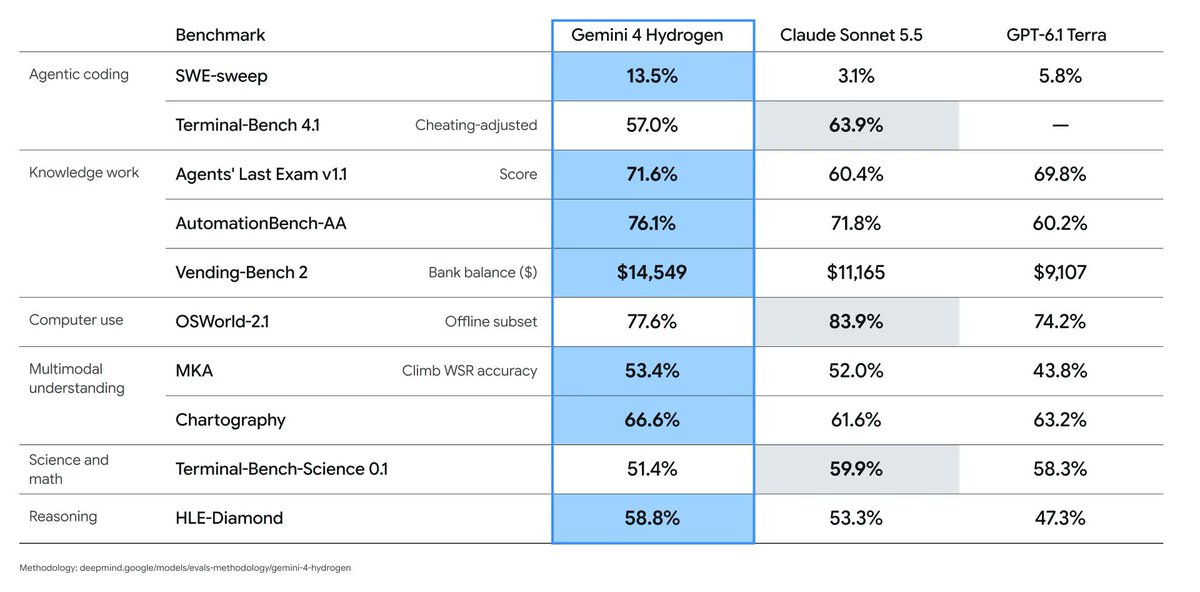
Everything in this section is vendor-reported: Google chose the benchmarks, the rival models and the settings. The table is copied from the DeepMind model card, which compares Hydrogen with Claude Sonnet 5.5 and GPT-6.1 Terra as of November 2026. Methodology notes live on Google’s evals methodology page linked from the card.
| Category | Benchmark (note) | Gemini 4 Hydrogen | Claude Sonnet 5.5 | GPT-6.1 Terra |
|---|---|---|---|---|
| Agentic coding | SWE-sweep | 13.5% | 3.1% | 5.8% |
| Agentic coding | Terminal-Bench 4.1 (cheating-adjusted) | 57.0% | 63.9% | not listed |
| Knowledge work | Agents’ Last Exam v1.1 (score) | 71.6% | 60.4% | 69.8% |
| Knowledge work | AutomationBench-AA | 76.1% | 71.8% | 60.2% |
| Knowledge work | Vending-Bench 2 (bank balance) | $14,549 | $11,165 | $9,107 |
| Computer use | OSWorld-2.1 (offline subset) | 77.6% | 83.9% | 74.2% |
| Multimodal | MKA (Climb WSR accuracy) | 53.4% | 52.0% | 43.8% |
| Multimodal | Chartography | 66.6% | 61.6% | 63.2% |
| Science and math | Terminal-Bench-Science 0.1 | 51.4% | 59.9% | 58.3% |
| Reasoning | HLE-Diamond | 58.8% | 53.3% | 47.3% |
Read the table the way Google’s own claim reads: Hydrogen leads on seven of the ten rows. The widest gap is SWE-sweep, where it has to find and repair a bug without breaking existing code (13.5% versus 3.1% and 5.8%). Claude Sonnet 5.5 leads on Terminal-Bench 4.1, OSWorld-2.1 and Terminal-Bench-Science 0.1, which is where command-line work, computer use and science tasks sit; GPT-6.1 Terra also edges Hydrogen on Terminal-Bench-Science 0.1 (58.3%). The Terminal-Bench 4.1 row is labelled cheating-adjusted and has no GPT-6.1 Terra number. Because these are single numbers from the vendor, without error bars or run counts in what we read, a few points of difference should not decide a purchase.
Other vendor-reported claims from the launch post
| Claim | Number | Notes |
|---|---|---|
| Artificial Analysis Intelligence Index | 51 at high (default), 54 at xhigh; Argon 50 | Google’s statement; AA’s page lists the xhigh run (see next section) |
| Speed versus Gemini 3.8 Flash | 2.5x faster task completion at the high default | Google-reported; not defined per benchmark in the post |
| Terminal-Bench 4.1 versus 3.8 Flash | 57% versus 18.2% | More than triples the Flash score |
| Fabricated claims versus 3.8 Flash | Cut by more than 5x | Google-reported |
| Agent Arena (arena.ai live benchmark) | Rank #5 | Open-ended multi-step tasks such as deep research |
| Vals Tax Agent Bench | 52.3%, #1 overall | As described by Google |
| Vals Legal Research Bench | 55.8%, tied for #1 | As described by Google |
| HLE-Diamond | 58.8%, leads its class | Also in the model card table |
| Partner speed and tokens (early tests) | 2x to 2.8x faster; 12% to 23% fewer tokens versus 3.8 Flash | Partners not named in the post |
| Gemini in Sheets canvas | Outputs over 30% faster than previous models | Google-reported |
| Orchestrator on Terminal-Bench | Near-Carbon success, 24% less quota, 19% faster | Google’s post says 4.0; Antigravity’s post says 4.1 |
One inconsistency is worth flagging. Google’s launch post describes the Orchestrator result on Terminal-Bench 4.0, while the Antigravity blog describes the same 24% and 19% figures on Terminal-Bench 4.1. We repeat both as written and could not tell which is the typo.
Independent data: Artificial Analysis
Artificial Analysis had a page up for the model on launch day. It is titled Gemini 4 Hydrogen (xhigh), so everything below describes the xhigh setting, not the default high level. The index version is v5.0.1, built from nine evaluations: AA-Briefcase v1.1, AutomationBench-AA, Terminal-Bench 4.0, FrontierCode-AA 2.0, AA-Omniscience v1.1, GDP.pdf, HLE-Diamond, CritPt v2 (Hard Subset) and Terminal-Bench-Science 0.1.
| Metric (xhigh) | Value | Context from the page |
|---|---|---|
| Intelligence Index | 54, rank #16 of 78 | Median of comparable models is 41 |
| Output speed | 198 tokens per second | Rank #40 of 77 |
| Time to first answer token | 41.11 s | Reasoning model, so this includes thinking |
| Time per Intelligence Index task | 13.0 minutes | Slightly slower than the 12.9-minute median of comparable models |
| Cost per Intelligence Index task | $3.16 | At $1.50 / $7.50 and a 95% cache discount; rank #41 of 77 |
| Output tokens used on the index | 304M | Median 72.8M; verbosity rank #76 of 77 |
| Context window | 1M tokens | Text, image, speech and video in; text out |
Three readings follow. The index number supports Google’s claim that Hydrogen is competitive at the top setting: 54 is well above that page’s comparison median. The speed picture is mixed: 198 tokens per second is fine, but 13 minutes per task is not faster than average for its class, and a 41-second wait for the first answer token is a reminder that xhigh thinks before it speaks. And the verbosity figure is the caveat that should shape how you test: 304M output tokens is about four times the comparison median, and the page calls the model very verbose. That is why the $3.16 per task, though lower than the $7.76 our Carbon guide recorded from Artificial Analysis for Carbon (high) as of November 11, reflects the verbosity as well as the price. The two runs are at different thinking levels, so this is not a like-for-like comparison.
We did not see an independent score for the default high level on the page we fetched, so Google’s 51 stays vendor-reported here. For the 3.8 Flash comparison there is no third-party number in our sources beyond Box’s eval below.
Thinking levels and when to use each
Thinking level is your main dial for quality, latency and cost. Google says the four levels scale smoothly and predictably, so you pay and wait only for the reasoning depth a task needs, and that across the levels Hydrogen often finishes faster and with fewer output tokens than competing models in its class. Thinking tokens are billed as output, so the level is also a price control.
| Level | Token use | Google’s guidance on when to use it |
|---|---|---|
| low | Fewest tokens, lowest latency | Cost- and latency-sensitive work such as fast chat and high-throughput processing; still capable on agentic tasks |
| medium | Lower token use, faster responses | Interactive coding, live UI prototyping, responsive chat and latency-sensitive tool calls |
| high (default) | Balanced intelligence and speed | The recommended default for most tasks, including complex coding, agentic execution, tool calling and multimodal knowledge work |
| xhigh | Most tokens, deepest reasoning | Hard multi-step coding and agentic problems where high falls short, if you can trade latency and tokens |
Google’s procedure is simple. Start with high, reserve xhigh for problems where high fails, run your evaluations at all four levels with a generous max_output_tokens so the cap does not cut answers short, and then pick the lowest level that meets your quality bar. Google also warns that xhigh can overthink simple prompts. Note that minimal, which some earlier Gemini models accepted, returns an error on Hydrogen.
Third parties give slightly different advice, and it is worth reading both. Cursor’s model page says to keep Hydrogen on high for agentic coding, that quality drops noticeably at medium and low so those suit only simple, latency-sensitive tasks, and that xhigh is for hard debugging at the cost of more thinking tokens and slower responses. Google’s docs, by contrast, name medium as a fit for interactive coding. The two are consistent if you read medium as live prototyping and chat, and high as the setting for multi-step agent runs. Our practical rule: default to high for anything with tools, drop to medium only after your own evals show no regression, and treat xhigh as a retry level, not a default, given Artificial Analysis’s verbosity numbers.
How to use Hydrogen
Google AI Studio (free and paid)
The fastest test is the AI Studio prompt page with the model preselected. Google says Hydrogen is on the free and paid tiers there, so you can try it without billing set up, within the free-tier rate limits and with the free-tier data-use terms noted above.
Gemini API: Python quickstart
Google’s quickstart uses the Interactions API. By default the model runs at high thinking with a 64K synchronous output limit. Install the latest google-genai SDK, set GEMINI_API_KEY, and run:
from google import genai

client = genai.Client()

interaction = client.interactions.create(
    model="gemini-4-hydrogen",
    input="Build an interactive single-file HTML token bucket rate-limiter simulator with live sliders for burst size and request traffic.",
)

print(interaction.output_text)
To change the thinking level, set it in generation_config. Output limits count thinking plus answer, so leave room:
from google import genai

client = genai.Client()

interaction = client.interactions.create(
    model="gemini-4-hydrogen",
    input="Audit this payment retry queue for race conditions and rewrite the lock acquisition logic.",
    generation_config={
        "thinking_level": "xhigh",  # low | medium | high (default) | xhigh
    },
)

print(interaction.output_text)
Gemini API: curl
The REST call follows the same pattern as our Carbon guide’s example, with the Hydrogen model ID. Google’s docs excerpt we read showed the thinking-level setting only in Python, so check the REST reference before copying the field into a raw request:
curl "https://generativelanguage.googleapis.com/v1beta/interactions" \
  -H "x-goog-api-key: $GEMINI_API_KEY" \
  -H 'Content-Type: application/json' \
  -X POST \
  -d '{
    "model": "gemini-4-hydrogen",
    "input": "Explain the difference between optimistic and pessimistic locking in three short paragraphs."
  }'
Long outputs with background execution
Synchronous responses stop at 65,536 tokens per hop. For longer output, set max_output_tokens above 65,536 (up to 1,048,576 minus your input tokens) and set background to true so Google’s servers continue in 64K hops, or use client-side continuation in the latest SDKs. If you set background without a token cap, the server stops at 65,536. Google recommends background execution for long decode.
import time
from google import genai

client = genai.Client()

interaction = client.interactions.create(
    model="gemini-4-hydrogen",
    input="Generate a complete multi-module migration specification and test suite for this service.",
    background=True,
    generation_config={
        "max_output_tokens": 262144,
        "thinking_level": "high",
    },
)

while interaction.status in ("in_progress", "queued"):
    time.sleep(5)
    interaction = client.interactions.get(id=interaction.id)

# Each 64K continuation hop adds a model_output step, so join them all.
text = "".join(
    content.text
    for step in interaction.steps
    if step.type == "model_output"
    for content in step.content
    if content.type == "text"
)
print(text)
print("Status:", interaction.status)
print("Usage:", interaction.usage)
Pairing Carbon and Hydrogen in one session
Google says you can route planning turns to Carbon and execution turns to Hydrogen in one multi-turn session using previous_interaction_id, or by preserving thought steps in stateless mode. The sketch below is assembled from those documented fields; we have not run it, so test it before relying on it.
from google import genai

client = genai.Client()

# Planning turn on Carbon
plan = client.interactions.create(
    model="gemini-4-carbon",
    input="Read the auth module and write a step-by-step plan to move sessions to signed cookies.",
)

# Execution turn on Hydrogen, continuing the same conversation
build = client.interactions.create(
    model="gemini-4-hydrogen",
    input="Implement step 1 and 2 of the plan and list the tests you would run.",
    previous_interaction_id=plan.id,
)

print(build.output_text)
Google Antigravity and Orchestrator
In Google Antigravity, Hydrogen is rolling out to paid Google AI Pro and Ultra subscribers and to enterprises through Gemini for business. The new Orchestrator entry in the model dropdown pairs Hydrogen with Carbon in one session. Google’s description is dynamic and bidirectional: Carbon starts in a read-only phase to explore dependencies, resolve ambiguities and build a plan with explicit re-planning triggers; Hydrogen takes over to write edits, update packages and run tests; and if Hydrogen hits friction it hands back to Carbon to inspect the state, repair the plan and resume. The Antigravity post contrasts this with a static model router that guesses difficulty from your first prompt and breaks down as agents run longer.
Google reports near-Carbon task success with 24% less quota and 19% faster completion. For parallel work, Carbon can coordinate while Hydrogen powers worker and verifier agents across isolated workspaces. Orchestrator is rolling out for Google AI Ultra subscribers first, with other plans promised later. If you picked up /swarm with Carbon, our Carbon guide covers it, and our Antigravity and Gemini 3.8 Flash integration guide shows the setup the older model used. Antigravity’s SDK also lets you wire the two models by role in code; Google’s demo is an issue-triage system where Hydrogen agents triage and code while a Carbon agent handles larger refactors and security checks.
On the API side, the Antigravity agent in Gemini Managed Agents now uses gemini-4-hydrogen by default, and you can override the underlying model through agent_config. Environment compute is not billed during the preview period, but model inference is charged at standard list rates:
from google import genai

client = genai.Client(http_options={"api_version": "v1beta"})

interaction = client.interactions.create(
    agent="antigravity-preview-09-2026",
    input=(
        "Audit https://web.dev for performance, Core Web Vitals, and SEO. "
        "Format the output as a side-by-side scorecard table with prioritized fixes."
    ),
    environment="remote",
)

print(interaction.output_text)
Gemini app, Search and Google Sheets
In the Gemini app, Hydrogen is in the model dropdown. Free users get it through auto model selection when Google decides it is the right model for the prompt, so you cannot pin it on a free account from what we read. In Google Search it is live globally for all users. In Gemini in Google Sheets it starts with Google AI Pro and Ultra subscribers and eligible business plans. Google’s consumer pitch is closer instruction following across turns, better tool calling, clean tables and visual breakdowns, and working layouts in fewer prompts.
Other tools
Cursor documents Hydrogen as the successor to Gemini 3.8 Flash, available with all agent tools. Cursor lists it as a third-party model, so it is not part of the usage included in Cursor plans. Google’s launch post also lists Android Studio on the paid tier. Box says Hydrogen is coming soon to Box AI. For provider-side options, see our best AI inference providers roundup; Hydrogen itself is a hosted proprietary model, so Google’s API is the first-party route.
Partner results and demos
Box is the only third-party eval with numbers in our sources. On the Box AI Complex Work Eval, a benchmark of realistic document-heavy tasks scored against weighted rubrics and run several times, Box reports Hydrogen at 79% against 74% for Gemini 3.8 Flash, in less than half the time and with about 12% fewer tokens on a typical task. Box’s per-industry examples, all versus 3.8 Flash, are public sector 69% to 95%, healthcare 76% to 81%, technology 68% to 78%, media and entertainment 57% to 76%, and life sciences 56% to 70%. Box says the gain is mostly reading exact rows, lining up records across sources and getting the same answer on every run. This is a partner’s own benchmark, published by the partner, so treat it as one data point.
Google’s demos show what the model is for rather than prove it. The launch post and Google’s YouTube channel show Geminisland, a shared voxel island where one prompt generates structures live; an e-commerce storefront built in one shot with a WebGL2 topographic shader and scrollytelling; Google Sheets turned into an animated pixel canvas; a multi-slide Google Slides deck generated from a YouTube keynote and then audited and fixed by an autonomous loop; a lightning-strike 3D globe with a Web Audio music engine; and an archival sizzle reel about the element. These are curated examples, with no failure rates attached.
Video: Geminisland: Gemini 4 Hydrogen, official, from the Google YouTube channel.
Safety claims
The launch post makes several agent-safety claims, all Google’s own internal evaluations compared with Gemini 3.8 Flash. Hydrogen reduces overreach in agentic tasks by up to 81% and under-service by up to 79%; cuts misaligned actions and task shortcutting across tool-use and coding evaluations by 12x; is up to 2x less likely to bypass permission boundaries on impossible or blocked tasks; and reaches a 96.7% honesty rate on Google’s internal agent honesty evaluation. Google also says it preserves 99.9% chain-of-thought legibility with zero deceptive reasoning edits across more than 200,000 audited turns, is more than 2.3x more resilient on the Gray Swan indirect prompt injection benchmark, and keeps false refusals on HealthBench Pro under 0.4%.
The model card is more measured. Against 3.8 Flash it shows small gains in text-to-text safety (+0.80 points), multilingual safety (+1.10) and a larger gain in image-to-text safety (+7.00), but a lower refusal-tone score (minus 0.65) and higher unjustified refusals (+5.57 points), particularly for multimodal prompts. On frontier safety, Google ran a targeted assessment because it could not rule out that Argon and Carbon reached the CBRN biological and cybersecurity critical capability levels. Hydrogen did not reach either level but did reach the alert thresholds for both, and Google says it continues to deploy mitigations. The full Safety and Security Report was listed as coming in the following days when we read the card.
Migrating from Gemini 3.8 Flash
Google’s checklist covers both the Gemini 3.8 Flash upgrade and the move from or pairing with Carbon and Argon. The Antigravity skill gemini-api-dev can automate the upgrade with a prompt such as the one Google shows in its docs. The manual steps:
- Change the model ID from
gemini-3.8-flashtogemini-4-hydrogen. - Plan for the unified window. 3.8 Flash separated 1M input and 64K output budgets. Hydrogen shares 1,048,576 tokens across input, thinking and output, and keeps a 65,536 default and cap per synchronous call. Remove hardcoded low
max_output_tokenssuch as 8,192 or raise them to 65,536. - Set
thinking_levelon purpose. The default is nowhigh, notmedium;xhighis new;minimalerrors. Testmediumandhighon your own eval suite to balance speed and cost. - Drop explicit caching. Remove
cached_contentfields andcaches.create. Implicit caching works on prompts of at least 4,096 tokens, with a 95% discount on hits. - Remove sampling parameters.
temperature,top_pandtop_kare ignored if sent. - Declare tools natively. Do not tell the model in a system prompt to emit raw JSON tool calls with no declared tools; that can return
MALFORMED_FUNCTION_CALL. Use function calling or structured outputs. - Keep conversation state. Use
previous_interaction_idin the Interactions API. In client-managedgenerateContenthistories, return prior model turns and thought signatures unchanged, and do not copy a signature across parallel function-call parts. - Use background execution for outputs past 64K tokens.
- Re-check billing estimates. Thinking tokens, grounding instructions and function declarations are all billed.
If you already run Carbon or Argon, adding Hydrogen needs no request schema change: set model to gemini-4-hydrogen, set thinking_level when you want medium or xhigh behavior, and note that Hydrogen allows 65,536 tokens per non-streaming hop against 32,768 per non-streaming REST hop on Carbon and Argon.
Limits and caveats
- Mostly vendor benchmarks. The ten-row table, the 2.5x speed claim and the safety figures are Google’s. Artificial Analysis is the only independent source we found, and it covers xhigh only.
- Very verbose at xhigh. Artificial Analysis recorded 304M output tokens on its index against a median of 72.8M, and ranks it #76 of 77 on verbosity. Google’s model card admits the model may use more tokens at higher thinking levels and can be occasionally slow or time out. We did not find an Artificial Analysis token count for the default high level.
- Sonnet 5.5 leads three rows. Terminal-Bench 4.1, OSWorld-2.1 and Terminal-Bench-Science 0.1 go to Claude Sonnet 5.5 in Google’s own table. Coding-agent and computer-use users should test both.
- Higher refusal rate on benign prompts. The model card’s unjustified-refusal figure is 5.57 points worse than 3.8 Flash, especially for multimodal prompts.
- Not a drop-in replacement on cost. Until December 31, 2026, 3.8 Flash is half the per-token price.
- No Live API, image generation, audio generation or explicit caching. Pick another model for those jobs.
- Hallucination is reduced, not removed. The model card lists hallucinations as a known limitation, and the knowledge cutoff is March 2026.
- Access is tiered. Free Gemini app users cannot pin the model; Orchestrator starts with Ultra; Antigravity needs a paid plan; Box AI support is listed as coming soon.
- Safety report pending. The full report was not out when we checked, and Hydrogen reaches the CBRN and cyber alert thresholds.
- Competitor prices unverified. We did not verify Claude Sonnet 5.5 or GPT-6.1 Terra list prices from a primary source, so this guide makes no price comparison with them.
Who should use it
| If you are | Use | Why |
|---|---|---|
| On Gemini 3.8 Flash and want better agent reliability | Hydrogen at high, then test medium | Google reports far higher Terminal-Bench 4.1 and fewer fabricated claims; budget for double the per-token cost until Jan 1, 2027 |
| Building a coding agent with planner and workers | Carbon plans, Hydrogen executes (Orchestrator in Antigravity or role routing in the SDK) | Google’s own multi-model pattern; reported 24% less quota and 19% faster |
| Building an interactive web or UI prototype | Hydrogen at medium or high | Google positions it for live UI prototyping and design-to-code iteration |
| Processing long PDFs, sheets, charts, audio or video | Hydrogen | 1M-token multimodal input, 1M output with long decode, and MKA and Chartography leads in Google’s table |
| Doing hard debugging, security audits or research | Carbon or Argon first, Hydrogen xhigh as a cheaper retry | Google reserves frontier models for the hardest problems |
| Running high-volume classification or routing | Gemini 3.5 Flash-Lite | Google’s docs keep it for the lowest cost and sub-second latency |
| A budget-limited hobby or student project | Hydrogen on the free tier | Free, rate-limited, with data-use terms you should read |
| Needing Live API, image or audio output | A different Gemini model | Hydrogen does not support them |
Verdict
Hydrogen is a clear, sensible product: a Carbon-derived model priced at $1.50 and $7.50, tuned for fast execution, with enough thinking-level range to stretch from chat to hard debugging. The evidence that it is a real step up from 3.8 Flash is decent (Google’s numbers, Box’s eval, and an independent index score of 54 at xhigh), but nearly all of it is vendor-reported or partner-reported, and the one independent page we have flags very high verbosity. It is not the strongest model Google sells, it does not win every row against Claude Sonnet 5.5, and for the next seven weeks it costs twice what 3.8 Flash does.
The practical plan is short. Run a fixed set of your own tasks on Hydrogen at low, medium, high and xhigh, record tokens, minutes and review outcomes, price them at $1.50 and $7.50, and compare against your current model. If you use Antigravity, try Orchestrator before you decide whether to pay for Carbon on every turn. For the surrounding context, read the Carbon versus Claude Fable 5.2 comparison and the Claude Fable 5.2 guide for the high end of the market.
FAQ
What is Gemini 4 Hydrogen?
Gemini 4 Hydrogen is the speed-and-efficiency model in Google’s Gemini 4 family, released November 12, 2026 as the successor to Gemini 3.8 Flash. Google’s model card says it is adapted from Gemini 4 Carbon. It is built for everyday coding, tool-using agents and multimodal knowledge work, and it can also act as the fast execution model next to Carbon and Argon.
What is the Gemini API model ID for Hydrogen?
gemini-4-hydrogen. That string is the model code on Google’s model page, the What’s new page and the pricing page. The model page lists a single stable version with that same ID.
How much does Gemini 4 Hydrogen cost?
$1.50 per million input tokens and $7.50 per million output tokens (thinking tokens included) on the paid tier, flat across the whole 1M-token context. Cached input is $0.075 per million through implicit caching. Batch and Flex are $0.75 and $3.75, and Priority is $2.70 and $13.50. There is no introductory discount to expire.
Is Gemini 4 Hydrogen free?
On the Gemini API and in Google AI Studio there is a free, rate-limited tier, and Google’s free-tier terms say content may be used to improve its products. In the Gemini app, free users reach Hydrogen through auto model selection when it fits the prompt. Google Search uses it for all users. Google Antigravity needs a paid Google AI Pro or Ultra plan.
Is Hydrogen better than Carbon or Argon?
Not as a rule. Google positions Carbon and Argon for the hardest long-horizon work and Hydrogen for fast execution. Google reports Hydrogen at 51 on the Artificial Analysis Intelligence Index at its default high level versus 50 for Argon, and 54 at xhigh. Carbon scored 60 on the same index in our Carbon guide, so Hydrogen is cheaper and faster rather than stronger.
Does Gemini 4 Hydrogen beat Claude Sonnet 5.5?
Google’s own table, which it picks, has Hydrogen ahead on seven of ten rows against Claude Sonnet 5.5 and GPT-6.1 Terra, and Sonnet 5.5 ahead on Terminal-Bench 4.1 (63.9% vs 57.0%), OSWorld-2.1 (83.9% vs 77.6%) and Terminal-Bench-Science 0.1 (59.9% vs 51.4%). These are vendor-reported numbers; check them against your own tasks.
What are the four thinking levels?
low, medium, high (the default) and xhigh. In the Gemini API you set thinking_level in generation_config. The value minimal is rejected with an error. Google advises starting at high and reserving xhigh for hard multi-step problems, because xhigh adds latency and tokens and can overthink simple prompts.
How is Hydrogen different from Gemini 3.8 Flash?
Google reports 2.5x faster task completion, Terminal-Bench 4.1 at 57% versus 18.2%, and more than 5x fewer fabricated claims. Pricing differs too: 3.8 Flash is $0.75/$3.75 through December 31, 2026, so Hydrogen costs double until the Flash price rises to $1.50/$7.50 on January 1, 2027. Hydrogen also drops explicit caching and ignores temperature, top-p and top-k.
What is Orchestrator in Google Antigravity?
A new model dropdown option that switches between Gemini 4 Carbon and Gemini 4 Hydrogen inside one session: Carbon plans and untangles, Hydrogen edits and runs tests, and control can hand back to Carbon when Hydrogen gets stuck. Google reports near-Carbon task success with 24% less quota and 19% faster completion on Terminal-Bench. Orchestrator is rolling out to Google AI Ultra subscribers.
What is the context window and output limit?
One unified window of 1,048,576 tokens shared by input, thinking and output. The default synchronous output cap is 65,536 tokens. For longer answers you set max_output_tokens above 65,536 and use background execution, which continues in 64K hops, up to 1,048,576 minus your input tokens.
Does Hydrogen support explicit context caching?
No. Google’s notes say cachedContents and caches.create are not supported. Implicit caching runs by default on prompts of at least 4,096 tokens and discounts cached input by 95% on a hit, which is where the $0.075 cached price comes from.
Sources
Sources checked November 12, 2026.
- Introducing Gemini 4 Hydrogen: Google blog, Nov 12, 2026, Koray Kavukcuoglu (announcement, claims, access, safety)
- Google Search gets a major upgrade with Gemini 4 Hydrogen: Google blog, Nov 12, 2026, Robby Stein
- Gemini 4 Hydrogen model card: Google DeepMind (inputs, cutoff, benchmark table, safety table, frontier safety)
- Gemini 4 Hydrogen model page, What’s new in Gemini 4 Hydrogen and pricing: Gemini API docs (model ID, thinking levels, code, migration, prices)
- Gemini 4 Hydrogen and Orchestrator: Google Antigravity blog, Nov 12, 2026
- Gemini 4 Hydrogen (xhigh): Artificial Analysis (independent index, speed, cost, verbosity)
- Gemini 4 Hydrogen in Cursor: Cursor docs (effort levels, billing)
- Gemini 4 Hydrogen brings accuracy and speed to data-heavy enterprise work: Box blog (partner eval, vendor-published)
- X posts: Sundar Pichai and Logan Kilpatrick, Nov 12, 2026
- YouTube: Single-Shot Website and Geminisland, official Google channel