Get the latest on AI, LLMs & developer tools
New MCP servers, model updates, and guides like this one — delivered weekly.
The Short Answer
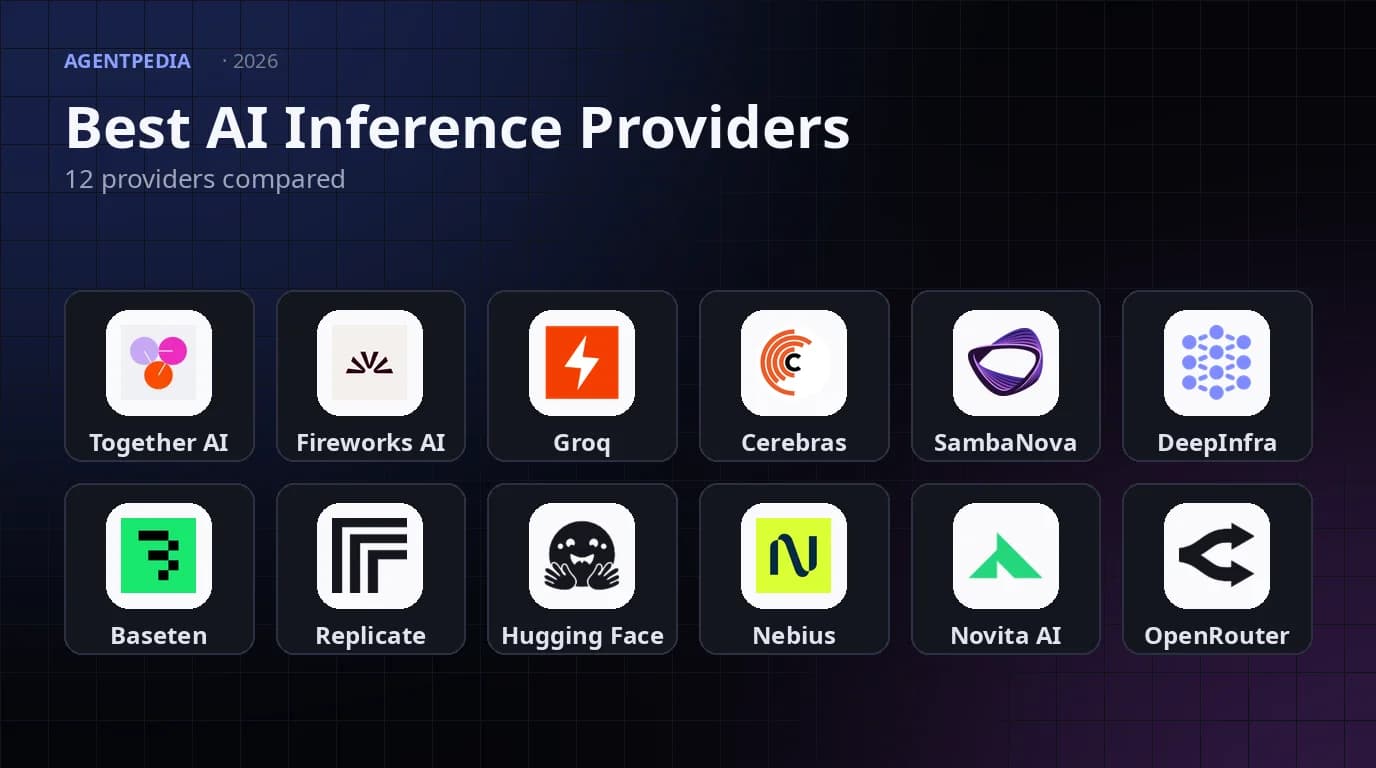
You have picked an open-weight model, such as gpt-oss-120b, DeepSeek V4.1 Flash, GLM-5.3 or Kimi K3, and you do not want to run GPUs yourself. Which hosted API should serve it? The same weights are sold by a dozen companies at very different prices, speeds and accuracy, and the leaderboard changes every few weeks.
Short version, as of Nov 11, 2026: use Cerebras or Groq when first-token latency and raw speed decide the product, use DeepInfra, Novita or Baseten when you want the lowest list price on gpt-oss-120b, and use Together AI or Fireworks AI when you also need fine-tuning, dedicated GPUs and production controls. Use OpenRouter or Hugging Face Inference Providers to test many models behind one key before you commit. If you would rather rent GPUs and run the weights yourself, read our best GPU cloud for AI guide.
Video: a talk by an Artificial Analysis co-founder on why intelligence, reasoning tokens, latency, open weights, cost and inference speed together decide what an application can do. Artificial Analysis is the independent source of the provider benchmarks used below.
Quick Picks
Every row below is a recommendation for one job, taken from the tables later in this guide. None of these providers paid for placement.
| Goal | Pick | Why (evidence) |
|---|---|---|
| Fastest output and lowest first-token latency | Cerebras | On the Artificial Analysis gpt-oss-120b page it finished an Intelligence Index task in 0.9 min with a 1.86 s first answer token, ahead of every other provider listed. |
| Best price per token for gpt-oss-120b | DeepInfra, Novita, Baseten | $0.037/$0.17, $0.05/$0.25 and $0.10/$0.50 per 1M input/output tokens on their own pages, against $0.15/$0.60 at Together, Fireworks and Groq. |
| Best all-round catalog, fine-tuning and dedicated GPUs | Together AI | Serverless, LoRA and full fine-tuning, dedicated H100/B200 at published hourly rates, US geo-pinned options, one billing account. |
| Best for production traffic modes and cost control | Fireworks AI | Standard, Priority, Fast, Batch (50% off) and Spot (30% off) modes on the same endpoint, plus per-GPU-second on-demand deployments. |
| Best for bring-your-own-model production serving | Baseten | Per-minute dedicated GPU pricing from T4 to B200 plus a Model APIs catalog, with custom regions on request. |
| Best for trying many models behind one key | OpenRouter | 600+ models and 80+ providers, inference at provider list price, a 5.5% fee when you buy credits. |
| Best for no extra account when you already use Hugging Face | Hugging Face Inference Providers | Routes to partner providers with no Hugging Face markup; PRO accounts get $2 of monthly credits. |
Master Comparison Table
This table puts all twelve providers side by side. Pricing cells come from each vendor's own pricing or docs page fetched for this guide. Where a page did not state a fact, the cell says so instead of guessing. The speed claims in the last column that are marked vendor-reported come from the vendor, not from an independent test.
| Provider | Pricing model (as of Nov 11, 2026) | Free tier or credit | Fine-tuning | Dedicated endpoints | Regions | Standout |
|---|---|---|---|---|---|---|
| Together AI | Pay per token; gpt-oss-120B $0.15/$0.60 | Free model listed (Ternary Bonsai 27B); no credit amount stated | Yes: LoRA and full, SFT and DPO | Yes: H100 $5.49, B200 $8.99 per GPU-hour | US geo-pinned variants (+25%) | Broad catalog, GPU-hour and token billing in one place |
| Fireworks AI | From $0.05/1M input; gpt-oss-120B $0.15/$0.60 | Prepaid credits, amount not stated | Training API billed per GPU-hour | Yes: on-demand H100 $8.00 to GB300 $20.00 per GPU-hour | Region-restricted at 1.5x; US-only serverless +50% | Standard, Priority, Fast, Batch, Spot modes |
| Groq | gpt-oss-120b $0.15/$0.60 | Developer plan limits published (250K TPM, 1K RPM) | Not documented on pages checked | Contact sales for some models | Not documented on pages checked | LPU hardware, 500 tokens/s listed for gpt-oss-120b (vendor-reported) |
| Cerebras | gpt-oss-120B $0.35/$0.75 | $5 one-time credit with a payment method, 30 days | By agreement (Enterprise) | Enterprise dedicated by quote | Not documented on pages checked | ~3000 tokens/s listed for gpt-oss-120B (vendor-reported) |
| SambaNova | gpt-oss-120b $0.22/$0.59 | Not stated on pages checked | Not documented on pages checked | SambaStack (product listed; pricing not public) | Not documented on pages checked | Few production models, many previews |
| DeepInfra | gpt-oss-120b $0.037/$0.17 | Not stated on pages checked | Not verified | Not verified | Not verified | Lowest list prices on several models |
| Baseten | gpt-oss-120B $0.10/$0.50 | Pay as you go, no contract | Training on dedicated GPUs | Yes: per-minute GPUs, H100 $6.50/h, B200 $9.98/h | Custom regions for production-scale deals | Fast variants of GLM-5.3 and DeepSeek V4.1 Flash |
| Replicate | No per-token LLM prices on pricing page; GPU time billing | Not stated | Fast-booting fine-tunes | Yes: private models on dedicated hardware, H100 $5.49/h | Not documented on pages checked | Cog packaging for custom models |
| Hugging Face Inference Providers | Provider rates passed through, no markup | PRO $2/month, Team and Enterprise $2 per seat | Via partner providers | Inference Endpoints (separate product) | Depends on provider | One token, 200+ models, optional own provider key |
| Novita AI | gpt-oss-120B $0.05/$0.25 | Not stated on pages checked | Not verified | Not verified | Not verified | Batch at an introductory 50% discount |
| Nebius Token Factory | Kimi-K3.1-Pro $2.00/$10.00 shown; most prices need login | Not stated | Yes: serverless SFT and speculator training | Yes: dedicated endpoints, region control | us-north1 shown in catalog | Post-training, Data Lab and batch inference in one console |
| OpenRouter | Provider list price, 5.5% fee on credit purchases | 25+ free models | No | Private Endpoints (Enterprise add-on) | EU and US in-region routing on Business and above | Aggregator over 80+ providers |
Open source is not a differentiator here: all twelve are hosted services. The open part is the model license, and Artificial Analysis lists every endpoint it tracks for these models with an “Open” license. If you need to self-host, the weights are the same; the question is whether you want to operate the GPUs.
Live Prices for Four Open Models
We picked four models that most of these providers host: gpt-oss-120b (the one with the widest support), DeepSeek V4.1 Flash, GLM-5.3 and Kimi K3. Prices are US dollars per 1M tokens, written as input / output, uncached, taken from each provider's page as of Nov 11, 2026. “Not listed” means the model did not appear on the page we fetched, which is not proof that it is unavailable.
| Provider | gpt-oss-120b | DeepSeek V4.1 Flash | GLM-5.3 | Kimi K3 |
|---|---|---|---|---|
| Together AI | $0.15 / $0.60 | $0.30 / $1.20 | $1.40 / $4.40 | $3.00 / $15.00 |
| Fireworks AI | $0.15 / $0.60 | $0.30 / $1.20 | $1.40 / $4.40 | $3.00 / $15.00 |
| Groq | $0.15 / $0.60 | not listed | not listed | not listed |
| Cerebras | $0.35 / $0.75 | not listed | not listed | not listed |
| SambaNova | $0.22 / $0.59 | not listed | $2.80 / $8.80 | not listed |
| DeepInfra | $0.037 / $0.17 | $0.20 / $0.60 (promo $0.14 / $0.42) | $0.90 / $4.00 (promo $0.5625 / $2.50) | $2.85 / $14.25 |
| Baseten | $0.10 / $0.50 | $0.30 / $1.20 | $1.40 / $4.40 | $3.00 / $15.00 |
| Novita AI | $0.05 / $0.25 | $0.30 / $1.20 | $1.40 / $4.40 | $3.00 / $15.00 |
| Replicate | no per-token price | no per-token price | no per-token price | no per-token price |
| Nebius | login required | login required | login required | login required (K3.1 Pro: $2.00 / $10.00) |
Three things stand out. First, Together AI, Fireworks AI and Baseten quote the same list price for DeepSeek V4.1 Flash, GLM-5.3 and Kimi K3 ($0.30/$1.20, $1.40/$4.40 and $3.00/$15.00), so on those models you choose between them on speed, features and caching, not on token price. Second, the price spread opens up on gpt-oss-120b, where input runs from $0.037 to $0.35, almost a tenfold gap. Third, DeepInfra's page shows promotional discounts on some models (for GLM-5.3 it lists $0.90/$4.00 with a 38% discount to $0.5625/$2.50), which may change at any time, so treat promo numbers as temporary.
Cached input matters more than headline price for agents. Together lists DeepSeek V4.1 Flash cached input at $0.006 per 1M tokens against $0.30 uncached, and Fireworks states that cached input is billed at half price or less with no write fee. An agent that resends a long system prompt every turn pays mostly the cached rate on providers that cache well. Artificial Analysis also publishes a cache hit rate measured over multi-turn agentic sessions (last updated Oct 26, 2026), a useful sanity check on whether a provider's cache works in practice.
Speed and Latency Data (Artificial Analysis, read Nov 11, 2026)
Artificial Analysis runs the same benchmark workload against each provider endpoint every six hours and averages the last five days. Its headline speed metric is now time per task: the output tokens needed for one Intelligence Index task divided by the endpoint's end-to-end output speed, in minutes. Its latency metric is time to first answer token, in seconds. A raw tokens-per-second figure still exists in its charts, but the numbers behind those charts were not available as text on the pages we read, so we report time per task and first-token latency rather than guessing at tokens per second. Lower is better for both.
gpt-oss-120b (high reasoning), the best-covered model
Artificial Analysis lists 16 providers for this model. We show the ones covered in this guide. “Cost per task” is the weighted cost of one Intelligence Index task, which folds in how many tokens each endpoint uses. The accuracy column is the Endpoint Accuracy Index, a percentage of a reference endpoint.
| Provider | Time per task (min) | First answer token (s) | Error rate | Endpoint accuracy | Cost per task |
|---|---|---|---|---|---|
| Cerebras | 0.9 | 1.86 | 0.7% | 92% | $0.76 |
| SambaNova | 3.1 | 5.78 | 0.0% | 99% | $0.49 |
| Groq | 3.3 | 4.98 | 3.5% | 90% | $0.32 |
| Nebius (Base) | 5.7 | 11.74 | 7.5% | 102% | $0.35 |
| Baseten | 6.0 | 10.70 | 6.3% | 100% | $0.24 |
| Novita | 7.3 | 12.67 | 2.1% | 93% | $0.12 |
| Together AI | 18.9 | 38.43 | 7.5% | 81% | $0.35 |
| DeepInfra (cheaper endpoint) | 40.9 | 63.91 | 11.5% | 98% | $0.09 |
| DeepInfra (other endpoint) | 39.8 | 50.58 | 9.8% | 85% | $0.35 |
The pattern is clear. Cerebras, SambaNova and Groq finish a task in 0.9, 3.1 and 3.3 minutes, with first answer tokens at 1.86, 5.78 and 4.98 seconds. Cerebras is 45.4 times quicker than the slowest DeepInfra endpoint at 40.9 minutes. The cheapest per-token providers are slower: DeepInfra's cheaper endpoint takes 40.9 minutes and shows an 11.5% error rate in the sampled window. Cerebras is the most expensive per task here at $0.76 and is also the one with the highest blended token price ($0.39 per 1M against $0.044 for CoreWeave, per the Artificial Analysis FAQ), and its accuracy index of 92% sits below SambaNova (99%), Baseten (100%) and Nebius (102%).
Two lessons follow. Speed costs money on the specialized-silicon providers, and the cheapest endpoint is not automatically the cheapest per finished task when the model takes longer or the endpoint fails more often. Error rates also vary: SambaNova recorded 0.0% and Cerebras 0.7% in the window, against 6.3% for Baseten, 7.5% for Together AI and 11.5% for one DeepInfra endpoint. A five-day average can move, so rerun the check before a big commitment.
GLM-5.3 (max reasoning), a heavier model
GLM-5.3 has 29 tracked providers on the same site. Reasoning-heavy models spend most of their latency thinking, so first answer tokens are tens of seconds even on fast hosts. Providers in this guide:
| Provider | Time per task (min) | First answer token (s) | Error rate | Endpoint accuracy | Cost per task |
|---|---|---|---|---|---|
| Fireworks | 8.9 | 24.18 | 0.0% | n/a | $10.32 |
| Baseten (faster endpoint) | 8.0 | 17.67 | 3.3% | 98% | $9.52 |
| Baseten (slower endpoint) | 24.6 | 59.47 | 1.2% | 97% | $3.45 |
| Nebius | 13.2 | 35.25 | 0.0% | 99% | $4.92 |
| Together AI | 13.5 | 48.03 | 1.1% | 97% | $4.92 |
| Novita | 17.5 | 58.89 | 0.0% | 96% | $5.00 |
| DeepInfra | 25.7 | 73.37 | 1.3% | 96% | $2.39 |
Fireworks and the faster Baseten endpoint finish a task in 8.9 and 8.0 minutes, while DeepInfra takes 25.7 but costs $2.39 per task against $9.52 for the fast Baseten endpoint and $10.32 for Fireworks. This is the same trade-off as before: you can buy speed, and the price of a finished task rises with it. For Kimi K3 the Artificial Analysis first-answer-token figures were Baseten 20.02 s, Fireworks 40.57 s, Together AI 50.12 s and Nebius 70.77 s, and for DeepSeek V4.1 Flash Together AI was 21.79 s and DeepInfra 49.85 s. Cost per task was not populated on those two pages when we read them, so we do not rank them on cost.
Vendor-reported speeds, for context only: Cerebras lists about 3000 tokens/s for gpt-oss-120B and about 1,850 tokens/s for Qwen 3.8 27B on its pricing page, Groq lists 500 tokens/s for gpt-oss-120b and 450 for Qwen3.8-27B on its models page, and Nebius shows 195 tokens/s next to Kimi-K3.1-Pro in its catalog. Fireworks describes its Fast mode as 100+ tokens per second. These are vendor-reported and use different methods, so do not compare them with each other or with the Artificial Analysis end-to-end numbers.
Together AI
Together AI is the closest thing to a general-purpose open-model cloud in this list. It sells serverless tokens, fine-tuning and dedicated capacity from one account, and its catalog on the pricing page spans gpt-oss-120B, the DeepSeek V4 family, GLM-5.2 and 5.3, Kimi K3 and K3.1 Pro, and several Qwen models. A free model (Ternary Bonsai 27B) is listed at $0 for both input and output.
Pricing (as of Nov 11, 2026): gpt-oss-120B $0.15/$0.60, DeepSeek V4.1 Flash $0.30/$1.20 with $0.006 cached input, GLM-5.3 $1.40/$4.40, Kimi K3 $3.00/$15.00. Some models have US geo-pinned variants priced 25% higher, for example DeepSeek V4.1 Flash at $0.375/$1.50. Fine-tuning is billed per training token: Llama 3.3 70B costs $2.03 per 1M tokens for SFT and $5.08 for DPO with a $4.00 minimum, and gpt-oss-120B costs $2.50 for SFT and $6.25 for DPO with a $6.00 minimum. Dedicated GPUs are listed at $5.49 per hour for HGX H100 and $8.99 for HGX B200, with H200 and B300 by contact, plus reserved throughput units for capacity you want guaranteed.
Strengths: the widest set of production features under one roof, published hourly GPU prices, LoRA and full fine-tuning, and geo-pinned options. Weaknesses: on the Artificial Analysis gpt-oss-120b page it was mid-pack on speed (18.9 min per task, 38.43 s first answer token), had a 7.5% error rate in the window and the lowest accuracy index of the providers in this guide (81%). That was one model on one date, but it is a reason to test your own prompts. Best for: teams that want to prototype, fine-tune and deploy on one platform. The fetched pricing page does not state a free credit amount.
Fireworks AI
Fireworks sells the same open models with a stronger emphasis on production controls. Its pricing page says serverless starts from $0.05 per 1M input tokens, and each request can pick a mode on the same endpoint: Standard, Priority, Fast (100+ tokens per second, vendor-reported), Ultra-fast (preview), Batch (50% off input and output) or Spot (30% off Standard, best effort and for select models, with throughput that can drop to zero).
Pricing: gpt-oss-120B $0.15/$0.60 with $0.015 cached input, GLM 5.3 $1.40/$4.40, Kimi K3 $3.00/$15.00, DeepSeek V4.1 Flash $0.30/$1.20 with $0.006 cached input. Priority adds roughly 20 to 25 percent (gpt-oss-120B Priority is $0.18/$0.72). On-demand GPUs are billed per GPU-second at $8.00 per hour for H100 and H200, $13.00 for B200, $15.00 for B300 and $20.00 for GB300, and idle deployments scale to zero after one hour by default. Region-restricted deployments are priced at 1.5 times, US-only serverless is available on select models at a 50% premium, and the Fireworks Sovereign option (inference in your own cloud account or data center) is in private preview for Enterprise customers.
Strengths: the clearest cost levers (Batch, Spot, cached input with no write fee), SOC 2 Type II, ISO 27001, 27701 and 42001 and HIPAA with a BAA, and first-party availability in Microsoft Foundry so usage counts toward an Azure commitment. It also holds up on reasoning latency: on GLM-5.3 it finished a task in 8.9 minutes with a 24.18 s first answer token and a 0.0% error rate on Artificial Analysis. Weaknesses: GLM-5.3 cost per task was the highest in our table ($10.32), and the on-demand H100 rate is higher than Together's or Baseten's listed rates. Best for: production workloads that mix interactive and batch traffic.
Groq
Groq runs models on its own LPU hardware and, according to its homepage, now pairs it with NVIDIA GPUs through LPX. The models page lists speed per model: gpt-oss-120b at 500 tokens/s, gpt-oss-20b at 1000, Qwen3.8-27B at 450 and Muse Spark Open at 350 (all vendor-reported). Its public pricing is short: gpt-oss-120b $0.15/$0.60, gpt-oss-20b $0.075/$0.30 and Qwen3.8-27B $0.80/$4.00 per 1M tokens, with Llama 3.3 70B, Muse Spark Open and MiniMax M2.7 marked “Contact Sales”. The Developer plan limit for gpt-oss-120b is 250K tokens per minute and 1K requests per minute.
Strengths: second-fastest first answer token on gpt-oss-120b in the Artificial Analysis table (4.98 s), 3.3 minutes per task, and a simple OpenAI-compatible API at https://api.groq.com/openai/v1. Weaknesses: a small model list (several entries are Preview, meant for evaluation only and not for production), a 90% accuracy index on gpt-oss-120b, a 3.5% error rate in the window, and nothing about fine-tuning or regions on the pages we checked. Cost per task was $0.32, so it is not the cheapest. Best for: latency-sensitive chat and voice front ends that fit its model list; see our voice agent platforms guide for where first-token time matters.
Cerebras
Cerebras serves models on wafer-scale chips. Its pricing page has two tiers: Developer, self-serve pay-as-you-go with a one-time $5 credit (needs a payment method, expires after 30 days) for exploration, and Enterprise by quote with production capacity, higher rate limits and, by agreement, custom weights and fine-tuning. The Developer tier is marked as not intended for production. It lists GPT OSS 120B at about 3000 tokens/s for $0.35 input and $0.75 output, and Qwen 3.8 27B at about 1,850 tokens/s for $0.99 and $1.49 (vendor-reported speeds).
Strengths: on Artificial Analysis it was first on both time per task (0.9 min) and first answer token (1.86 s) for gpt-oss-120b, with a 0.7% error rate. Weaknesses: the highest cost per task among the providers we show ($0.76), a 92% accuracy index, only two models on the Developer tier, and no documented regions or self-serve dedicated plan. Best for: products where waiting is the cost, such as real-time agents and interactive code tools, and teams willing to pay more for speed.
SambaNova
SambaNova's SambaCloud runs on its RDU chips. Its docs list three production models (DeepSeek-V3.1, Meta-Llama-3.3-70B-Instruct and gpt-oss-120b) and several previews (MiniMax-M3.1-Flash, DeepSeek-V3.2, gemma-4-31B-it). Pricing on its cloud pricing page is per 1M tokens: gpt-oss-120b $0.22/$0.59, Meta-Llama-3.3-70B-Instruct $0.60/$1.20, GLM-5.3 $2.80/$8.80 with $0.14 cached input, MiniMax-M3.1-Flash $0.30/$1.20 and gemma-4-31B-it $0.38/$1.15. Products named on its site include SambaCloud and SambaStack.
Strengths: on gpt-oss-120b it was second on speed (3.1 min per task) and third on latency (5.78 s, behind Cerebras and Groq), with a 0.0% error rate and a 99% accuracy index in the window, the best reliability-and-fidelity combination among the fast providers. Weaknesses: a short production list, GLM-5.3 priced at double the common $1.40/$4.40, and no public details we could verify on fine-tuning, free credit or regions. Best for: teams that want fast gpt-oss-120b or Llama 3.3 70B with low error rates.
DeepInfra
DeepInfra competes on price. Its model pages list gpt-oss-120b at $0.037 input and $0.17 output, DeepSeek-V3.2 at $0.26/$0.38, DeepSeek-V3.1 at $0.25/$0.95, DeepSeek V4.1 Flash at $0.20/$0.60 (shown with a 30% promotion to $0.14/$0.42), GLM-5.3 at $0.90/$4.00 (38% promotion to $0.5625/$2.50) and Kimi K3 at $2.85/$14.25. Many entries show cached input rates and 1M-token (1024k) context windows.
Strengths: the lowest per-token list price on gpt-oss-120b among these providers and competitive prices on GLM-5.3 and DeepSeek V3.2. On Artificial Analysis it also had the second-lowest cost per gpt-oss-120b task ($0.09). Weaknesses: it was the slowest on gpt-oss-120b (about 40 minutes per task, 50.58 to 63.91 s first answer token), had error rates of 9.8% and 11.5% in the window, and one of its two endpoints scored 85% on the accuracy index. We could not verify fine-tuning or dedicated GPU rates from the pages we read. Best for: cost-first batch jobs that can tolerate slower responses and some retries.
Baseten
Baseten sells both a Model APIs catalog and Dedicated Inference for your own models, plus Training and Sandboxes. Token pricing: gpt-oss-120B $0.10/$0.50, GLM-5.3 $1.40/$4.40 (Fast variant $2.10/$6.60), DeepSeek V4.1 Flash $0.30/$1.20 with cache input $0.007, and Kimi K3 $3.00/$15.00. Dedicated GPUs are billed per minute: T4 about $0.63 per hour, L4 $0.85, A10G $1.21, A100 $4.00, H100 MIG $3.75, H100 $6.50 and B200 $9.98, with CPU instances from about $0.03 per hour. For production scale it offers volume discounts, reserved and priority compute, and custom regions and support.
Strengths: a clear pay-as-you-go path from API to dedicated GPUs, and the “Fast” variants let you buy speed deliberately. On Artificial Analysis its faster GLM-5.3 endpoint finished a task in 8.0 minutes with a 17.67 s first answer token, the best latency among the providers we show for that model, and its gpt-oss-120b endpoint had a 100% accuracy index. Weaknesses: the gpt-oss-120b error rate was 6.3% in the window, and the fast endpoint costs $9.52 per GLM-5.3 task. Best for: teams that start on Model APIs and expect to move to dedicated serving of their own or fine-tuned model.
Replicate
Replicate is an outlier. Its pricing page is built around hardware time rather than tokens: A100 (80GB) at $5.04 per hour, H100 at $5.49, L40S at $3.51, T4 at $0.81 and H200 at $5.49 (H200 and multi-GPU capacity through committed-spend contracts), billed per second. You package a model with the open-source tool Cog. Private models run on dedicated hardware, and you pay for setup, idle and active time, except fast-booting fine-tunes, which bill only while active.
Strengths: any model you can containerize, a good fit for image, audio and custom pipelines next to an LLM, and fine-tunes that do not charge for idle time. Weaknesses: the pricing page lists no per-token prices for public LLMs, Artificial Analysis does not list Replicate on the gpt-oss-120b page, and idle billing on ordinary private models can surprise you. We could not verify regions. Best for: custom or multimodal models, less so for straight chat-completion cost comparison.
Hugging Face Inference Providers
Inference Providers is a router in front of partner providers, reachable with a Hugging Face token at https://router.huggingface.co/v1. Its documentation advertises 200+ models and says Hugging Face charges the same rates as the provider with no additional fees. PRO users get $2.00 of monthly credits, Team and Enterprise organizations get $2.00 per seat, and free users buy credits. You can also set a custom provider key, in which case the provider bills you and the credits do not apply. The built-in hf-inference provider now focuses mostly on CPU inference such as embeddings and small classic models.
Strengths: one account and token across many providers, consolidated billing, and an organization-billing header (X-HF-Bill-To) for teams. Weaknesses: $2.00 of credit is small for real workloads, and you inherit the speed, price and region of whichever provider serves the request. Best for: evaluation and for teams already organized around the Hub.
Novita AI
Novita lists gpt-oss-120B at $0.05 input and $0.25 output, DeepSeek V4.1 Flash at $0.30/$1.20 with $0.006 cache read, GLM 5.3 at $1.40/$4.40 and Kimi K3 at $3.00/$15.00 (with a $0.30 cache read and cache write charges). Its pricing page says batch inference is available at an introductory 50% discount on input and output tokens for supported models. It also lists speed-oriented variants such as Kimi K3.1 Pro Highspeed at $4.00/$20.00.
Strengths: the second-lowest gpt-oss-120b price in our table, a 2.1% error rate and a $0.12 cost per task on Artificial Analysis, which is third-lowest on that chart. Weaknesses: mid-pack speed (7.3 min per task, 12.67 s first answer token), a 93% accuracy index, and on GLM-5.3 a 58.89 s first answer token. We could not verify dedicated endpoints, fine-tuning or regions. Best for: price-sensitive production traffic on gpt-oss-120b.
Nebius Token Factory (formerly AI Studio)
Nebius AI Studio documentation now redirects to Nebius Token Factory, which describes itself as a place to “build, fine-tune, and run open models at production scale”. Features on the docs home page include an OpenAI-compatible API for inference and fine-tuning, serverless post-training (supervised fine-tuning and custom speculator training with per-token pricing), Data Lab for datasets, Batch Inference, Sandboxes, and dedicated endpoints on isolated GPUs with defined scaling, region and performance. Most price tables sit behind a login, so we can only quote what the public catalog shows: Moonshot AI Kimi-K3.1-Pro at $2.00 input, $0.20 cached input and $10.00 output per 1M tokens, the Base flavor at 195 tokens/s (vendor-reported), in region us-north1. The page also notes that some serverless endpoints are deprecated and removed on November 9.
Strengths: strong Artificial Analysis accuracy on gpt-oss-120b (102%) and GLM-5.3 (99%), 0.0% GLM-5.3 error rate, and a full path from fine-tuning to dedicated serving. Weaknesses: gpt-oss-120b error rate of 7.5% in the window, 70.77 s first answer token on Kimi K3, and pricing that needs an account to read. Best for: teams that want fine-tuning and dedicated endpoints in one console.
OpenRouter (as aggregator)
OpenRouter does not host models itself. It routes your request to one of 80+ providers across 600+ models and bills at the provider's list price. Its fee is charged when you buy credits: 5.5% on Standard and 8% on Business, with Enterprise fee discounts by contract. The Free tier offers 25+ free models from 4 free providers. Standard adds auto-routing, preferred vendor selection, budgets and spend controls, and prompt caching. Business adds EU and US in-region routing. Private Endpoints are an Enterprise add-on. With bring-your-own-key, Standard and Business include $25,000 of list-price inference per month with no OpenRouter fee, then 5%. A failed attempt that returns an error is not charged for its model tokens.
Strengths: one key and one invoice across many providers, fallback when a provider is down, and an easy way to test the same model on several hosts. Weaknesses: you add a layer that can be a point of failure, and you do not control which provider endpoint serves you unless you set preferences, which matters given the accuracy spread above. Best for: experimentation, failover and teams that want one bill. For gateway features and how it compares with others, see our guide to the best LLM API gateways and routers.
Fine-Tuning, Dedicated Endpoints and Regions
Per-token price is only half the decision. If you need your own fine-tuned model, your own GPUs, or a region guarantee, the list shrinks quickly. This table shows what each vendor's page actually states. “Not documented on pages checked” means we did not find it on the pages we fetched, not that it does not exist.
| Provider | Fine-tuning | Dedicated endpoints / GPUs | Regions and data residency |
|---|---|---|---|
| Together AI | LoRA and full fine-tuning, SFT and DPO; Llama 3.3 70B SFT $2.03 and DPO $5.08 per 1M training tokens (min $4.00); gpt-oss-120B SFT $2.50 | HGX H100 $5.49, HGX B200 $8.99 per GPU-hour; reserved throughput units (PTU) | US geo-pinned model variants |
| Fireworks AI | Dedicated Training API billed per GPU-hour; serve trained models at no extra serving fee | On-demand H100 and H200 $8.00, B200 $13.00, B300 $15.00, GB300 $20.00 per hour, per GPU-second billing | Region-restricted deployments at 1.5x; US-only serverless +50% on select models; Fireworks Sovereign (private preview) |
| Groq | Not documented on pages checked | Some models are 'Contact Sales' | Not documented on pages checked |
| Cerebras | Fine-tuning and training services, by agreement (Enterprise) | Enterprise tier by quote | Not documented on pages checked |
| SambaNova | Not documented on pages checked | SambaStack product; pricing not public | Not documented on pages checked |
| DeepInfra | Not verified | Not verified | Not verified |
| Baseten | Training on dedicated GPUs (H100 MIG, H100, B200) | T4 $0.63/h up to B200 $9.98/h, per-minute billing | Custom regions through production-scale agreements |
| Replicate | Fast-booting fine-tunes bill only active time | Private models on dedicated hardware, billed for setup, idle and active time | Not documented on pages checked |
| Hugging Face | Through partner providers | Inference Endpoints is a separate product, not priced here | Depends on the chosen provider |
| Novita AI | Not verified | Not verified | Not verified |
| Nebius Token Factory | Serverless SFT and custom speculator training, per-token pricing | Dedicated endpoints: isolated GPUs with defined scaling, region and performance | Catalog shows region us-north1; other regions need login |
| OpenRouter | None | Private Endpoints (Enterprise add-on) | EU and US in-region routing (Business and Enterprise) |
A simple rule: if you fine-tune, check that the platform will serve the result without a separate contract. Together, Fireworks and Nebius document that path. If you need a hard residency guarantee, ask the vendor for the exact regions in writing, because “US geo-pinned” and “region-restricted” are not the same promise as a named country or data center.
How to Choose
| Use case | Start with | Reason |
|---|---|---|
| Voice agent or live coding assistant where the first token matters | Cerebras or Groq | They lead the AA latency column for gpt-oss-120b (1.86 s and 4.98 s). |
| Cheapest tokens for batch classification or extraction | DeepInfra, Novita, or Fireworks Batch/Spot | Lowest list prices on gpt-oss-120b; Fireworks Batch is 50% off and Novita batch has an introductory 50% discount. |
| Agent loops with long, repeated prompts | Fireworks, Together, Novita (cached input pricing) | Cached input is billed at a fraction of normal input on all three. |
| Fine-tune an open model, then serve it | Together AI, Fireworks, Nebius | Published fine-tuning prices and serving of the trained model on the same platform. |
| Serve your own custom model with an SLA | Baseten, Together dedicated, Fireworks on-demand | Per-minute or per-GPU-second GPU billing, scale to zero options. |
| Regulated data, region pinning | Together (US geo-pinned), Fireworks (region-restricted), Nebius, OpenRouter Business | Each documents some region control; verify the exact regions with sales. |
| Evaluate many models before committing | OpenRouter or Hugging Face Inference Providers | One key, many upstream providers. |
| Quality-sensitive reasoning workloads | Check AA Endpoint Accuracy Index first | Same model weights can score differently by endpoint (81% to 102% for gpt-oss-120b). |
Agents add a wrinkle. A coding agent or browser agent resends long context every turn and calls tools in a loop, so cached input price, first-token latency and error rate shape cost and reliability more than the headline per-token price. Our guides to AI coding agents and browser infrastructure for AI agents cover the agent side. If the model also feeds retrieval, pair it with the right store from our vector database guide, and if the agent runs as a long-lived service see the agent hosting platforms comparison.
Setup: Switching Providers in Code
Most providers here speak the OpenAI chat-completions format, so switching is usually a change of base URL, key and model ID. The three base URLs and model IDs below were taken from the Groq models page, the Hugging Face pricing docs and the Nebius Token Factory docs.
# One OpenAI-compatible client, three different providers.
# Base URLs and model IDs below come from each provider's own docs.
import os
from openai import OpenAI

groq = OpenAI(base_url="https://api.groq.com/openai/v1",
              api_key=os.environ["GROQ_API_KEY"])
hf = OpenAI(base_url="https://router.huggingface.co/v1",
            api_key=os.environ["HF_TOKEN"])
nebius = OpenAI(base_url="https://api.tokenfactory.us-north1.nebius.com/v1/",
                api_key=os.environ["NEBIUS_API_KEY"])

r = groq.chat.completions.create(
    model="openai/gpt-oss-120b",
    messages=[{"role": "user", "content": "Summarize RFC 9110 in two lines."}],
)
print(r.choices[0].message.content)
Published benchmarks average across a standard workload, and yours is different. Before you commit, run the same ten to twenty real prompts against two or three candidates and record time to first token, finish time and failures. The snippet below does the streaming part. It counts streamed chunks rather than exact tokens, so use it to compare providers with each other, not to quote tokens per second.
# Measure time to first token and rough output speed on YOUR prompts.
import time

def probe(client, model, prompt):
    t0 = time.perf_counter()
    first = None
    chunks = 0
    stream = client.chat.completions.create(
        model=model, stream=True,
        messages=[{"role": "user", "content": prompt}],
    )
    for event in stream:
        if event.choices and event.choices[0].delta.content:
            if first is None:
                first = time.perf_counter() - t0
            chunks += 1
    total = time.perf_counter() - t0
    return {"ttft_s": round(first or 0, 2), "chunks_per_s": round(chunks / total, 1)}
How We Evaluated
We fetched each vendor's pricing and model pages on Nov 11, 2026 and took prices only from those pages. For speed and latency we used the Artificial Analysis provider pages for gpt-oss-120b, GLM-5.3, Kimi K3 and DeepSeek V4.1 Flash, because they use one method across all providers; the pages say they average the last five days of runs made every six hours. Vendor speed claims are labeled vendor-reported. Where a page hid a price behind a login, said “contact sales”, or did not mention a feature, the table says so. Ranking is editorial, by use case, and no provider paid for placement; there are no affiliate links in this guide.
Limits of the method: we did not run our own load tests, we compared list prices rather than negotiated or volume prices, we did not verify every provider's regions, SLAs or data retention terms, and some figures on Artificial Analysis (such as tokens-per-second chart values) were not readable as text. Prices and rankings change quickly, so treat every number as a dated snapshot.
Caveats
- Same name, different endpoint. Artificial Analysis lists some providers twice with different prices, speeds or accuracy (DeepInfra and Baseten for example). Pick the specific endpoint, not just the vendor.
- Quantization and accuracy. Endpoint Accuracy ranged from 81% to 102% on gpt-oss-120b. A cheaper or faster endpoint may serve the model differently from the reference.
- Reasoning mode changes everything. The AA pages we used test specific reasoning settings (high for gpt-oss-120b, max for GLM-5.3 and Kimi K3). Latency for a non-reasoning call will be lower.
- Promotional prices. DeepInfra shows temporary discounts, and Novita's batch discount is introductory. Recheck before you budget.
- Preview models. Groq and SambaNova mark some models as preview and not for production.
- Catalog churn. Nebius said some serverless endpoints were being removed on November 9, and model lineups change monthly across all of these vendors.
Verdict
There is no single winner, and the data shows why. Cerebras bought the best speed and latency at the highest cost per task, DeepInfra bought the lowest list price at the slowest speed and highest error rate, and SambaNova and Baseten posted the best mix of fidelity and reliability among the faster options. Together AI and Fireworks AI are the safest platforms if you also need fine-tuning, dedicated capacity and compliance paperwork, and they charge the same on the models where we could compare them.
Our default advice: start with OpenRouter or Hugging Face to evaluate two or three models, shortlist two providers from the tables above for your model, measure them on your own prompts, and only then pick. Keep a second provider configured for failover. Revisit the choice every quarter because prices and speed leaders move.
FAQ
What is the best AI inference provider for open models in 2026?
It depends on what you optimize. On the Artificial Analysis gpt-oss-120b page (read Nov 11, 2026), Cerebras was fastest (0.9 min per Intelligence Index task, 1.86 s to first answer token), while DeepInfra, Novita and Baseten had the lowest list prices among the providers we checked. Together AI and Fireworks AI are the broadest platforms if you also need fine-tuning and dedicated GPUs.
Which provider has the cheapest gpt-oss-120b API?
As of Nov 11, 2026, DeepInfra lists $0.037 per 1M input and $0.17 per 1M output tokens, Novita lists $0.05 and $0.25, and Baseten lists $0.10 and $0.50. Together AI, Fireworks AI and Groq list $0.15 and $0.60. SambaNova lists $0.22 and $0.59 and Cerebras lists $0.35 and $0.75. Artificial Analysis also lists CoreWeave at $0.03 input and $0.17 output, which is not one of the twelve providers in this guide.
Does a cheaper endpoint give the same quality?
Not always. Artificial Analysis publishes an Endpoint Accuracy Index that re-runs BFCL v4-500, HLE-250 and AA-LCR-25 against each endpoint and reports the result as a percentage of a reference endpoint. For gpt-oss-120b it ranged from 81% (Together AI) to 102% (Nebius Base) among the providers in this guide, and one DeepInfra endpoint scored 85% while another scored 98%. Check the accuracy column before you pick on price alone.
Are tokens per second numbers comparable across providers?
Only when they come from the same method. Cerebras lists about 3000 tokens/s and Groq lists 500 tokens/s for gpt-oss-120b on their own pages, which are vendor-reported figures. Artificial Analysis now leads with time per task (output tokens divided by end-to-end output speed) and first-answer-token latency, measured every six hours and averaged over five days. This guide uses the Artificial Analysis figures for ranking and labels vendor speeds as vendor-reported.
Why is time to first token so high for GLM-5.3 and Kimi K3?
Artificial Analysis reports time to first answer token, which for reasoning models includes the thinking time before the answer starts. That is why GLM-5.3 and Kimi K3 show tens of seconds, while gpt-oss-120b shows single digits at the faster providers. Compare the same model across providers rather than different models against each other.
Do I need a dedicated endpoint?
Usually not at first. Serverless per-token pricing is simpler and scales to zero cost. Move to dedicated GPUs when your utilization is high, when rate limits get in the way, or when you need to serve a model that is not on the serverless catalog, such as your own fine-tune. Fireworks states that a busy on-demand deployment usually costs less per token than serverless.
Is OpenRouter more expensive than going direct?
OpenRouter says inference is billed at the provider's list price on every plan, and its fee is charged when you buy credits: 5.5% on Standard and 8% on Business. With bring-your-own-key, Standard and Business include $25,000 of list-price inference per month with no OpenRouter fee, then 5% above that. You pay for convenience and routing, not a per-token markup.
Does Hugging Face add a markup to Inference Providers?
Hugging Face's documentation says it charges the same rates as the provider with no additional fees. PRO users get $2.00 of monthly credits and Team or Enterprise organizations get $2.00 per seat; free users must buy credits. You can also set a custom provider key so the provider bills you directly, in which case the monthly credits do not apply.
Which provider should an AI coding agent use?
Agent loops resend long prompts, so cached-input pricing and first-token latency matter more than headline per-token price. Fireworks, Together and Novita publish cached input rates, and Cerebras and Groq lead on latency for gpt-oss-120b. See our guide to the best AI coding agents for how those agents consume tokens.
Where can I self-host instead of paying per token?
Rent GPUs and run the open weights yourself. Our best GPU cloud for AI guide compares those providers. The inference providers here also rent dedicated GPUs (for example Together H100 at $5.49 per GPU-hour and Baseten H100 at $6.50 per hour) if you want managed serving on reserved hardware.
Sources
All pages were read on Nov 11, 2026 unless noted.
- Artificial Analysis: gpt-oss-120b providers
- Artificial Analysis: GLM-5.3 providers
- Artificial Analysis: Kimi K3 providers
- Artificial Analysis: DeepSeek V4.1 Flash providers
- Together AI pricing
- Fireworks AI pricing
- GroqDocs: supported models
- Cerebras inference pricing
- SambaCloud pricing and SambaCloud models
- DeepInfra pricing and gpt-oss-120b model page
- Baseten pricing
- Replicate pricing
- Hugging Face: Inference Providers pricing and billing
- Novita AI pricing
- Nebius Token Factory docs and Token Factory console home
- OpenRouter pricing
- YouTube: Trends Across the AI Frontier (AI Engineer)