The loudest claim comes from Varun Mohan of the Antigravity team, posted on November 18, 2026, about two minutes after Sundar Pichai’s launch post. Read it first, then the numbers below, because the numbers are more mixed than the tweet.
Excited to launch Gemini 4 Neon. It's cheaper, faster, and better behaved than Carbon. It beats Opus 5.5 and Sol 6.2 on most benchmarks and #3 on AA. It's been great to use internally so excited for you to try it on Antigravity today on all paid plans! Please try before GTA 6 🙂
— @_mohansolo November 18, 2026
Short answer
Gemini 4 Neon (API model ID gemini-4-neon) is Google’s middle Gemini 4 model, released November 18, 2026. It costs $3 per million input tokens and $15 per million output tokens, has a 1M-token context window and four thinking levels, and is available on the paid Gemini API tier, in Google Antigravity for paid AI Pro and Ultra plans, and in the Gemini app for Pro and Ultra. On Google’s own 19-row chart it beats Claude Opus 5.5 on 16 of the 18 rows where Opus has a score and GPT-6.2 Sol on 16 of the 17 rows where Sol has one. Opus wins two rows by about a point; Sol wins one.
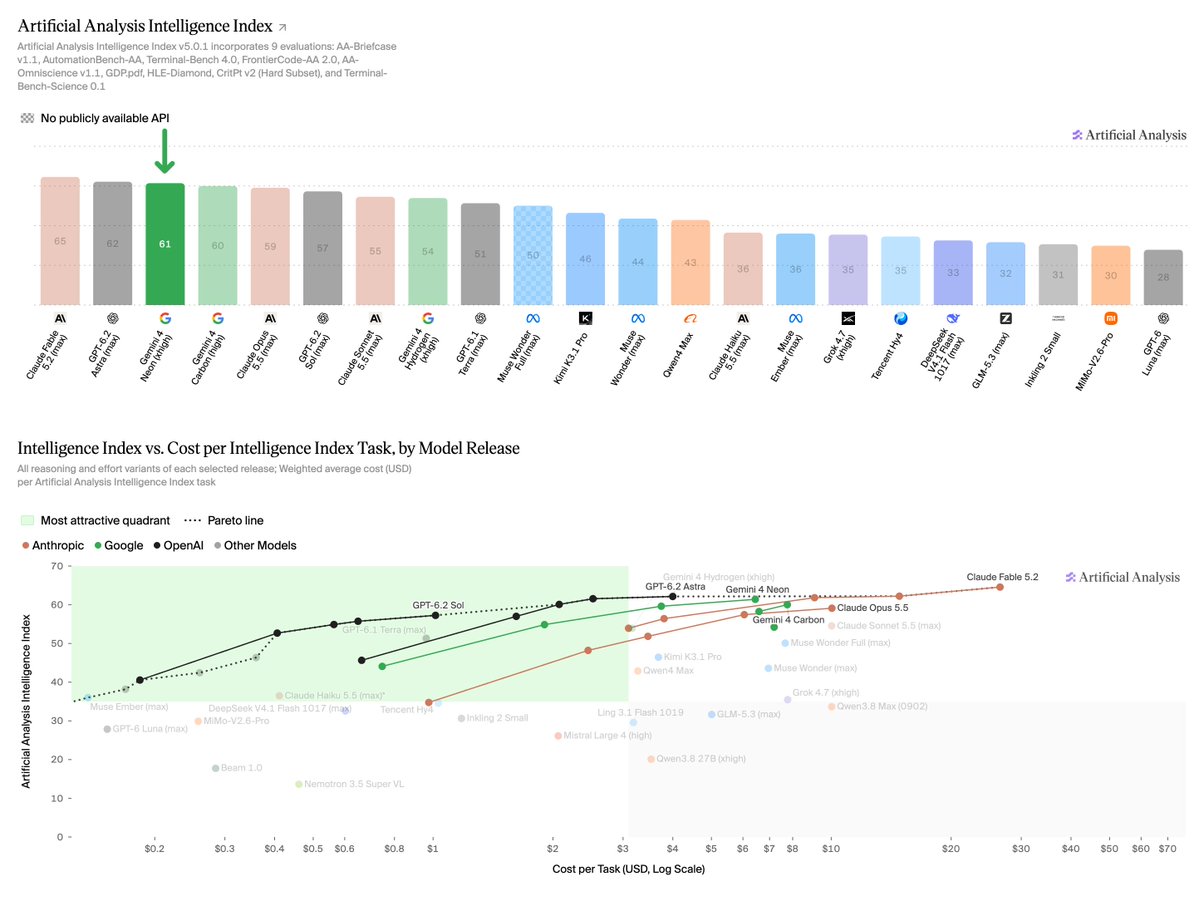
Four things keep that headline honest. The chart is Google’s, with Google’s choice of rows and no Claude Sonnet 5.5 column. The independent numbers are good but narrower: Artificial Analysis scores Neon 61 at xhigh against 59 for Opus 5.5 and 57 for Sol, and Vals puts it second on its Index at 70.87%, 0.44 points behind Claude Fable 5.2. Neon is also not the cheapest way to buy that score, since Sol and Sonnet 5.5 list at $2 / $10, and Artificial Analysis calls it slow and very verbose at xhigh. And it is adapted from Gemini 4 Carbon, so Google still points to Carbon for its hardest problems.
We ran no hands-on tests. Every figure comes from the source named beside it and is tagged vendor-reported, independent or press. For the rest of the family see our Gemini 4 Hydrogen guide, Gemini 4 Carbon guide and Gemini 4 Argon guide. Prices and benchmarks are as of November 19, 2026.
Video: Turing Machine 1936: Gemini 4 Neon, an official clip from the Google YouTube channel. Google’s launch post says Neon built this interactive 3D recreation of Alan Turing’s 1936 study, with a working Universal Turing Machine, using /swarm in Antigravity. A second clip, Chamonix Ski Simulator: Gemini 4 Neon, appears later in this guide.
What Google announced
Sundar Pichai, the Google DeepMind account and Demis Hassabis posted within about two minutes of one another, with Varun Mohan’s post landing at almost the same time as Demis’s. Koray Kavukcuoglu’s blog post, “Introducing Gemini 4 Neon”, is dated November 18, 2026 and describes “frontier-level intelligence with fast end-to-end task completion across complex software engineering, knowledge work, and science workflows.”
Gemini 4 Neon: frontier-level intelligence with fast end-to-end task completion across complex software engineering, knowledge work, and science workflows. Begins rolling out today in the Gemini API in @GoogleAIStudio, Gemini for business, for paid Google AI Pro and Ultra
— @sundarpichai November 18, 2026
The claims in the launch post, in the order Google makes them:
- Rankings (independent, cited by Google): #3 overall on the Artificial Analysis Intelligence Index with 61 at xhigh, “just behind larger, slower models”; #2 on the Vals Index; #2 on steerability and #2 overall (1336) on Arena’s new Agent Arena Index across 4,200+ real agent sessions.
- Price: $3 input, $0.15 cached input (a 95% discount), $15 output per million tokens, 1M context.
- Enterprise and science: #1 on the Vals Legal Research Bench and Tax Agent Bench, #1 on Zapier’s AutomationBench (56.3%) and Andon Labs’ Vending-Bench 2 ($16,843), and best in class on Terminal-Bench Science (70.5%), RiemannBench (84.0%) and HLE-Diamond (71.3%).
- Coding: #1 on the Artificial Analysis Coding Agent Index (58.6), 65.2% on Terminal-Bench 4.1, 46.2% on FrontierCode 2.0, and 12.8% on SWE-sweep with mini-SWE versus 39.0% inside Antigravity.
- Cost control: at the default high level, a 32% lower Artificial Analysis cost per task than Carbon; at xhigh, 36%+ lower cost per task than competing models at their highest settings.
- Cyber: a Neon for cyber variant rolling out to trusted defenders in the Fairwind Program.
- Behavior: “our lowest fabrication rate yet” in internal Antigravity testing, 0.0% cheating on Terminal-Bench 4.0, and Carbon-level protections against severe misuse and prompt injection.
Press framing is similar but sharper on price. VentureBeat’s headline is “Opus 5.5-level coding performance at 25% lower API token prices,” which compares Neon’s $3 / $15 with Opus 5.5’s $4 / $20 and holds only on the two engineering benchmarks where Neon lands within about a point of Opus. SiliconANGLE’s headline says “three times faster than Carbon”; the only 3x figure we found is a customer quote, covered in the pricing section.
Where Neon sits: Hydrogen, Neon, Carbon, Argon
Google’s model card says Neon is adapted from Carbon, and the launch post gives the division of labor in one sentence: Carbon tackles your hardest long-horizon projects, Hydrogen handles fast everyday execution, and Neon balances depth and efficiency for complex, high-frequency workflows. Neon is the fourth Gemini 4 model, after Argon, Carbon and Hydrogen. VentureBeat dates Argon to about seven weeks before Neon.
Gemini 4 Neon is rolling out now. Sitting between Carbon and Hydrogen, it brings frontier intelligence and fast task completion for complex software engineering, knowledge work, and science.
— @GoogleDeepMind November 18, 2026
| Model | Price in / out per 1M | AA Intelligence Index (effort) | Vals Index | Google’s positioning |
|---|---|---|---|---|
| Gemini 4 Hydrogen | $1.50 / $7.50 | 54 (xhigh) | 68.49% | Fast everyday coding and agent work, high volume |
| Gemini 4 Neon | $3 / $15 | 61 (xhigh), 60 (high) | 70.87% | Complex, high-frequency coding, knowledge work and science |
| Gemini 4 Carbon | $2 / $10 through Nov 30, then $4 / $20 | 60 (high) | 70.45% | Hardest, long-horizon architecture, debugging, science, security |
| Gemini 4 Argon | $2 / $10 through Nov 30, then $4 / $20 | 50 | 69.39% | Earlier Gemini 4 release, see our Argon guide |
Sources: Google AI Studio pricing and What’s new pages (Neon, Hydrogen prices), VentureBeat (Carbon and Argon price schedule, AA and Vals figures for Hydrogen and Carbon), Artificial Analysis (Neon 61 and 60, Argon 50, Hydrogen 54, Carbon 60), Vals (rank table on its Neon page). AA figures are independent; effort settings differ by row.
The ordering by price does not map cleanly to the ordering by score. At its highest setting Neon edges past Carbon on the Artificial Analysis index (61 against 60 for Carbon at high) and the three Google models finish within about 2.5 points of each other on Vals (68.49% to 70.87%). Hydrogen is still the speed leader: VentureBeat cites 167 tokens per second on high and 171 on xhigh, against about 110 for Neon at xhigh. For the model that sits above, read our Carbon vs Claude Fable 5.2 comparison.
Specs and model ID
| Property | Gemini 4 Neon |
|---|---|
| API model ID | gemini-4-neon (one stable version listed; no dated or preview alias found) |
| Release | November 18, 2026 |
| Inputs | Text, image, video, audio and PDF |
| Output | Text only (no image or audio generation) |
| Context window | 1,048,576 tokens, one unified window for input, thinking and output |
| Max output | 65,536 synchronous by default; up to 1,048,576 with long decode and background execution |
| Thinking levels | low, medium, high (default), xhigh; minimal is rejected |
| Supported | Function calling, structured outputs, code execution, computer use, file search, URL context, Google Search and Maps grounding, implicit caching, Batch, Flex and Priority |
| Not supported | Explicit context caching, Live API, image generation, audio generation |
| Knowledge cutoff | March 2026 (model card) |
| Sampling | temperature, top_p and top_k should be removed; out-of-range values return a 400 |
| Free tier | Not available; paid tier only |
Two details matter if you are migrating. Neon defaults to high and supports xhigh, like Hydrogen, whereas Carbon and Argon default to medium and top out at high. And the unified window means input, thinking and output tokens share the 1,048,576 budget, unlike Gemini 3.8 Flash’s separate 1M input and 64K output budgets. All of this comes from Google’s model page and What’s new page.
Pricing and cost-per-task math
Google lists one flat rate across the full 1M context, with no long-context surcharge. That is a real difference from OpenAI’s GPT-6.2 Sol, which VentureBeat says moves to $4 / $15 for the whole request above 272,000 input tokens.
| Tier | Input per 1M | Cached input per 1M | Output per 1M (incl. thinking) |
|---|---|---|---|
| Standard (paid) | $3.00 | $0.15 | $15.00 |
| Batch | $1.50 | $0.075 | $7.50 |
| Flex | $1.50 | $0.075 | $7.50 |
| Priority | $5.40 | $0.27 | $27.00 |
Caching is implicit only, applies to prompts of at least 4,096 tokens, and discounts hits by 95%. Grounding with Google Search is billed per query: 5,000 free requests a month shared across Gemini 3 and newer models, then $14 per 1,000, with a cap of 1,500 requests a day. Google counts every token the model processes, including thinking tokens and the internal system instructions behind grounding and function declarations. Paid-tier data is not used to improve Google’s products.
Rival list prices
| Model | Input / cached / output per 1M | Per-token versus Neon |
|---|---|---|
| Gemini 4 Neon | $3 / $0.15 / $15 | baseline |
| Claude Opus 5.5 | $4 / $0.20 / $20 | 33% more |
| GPT-6.2 Sol (up to 272K input) | $2 / $0.10 / $10 | 33% less (Neon is 50% higher) |
| Claude Sonnet 5.5 | $2 / $0.10 / $10 | 33% less (Neon is 50% higher) |
| Gemini 4 Hydrogen | $1.50 / $0.075 / $7.50 | 50% less |
| Gemini 4 Carbon, through Nov 30 | $2 / $0.10 / $10 | 33% less |
| Gemini 4 Carbon, from Dec 1 | $4 / $0.20 / $20 | Neon is 25% cheaper |
Source: Google pricing page for Neon and Hydrogen; VentureBeat’s price comparison for the others, checked November 19, 2026. Verify rival prices on their own pages before budgeting.
The Carbon schedule is the easy thing to miss. Through November 30, Carbon and Argon sit on a $2 / $10 promotional rate, which makes Carbon cheaper per token than Neon for the rest of this month. From December 1 they move to $4 / $20, and Neon’s rates are 25% below Carbon’s. If you benchmark the two now, price the comparison at the December rate.
Worked examples (same token counts, list prices)
| Scenario | Neon | Opus 5.5 | Sol / Sonnet 5.5 | Hydrogen | Carbon (Dec 1) |
|---|---|---|---|---|---|
| 100K in, 10K out, no cache | $0.450 | $0.600 | $0.300 | $0.225 | $0.600 |
| 100K in (90K cached), 10K out | $0.194 | $0.258 | $0.129 | $0.097 | $0.258 |
| Same as row 1, Batch tier | $0.225 | n/a | n/a | n/a | n/a |
We priced Batch only for Neon because we did not confirm batch rates for the others. Arithmetic for row 1 on Neon: 100,000 × $3 / 1M = $0.30 plus 10,000 × $15 / 1M = $0.15, total $0.45. Opus is $0.40 + $0.20. Sol and Sonnet are $0.20 + $0.10. These assume equal token counts, which is the weakest assumption in the table, because models differ in how many tokens they spend per task.
VentureBeat does the break-even for you: at the same input and output mix, Neon needs to use roughly one-third fewer tokens than Sol or Sonnet to erase its 50% per-token premium. The independent per-task data is mixed. On Vals’ own runs, Neon costs $7.40 per test against $3.18 for Sol (2.3 times as much), $16.18 for Sonnet 5.5 (54% less), $17.94 for Claude Fable 5.2 and $10.51 for Carbon (30% less). On Artificial Analysis, Neon at xhigh costs $6.44 per Intelligence Index task, and VentureBeat reports that this shrinks its advantage over Carbon at high to about 17%, down from Google’s 32% figure at Neon’s default high level.
On speed, Google gives no matched time. Glean’s AI product lead Thai Tran is quoted in Google’s announcement as saying Neon “matched or exceeded Gemini 4 Carbon on overall quality at 3x the speed and 60% of the cost”, a vendor-published customer claim that we found in VentureBeat’s coverage rather than on the launch-post copy we fetched. Artificial Analysis’s output-speed reading is about 110 tokens per second at xhigh, roughly 1.9 times Carbon’s 59 on high, which is less than 3 times, and its time to first answer token is 56.51 seconds at xhigh.
Benchmarks: the full Google table
Everything in this section comes from the table on Google’s Gemini 4 Neon model card, which is also the chart Demis Hassabis and Varun Mohan posted. It is vendor-reported: Google chose the rows, the rival settings and the harnesses. It compares Neon with Claude Opus 5.5 and GPT-6.2 Sol only, so Sonnet 5.5, Carbon and Hydrogen appear later where an independent source has a number for them. “No score” means Google published no result for that model.
Excited to launch Gemini 4 Neon: frontier-level intelligence, super fast task completion, and available to Pro & Ultra users now!! We think you’ll enjoy this model. Alchemy at its finest… 🧪
— @demishassabis November 18, 2026

Capability indices
| Benchmark | Neon | Opus 5.5 | GPT-6.2 Sol | Neon’s margin |
|---|---|---|---|---|
| AA Index v5.0.1 | 61 | 59 | 57 | +2 vs Opus, +4 vs Sol |
| Vals Index v2.2 | 70.9% | 70.1% | 66.1% | +0.8 vs Opus, +4.8 vs Sol |
These two rows are independent evaluations that Google reproduces on its chart. We cover them in the independent section.
Agentic coding
| Benchmark (setting) | Neon | Opus 5.5 | GPT-6.2 Sol | Result |
|---|---|---|---|---|
| CursorBench 4.1 (score) | 65.4% | 58.1% | no score | Neon +7.3 vs Opus |
| Terminal-Bench 4.1 (cheating-adjusted accuracy) | 65.2% | 65.8% | 61.5% | Opus +0.6 over Neon; Neon +3.7 vs Sol |
| FrontierCode 2.0 (main score) | 46.2% | 47.3% | 43.8% | Opus +1.1 over Neon; Neon +2.4 vs Sol |
| SWE-sweep (provider harness) | 39.0% | 10.1% | 8.3% | Neon +28.9 vs Opus, +30.7 vs Sol |
| SWE-sweep (mini-SWE harness) | 12.8% | 3.6% | 11.6% | Neon +9.2 vs Opus, +1.2 vs Sol |
This is where Neon is least dominant. On the two standard coding rows, Terminal-Bench 4.1 and FrontierCode 2.0, Opus 5.5 is ahead by 0.6 and 1.1 points. Those are the gaps VentureBeat means by “within about a percentage point”. The big margins sit on CursorBench and SWE-sweep, where the harness matters, which the harness section takes apart. Note that Neon’s FrontierCode score is at its default high setting, not xhigh.
Knowledge work, science, reasoning
| Benchmark | Neon | Opus 5.5 | GPT-6.2 Sol | Result |
|---|---|---|---|---|
| AutomationBench (Zapier) | 56.3% | 42.5% | 41.3% | Neon +13.8 vs Opus, +15.0 vs Sol |
| Agents’ Last Exam v1.1 | 75.8% | 71.6% | 73.0% | Neon +4.2 vs Opus, +2.8 vs Sol |
| RiemannBench | 84.0% | 80.0% | 80.0% | Neon +4.0 vs both |
| Terminal-Bench-Science 0.1 | 70.5% | 63.3% | 68.0% | Neon +7.2 vs Opus, +2.5 vs Sol |
| HLE-Diamond | 71.3% | 67.9% | 64.0% | Neon +3.4 vs Opus, +7.3 vs Sol |
AutomationBench is the widest gap on the whole chart outside SWE-sweep and long context: Neon at 56.3% against 42.5% and 41.3%. Google also says it is #1 overall there. A Google spokesperson told VentureBeat that Terminal-Bench Science is a result it wanted highlighted. These are mostly agentic and quantitative tasks, which is the “knowledge work and science” half of Google’s pitch.
Multimodal and long context
| Benchmark (setting) | Neon | Opus 5.5 | GPT-6.2 Sol | Result |
|---|---|---|---|---|
| MKA (Climb WSR) | 56.5% | 53.0% | 52.7% | Neon +3.5 vs Opus, +3.8 vs Sol |
| Chartography | 73.5% | 66.3% | 75.1% | Sol +1.6 over Neon; Neon +7.2 vs Opus |
| LVBench | 89.0% | 83.7% | 87.6% | Neon +5.3 vs Opus, +1.4 vs Sol |
| GraphWalks (256k to 1M, BFS, F1) | 95.2% | 66.8% | 80.1% | Neon +28.4 vs Opus, +15.1 vs Sol |
Sol’s one clear win is Chartography, reading dense professional charts, and Google’s own launch post cites Neon’s 73.5% without claiming the lead. The long-context row is the biggest single gap on the table, but GraphWalks here is the 256k to 1M breadth-first-search variant, one narrow probe of long-context reasoning, and Google reports it without a harness note.
Cybersecurity
| Benchmark | Neon | Opus 5.5 | GPT-6.2 Sol | Result |
|---|---|---|---|---|
| CWE-Bench v2 (patching) | 70.7% | 67.1% | 66.0% | Neon +3.6 vs Opus, +4.7 vs Sol |
| SEC-bench Pro (vulnerability finding) | 90.5% | no score | 88.3% | Neon +2.2 vs Sol |
| WebExploitBench v1.2 | 51.3% | 37.1% | no score | Neon +14.2 vs Opus |
Google’s launch post adds cyber results that are not on the three-column chart: AutoBaxBench hard tier 76% (state of the art), ExploitGym at frontier level with half the tokens of Carbon, and CWE-bench v2 up 3.4% over Carbon. Those come from the cyber-specialized Neon variant, covered in the Fairwind section, and Google gives no rival numbers for them.
Rows only in Google’s launch post
| Benchmark | Neon | Who measured | Label |
|---|---|---|---|
| Vending-Bench 2 (Andon Labs) | $16,843, #1 | Andon Labs, reported by Google | Third-party benchmark, vendor-cited |
| Agent Arena Index (Arena) | 1336, #2 overall | Arena, 4,200+ agent sessions | Independent, see below |
| AA Coding Agent Index | 58.6, #1 overall | Artificial Analysis | Independent, cited by Google |
| Surge AI evaluations | #1 on most finance, accounting, spreadsheet modeling and constraint-following benchmarks | Surge AI, reported by Google | No scores published in the post |
| Cost per task vs Carbon at high | 32% lower | Artificial Analysis data, Google’s summary | See pricing section |
Neon vs Opus 5.5, Sol and Sonnet 5.5
Scoring Google’s chart row by row: Neon is ahead of Opus 5.5 on 16 of the 18 rows where Opus has a score, and ahead of GPT-6.2 Sol on 16 of the 17 rows where Sol has one. That is a strong chart, and it is Google’s chart. Where each rival wins or stays close:
| Rival | Where it wins or ties on Google’s table | Where Neon is clearly ahead | List price vs Neon |
|---|---|---|---|
| Claude Opus 5.5 | Terminal-Bench 4.1 (65.8 vs 65.2) and FrontierCode 2.0 (47.3 vs 46.2); Vals Index within 0.8 | SWE-sweep provider harness, GraphWalks, AutomationBench, WebExploitBench | Opus costs 33% more: $4 / $20 |
| GPT-6.2 Sol | Chartography (75.1 vs 73.5); mini-SWE harness is close (11.6 vs 12.8) | AutomationBench, GraphWalks, HLE-Diamond, SWE-sweep provider harness | Sol is cheaper per token: $2 / $10, and Vals measured $3.18 per test |
| Claude Sonnet 5.5 | No Google chart column; Vals Index 70.85 vs Neon 70.87 is a statistical tie | AA Index 61 (xhigh) vs 55 (max); Vals cost per test $7.40 vs $16.18 | Sonnet is cheaper per token: $2 / $10 |
Sol’s only win on Google’s chart is Chartography. On the independent side, Neon’s lead over Sol on the Vals Index is 4.8 points, but Sol is far cheaper to run on Vals’ tasks, which is the same trade-off VentureBeat describes: Sol “offers a different bargain.”
Sonnet 5.5 is the model to watch for cost-conscious teams. It has no column on Google’s chart, so we have only independent numbers for it: Vals scores it 70.85%, a hair under Neon, at $16.18 per test and 1h25m59s latency against Neon’s 31m25s, and Artificial Analysis lists it at 55 on its index at max effort. VentureBeat notes the readings come from public snapshots and the Vals leaderboard snapshot there predates Neon’s release, so treat these as a launch-week picture. For the Anthropic side of the comparison, see our Opus 5.5 vs Sonnet 5.5 coding comparison, and for OpenAI’s line, our GPT-6.1 Sol guide, which predates the 6.2 release.
VentureBeat’s read on the contest: Neon outscored GPT-6.2 Sol on business automation, while Sol read dense charts more accurately, and a team choosing a model for a weekly report may find that moving information through several applications and reading the key figure correctly are two different jobs.
The harness effect
The single most useful number in the launch is not a ranking. Google reports Neon at 12.8% on SWE-sweep with the mini-SWE harness and 39.0% in Google Antigravity, same model, a 3.05-times spread. On the model card’s chart, Opus 5.5 gets 3.6% on mini-SWE and 10.1% on its provider harness, and Sol gets 11.6% and 8.3%.
Two lessons follow. First, harness choice can swing a score by more than the gap between models, so any single coding leaderboard is a statement about model plus scaffold. Second, Google’s state-of-the-art 39.0% is Neon inside Google’s own agent product, compared with rival models on “provider harness” settings that Google does not describe in detail. That makes the headline gap a vendor-reported comparison, not a controlled one. VentureBeat’s advice for teams running their own agent software is to test Neon inside Antigravity before trusting any single leaderboard rank, and we would add: test it inside your own harness too.
Independent results
Artificial Analysis
| Neon setting | AA Intelligence Index | Time per task | Time to first answer token | Output tokens for the full index |
|---|---|---|---|---|
| xhigh | 61 | 21.5 min | 56.51 s | 283M |
| high (default) | 60 | 14.8 min | 40.64 s | 123M |
| medium | 55 | 8.3 min | 20.14 s | 62.9M |
| low | 44 | 3.7 min | 13.93 s | 28.3M |
Artificial Analysis lists Neon (xhigh) at 61 on Intelligence Index v5.0.1, which it says is well above the median of 43 for comparable models. It prices an Intelligence Index task at $6.44 on average and measures 110 tokens per second at xhigh. Its verdict is not flattering on efficiency: “somewhat expensive when comparing to other models of similar price,” “notably slow per task and very verbose,” with 283M output tokens against a 65.1M median. Neon’s model page shows it as #6 of 96 entries, while Google and the Antigravity post say #3 overall, and VentureBeat reports that Artificial Analysis confirmed third place on X. We could not reconcile the two counts from the page alone; the likely cause is that the page ranks effort variants as separate entries, but that is our guess.
The high setting is the sweet spot on these numbers: one point lower than xhigh at 60, with 43% of the output tokens and about 69% of the time per task. Medium gives up five points for roughly 56% of high’s time. That curve is why Google’s docs tell you to start at high.
Vals AI
Google DeepMind’s Gemini 4 Neon debuts at #2 on the Vals Index (70.9%), 0.4 points behind Claude Fable 5.2 at less than half the cost per task. It also takes #1 on our Finance and Legal Indexes, Tax Agent and Legal Research.
— @ValsAI November 18, 2026

| Vals benchmark | Neon score | Rank |
|---|---|---|
| Vals Index | 70.87% | 2 of 42 |
| Vals Finance Index | 68.31% | 1 of 45 |
| Vals Legal Index | 78.36% | 1 of 43 |
| Vals Science Index | 62.63% | 4 of 28 |
| Earnings Modeling Bench v1.1 | 76.46% | 4 of 47 |
| Finance Agent v2.1 | 68.56% | 2 of 45 |
| Legal Research Bench | 56.25% | 1 of 99 |
| Tax Agent Bench | 54.89% | 1 of 90 |
| Vibe Code Bench v1.1 | 93.70% | 2 of 133 |
| BioMysteryBench | 80.00% | 4 of 34 |
| Terminal-Bench Science | 62.86% | 2 of 48 |
| Terminal-Bench 4.0 | 61.62% | 7 of 69 |
| MysteryMechanism | 45.05% | 9 of 34 |
| Harvey legal agent benchmark (HLAB-Vals-1.1) | 19.58% | 8 of 43 |
Vals puts Neon on the score-versus-cost Pareto frontier on 7 of its 14 leaderboards: the Index, Finance and Legal indexes, Earnings Modeling, Legal Research, Tax Agent and Vibe Code Bench. Settings were reasoning effort xhigh with a 1,048,576 max output tokens. Costs per test: $7.405 on the Index, $4.88 Finance, $6.10 Legal, $8.26 Science. The weak spots are visible too: ninth of 34 on MysteryMechanism, eighth on the Harvey legal agent benchmark and seventh on Terminal-Bench 4.0 (61.62%, which sits below the 65.2% Google reports for Terminal-Bench 4.1, a different version and harness).
In Vals’ head-to-head top ten, Neon at 70.87% sits between Claude Fable 5.2 (71.31%, $17.94 per test) and Claude Sonnet 5.5 (70.85%, $16.18), ahead of Gemini 4 Carbon (70.45%, $10.51), Gemini 4 Argon (69.39%, $13.37), Gemini 4 Hydrogen (68.49%, $9.84), GPT-6.2 Astra (67.66%, $10.68) and GPT-6.2 Sol (66.06%, $3.18). With a stated margin of error of ±0.94, Neon, Fable and Sonnet are close to a statistical tie.
Arena’s Agent Arena Index
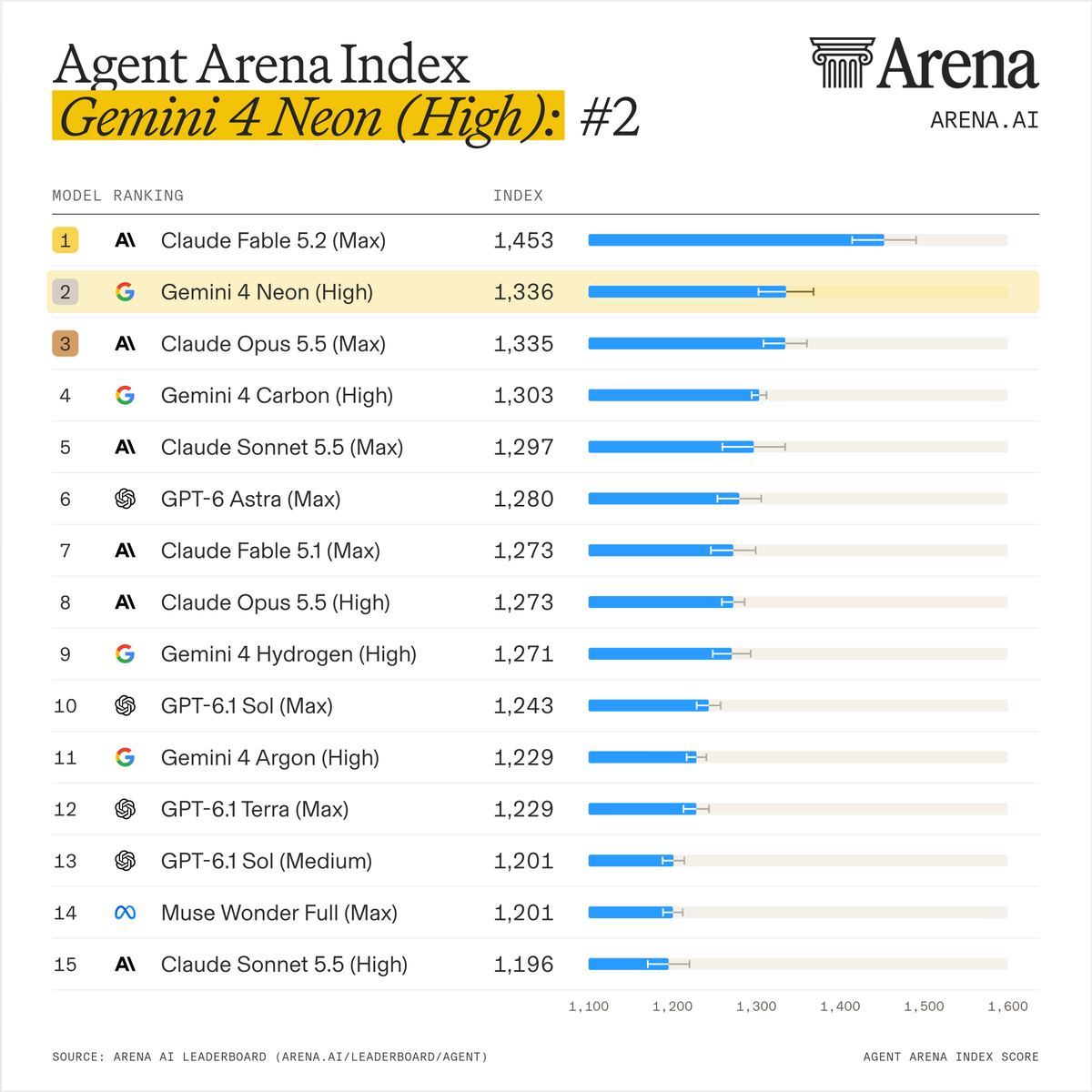
Google cites 1336 for Neon at high and #2 overall. Opus 5.5 at max is one point behind, so the second place is a statistical tie, not a gap. The ranking also changes with the effort level the model ran at: the chart lists Opus 5.5 and Sonnet 5.5 at both max and high as separate entries.
Thinking levels
Neon has four levels, set with thinking_level inside generation_config. Google’s docs make high the default, add xhigh above it, and reject minimal with an error. The independent scores in the last section show what each level buys.
| Level | Google’s guidance | AA index | AA time per task |
|---|---|---|---|
| low | Fewest tokens, lowest latency. Fast chat, high-throughput work. Still capable on agentic tasks. | 44 | 3.7 min |
| medium | Interactive coding, live UI prototyping, responsive chat, latency-sensitive tool calls. | 55 | 8.3 min |
| high (default) | Recommended default for complex coding, agent execution, tool calling and multimodal knowledge work. | 60 | 14.8 min |
| xhigh | Hard, multi-step engineering, analytical and scientific problems where high falls short. Most tokens and latency. | 61 | 21.5 min |
Google’s advice is to run your own evaluations at all four levels with a high max_output_tokens so the cap does not truncate answers, then pick the lowest level that clears your bar. One caution on comparisons: the rival scores on Google’s chart and in the AA column use each lab’s own effort definitions (Opus and Sol at max, Neon at xhigh or high depending on the row), and VentureBeat points out that two models at maximum effort can spend very different amounts of time and money. Vals ran Neon at xhigh.
How to use Neon
Neon is a great model : )
— @OfficialLoganK November 18, 2026
Where it is available
| Surface | Who gets it | Source |
|---|---|---|
| Gemini API and Google AI Studio | Paid API tier; Pro and Ultra plan holders can also use it in AI Studio | Google launch post, What’s new page |
| Android Studio | Gemini API paid tier | Google launch post |
| Google Antigravity (desktop app, CLI, IDE extensions) | Paid Google AI Pro and Ultra subscribers | Antigravity blog |
| Gemini for business | Enterprises, via API and model dropdown, and in Antigravity | Google launch post |
| Gemini app | Google AI Pro and Ultra subscribers, from the model dropdown | Google launch post |
| Fairwind Program (Neon for cyber) | Eligible trusted defenders, request through your Cloud account team | Google launch post |
VentureBeat adds a detail from Logan Kilpatrick’s guide: Pro subscribers can pick Neon in the Gemini app, while Carbon requires Ultra. There is no free API tier for Neon. You can try prompts at AI Studio with the model preselected.
First call (Interactions API, Python)
from google import genai

client = genai.Client()

interaction = client.interactions.create(
    model="gemini-4-neon",
    input="Build an interactive single-file HTML token bucket rate-limiter simulator with live sliders for burst size and request traffic.",
)

print(interaction.output_text)
Google’s examples use the Interactions API. Gemini’s What’s new page says Neon also works through generateContent. The same call over REST:
curl "https://generativelanguage.googleapis.com/v1beta/interactions" \
  -H "x-goog-api-key: $GEMINI_API_KEY" \
  -H 'Content-Type: application/json' \
  -X POST \
  -d '{
    "model": "gemini-4-neon",
    "input": "Explain the difference between optimistic and pessimistic locking in three short paragraphs."
  }'
Choose a thinking level
from google import genai

client = genai.Client()

interaction = client.interactions.create(
    model="gemini-4-neon",
    input="Audit this payment retry queue for race conditions and rewrite the lock acquisition logic.",
    generation_config={
        "thinking_level": "xhigh",  # low | medium | high (default) | xhigh
    },
)

print(interaction.output_text)
Outputs past 64K
Synchronous responses cap at 65,536 tokens per hop. For longer output, set max_output_tokens above 65,536 (up to 1,048,576 minus your input tokens) and background to true. Google’s note: if you set background without max_output_tokens, the server stops at 65,536. Hard prompts can run for minutes, so use background execution or HTTP client timeouts of at least 15 minutes.
import time
from google import genai

client = genai.Client()

interaction = client.interactions.create(
    model="gemini-4-neon",
    input="Generate a complete multi-module migration specification and test suite for this service.",
    background=True,
    generation_config={
        "max_output_tokens": 262144,
        "thinking_level": "high",
    },
)

while interaction.status in ("in_progress", "queued"):
    time.sleep(5)
    interaction = client.interactions.get(id=interaction.id)

# Join text across all 64K continuation hops.
text = "".join(
    content.text
    for step in interaction.steps
    if step.type == "model_output"
    for content in step.content
    if content.type == "text"
)
print(text)
print("Status:", interaction.status)
print("Usage:", interaction.usage)
Planner and executor: Neon plus Hydrogen
Antigravity’s Orchestrator can now pair Neon as planner with Hydrogen as executor in one session: Neon does planning, architecture and complex reasoning, Hydrogen takes routine edits, package updates and test runs, and if Hydrogen hits friction it hands back to Neon to inspect state and repair the plan. Google’s pitch is Neon’s judgment where it matters and Hydrogen’s speed and token efficiency elsewhere, stretching quota. In the API you can approximate the pattern by continuing a conversation across models with previous_interaction_id:
from google import genai

client = genai.Client()

# Planning turn on Neon
plan = client.interactions.create(
    model="gemini-4-neon",
    input="Read the billing module and write a step-by-step plan to add usage-based invoicing.",
)

# Execution turn on Hydrogen, continuing the same conversation
build = client.interactions.create(
    model="gemini-4-hydrogen",
    input="Implement steps 1 and 2 of the plan and list the tests you would run.",
    previous_interaction_id=plan.id,
)

print(build.output_text)
This is our adaptation of Google’s multi-model pattern with Carbon and Hydrogen in the Hydrogen docs, not an example copied from the Neon page. Google also says the Antigravity agent in Gemini Managed Agents supports gemini-4-neon, standalone or paired with Hydrogen. See our Hydrogen guide for the executor side.
Migration notes
- From Carbon, Argon or Hydrogen, you change only the model ID. Check the default thinking level and use a paid-tier project.
- From Gemini 3 and earlier: remove
temperature,top_pandtop_k, drop explicit caching, raise lowmax_output_tokenscaps, declare tools natively rather than asking for raw-text JSON tool calls (which can returnMALFORMED_FUNCTION_CALL), and preserve thought signatures across turns. - If you route Gemini through a gateway or provider aggregator, see our guides to LLM API gateways and AI inference providers; we did not check which of them list Neon yet.
What Google says Neon built
Google’s demonstrations all run inside Antigravity with /swarm: a first-person WebGL2 ski simulator on real Mont Blanc and Chamonix terrain (10,200 lines of shaders, 120 Hz physics, six alpine lines, slab avalanches), a Blender MCP lab bench that visualizes the Gemini 4 model names with elemental accuracy, and a 100,000-cell Google Sheet that turns one image into edge detection, depth mapping and relighting using more than 500,000 live formulas with no embedded images and no Apps Script. The Antigravity post adds a multi-level two-player game in which the agent plays the second player in the built-in browser. These are vendor demos, not benchmarks.
Video: Chamonix Ski Simulator: Gemini 4 Neon, official, from the Google YouTube channel. Google also published Sheets CV Lab and Gemini Elements 3D clips for Neon.
Neon for cyber and the Fairwind Program
Google is splitting the security rollout. The general model ships with the Carbon-level misuse safeguards, while a cyber-specialized Neon goes to eligible members of the Fairwind Program over the days after launch. Enterprises request access through their Google Cloud account team. Google’s What’s new page says dual-use offensive cyberdefense capabilities are available to defenders through Fairwind, which implies ordinary API users do not get them by default.
| Cyber benchmark | Neon for cyber (Google) | Context |
|---|---|---|
| AutoBaxBench, hard tier (secure code generation) | 76%, state of the art | More secure code than Carbon on easy, medium and hard |
| WebExploitBench v1.2 (penetration testing) | 51.26%, state of the art | Half the cost of competing large models; Opus 5.5 scores 37.1% on the model card |
| SEC-bench Pro (finding vulnerabilities) | 90.5%, state of the art | Roughly half the cost per challenge; Sol 88.3% on the model card |
| ExploitGym (validating exploits) | Frontier-level | Half the tokens of Carbon; no score published |
| CWE-bench v2 (patching, Collinear) | 70.7% | 3.4% uplift over Carbon; Opus 67.1%, Sol 66.0% on the model card |
Two caveats. Google’s launch post labels these as results for “Neon for cyber”, while the model card table lists the same three rows under plain Gemini 4 Neon, so the card and the post are not perfectly aligned on which variant was measured. And every number here is vendor-reported: we found no independent replication of the cyber scores in launch week.
Safety claims and the model card
Google’s Safety and Security Report for Neon was listed as “coming in the next few days” on the model card, so everything below is from the launch post and the card, both Google. Treat it as vendor-reported until the full report and outside evaluations arrive.
| Claim | Figure | Source |
|---|---|---|
| Cheating on Terminal-Bench 4.0 | 0.0%, matching Carbon | Google launch post |
| Shortcut rate on Google’s coding cheating evaluation | 2.45%, lowest of any Gemini 4 model | Google launch post |
| Misaligned action rate on the agentic safety suite | 0.09% | Google launch post |
| Agent honesty evaluation pass rate | 99.2% | Google launch post |
| Under-service and overreach vs Carbon | Down 43% to 56% and 15% to 35%, by effort level | Google launch post |
| Refusals on benign tasks | 1.98% of Terminal-Bench 4.0 tasks, 0% on Terminal-Bench-Science | Google launch post |
| Gray Swan indirect prompt injection | 0.0% attack success at the highest thinking level with real-time safeguards, matching other Gemini models | Google launch post |
| Unjustified refusals vs Hydrogen | -3.00 percentage points (fewer) | Model card |
| Image-to-text safety vs Hydrogen | +1.90 percentage points | Model card |
| Multilingual safety vs Hydrogen | -0.40 percentage points, inside confidence interval | Model card |
On frontier safety, Google ran a Material Capability Change assessment against Gemini 4 Argon. Neon showed a general capability increase, below the threshold that would require the full critical-capability suite, so Google carries forward Argon’s determinations. That includes “CCL cannot be ruled out” for biological uplift and for cybersecurity uplift, with mitigations deployed. Note that Google’s “lowest fabrication rate yet” is an internal Antigravity measurement with no published number.
Which model to pick
| If you need… | Pick | Why (and the catch) |
|---|---|---|
| Cheapest everyday coding and agent loops, high volume | Gemini 4 Hydrogen | $1.50 / $7.50 and 167 to 171 tok/s; AA 54, Vals 68.49% |
| Complex coding and analysis at frontier-level scores, many times a day | Gemini 4 Neon | AA 61, Vals 70.87%, 32% lower AA cost per task than Carbon at high; slower and more verbose at xhigh |
| The hardest architecture, debugging, science or security problems | Gemini 4 Carbon | Google’s own recommendation; $2 / $10 until Nov 30, then $4 / $20 |
| Lowest per-token price among mid-tier rivals | GPT-6.2 Sol or Claude Sonnet 5.5 | Both $2 / $10; Neon needs about a third fewer tokens to break even |
| Best terminal and general-coding score by a hair | Claude Opus 5.5 | Leads Terminal-Bench 4.1 and FrontierCode 2.0 on Google’s own chart, at $4 / $20 |
| Chart reading | GPT-6.2 Sol | 75.1% vs 73.5% on Chartography; Sol takes text and image input only |
| Mixed audio, video, PDFs and spreadsheets in one 1M context | Gemini 4 Neon | Neon takes text, image, video, audio and PDF; VentureBeat notes Sol’s API is text and image |
| Planner plus executor in an IDE | Neon plus Hydrogen in Antigravity Orchestrator | Paid AI Pro or Ultra plan required |
Practical step: take a fixed set of your own tasks, run them at high and xhigh on Neon and at the effort levels you use elsewhere, record tokens, wall time and review outcomes, and price them at the table above. Vals’ numbers show cost per test can differ by more than 2 times at near-identical accuracy (Neon $7.40 against Sonnet 5.5 at $16.18), so token spend, not list price, decides.
Limits and caveats
- Google picked the rows. The 19-row table is Google’s chart, Sonnet 5.5 is absent, and rival settings (max effort, “provider harness”) are not detailed.
- Effort levels are not comparable across labs. Neon at xhigh against rivals at max is not a controlled test, and the xhigh cost advantage shrinks to about 17% against Carbon at high, per VentureBeat’s citation of Artificial Analysis.
- Vals snapshot timing. VentureBeat says the peer results come from a public snapshot that predates Neon’s release, so check the live leaderboard before citing a rank.
- Margins are small where it matters. The Vals Index top three sit within 0.5 points on a ±0.94 interval, and Opus 5.5 trails Neon by one point on Arena’s Agent Arena Index.
- Neon is slow and token-hungry at xhigh. Artificial Analysis: 56.51 s to first answer token, 21.5 minutes per task, 283M output tokens for the index.
- Feature gaps. No Live API, no explicit caching, no image or audio output, no free API tier, and sampling parameters are ignored or rejected.
- Carbon pricing flips on December 1. Compare at $4 / $20, not at the promotional $2 / $10.
- Model card caveat. Google lists hallucinations as a known limitation and a March 2026 knowledge cutoff.
- Customer quotes are marketing. The Glean “3x the speed and 60% of the cost” line is one customer’s early evaluation, not a measured benchmark.
Verdict
Neon is a credible frontier-class mid-tier model. Independently it is #2 on the Vals Index, #3 on Artificial Analysis at xhigh by Google’s account (the AA page itself lists #6 of 96 entries), #1 on Vals Finance and Legal, and #2 on Arena’s agent index. At $3 / $15 it is 25% under Opus 5.5 and level with it on the two coding rows where Opus leads by about a point. It is also more than 2 times Sol’s cost on Vals’ test suite and slow at xhigh. Our reading: adopt it first for knowledge-work, document and spreadsheet agents and for long-context multimodal inputs, where the evidence is strongest, and run your own coding bake-off against Sonnet 5.5 and Sol before moving a large coding workload, because that is where the price-per-token gap and the harness effect bite hardest.
FAQ
What is Gemini 4 Neon?
Gemini 4 Neon is the middle model in Google’s Gemini 4 family, announced November 18, 2026. Google’s model card says it is adapted from Gemini 4 Carbon, and Google positions it between Carbon (hardest long-horizon work) and Hydrogen (fast everyday execution) for complex, high-frequency coding, knowledge work and science tasks.
What is the Gemini API model ID for Neon?
gemini-4-neon. It is the model code on Google’s model page, the What’s new page and the pricing page, and the model page lists one stable version with that same string. We found no separate dated or preview alias.
How much does Gemini 4 Neon cost?
$3.00 per million input tokens and $15.00 per million output tokens (thinking included) on the paid tier, flat across the 1M context. Implicit cache hits cost $0.15 per million, a 95% discount. Batch and Flex are $1.50 and $7.50, and Priority is $5.40 and $27.00. There is no free tier for Neon.
Is Gemini 4 Neon free?
No on the API. Google’s pricing page says Neon is not available on the Free tier of the Gemini API. Access is through the paid API tier, paid Google AI Pro and Ultra plans in Google Antigravity, and Pro and Ultra subscriptions in the Gemini app and AI Studio.
Does Gemini 4 Neon beat Claude Opus 5.5 and GPT-6.2 Sol?
On Google’s own 19-row table, Neon leads Opus 5.5 on 16 of 18 scored rows and GPT-6.2 Sol on 16 of 17. Claude Opus 5.5 leads on Terminal-Bench 4.1 (65.8% vs 65.2%) and FrontierCode 2.0 (47.3% vs 46.2%), and GPT-6.2 Sol leads on Chartography (75.1% vs 73.5%). Those are mostly vendor-reported numbers with Google choosing the rows. Independent: Artificial Analysis lists Neon (xhigh) at 61, Opus 5.5 at 59 and Sol at 57.
Is Neon better than Gemini 4 Carbon?
Not across the board. Artificial Analysis has Neon at xhigh scoring 61 against 60 for Carbon at high, and Google reports 32% lower cost per task than Carbon at the default high level. But Neon is a smaller, cheaper model adapted from Carbon, and Google still points to Carbon for the hardest architecture, debugging, science and security problems.
What are Neon’s four thinking levels?
low, medium, high (the default) and xhigh, set with thinking_level in generation_config. Artificial Analysis scores them at 44, 55, 60 and 61 on its Intelligence Index. The value minimal is rejected. Google advises starting at high and reserving xhigh for problems where high falls short.
What is the context window and output limit?
One unified window of 1,048,576 tokens shared by input, thinking and output. The default synchronous output cap is 65,536 tokens. For longer output you set max_output_tokens above 65,536 and use background execution, up to 1,048,576 minus your input tokens.
What is the SWE-sweep 12.8% versus 39.0% result?
Google reports Neon at 12.8% on SWE-sweep with the mini-SWE harness and 39.0% in Google Antigravity, with the same underlying model. It is a vendor-reported illustration of how much the agent harness matters, not a like-for-like comparison with other models.
How do I use Neon in Google Antigravity?
Paid Google AI Pro and Ultra subscribers can pick Gemini 4 Neon in the Antigravity desktop app, CLI and IDE extensions, and enterprises can use it through Gemini for business. Orchestrator in Antigravity can pair Neon as planner with Gemini 4 Hydrogen as executor in one session.
Does Neon support explicit context caching or the Live API?
No on both. Google’s model page lists explicit caching, the Live API, image generation and audio generation as not supported. Implicit caching works by default on prompts of at least 4,096 tokens and discounts cached input by 95%.
What is the Fairwind Program and Neon for cyber?
Fairwind is Google’s program for trusted cyber defenders. Google says a cyber-specialized Neon is rolling out to eligible Fairwind members over the days after launch, and you request access through your Google Cloud account team. Ordinary API users do not get the dual-use offensive capabilities by default.
Sources
Sources checked November 19, 2026.
- Introducing Gemini 4 Neon: Google blog, Nov 18, 2026, Koray Kavukcuoglu (announcement, claims, access, safety, cyber)
- Gemini 4 Neon model card: Google DeepMind (full benchmark table, inputs, cutoff, safety tables, frontier safety)
- Gemini 4 Neon model page, What’s new in Gemini 4 Neon and pricing: Gemini API docs (model ID, thinking levels, code, migration, prices)
- Gemini 4 Neon in Google Antigravity: Google Antigravity blog, Nov 18, 2026 (Orchestrator, availability)
- Gemini 4 Neon: Artificial Analysis (index, effort levels, speed, cost, verbosity; independent)
- Gemini 4 Neon on Vals AI: Vals (per-benchmark scores, cost and latency; independent)
- Google launches Gemini 4 Neon with Opus 5.5-level coding performance at 25% lower API token prices: VentureBeat, Carl Franzen, Nov 18, 2026 (rival prices, cost math, press analysis)
- X posts: Varun Mohan, Sundar Pichai, Google DeepMind, Demis Hassabis, Vals AI and Logan Kilpatrick, Nov 18, 2026
- YouTube: Turing Machine 1936, Chamonix Ski Simulator, Sheets CV Lab and Gemini Elements 3D, official Google channel