Get the latest on AI, LLMs & developer tools
New MCP servers, model updates, and guides like this one — delivered weekly.
What an LLM Gateway Does, and Who Wins for What
If you call more than one model provider, you eventually want one base URL, one bill, one set of keys and a way to survive a provider outage. That is the job of an LLM gateway or router. For a hosted catalog, start with OpenRouter; on Vercel, use Vercel AI Gateway; on Cloudflare, use Cloudflare AI Gateway; for self-hosting, use LiteLLM; for enterprise governance, look at Portkey, Kong or TrueFoundry.
The market also moved this year. OpenRouter agreed to join Stripe, Palo Alto Networks announced it would buy Portkey, Mintlify acquired Helicone, and LiteLLM had a supply-chain incident. A gateway sits on the path of every prompt and every credential, so ownership and security history matter as much as the price table. Everything below was checked against vendor pages on Nov 11, 2026, and vendor-reported numbers are labeled as such.
Community video (AgenticEngineering channel) comparing a local gateway with a hosted router and an open-source proxy. It is a third-party walkthrough, not a vendor demo.
Anthropic's own Claude Code documentation describes what a gateway should provide: provider keys kept server-side, per-developer usage tracking, budgets and rate limits in one place, audit logging, and provider switching without touching developer machines. It adds a warning worth repeating: Anthropic does not endorse, maintain or audit third-party gateways, and does not support routing Claude Code to non-Claude models through any gateway. Claude Code also ships its own self-hosted “Claude apps gateway” inside the claude binary for organizations that only need Claude models.
Quick Picks
| Category | Pick | Why |
|---|---|---|
| Best overall hosted router | OpenRouter | Largest public catalog, no inference markup, fallbacks without charging failed attempts. Now part of Stripe. |
| Best for Vercel teams | Vercel AI Gateway | No markup and no platform fee, a one-command Claude Code setup, and budgets per team, project, key or member. |
| Best free observability layer | Cloudflare AI Gateway | Analytics, caching and rate limiting are free on every plan; Unified Billing adds a 5% credit fee. |
| Best open-source, self-hosted | LiteLLM | Open-source proxy with virtual keys, budgets, fallbacks and a vendor-published 3,000 RPS benchmark. Pin versions after the March 2026 incident. |
| Best for enterprise governance | Portkey or Kong AI Gateway | Portkey is being folded into Palo Alto Networks Prisma AIRS; Kong sells AI governance on top of its API gateway. |
| Best budget / free coding setups | OmniRoute or 9router | MIT-licensed local gateways that chain free and subscription providers. Read the terms of every provider you connect. |
Master Comparison Table (as of Nov 11, 2026)
Model counts are not comparable across vendors: some count providers, some count model variants, some count only what the public API lists. Where I could query a public models endpoint on Nov 12, I list that number next to the vendor claim. Fees are the headline fee on the vendor's own pricing page.
| Gateway | Fees / pricing | Model count | Self-host | BYOK | Standout |
|---|---|---|---|---|---|
| OpenRouter | Free: no fee, 50 requests/day. Standard 5.5% credit-purchase fee ($0.80 min). Business 8%. Enterprise custom. | 600+ models, 80+ providers (pricing page); 468 in the public models API on Nov 12 | No (hosted) | Yes: $25,000/mo list-price inference free of OpenRouter fees, then 5% | Model and provider fallbacks, failed attempts not billed, :nitro / :floor variants |
| Vercel AI Gateway | No markup, no platform fee. $5/month free credit; paid tier = purchased credits. | 507 models in the public models API on Nov 12 | No (hosted) | Yes, paid tier, no markup | Budgets by team, project, key or member; Claude Code CLI setup; virtual models |
| Cloudflare AI Gateway | Core features free. Unified Billing: 5% fee on credits, no inference markup. | Provider catalog in docs; count not published on pricing page | No (hosted) | Yes (stored provider keys) | Free caching, rate limiting, analytics; dynamic routes; DLP; guardrails via Workers AI |
| Portkey | OSS free. Developer free (10k logs/mo). Production $49/mo. Enterprise custom. | 250+ LLMs (gateway README); 1,600+ models (README body) | Yes (open-source gateway) | Yes (provider slugs in Model Catalog) | Configs for fallback, load balancing, semantic caching, guardrails |
| LiteLLM | Open-source proxy free. Enterprise license for SSO and commercial features. | 100+ providers | Yes | Yes (you hold provider keys) | Virtual keys, budgets, Router fallbacks, 8ms P95 at 1k RPS (vendor-reported) |
| Helicone | Hobby free (10k requests). Pro $79/mo. Team $799/mo. Gateway credits at 0% markup. | 100+ providers | Yes (open source) | Yes | Observability-first gateway; now in maintenance-style ownership change |
| Kong AI Gateway | Plus from $25/month plus usage; $200 per extra 1M requests; Enterprise custom. | Provider list in docs; 5 models on Plus before $100/model | Yes (self-hosted option) | Yes | Semantic cache, prompt guard, rate limiting, MCP and A2A traffic |
| TrueFoundry | Developer $0 (3 users). Pro $25/user/month. Enterprise custom. | 1000+ LLMs (docs) | Yes (VPC, on-prem on Enterprise) | Yes | Virtual models, budgets, MCP gateway, guardrails |
| Requesty | Free (200 req/day on free models). Pay as you go: 5% markup. | 600+ models, 30+ providers | No (hosted) | Yes | Fallback and load-balancing policies, latency routing, EU data residency |
| OmniRoute | Free, MIT. You supply provider accounts. | 375 providers, 1,400+ models (README) | Yes (local, Docker) | Yes | Combos with quota-aware fallback, RTK + Caveman compression |
| 9router | Free, MIT. | 40+ providers (README) | Yes (local npm) | Yes | Auto-fallback, RTK token saver, free-provider presets |
Who Owns What Now
Three of the eleven products changed hands or announced a deal in 2026. None of them stopped working, but each changes the risk profile.
- OpenRouter announced on Aug 19, 2026 that it is joining Stripe, promising “same mission, same name, same product, same roadmap,” and says it processes 10+ trillion tokens per day from 400+ models for 10 million developers and companies. On Nov 10, its account posted that it is officially part of Stripe (embedded below). Deal terms were not disclosed in the sources I checked.
- Portkey: Palo Alto Networks announced in May 2026 that it intends to acquire Portkey and make it the AI Gateway for Prisma AIRS, with closing expected in its fiscal Q4 2026. Portkey's homepage now reads “Portkey is now PRISMA AIRS AI Gateway, generally available for all enterprises.” One outlet reports the deal closed; I could not confirm that from a primary source.
- Helicone: Mintlify announced the acquisition on March 3, 2026. Helicone's current pricing page carries a banner saying it is now part of Experiential Labs, with “details to come soon.” I could not find a primary source explaining the second change, so treat the long-term roadmap as unknown.
OpenRouter is officially part of @stripe today! More than 10 million developers and companies use OpenRouter, and as they build with more models across more workloads, they need control over what it costs and where their data goes.
— @OpenRouter November 10, 2026
OpenRouter
What it is. A hosted marketplace and gateway: one OpenAI-compatible API (/chat/completions and /responses) in front of hundreds of models. Its pricing page lists 600+ models from 80+ providers on paid plans and 25+ free models from 4 free providers on the Free plan. The public models API returned 468 entries on Nov 12, so expect the headline number and the listed number to differ.
Pricing. OpenRouter says it does not mark up inference on any plan. The fee is charged when you buy credits: 5.5% on Standard ($0.80 minimum per the FAQ), 8% on Business, 5% for crypto, and custom discounts on Enterprise. The Free plan has no fee but is limited to 50 requests per day and no BYOK. With BYOK, Standard and Business include $25,000 per month of list-price inference with no OpenRouter fee, then 5% above that. Failed or fallback attempts are not billed, so you pay for the attempt that answers.
Strengths. The widest catalog, routing variants (:nitro for throughput, :floor for price, :exacto, :free), openrouter/auto, provider fallbacks, spend controls and prompt caching on Standard and up, and workspaces (5 on Free and Standard, 1,000 on Business). EU and US in-region routing starts at Business. Weaknesses. No self-hosting, a credit-purchase fee that grows with volume, and a Claude Code warning in its own docs: it is only guaranteed to work with the Anthropic first-party provider, so set that provider as top priority. Best for individuals and teams that want the largest catalog with no servers.
# OpenRouter docs: Claude Code
export ANTHROPIC_BASE_URL="https://openrouter.ai/api"
export ANTHROPIC_AUTH_TOKEN="$OPENROUTER_API_KEY"
export ANTHROPIC_API_KEY=""   # must be explicitly empty
export CLAUDE_CODE_ENABLE_GATEWAY_MODEL_DISCOVERY=1  # optional model picker
Vercel AI Gateway
What it is. A gateway built into Vercel teams, usable from the AI SDK or any OpenAI-, Anthropic- or Responses-compatible client. Its public models API listed 507 models on Nov 12. Vercel's pricing page says it charges no markup and no platform fee on tokens: you pay the provider's list price from purchased credits.
Pricing. Every team gets a free tier with $5 per month in credit, access to a subset of models and lower rate limits; no BYOK there. Buying credits moves you to the paid tier with all models, custom limits and BYOK, still with zero markup. Add-ons cost extra: Custom Reporting is $0.075 per 1,000 tag writes and $5 per 1,000 queries; a team-wide provider allowlist is $0.10 per 1,000 billed requests on Pro and Enterprise; team-wide Zero Data Retention and Trace Drains are priced separately. Enterprise teams can pay by invoice, and volume discounts are custom.
Strengths. Budgets by team, project, API key or member; model fallbacks, provider timeouts, caching, routing rules and virtual models (announced Oct 28, 2026); a single-command setup for many coding agents. Weaknesses. Budgets exclude BYOK spend, so you need provider-side limits too; if a BYOK request fails, the gateway retries with its own credentials and bills that fallback to your credits; it is tied to the Vercel platform. Best for Vercel users and teams that want clear zero-markup billing. For the Claude Code walkthrough see our Vercel AI Gateway for coding agents guide.
# Vercel docs: one-command setup
npx vercel@latest ai-gateway setup --agent claude-code

# or manually
export ANTHROPIC_BASE_URL="https://ai-gateway.vercel.sh/claude-code"
export ANTHROPIC_AUTH_TOKEN="your-ai-gateway-api-key"
export ANTHROPIC_API_KEY=""
Introducing virtual models on AI Gateway. Use a single virtual model ID across agents to centrally manage model strings and configs, immediately update to new models, and enforce Zero Data Retention.
— @vercel October 28, 2026
Cloudflare AI Gateway
What it is. A proxy layer on the Cloudflare network. Its pricing page (updated Nov 2, 2026) says AI Gateway is available on all plans and that its core features, dashboard analytics, caching and rate limiting, are free. It supports model aliases, dynamic routes, retries and fallback, DLP scanning (free) and Guardrails (billed as Workers AI inference using Llama Guard 3 8B).
Pricing details. Unified Billing lets you load credits and call third-party models with one wallet: a 5% fee applies to credit purchases ($100 buys $105 of charge), card only, with inference passed through at provider rates. Log storage changed on Sep 24, 2026: accounts whose first gateway was created on or after that date use Workers Logs pricing, while older accounts keep Legacy Logs (100,000 logs total on Workers Free, 10,000,000 per gateway on Workers Paid). Logpush exports are billed separately. Cloudflare added real-time spend limits with Cloudflare Access identity budgets in June 2026 (beta per its docs).
Strengths. Free caching and rate limiting, deep Cloudflare integration, stored provider keys (BYOK), Anthropic, Bedrock and Vertex endpoints for Claude Code. Weaknesses. Not self-hostable; the OpenAI-compat chat-completions endpoint is marked deprecated for single-model calls in favor of the REST API (/ai/v1/chat/completions, /ai/v1/messages); no public model count on its pricing page. Best for teams already on Cloudflare who want free observability and caching in front of any provider.
# Cloudflare docs: Claude Code through an authenticated gateway
export ANTHROPIC_BASE_URL="https://gateway.ai.cloudflare.com/v1/<ACCOUNT_ID>/<GATEWAY_ID>/anthropic"
export ANTHROPIC_API_KEY="<CF_AIG_TOKEN>"
export ANTHROPIC_CUSTOM_HEADERS="cf-aig-authorization: Bearer <CF_AIG_TOKEN>"
AI Gateway now features real-time spend limits to prevent runaway token bills across multiple AI providers. By integrating with Cloudflare Access, companies can use identity-driven budgets and policies.
— @Cloudflare June 5, 2026
Portkey
What it is. An AI gateway plus observability, guardrails and prompt management. The open-source gateway (about 10.2K GitHub stars per its pricing page) is self-hostable; the README advertises routing to 250+ LLMs and a Gateway 2.0 pre-release that merges its enterprise gateway into open source.
Pricing. Developer is free forever with 10k recorded logs per month, 3 days of log retention and up to 3 prompt templates, and Portkey says it is not suitable for production. Production is $49 per month with 100k logs, $9 per extra 100k up to 3M requests, 30-day logs, simple and semantic caching, guardrails and RBAC. Enterprise is custom (SSO, VPC hosting, compliance paperwork). Fallbacks, load balancing, retries and timeouts are listed as available on all plans.
Strengths. Config-driven fallbacks, load balancing and caching, virtual keys with budgeting, rich logs and traces. Weaknesses. The Palo Alto Networks deal changes the product direction toward enterprise security, and the pricing page still shows a 2025 footer, so confirm current plans with sales. Best for teams that want gateway plus observability in one tool and can tolerate vendor change.
LiteLLM
What it is. An open-source Python SDK and proxy server (“AI Gateway”) that calls 100+ providers in OpenAI format. The README lists virtual keys, spend tracking, guardrails, load balancing and an admin dashboard, plus endpoints such as /chat/completions, /responses, /embeddings, /messages and /a2a. Features under the LiteLLM Commercial License (SSO, professional support, custom SLAs) require an enterprise license; the core proxy is free.
Performance (vendor-reported). The README claims 8 ms P95 latency at 1k RPS. The docs benchmark page reports 3,000 RPS with p50 30.6 ms, p95 54.0 ms and p99 91.6 ms of gateway latency across 33 pods with a mock model, PostgreSQL and Redis. These are LiteLLM's own numbers on its own harness and do not include real provider latency.
Security history. On March 24, 2026, litellm 1.82.7 and 1.82.8 on PyPI were compromised and live for about 40 minutes before PyPI quarantined them. LiteLLM says the compromise likely originated from a Trivy dependency in its CI/CD scanning workflow, that customers using the official Proxy Docker image were not impacted, and that v1.83.0 shipped March 30 from a new CI/CD pipeline. It recommends the -stable Docker tags. Pin versions and verify checksums from the incident page.
Strengths. Full control, any provider, virtual keys with budgets (needs Postgres), Router fallbacks of three kinds (general, context-window, content-policy). Weaknesses. You operate it: database, Redis, upgrades, patches. Provider-native features lag behind the provider's own API sometimes. Best for platform teams that want a self-hosted gateway under their own control.
# LiteLLM docs: unified endpoint (proxy on port 4000)
export ANTHROPIC_BASE_URL="http://0.0.0.0:4000"
export ANTHROPIC_AUTH_TOKEN="$LITELLM_KEY"   # master key or a virtual key
# LiteLLM docs: config.yaml with a fallback
model_list:
  - model_name: primary-model
    litellm_params:
      model: azure/<your-deployment-name>
      api_base: <your-azure-endpoint>
      api_key: <your-azure-api-key>
      rpm: 6
  - model_name: backup-model
    litellm_params:
      model: azure/gpt-4-ca
      api_base: https://my-endpoint-canada-berri992.openai.azure.com/
      api_key: <your-azure-api-key>
      rpm: 6

router_settings:
  fallbacks: [{"primary-model": ["backup-model"]}]

# then: litellm --config /path/to/config.yaml
Helicone
What it is. An open-source LLM observability platform with an AI gateway at https://ai-gateway.helicone.ai, advertised as one OpenAI-compatible API for 100+ providers with credits at 0% markup, automatic fallbacks, caching and custom rate limits.
Pricing (pricing page, as of Nov 11, 2026). Hobby is free with 10,000 requests, 1 GB storage and 7-day retention. Pro is $79 per month (unlimited seats, alerts, HQL query language, usage-based pricing on top). Team is $799 per month (5 organizations, SOC 2 and HIPAA). Enterprise adds SAML SSO and on-prem. Discounts exist for startups (50% off year one), students and open-source companies.
Caveats. Helicone's own docs compare itself to OpenRouter by calling OpenRouter's fee a 5.5% markup; OpenRouter itself describes the fee as charged on credit purchases, not on requests. Combine that with the Mintlify acquisition and the new “Experiential Labs” banner and I would not start a new long-term dependency on Helicone without confirming its roadmap. Best for teams that already use it for logging. For logging and evals specifically, see our LLM observability roundup.
Kong AI Gateway
What it is. Kong's AI layer on top of its API gateway: the AI Proxy plugin accepts OpenAI-format requests and translates them to the configured provider, with chat, embeddings, batches, files, audio, image and video support. Kong positions it as a unified gateway for LLM, MCP and A2A traffic.
Pricing. Kong's pricing page lists AI Management Plus from $25 per month plus usage, with a 30-day free trial. Serverless AI gateway control planes are $25/month each (up to 5), hybrid control planes are $200/month, Dedicated Cloud Gateways are $500/month per control plane plus $0.15/GB bandwidth, and 1 million requests per month are included with $200 per additional million. The Plus tier limits you to 5 unique proxied LLMs; extra models are $100/month each. Enterprise is custom. Semantic cache, semantic prompt guard, prompt compressor and advanced rate limiting are enterprise-tier or add-on plugins.
Strengths. Mature API-management plumbing, self-hosted data planes, policy plugins. Weaknesses. Pricing is built for platform teams, not individual developers; model-count pricing is unusual. Best for organizations that already run Kong and want AI traffic under the same governance.
TrueFoundry
What it is. An AI platform whose AI Gateway proxies LLMs and MCP servers behind an OpenAI-compatible schema. Its docs claim access to 1000+ LLMs, load balancing by weight, latency or priority, semantic caching, batch APIs, access control and API keys.
Pricing. Developer is $0 for up to 3 users with 10K requests and tool calls per user per month and 7-day log retention. Pro is $25 per user per month with 20K requests per user, built-in guardrails, budget limiting, SSO and 30-day retention, plus $20 per additional 100K requests. Enterprise adds VPC, on-prem, data residency and custom retention. Strengths. Governance features at a low per-seat price, virtual models and MCP gateway. Weaknesses. A broader platform than a simple router, so more to adopt; per-user quotas can be awkward for service traffic. Best for teams that want budgets, guardrails and MCP governance without building them.

Requesty
What it is. A hosted router with one OpenAI-compatible endpoint, 600+ models and 30+ providers. Pricing. The pricing page says: no per-seat pricing, no minimum spend, and you pay what your application spends plus 5%; a $10 per million token model costs $10.50. The Free plan gives access to free models with 200 requests per day, and routing, caching and fallbacks, plus EU data residency are included on every plan. Enterprise adds SSO, RBAC, audit logs and custom SLAs on request.
Strengths. Fallback, load-balancing and latency-based routing policies, spend limits per key, BYOK, an MCP gateway, a CLI that writes your Claude Code settings. Weaknesses. A flat 5% on all model spend is the highest recurring cost of the hosted options when volume is large; smaller ecosystem than OpenRouter. Best for teams that want EU data residency and routing policies in a hosted product.
{
  "env": {
    "ANTHROPIC_BASE_URL": "https://router.requesty.ai",
    "ANTHROPIC_AUTH_TOKEN": "your_requesty_api_key"
  }
}
OmniRoute and 9router
These two are open-source, MIT-licensed local gateways aimed at coding agents. They are a different category from the hosted and enterprise products above: you run them on your machine or a VPS, you bring the provider accounts, and the main selling point is stretching free tiers and subscription quota across many tools.
OmniRoute describes itself as a free MIT AI gateway with one endpoint, 375 providers (150+ free) and 1,400+ models, with quota-aware auto-fallback, MCP and A2A support and RTK plus Caveman compression that it says saves 15 to 95% of tokens (vendor-reported, not independently measured). Install is npm install -g omniroute and the local endpoint is http://localhost:20128/v1. A “combo” is a chain of models that it moves through when quota runs out or a provider fails. Our OmniRoute setup guide covers the install and combos in depth.
9router pitches “unlimited free AI coding” through 40+ providers with auto-fallback and an RTK token saver that it claims cuts tokens by 20 to 40% (vendor-reported). Install is npm install -g 9router, and the dashboard opens on http://localhost:20128. See the 9router token-saver guide.
Caveats. Both projects are fast-moving community software with large dependency trees and a local dashboard that holds provider credentials. Using free or consumer subscription quota through a router can conflict with a provider's terms, so read them before you connect an account, and do not put either behind production traffic. As of the pages I fetched, OmniRoute showed about 86.7k GitHub stars and 9router about 32.3k; stars measure attention, not safety. Best for hobby and prototype coding on a budget, plus anyone who wants a local fallback chain.
Pointing Claude Code at a Gateway
Claude Code's documentation says to set ANTHROPIC_BASE_URL to the gateway and use ANTHROPIC_AUTH_TOKEN when the gateway uses bearer tokens (or ANTHROPIC_API_KEY when it expects x-api-key). Setting only the base URL does not replace a saved claude.ai subscription login, so usage limits and billing still follow the subscription; setting a gateway credential variable or apiKeyHelper sends traffic with the gateway credential instead, billed per token to whoever owns the forwarded credential. Run /status to see which base URL and credential source are active, and keep credentials out of a committed .claude/settings.json.
The snippets for each vendor above are copied from the vendors' docs. Three reminders:
- Blank out
ANTHROPIC_API_KEYwhere the vendor tells you to (OpenRouter and Vercel do). Claude Code reads it first. - Gateways must forward the
Authorizationheader and the OAuth capability inanthropic-betaif they pass traffic on to Anthropic, per Claude Code's protocol notes. - Routing to non-Claude models is outside what Anthropic supports. If you do it anyway, test tool calling and thinking blocks yourself.
If you are choosing the agent itself, our best AI coding agents roundup and the MCP servers for Claude Code list cover the other half of the stack.
OpenAI SDK base_url Snippets
Nearly every product here exposes an OpenAI-compatible endpoint, so the migration is usually two lines: change the base URL and swap the API key. Model naming differs, which is where most first-day errors come from: Cloudflare uses {provider}/{model}, Portkey uses @provider-slug/model, OpenRouter uses author/model.
// Cloudflare (docs): OpenAI JS SDK against the compat endpoint
const client = new OpenAI({
  apiKey: "{cf_api_token}",
  baseURL: "https://gateway.ai.cloudflare.com/v1/{account_id}/{gateway_id}/compat",
});
// model format: "{provider}/{model}"

// Helicone (docs)
const client = new OpenAI({
  baseURL: "https://ai-gateway.helicone.ai",
  apiKey: process.env.HELICONE_API_KEY,
});

# Portkey (docs)
from portkey_ai import PORTKEY_GATEWAY_URL
client = OpenAI(api_key="PORTKEY_API_KEY", base_url=PORTKEY_GATEWAY_URL)
# model="@openai/gpt-4o"  (provider slug from Model Catalog)

# LiteLLM proxy: point any OpenAI client at http://0.0.0.0:4000
# OpenRouter: base URL https://openrouter.ai/api/v1
# OmniRoute (README): POST http://localhost:20128/v1/chat/completions, model "auto"
Fallback Config Compared
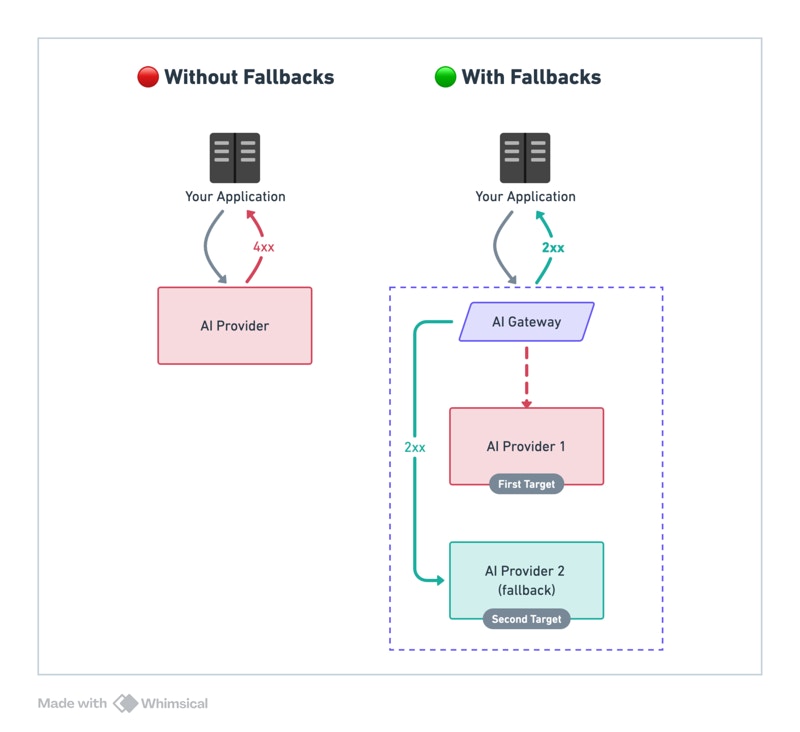
Fallbacks look similar on a feature list and differ in practice. OpenRouter takes a models array per request and does not bill failed attempts. Portkey keeps fallback in a reusable config that can trigger on specific status codes. LiteLLM puts it in router_settings and distinguishes general errors, context-window errors and content-policy errors; it also strips undecryptable encrypted reasoning when a fallback crosses providers, so the backup model reasons fresh on that turn. Vercel documents model fallbacks and provider timeouts, and Requesty and TrueFoundry offer policy-based routing by latency, weight or priority.
// OpenRouter docs: models array, tried in order
body: JSON.stringify({
  models: ['~anthropic/claude-sonnet-latest', 'gryphe/mythomax-l2-13b'],
  input: 'What is the meaning of life?',
})  // POST https://openrouter.ai/api/v1/responses
// Portkey docs: fallback config (any non-2xx by default)
{
"strategy": { "mode": "fallback", "on_status_codes": [429] },
"targets": [
{ "provider": "@openai-prod" },
{ "provider": "@azure-prod" }
]
}Benchmarks and Independent Data
I found no neutral, reproducible benchmark that compares all of these gateways on added latency, throughput or failover time. What exists is vendor-published: LiteLLM's 3,000 RPS test above (vendor-reported, mock model), Vercel's “sub-20ms latency” claim in its GA post (vendor-reported), and various comparison posts written by competing gateway vendors. Treat all of them as directional. Because gateway overhead is small next to model latency, the better test is your own: send a few thousand representative requests through each candidate and compare p50, p95 and error rate with and without the gateway.
One independent-style data point is public usage: Vercel's October 2026 AI Gateway Index and OpenRouter's rankings show which models developers actually route, but they describe model popularity, not gateway quality.
How to Choose
| If you need | Shortlist | Note |
|---|---|---|
| I want one key for every model and no servers | OpenRouter, Vercel AI Gateway, Requesty | Hosted catalogs; compare the fee on credits (5.5%, 0%, 5%). |
| My app already runs on Vercel | Vercel AI Gateway | Same invoice and dashboard; zero markup; per-key budgets. |
| My traffic already runs through Cloudflare | Cloudflare AI Gateway | Free analytics, caching and rate limits; add Unified Billing only if you want one wallet. |
| Data must stay in my network | LiteLLM, Portkey OSS, Kong, TrueFoundry, OmniRoute | Self-host; you own uptime and patching. |
| I need per-team budgets and audit logs | LiteLLM (virtual keys), Portkey, TrueFoundry Pro, Vercel | Check whether BYOK spend is excluded from budgets (Vercel excludes it). |
| I already run Kong for APIs | Kong AI Gateway | Reuse plugins, auth and observability. |
| I mainly need logging and cost analytics | Helicone (check its status), Portkey, Cloudflare | See also the observability roundup linked below. |
| I want to stretch free tiers for hobby coding | OmniRoute, 9router | Local, unofficial routing across free quotas. Not for production. |
A few rules of thumb. Compare total fee on credits, not the label: 5.5% on OpenRouter Standard, 5% on Cloudflare Unified Billing and Requesty, 0% on Vercel and Helicone credits. Check whether budgets include BYOK. Check what happens to logs and prompts: OpenRouter says prompts are not logged by default, Vercel and Cloudflare offer zero data retention and DLP options, and self-hosted gateways keep everything in your own database. And decide who patches the gateway, because it will hold every provider credential.
If you plan to run the gateway yourself, you will also need somewhere to host it. Our agent hosting roundup and, for the model side, inference providers roundup are the natural next reads.
How We Evaluated
I fetched each vendor's pricing page, documentation and, where useful, public APIs on Nov 11 and 12, 2026, and recorded prices, limits and model counts with dates. I did not run load tests and I did not take payment, referral links or sponsorship from any vendor: there is no paid placement in this ranking. Where a vendor hides pricing behind sales (Enterprise tiers), I say so. Quotes of ownership changes come from the companies' own announcements where I could fetch them, and from press coverage where I could not. Claims I could not verify are flagged in the text. Prices change often; verify on the vendor page before you buy.
FAQ
What is the best LLM API gateway in 2026?
It depends on where you run. OpenRouter is the default hosted router with the biggest catalog and no inference markup, Vercel AI Gateway is the natural pick for Vercel apps, Cloudflare AI Gateway gives free caching and analytics, and LiteLLM is the most-used open-source self-hosted proxy. Enterprises that need policy enforcement should look at Portkey, Kong AI Gateway or TrueFoundry. Prices and ownership changed in 2026, so check the dated tables above.
Does OpenRouter mark up model prices?
Not per request, according to OpenRouter's pricing page as of Nov 11, 2026. Inference is billed at the provider's list price. OpenRouter charges a fee when you buy credits: 5.5% on Standard (with a $0.80 minimum per its FAQ), 8% on Business, and 5% on crypto payments. Some competitors describe that fee as a markup, which is a fair way to compare total cost but not how OpenRouter labels it.
Is Vercel AI Gateway free?
There is a free tier of $5 per month in credits on a subset of models with lower rate limits. The paid tier is pay-as-you-go through purchased credits at provider list rates with no markup and no platform fee. Optional add-ons such as team-wide provider allowlists ($0.10 per 1,000 billed requests) and Custom Reporting do cost extra.
What is the difference between a gateway and a router?
In practice the words overlap. A router picks which model or provider serves a request (OpenRouter, OmniRoute, 9router). A gateway adds governance around the call: keys, budgets, logging, caching, guardrails (Portkey, Kong, TrueFoundry, LiteLLM). Most products here do both.
Can I use Claude Code through a gateway?
Yes. Claude Code reads ANTHROPIC_BASE_URL and ANTHROPIC_AUTH_TOKEN, and Anthropic documents the setup for any gateway that exposes a supported API format. Anthropic also states that it does not support routing Claude Code to non-Claude models through any gateway, so treat non-Claude routing as unsupported territory.
Is LiteLLM safe to use after the March 2026 supply-chain incident?
LiteLLM's own incident report says PyPI versions 1.82.7 and 1.82.8 were malicious and live for about 40 minutes on March 24, 2026, that the official Proxy Docker image was not affected, and that a clean v1.83.0 shipped on March 30 from a new CI/CD pipeline. If you run it, pin an audited version, prefer the -stable Docker tags, and rotate any credentials that were exposed to the bad versions.
Which gateway is cheapest?
Self-hosted LiteLLM, OmniRoute and 9router cost nothing in license fees but cost your time and servers. Among hosted options, Vercel AI Gateway and Cloudflare (core features) add no per-token markup, OpenRouter and Cloudflare Unified Billing charge a credit fee, and Requesty charges 5% on model cost. Provider list prices dominate the bill in every case.
What happened to Helicone and Portkey?
Mintlify announced on March 3, 2026 that it was acquiring Helicone, and Helicone's pricing page now says it is part of Experiential Labs with details to come. Palo Alto Networks announced in May 2026 that it would acquire Portkey, and Portkey's site now says it is the Prisma AIRS AI Gateway. Both remain usable, but evaluate roadmap risk before committing.
Sources
All fetched Nov 11-12, 2026.
- OpenRouter pricing and FAQ
- OpenRouter is Joining Stripe (Aug 19, 2026)
- OpenRouter docs: Claude Code and model fallbacks
- Vercel AI Gateway pricing and Claude Code setup
- Cloudflare AI Gateway pricing, REST API, Claude Code
- Portkey pricing, gateway README, fallbacks docs
- Pulse 2.0: Palo Alto Networks to acquire Portkey (May 1, 2026, press coverage)
- LiteLLM README, benchmarks, reliability and fallbacks, Claude Code tutorial
- LiteLLM: Security Update, Suspected Supply Chain Incident (Mar 24, 2026, updated)
- Helicone pricing, AI Gateway docs, Mintlify acquires Helicone (Mar 3, 2026)
- Kong pricing and AI Gateway docs, AI Proxy plugin
- TrueFoundry pricing and AI Gateway intro
- Requesty pricing and Claude Code integration
- OmniRoute repository and 9router repository
- Claude Code docs: LLM gateways, overview and connect
- OpenRouter on X, Vercel on X, Cloudflare on X