
The short answer
GLM-5.3-Flash is Z.ai’s cheap multimodal model, and it is the model that spent six days on OpenRouter as the free stealth model Ox Alpha. Its official API list price is $0.15 per million input tokens, $0.03 per million cached input tokens and $0.50 per million output tokens. GLM-5.3, the larger text-only sibling, lists at $1.40, $0.26 and $4.40, the same as GLM-5.2. By list price Flash is about nine times cheaper per token. Both models have open weights on Hugging Face, Flash under the MIT license.
Three things keep the picture from being as simple as the price ratio suggests. First, Z.ai’s own effort chart shows Flash using more output tokens per task than GLM-5.3, so the cost per finished task is closer to a factor of four to six than nine. Second, every benchmark number in Z.ai’s two launch posts is vendor-reported, and the only independent source we could read, the Artificial Analysis model page, showed no index score for Flash when we fetched it. Third, Z.ai’s own sources disagree on the GLM-5.3 release date: the blog post and launch tweet say August 14, 2026, while the docs release notes and the API-live tweet say August 18. This guide states both.
The guide is built from Z.ai’s GLM-5.3 and GLM-5.3-Flash posts, the pricing page, the release notes, the model docs, the Hugging Face repositories, OpenRouter’s listing and stealth-model page, and five first-party posts from the @Zai_org account. Press and analyst coverage appears where it adds context, and is labeled as such. We did no hands-on testing; the cost arithmetic below is ours, built from published prices and stated usage shapes.
The launch posts
Z.ai announced GLM-5.3 on X at 05:17 UTC on August 14, 2026. The post calls it “Built to Code. Ready for Cyber Defense.” and says the gains come from post-training on a 743B base model. The linked tech blog is dated the same day.
Introducing GLM-5.3: Built to Code. Ready for Cyber Defense. Top-tier coding and agentic capabilities, achieved through post-training on the 743B base model. A major leap in cybersecurity, setting a new standard among open models.
— @Zai_org August 14, 2026
The API followed on August 18. That post says GLM-5.3 is priced the same as GLM-5.2 and is available through the official API and partner model gateways. The Z.ai docs release notes carry the same date for the GLM-5.3 entry, which is the source of the date discrepancy covered in the family map below.
GLM-5.3 API is now live. Built for coding, defensive cybersecurity, and long-horizon agentic tasks. Priced the same as GLM-5.2. Available via the official API and partner model gateways.
— @Zai_org August 18, 2026
GLM-5.3-Flash arrived on August 26. The launch post lists the headline specs in one line: natively multimodal, a 1M-token context window, a 320B-A18B model under the MIT license, “previously previewed as Ox Alpha, running entirely on Chinese AI chips.”
Introducing GLM-5.3-Flash. Leading capabilities at a highly competitive price. Natively multimodal with a 1M-token context window. A 320B-A18B model released under the MIT License. Previously previewed as Ox Alpha, running entirely on Chinese AI chips.
— @Zai_org August 26, 2026
A second post, one second later, gave the standard API prices.
Standard API Pricing for GLM-5.3-Flash (per 1M tokens). Input: $0.15. Output: $0.50. Cached input: $0.03.
— @Zai_org August 26, 2026
The GLM-5.3 weights took longer. The blog post promised them “in two weeks after launch, once safety evaluation and hardening are complete.” A post on August 27 said they would arrive the next day, and on August 28 Z.ai announced the release.
GLM-5.3 is now open-weight. Our most capable model for agentic coding and cyber defense is now available to download, run, and customize.
— @Zai_org August 28, 2026
Family map: GLM-5.2, GLM-5.3 and GLM-5.3-Flash
The three names look like a version ladder, but GLM-5.3-Flash is not a smaller GLM-5.3. The two models have different bases, different sizes and different input types. The table collects what Z.ai’s pages state.
| GLM-5.2 | GLM-5.3 | GLM-5.3-Flash | |
|---|---|---|---|
| Released | June 16, 2026 (release notes) | Blog and launch tweet August 14; release notes and API tweet August 18 | August 26, 2026 |
| Base model | 743B base (per The Batch and Z.ai’s GLM-5.3 post) | Same base as GLM-5.2; Z.ai says every gain comes from post-training | Newly trained base; 320B total, 18B active |
| Architecture notes | IndexShare, SAO, slime stack | Same base, scaled post-training and environments | Hybrid sparse and linear attention, IndexPool, mHC |
| Inputs | Text | Text only | Text, image, video and file |
| Context / max output | 1M context (release notes) | 1M context, 128K max output | 1M context, 128K max output |
| Thinking | Not covered here | Always on; low, high or max effort | Always on; low, high or max effort |
| List price (input / cached / output per 1M) | $1.40 / $0.26 / $4.40 | $1.40 / $0.26 / $4.40 | $0.15 / $0.03 / $0.50 |
| Weights | Not covered here | Hugging Face, license listed as other, announced August 28 | Hugging Face, MIT license, available at launch |
GLM-5.3 reuses the GLM-5.2 base. Z.ai’s post says “it uses the same base model as GLM-5.2 — every gain comes from post-training,” and credits more environments, more diverse tasks and more training compute. One detail we could not reconcile: the Hugging Face API reports 753,329,940,480 parameters for the GLM-5.3 repository, while Z.ai’s tweet and The Batch both say 743B. Z.ai’s pages do not explain the gap, and it may simply be a difference in what is counted, so this guide uses Z.ai’s figure for the base and flags the other.
GLM-5.3-Flash is a different design. Z.ai describes it as the first natively multimodal model in the GLM-5 series, trained on a 30T-token multimodal corpus. It combines linear attention, which models local dependencies, with sparse attention, which retrieves global context through an indexer. A component called IndexPool compresses four indexer key vectors into one so the indexer stays cheap at a 1M-token context. Z.ai reports that, compared with GLM-5.3, Flash uses 3.0 times less attention compute and a 4.4 times smaller KV cache, and it concedes that Flash’s KV cache is still slightly larger than those of Kimi-K3 and DeepSeek-V4-Flash. Against the GLM-4.5 series, Z.ai says Flash keeps a similar total parameter count (320B versus 355B) but nearly halves active parameters (18B versus 32B) and layers (45 versus 92).
Two more models share the Flash price page. GLM-5.3-FlashX is a faster variant that Z.ai’s docs rate at 200 tokens per second, listed at $0.37, $0.075 and $1.25 per million tokens. GLM-5.3-FlashX-Legal, a legal-domain model, is listed at the same prices. The docs state that FlashX was not yet available on the Coding Plan.
The release-date discrepancy
Z.ai’s own first-party sources give two dates for GLM-5.3. The blog post header reads 2026-08-14, the launch tweet was posted at 05:17 UTC that day, and the blog’s benchmark footnotes record FrontierSWE results “as of 2026/08/14.” The docs release notes list GLM-5.3 under 2026-08-18, and the tweet saying the API is live was posted on August 18. The most consistent reading is that the announcement and Coding Plan rollout came on August 14 and the public API and docs entry on August 18, but no Z.ai page says so explicitly. Treat August 14 as the announcement date and August 18 as the API date, and cite both if the distinction matters to you.
The Ox Alpha story
Ox Alpha appeared on OpenRouter and the OpenCode coding agent on August 20, 2026, labeled a “stealth model.” OpenRouter’s page described it as a reasoning model for coding, sustained agentic work and production workloads, with a 1,048,576-token context window and text, image and video input. It was free to use, and the page said the developer had chosen to remain anonymous during the preview. Bloomberg picked it up on August 23 under the headline “Mystery AI Model Ox Alpha Draws Developers With Free Access.”
Speculation about the maker ran for six days. The Batch, summarizing reporting from WCCF Tech, listed the evidence that pointed to Zhipu, the company behind Z.ai: matching tokenizer arithmetic, video encoding pipelines, near-identical responses, and a habit of live-testing unreleased models under “Alpha” codenames. It reported a Kingbench score of 87.5 percent for Ox Alpha against 91.25 percent for GLM-5.3, with vision and video abilities that GLM-5.3 does not publicly have. It also reported DeepSeek as a candidate and a later claim that Ox Alpha used OpenAI’s cl100k_base tokenizer, which shifted some speculation toward Microsoft’s upcoming MAI 2. We did not verify any of those third-party claims, and the Microsoft theory did not hold: Z.ai’s GLM-5.3-Flash post states that it “tested GLM-5.3-Flash anonymously as ox-alpha on OpenCode and OpenRouter to gather user feedback,” and that the model “quickly became the most popular model of the week — with all of this traffic served on Chinese AI chips.” OpenRouter’s Ox Alpha page now carries the banner “revealed to be ZAI GLM-5.3-Flash.”
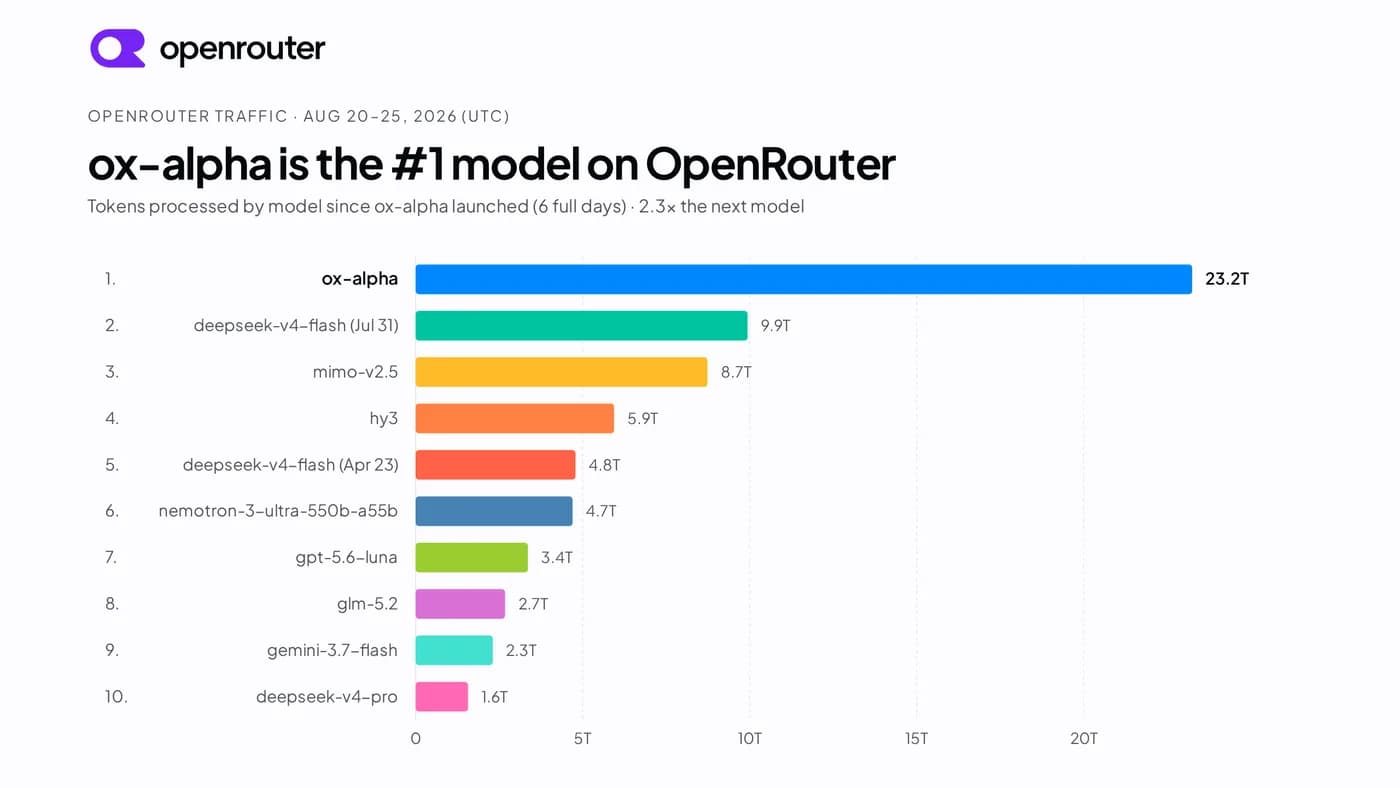
The chart is the numerical basis for “most popular model of the week.” It is an OpenRouter-branded graphic that Z.ai embedded in its own post; we read the values from the image and could not recompute them from OpenRouter data. The ranking beneath ox-alpha, as printed, is deepseek-v4-flash (July 31 release) at 9.9T, mimo-v2.5 at 8.7T, hy3 at 5.9T and an older deepseek-v4-flash at 4.8T. The Batch separately reported that the free allowance was 100 trillion tokens per day for a week; we did not find that figure on the OpenRouter page text we saved, so treat it as a press claim. Note also that free access drives volume in its own right, so token counts for a free stealth model are not directly comparable to paid traffic for other models.
One practical detail matters for anyone who used it. OpenRouter’s stealth-model notice says prompts and completions for Ox Alpha “were retained by the provider and are not used for training.” In other words, Z.ai could see what testers sent during the preview. That is the normal trade for a free preview, but it is why a stealth model is a poor place to send code or documents you would not otherwise share.
Timeline
| Date (2026) | Event | Source |
|---|---|---|
| Aug 14 | GLM-5.3 announced on X; tech blog dated the same day | Z.ai tweet, blog |
| Aug 18 | GLM-5.3 API live; docs release-note entry dated Aug 18 | Z.ai tweet, release notes |
| Aug 20 | Ox Alpha appears free on OpenRouter and OpenCode | OpenRouter page |
| Aug 23 | Bloomberg reports on the mystery model | Bloomberg |
| Aug 24 | The Batch summarizes the identity speculation | The Batch |
| Aug 26 | GLM-5.3-Flash launched; Z.ai confirms it was ox-alpha; prices published | Z.ai blog, tweets, release notes |
| Aug 27 | Z.ai says GLM-5.3 weights arrive tomorrow | Z.ai tweet |
| Aug 28 | GLM-5.3 announced as open-weight | Z.ai tweet |
Pricing and cost math
Z.ai’s pricing page, fetched October 29, 2026, lists these standard rates per million tokens. Cached input storage is shown as “Limited-time Free” for every model in the table.
| Model | Input | Cached input | Output |
|---|---|---|---|
| GLM-5.3-Flash | $0.15 | $0.03 | $0.50 |
| GLM-5.3-FlashX | $0.37 | $0.075 | $1.25 |
| GLM-5.3-FlashX-Legal | $0.37 | $0.075 | $1.25 |
| GLM-5.3 | $1.40 | $0.26 | $4.40 |
| GLM-5.2 | $1.40 | $0.26 | $4.40 |
Flash’s price is 9.3 times lower than GLM-5.3 on input, 8.7 times lower on cached input and 8.8 times lower on output. Z.ai’s launch post phrases the comparison against GLM-5.2 as “one-tenth the price”; the table supports a ratio of roughly nine.
OpenRouter lists both models with several providers, and the spread is wide. For z-ai/glm-5.3-flash the endpoints API returned 40 endpoint rows on October 29, with input prices from $0.0457 to $0.225 and output prices from $0.0625 to $0.75 per million tokens; the Z.AI row matches the list price at $0.15 and $0.50. For z-ai/glm-5.3 it returned 49 rows, input from $0.0699 to $2.80 and output from $0.88 to $8.80, with Z.AI at $1.40 and $4.40. Quantization labels across rows include fp4, fp8, nvfp4 and unknown. Cheaper rows may serve a lower-precision build, may differ on caching, rate limits or data retention, and can change at any time, so a quoted OpenRouter low price is a starting point for a routing test and not a property of the model.
What a task costs at list price
Per-token prices say little about a bill until you attach a usage shape. The table uses three assumed shapes and Z.ai’s list prices. These are our arithmetic, not measurements, and the shapes are invented examples: change the token counts and the totals change.
| Assumed run shape | GLM-5.3-Flash | GLM-5.3-FlashX | GLM-5.3 / 5.2 |
|---|---|---|---|
| A: 12K input, 0 cached, 1.5K output | $0.0026 | $0.0063 | $0.0234 |
| B: 300K input of which 240K cached, 20K output | $0.0262 | $0.0652 | $0.2344 |
| B without any cache hits | $0.0550 | $0.1360 | $0.5080 |
| D: 1.5M input of which 1.35M cached, 120K output | $0.1230 | $0.3067 | $1.0890 |
Two readings follow. Caching moves the bill more than the choice between Flash and FlashX does: shape B drops from $0.0550 to $0.0262 on Flash when 240K of the 300K input tokens hit the cache. And the Flash-to-GLM-5.3 gap on a single run holds near 9 times only if both models consume the same number of tokens, which the next sections show is not Z.ai’s own finding.
Benchmarks, labeled
Every number in this section comes from Z.ai’s two launch posts and is vendor-reported. Z.ai documents harnesses in footnotes: Terminal-Bench 2.1 runs in Claude Code 2.1.207 with a 6-hour timeout, DeepSWE uses the mini-swe-agent harness with a 400K context, Toolathlon Verified comes from the official evaluation service as pass@1 averaged over three runs, and GDPval-AA v2 is evaluated by Artificial Analysis. We did not rerun any of them.
GLM-5.3 against GLM-5.2 and its peers
| Benchmark (vendor-reported) | GLM-5.3 | GLM-5.2 | Kimi K3 | Opus 4.8 | Fable 5 (w/ fallback) | GPT-5.6 Sol |
|---|---|---|---|---|---|---|
| Terminal Bench 2.1 | 88.2 | 81.0 | 88.3 | 85.0 | 88.0 | 88.8 |
| Terminal Bench 3.0 | 28.3 | 4.6 | 17.4 | 21.1 | 33.7 | 34.6 |
| DeepSWE v1.1 | 66.9 | 46.2 | 67.5 | 58.0 | 69.7 | 72.7 |
| NL2Repo | 58.0 | 48.9 | 58.0 | 69.7 | - | - |
| CyberGym | 84.5 | 77.2 | 80.0 | 78.1 | 83.8 | 83.6 |
| ExploitBench | 54.4 | 24.4 | 32.2 | 40.0 | 78.0 | 76.5 |
| Toolathlon Verified | 73.0 | 59.9 | 76.5 | 76.2 | 74.7 | 74.9 |
| AutomationBench v1.0.6 | 48.2 | 26.2 | 46.7 | 41.0 | 46.2 | 45.8 |
| HLE w/ Tools | 62.5 | 54.7 | 59.8 | 57.9 | 63.9 | 64.5 |
| GDPval-AA v2 | 1769 | 1508 | 1682 | 1588 | 1743 | 1730 |
The pattern in Z.ai’s own table is a large jump over GLM-5.2 on long-horizon coding (Terminal Bench 3.0 from 4.6 to 28.3, DeepSWE from 46.2 to 66.9) and a gap that remains to the closed frontier on the hardest tasks. On Terminal Bench 3.0 the table puts Fable 5 at 33.7 and GPT-5.6 Sol at 34.6 against GLM-5.3’s 28.3. The cyber results are the post’s emphasis: GLM-5.3 tops CyberGym at 84.5 but trails Fable 5 (78.0) and GPT-5.6 Sol (76.5) on ExploitBench at 54.4, and Z.ai’s own wording is that capability “is growing fastest exactly where we are furthest behind.” Z.ai also reports that the model found 2,436 vulnerabilities across 269 open-source projects, 1,097 of them medium or high severity, with a public disclosure ledger of which 53 findings were disclosed at the time of the post. That is a vendor claim; the ledger is the place to check progress.
GLM-5.3-Flash against GLM-5.2 and other cheap models
| Benchmark (vendor-reported) | GLM-5.3-Flash | GLM-5.2 | DeepSeek-V4-Vision-Exp | Opus 4.8 | GPT-5.6 Terra | Gemini 3.7 Flash |
|---|---|---|---|---|---|---|
| Terminal Bench 2.1 | 84.3 | 81.0 | 83.9 | 85.0 | 87.4 | 85.8 |
| DeepSWE v1.1 | 63.4 | 46.2 | 59.3 | 58.0 | 69.6 | 65.3 |
| NL2Repo | 56.3 | 48.9 | 57.7 | 69.7 | - | - |
| Toolathlon Verified | 78.4 | 59.9 | 75.9 | 76.2 | 74.9 | - |
| AutomationBench v1.0.6 | 48.8 | 26.2 | 38.8 | 41.0 | 37.2 | 52.3 |
| Agents’ Last Exam | 26.3 | 20.4 | 27.3 | 27.0 | 28.0 | - |
| HLE w/ Tools | 55.3 | 54.7 | 55.1 | 57.9 | - | - |
| GDPval-AA v2 | 1773 | 1504 | 1675 | 1582 | 1571 | 1527 |
| OSWorld 2.0 | 59.1 | - | 54.9 | 54.8 | 50.2 | 47.9 |
| OfficeQA Pro | 62.4 | - | 57.9 | 48.9 | - | - |
| BabyVision | 53.4 | - | 35.1 | 46.8 | 61.6 | 70.9 |
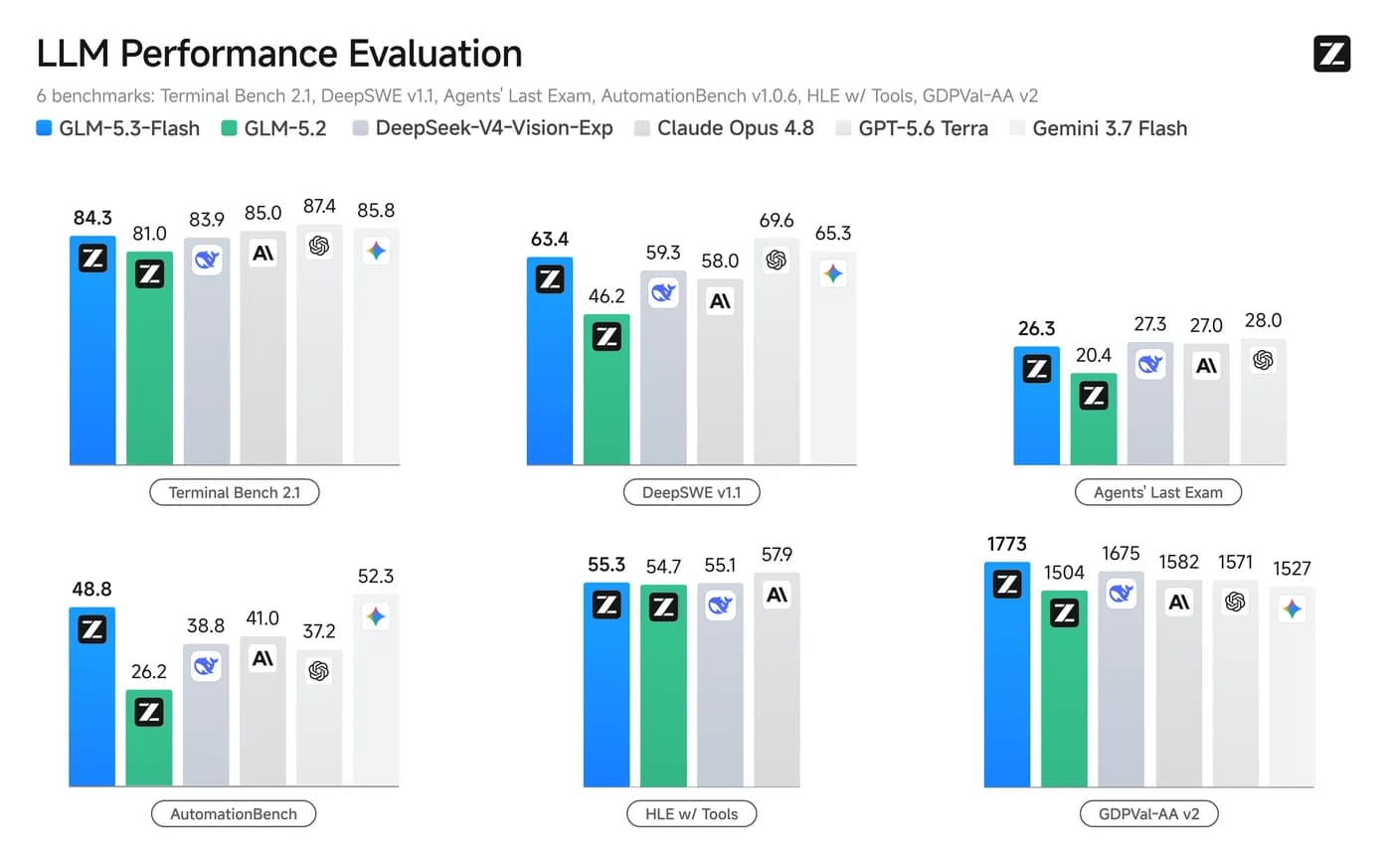
Z.ai summarizes Flash as “approaching Claude Opus 4.8 overall,” and the table supports a narrower statement: Flash is ahead of Opus 4.8 on DeepSWE (63.4 against 58.0), Toolathlon Verified (78.4 against 76.2), AutomationBench (48.8 against 41.0) and GDPval-AA v2, behind on Terminal Bench 2.1 (84.3 against 85.0), NL2Repo (56.3 against 69.7) and HLE with tools (55.3 against 57.9). Against Gemini 3.7 Flash, the other cheap multimodal model in the table, Flash leads on Terminal-style and agentic rows but trails clearly on BabyVision (53.4 against 70.9), MVBench and MMVU. The vision benchmarks are the part of the table with the thinnest comparison set: several rival cells are blank.
Flash against GLM-5.3, row by row
Because Z.ai published both tables with the same footnote style, the Flash and GLM-5.3 columns can be set side by side. The tables use slightly different benchmark labels in places (the GLM-5.3 post reports Agents’ Last Exam as ALE-CLI), so treat the pairs as indicative.
| Benchmark (vendor-reported) | GLM-5.3-Flash | GLM-5.3 | Gap |
|---|---|---|---|
| Terminal Bench 2.1 | 84.3 | 88.2 | Flash 3.9 lower |
| DeepSWE v1.1 | 63.4 | 66.9 | Flash 3.5 lower |
| NL2Repo | 56.3 | 58.0 | Flash 1.7 lower |
| Toolathlon Verified | 78.4 | 73.0 | Flash 5.4 higher |
| AutomationBench v1.0.6 | 48.8 | 48.2 | Flash 0.6 higher |
| Agents’ Last Exam | 26.3 | 28.5 | Flash 2.2 lower |
| HLE w/ Tools | 55.3 | 62.5 | Flash 7.2 lower |
| GDPval-AA v2 | 1773 | 1769 | Flash 4 higher |
On Z.ai’s numbers the larger model leads on the coding and reasoning rows, while Flash matches or leads on the tool-use and knowledge-work rows (Toolathlon, AutomationBench, GDPval-AA). That is a notable claim for a model that lists at one-ninth the price, and it is the one most worth checking on your own workload before trusting it, since these are exactly the rows where harness and scoring details matter most.
Effort levels and token use
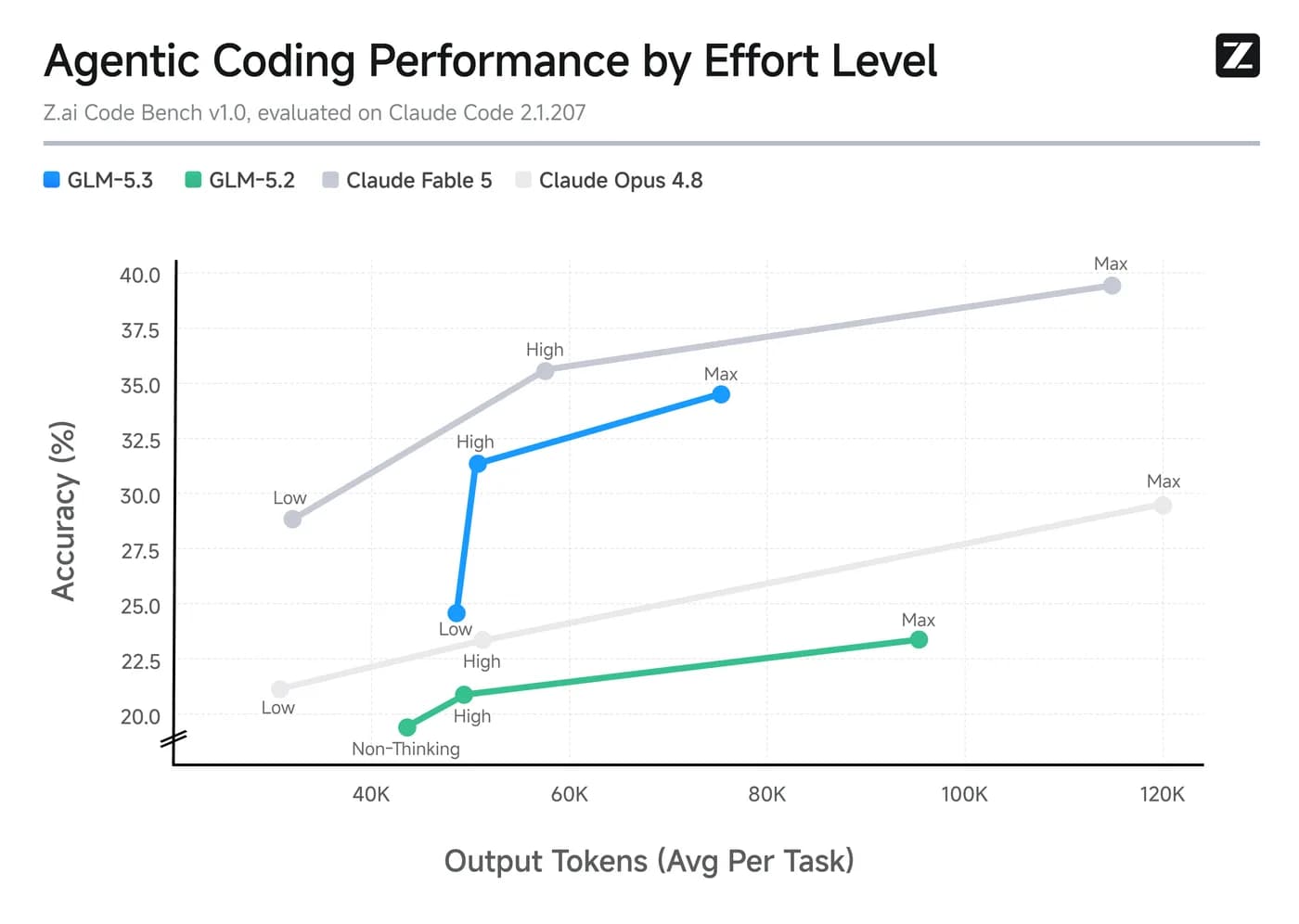
Both models run with thinking on, and each offers three reasoning effort levels: low, high and max. Z.ai’s in-house Z.ai Code Bench v1.0, a private benchmark run on Claude Code 2.1.207, plots accuracy against average output tokens per task at each level. The figures below are read from the chart images, so they are approximate, and the benchmark is private and unaudited.
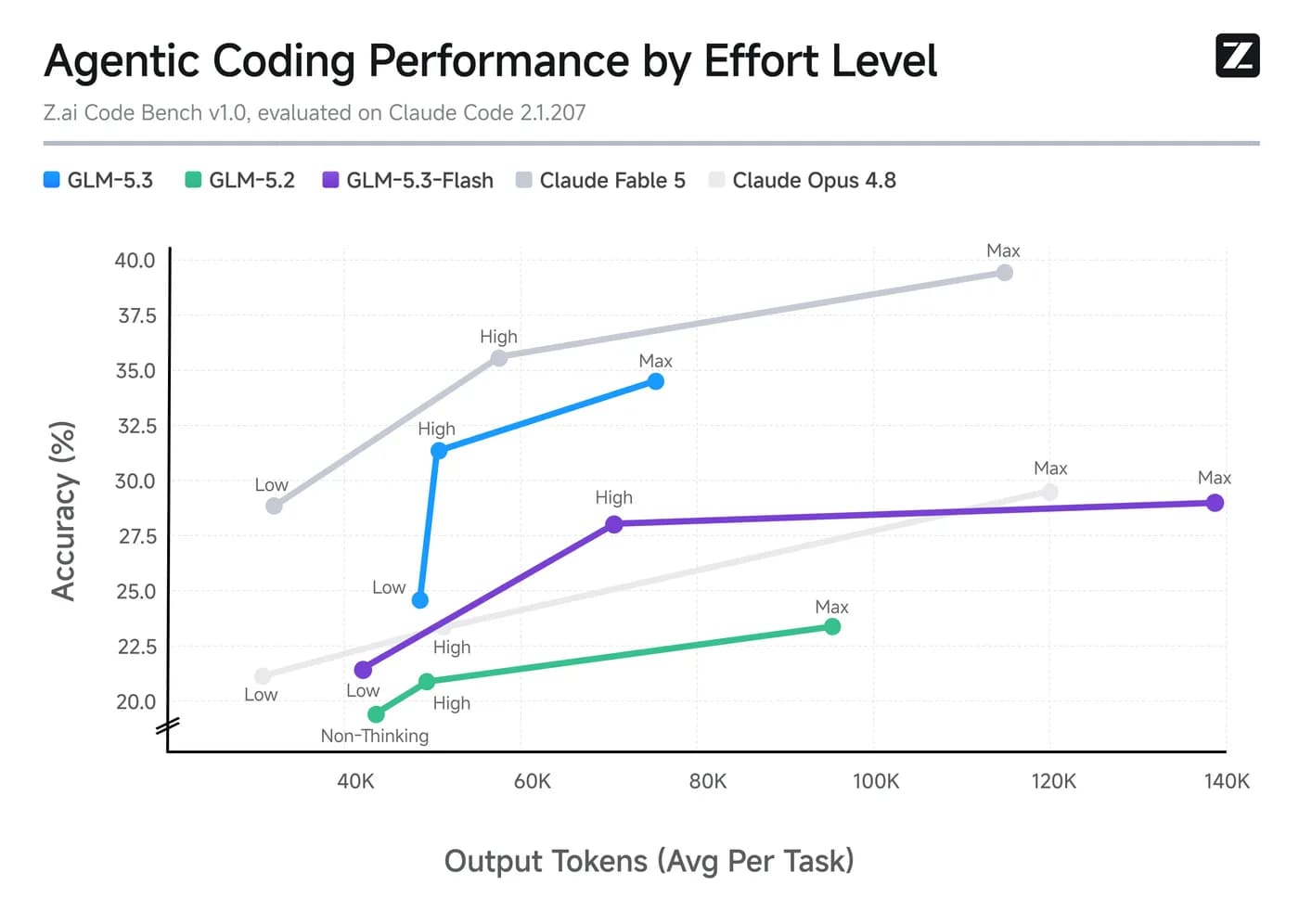
| Effort (Code Bench v1.0, chart readings) | GLM-5.3-Flash | GLM-5.3 | Output-token cost, Flash vs GLM-5.3 |
|---|---|---|---|
| Low | about 21.4% at about 41K tokens | about 24.6% at about 47K tokens | about $0.02 vs about $0.21 per task |
| High | about 28.0% at about 70K tokens | about 31.4% at about 48K tokens | about $0.04 vs about $0.21 per task |
| Max | about 29.0% at about 139K tokens | about 34.5% at about 75K tokens | about $0.07 vs about $0.33 per task |
Z.ai’s own text states the GLM-5.3 figures: at Max effort GLM-5.3 reaches 34.5 percent at roughly 75K output tokens per task, against 23.4 percent at 96K for GLM-5.2, and at High it reaches 31.4 percent at around 50K tokens, ahead of Claude Opus 4.8 at 29.5 percent with 120K. For Flash, the post says only that it “nearly matches Claude Opus 4.8 (29.0 vs. 29.5)” at max effort. The token counts for Flash are chart readings.
The last column multiplies those token readings by the output list price only, ignoring input and cache. It shows the effect plainly: at Max, Flash emits roughly 1.9 times the output tokens of GLM-5.3 on this benchmark, so the output-token cost gap shrinks from 8.8 times to about 4.7 times, and Flash scores about five points lower. At High the gap is about six times and Flash scores about three points lower. Whether that trade suits you depends on whether a few points of accuracy or the lower bill matters more for the job, and on whether latency from longer outputs matters. The chart is the best argument for measuring cost per finished task rather than cost per token.
Independent evidence
The only independent measure we could read is Artificial Analysis. Z.ai’s Flash post cites the Artificial Analysis Intelligence Index v4.1.1, saying Flash “pushes the Pareto frontier” by “scoring 57 at just $0.045 per task (discounted).” The post also includes the Pareto chart.
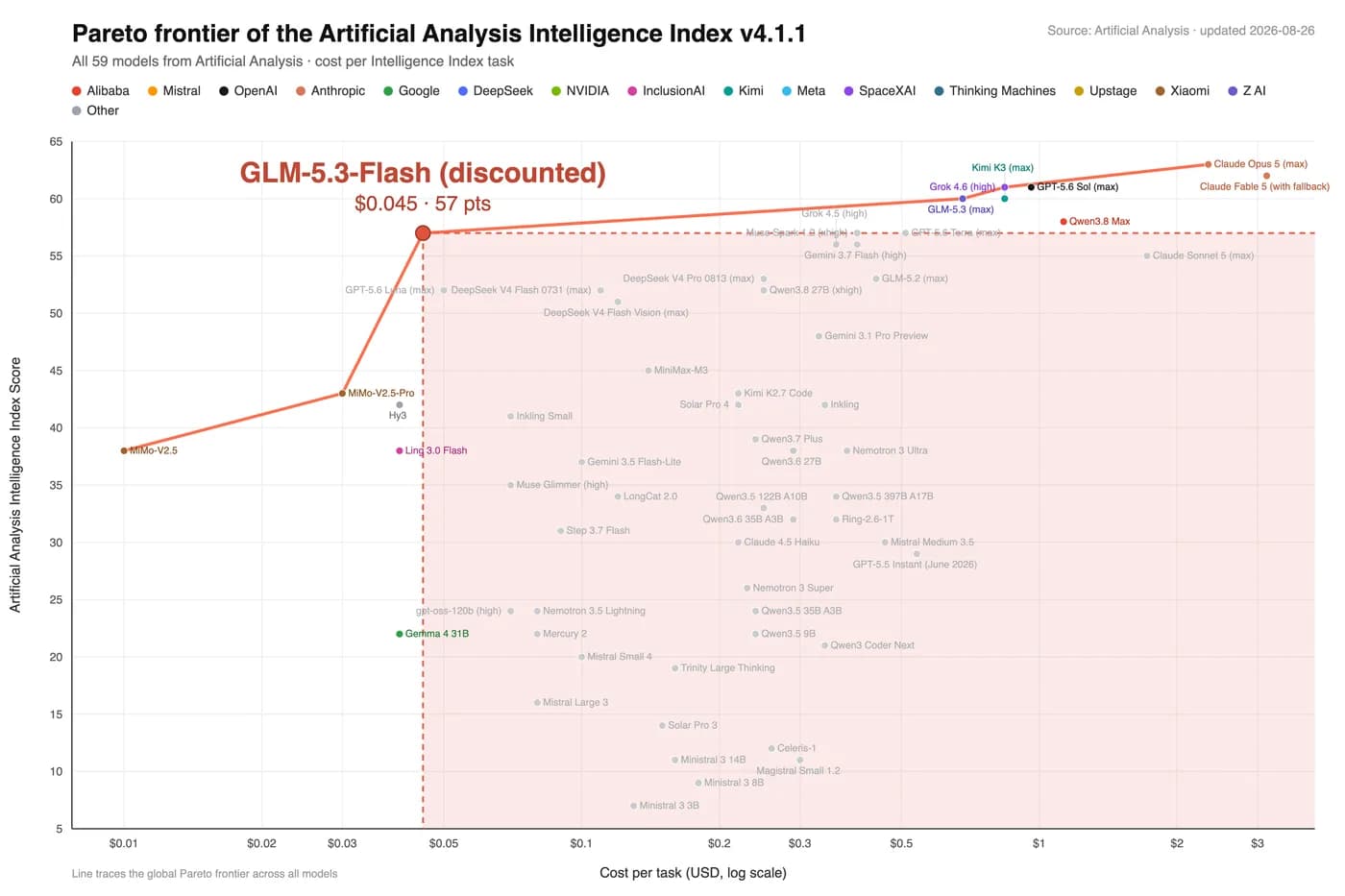
Read the label closely. The chart tags the Flash point “discounted,” and neither the chart nor the post says what price was used, so $0.045 should not be read as a list-price cost per task. The same chart, read from the image, places GLM-5.3 (max) near 60 points at roughly $0.68 per task and GLM-5.2 (max) near 53 at roughly $0.44, consistent with The Batch’s report that GLM-5.3 scored 60 on the index. Those chart readings are approximate.
When we fetched the Artificial Analysis page for GLM-5.3-Flash on October 29, it listed the model as MIT-licensed with 1M context and an output speed of 74.7 tokens per second, but showed the Intelligence Index, cost per task and token-use fields as N/A and noted “No publicly available API.” The page also referenced Intelligence Index v5.0, a newer version than the one in Z.ai’s chart. We could not find an independent index score for Flash on a current index version, so the 57 remains a figure we could see only in the vendor’s chart. For GLM-5.3 itself, we found no independent reproduction of the Z.ai benchmark table.
How to use them
There are three practical routes: Z.ai’s own API, OpenRouter, and the GLM Coding Plan inside a coding agent. Self-hosting is the fourth option for teams with the hardware.
Route 1: the Z.ai API
The model codes are glm-5.3, glm-5.3-flash, glm-5.3-flashx and glm-5.3-flashx-legal. The GLM-5.3 guide’s examples use the OpenAI-style chat completions endpoint at https://api.z.ai/api/paas/v4/chat/completions. The Flash docs say its text parameters match GLM-5.3, so the example below is the documented GLM-5.3 request with the model code swapped, not a separate Flash example.
curl -X POST "https://api.z.ai/api/paas/v4/chat/completions" \
  -H "Content-Type: application/json" \
  -H "Authorization: Bearer $ZAI_API_KEY" \
  -d '{
    "model": "glm-5.3-flash",
    "messages": [
      {"role": "user", "content": "Review this function for off-by-one errors."}
    ],
    "thinking": {"type": "enabled"},
    "reasoning_effort": "max",
    "temperature": 1.0,
    "top_p": 0.95,
    "stream": true,
    "tool_stream": true
  }'
Four API details from the docs matter when migrating. Thinking cannot be disabled on either model: thinking.type only accepts enabled. The reasoning_effort parameter accepts low, high or max and defaults to max. Z.ai’s migration guide says that if your application sends thinking.type: "disabled", you should change it to enabled and set the effort to low before switching the model ID to glm-5.3, “otherwise, the request will fail.” For Flash, the docs recommend temperature: 1, top_p: 0.95, reasoning_effort: max, thinking.clear_thinking: false, and, for streaming, both stream: true and tool_stream: true. And in the function-calling docs, tool_choice defaults to auto and the docs say it only supports auto, so you cannot force a specific tool call. Input limits are a 1M-token context and 128K maximum output for both; GLM-5.3 takes text only, while Flash takes video, image, text and file input and returns text.
The GLM-5.3 guide also lists a table of base URLs that includes https://api.z.ai/api/coding/paas/v4 for the OpenAI chat protocol, https://api.z.ai/api/v1 for the OpenAI Response protocol and https://api.z.ai/api/anthropic for the Anthropic message protocol, while its code examples use the general paas/v4 path. We did not find a page we read that states which endpoint bills against the Coding Plan quota and which against pay-as-you-go balance, so check that against your plan before pointing a production tool at either.
Route 2: OpenRouter
OpenRouter lists z-ai/glm-5.3-flash and z-ai/glm-5.3 behind its OpenAI-compatible API at https://openrouter.ai/api/v1. The attraction is one key and routing across providers; the cost, as the pricing section showed, is that providers differ in price, quantization and policy. If you route on price, pin the provider or set provider preferences deliberately, and run your own checks against the endpoint you will actually use. The old ox-alpha stealth page remains as a record and points to the Flash listing.
Route 3: the GLM Coding Plan
If you work inside a coding agent rather than calling a raw API, the Coding Plan covers that case. It is the subject of the next section.
Self-hosting
GLM-5.3-Flash is on Hugging Face under the MIT license, with 321,323,031,390 parameters reported by the Hugging Face API and a model card listing SGLang, vLLM, TokenSpeed, Transformers and KTransformers as supported inference frameworks. GLM-5.3 is on Hugging Face too, but with the license listed as “other.” Its LICENSE includes a Model-as-a-Service clause: an operator of a model-as-a-service business with more than USD 10 billion in aggregate revenue over any consecutive twelve months must pass a Z.ai security review before using the software or derivatives for commercial purposes. The clause excludes end-user products with model capabilities embedded in specific features and mere request relaying. Read the license text itself if you operate a hosting business.
Both repositories were still being maintained when we fetched them: the commit history shows chat-template changes on September 4 and again on October 14 and 15 (“speed up tool-result validation and reordering”). Pin a revision if you depend on exact template behavior.
The GLM Coding Plan
Z.ai’s Coding Plan documentation describes subscription tiers that work with agent tools such as Claude Code, ZCode, OpenCode, Cline, AutoClaw and others, with plans starting at $18 per month according to the docs metadata. Quota is a credit system with a 5-hour limit and a weekly limit.
| Plan | 5-hour credits | Weekly credits |
|---|---|---|
| Lite | 2,000 | 10,000 |
| Pro | 12,000 | 60,000 |
| Max | 28,000 | 140,000 |
Credit use per call is (input tokens times the input multiplier plus cached tokens times the cached multiplier plus output tokens times the output multiplier) divided by 10,000. The multipliers differ by model.
| Model | Input multiplier | Cached input multiplier | Output multiplier |
|---|---|---|---|
| GLM-5.3 | 6.9 | 1.7 | 24 |
| GLM-5.3-Flash (including the vision MCP) | 2.3 | 0.56 | 8 |
Peak hours are Monday to Friday, 14:00 to 18:00 Singapore Standard Time (UTC+8), which is 06:00 to 10:00 UTC. Calls outside peak hours cost 50 percent of the standard credits, weekends included. Z.ai’s estimated token allowance at a 98 percent cache hit rate is 52 to 104 million GLM-5.3 tokens per week on Lite against 158 to 317 million for Flash, 313 to 627 million against 950 to 1,900 million on Pro, and 731 to 1,463 million against 2,217 to 4,433 million on Max. The low end assumes all use at peak and the high end all use off-peak. Z.ai’s post summarizes this as Flash giving “3x the usable quota of GLM-5.3,” and the multipliers agree: 6.9 divided by 2.3 is 3.0.
Applying the formula to shape B from the pricing section (60K uncached input, 240K cached, 20K output) gives 43.24 credits on Flash and 130.2 on GLM-5.3, so a Lite plan’s 2,000-credit window would cover about 46 such runs on Flash against about 15 on GLM-5.3 at peak rates, and about twice that off-peak. That is our arithmetic on an assumed shape. The docs also state that requests for GLM-5.2 and GLM-5.1 are automatically routed to GLM-5.3 and requests for GLM-4.7 to GLM-5.3-Flash on the plan. One other note: the GLM-5.3 post mentioned a limited-time 1.5x quota boost through August 31, which had expired by the time of writing.
Claim and evidence table
| Claim | Where it comes from | Status |
|---|---|---|
| GLM-5.3-Flash was the stealth model Ox Alpha | Z.ai Flash blog; OpenRouter stealth page banner; Z.ai launch tweet | Confirmed by the maker and the platform |
| GLM-5.3 was released August 14 | Z.ai blog date; launch tweet | First-party; conflicts with release notes |
| GLM-5.3 was released August 18 | Docs release notes; API-live tweet | First-party; read as the API date |
| GLM-5.3 reuses the GLM-5.2 base | Z.ai GLM-5.3 blog | Vendor statement; the parameter count differs between tweet and Hugging Face metadata |
| Flash lists at $0.15, $0.03 and $0.50 per million tokens | Z.ai pricing page; Z.ai tweet | Confirmed on the October 29 pricing page |
| GLM-5.3 lists at $1.40, $0.26 and $4.40 | Z.ai pricing page | Confirmed; same as GLM-5.2 |
| Flash weights are public under MIT | Hugging Face repository and API; Z.ai tweet | Confirmed |
| GLM-5.3 weights are public | Z.ai tweet August 28; Hugging Face repository | Confirmed; license listed as other with a MaaS clause |
| Flash approaches Claude Opus 4.8 | Z.ai Flash blog tables | Vendor-reported; mixed row by row |
| Flash scores 57 on the AA index at $0.045 per task | Z.ai chart citing Artificial Analysis | Vendor chart; labeled discounted; not visible on the AA page we fetched |
| Ox Alpha processed 23.2T tokens in six days | OpenRouter chart in Z.ai’s post | Read from the image; could not be recomputed |
| Served entirely on Chinese AI chips | Z.ai Flash blog and tweet | Vendor statement; not independently verified |
| Ox Alpha used the cl100k_base tokenizer | The Batch citing WCCF Tech | Third-party report; not verified |
A test plan before you switch
Nothing above replaces a test on your own tasks. A small plan that fits an afternoon:
- Pick 20 to 40 real tasks from your own repository or workflow, including a few that previously failed. Keep them fixed.
- Run each task on both models at the same effort setting, then again at one lower setting. Z.ai’s chart suggests the effort level changes both accuracy and token use for each model.
- Record tokens, not only dollars: input, cached input and output per task, from the API usage fields. Compute cost per finished task with the list prices above.
- Score outcomes with a checker you trust, such as tests passing or a diff reviewed against a rubric, and count retries separately from clean passes.
- Test your tool loop: because
tool_choiceonly supportsauto, check how often the model calls the tool you expect, and how it handles a tool error. - Repeat on the provider you will actually use. If you route through OpenRouter, run the same set on the specific endpoint, since quantization and caching differ.
- Check images separately if you will send screenshots or video: only Flash accepts them, and the vision benchmark set in Z.ai’s table is thin.
Which model for which job
| Situation | Reasonable starting point | Why |
|---|---|---|
| High-volume agent loops with long stable prefixes | GLM-5.3-Flash | Lowest list price and the cheapest cached rate; Z.ai reports strong tool-use rows |
| Hardest coding and long-horizon tasks | GLM-5.3 at high or max | Leads Flash on Terminal Bench, DeepSWE and HLE with tools in Z.ai’s tables |
| Screenshots, UI work, documents, video | GLM-5.3-Flash | GLM-5.3 is text-only; Flash takes image, video and file input |
| Latency-sensitive interactive use | GLM-5.3-FlashX | Docs rate it at 200 tokens per second; compare against Flash on your tasks |
| Security and vulnerability research | GLM-5.3, with human review | Z.ai’s cyber results are for GLM-5.3 and remain below the closed frontier on exploitation rows |
| A coding agent on a flat monthly plan | Flash first, GLM-5.3 for hard tasks | Flash draws 3.0 times fewer credits per token on the Coding Plan |
| Work involving sensitive code | Self-hosted weights or a provider whose policy you have read | Stealth and free tiers retained prompts during the preview |
For comparison with other cost-tier choices, see GPT-6 Astra vs Sol vs Luna pricing and usage, Claude Opus 5.5 vs Sonnet 5.5 for coding and Kimi K3, another open-weight model that appears in Z.ai’s comparison tables.
Limitations
- Every benchmark number in this guide is vendor-reported by Z.ai. We read the tables and chart images, cross-checked the table against the chart where both exist, and did not rerun a benchmark.
- The effort-chart token counts and the Artificial Analysis chart values come from reading rendered images and are approximate. The traffic chart is OpenRouter-branded but embedded in Z.ai’s post; we could not recompute it.
- We found no independent Intelligence Index score for GLM-5.3-Flash on a current index version, and no independent reproduction of Z.ai’s GLM-5.3 table. The Artificial Analysis page we fetched showed N/A for the index fields.
- The GLM-5.3 release date differs between Z.ai’s own sources (August 14 versus August 18); this guide states both and does not pick one as the single truth.
- The 743B versus 753B parameter difference for GLM-5.3 is unexplained in the pages we read.
- The claim that all Ox Alpha traffic was served on Chinese AI chips, the Kingbench scores, the cl100k_base tokenizer claim and the 100-trillion-tokens-per-day allowance are statements by Z.ai or by press coverage and were not verified here.
- We did not test API latency, tool-calling error rates, long-context accuracy or image quality. No independent tool-calling reliability figures were found.
- Which Z.ai endpoint bills against the Coding Plan quota was not confirmed in the pages we read. Prices on OpenRouter vary by provider and change without notice. Third-party promotions and reseller discounts were not verified and are left out.
Verdict
GLM-5.3-Flash is the more interesting of the two releases for most builders. It is multimodal, MIT-licensed, listed at $0.15 and $0.50 per million tokens, and Z.ai’s own tables put it ahead of GLM-5.2 on every row they share and near GLM-5.3 on tool-use rows. Z.ai’s own effort chart is also the reason to be careful: Flash spends more output tokens to reach a lower score, so the real saving per finished task is smaller than the per-token ratio.
GLM-5.3 remains the choice when you want the top Z.ai score on hard coding tasks and can pay about nine times the token price. The Ox Alpha episode is a useful case study in how a vendor can collect real traffic before a launch, at the cost of letting testers’ prompts be retained. Start with Flash on a fixed set of your own tasks, record tokens and outcomes, and escalate to GLM-5.3 only for the tasks where the accuracy gap shows up in your data.
FAQ
What was Ox Alpha?
Ox Alpha was a free stealth model on OpenRouter and OpenCode from August 20, 2026. Z.ai’s GLM-5.3-Flash blog post says it tested GLM-5.3-Flash anonymously under that name, and OpenRouter’s page now says it was revealed to be ZAI GLM-5.3-Flash. Z.ai launched Flash under its own name on August 26.
How much does GLM-5.3-Flash cost?
On Z.ai’s pricing page, GLM-5.3-Flash lists at $0.15 per million input tokens, $0.03 per million cached input tokens and $0.50 per million output tokens. GLM-5.3-FlashX lists at $0.37, $0.075 and $1.25. OpenRouter providers list different rates, from about $0.046 to $0.225 for input.
What is the difference between GLM-5.3 and GLM-5.3-Flash?
GLM-5.3 is a text-only model built on the GLM-5.2 base with scaled post-training, listed at $1.40 and $4.40 per million input and output tokens. GLM-5.3-Flash has a newly trained base with 320B total and 18B active parameters, accepts image, video and file input, and lists at $0.15 and $0.50. Z.ai’s tables show GLM-5.3 ahead on most coding rows and Flash level or ahead on several tool-use rows.
When was GLM-5.3 released, August 14 or August 18?
Both dates appear in Z.ai’s own materials. The blog post and launch tweet are dated August 14, 2026. The docs release notes and the API-live tweet are dated August 18. The announcement and API availability probably account for the two dates, but Z.ai does not say so. Cite both.
Are the GLM-5.3 and GLM-5.3-Flash weights available?
Yes. GLM-5.3-Flash weights are on Hugging Face under the MIT license. GLM-5.3 weights were announced as open on August 28, 2026, and the Hugging Face repository lists the license as other, with a Model-as-a-Service clause that affects very large hosting businesses.
Can I turn thinking off?
No. Both models always run with thinking enabled and offer low, high and max effort, with max as the default. Z.ai’s migration guide says requests that send thinking disabled will fail, and tells you to use enabled with low effort instead.
Is GLM-5.3-Flash really near Claude Opus 4.8?
On Z.ai’s own tables it is ahead on some rows (DeepSWE, Toolathlon Verified, AutomationBench) and behind on others (Terminal Bench 2.1, NL2Repo, HLE with tools). All of it is vendor-reported, and we found no independent Intelligence Index score for Flash. Test on your own tasks.
How do I use GLM-5.3-Flash with the Coding Plan or OpenRouter?
On the Coding Plan, Flash is available in supported agent tools and draws about a third of the credits GLM-5.3 does per token. On OpenRouter, call z-ai/glm-5.3-flash through its OpenAI-compatible API and check which provider serves your requests, since price, quantization and policy vary.
Sources
Sources checked October 29, 2026.
- GLM-5.3: Frontier Coding with Emergent Cyber Capabilities — Z.ai blog (benchmark table, Code Bench chart, API changes, weights timeline)
- GLM-5.3-Flash: Frontier Intelligence, Flash Cost — Z.ai blog (architecture, benchmark tables, Ox Alpha statement, charts)
- Z.ai pricing page and release notes
- GLM-5.3 guide, GLM-5.3-Flash guide, migration guide and function-calling docs
- GLM Coding Plan overview (credits, multipliers, peak hours, token allowances)
- GLM-5.3-Flash on Hugging Face and GLM-5.3 on Hugging Face (model cards, licenses, repository metadata, commit history)
- OpenRouter: Ox Alpha stealth model, z-ai/glm-5.3-flash and z-ai/glm-5.3 (stealth notice, endpoint prices and quantization labels)
- Z.ai on X: GLM-5.3 announcement, API live, GLM-5.3-Flash announcement, Flash pricing, weights tomorrow and open-weight announcement
- Artificial Analysis: GLM-5.3-Flash (independent speed and license fields; index fields N/A at fetch)
- Bloomberg, August 23, 2026 and The Batch, August 24, 2026 (press coverage of the stealth model; third-party claims labeled as such)
Related reading: GPT-6.1 Sol guide, Claude Opus 4.8 launch, CodeWhale and DeepSeek terminal agent guide and Kimi K3 open frontier intelligence.