Get the latest on AI, LLMs & developer tools
New MCP servers, model updates, and guides like this one — delivered weekly.
What Grok 4.5 Is
Grok 4.5 is a mixture-of-experts model for coding, agentic work, and knowledge tasks that SpaceXAI (xAI) and Cursor trained togetherand launched on July 8, 2026. It is unusual for a single model to ship under two brands on the same day: xAI calls it “our strongest model ever,” and Cursor calls it “our most intelligent model and the first we've built for more than software engineering.” The API model ID is grok-4.5.
Here is the honest headline before the marketing one: on the official launch benchmarks, Grok 4.5 is not the top scorer. Anthropic's Fable 5 leads most of the coding evals, and Opus 4.8 beats Grok 4.5 on a couple of them. What Grok 4.5 wins on is throughput, token efficiency, and price: it is served at 80 tokens per second, uses roughly 4.2× fewer output tokens than Opus 4.8 on SWE-Bench Pro, and costs $2 per million input tokens and $6 per million output tokens. If your bottleneck is latency and cost per solved task rather than the last point of benchmark accuracy, that trade is the whole story.
Announcing Grok 4.5, our first model trained specifically for coding and agents. It was trained with Cursor and offers frontier intelligence at leading speeds and cost efficiency.
— SpaceXAI (@SpaceXAI)July 8, 2026
Grok 4.5 at a glance (as of July 8, 2026)

API model ID:   grok-4.5
Architecture:   mixture-of-experts
Built by:       SpaceXAI (xAI) + Cursor, co-trained
Serving speed:  ~80 tokens/sec ("fast-model" tier)
Pricing:        $2 / MTok input, $6 / MTok output
Available in:   Cursor (all plans), Grok Build CLI, SpaceXAI API
Not yet in:     the EU (expected mid-July 2026)
The SpaceXAI × Cursor Partnership
Grok 4.5 did not appear from nowhere. On April 21, 2026, Cursor announced it was partnering with SpaceX to accelerate model training, using SpaceXAI's Colossus infrastructure to get past a compute bottleneck. Cursor's own model line had been climbing fast: Composer shipped as its first agentic coding model, Composer 1.5 scaled reinforcement learning by more than 20×, and Composer 2 added continued pretraining to reach frontier-level results at a fraction of the cost. Grok 4.5 is the next rung on that ladder — and this time it carries xAI's Grok brand as well.
The two launch posts describe the same model from two angles. xAI says Grok 4.5 was “trained alongside Cursor” across tens of thousands of NVIDIA GB300 GPUs, with heavy data filtering and reinforcement learning over hundreds of thousands of multi-step software-engineering tasks. Cursor says the model is a mixture-of-experts network trained on “trillions of tokens of Cursor data” plus deliberately broader material — high-quality STEM tasks, research papers, and other knowledge work — so it can go past pure software engineering into data science, finance, and legal work. Cursor keeps Composer 2.5available too, as a different weight class.
We've partnered with SpaceXAI to train Grok 4.5.
— Cursor (@cursor_ai)July 8, 2026
It's our most powerful model yet and the first we've built for more than software engineering.
A naming note, because it trips people up: xAI refers to itself as SpaceXAI throughout these announcements (the X account is @SpaceXAI, and the developer console lives at console.x.ai), while the domain and docs stay on x.ai. In this article “SpaceXAI” and “xAI” mean the same company.
Official Benchmarks
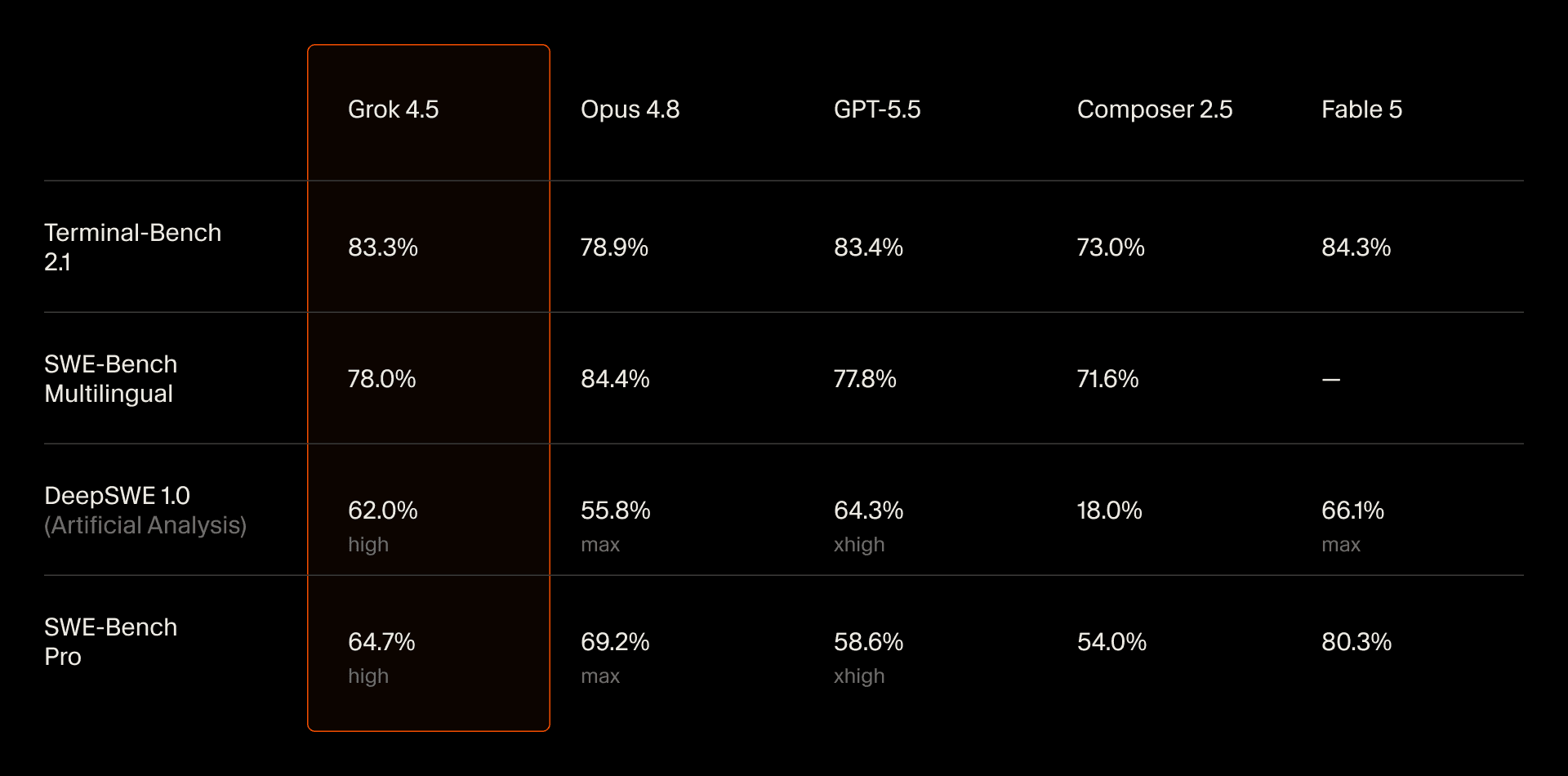
Both companies published benchmark charts. The table below is the one from Cursor's launch post, which is the most complete because it includes Composer 2.5 and Anthropic's Fable 5 in the same grid. Every number here is vendor-reported and reflects each model at a specific reasoning-effort setting, which matters — see the caveats right after.
| Benchmark | Grok 4.5 | Opus 4.8 | GPT-5.5 | Composer 2.5 | Fable 5 |
|---|---|---|---|---|---|
| Terminal-Bench 2.1 | 83.3% | 78.9% | 83.4% | 73.0% | 84.3% |
| SWE-Bench Multilingual | 78.0% | 84.4% | 77.8% | 71.6% | — |
| DeepSWE 1.0 (Artificial Analysis) | 62.0% | 55.8% | 64.3% | 18.0% | 66.1% |
| SWE-Bench Pro | 64.7% | 69.2% | 58.6% | 54.0% | 80.3% |
Effort settings in this chart: Grok 4.5 at high, Opus 4.8 and Fable 5 at max, GPT-5.5 at xhigh. Source: Cursor launch post.
xAI's own chart adds a second variant, DeepSWE 1.1 (a mini-swe-agent harness run by DataCurve), where the order is Fable 5 at 70%, GPT-5.5 at 67%, Opus 4.8 at 59%, Grok 4.5 at 53%, and GLM 5.2 at 44%. xAI also reports Grok 4.5 at #1 on Harvey's Legal Agent Benchmark, its strongest single result and the basis for the “more than software engineering” claim. The two official charts agree to within rounding on the shared rows (for example, xAI lists Fable 5 at 80.4% on SWE-Bench Pro versus Cursor's 80.3%).
How to Read the Numbers
Three caveats decide whether these benchmarks mean anything for your workload:
- The effort settings are not equal. Grok 4.5 is measured at
highwhile Opus 4.8 and Fable 5 are atmax. That is a reasonable way to show “intelligence per unit of compute,” but it is not a like-for-like ceiling comparison. Read the table as “here is what each model does at these settings,” not “here is each model's best.” - Cursor disclosed a contamination issue. In its own post, Cursor notes that Grok 4.5 has an advantage on CursorBench because an earlier snapshot of the Cursor codebase was accidentally included in training. That is a commendably honest footnote — and a reason to discount any CursorBench figure for this model.
- Grok 4.5 rarely tops a row. Fable 5 leads Terminal-Bench, DeepSWE, and SWE-Bench Pro; Opus 4.8 leads SWE-Bench Multilingual and SWE-Bench Pro against Grok. Grok 4.5 is consistently competitive, not consistently first. The pitch is deliberately about speed and cost, which the next section quantifies.
Speed, Efficiency, and Cost
This is where Grok 4.5 makes its case. xAI serves it at ~80 tokens per second, which it calls fast-model speed, and pairs that with a token-efficiency claim: on SWE-Bench Pro, Grok 4.5 resolves tasks using 15,954 output tokens on average, about 4.2× fewer than Opus 4.8 at max (67,020 tokens). xAI frames this as “solving tasks in under half the number of steps” and “roughly 2× the token efficiency of comparable leading models.”
| Signal | Grok 4.5 | Reference | Why it matters |
|---|---|---|---|
| Serving speed | ~80 tokens/sec | xAI “fast-model” tier | Shorter wall-clock time on long agentic runs. |
| Output tokens / task | 15,954 (SWE-Bench Pro) | Opus 4.8 (max): 67,020 | ≈4.2× fewer tokens billed per solved task. |
| Price | $2 in / $6 out per MTok | vs frontier flagships | Lower unit price compounds with fewer tokens. |
The practical implication: cost per solved task can land well below a higher-scoring but chattier model, even when the headline benchmark is a point or two lower. If you run agents at scale — many long, tool-heavy sessions — that difference shows up on the invoice and in latency, not on a leaderboard. The honest counter is that on the hardest, highest-effort tasks, a Fable 5or Opus 4.8 run at max may still resolve something Grok 4.5 does not.
Pricing and Plans
Grok 4.5 is priced the same on xAI's API and Cursor's standard tier, with one extra option in Cursor for lower latency:
| Surface | Input / MTok | Output / MTok | Notes |
|---|---|---|---|
| SpaceXAI API (grok-4.5) | $2.00 | $6.00 | OpenAI-compatible; keys at console.x.ai. Early access. |
| Cursor — standard | $2.00 | $6.00 | Included in individual and team plans; 2× usage the first week. |
| Cursor — fast variant | $4.00 | $18.00 | Lower-latency serving of the same model. |
Cursor includes Grok 4.5 in individual and team plans with a meaningful usage allocation and 2× usage for the first week. xAI is also offering free Grok 4.5 usage for a limited time in Grok Build and Cursor. Pricing and promotions are volatile; the figures here are as of July 8–9, 2026.
Availability and the EU Delay
Grok 4.5 is available on day one in three places: Cursor (all plans, across desktop, web, iOS, CLI, and SDK), Grok Build (the xAI CLI, where it is now the default model), and the SpaceXAI API via console.x.ai. The one hard limit to know about: xAI states plainly that Grok 4.5 is not yet available in the EU in any SpaceXAI product or the API console, with EU availability expected in mid-July 2026. If you or your users are in the EU, plan a fallback model until then.
Grok Build: The CLI
Grok 4.5 is the default model in Grok Build, xAI's terminal coding agent (currently in beta and available to SuperGrok and X Premium+ subscribers). If you have used Claude Code or the Antigravity CLI, the feature set will feel familiar: plan mode that blocks edits until you approve, parallel subagents with worktree support, skills that auto-invoke or run by name, a plugin marketplace, MCP servers, hooks, and persistent memory. xAI highlights Grok 4.5's office-work range here too — building multi-sheet Excel models, PowerPoint diagrams from native shapes, and Word documents, with published Microsoft marketplace plugins.
How to Access grok-4.5
In Cursor, open the model picker and choose Grok 4.5 — no setup beyond being on a current plan. In Grok Build, install from x.ai/cli and it is already the default. On the API, create a key at console.x.ai and call the OpenAI-compatible endpoint. The examples below are from the official SpaceXAI docs:
curl https://api.x.ai/v1/responses \
  -H "Authorization: Bearer $XAI_API_KEY" \
  -H "Content-Type: application/json" \
  -d '{
    "model": "grok-4.5",
    "input": "Refactor this module and add tests."
  }'
from openai import OpenAI
client = OpenAI(
api_key="<YOUR_XAI_API_KEY_HERE>", # create one at console.x.ai
base_url="https://api.x.ai/v1",
)
response = client.responses.create(
model="grok-4.5",
input="Refactor this module and add tests.",
)
print(response.output_text)xAI also ships a native xai_sdk and a Vercel AI SDK provider (@ai-sdk/xai), both using the same grok-4.5 model ID. Because the API is OpenAI-compatible, most existing OpenAI-style clients work by swapping the base URL and model name.
Use It If, Skip It If
Use Grok 4.5 if you run coding agents at volume and care about cost per solved task and latency: the 80 TPS serving speed, ~4.2× token efficiency versus Opus 4.8, and $2/$6 pricing are a real edge for long, tool-heavy sessions. It is a strong default inside Cursor, and the OpenAI-compatible API makes it a low-friction A/B test against your current model. It also reaches into office and knowledge work, with a #1 result on Harvey's Legal Agent Benchmark.
Skip it, for now, if you are in the EU (wait for the mid-July rollout), if you need the absolute top score on the hardest tasks (the official charts still favor Fable 5, and Opus 4.8 on a couple of evals), or if your evaluation leans on CursorBench, where Cursor itself flagged training contamination. As always, the deciding test is your own hardest workflow, run at a fixed effort setting, priced per completed task rather than per token.
FAQ
What is Grok 4.5?
Grok 4.5 is a mixture-of-experts coding and agentic model launched on July 8, 2026, trained jointly by SpaceXAI (xAI) and Cursor. xAI ships it as its strongest model to date; Cursor ships it as its most capable model and the successor to Composer 2.5. The API model ID is grok-4.5.
Did xAI or Cursor build Grok 4.5?
Both. The two companies co-trained it on SpaceXAI's Colossus infrastructure using trillions of tokens of Cursor data plus broader STEM and knowledge-work data. It launched the same day under both brands: Grok 4.5 on x.ai and Cursor's most capable model on cursor.com.
Is Grok 4.5 the best coding model?
Not on raw benchmark scores. On the official launch charts, Anthropic's Fable 5 leads Terminal-Bench 2.1, DeepSWE, and SWE-Bench Pro, and Opus 4.8 beats Grok 4.5 on SWE-Bench Multilingual and SWE-Bench Pro. Grok 4.5's advantage is efficiency: 80 tokens per second serving speed, roughly 4.2× fewer output tokens than Opus 4.8 on SWE-Bench Pro, and $2/$6 pricing.
How much does Grok 4.5 cost?
$2 per million input tokens and $6 per million output tokens on the SpaceXAI API and Cursor's standard tier. Cursor also offers a faster variant at $4 input and $18 output per million tokens.
How do I use Grok 4.5?
Three ways: select it in Cursor (available on all plans), install Grok Build from x.ai/cli (where grok-4.5 is the default model, for SuperGrok and X Premium+ users), or call the SpaceXAI API with model grok-4.5 at base URL https://api.x.ai/v1 after creating a key at console.x.ai.
Is Grok 4.5 available in the EU?
Not at launch. xAI's announcement states Grok 4.5 is not yet available in the EU in any SpaceXAI product or the API console, with EU availability expected in mid-July 2026.
What is the CursorBench caveat?
Cursor disclosed in its own launch post that an earlier snapshot of the Cursor codebase was accidentally included in training, which gives Grok 4.5 an advantage on CursorBench. Treat any CursorBench figure for Grok 4.5 with caution.
Official Sources
This article uses first-party sources only — no community benchmarks, press coverage, or unofficial commentary. Every claim above maps to one of these:
- xAI: Introducing Grok 4.5 (launch post, benchmarks, pricing, EU note)
- Cursor: Grok 4.5 launch post (benchmark chart, pricing, CursorBench caveat)
- Cursor: Partnership with SpaceX on model training (April 21, 2026)
- xAI: Grok Build (the CLI and its features)
- SpaceXAI API docs: model grok-4.5, base URL, code samples
- @SpaceXAI launch thread on X
- @cursor_ai launch post on X
- SpaceXAI console (API keys)