Get the latest on AI, LLMs & developer tools
New MCP servers, model updates, and guides like this one — delivered weekly.
Start with a hosted parser that returns bounding boxes, run it against 50 of your own pages, and keep Docling in reserve for anything that cannot leave your network. That is the short answer to “what is the best OCR API,” and the longer answer is that the best one depends on your documents. Mistral OCR 4.1 lists at $4 per 1,000 pages. LlamaParse sells four tiers from 1 to 25 credits a page. Reducto prices its r-1 model at $10 per 1,000 pages and r-1 mini at $1. Docling is MIT licensed and had 70,992 GitHub stars on Nov 25, 2026. We did not run accuracy tests, so every accuracy number below belongs to the vendor that stated it.
The rest of the page backs those calls with dated prices, the rules that change a bill, and the caveats vendors leave out. If you are building the retrieval layer behind the parser, read our best vector databases for AI agents guide next. If your documents live on the web rather than in files, start with best web scraping APIs for AI agents, because scraping and parsing are separate jobs.
Mistral's own launch video for OCR 4 (YouTube, title and channel verified through YouTube oEmbed). It is vendor marketing, so use it for orientation and check the claims against the pages cited below.
Quick Picks
| Need | Pick | Why |
|---|---|---|
| Default hosted pick for most agent builders | Mistral OCR | One endpoint, $4 per 1,000 pages for OCR 4.1 on the model list, bounding boxes, block types and confidence scores in every response, plus a Batch API at half price (stated for OCR 4). |
| Most tiers and the cheapest agentic option on a published rate card | LlamaParse | Four parse tiers from 1 to 25 credits a page, 10,000 free credits a month, $1.50 per 1,000 credits pay as you go. |
| Hardest tables, strikethroughs and scans | Reducto | r-1 at $10 per 1,000 pages and r-1 mini at $1 per 1,000 pages. Citations are an optional add-on. |
| Open source you can run in an air-gapped box | Docling | MIT license, 70,992 GitHub stars, MCP server, API server and many input formats. No per-page fee. |
| Open-source Markdown conversion with a hosted option | Marker (Datalab) | Marker is on GitHub (41,062 stars). Datalab hosts it from $0.375 per 1,000 pages for its lite Convert mode. |
| Already on Azure, Google Cloud or AWS | Azure Document Intelligence, Google Document AI or AWS Textract | Plain text reads cost about $1.50 per 1,000 pages on Azure and Google and $1.50 per 1,000 on Textract in us-west-2. Forms, tables and prebuilt models cost much more. |
| Pipeline with connectors and chunking | Unstructured | $0.010 per page for Balanced, $0.015 for Best, and a $150 one-time credit on the personal plan. |
| Cheapest GPU self-hosting at volume | olmOCR or PaddleOCR | olmOCR claims under $200 per million pages on your own GPUs. PaddleOCR-VL is a 0.9B model that runs on much smaller hardware. |
| Research into optical compression | DeepSeek-OCR | MIT license and a vision-token approach, but the repo has not been pushed since Jan 27, 2026. |
Why Agents Need a Parser, Not Just OCR
Classic OCR returns characters. An agent needs more than characters. It needs to know that a number belongs to the column headed “Three Months Ended,” that a struck-through clause was deleted, that a checkbox was ticked, and where on the page a fact came from so a human can check it. LlamaIndex makes this point in its OCRia-1.5 post with a spanning header over several columns: drop the header and the numbers are still right, but you can no longer tell whether they cover three months or twelve. Reducto's r-1 announcement says the same about strikethroughs and contracts.
That is why the products in this guide return Markdown or JSON plus layout, not a string. The newest hosted models, Mistral OCR 4 and Reducto r-1, return a box for each block. LlamaParse and Datalab sell boxes too, and Docling and PaddleOCR return coordinates when you run them locally. If your agent cites sources, boxes are the feature to prioritize, because they let you highlight the exact region behind an answer.
Parsing also sits upstream of everything else in a document agent. A bad table becomes a bad embedding, which becomes a bad retrieval, which becomes a confident wrong answer. Cheap mistakes at the parser are expensive downstream, so price per page is only half of the decision. For where parsed output goes next, see our guides to AI agent memory tools and data pipeline tools.
How Parsers Bill: Pages, Credits, Counts and Tiers
Vendors count different things, and the unit changes the math. Mistral, Reducto, Azure and Datalab quote a price per 1,000 pages. Unstructured quotes a price per page. LlamaParse sells credits and charges 1 to 25 of them per page by tier. Google bills most processors per page but its specialized parsers per count, where one count covers up to 10 pages. AWS Textract prices each feature combination separately, so a page with forms, tables and queries costs far more than a page of plain text. Open-source tools have no page fee, but you pay for GPUs, engineering time and operations.
Three other rules matter. First, add-ons: Reducto charges extra for citations and advanced charts, Datalab charges $1.50 per 1,000 pages for word-level boxes, and Google charges $6.00 per 1,000 for OCR add-ons. Second, failed requests: Google says it does not bill 4xx or 5xx responses, and LlamaParse stops new jobs when credits run out while letting running jobs finish. Third, caching: LlamaParse lists re-parsing a cached file at zero credits, which is worth real money if your agent re-reads the same documents. Whatever you pick, cache parsed output by content hash.
Master Comparison
One row per product, in the order of the sections below. The order is our editorial sequence for an agent builder (hosted APIs first, then pipelines, open source, hyperscalers and research models), not a quality ranking.
| Product | Shape | Price snapshot | Headline capabilities | Best for |
|---|---|---|---|---|
 Mistral OCR | Hosted API (OCR 4.1, GA) with self-host option for enterprise | $4 per 1,000 pages; $2 with Batch API (OCR 4 article); OCR 3 $2 per 1,000 | Bounding boxes, block types, confidence, 170 languages, JSON schema via Document AI params | Teams that want one accurate hosted endpoint |
 LlamaParse | Hosted API with four tiers | 10,000 free credits a month; $1.50 per 1,000 credits; Pro $500 a month | Fast, Cost-effective, Agentic, Agentic Plus; layout extraction; cached re-parse is free | Teams that want to dial cost against difficulty per page |
 Reducto | Hosted API | $150 free credits; r-1 $10 and r-1 mini $1 per 1,000 pages | Single-pass page model, bounding boxes, citations add-on, Extract, Split, Classify | Financial, legal and tax documents with hard layouts |
 Unstructured | Hosted API + open-source library | $150 one-time credit; Balanced $0.010 and Best $0.015 per page | Connectors, chunking, documents, images, audio and video | Ingestion pipelines across many source systems |
 Docling | Open-source library (MIT) | Free; you pay for compute | Many formats, DoclingDocument, MCP server, docling-serve, GraniteDocling | Self-hosted, private, air-gapped conversion |
 Marker | Open-source code + Datalab hosted API | Free credit up to $20; Launch $25 a month; Convert from $0.375 to $7.50 per 1,000 pages | Markdown/HTML conversion, extraction, segmentation, word boxes add-on | Fast PDF to Markdown with a hosted escape hatch |
 Azure Document Intelligence | Cloud service | 500 pages free a month; Read $1.50 per 1,000; Layout and prebuilt $10 per 1,000 | Read, Layout, prebuilt invoices, IDs, custom models, containers | Azure shops and form-heavy workloads |
 Google Document AI | Cloud service | OCR $1.50 per 1,000; Layout Parser $10; Form Parser $30 (first million) | Enterprise OCR, Layout Parser with chunking, specialized parsers | Google Cloud shops and specialized document types |
 AWS Textract | Cloud service | Detect text $0.0015 per page; tables $0.015; forms $0.05 (us-west-2) | Text, forms, tables, queries, signatures, invoices, IDs, lending | AWS shops and form key-value extraction |
 DeepSeek-OCR | Open-source model (MIT) | Free; GPU required | Vision-token compression modes from 64 to 400 tokens, prompt-driven output | Research and experiments |
 olmOCR | Open-source toolkit (Apache-2.0) | Free; README claims under $200 per million pages on your own GPU | 7B VLM, FP8 weights, vLLM pipeline, olmOCR-Bench | High-volume offline conversion for LLM data |
 PaddleOCR | Open-source toolkit (Apache-2.0) | Free | PP-OCRv6, PaddleOCR-VL 0.9B, PP-StructureV3, 100+ languages, browser SDK | Multilingual OCR on modest hardware |
1. Mistral OCR
What it is. Mistral OCR is a hosted document model from Mistral AI. OCR 4 was announced on June 23, 2026, according to the launch post on X, and the Mistral docs now list OCR 4.1 as generally available with a release date of July 16, 2026. The API names are mistral-ocr-4-1, mistral-ocr-4 and mistral-ocr-latest. Every response carries extracted content, bounding boxes, block types and confidence scores, plus Markdown-structured text.
Who it is for. Teams that want one endpoint for most documents and are happy to pay a flat per-page rate. It is the product most readers expect to see in a list called “best OCR API,” and it earns its place on the combination of structured output and a low list price.
What changed recently
The OCR 4 article says the model supports 170 languages across 10 language groups, accepts PDF, DOC, PPT and OpenDocument files, and is compact enough to run in a single container for self-hosted deployments, which it says is available to enterprise customers. It also says OCR 4 is an ingestion component of Mistral's open-source Search Toolkit, which was in public preview when the post went out. The article lists availability through Mistral Studio, Amazon SageMaker and Microsoft Foundry, with Snowflake Parse Document marked as coming soon.
Introducing Mistral OCR 4. It creates structure with bounding boxes, block classification, and inline confidence scores in 170 languages.
— @MistralAI Jun 23, 2026
The benchmark claims, with caveats. Mistral says independent annotators blindly ranked 600+ documents across 12+ languages and preferred OCR 4 over every system tested, with win rates averaging 72%. It also reports the top overall score among the models it tested on OlmOCRBench (85.20), a score of 93.07 on OmniDocBench, and .98 on its own Crawl Multilingual evaluation. Mistral's own article adds that both public benchmarks have known scoring limitations, including ground-truth errors and header and footer handling, and says a single aggregate can understate or overstate real-world performance. Those are vendor-reported numbers and we did not reproduce them. A researcher publicly objected on launch day that the comparison table left out two models that scored higher on OlmOCRBench, and a follow-up from the same account said Mistral may have evaluated them but been unable to reproduce the results, which would make it a communication gap rather than an omission. We did not verify either claim.
We ran OCR 4 head-to-head against the field. Independent annotators blindly ranked 600+ real-world documents across 12+ languages, and preferred OCR 4 over every system tested, with win rates averaging 72%.
— @MistralAI Jun 23, 2026
| Pricing (as of Nov 25, 2026) | Model list: OCR 4.1 $4 per 1,000 pages, $5 per 1,000 annotated pages; OCR 3 $2 per 1,000 pages. The OCR 4 launch article states $4 per 1,000 pages and a 50% Batch API discount, which brings it to $2 per 1,000. |
| Free tier | We did not find a free API allowance on the pages we read. Check Mistral Studio for current trial terms. |
| Structured extraction | Document AI parameters on the same endpoint: pass a JSON schema and the OCR output is shaped by mistral-small-2603, or pass an image annotation schema to add a vision-language call per image. Annotated pages are priced separately. |
| Deployment | Hosted API, Mistral Studio, Amazon SageMaker, Microsoft Foundry. Self-managed deployment through sales. |
| Out of scope | Mistral says OCR 4 is not intended for medical diagnosis, legal judgment, high-stakes financial decisions, safety-critical systems or real-time, latency-sensitive processing. |
| Standout | Boxes, typed blocks and confidence scores in every response at a flat list price. |
| Skip it if | You need fully open weights, a published free allowance, or an independently reproduced benchmark before you buy. |
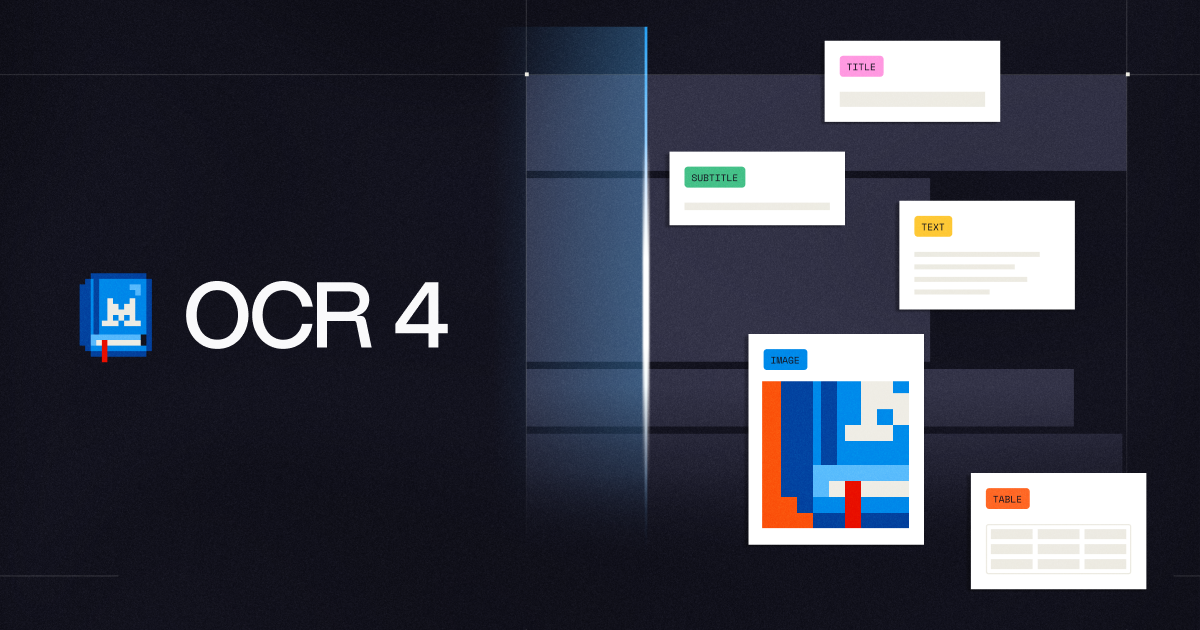
- Bounding boxes, block classification and per-block confidence come back on every call, not as an upgrade.
- List price of $4 per 1,000 pages is low next to layout-aware rivals, and Batch API halves it per the launch article.
- 170 languages across 10 groups, and many Office and OpenDocument inputs besides PDF.
- Available on three cloud marketplaces, so procurement can often use an existing cloud contract.
- No open weights. Self-hosting needs a sales conversation.
- Benchmark claims are Mistral's own and one public critique exists, so reproduce on your documents.
- JSON-schema extraction adds a second model call and a separate annotated-page price.
- We could not find a published free tier, unlike LlamaParse, Reducto and Unstructured.
Benefits for agents. Boxes and confidence scores let an agent decide when to trust a region and when to escalate it to a human or a second parser. Typed blocks (titles, tables, equations, signatures) make chunking for retrieval more predictable than splitting on blank lines. One customer quoted in the launch article, an AI engineer at a data company, says Mistral OCR 4 matched leading agentic parsers on a chart-heavy financial QA set at roughly 8x lower cost and 17x lower latency. That is a customer testimonial in a vendor post, so treat it as one data point.
2. LlamaParse
What it is. LlamaParse is the commercial document parsing and extraction platform from LlamaIndex. You pick a tier per job: Fast at 1 credit a page, Cost-effective at 3, Agentic at 10 and Agentic Plus at 25. A Cost-Optimizer is included on every plan, and layout extraction adds 3 credits a page on any tier. The company also ships LiteParse, an open-source local parser for simpler documents that needs no API key, which had 13,330 GitHub stars on Nov 25, 2026.
Who it is for. Teams with a mix of easy and hard documents that want to pay for difficulty only where it exists, and teams already building on the LlamaIndex framework.
What changed recently
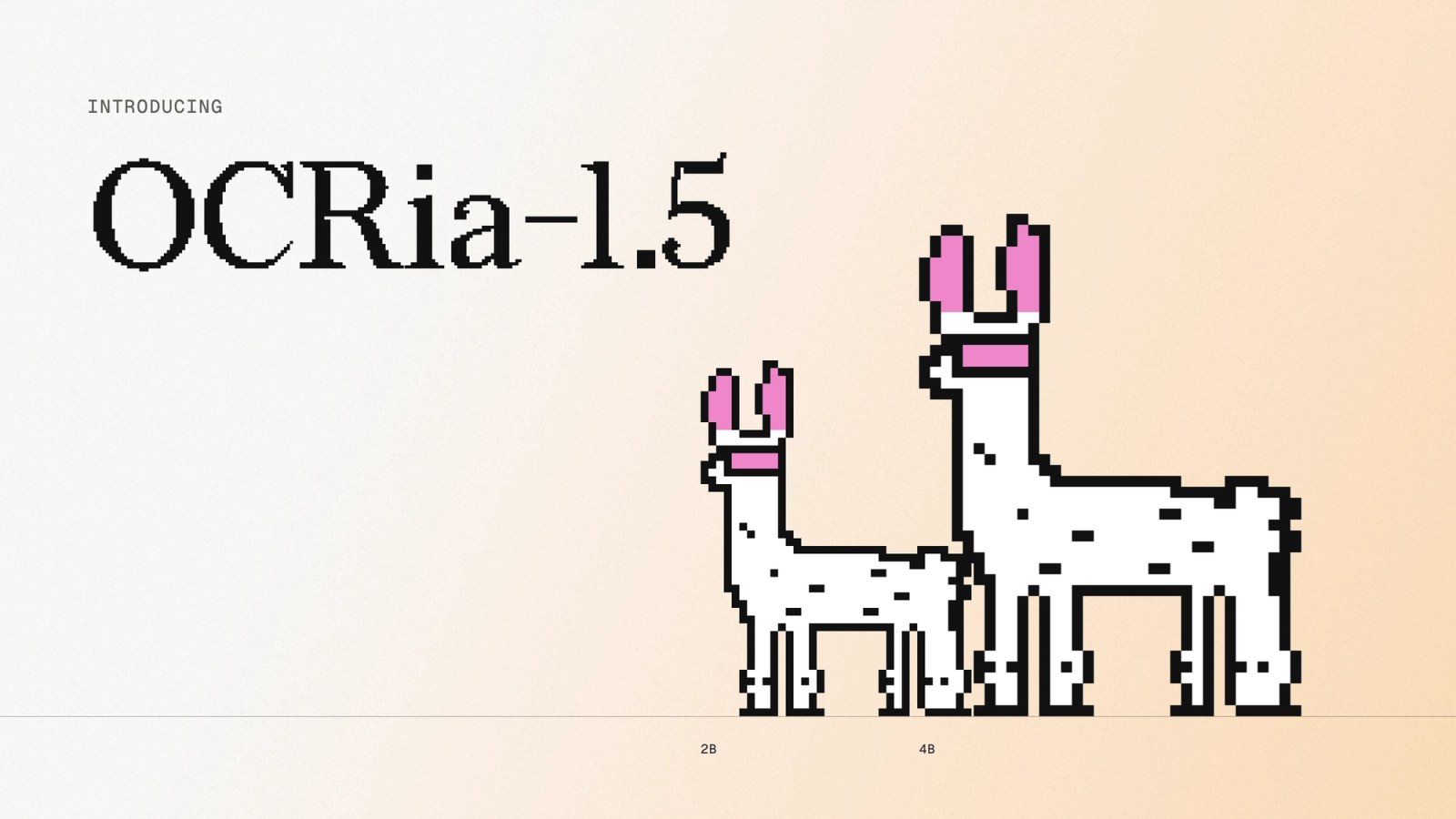
On Nov 18, 2026 LlamaIndex announced OCRia-1.5. OCRia-1.5-4B runs the Agentic tier and a new 2B model runs Cost-effective. On its own ParseBench-2 benchmark, the post reports table scores rising from 86.5 to 90.1 in Agentic and from 83.2 to 87.5 in Cost-effective, chart scores from 74.9 to 76.8 and from 67.3 to 73.0, and Cost-effective visual grounding from 77.0 to 88.5. These are vendor-reported numbers on a vendor-built benchmark. On Nov 13 the company posted that Agentic Plus dropped from 45 credits a page to 25.
Stop paying 45 credits a page for your hardest PDFs. Agentic Plus is now 25 credits per page. It's the same API call with nothing to migrate. Our new OCRia-1.5 family of models and a tighter agent harness means every page costs us less to process, and we're passing that…
— @llama_index Nov 13, 2026
| Pricing (as of Nov 25, 2026) | Free: 10,000 credits a month, then $1.50 per 1,000 credits. Pro: $500 a month with 400,000 credits a month, then $1.25 per 1,000, plus a limited-time one-time bonus of 800k credits for business email domains. Enterprise is custom. |
| Per 1,000 pages | Pay as you go: Fast $1.50, Cost-effective $4.50, Agentic $15.00, Agentic Plus $37.50. Pro: $1.25, $3.75, $12.50, $31.25. |
| Free tier | 10,000 credits a month on every account. Monthly credits reset and do not carry over. |
| Limits and rules | Layout extraction +3 credits a page. Extract adds its own credits on top of parse. Re-parsing a cached file costs 0 credits. When credits run out, new jobs pause and running jobs finish. |
| Example from the pricing page | 500,000 credits a month costs $735 on pay as you go and $625 on Pro, parsing only. |
| Standout | Four tiers on one API, with a cost optimizer and free cache hits. |
| Skip it if | You want a flat per-page rate with no credit math, or you need open weights for the hardest tier. |
- Four published tiers let you spend 1 credit on a clean PDF and 25 on a nightmare scan.
- 10,000 free credits a month is enough to test every tier on real files.
- Cached re-parses are free, which suits agents that revisit documents.
- Vendor-reported ParseBench-2 gains from OCRia-1.5 land in the same API with nothing to migrate.
- Credits are an extra unit to convert, and layout, extract and classify each add credits.
- Benchmarks are on LlamaIndex's own ParseBench-2, so they are not independent.
- Agentic Plus at 25 credits is $37.50 per 1,000 pages on pay as you go, the priciest hosted tier here besides the hyperscaler form parsers.
- Unused monthly credits do not roll over.
Benefits for agents. A router can send first-pass pages to Fast or Cost-effective and escalate only the pages that come back thin or low-confidence. Because the tiers share one API, the router is a parameter, not a second integration. If your stack is built on LlamaIndex, the framework-side integration is the shortest path from a file to an indexed node.
3. Reducto
What it is. Reducto is a hosted document API with Parse, Extract, Split, Classify and Edit endpoints. Its r-1 model reads each page in one pass and returns text, tables, figures, layout, reading order and formatting, with a bounding box for every block, according to the Reducto docs. Formatting such as headings, bold, underline, strikethrough, highlights, signatures and watermarks is kept as meaningful content.
Who it is for. Teams parsing financial statements, tax packets, contracts and other pages where layout carries meaning, and where one wrong cell is expensive.
What changed recently
Reducto announced r-1 on Sept 1, 2026, in preview. The company says it reduces errors by 20% against its legacy agentic pipelines and costs one cent a page, compared with the 3 to 6 cents its legacy agentic models cost. r-1 mini, a smaller model at $1 per 1,000 pages, is now documented. The docs say that starting Dec 7, 2026, Parse defaults to r-1, and that you must set the model to “legacy” to keep the old pipeline. r-1 requires the V3 API. On Oct 6 the company posted that r-1 led K1Bench, Verona's human-adjudicated benchmark, with 85.20% of pages parsed without a material error, 9.2 percentage points ahead of the next system. That is the vendor summarizing a third-party benchmark, and it is a different benchmark from the 85.20 that Mistral reports on OlmOCRBench.
r-1 led K1Bench, Verona's human-adjudicated benchmark of production document parsers, with 85.20% of pages parsed without a material error, 9.2 percentage points ahead of the next-highest system. The benchmark used real-world K-1 packets supplied by a partner accounting firm.
— @reductoai Oct 6, 2026
| Pricing (as of Nov 25, 2026) | Standard rates per 1,000 pages: r-1 Parse $10, r-1 mini Parse $1, Extract $20, Deep Extract $40, Split $20, Deep Split $40, Classify $7.50, Deep Classify $15, Edit $60 ($15 for fully prefilled pages). Growth and Enterprise are custom. |
| Free tier | Standard includes $150 in free usage, with no page limit stated. Up to $5,000 in migration credits if you switch from another processor. A startup program offers free credits and discounted Growth pricing for teams under $15M in funding and $3M in revenue. |
| Add-ons | Parse citations (word-level boxes and table cell boxes), advanced chart extraction, and LLM enrichment, which Reducto itself does not recommend for most workloads. Add-on prices are on its credit usage page, which we did not read in full. |
| Limits | Standard concurrent pages: 500 for r-1 and 50 for r-1 mini (US limits, EU limits are half). r-1 mini does not accept spreadsheets. |
| Output | Table output defaults to HTML with r-1. Markdown, JSON, CSV and dynamic are available. Chunking for RAG, page ranges and DOCX change tracking still work. |
| Standout | A single model for hard layouts, with formatting preserved as meaning. |
| Skip it if | You parse simple digital PDFs at huge volume and $10 per 1,000 pages is more than you need, or you need to self-host without an enterprise contract. |

- One model for text, tables, figures and formatting, with a box per block by default.
- Strikethroughs, watermarks and signatures are preserved, which matters for contracts and tax documents.
- $1 per 1,000 pages r-1 mini gives a cheap lane inside the same vendor.
- $150 of free usage and up to $5,000 in migration credits make a fair side-by-side test easy.
- r-1 at $10 per 1,000 pages is ten times r-1 mini and roughly six times Mistral OCR 4.1's list price.
- Legacy settings such as ocr_system and summarize_figures have no effect on r-1, and the Dec 7, 2026 default switch can change output for existing integrations.
- Accuracy claims are the vendor's, including its reading of K1Bench.
- Citations and chart extraction cost extra.
Benefits for agents. If an agent reads a K-1, a 10-K or a multi-party contract, the cost of one silently wrong cell can exceed the whole parsing bill. Reducto sells exactly that risk reduction, and the box per block makes it possible to show a reviewer the source region. Pin the model setting explicitly in your code now, so the Dec 7 default change does not move your output under you.
4. Unstructured
What it is. Unstructured is a hosted platform and an open-source library for turning documents, images, audio and video into LLM-ready elements, with chunking and connectors around the parser. The unstructured repository showed 15,778 GitHub stars, an Apache-2.0 license and a last push on Nov 24, 2026.
Who it is for. Data and platform teams that need ingestion from many sources and output ready for a vector store, not only a parser. Its Business plan offers dedicated instances, your own VPC, SSO and bring-your-own model keys.
| Pricing (as of Nov 25, 2026) | Documents and images: Balanced $0.010 per page (the default), Best $0.015 per page. Legacy strategies: Fast $0.002, Hi-Res $0.020, VLM $0.030 per page. Audio $0.015 a minute, video $0.045 a minute, or $0.060 for a video with sound. |
| Plans | Personal plan: $150 in credit, one time, no card, add balance from $50. Team: add a card and balance from $50, no free credit, shared workspace and role-based access. Business: custom, with SSO and VPC options. |
| Billing model | Everything draws from a prepaid balance. The pricing page says nothing is billed after the fact. |
| Standout | Connectors, chunking strategies (by character, title, page, similarity, contextual) and a mixed-media pipeline. |
| Skip it if | You only need a parser and would rather not run a pipeline product around it. |
- A real pipeline product: connectors, chunking and parsing in one place.
- Open-source library under Apache-2.0 that runs locally and is actively pushed.
- Prepaid balance with no after-the-fact billing makes spend easy to cap.
- Handles audio and video besides documents and images.
- Page prices of $0.010 to $0.030 are higher than Mistral, Azure Read or Textract text detection.
- Two sets of strategies (new and legacy) with different names and rates are easy to confuse.
- We did not find an independent accuracy benchmark in the vendor pages we read.
- Team plan has no free credit.
Benefits for agents. If the hard part of your problem is getting documents from SharePoint, S3 and email into a consistent element format, Unstructured removes a lot of glue code. If the hard part is accuracy on one nasty table layout, a specialist parser is the better first test. See our data pipeline tools guide for the surrounding stack.
5. Docling
What it is. Docling is an open-source document conversion toolkit, MIT licensed, that parses many formats and exports to Markdown, HTML, lossless JSON and its own DoclingDocument format. The repository showed 70,992 GitHub stars, a last push on Nov 24, 2026 and release v2.152.0 on Nov 23, 2026. The README lists a Linux Foundation AI and Data badge.
Who it is for. Teams with privacy or air-gap requirements, teams that want no per-page fee, and developers who want a local parser with first-class agent integrations.
Key features
The README lists PDF, DOCX, PPTX, XLSX, HTML, EPUB, Apple Pages, Numbers and Keynote, WAV, MP3, WebVTT, email formats, images, LaTeX and plain text as inputs. Advanced PDF understanding covers layout, reading order, table structure, code, formulas and image classification. It supports several OCR engines and visual language models, including GraniteDocling, and exposes an MCP server, an API server called docling-serve and a CLI. Integrations include LangChain, LlamaIndex, CrewAI and Haystack. Local execution is a stated design goal, including air-gapped environments.
| Pricing (as of Nov 25, 2026) | Free. MIT license. You pay for compute, GPUs where you use a vision model, and the engineering to run it. |
| Free tier | Not applicable. The whole toolkit is open source. |
| Deployment | pip install, CLI, docling-serve API server, MCP server. |
| Limits | Speed and accuracy depend on the pipeline, OCR engine and hardware you choose. We did not benchmark them. |
| Standout | Unified document representation, many input formats and the strongest agent-framework integrations of the open-source options. |
| Skip it if | You do not want to operate infrastructure, or you need a vendor SLA and a support contract. |
- MIT license and no per-page fee. Data stays on your machines.
- Very broad input coverage, including office files, email, audio and LaTeX.
- MCP server and docling-serve make it easy to give an agent a local parsing tool.
- Very active: a release two days before this guide was checked.
- You own scaling, GPUs, queues and retries.
- No hosted SLA, and no vendor to call when a page parses badly.
- We did not measure its table accuracy against hosted products, and no vendor-neutral benchmark in this guide ranks it.
- Handwriting and scan quality depend on the OCR engine you plug in.
A third-party test of five parsers including Docling and LlamaParse by Dr. Maryam Miradi (YouTube, title and channel verified through oEmbed). It is one creator's opinion on her own documents, not our test.
Benefits for agents. Install it, wrap it in the MCP server, and your coding or research agent can convert a folder of PDFs to Markdown without sending a byte to a vendor. That is the cleanest answer to a security review. The trade is that you must test accuracy yourself.
6. Marker (Datalab)
What it is. Marker is an open-source tool that converts PDFs to Markdown and JSON, built by Datalab (formerly the Vik Paruchuri project). The repository showed 41,062 GitHub stars, an Apache-2.0 code license, release v2.2.0 on Nov 12, 2026 and a last push on Nov 20, 2026. Datalab also runs a hosted API on the same models plus its Chandra OCR model.
Who it is for. Developers who want fast PDF to Markdown, either locally or through a metered API, and who can live with the weight license.
The license detail that matters
Datalab says its model weights are free for research and personal use, and free for commercial use if your company is under the threshold on both revenue and funding: $2M for Chandra and $5M for Marker and Surya. Above either threshold you need a commercial license. The code is Apache-2.0 on GitHub, but the weights follow this separate rule, so read it before you ship Marker inside a product. Datalab also runs a startup program that takes a third off per-page rates and the Team fee for twelve months for qualifying companies.
| Pricing (as of Nov 25, 2026) | Pay per processor, per 1,000 pages, with a 25% data-sharing discount already applied on the page: Convert lite $0.375, fast $1, balanced $3, accurate $7.50. Extraction turbo or fast $4.50, balanced $11.25 plus fees, accurate $15 plus fees. Segment page level $0.375. Agent processor $7.50. Word bounding boxes +$1.50. Chart understanding +$2.25. Infographics +$3. |
| Plans | Free: up to $20 of credit once. Launch: $25 a month ($300 a year) including $25 of usage and 16x the Free rate limit. Team: $400 a month ($4,800 a year) including $400 of usage. Enterprise and self-hosted options exist. |
| Extras | EU processing adds 25%. Spreadsheets bill by cells, not pages. Up to $5,000 in migration credits. |
| Standout | A wide range of cheap-to-accurate conversion modes, with a free open-source path. |
| Skip it if | Your company is above the revenue or funding thresholds and you do not want to negotiate a weight license, or you need a vendor-neutral benchmark before buying. |
- Convert lite at $0.375 per 1,000 pages is the cheapest hosted layout-aware rate in this guide.
- Four Convert modes let you trade cost for fidelity on one API.
- Open-source code with frequent releases, and a hosted option when you do not want to run GPUs.
- Free credit of up to $20 and migration credits of up to $5,000.
- The weight license has revenue and funding thresholds that catch larger companies.
- Some processors bill compute above the flat rate in rare cases, and the page says around 5% of Balanced and Accurate extractions do.
- Rates shown assume the 25% data-sharing discount, so turn it off for sensitive documents and recompute.
- Older Marker 1.10.1 scored 76.1 on olmOCR-Bench in Ai2's README, and we did not find a current-version score.
Benefits for agents. Marker is the fastest way to get a PDF into Markdown on a laptop, and the hosted API gives you the same family of models without GPU work. Keep an eye on the data-sharing toggle: the headline prices only apply if you share data for training.
7. Azure Document Intelligence
What it is. Azure Document Intelligence is Microsoft's document analysis service, with a Read model for text, a Layout model, prebuilt models for invoices, receipts, IDs, tax forms, health insurance cards and contracts, and custom extraction and classification models. It runs in the cloud or in containers.
Who it is for. Azure shops, regulated teams that need containers or private networking, and anyone with a stack of standard forms that prebuilt models already understand.
A note on pricing sources. Microsoft's pricing page rendered dashes where prices should be when we fetched it, so the numbers below come from the public Azure Retail Prices API for the eastus region, queried on Nov 25, 2026. Your region, currency and agreement may differ, so confirm in the Azure calculator.
| Pricing (eastus, retail, as of Nov 25, 2026) | Read: $1.50 per 1,000 pages up to 1M, $0.60 per 1,000 above 1M. Pre-built models and Layout: $10 per 1,000 pages. Custom extraction: $30 per 1,000. Custom generative extraction: $30. Add-ons: $6. Query fields: $10. Document classifier: $3. Custom neural training: $3 an hour after the first 10 free hours. |
| Free tier | F0: 500 pages free a month, per the pricing page. |
| Commitment tiers | Monthly or yearly commitment tiers for Read, Pre-built and Custom, for example 2,000K Read pages a month at $1,200 on Azure. |
| Deployment | Cloud API, connected or disconnected containers. |
| Standout | Prebuilt models for common forms and a container option inside regulated networks. |
| Skip it if | Your documents are long, layout-heavy reports where LLM-based parsers are reported to do better, or you are not on Azure. |
- Read at $1.50 per 1,000 pages is cheap, and drops to $0.60 per 1,000 above a million.
- Prebuilt invoice, receipt, ID and tax models save training time.
- Containers and commitment tiers suit regulated and high-volume buyers.
- Custom template training is free and neural training includes 10 free hours.
- Layout and prebuilt models list at $10 per 1,000 pages, around ten times Mistral OCR 4.1's $4 only on a per-feature basis, so compare like for like.
- Pricing page did not render numbers when we fetched it, so you need the calculator.
- Output is not built for LLMs first. You may need to convert it to Markdown yourself.
- Custom extraction is $30 per 1,000 pages.
Benefits for agents. If your agent processes 50,000 invoices a month on Azure, a prebuilt model plus your existing identity and network controls is often the least friction. For free-form reports an agent will reason over, test it against LLM-native parsers before committing. Reducto's press release names Azure Document Intelligence and Amazon Textract as established services and says r-1 outperformed them in Reducto's own evaluations, which is a vendor claim.
8. Google Document AI
What it is. Google Document AI is a set of processors on Google Cloud: Enterprise Document OCR, a Layout Parser that includes initial chunking, a Form Parser, custom extractors, classifiers and splitters, and a family of specialized parsers for invoices, expenses, utilities, bank statements, pay slips, W-2s, driver licenses and passports.
Who it is for. Teams on Google Cloud, and teams whose documents match one of the specialized parsers, such as lending or procurement workflows.
| Pricing (as of Nov 25, 2026) | Enterprise Document OCR: first 1,000 pages free on the price row, then $1.50 per 1,000 pages up to 5M and $0.60 above. OCR add-ons: $6.00 per 1,000. Layout Parser: $10 per 1,000. Form Parser and custom extractor: $30 per 1,000 up to 1M, then $20. Custom splitter and classifier: $5, then $3. Summarizer: $0.025 per page. |
| Specialized parsers | Invoice, expense and utility parsers, driver license, passport and identity proofing: $0.10 per count, where one count covers up to 10 pages. Bank statement $0.75 per classified document, pay slip and W-2 $0.30, procurement and lending splitters $0.05. |
| Other costs | Custom model hosting $0.05 an hour per deployed version, about $438 a year. Re-chunking $0.02 per 1,000. Savings plans lower the list price. |
| Limits | Specialized processors do not support synchronous requests above 10 pages. Batch requests allow up to 200 pages per document. |
| Billing rule | Failed requests (4xx or 5xx) are not billed. |
| Standout | The widest set of specialized document parsers among the cloud vendors, plus a Layout Parser designed for RAG chunking. |
| Skip it if | You are not on Google Cloud, or you need to self-host. |
- OCR at $1.50 per 1,000 pages, falling to $0.60 at volume.
- Layout Parser with chunking at $10 per 1,000 is aimed squarely at RAG pipelines.
- Specialized parsers for lending, procurement and identity documents.
- No charge for failed requests.
- Form Parser and custom extractors cost $30 per 1,000 pages for the first million.
- Pricing is spread across many processors with different units (pages and counts).
- Cloud only. No container option appears on the pricing page we read.
- Custom processors add hosting fees on top of prediction fees.
Benefits for agents. If your agent's job is to read bank statements, pay slips or invoices, the specialized parsers are the shortest path to structured fields and they come with a clear per-document price. For general reports, test the Layout Parser against an LLM-native parser. Our AI agent frameworks guide covers how to wire a parser like this in as a tool.
9. AWS Textract
What it is. Amazon Textract extracts text, forms, tables, queries, signatures, layout, invoices, identity documents and mortgage documents. You pay per page processed, with no minimum fees or upfront commitment.
Who it is for. AWS teams that need forms and key-value extraction, lending workflows, or the cheapest plain-text detection at very large volume.
| Pricing (US West Oregon, as of Nov 25, 2026) | Detect Document Text: $0.0015 per page for the first million, $0.0006 after. Analyze Document: tables $0.015, forms $0.05, queries $0.015, tables plus queries $0.020, tables plus forms plus queries $0.070 for the first million. Signatures $0.0035 for the first million. Prices fall after one million pages. |
| Free tier | Three months for new AWS customers: 1,000 pages a month of Detect Document Text, 1,000 pages a month for Analyze Document signatures only, and 100 pages a month for forms, tables and layout. Smaller allowances for Expense, ID and Lending. |
| Worked examples from AWS | 100,000 pages of Detect Document Text cost $150. 5,000 pages with tables and forms cost $325. 2,000,000 pages of tables, forms and queries cost $125,000. |
| Standout | Mature forms and queries features, and a very low price for raw text detection. |
| Skip it if | You want Markdown output with reading order out of the box, or you are not on AWS. |
- Plain text detection at $1.50 per 1,000 pages, dropping to $0.60 per 1,000 after a million, the cheapest hosted text rate in this guide.
- Forms, tables, queries and signatures as separate features, so you pay only for what you need.
- Mortgage, lending, invoice and ID models for regulated workflows.
- Per-page pricing with no minimums or commitments.
- Feature combinations multiply the price: a page with tables, forms and queries is $0.070.
- Output is JSON blocks, not LLM-ready Markdown.
- Cloud only. No self-hosting.
- Free tier lasts only three months and is small for forms and tables.
Benefits for agents. Textract is a good low-cost first pass for scans where you only need text, and Queries lets an agent ask for specific fields. Do the arithmetic before you scale: forms-heavy pages cost 33 times a plain text page at the first-million rate.
10. DeepSeek-OCR
What it is. DeepSeek-OCR is an open-source model from DeepSeek, titled “Contexts Optical Compression.” The idea is to represent text as an image and decode it from a small number of vision tokens. The README lists four modes: Tiny at 512 by 512 with 64 vision tokens, Small at 640 by 640 with 100, Base at 1024 by 1024 with 256, and Large at 1280 by 1280 with 400. It lists PDF throughput of roughly 2,500 tokens a second on an A100-40G.
Who it is for. Researchers and teams that want to experiment with optical compression or run a small open model on their own GPUs.
| Pricing (as of Nov 25, 2026) | Free. MIT license. You pay for GPU time. |
| Repository | 24,191 GitHub stars on Nov 25, 2026. Created Oct 17, 2025. Last push Jan 27, 2026. |
| Benchmark context | Ai2's olmOCR README lists DeepSeek-OCR at 75.7 plus or minus 1.0 on olmOCR-Bench, below olmOCR v0.4.0 at 82.4. |
| Standout | A distinctive compression approach with published modes. |
| Skip it if | You need a maintained production service. The repo has not been pushed in about ten months. |
- MIT license and open weights.
- Four documented resolution modes let you trade tokens for fidelity.
- A large community: 24,191 stars.
- Interesting for research on long-context compression.
- No push since Jan 27, 2026, so do not expect fixes or new features.
- Prompt-driven output means you build your own post-processing for tables and boxes.
- Scored below newer specialist models in Ai2's own table.
- GPU required, and no hosted API from DeepSeek in the sources we read.
Benefits for agents. Treat it as a lab tool. If your agent pipeline already runs vLLM, it is a cheap thing to try on a sample set, but we would not put it on the critical path without your own evaluation.
11. olmOCR
What it is. olmOCR is the Allen Institute for AI's toolkit for linearizing PDFs for LLM datasets and training, built on a 7B vision-language model. The README says it converts PDF, PNG and JPEG documents to clean Markdown, handles equations, tables and handwriting, removes headers and footers, and keeps a natural reading order. It also ships olmOCR-Bench, a suite of over 7,000 test cases across 1,400 documents.
Who it is for. Teams converting very large PDF collections on their own GPUs, for training data or offline indexing, where cost per page matters more than latency.
| Pricing (as of Nov 25, 2026) | Free. Apache-2.0. The README claims under $200 per million pages converted, on a 7B model that needs a GPU. We did not verify that figure, and it depends entirely on your GPU rates. |
| Repository | 19,846 GitHub stars, release v0.4.27 on Mar 12, 2026, last push on Mar 25, 2026. |
| Hardware | Recent NVIDIA GPU with at least 12 GB of memory; tested on RTX 4090, L40S, A100 and H100. A remote vLLM server option avoids installing heavy GPU dependencies locally. |
| Benchmark (Ai2 README) | olmOCR v0.4.0 scores 82.4 plus or minus 1.1 on olmOCR-Bench, which Ai2 also authored. Treat it as vendor-reported. |
| Standout | The cheapest claimed cost per page at scale, with an open benchmark you can rerun. |
| Skip it if | You need bounding boxes for citations, low latency, or a vendor to support you. |
- Apache-2.0 and open weights, with an open benchmark.
- README claims under $200 per million pages for a 7B model.
- Handles equations, tables and handwriting per the README.
- Official docker images and a vLLM pipeline.
- Strips headers and footers by design, which can remove content you want.
- No bounding boxes listed in the README, so it is weaker for cited answers.
- Needs a 12 GB GPU and operational work.
- Last push Mar 25, 2026, so activity is slower than Docling or Marker.
Benefits for agents. For an agent whose knowledge base is millions of pages of papers and reports converted once, olmOCR is the budget route. For an agent that quotes a source region back to a user, pick a parser with boxes.
12. PaddleOCR
What it is. PaddleOCR is Baidu's open-source OCR toolkit, described on GitHub as a way to turn any PDF or image document into structured data for AI, supporting 100+ languages. It had 93,143 GitHub stars, an Apache-2.0 license, release v3.7.0 on June 11, 2026 and a last push on Sept 16, 2026. It bundles several model families.
Who it is for. Teams that need multilingual OCR on modest hardware, including CPU and browser deployments, and teams that want a small document VLM.
Key features
The README describes PaddleOCR-VL-1.6, a 0.9B document model that it says reaches 96.3% on OmniDocBench v1.6, and PP-StructureV3, which converts documents to Markdown or JSON with finer coordinate information, including table cell coordinates. PP-OCRv6 covers 50 languages in one model, and the README claims gains of 4.6% in detection and 5.1% in recognition over PP-OCRv5 and a 5.2x CPU speedup. These are vendor-reported figures. There is also PaddleOCR.js, an official browser inference SDK, and DOCX export for parsed results. In Ai2's olmOCR README table, PaddleOCR-VL scores 80.0 plus or minus 1.0.
| Pricing (as of Nov 25, 2026) | Free. Apache-2.0. You pay for compute. |
| Repository | 93,143 GitHub stars, release v3.7.0 (June 11, 2026), last push Sept 16, 2026. |
| Deployment | Python toolkit with CPU and GPU paths, plus a browser SDK. |
| Standout | Small models, wide language coverage and fine-grained coordinates from PP-StructureV3. |
| Skip it if | You want one hosted endpoint with an SLA, or your team is not comfortable with the PaddlePaddle ecosystem. |
- The most GitHub stars of any parser in this guide besides markitdown and MinerU, with a permissive license.
- A 0.9B document VLM and a 34.5M-parameter OCR tier run on modest hardware.
- Table cell coordinates and Markdown or JSON output from PP-StructureV3.
- Browser SDK and DOCX export.
- Most accuracy claims are the project's own.
- Depends on the PaddlePaddle framework, which fewer agent teams already run.
- No hosted service from the project, so you operate it.
- Model and version names change quickly (PP-OCRv5, v6, VL-1.5, VL-1.6), which complicates pinning.
Benefits for agents. If you need a free, multilingual, locally run parser with coordinates, PaddleOCR is the strongest open-source alternative to Docling. Pin versions and rerun your test set whenever you upgrade.
Benchmarks: How to Read Them
Every vendor here publishes a benchmark in which it does well. That is not dishonest, but it means no single number in this guide is neutral. The table below collects the scores we found and who produced them. Do not compare across rows, because the benchmarks, versions and scoring rules differ.
| Source | Benchmark | Result | Who ran it |
|---|---|---|---|
| Mistral OCR 4 | OlmOCRBench | 85.20 overall, top among models Mistral tested | Mistral (vendor-reported) |
| Mistral OCR 4 | OmniDocBench | 93.07, with a stated caveat on scoring | Mistral (vendor-reported) |
| Mistral OCR 4 | Human preference, 600+ documents | 72% average win rate | Mistral with independent annotators |
| Reducto r-1 | K1Bench (Verona) | 85.20% of pages without a material error, 9.2 points ahead | Verona benchmark, summarized by Reducto |
| LlamaParse OCRia-1.5 | ParseBench-2 tables | Agentic 90.1, Cost-effective 87.5 | LlamaIndex (vendor-reported) |
| PaddleOCR-VL-1.6 | OmniDocBench v1.6 | 96.3% | PaddleOCR project (vendor-reported) |
| olmOCR v0.4.0 | olmOCR-Bench | 82.4 plus or minus 1.1 | Ai2 README |
| PaddleOCR-VL | olmOCR-Bench | 80.0 plus or minus 1.0 | Ai2 README |
| Marker 1.10.1 | olmOCR-Bench | 76.1 plus or minus 1.1 | Ai2 README |
| DeepSeek-OCR | olmOCR-Bench | 75.7 plus or minus 1.0 | Ai2 README |
| Mistral OCR API (earlier version) | olmOCR-Bench | 72.0 plus or minus 1.1 | Ai2 README |
Two lessons. First, the same number can mean different things: Mistral's 85.20 is an OlmOCRBench score and Reducto's 85.20% is a share of K-1 pages, which is a coincidence and not a tie. Second, benchmark versions move. The Ai2 table lists an earlier Mistral OCR API version, so it says little about OCR 4.1. Build a test set of 50 to 200 of your own pages, including your ugliest scans, and score tables, reading order and numbers by hand.
Who We Left Out
MinerU (84,293 GitHub stars on Nov 25, 2026) and markitdown (198,293 stars, MIT) are widely used open-source converters. We left them out because we did not read their documentation closely enough to cover them fairly, and the GitHub API reports MinerU's license as NOASSERTION, so check its terms yourself. LiteParse from LlamaIndex is covered inside the LlamaParse section. Chandra, Surya, Nanonets-OCR and Infinity-Parser appear in Ai2's benchmark table but we did not review them as products. General multimodal LLMs from the big labs can also read documents, but we did not research their per-page cost or consistency, so they are outside this comparison.
Related hands-on guides on this site cover LlamaIndex document routing with Parse Gateway, Firecrawl AnyDoc for any-document Markdown and the LlamaIndex ExtractBench evaluation guide. For broader reading, see best AI deep research tools.
Pricing Table
List prices in USD as of Nov 25, 2026, excluding tax. Each vendor quotes a different unit, so read the notes column.
| Product | Free tier | Paid prices | Notes |
|---|---|---|---|
| Mistral OCR | No free API tier verified on the pricing pages we read | OCR 4.1 $4 per 1,000 pages; $5 per 1,000 annotated pages; OCR 3 $2 per 1,000 pages | Batch API 50% off (stated for OCR 4); Document AI in Studio and self-hosting via sales |
| LlamaParse | 10,000 credits a month, free | Pay as you go $1.50 per 1,000 credits; Pro $500 a month with 400,000 credits then $1.25 per 1,000; Enterprise custom | Fast 1, Cost-effective 3, Agentic 10, Agentic Plus 25 credits a page; layout extraction +3 |
| Reducto | $150 in free usage on Standard | r-1 $10, r-1 mini $1, Extract $20, Deep Extract $40, Split $20, Classify $7.50, Edit $60 per 1,000 pages | Growth and Enterprise are custom; up to $5,000 migration credits |
| Unstructured | $150 one-time credit, no card | Balanced $0.010, Best $0.015 per page; legacy Fast $0.002, Hi-Res $0.020, VLM $0.030 | Team adds a card and balance from $50; Business custom |
| Docling | Free and open source (MIT) | No per-page fee | Compute, GPUs and engineering time are yours |
| Marker | Up to $20 of free credit on Datalab | Launch $25 a month, Team $400 a month; pay per processor | Rates shown include a 25% data-sharing discount; EU processing +25% |
| Azure Document Intelligence | 500 pages free a month on F0 | Read $1.50 per 1,000 then $0.60 after 1M; Layout and prebuilt $10; custom extraction $30 | Commitment tiers and containers; prices from the Azure Retail Prices API, eastus |
| Google Document AI | First 1,000 units listed at $0.00 on the OCR row | Enterprise OCR $1.50 per 1,000 pages; Layout Parser $10; Form Parser $30; invoice parser $0.10 per 10 pages | Savings plans discount list prices; failed 4xx and 5xx requests are not billed |
| AWS Textract | Three-month free tier for new AWS customers | Detect Document Text $0.0015 per page; tables $0.015; forms $0.05; queries $0.015; signatures $0.0035 (first million, US West Oregon) | Volume tiers drop prices after one million pages |
| DeepSeek-OCR | Free and open source (MIT) | No per-page fee | GPU needed; README cites about 2,500 tokens per second on an A100-40G for PDFs |
| olmOCR | Free and open source (Apache-2.0) | No per-page fee; README claims under $200 per million pages converted | 7B VLM; needs a recent NVIDIA GPU with at least 12 GB of memory |
| PaddleOCR | Free and open source (Apache-2.0) | No per-page fee | CPU and GPU paths; PP-OCRv6 and PaddleOCR-VL 0.9B |
What 100,000 Pages Costs
A rough, list-price estimate of parsing 100,000 plain pages once, using only the published rates above and ignoring free allowances, volume discounts, add-ons, taxes and retries. Self-hosted tools show only the license cost because GPU and labor costs are yours.
| Product | 100,000 pages | How we got there |
|---|---|---|
| Mistral OCR | $400 | OCR 4.1 at $4 per 1,000 pages. The OCR 4 article says Batch API halves it to $200. |
| LlamaParse | $150 to $3,750 | Fast (1 credit) $150, Cost-effective $450, Agentic $1,500, Agentic Plus $3,750 at $1.50 per 1,000 credits, before the monthly free credits. |
| Reducto | $100 to $1,000 | r-1 mini $100, r-1 $1,000. Extract is $2,000. |
| Unstructured | $200 to $3,000 | Legacy Fast $200, Balanced $1,000, Best $1,500, Hi-Res $2,000, VLM $3,000. |
| Docling | $0 license | Your compute only. We did not measure throughput or GPU cost. |
| Marker | $37.50 to $750 | Datalab Convert lite $37.50, fast $100, balanced $300, accurate $750, at the listed rates that include the 25% data-sharing discount. |
| Azure Document Intelligence | $150 to $3,000 | Read $150, Layout or prebuilt $1,000, custom extraction $3,000, at eastus list prices. |
| Google Document AI | $150 to $3,000 | Enterprise OCR about $150, Layout Parser $1,000, Form Parser $3,000 at first-million list prices. |
| AWS Textract | $150 to $1,500 and up | Detect text $150, tables $1,500, queries $1,500, forms $5,000, in US West (Oregon). |
| DeepSeek-OCR | $0 license | GPU time is yours. |
| olmOCR | Under $20 (vendor claim) | The README says under $200 per million pages. We did not verify that number. |
| PaddleOCR | $0 license | Your compute only. |
Feature Matrix
Based on vendor documentation and READMEs. “Not stated” means the pages we read did not say, not that the feature is missing. We did not test any of these.
| Product | Bounding boxes | Tables | Handwriting | Self-host | Open source | Structured JSON extraction |
|---|---|---|---|---|---|---|
| Mistral OCR | Yes | Yes | Not stated on the pages we read | Enterprise only | No | Yes, via Document AI parameters |
| LlamaParse | Yes | Yes | Not stated on the pages we read | Enterprise | No (LiteParse is open source) | Yes, Extract |
| Reducto | Yes | Yes | Yes | Enterprise | No | Yes, Extract and Deep Extract |
| Unstructured | Yes (Hi-Res and newer strategies) | Yes | Partial | Yes, VPC and open source | Partial (library is Apache-2.0) | Partial |
| Docling | Yes | Yes | Partial, depends on OCR engine | Yes | Yes | Partial, via integrations |
| Marker | Yes (word boxes add-on) | Yes | Partial | Yes, under license terms | Partial (code Apache-2.0, weights restricted) | Yes, hosted Extraction |
| Azure Document Intelligence | Yes | Yes | Yes | Yes, containers | No | Yes |
| Google Document AI | Yes | Yes | Yes | No | No | Yes |
| AWS Textract | Yes | Yes | Partial | No | No | Yes, Queries and Analyze APIs |
| DeepSeek-OCR | Partial, prompt-driven | Partial | Not stated | Yes | Yes | No |
| olmOCR | No | Yes | Yes (README) | Yes | Yes | No |
| PaddleOCR | Yes (PP-StructureV3 and cells) | Yes | Partial | Yes | Yes | Partial |
Best for X
| If you need | Pick | Why |
|---|---|---|
| You want the shortest path to accurate Markdown with boxes | Mistral OCR | One endpoint returns text, boxes, block types and confidence. |
| You parse a mix of easy and hard PDFs and want to pay less for the easy ones | LlamaParse | Four tiers and a cost optimizer let you spend credits where pages are hard. |
| Your documents are financial statements, K-1s or contracts | Reducto | Built and priced around hard tables and formatting that changes meaning. |
| Your data lives in many systems and you need chunking and connectors | Unstructured | Pipeline products around the parser, not only the parser. |
| Your data cannot leave your network | Docling, Marker, olmOCR or PaddleOCR | All four run locally under open or source-available licenses. |
| You already pay a hyperscaler and need forms or IDs | Azure, Google or AWS | Prebuilt invoice, receipt, ID and lending models exist there. |
| You need the cheapest plain text OCR at huge volume | Textract Detect, Azure Read or Google Enterprise OCR | List prices around $0.0006 to $0.0015 per page at volume. |
| You want to experiment with new model research | DeepSeek-OCR or PaddleOCR-VL | Small VLMs with published modes and papers. |
Setup Examples
Docling, locally
# Docling: convert a PDF to Markdown locally
# pip install docling
from docling.document_converter import DocumentConverter

converter = DocumentConverter()
result = converter.convert("https://arxiv.org/pdf/2408.09869")
print(result.document.export_to_markdown())
Reducto r-1
The call below is the Python example from the Reducto docs. Pinning the model explicitly protects you from the Dec 7, 2026 default change.
# Reducto: parse with the r-1 model (from the Reducto docs, Nov 25, 2026)
from reducto import Reducto

client = Reducto()
result = client.parse.run(
    input="https://cdn.reducto.ai/samples/fidelity-example.pdf",
    settings={"model": "r-1"},
)
for chunk in result.result.chunks:
    print(chunk.content)
Mistral OCR
This sketch follows Mistral's documented model names. Confirm the exact request fields in the current docs before you ship it.
# Mistral OCR: one call, Markdown plus structure. Check the current docs for exact field names.
# pip install mistralai
import os
from mistralai import Mistral

client = Mistral(api_key=os.environ["MISTRAL_API_KEY"])
resp = client.ocr.process(
    model="mistral-ocr-latest",
    document={"type": "document_url", "document_url": "https://arxiv.org/pdf/2408.09869"},
)
for page in resp.pages:
    print(page.markdown)
A parsing router with a cache
// Provider-agnostic parsing router (TypeScript sketch).
// Parse cheap first, escalate pages that look hard, cache everything by content hash.
type Parsed = { markdown: string; lowConfidenceBlocks: number; pages: number };
type Parser = (file: Uint8Array) => Promise<Parsed>;

const cache = new Map<string, Parsed>();

async function parseWithEscalation(hash: string, file: Uint8Array, cheap: Parser, premium: Parser) {
    const hit = cache.get(hash);
    if (hit) return hit;                                   // never pay twice for the same file
    let out = await cheap(file);
    const lowShare = out.lowConfidenceBlocks / Math.max(out.pages, 1);
    if (out.markdown.length < 200 || lowShare > 0.5) {     // thresholds are examples: tune on your own set
        out = await premium(file);
    }
    cache.set(hash, out);
    return out;
}
Mistakes and Checklist
- Do not choose from vendor benchmarks alone. Score your own 50 to 200 pages on tables, reading order and numbers.
- Do not compare per-page prices across different units. Convert everything to dollars per 1,000 pages for the features you use.
- Do not forget add-ons. Boxes, citations, charts and extraction can double a bill.
- Do not re-parse the same file. Cache by content hash, store boxes with the text and keep the original file.
- Do not send everything to the premium tier. Route clean digital PDFs to a cheap lane and escalate low-confidence pages.
- Do not ignore licenses. Check the Marker weight thresholds, MinerU terms and any commercial restriction before shipping a self-hosted model.
- Pin model names and versions. Reducto defaults to r-1 on Dec 7, 2026 and PaddleOCR renames models often.
- Check data handling. Datalab's headline rates assume data sharing for training, and every vendor has its own retention terms.
- Cap spend and alert on it, especially with agentic tiers that cost 10 to 25 times a fast tier.
- Send low-confidence regions to a human when the document drives money, health or legal decisions.
How We Evaluated
We read each vendor's pricing and product pages and the docs, announcements and GitHub pages that exist for each tool, on Nov 25, 2026. Azure prices came from the Azure Retail Prices API because the pricing page did not render numbers. GitHub star counts, licenses, release tags and push dates came from the GitHub API on the same day. We verified each YouTube video through YouTube oEmbed, each X post through X's syndication endpoint, and each image URL with a header check. We did not run hands-on speed, accuracy or cost tests, so every performance number here belongs to the vendor or project that stated it. Where a source was silent we say so. Prices are list prices in USD excluding tax. No entry is paid, there are no affiliate links, and the order of sections is not a quality ranking.
FAQ
What is the best OCR API for AI agents in 2026?
There is no single winner, and we did not run our own accuracy tests. For a default hosted choice, Mistral OCR (OCR 4.1 at $4 per 1,000 pages) and LlamaParse (four tiers, 10,000 free credits a month) are the easiest places to start, and Reducto is the pick we would trial first for hard tables. Docling is the default open-source choice. Test two or three on your own documents.
What is the difference between OCR and document parsing?
OCR turns pixels into characters. Document parsing goes further: it recovers reading order, tables, headings, figures and sometimes structure such as bounding boxes and typed blocks, so an LLM can use the page. Modern products like Mistral OCR, Reducto and LlamaParse blur the line, because the OCR model itself returns structure.
Is Mistral OCR 4 better than LlamaParse or Reducto?
We do not know for your documents. Mistral reports human-preference win rates averaging 72% and an OlmOCRBench score of 85.20, Reducto reports a K1Bench lead, and LlamaIndex reports ParseBench-2 gains. Each number comes from a different benchmark chosen by the vendor, so they cannot be compared directly. A third party has also disputed which comparison points Mistral kept in its table.
Which OCR APIs have a free tier?
As of Nov 25, 2026: LlamaParse gives 10,000 credits a month, Reducto gives $150 in free usage on Standard, Unstructured gives a $150 one-time credit, Datalab gives up to $20 in credit, Azure Document Intelligence gives 500 free pages a month on F0, and AWS Textract has a three-month free tier for new AWS customers. Docling, Marker, olmOCR, DeepSeek-OCR and PaddleOCR are free to run yourself.
What is the cheapest way to OCR a million pages?
At list prices, plain text detection is cheapest: AWS Textract Detect Document Text is $0.0015 per page for the first million and $0.0006 after, Azure Read is $1.50 per 1,000 pages, and Google Enterprise OCR is $1.50 per 1,000. Self-hosting olmOCR is claimed by its README at under $200 per million pages. Layout-aware parsing costs more: $1 to $10 per 1,000 pages at Reducto and Datalab, and $10 or more on the hyperscalers.
Can I self-host these OCR tools for sensitive documents?
Yes for Docling (MIT), Marker (Apache-2.0 code, with weight license limits), olmOCR (Apache-2.0), PaddleOCR (Apache-2.0) and DeepSeek-OCR (MIT). Azure offers containers. Mistral, Reducto, LlamaParse and Unstructured describe self-hosted or VPC options for enterprise customers. Google Document AI and AWS Textract are cloud only.
Do I still need OCR if my PDFs have a text layer?
Often you do not. A text layer gives you characters for free, but not reading order, tables or figures. LlamaParse's Fast tier, Unstructured's legacy Fast strategy and Datalab's balanced mode check output against the PDF text layer to save cost. Scans, photos and PDFs with broken layers still need real OCR.
How do I get citations or bounding boxes for an agent's answer?
Pick a parser that returns coordinates. Mistral OCR 4.1 returns bounding boxes, block types and confidence in every response. Reducto returns a box per block and has a word-level citations add-on. LlamaParse returns boxes, Datalab sells word boxes as a +$1.50 per 1,000 page add-on, and Docling and PaddleOCR return coordinates locally.
What does DeepSeek-OCR do differently?
Its README frames it as contexts optical compression: render text as an image and use a small number of vision tokens to represent it. It lists Tiny, Small, Base and Large modes at 64, 100, 256 and 400 vision tokens. It is an open model, not a hosted service, and its repo was last pushed on Jan 27, 2026.
How should an AI agent use an OCR API?
Treat parsing as an ingestion step with a budget. Parse once, cache the output, store boxes for citations, route easy pages to cheap tiers, send hard pages to an agentic or premium tier, and log confidence so low-confidence regions go to review. For retrieval, pair the parsed output with a vector store or memory layer.
Are vendor benchmark numbers reliable?
Treat them as marketing until you reproduce them. Mistral itself warns that OlmOCRBench and OmniDocBench have ground-truth errors and scoring quirks. Reducto's K1Bench is a third-party benchmark but the post we read is the vendor's summary. LlamaIndex's ParseBench-2 is its own benchmark. Build a 50 to 200 page test set from your own documents.
Why is MinerU or markitdown not on the list?
They are real and popular. MinerU had 84,293 GitHub stars and markitdown had 198,293 on Nov 25, 2026, but we did not read their licensing and product details closely enough to cover them fairly, and the GitHub API reported MinerU's license as NOASSERTION. See the Who We Left Out section.
Sources
All pages accessed Nov 25, 2026.
Pricing and product pages
- Mistral: Introducing OCR 4 and Mistral pricing
- Mistral docs: OCR 4.1 model card
- LlamaParse pricing and OCRia-1.5 announcement
- Reducto pricing, r-1 announcement and r-1 docs
- Unstructured pricing
- Datalab pricing
- Azure Document Intelligence pricing and Azure Retail Prices API
- Google Document AI pricing
- Amazon Textract pricing
GitHub
- docling-project/docling
- datalab-to/marker
- deepseek-ai/DeepSeek-OCR
- allenai/olmocr
- PaddlePaddle/PaddleOCR
- Unstructured-IO/unstructured
- run-llama/liteparse
- opendatalab/MinerU and microsoft/markitdown
Media
- Mistral: Introducing Mistral OCR 4
- Dr. Maryam Miradi: I Tested 5 Document Parsers for AI Agents
- Mistral on X: OCR 4 launch, human evaluation. Third-party reaction: objection and follow-up
- LlamaIndex on X: Agentic Plus pricing
- Reducto on X: K1Bench