Get the latest on AI, LLMs & developer tools
New MCP servers, model updates, and guides like this one — delivered weekly.
The Short Answer
You want a model that does one job better than a prompt can: a fixed output format, a house tone, a domain skill, or behavior you can score with a reward. The question is where to train it. In 2026 the answer splits by how much control you want. Managed jobs (upload data, get a model) live at Together AI, Oumi and the hyperscalers. Bring-your-own-loop APIs (you write the algorithm, they run the GPUs) live at Tinker, Fireworks, Baseten and Together Post-Training. Open-source trainers (Unsloth, Axolotl) cost nothing but your GPU time.
Short version, as of Nov 26, 2026: pick Together AI for the quickest managed SFT or DPO job, Tinker or Fireworks AI for custom loops, Prime Intellect for RL against your own environments, Unsloth or Axolotl on Modal or your own GPU for the cheapest run and full weight ownership, and Vertex AI or Bedrock only if your company already lives in that cloud. If you tune GPT models at OpenAI today, plan a move: self-serve job creation ends on Dec 15, 2026.
Video: a third-party walkthrough of Tinker, the training-loop API covered below. It is a creator explainer, not an official demo, and it predates some of the 2026 pricing and model changes in this guide.
Quick Picks
Each row is one job and the product the evidence points to.
| Goal | Pick | Why (evidence) |
|---|---|---|
| Fastest path from dataset to a served open model, job-based | Together AI | Upload JSONL, pick a model, get a price estimate before launch. $0.34 per 1M training tokens for Qwen3.5 up to 9B, $4.00 minimum. |
| Write your own training loop (SFT, DPO, RL) without owning GPUs | Tinker, Fireworks AI, Together AI, Baseten | All four run the loop on your laptop and the trainer on their GPUs, billed per token (Tinker, Fireworks, Baseten) or per GPU-minute (Together Post-Training). |
| RL against your own environments | Prime Intellect | Hosted RL on prime-rl with an Environments Hub of 2,500+ community environments, billed per GPU-hour. |
| Cheapest per-token SFT on a small model | Together AI, Oumi, Tinker | $0.34 (Together, up to 9B), $0.44 (Tinker Qwen3-8B train meter), $0.49 (Oumi, up to 16B) per 1M tokens. |
| Free, open source, on your own GPU | Unsloth, Axolotl | Apache-2.0 cores. You pay only for the GPU, for example Modal at about $2.50 per hour for an A100 80 GB. |
| No-code fine-tuning on a local NVIDIA machine | Unsloth | Unsloth Studio, a beta open-source web UI launched Mar 17, 2026. |
| Rent GPUs by the second for your own scripts | Modal | Per-second billing, $30 per month of free credit on Starter, no idle charge. |
| Already on Google Cloud or AWS and need a managed tune of a closed model | Google Vertex AI, AWS Bedrock | Gemini and Nova tuning with IAM, billing and data residency you already have. |
What Changed in 2025-2026
The category moved fast. Several names you may remember from 2024 guides are gone, absorbed or restricted. Check this table before you build on a platform you read about a year ago.
| Product | Status | Source |
|---|---|---|
| OpenAI fine-tuning | Winding down. New self-serve job creation ends Dec 15, 2026 (moved up from Jan 6, 2027). Organizations that never ran a job were blocked May 7, 2026. | OpenAI deprecations page, read Nov 26, 2026 |
| Mistral fine-tuning API | Documentation marks it Deprecated and no longer actively supported. No shutdown date found. | docs.mistral.ai, read Nov 26, 2026 |
| Hugging Face AutoTrain Advanced | README states the project is no longer maintained and points to Axolotl, TRL or transformers.Trainer. | GitHub README, read Nov 26, 2026 |
| OpenPipe | CoreWeave announced an agreement to acquire it on Sep 3, 2025. OpenPipe built the open-source ART library for RL. | CoreWeave press release, TechCrunch |
| Predibase | Rubrik announced the acquisition on Jun 25, 2025. Press reported over $100 million, not confirmed by Rubrik. | TechCrunch, SiliconANGLE |
| Replicate | Cloudflare announced it would acquire Replicate on Nov 17, 2025. | Cloudflare press release |
| Prime Intellect shared LoRA | The shared multi-tenant LoRA service was retired. Existing adapters stay downloadable, but adapter serving was removed. Replaced by on-demand Hosted Training billed per GPU-hour. | Prime Intellect docs, read Nov 26, 2026 |
| Fireworks Managed Training | Dataset creation and Managed Training are retired in favor of the Training API (serverless or dedicated). | Fireworks docs, read Nov 26, 2026 |
| Tinker waitlist | Thinking Machines made Tinker generally available on Dec 12, 2025. | Thinking Machines blog and X |
The pattern: general-purpose supervised fine-tuning APIs from the frontier labs are shrinking, while open-model platforms are adding RL and custom-loop products. Funding backs that shift. Together raised $800 million at $8.3 billion (Jul 1, 2026), Fireworks $1.505 billion at $17.5 billion (Jul 16, 2026), Baseten $1.5 billion in a Series F (June 2026), Modal $355 million at $4.65 billion (May 21, 2026) and Prime Intellect $130 million at $1 billion (Jul 8, 2026). Those are company and press figures, and they say nothing about training quality.
We're making Tinker generally available with new models and features. (Mira Murati, Thinking Machines)
— @miramurati December 12, 2025
Master Comparison Table
Methods and prices come from vendor pages read on Nov 26, 2026. Where a page did not state a fact, we say so rather than guess.
| Platform | Methods | Pricing model | Serving and weights | RL | Models |
|---|---|---|---|---|---|
 Together AI | SFT, DPO, LoRA or full via jobs; SFT, DPO, GRPO, multi-turn GRPO via Post-Training | Per 1M tokens (jobs, $4.00 min); per GPU-minute (Post-Training, B200 $11/GPU-hr list) | Dedicated endpoints; weights downloadable | Jobs: SFT, DPO. Post-Training: GRPO, multi-turn | Open models |
 Fireworks AI | SFT, DPO, RL, GRPO, distillation via Training API | Serverless: per token (train $2.14 to $32.55 per 1M); Dedicated: from $8.00 per GPU-hour | Serverless LoRA preview (1 model); on-demand deployments | Yes | Open models |
 Tinker | SFT, RL (PPO, CISPO, GSPO and more), DPO, RLHF, LoRA only | Per 1M tokens (Qwen3-8B train $0.44); storage $0.10 per GB-month | Weights download; hosted inference beta for Inkling models only | Yes | Open models and Inkling |
 Prime Intellect | Hosted RL (beta), Hosted SFT (beta), pretraining, full-parameter | Per GPU-hour, prorated to the second; rates via CLI | Dedicated inference deployments; weights via volumes | Yes, core focus | Open models |
 Baseten | SFT and RL via Loops SDK; Training Jobs for your own code | Loops per 1M tokens (Qwen3.6 35B-A3B train $1.71); jobs H100 $6.50/hr | Dedicated Inference, one-step deploy | Yes (Loops, RL rollouts) | Open models |
 Unsloth | LoRA, QLoRA, full, pretraining, SFT, DPO, GRPO, FP8 | Free (Apache-2.0 core; Studio parts AGPL-3.0); you pay for GPU | Export GGUF, others; self-host | Yes (GRPO) | Open models |
 Axolotl | Full, LoRA, QLoRA, DPO, IPO, KTO, ORPO, GRPO, GDPO | Free (Apache-2.0); you pay for GPU | Self-host; your weights | Yes (GRPO) | Open models |
 Modal | Whatever your script does | Per-second GPU; A100 80 GB about $2.50/hr; $30/month free on Starter | Your own (Modal also sells model APIs) | Your own code | Any |
 Oumi | SFT, LoRA, QLoRA (Free), on-policy distillation (Pro), RL (Enterprise) | SFT per 1M tokens from $0.49; Pro $25/month | Hosted inference; 1 weights download per month on Pro | Enterprise only on the platform; GRPO in the OSS library | Open models |
 Nebius Token Factory | SFT (LoRA or full), custom speculator training; RFT by request | Per token, prices not public on pages we could read | Serverless, on-demand GPU, dedicated; checkpoints downloadable | Limited professional service | Open models |
 Google Vertex AI | SFT, RL (some Gemini), preference tuning, open-model SFT | Per 1M or 1K training tokens, for example Gemini 3.5 Flash Lite $0.003 per 1K | Tuned endpoint on Google Cloud | Yes, select Gemini models | Gemini, Gemma, Llama, Qwen |
 AWS Bedrock | SFT, RFT, distillation, continued pretraining, Custom Model Import | Per 1K tokens trained plus monthly storage plus inference (numbers did not render) | Provisioned Throughput or on-demand, in Bedrock | Yes (reward via Lambda) | Nova, Llama, others |
Open-source options in this list are Unsloth (Apache-2.0 core, AGPL-3.0 for parts such as the Studio UI), Axolotl (Apache-2.0), Oumi's library (Apache-2.0), and the Prime Intellect trainers prime-rl (Apache-2.0) and verifiers (MIT). The hosted services themselves are closed. GitHub stars read on Nov 26, 2026: Unsloth 80,277; Axolotl 12,751; Oumi 9,442; Hugging Face TRL 19,835; prime-rl 2,279; verifiers 4,809; tinker-cookbook 4,359.
Training Prices Side by Side
Per-token training prices are not directly comparable: Tinker, Fireworks and Baseten bill separate prefill, sample and train meters; Together and Oumi bill one training rate per token processed; Vertex quotes per 1,000 tokens for Gemini. The table shows the train meter in US dollars per 1M tokens for a small, a mid and a large model on each platform.
| Platform | Small model | Mid model | Large model | Notes |
|---|---|---|---|---|
| Together AI | $0.34 (Qwen3.5 0.8B to 9B, Llama 3.1 8B) | $2.03 (Llama 3.3 70B) | $2.50 (gpt-oss-120B); $5.60 (Llama 4 Maverick) | $4.00 minimum per job on most models |
| Fireworks AI | $2.14 (Qwen 3.6 35B A3B train) | $5.86 (Muse Glimmer 30B train); free through Nov 30 | $14.58 (GLM 5.3 train) | Prefill, sample and train are separate meters |
| Tinker | $0.44 (Qwen3-8B), $0.396 (GPT-OSS-20B) | $0.737 (GPT-OSS-120B 32K) | $3.00 (Inkling 2 Small 256K) | Free Inkling 2 Mini tier at 64K; prices as of Oct 19, 2026 |
| Baseten Loops | $1.71 (Qwen3.6 35B-A3B) | $4.46 (GLM-5.3-Flash) | $11.66 (GLM-5.3) | Shown with 20% off for limited time |
| Oumi | $0.49 (up to 16B) | $2.00 (16.1B to 32B) | $3.00 (32.1B to 80B), $6.00 (80.1B to 300B) | Priced by model size |
| Vertex AI (open models) | $0.67 (Llama 3.1 8B), $4.18 (Qwen 3 8B) | $6.57 (Qwen 3 32B) | $6.72 (Llama 3.3 70B) | Gemini models priced per 1K tokens |
GPU-hour billing
If you run your own loop on rented GPUs, or use a platform that bills per GPU, compare these rates.
| Platform | GPU | Rate | Notes |
|---|---|---|---|
| Together Post-Training | B200 | $11.00 per GPU-hour list, $9.00 promo until 12/14/2026 | Per minute while the model resource is READY |
| Fireworks Dedicated Training | H100 / H200 | $8.00 per GPU-hour ($0.134 per minute) | B200 $13.00, B300 $15.00, GB300 $20.00 |
| Baseten Training Jobs | H100 / B200 | $6.50 / $9.98 per hour | A100 $4.00, H100 MIG $3.75, T4 $0.6312, L4 $0.8484, A10G $1.2072 |
| Modal | H100 SXM5 / B200 | $0.001097 / $0.001736 per second (about $3.95 / $6.25 per hour) | A100 80 GB $0.000694 per second (about $2.50 per hour) |
| Oumi on-policy distillation | H100 / A100-80GB | $4.00 / $2.90 per GPU-hour | Runs on 8 GPUs, subject to availability |
| Prime Intellect Hosted Training | Varies | Shown by prime train models | Prorated to the second, no minimum; volumes $0.09 per GiB-month |
Note the spread: an H100 is $8.00 per hour on Fireworks Dedicated Training, $6.50 on Baseten Training Jobs and about $3.95 per hour on Modal (0.001097 x 3,600). Training platforms bundle trainers, generators and weight sync into those rates, so GPU price alone is not the whole comparison.
Worked Cost Example
A concrete job: 10,000 chat examples of 600 tokens each is 6M tokens per epoch. Three epochs is 18M training tokens (10,000 x 600 x 3). All figures use the train meter or training rate as of Nov 26, 2026 and ignore evaluation tokens, storage, and the cost of serving the result.
| Platform | Model and method | Arithmetic | Cost |
|---|---|---|---|
| Together AI | Qwen3.5 9B, LoRA SFT | 18M x $0.34 | $6.12 |
| Tinker | Qwen3-8B, train meter only | 18M x $0.44 | $7.92 |
| Oumi | Up to 16B, SFT | 18M x $0.49 | $8.82 |
| Vertex AI | Llama 3.1 8B, SFT | 18M x $0.67 | $12.06 |
| Baseten Loops | Qwen3.6 35B-A3B, train meter (20% promo) | 18M x $1.71 | $30.78 |
| Together AI | Llama 3.3 70B, LoRA SFT | 18M x $2.03 | $36.54 |
| Fireworks AI | Qwen 3.6 35B A3B, serverless train meter | 18M x $2.14 | $38.52 |
| Together AI | gpt-oss-120B, LoRA SFT | 18M x $2.50 | $45.00 |
| Vertex AI | Gemini 3.5 Flash Lite, SFT | 18M x $3.00 ($0.003 per 1K) | $54.00 |
| Fireworks AI | Muse Glimmer 30B, serverless train meter | 18M x $5.86 (free through Nov 30) | $105.48 (or $0 if started by Nov 30) |
| Modal, Unsloth or Axolotl on one A100 80 GB | Your own run, assumed 2 hours | 2 h x about $2.50 | about $5.00 (measure your own throughput) |
Three lessons. First, model size dominates: the same 18M tokens cost $6.12 on Qwen3.5 9B and $36.54 on Llama 3.3 70B at Together. Second, free promotions matter at this scale: Muse Glimmer 30B would cost $105.48 on Fireworks but is $0 for a LoRA SFT started by Nov 30, 2026. Third, the cheapest run is often your own GPU: if an A100 80 GB at about $2.50 per hour finishes in two hours, you pay about $5.00. We did not measure throughput, so that row is an assumption, not a benchmark.
Serving is the second bill. Together bills a dedicated endpoint per minute per replica, even when idle. Fireworks bills deployments per GPU-second and scales to zero after one hour by default. For inference-side prices of the open models you might tune, see our best AI inference providers guide.
1. Together AI
Together AI sells two things for training. The older one is standard fine-tuning: you upload a JSONL or Parquet file, choose a model and a method, and a managed job runs and bills per token. The newer one, Together Post-Training, launched on Oct 19, 2026: you keep the training loop in your own Python code and Together runs the sharded trainer, the generator replicas and the weight sync between them.
On Jul 1, 2026 Together announced an $800 million Series C at an $8.3 billion valuation led by Aramco Ventures, per TechCrunch. That is context for vendor stability, not a quality signal.
Who it is for. Developers who want a managed SFT or DPO job with a price estimate up front, and teams that want GRPO or multi-turn RL with their own loop on a large open model.
Key features
- Standard jobs: supervised fine-tuning and direct preference optimization, LoRA or full fine-tuning, with data formats conversational, instruction, preference and generic text.
- Vision, function-calling and reasoning fine-tuning guides, and a bring-your-own-model path for Hugging Face models not in the catalog.
- Post-Training: SFT, DPO as a custom loss, GRPO, and multi-turn GRPO for tool-use agents, with your own loss functions in PyTorch.
- Several LoRA sessions can share one model resource, so a hyperparameter sweep costs one resource rather than many.
- Estimate calls (CLI, console and API) price a job before you launch. Failed jobs are fully refunded, and cancelled jobs bill completed steps only.
- Deploy a completed fine-tune to a dedicated endpoint, or download the weights.
Pricing (as of Nov 26, 2026)
- Jobs, LoRA SFT per 1M training tokens: Qwen3.5 0.8B/2B/4B/9B and Llama 3.1 8B $0.34; Qwen3.5 27B and 35B A3B, Gemma 4 and Mixtral 8x7B $1.05; Llama 3.3 70B $2.03; Llama 4 Scout $2.10; gpt-oss-20B $0.40; gpt-oss-120B $2.50; Llama 4 Maverick and Qwen3.5 397B A17B $5.60; DeepSeek V4 Flash 0731 $6.00; DeepSeek-V3.1 $7.00; Kimi K2.6 $15.00; GLM-5.1 and GLM-5.2 $40.00.
- Jobs, DPO per 1M tokens is about 2.5 times SFT: $0.84 for Qwen3.5 up to 9B, $5.08 for Llama 3.3 70B, $6.25 for gpt-oss-120B.
- Full fine-tuning is a short list at slightly higher rates, for example Qwen3.5 9B $0.38, Llama 3.3 70B $2.24 and Gemma 4 31B $1.16 (SFT).
- Minimum charge $4.00 per job for most models; $6.00 to $22.00 on mid-size models, $60.00 on Kimi and GLM.
- Tokens billed = epochs x training tokens, plus evaluation tokens. Packing is on by default; turning it off bills dataset length x max sequence length.
- Post-Training bills per GPU-minute while a model resource is READY, idle or not. B200 is listed at $11.00 per GPU-hour with a $9.00 promo until 12/14/2026 on the pricing page; the launch post on X says the promo applies for the first eight weeks.
- Hosting the result on a dedicated endpoint is billed separately per minute per running replica, even when idle.
Free tier or credits. The pricing page names no free fine-tuning credit. The B200 Post-Training promo above is the only discount we found.
Limits to know
- A resource keeps billing after your script exits unless it stops the resource; default idle timeout is one hour.
- Full-weight training allows one session per resource and works on a subset of models.
- Cost estimates only work after server-side dataset validation passes.
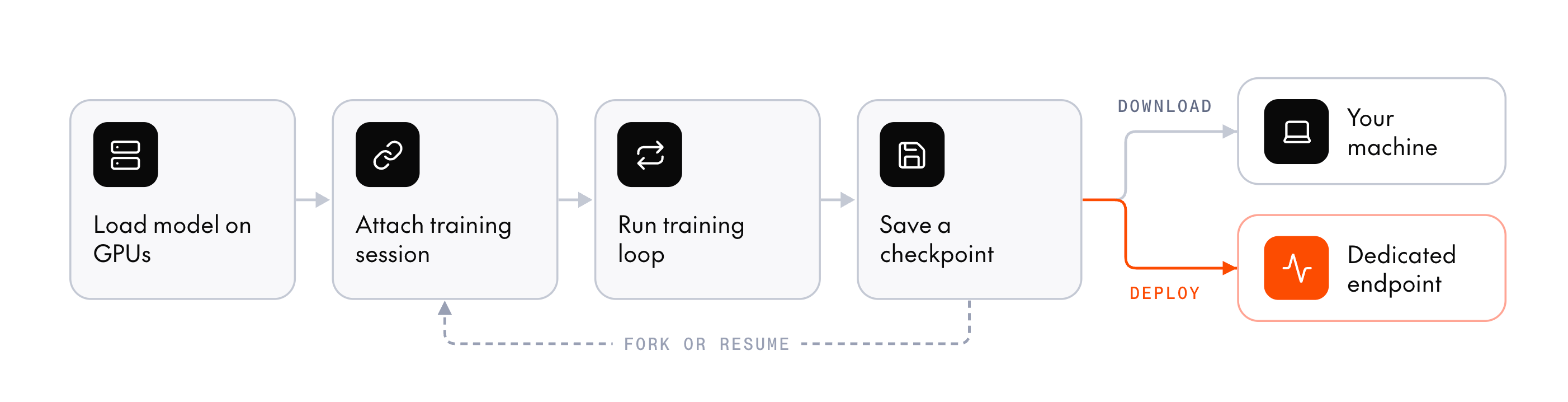
Together Post-Training is live. Turn open models into custom models you own, with SFT or RL. You define the data, rewards, environments and the training loop itself. We run the hard infrastructure underneath it, tuned for quality and speed.
— @togethercompute October 19, 2026
Estimate a job before you run it (from the Together docs):
from together import Together
client = Together()

estimate = client.fine_tuning.estimate_price(
    training_file="file-abc123",
    model="meta-llama/Meta-Llama-3.1-8B-Instruct-Reference",
    n_epochs=3,
    training_method={"method": "sft"},
    training_type={"type": "Lora", "lora_r": 8},
)
print(estimate)   # price, token counts, credit limit, allowed to proceed?
Pros
- Published per-model rates, a price estimate before launch, and refunds on failed jobs.
- Two modes on one account: managed jobs for simple SFT and DPO, a custom loop for RL.
- Very large model list, including DeepSeek, Kimi, GLM and Qwen3.5 397B.
Cons
- High job minimums on large models ($60 on Kimi and GLM).
- A fine-tune is served on a dedicated endpoint, which bills while it runs; no pay-per-token adapter serving was documented.
- Post-Training GPU billing is harder to predict than per-token pricing.
Benefits for your use case. If your question is how much will this cost and how fast can I serve it, Together answers both on one page. The estimate API means finance can approve a run before it starts.
Standout use case. A first LoRA SFT on Qwen3.5 9B with the CoQA dataset; the quickstart says end to end it takes roughly 20 to 40 minutes.
Skip it if you need adapters served per token on shared GPUs, or you need a no-GPU-hour model of cost for RL experiments.
2. Fireworks AI
Fireworks replaced its Managed Training with the Training API. You write a Python loop with the cookbook recipes (SFT, DPO, GRPO, agentic RL, distillation) and choose where it runs: Serverless Training on a shared trainer pool billed per token, or Dedicated Training on reserved GPUs billed per GPU-hour. A third option, Fireworks Lab, puts their researchers on your project and is priced per engagement.
Fireworks announced a $1.505 billion Series D at a $17.5 billion valuation on Jul 16, 2026, after a $250 million Series C at $4 billion in October 2025.
Who it is for. ML engineers who want a loop they control, RL and agentic training, and the option to scale to full-parameter or the largest MoE models on dedicated GPUs.
Key features
- Serverless Training: LoRA only, nothing to provision, repeated prefixes bill 80% off.
- Dedicated Training: full-parameter training, the largest MoE models, longer context and higher LoRA ranks, billed at on-demand GPU rates.
- Methods: SFT, DPO, RL and custom ones such as GRPO and distillation. Vision SFT is in the cookbook.
- A Migrate from Tinker guide, and an RL rollout integration if you run your own trainer and just want Fireworks inference.
- Agent Skills for Claude Code, Cursor, Codex and OpenCode, so a coding agent can research, configure and launch a run.
- Zero data retention by default, SOC 2 Type II and HIPAA with a BAA.
Pricing (as of Nov 26, 2026)
- Serverless Training, USD per 1M tokens (prefill / cached prefill / sample / train): Kimi K3 $10.87 / $2.17 / $27.11 / $32.55; GLM 5.3 $4.86 / $0.972 / $12.15 / $14.58; GLM 5.3 Flash $2.96 / $0.593 / $7.41 / $8.89; Muse Glimmer 30B $1.96 / $0.39 / $4.88 / $5.86; Qwen 3.8 27B $1.86 / $0.372 / $5.595 / $4.103; DeepSeek V4.1 Flash 1017 $0.60 / $0.12 / $3.60 / $4.98; Nemotron 3.5 Super VL 120B $0.57 / $0.114 / $1.44 / $2.32; Qwen 3.6 35B A3B $0.45 / $0.09 / $1.335 / $2.14.
- Dedicated Training: from $8.00 per GPU-hour. H100 and H200 $8.00, B200 $13.00, B300 $15.00, GB300 $20.00 per hour. Region-restricted deployments are 1.5x.
- Serving a trained model costs no extra beyond the deployment itself, billed per GPU-second on On Demand.
Free tier or credits. Muse Glimmer 30B LoRA SFT is free through Nov 30, 2026 in the UI and the Serverless Training API, with no credit card. Starting after the cut-off requires passing a paid flag in the starter script. RL, DPO, full-parameter training, deployments and inference are not covered.
Limits to know
- Serverless Training supports LoRA only. Kimi K3 LoRA trains attention layers and the shared expert; routed experts and the router stay frozen.
- Checkpoint names must be 17 characters or fewer, and this is only checked when you promote a checkpoint.
- Serverless adapter serving (Specialized Model Inference) is a preview, on request, for GLM 5.3 Flash only, max LoRA rank 64, 3 adapters per base model.
- On Demand scales to zero after one hour by default.
We trained @Meta's Muse Glimmer on Kalshi outcomes. One pass put it 11.2 percentage points ahead of Jev in prediction accuracy. In a backtest, it returned +7.1% to Jev's -8.1%. Good thing the money was hypothetical. Train it for free with SFT through Nov 30.
— @FireworksAI_HQ October 21, 2026
The tweet reports vendor results from one run and a hypothetical backtest; we did not reproduce them. The free SFT offer is confirmed in the Fireworks docs. The first run from the cookbook:
git clone --depth 1 https://github.com/fw-ai-external/cookbook.git
cd cookbook/training && pip install -e .
export FIREWORKS_API_KEY="fw_..."
python -m examples.sft.example_datasets --example prompt-router
python -m examples.sft.muse_glimmer_starter plan --surface serverless --file prompt-router.jsonl
python -m examples.sft.muse_glimmer_starter launch --surface serverless --file prompt-router.jsonl --run-id $RUN
Pros
- Clear per-token table for training, with an explicit sample meter for RL.
- One GPU rate card for serving and training.
- Free first LoRA run on Muse Glimmer 30B this week.
Cons
- Four token meters (prefill, cached prefill, sample, train) take effort to forecast for RL.
- Adapter serving on shared serverless is a narrow preview.
- Managed jobs from before the retirement need migration.
Benefits for your use case. Fireworks is the most flexible ladder here: start with a free serverless LoRA SFT, then move the same loop to dedicated GPUs for full-parameter work, and deploy where you trained.
Standout use case. Agentic RL on a LoRA with the HUD or tool-use cookbook recipes, then a promoted sampler checkpoint deployed to a dedicated endpoint.
Skip it if you need full-parameter training without a dedicated GPU budget, or a no-code job runner.
3. Tinker (Thinking Machines)
Tinker is a training API from Thinking Machines Lab. You call forward_backward and optim_step from your own code; Tinker runs the distributed trainer and sampler. It trains LoRA adapters, which the company says matches full fine-tuning performance with the right setup, and it was made generally available on Dec 12, 2025.
Its models include the company's own Inkling family plus open models such as Qwen, gpt-oss, Kimi, GLM and DeepSeek.
Who it is for. Researchers and ML engineers who want algorithm-level control (custom losses, RL environments) and per-token billing.
Key features
- SFT, RL with PPO, CISPO, DRO, GSPO and custom loss functions, DPO and an RLHF example, in the open Tinker Cookbook.
- Weights export: save_weights_external plus weights.download, merge into a Hugging Face model, build a PEFT LoRA adapter, publish to the Hub.
- OpenAI-compatible and Anthropic-compatible inference docs for trained checkpoints; hosted serverless inference is a beta limited to Inkling 2 Small, Inkling and Inkling-Small.
- Enterprise controls: customer-managed encryption, VPC PrivateLink or custom OIDC, audit logs, project roles.
Pricing (as of Nov 26, 2026)
- Per 1M tokens for training, sampling and prefill, as of Oct 19, 2026 on the pricing page. Qwen3-8B (32K): prefill $0.195, cached $0.039, sample $0.60, train $0.44. GPT-OSS-20B train $0.396. GPT-OSS-120B (32K) train $0.737, (128K) $2.33. Qwen3.5-9B (64K) train $1.463. Inkling 2 Mini train $0.75 (64K) or $1.50 (256K). Inkling 2 Small train $1.50 (64K) or $3.00 (256K). Mixture-of-experts models are priced by active parameters.
- Checkpoint storage $0.10 per GB per month.
- Serverless inference (beta): Inkling 2 Small $0.30 input, $1.00 output per 1M tokens; Inkling $1.00 / $4.05; Inkling-Small $0.30 / $1.20.
Free tier or credits. A free Inkling 2 Mini tier at 64K context ($0.00 across all meters).
Limits to know
- LoRA only, no full-parameter training.
- Serverless production use of the inference beta needs a waitlist email.
- The docs home was a single-page app that returned 404 for several deep links when we tried them, so some details come from the pricing page and the cookbook README.
The primitives, from the Tinker Cookbook README:
import tinker
service_client = tinker.ServiceClient()
training_client = service_client.create_lora_training_client(
  base_model="meta-llama/Llama-3.2-1B", rank=32,
).result()
training_client.forward_backward(...)
training_client.optim_step(...)
sampling_client = training_client.save_weights_and_get_sampling_client().result()
Pros
- Per-token pricing with a free tier and a published storage rate.
- Open cookbook with worked recipes for SFT, RL, DPO and distillation.
- Fireworks documents a migration path from Tinker, which lowers lock-in.
Cons
- You write the training loop; there is no managed job.
- Serving your fine-tune of a third-party model is your job.
- Customer results shown on the product page are vendor-reported.
Benefits for your use case. If you have an RL idea and want to run it without building trainer infrastructure, Tinker is the shortest path. Per-token pricing means a failed experiment costs only its tokens.
Standout use case. Tool-use RL. The vendor reports that Exa trained Qwen3-4B on Tinker and raised 2WikiMultihopQA accuracy from 50.0% to 83.9% (vendor-reported, not independently checked).
Skip it if you want a form-based job, or full-parameter training.
4. Prime Intellect
Prime Intellect launched Model Factory in November 2026: train, evaluate, deploy and improve models on one stack. Hosted Training runs prime-rl, its open-source asynchronous RL trainer, on GPUs it operates. You submit a TOML config with the prime CLI and the run bills per GPU-hour.
On Jul 8, 2026 Prime Intellect announced a $130 million Series A at a $1 billion valuation led by Radical Ventures, per press coverage.
Who it is for. Teams that want RL against their own environments, with an Environments Hub of 2,500+ community environments (company figure) and open-source trainers they can also run themselves.
Key features
- Hosted RL (beta): full-parameter RL on dedicated pods sized by a deployment block; hosted SFT (beta) and pretraining use the same dispatch.
- Environments Hub and the verifiers library for building reward environments.
- Hosted evaluations, Prime Traces to find failure modes, sandboxes, and dedicated inference deployments for trained checkpoints.
- Pause and resume releases GPUs at a checkpoint.
Pricing (as of Nov 26, 2026)
- Per GPU-hour, prorated to the second, no minimum. The meter starts when pods are Ready; queueing and image pull are free.
- Rates are not in the docs. Run prime train models to see the On-Demand Capacity table, and the CLI prints the rate before you dispatch.
- Volumes $0.09 per GiB per month.
- Dedicated Model Factory clusters are contact-sales.
Free tier or credits. Not documented on pages read. Credit grants apply against your wallet if given.
Limits to know
- Default 64 GPUs per run and 10 queued runs per user.
- Checkpointing is off by default; without a volume and a ckpt block you end with metrics and no model.
- Checkpoints are DCP-sharded and need conversion before other tools load them.
- Shared LoRA training was retired. Old adapters can be downloaded but not served through Prime Inference.
- Hosted SFT needs access enabled on your account.
Introducing Model Factory. Train, deploy, and continuously improve your own models on one stack. Run on-demand, on dedicated clusters, or bring your own. Own your intelligence. Own your model factory.
— @PrimeIntellect November 19, 2026
The hosted run flow from the Prime docs:
uv tool install -U prime && prime login
prime train models                       # models + current $/GPU-hour
prime volumes create research --size 100Gi
prime train configs/rl.toml --volume research
prime train logs <run-id> -f
prime train stop <run-id>                # stop the meter
Pros
- Open-source trainer, so you can leave and run the same configs yourself.
- RL-first tooling: environments, evals and traces in one place.
- Per-second billing with a visible rate before dispatch.
Cons
- No per-token option now that shared LoRA is gone; small experiments still pay for whole GPUs.
- Prices are only visible in the CLI.
- Model Factory is brand new and several pieces are beta.
Benefits for your use case. You get the RL plumbing (environments, rollouts, traces) that most generic fine-tuning APIs leave to you, and you can take the stack to your own cluster later.
Standout use case. Training a specialist agent against a verifiers environment, for example the vendor case study where Ramp trained a 35B FastAsk model (vendor-reported).
Skip it if your task is plain SFT on a few thousand examples; a job-based platform is simpler.
5. Baseten
Baseten has two training products. Loops is an SDK for SFT and RL with serverless or dedicated trainers, billed per token on serverless and announced generally available on Nov 6, 2026. Training Jobs runs your own code on managed GPUs, from a single node to multi-node, with SSH workstation access for debugging.
Baseten announced a $1.5 billion Series F in June 2026 at a valuation reported at up to $13 billion.
Who it is for. Teams that want to train and serve on one platform, where the model you train is the model you serve.
Key features
- Loops: choose base model, context length and LoRA rank; async RL; deploy a checkpoint directly to Dedicated Inference.
- Training Jobs: bring your framework for full fine-tuning or custom work; Baseten handles provisioning and checkpoint storage.
- RL Rollouts: bring your own trainer and scale samplers on Baseten's fleet with fast delta weight syncs.
- Zero data retention by default, data residency zones and HIPAA clusters; Baseten states you keep ownership of models, scripts, data and artifacts.
Pricing (as of Nov 26, 2026)
- Serverless Loops, per 1M tokens (prefill / cached / sample / train), shown with 20% off for a limited time: DeepSeek V4.1 Flash 1017 $0.48 / $0.10 / $2.88 / $3.98; GLM-5.3-Flash $0.67 / $0.13 / $1.69 / $4.46; GLM-5.3 $3.02 / $0.60 / $9.72 / $11.66; Qwen3.6 35B-A3B $0.36 / $0.07 / $1.07 / $1.71.
- Training Jobs per hour: T4 $0.6312, L4 $0.8484, A10G $1.2072, A100 $4.00, H100 MIG $3.75, H100 $6.50, B200 $9.98. Billed per minute.
Free tier or credits. Not documented on pages read.
Limits to know
- Loops serverless covers a short model list on the pricing page (four models).
- Dedicated Loops is needed for other models or configurations.
Baseten Loops is now GA, and serverless. Teams at @AmbienceAI, @datadoghq, and @LangChain use the Loops SDK for SFT and RL training to build durable intelligence.
— @baseten November 6, 2026
Creating a serverless LoRA run (from the Baseten docs):
from baseten.loops import ServiceClient

service_client = ServiceClient()
training_client = service_client.create_lora_training_client(
    base_model="zai-org/GLM-5.3-Flash",
    rank=32,
    max_seq_len=16384,
    scope="serverless",
)
Pros
- Shorter gap between training and production inference.
- Both per-token and per-minute training options.
- Large MoE support: the vendor says 2T+ models at 256K+ sequence length.
Cons
- The promo discount makes today's per-token numbers temporary.
- Few base models on the serverless table.
Benefits for your use case. If the serving side is your pain point, Baseten removes the gap between a trained checkpoint and a production endpoint.
Standout use case. A Loops SFT run on GLM-5.3-Flash with the pirate-ultrachat dataset from the docs, then sampling from the checkpoint.
Skip it if you want to export weights and serve elsewhere on day one; check the export path first.
6. Unsloth
Unsloth is an open-source library for fast LoRA, QLoRA, full fine-tuning and RL on a GPU you control, plus Unsloth Studio, a local web UI for running and training models. It is a Y Combinator Summer 2024 company. The GitHub repository had 80,277 stars when we read it on Nov 26, 2026.
Studio launched on Mar 17, 2026 as a beta open-source no-code interface. Unsloth Desktop, a desktop app, is also listed.
Who it is for. Developers with their own GPU, a Colab account, or a rented one, who want the lowest cost and full control of weights.
Key features
- LoRA, QLoRA, full fine-tuning, pretraining, RL, GRPO, DPO and FP8, per the README.
- Claims 2x faster training and 70% less VRAM with no accuracy loss (vendor-reported).
- Export to GGUF, NVFP4, FP8 and more; serve through an OpenAI-compatible API.
- Studio Data Recipes build datasets from PDFs, CSVs and DOCX files.
- Free Colab and Kaggle notebooks, including gpt-oss 20B GRPO.
Pricing (as of Nov 26, 2026)
- Free. Core package Apache-2.0. Optional components such as the Studio UI are AGPL-3.0.
- You pay for the GPU. For example Modal lists an A100 80 GB at $0.000694 per second, about $2.50 per hour.
Free tier or credits. Everything above is free, including notebooks. No hosted pricing exists.
Limits to know
- Third-party coverage says Studio training needs an NVIDIA GPU; CPU and AMD can run chat and Data Recipes.
- No managed serving or hosted jobs.
Introducing Unsloth Studio. A new open-source web UI to train and run LLMs.
— @UnslothAI March 17, 2026
Video: a third-party Unsloth Studio tutorial from April 2026. It recommends a rented GPU and shows the no-code flow.
The core library, from Unsloth's Llama 3.1 8B notebook:
from unsloth import FastLanguageModel
model, tokenizer = FastLanguageModel.from_pretrained(
    model_name="unsloth/Llama-3.1-8B", max_seq_length=2048, load_in_4bit=True)
model = FastLanguageModel.get_peft_model(
    model, r=16, lora_alpha=16, lora_dropout=0, use_gradient_checkpointing="unsloth",
    target_modules=["q_proj","k_proj","v_proj","o_proj","gate_proj","up_proj","down_proj"])
from trl import SFTConfig, SFTTrainer
trainer = SFTTrainer(model=model, tokenizer=tokenizer, train_dataset=dataset,
    args=SFTConfig(per_device_train_batch_size=2, gradient_accumulation_steps=4,
                   max_steps=60, learning_rate=2e-4, optim="adamw_8bit", output_dir="outputs"))
trainer.train()
Pros
- Zero platform cost and full weight ownership.
- Active repository: last push Nov 26, 2026.
- One toolchain from data to GGUF export.
Cons
- You manage the GPU, drivers and environment.
- AGPL components need legal review before embedding in a product.
- Multi-node training of very large models is not its home turf.
Benefits for your use case. For small and mid-size models, it is the cheapest route. The cost is your time operating the stack.
Standout use case. QLoRA on a single consumer or rented GPU, then export to GGUF and run locally. See our guide on small models on device.
Skip it if you need no-ops managed training or multi-node large-model runs.
7. Axolotl
Axolotl is an open-source fine-tuning framework driven by a single YAML file for dataset preprocessing, training, evaluation, quantization and inference. The repository had 12,751 stars and an Apache-2.0 license on Nov 26, 2026. Modal and Baseten are among the clouds it documents recipes for.
Who it is for. Practitioners who want a reproducible config-file workflow, multi-GPU scale, and the freedom to run in any cloud or on-prem.
Key features
- Full fine-tuning, LoRA, QLoRA, GPTQ, QAT, preference tuning (DPO, IPO, KTO, ORPO), RL (GRPO, GDPO) and reward models.
- Multi-GPU and multi-node: FSDP2, DeepSpeed, context and expert parallelism, and the Muon optimizer.
- Async GRPO (the README says up to 58% faster steps, vendor-reported).
- New cloud interfaces to launch jobs, including Nebius Serverless Jobs.
- Quick start: axolotl fetch examples, then axolotl train examples/llama-3/lora-1b.yml.
Pricing (as of Nov 26, 2026)
- Free. Apache-2.0. You pay for your compute.
Free tier or credits. Free software; Colab example notebook provided.
Limits to know
- No hosted service; no managed serving.
- YAML configs have many knobs; version pins matter (the README pins a specific torch version).
uv pip install axolotl[deepspeed]
axolotl fetch examples
axolotl train examples/llama-3/lora-1b.yml
Pros
- Broadest method list among open-source options, and a config you can commit to git.
- Scales past one GPU with documented parallelism strategies.
- Hugging Face recommends it in the AutoTrain deprecation notice.
Cons
- Steeper learning curve than a hosted job.
- You own debugging of CUDA, drivers and OOMs.
Benefits for your use case. Your data never has to leave your account and the same config runs on any provider.
Standout use case. Fine-tuning gpt-oss 120B, a recipe featured on the Axolotl site (we did not run it).
Skip it if you want someone else to run and bill the GPUs.
8. Modal
Modal is serverless GPU infrastructure for your own code: write a Python function, request a GPU, and pay by the second. It is not a fine-tuning service. It is where Axolotl, Unsloth, TRL or your RL loop run without you managing machines. Modal's site lists Training (fine-tune, run RL, evaluate), Inference, Sandboxes and Model APIs as products.
Modal announced a $355 million Series C at a $4.65 billion valuation on May 21, 2026, led by Redpoint and General Catalyst.
Who it is for. Developers who have a training script and want elastic GPUs without reserving them, including RL rollouts in sandboxes.
Key features
- Per-second GPU and CPU billing; no charge for idle resources.
- GPUs from T4 to B300; volumes for datasets and checkpoints.
- Sandboxes for isolated rollouts and untrusted code.
- Model APIs for open-weight models if you also need token inference.
Pricing (as of Nov 26, 2026)
- GPU per second: B300 $0.001972, B200 $0.001736, H200 $0.001261, H100 SXM5 $0.001097, RTX PRO 6000 $0.000842, A100 80 GB $0.000694, A100 40 GB $0.000583, L40S $0.000542, A10 $0.000306, L4 $0.000222, T4 $0.000164.
- Plans: Starter $0 plus compute with $30 per month free credits; Team $250 per month plus compute with $100 free credits.
- Volumes $0.09 per GiB per month, includes 1 TiB per month free.
Free tier or credits. $30 per month of free credits on Starter; academics can apply for up to $10k of credits; startups can apply for grants.
Limits to know
- Starter: 250 containers and 10 GPU concurrency. Team: 10,000 containers and 50 GPU concurrency.
- You provide the training code and the serving plan.
Pros
- No idle cost and no minimums.
- Works with any open-source trainer.
Cons
- Not a managed fine-tune: no dataset validation, loss curves or price estimate for a job.
- GPU concurrency caps on lower plans.
Benefits for your use case. You pay only for run time and keep every artifact. It pairs well with Unsloth or Axolotl.
Standout use case. Burst multi-GPU runs with an open-source trainer, then shut down with zero idle cost.
Skip it if you want a managed job with a price estimate and a hosted endpoint.
9. Oumi
Oumi began as an open-source platform. It came out of stealth in January 2025 with a $10 million seed round led by Venrock and Obvious Ventures. In 2026 it launched a commercial hosted platform built around FAiE, an agent that handles evaluation, data curation, training, inference and monitoring. The open-source repository had 9,442 stars and an Apache-2.0 license on Nov 26, 2026, and v0.9 shipped in September 2026.
Who it is for. Teams that want an agent-guided workflow, or developers who want an open framework plus an optional hosted product.
Key features
- Free plan: data synthesis, data analysis, evaluation with failure modes, SFT and PEFT (LoRA, QLoRA).
- Pro: on-policy distillation, concurrent jobs, production inference with autoscaling, one weights download per month.
- Enterprise: bring your own cloud, RL and custom pipelines, SLAs.
- OSS library: SFT, LoRA, QLoRA, DPO, GRPO (including tool use) and an oumi deploy command to dedicated endpoints on Fireworks and Parasail.
Pricing (as of Nov 26, 2026)
- Free $0 with up to $50 in credits for 3 months. Pro $25 per month, pay as you go after, with $25 per month of credits.
- SFT per 1M training tokens (dataset tokens x epochs): up to 16B $0.49; 16.1B to 32B $2.00; 32.1B to 80B $3.00; 80.1B to 300B $6.00.
- On-policy distillation per GPU-hour on 8 GPUs: A100-80GB $2.90, H100-80GB $4.00.
- Oumi agent tokens $6.25 input and $31.25 output per 1M; evaluation 1,000 judgments per $1; data synthesis 1,000 rows per $1; storage 4 GB per month per $1.
Free tier or credits. Up to $50 in credits for 3 months on the Free plan.
Limits to know
- Hosted RL is listed under Enterprise.
- Weights download is one per month on Pro.
- Agent tokens are billed on top of training.
Pros
- Open source plus a hosted product, with a free plan.
- Transparent price table by model size.
Cons
- Agent cost can add up.
- Hosted RL is not self-serve.
Benefits for your use case. If you do not know your data and eval design yet, the agent can draft them, and you can still run the open library yourself.
Standout use case. Going from a few examples to an evaluated, deployed small model with the agent.
Skip it if you want to download and move weights often.
10. Nebius Token Factory
Nebius Token Factory is Nebius's inference and post-training service. Post-training covers supervised fine-tuning on full weights or LoRA, custom speculator training for faster inference, and a limited reinforcement fine-tuning program by request.
Who it is for. Teams that want long-context fine-tuning of large open models and an OpenAI-compatible API, with a path to dedicated endpoints.
Key features
- Marketing page: 30+ open models, scaling from 8 to 512 GPUs with no code changes, long-context training up to 131k tokens.
- Models include Gemma 4, gpt-oss 20B and 120B (bf16 from Unsloth), Qwen3 and Qwen2.5 families; the docs list LoRA, full or both per model.
- Dataset formats: conversational (with tool calls), instruction, text, pretokenized. Size limits 50 GB via Data Lab and 20 GB via the Files API.
- OpenAI SDK jobs API with W&B and Hugging Face integrations; checkpoints can be downloaded.
- Guide to merge MoE LoRA adapters for dedicated endpoints.
Pricing (as of Nov 26, 2026)
- Token-based per the vendor, with no idle GPU charges. Per-model fine-tuning rates were not visible on the pages we could read (the Token Factory site returned HTTP 403 to our client and the Nebius price page did not list them).
Free tier or credits. Not documented on pages read.
Limits to know
- Default fine-tune context is 8192 tokens unless you override it.
- Reinforcement fine-tuning is a limited professional service.
An SFT job through the OpenAI-compatible API (condensed from the Nebius docs):
from openai import OpenAI
import os
client = OpenAI(base_url="https://api.tokenfactory.nebius.com/v1/",
                api_key=os.environ["NEBIUS_API_KEY"])

training_file = client.files.create(file=open("training.jsonl", "rb"), purpose="fine-tune")
job = client.fine_tuning.jobs.create(
    model="meta-llama/Llama-3.1-8B-Instruct",
    training_file=training_file.id,
    hyperparameters={"n_epochs": 3, "learning_rate": 1e-5, "lora": True, "lora_r": 16, "lora_alpha": 16},
)
Pros
- Long context and large models, with distributed training handled for you.
- Standard OpenAI-style API.
Cons
- Prices not public in our check.
- No self-serve RL.
Benefits for your use case. A natural fit if you already serve on Nebius and want training next to inference.
Standout use case. Training a custom speculator for a base model to raise inference throughput.
Skip it if you need a visible rate card before you talk to anyone.
11. Google Vertex AI
Vertex AI model tuning covers Gemini, Gemma, Llama and Qwen models. Google's pricing page now also uses the name Agent Platform in places, so expect console naming to differ. This is a shorter section: Vertex is the pick when your company is already on Google Cloud.
Who it is for. Google Cloud teams that need managed tuning with IAM, regional controls and one bill.
Key features
- Supervised fine-tuning on Gemini 3.8 Flash, 3.5 Flash, 3.5 Flash Lite, 3.1 Flash Lite, 2.5 Pro, Flash and Flash Lite, plus Gemma 3, Llama 3.1 to 3.3, Llama 4 Scout and Qwen 3.
- Reinforcement learning fine-tuning listed for Gemini 3.5 Flash and 3.1 Flash Lite; preference tuning for Gemini 2.5 Flash and Flash Lite.
Pricing (as of Nov 26, 2026)
- Gemini, per 1,000 training tokens: 3.8 Flash $0.01; 3.5 Flash $0.01; 3.5 Flash Lite $0.003; 3.1 Flash Lite $0.003; 2.5 Pro $0.025; 2.5 Flash $0.005; 2.5 Flash Lite $0.0015. The page lists SFT and RL (or preference) together under one price per model.
- Open models, per 1M training tokens (SFT): Gemma 3 4B $1.14, 12B $1.82, 27B $6.83; Llama 3.1 8B $0.67, 3.3 70B $6.72, Llama 4 Scout $5.77; Qwen 3 8B $4.18, 14B $8.46, 32B $6.57.
- Tuned endpoint inference costs the same as the base model, except Gemini 3.1 Flash Lite, 3.5 Flash and 3.5 Flash Lite cost 1.5x outside the global region.
Free tier or credits. Not documented on pages read.
Limits to know
- Tuned Gemini models stay on Google's platform.
Pros
- Closed frontier models can be tuned; enterprise controls.
Cons
- No weight export for tuned Gemini; regional inference premium on some models.
Benefits for your use case. Fine-tune a Gemini Flash model for a fixed format without moving data off Google Cloud.
Standout use case. Tuning Gemini 3.5 Flash Lite at $3 per 1M training tokens.
Skip it if you want portable weights.
12. AWS Bedrock
Amazon Bedrock offers supervised fine-tuning, reinforcement fine-tuning (reward functions you write as AWS Lambda functions), distillation and continued pretraining for supported models, plus Custom Model Import for weights you trained elsewhere. This is a shorter section.
Who it is for. AWS-native teams that want tuning inside their existing accounts and compliance setup.
Key features
- SFT on labeled data, RFT with your own reward Lambda, distillation from a teacher to a student model.
- Custom models can use Provisioned Throughput or, for parameter-efficient methods, on-demand pricing; full-rank fine-tuned models use Provisioned Throughput only.
Pricing (as of Nov 26, 2026)
- Training is priced per 1,000 tokens (tokens x epochs) for SFT and per hour for RFT on Nova 2 Lite, plus monthly storage per custom model.
- The pricing page loads its numbers client-side, so the exact dollar figures did not appear when we fetched it. Check the live page for Nova and Llama rates.
Free tier or credits. Not documented on pages read.
Limits to know
- Custom models live in Bedrock; the rates differ by model.
Pros
- Reward-based RFT with Lambda; no GPU management.
Cons
- Prices need the live page; weights are not exported.
Benefits for your use case. Keep data and tuning inside AWS governance.
Standout use case. RFT where a Lambda checks the answer.
Skip it if you need weights you can move.
Feature Matrix
Yes, no or partial, based on the pages and docs we read. Cells that say not documented are not proof that a feature is missing.
| Platform | SFT | LoRA/QLoRA | Full-parameter | DPO/preference | RL (GRPO and similar) | Serve the result | Download weights | Open source |
|---|---|---|---|---|---|---|---|---|
| Together AI | Yes | Yes | Yes (select models) | Yes | Yes (Post-Training) | Yes (dedicated) | Yes | No |
| Fireworks AI | Yes | Yes (serverless) | Yes (dedicated) | Yes | Yes | Yes | Endpoint documented, not tested | No |
| Tinker | Yes | Yes (LoRA only) | No | Yes | Yes | Partial (beta, Inkling only) | Yes | SDK and cookbook |
| Prime Intellect | Yes (beta) | Partial (hosted shared LoRA retired) | Yes | Not documented on pages read | Yes (beta) | Yes (dedicated) | Yes (DCP, convert to HF) | prime-rl, verifiers |
| Baseten | Yes | Yes | Yes (Training Jobs) | Not documented on pages read | Yes | Yes (dedicated) | Not tested | No |
| Unsloth | Yes | Yes | Yes | Yes | Yes | Local, GGUF export | Yes (you own them) | Yes (Apache-2.0 / AGPL-3.0) |
| Axolotl | Yes | Yes | Yes | Yes | Yes | Self-host | Yes (you own them) | Yes (Apache-2.0) |
| Modal | Your script | Your script | Your script | Your script | Your script | Partial (model APIs, your own serving) | Yes | No |
| Oumi | Yes | Yes | Not stated for hosted | Not stated for hosted | Enterprise (hosted); GRPO in OSS | Yes (autoscaling, Pro) | Partial (1 per month on Pro) | Yes (Apache-2.0) |
| Nebius Token Factory | Yes | Yes | Yes | Not documented on pages read | Request only | Yes | Yes | No |
| Google Vertex AI | Yes | Not verified | Not verified | Yes (Gemini 2.5) | Yes (select Gemini) | Yes (Google Cloud) | Not verified | No |
| AWS Bedrock | Yes | Yes (parameter-efficient) | Yes (provisioned only) | Yes (preference optimization) | Yes (RFT) | Yes (Bedrock) | No (stays in Bedrock) | No |
Serving and Weight Ownership
Training is half the cost. Before you commit, answer two questions: where does the tuned model run, and can you take it with you?
- Together: serve on a dedicated endpoint billed per minute per replica, or download the weights (docs and launch post).
- Fireworks: deploy to On Demand (per GPU-second) or, for GLM 5.3 Flash only, load an adapter on serverless in preview (rank up to 64, 3 adapters). The API reference lists a model download endpoint, which we did not test.
- Tinker: download checkpoints through an API and merge into a Hugging Face model or a PEFT adapter; hosted inference is a beta for Inkling models only.
- Prime Intellect: download checkpoints from volumes (DCP-sharded, convert to HF); serve with dedicated deployments or self-host with prime-rl. Shared adapter serving was removed.
- Baseten: deploy to Dedicated Inference in one step; the vendor states you keep ownership of models and artifacts.
- Oumi: hosted inference with autoscaling on Pro; one weights download per month on Pro.
- Nebius: serverless, on-demand GPU or dedicated; checkpoints downloadable through the API.
- Vertex and Bedrock: the tuned model stays in that cloud. Bedrock also supports Custom Model Import for weights trained elsewhere.
- Unsloth, Axolotl, Modal: your weights, your serving plan. Unsloth exports GGUF and others.
If you tuned a small model to run locally, read our guide to fine-tuning small models on device.
How to Choose
| If this is you | Pick | Why |
|---|---|---|
| I have 5,000 chat examples and want a tuned 8B model by tonight | Together AI or Oumi | Job-based, price shown before launch, serve on a dedicated endpoint or download. |
| I want to change the loss, mix SFT and RL, or run an algorithm from a paper | Tinker, Fireworks Training API, Baseten Loops, Together Post-Training | You write the loop, they run the distributed trainer. |
| I have a verifiable reward (tests pass, answer matches) and a tool-use agent | Prime Intellect, Fireworks, Together GRPO | Environments plus RL on managed GPUs. |
| My data cannot leave my infrastructure | Unsloth or Axolotl on your GPUs, or Modal with your own code | Open frameworks; you control where the weights and data live. |
| I only have a laptop with an NVIDIA GPU and want a UI | Unsloth Studio | Local, no code; training needs NVIDIA per third-party coverage of the docs. |
| I need to tune a large MoE with long context | Fireworks Dedicated, Together Post-Training, Nebius, Prime Intellect | Multi-node training you cannot reproduce cheaply yourself. |
| My company is all-in on Google Cloud or AWS | Vertex AI or Bedrock | Billing, IAM and private networking you already run. |
| I currently tune GPT models at OpenAI | Move now | Self-serve job creation ends Dec 15, 2026. |
Three rules of thumb. Start with SFT unless you can write a reward function; RL needs a scorer and often fewer than 100 prompts, per Fireworks' own guidance, but the scorer is the hard part. Start small: validate your data and config on a 1B to 9B model before you pay for a 70B or MoE run. And decide the serving path before training, because an adapter you cannot serve cheaply is a prototype.
Data Formats and a Minimal Job
Nearly every platform here takes chat-style JSONL. One line per conversation, with the final message from the assistant. Together, Nebius and Fireworks all use this shape (Together and Nebius also support instruction, text and preference variants; Together adds Parquet for pretokenized data and custom loss masking).
{"messages": [
  {"role": "system", "content": "You are a friendly dinner planner."},
  {"role": "user", "content": "What's for dinner tonight?"},
  {"role": "assistant", "content": "What cuisine do you prefer?"}
]}
Prime Intellect SFT expects prompt and completion or messages columns, and RL expects an environment rather than a file. Tinker, Fireworks and Baseten Loops expect you to tokenize and build datums yourself, masking prompt tokens in the loss. A minimal managed job at Nebius, adapted from its docs:
from openai import OpenAI
import os
client = OpenAI(base_url="https://api.tokenfactory.nebius.com/v1/",
                api_key=os.environ["NEBIUS_API_KEY"])

training_file = client.files.create(file=open("training.jsonl", "rb"), purpose="fine-tune")
job = client.fine_tuning.jobs.create(
    model="meta-llama/Llama-3.1-8B-Instruct",
    training_file=training_file.id,
    hyperparameters={"n_epochs": 3, "learning_rate": 1e-5, "lora": True, "lora_r": 16, "lora_alpha": 16},
)
For data prep itself, see our guides on synthetic data tools and turning PDFs into training data. Evaluate the result with an LLM eval and observability tool, and rent bare GPUs from the GPU cloud guide.
How We Evaluated
We read each vendor's pricing page, docs and (for open-source projects) GitHub repository on Nov 26, 2026, and verified funding and acquisition news against press coverage and company announcements. We did not run fine-tuning jobs on these platforms, so we make no quality, speed or reliability claims. Cost examples are arithmetic on published rates. Vendor-reported numbers are labeled. Ranking is neutral, and the post contains no affiliate links. Hyperscalers are covered in shorter sections because their tuned models are not portable.
Known gaps: Bedrock dollar figures did not render; Nebius per-model prices were not public in our check; Prime Intellect and Baseten GPU rates can change.
Common Mistakes and Checklist
- Fine-tuning before trying prompting, retrieval and few-shot examples. Together's docs say to almost always try prompting first.
- Forgetting that a resource keeps billing after your script ends (Together Post-Training, Prime Intellect runs). Stop it explicitly.
- Not enabling checkpoints on Prime Intellect, so a finished run leaves no model.
- Assuming per-token adapter serving exists. It usually does not.
- Training on prompt tokens instead of masking them in a custom loop.
- Comparing prices across different meters (prefill, sample, train) without a worked example.
- Treating a promo (20% off on Baseten, free Muse Glimmer SFT, the B200 promo) as a permanent price.
Before you start: define a metric, hold out an evaluation set, price the job and the serving, confirm weights export, and run a small pilot first.
Verdict
For most developers with a labeled dataset and an open base model, Together AI is the simplest managed route today. For algorithm control and RL, choose between Tinker, Fireworks, Baseten Loops and Prime Intellect based on billing model and where you want to serve. For cost and ownership, Unsloth or Axolotl on rented GPUs remains the budget answer. Use Vertex or Bedrock when governance beats portability.
FAQ
What is the best platform to fine-tune an open model in 2026?
There is no single winner. For a managed, job-based SFT run, Together AI shows the lowest listed per-token price we found for small models ($0.34 per 1M training tokens for Qwen3.5 up to 9B, $4.00 minimum, as of Nov 26, 2026). For custom loops and RL, Tinker, Fireworks, Baseten Loops, Prime Intellect and Together Post-Training are the options. For free open-source tooling on your own GPU, Unsloth and Axolotl.
How much does it cost to fine-tune a model?
It depends on tokens and model size. Using 10,000 examples of 600 tokens for 3 epochs (18M training tokens), the listed training-meter prices work out to $6.12 on Together (Qwen3.5 9B), $7.92 on Tinker (Qwen3-8B), $8.82 on Oumi (up to 16B), $36.54 on Together (Llama 3.3 70B) and $38.52 on Fireworks serverless (Qwen 3.6 35B A3B). Serving the result is billed separately.
Is OpenAI fine-tuning still available?
Only for existing users, and not for long. OpenAI's deprecations page says new self-serve fine-tuning job creation ends on Dec 15, 2026, after an earlier plan for Jan 6, 2027. Organizations that never ran a fine-tuning job were blocked on May 7, 2026. Existing fine-tuned models can keep running inference until OpenAI retires their base model.
What is the difference between SFT, DPO and RL?
SFT trains on example answers. DPO trains on pairs of preferred and rejected answers. RL, including GRPO, trains on a reward your code computes from the model's own outputs, so you need a way to score outcomes rather than a gold answer. Fireworks suggests hundreds of examples for SFT, hundreds to thousands of pairs for DPO, and often fewer than 100 prompts plus a scorer for RL.
Do I get to keep the weights?
Mostly yes on open-model platforms. Together documents downloading trained weights, Tinker documents a checkpoint download endpoint, Prime Intellect lets you download checkpoints from volumes (they need conversion to Hugging Face format), and Baseten states you keep full ownership of models, scripts, data and artifacts. Oumi limits downloads to one per month on Pro. Closed-model tuning on Vertex or Bedrock keeps the tuned model inside that cloud.
Can I serve a LoRA adapter on pay-per-token serverless?
Rarely. Fireworks has Specialized Model Inference on Serverless in preview, available on request, for GLM 5.3 Flash only, with up to 3 adapters loaded per base model and LoRA rank up to 64. Together serves fine-tunes on dedicated endpoints billed per minute per replica. Prime Intellect removed adapter serving when it retired shared LoRA. Plan for a dedicated deployment unless your model is on a supported list.
Which platforms support reinforcement learning?
Tinker, Fireworks (serverless and dedicated), Together Post-Training (GRPO, multi-turn GRPO), Baseten Loops, Prime Intellect Hosted RL (beta), and Bedrock reinforcement fine-tuning with reward functions in AWS Lambda. Vertex lists RL fine-tuning for select Gemini models. Oumi lists advanced methods such as RL under Enterprise. Unsloth and Axolotl support GRPO if you bring the GPU.
Is Unsloth free?
The core package is Apache-2.0 and free. Optional components such as the Unsloth Studio UI are AGPL-3.0, so read the license if you plan to embed or host them. You still pay for the GPU, though its free Colab notebooks cover small runs. The 2x faster and 70% less VRAM figures on its README are vendor-reported.
Should I fine-tune at all?
Try prompting, retrieval and few-shot examples first. Together's own docs say you should almost always try prompting first. Fine-tune when you need a consistent format or tone, domain behavior that prompts cannot hold, lower latency or cost from a smaller model, or behavior you can score with a reward.
What happened to OpenPipe, Predibase and Replicate?
CoreWeave announced it would acquire OpenPipe on Sep 3, 2025. Rubrik announced the Predibase acquisition on Jun 25, 2025. Cloudflare announced it would acquire Replicate on Nov 17, 2025. We did not review their current post-acquisition products for this guide.
How is Prime Intellect pricing different now?
Hosted Training is on-demand and billed per GPU-hour, prorated to the second, with no minimum. Rates are not on the docs page: the prime train models command prints the current $/GPU-hour table, and the dispatch command echoes the rate before the run starts. The older shared LoRA, per-token service was retired.
Which free credits are available?
Fireworks: Muse Glimmer 30B LoRA SFT is free through Nov 30, 2026 with no credit card. Tinker: a free Inkling 2 Mini tier at 64K context. Modal: $30 per month of free credits on Starter and up to $10k for academics. Oumi: up to $50 in credits for 3 months. Together: a promo of $9 per GPU-hour on B200 Post-Training until Dec 14, 2026.
Sources
All pages were read on Nov 26, 2026 unless noted.
- Together AI pricing (fine-tuning tables, Post-Training GPU rates)
- Together docs: Post-Training overview
- Together docs: Post-Training pricing
- Together docs: fine-tuning pricing
- Together docs: fine-tuning quickstart
- Together docs: deploy a fine-tuned model
- TechCrunch: Together AI $800M Series C
- Fireworks pricing
- Fireworks docs: Training overview
- Fireworks docs: Serverless Training
- Fireworks docs: Muse Glimmer first fine-tune
- Fireworks docs: Specialized Model Inference on Serverless
- Fireworks: Series D announcement
- Tinker pricing
- Tinker Cookbook (GitHub)
- Thinking Machines: Tinker general availability
- Prime Intellect docs: Hosted Training billing
- Prime Intellect docs: Shared LoRA retired
- Prime Intellect docs: Hosted RL
- Prime Intellect: Series A
- Baseten pricing
- Baseten Training
- Baseten docs: Loops SFT example
- Unsloth (GitHub)
- Axolotl (GitHub)
- Modal pricing
- Modal: Series C
- Oumi pricing
- Oumi (GitHub)
- Nebius Token Factory post-training
- Nebius docs: post-training
- Google Vertex AI generative AI pricing
- Amazon Bedrock pricing
- Amazon Bedrock: customize models
- OpenAI deprecations (fine-tuning timeline)
- Mistral: Fine-tuning API (legacy)
- Hugging Face AutoTrain Advanced (GitHub)
- TechCrunch: CoreWeave and OpenPipe
- TechCrunch: Rubrik and Predibase
- Cloudflare: acquire Replicate
- GeekWire: Oumi $10M seed
- YouTube: Tinker, an API for Fine-Tuning and RL (AI Makerspace)
- YouTube: Fine-Tune Gemma 4 in Minutes, Unsloth Studio Tutorial