Each model got its own launch post, its own benchmark chart and its own set of rivals, so the three launches never sat in one table. That is the gap here. Below are the three launch posts from Google and its executives, then the comparison.
Our strongest frontier model, Gemini 4 Carbon, is now available. Built for deeply complex, long-horizon workflows that push a frontier model’s intelligence, Carbon delivers frontier performance in agentic workflows across complex knowledge work, software engineering and web…
— @GoogleAI November 10, 2026
Following Carbon + Argon, Gemini 4 Hydrogen brings cutting-edge intelligence to everyone. Built for speed and efficiency for everyday tasks, coding and agentic workflows. Compared to 3.8 Flash, it finishes tasks 2.5x faster. Also has 4 thinking levels, so you only wait and pay
— @sundarpichai November 12, 2026
Excited to launch Gemini 4 Neon. It's cheaper, faster, and better behaved than Carbon. It beats Opus 5.5 and Sol 6.2 on most benchmarks and #3 on AA. It's been great to use internally so excited for you to try it on Antigravity today on all paid plans! Please try before GTA 6 🙂
— @_mohansolo November 18, 2026
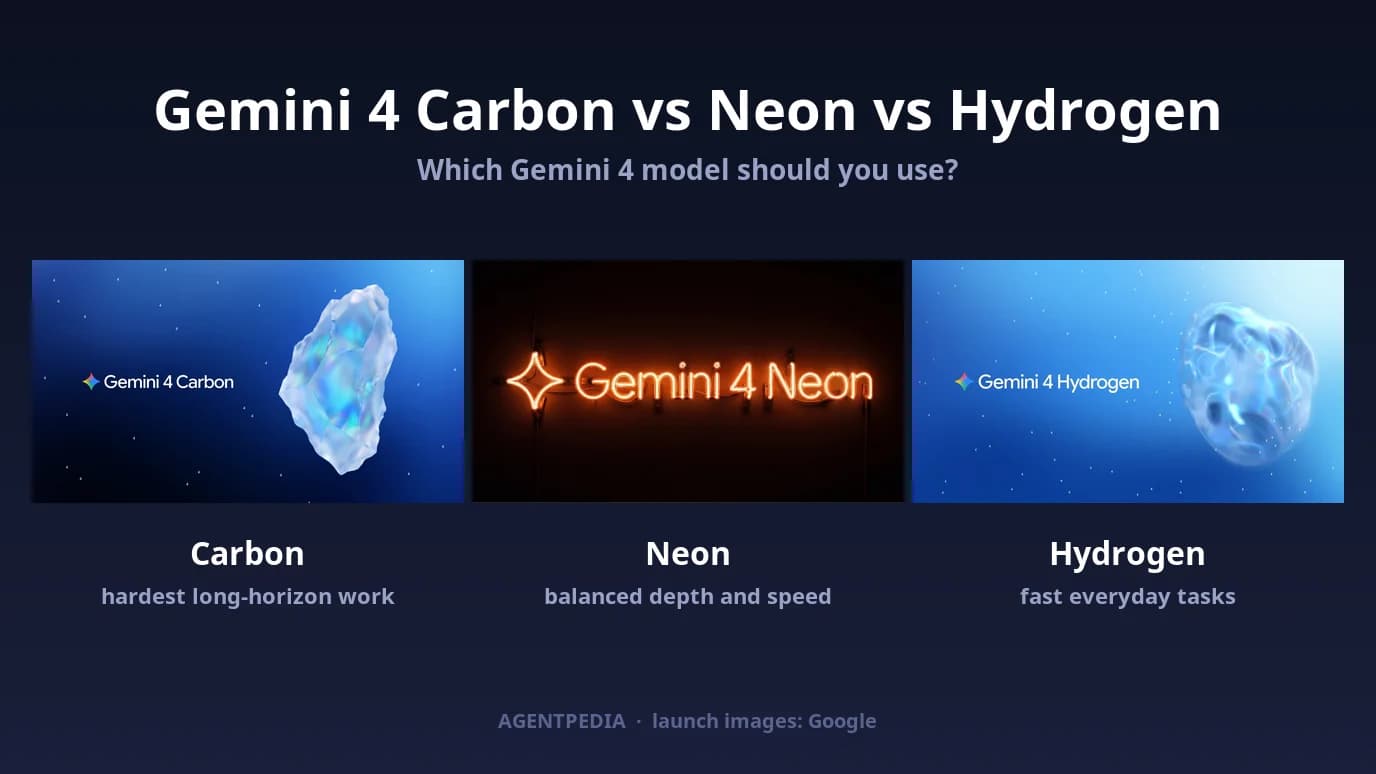
TL;DR: which one to use
- Gemini 4 Carbon (
gemini-4-carbon): pick it when a wrong answer is expensive, such as security audits, cross-subsystem debugging, architecture and the coordinator or verifier seat in a multi-agent run. It is the slowest of the three and goes from $2 / $10 to $4 / $20 per million tokens on December 1. - Gemini 4 Neon (
gemini-4-neon): the default for serious daily coding and knowledge work. It posts the highest independent scores of the three (Artificial Analysis 61 at xhigh, Vals 70.87%), runs about twice as fast as Carbon on Artificial Analysis’s speed reading, and costs $3 / $15, which is 25% under Carbon once Carbon’s promotion ends. - Gemini 4 Hydrogen (
gemini-4-hydrogen): pick it for volume, latency and cost. At $1.50 / $7.50, with a free API tier, it is the cheapest and fastest, scores 68.49% on Vals and 54 on Artificial Analysis at xhigh, and is the natural worker model under a Carbon or Neon planner.
If you have time to run only one experiment, run your own task set on Neon and Hydrogen at high and compare pass rate per dollar. Add Carbon only for the slice where the cheaper two fail. The independent margins between all three are small enough that your workload will decide more than the leaderboards do.
Video: Turing Machine 1936: Gemini 4 Neon, an official Google demo of Neon. It shows one model, not a comparison.
The three models at a glance
Everything in the first group of rows comes from Google’s model pages, model cards and pricing page. The last rows come from Artificial Analysis and Vals, which test the models independently, each at one effort level that differs by model.
| Gemini 4 Carbon | Gemini 4 Neon | Gemini 4 Hydrogen | |
|---|---|---|---|
| API model ID | gemini-4-carbon | gemini-4-neon | gemini-4-hydrogen |
| Release | Announced Oct 28; available Nov 10, 2026 | Nov 18, 2026 | Nov 12, 2026 |
| Google’s positioning | Strongest model for long-horizon engineering, science, security and agents | Frontier-level intelligence with fast task completion; between Carbon and Hydrogen | Speed and efficiency for everyday coding and agents; successor to Gemini 3.8 Flash |
| Lineage | Based on Gemini 4 Argon (model card) | Smaller, cheaper model adapted from Carbon | Adapted from Carbon (model card) |
| Input / cached / output per 1M, Standard | $2 / $0.10 / $10 through Nov 30; $4 / $0.20 / $20 from Dec 1 | $3 / $0.15 / $15 | $1.50 / $0.075 / $7.50 |
| Context window | 1,048,576 tokens, shared by input, thinking and output | 1,048,576, same | 1,048,576, same |
| Max output | 65,536 per synchronous call; up to 1,048,576 minus input with background execution | Same | Same |
| Thinking levels | low, medium (default), high | low, medium, high (default), xhigh | low, medium, high (default), xhigh |
| Artificial Analysis Intelligence Index v5.0.1 | 60 (high), #8 of 95 | 61 (xhigh), #6 of 95 | 54 (xhigh), #26 of 95; 51 at high |
| Vals Index v2.2 | 70.45% (high), #4 of 43 | 70.87% (xhigh), #2 of 43 | 68.49% (xhigh), #7 of 43 |
| Free API tier | No | No | Yes, rate limited; content may be used to improve products |
| Where you can use it | Gemini API paid tier, AI Studio, Android Studio, Gemini for business, Antigravity (Ultra), Gemini app and AI Mode (Ultra), Cursor | Gemini API paid tier, Antigravity (paid Pro and Ultra), Gemini for business, Gemini app for paid plans | Gemini API free and paid, AI Studio, Gemini app (free via auto selection), Search, Google Sheets, Antigravity (paid Pro and Ultra), Cursor, Android Studio |
Two details trip people up. The thinking-level defaults differ: Carbon starts at medium and tops out at high, while Neon and Hydrogen start at high and add xhigh. And the Artificial Analysis and Vals rows are not apples to apples, since Carbon was tested at high and the other two at xhigh. We keep that visible in every table below. Our single-model guides cover each in depth: Carbon, Neon, Hydrogen and Argon, the fourth family member.
Pricing and the November 30 Carbon change
Google’s pricing page lists one flat rate per model across the whole 1M-token context, with no long-context surcharge. It bills every token the model processes, including thinking tokens and the hidden instructions that grounding and function declarations add. Two things make this section time-sensitive. As of November 21, Carbon is still on its introductory rate of $2 input and $10 output per million tokens. That rate ends on November 30, 2026, and from December 1 Carbon costs $4 and $20, double. Google applies the same schedule to Argon.
| Per 1M tokens, paid tier | Hydrogen | Neon | Carbon through Nov 30 | Carbon from Dec 1 |
|---|---|---|---|---|
| Input | $1.50 | $3.00 | $2.00 | $4.00 |
| Cached input (implicit only) | $0.075 | $0.15 | $0.10 | $0.20 |
| Output, thinking included | $7.50 | $15.00 | $10.00 | $20.00 |
| Batch and Flex (input / output) | $0.75 / $3.75 | $1.50 / $7.50 | Not confirmed | Not confirmed |
| Priority (input / output) | $2.70 / $13.50 | $5.40 / $27.00 | Not confirmed | Not confirmed |
| Free API tier | Yes, rate limited | No | No | No |
Batch, Flex and Priority figures for Hydrogen and Neon come from our single-model guides, which read them off Google’s pricing page. The pricing page excerpt we re-read on November 21 shows Standard rates for all three and a general 50% Batch API discount, but no Carbon-specific Batch, Flex or Priority line, so we marked those “not confirmed” rather than guess. Grounding with Google Search is the same on all three: 5,000 free requests a month shared across Gemini 3 and newer models, then $14 per 1,000 requests, capped at 1,500 a day. Paid-tier data is not used to improve Google’s products; on Hydrogen’s free tier it can be.
What the price gaps look like
| Comparison | Today (Nov 21 to Nov 30) | From Dec 1 |
|---|---|---|
| Carbon vs Neon | Carbon is 33% cheaper ($2 vs $3 input) | Neon is 25% cheaper ($3 vs $4) |
| Hydrogen vs Neon | Hydrogen is 50% cheaper | Same |
| Hydrogen vs Carbon | Hydrogen is 25% cheaper ($1.50 vs $2) | Hydrogen is 62.5% cheaper ($1.50 vs $4) |
The practical consequence: any benchmark you run on Carbon this week is priced at half what it will cost in December. If you are comparing Carbon with Neon for a budget, use the December rate. If you have a one-off job you were going to run on Carbon anyway, doing it before December 1 halves the token bill.
Worked examples before and after December 1
These are list-price arithmetic with identical token counts for every model, which is the weakest assumption in the table. Models spend different numbers of tokens on the same task, as the speed section shows. Costs are Standard tier. The coding session row assumes 600K total input tokens across the session of which 500K are implicit cache hits, plus 60K output tokens including thinking.
| Workload | Hydrogen | Neon | Carbon through Nov 30 | Carbon from Dec 1 |
|---|---|---|---|---|
| Chat app: 1,500 in and 400 out per turn, 100,000 turns a month, no cache | $525 | $1,050 | $700 | $1,400 |
| Coding agent session: 100K uncached in, 500K cached in, 60K out | $0.64 | $1.28 | $0.85 | $1.70 |
| Long-document analysis: 800K uncached in, 20K out, one call | $1.35 | $2.70 | $1.80 | $3.60 |
Arithmetic for the coding row on Neon: 0.1M × $3 = $0.30, plus 0.5M × $0.15 = $0.075, plus 0.06M × $15 = $0.90, total $1.275. On Carbon after December 1: $0.40 + $0.10 + $1.20 = $1.70. For the chat row, Hydrogen is 1,500 × $1.50 / 1M = $0.00225 plus 400 × $7.50 / 1M = $0.003, or $0.00525 a turn, times 100,000. Neon’s December advantage over Carbon is a flat 25% on every row. Hydrogen’s is a flat 50% against Neon and 62.5% against Carbon. What changes with real traffic is token counts, and that cuts both ways: a cheaper model that needs more thinking tokens can erase part of its price lead, which is exactly what Vals’ per-test costs show below.
Benchmarks side by side
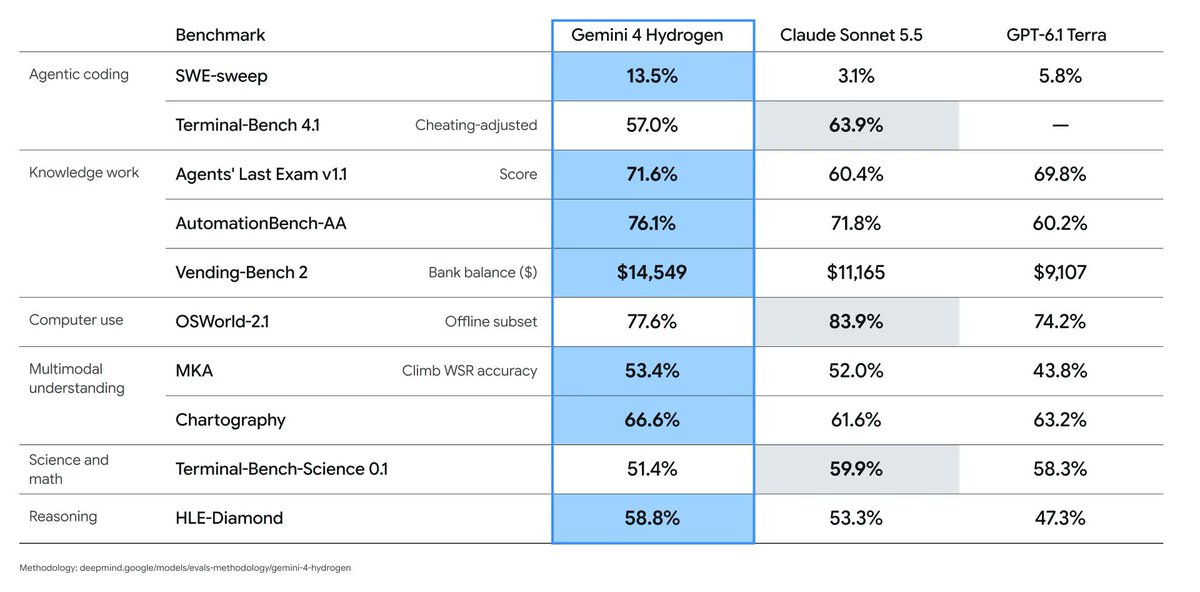
Google published three model cards, each with its own chart. Carbon’s compares it with Argon, GPT-6 Astra, Claude Opus 5.5 and Claude Fable 5.1. Neon’s compares it with Opus 5.5 and GPT-6.2 Sol. Hydrogen’s compares it with Claude Sonnet 5.5 and GPT-6.1 Terra. The rival sets, dates and effort levels differ, and a few benchmark names differ by version. So this section only puts two Gemini numbers in one row when the benchmark and its name match, and writes “not reported” where the model’s card has no figure. Every number in the Google columns is vendor-reported: Google chose the rows, the rival settings and the harnesses.

Agentic coding
| Benchmark (Google-reported) | Carbon | Neon | Hydrogen | Read it as |
|---|---|---|---|---|
| Terminal-Bench 4.1, cheating-adjusted | Not reported | 65.2% | 57.0% | Neon +8.2 points over Hydrogen; no Carbon number on 4.1 |
| Terminal-Bench 4.0 (AA-run) | 65.2% | Not reported | Not reported | Carbon only; the same 65.2% as Neon’s 4.1 score, but a different benchmark version, so not a tie |
| SWE-sweep | Not reported | 39.0% provider harness; 12.8% mini-SWE | 13.5% (harness not stated) | Hydrogen’s 13.5% sits next to Neon’s mini-SWE 12.8%; do not compare to Neon’s 39.0% |
| CursorBench | 60.4% at high effort (Cursor’s post; version not stated) | 65.4% (CursorBench 4.1) | Not reported | Versions may differ; treat as indicative |
| FrontierCode 2.0 | Not reported | 46.2% | Not reported | Neon only |
| FrontierSWE 2 | 61.2% | Not reported | Not reported | Carbon only |
Only one row has a clean head-to-head: Terminal-Bench 4.1, where Neon leads Hydrogen by 8.2 points. For Carbon the card uses the older Terminal-Bench 4.0, so a matched coding comparison needs the independent numbers in the next section, where Vals ran all three on Terminal-Bench 4.0. The harness caveat is the one to remember: Neon’s 39.0% versus 12.8% on SWE-sweep is the same model in two scaffolds, so any single coding score is a statement about model plus harness.
Knowledge work and agents
| Benchmark (Google-reported) | Carbon | Neon | Hydrogen | Read it as |
|---|---|---|---|---|
| AutomationBench (Zapier) | 53.9% | 56.3% | 76.1% on AutomationBench-AA | Neon +2.4 over Carbon; Hydrogen’s row is the AA variant, not comparable |
| Agents’ Last Exam v1.1 | Not reported | 75.8% | 71.6% | Neon +4.2 over Hydrogen |
| Vending-Bench 2 (bank balance) | Not reported | $16,843, #1 per Google | $14,549 | Neon ahead by about $2,300; different rival sets |
| OSWorld-2.1, offline subset (computer use) | 81.5% | Not reported | 77.6% | Carbon +3.9 over Hydrogen |
Science, math and reasoning
| Benchmark (Google-reported) | Carbon | Neon | Hydrogen | Read it as |
|---|---|---|---|---|
| Terminal-Bench-Science 0.1 | 64.8% | 70.5% | 51.4% | Neon first, Carbon second, Hydrogen 19 points behind Neon |
| RiemannBench | 80.0% | 84.0% | Not reported | Neon +4.0 over Carbon |
| HLE-Diamond | Not reported | 71.3% | 58.8% | Neon +12.5 over Hydrogen |
| GraphWalks, 256k to 1M, BFS | 96.2% | 95.2% | Not reported | Carbon +1.0; the only long-context row with two of the three |
Neon’s card is ahead of Carbon’s on four of the six rows where both report (Terminal-Bench-Science, RiemannBench, AutomationBench, SEC-bench Pro) and behind on GraphWalks and, by 0.3 points, CWE-bench patching. That is notable for a model priced at 75% of Carbon’s December rate, and it matches Varun Mohan’s “cheaper, faster, and better behaved than Carbon” in the post at the top. It is still Google’s own table, built from different rival sets and effort settings on each card. Vals reports Terminal-Bench-Science for Neon (62.86%, #2 of 49) but we found no Carbon or Hydrogen figure on its pages, so the gap on this row has no independent cross-check.
Multimodal and cyber
| Benchmark (Google-reported) | Carbon | Neon | Hydrogen | Read it as |
|---|---|---|---|---|
| MKA (Climb WSR) | Ranked second per Google; no score on the card | 56.5% | 53.4% | Neon +3.1 over Hydrogen |
| Chartography | Not reported | 73.5% | 66.6% | Neon +6.9 over Hydrogen |
| LVBench (video) | Not reported | 89.0% | Not reported | Neon only |
| SEC-bench Pro, finding vulnerabilities | 88.2% (Fairwind access) | 90.5% | Not reported | Different access and setups; indicative only |
| CWE-bench patching | 71.0% (Collinear’s CWE-bench; Fairwind access) | 70.7% (CWE-Bench v2) | Not reported | Different versions; effectively level |
Carbon’s cyber numbers reflect access through the Fairwind program and were measured without guardrails, per its model card, so they describe a more permissive setup than the public model. Google gives no cyber number for Hydrogen. Safety claims (honesty, prompt injection, shortcutting) are Google-reported for each model against different baselines, so we do not tabulate them here; each single-model guide has its own.
Independent results
This is where the three models finally sit in one table with one method. Artificial Analysis and Vals each ran all three, but at different effort levels: Carbon at high, Neon and Hydrogen at xhigh on both sites. That favours the two xhigh models on the scores and penalises them on time and tokens. A same-effort table at the end of this section removes the mismatch for Artificial Analysis.

Vals AI (as of November 21, 2026)
| Vals benchmark | Carbon (high) | Neon (xhigh) | Hydrogen (xhigh) | Leader |
|---|---|---|---|---|
| Vals Index v2.2 | 70.45%, #4 of 43 | 70.87%, #2 of 43 | 68.49%, #7 of 43 | Neon |
| Cost per test (Vals Index) | $10.51 | $7.40 | $9.84 | Neon |
| Latency (Vals Index) | 47 min 45 s | 31 min 25 s | 32 min 5 s | Neon |
| Vals Finance Index | 67.05% | 68.31% | 66.14% | Neon |
| Vals Legal Index | 75.93% | 78.36% | 73.63% | Neon |
| Earnings Modeling Bench v1.1 | 76.47% | 76.46% | 75.80% | Tie, Carbon by 0.01 |
| Finance Agent v2.1 | 67.16% | 68.56% | 65.12% | Neon |
| Legal Research Bench | 55.77% | 56.25% | 53.85% | Neon |
| Tax Agent Bench | 51.78% | 54.89% | 52.30% | Neon |
| Vibe Code Bench v1.1 | 89.06% | 93.70% | 87.78% | Neon |
| Terminal-Bench 4.0 | 63.13% | 61.62% | 54.04% | Carbon |
| HLAB-Vals-1.1 (Harvey legal agent) | 17.50% | 19.58% | 11.25% | Neon |
Neon leads ten of the twelve rows, counting cost and latency. Carbon leads Terminal-Bench 4.0 by 1.5 points and Earnings Modeling by 0.01, and Hydrogen leads none. But look at the margins. The Vals page lists ±0.94 for Neon’s Index score and ±0.97 for Carbon’s, so Neon’s 0.42-point lead over Carbon is inside the error bars, and Hydrogen’s 2.4-point gap to Neon is only modestly outside them. Hydrogen’s best result on Vals is #2 of 91 on Tax Agent Bench (52.30%), where it edges Carbon’s 51.78% at a fraction of the price, the one row where the cheapest model beats the most expensive. Neon also lands on the score-versus-cost Pareto frontier on 7 of 14 Vals leaderboards, per Vals’ own post, which is the clearest independent case for it as the default.
The cost row holds the biggest surprise. Hydrogen’s per-token price is half of Neon’s, yet Vals measured $9.84 per test for Hydrogen against $7.40 for Neon, and Hydrogen’s 32-minute latency is level with Neon’s 31. At xhigh, Hydrogen spends enough extra tokens on the Vals Index tasks to wipe out its price advantage on that suite. Cost per token is not cost per task; run your own tasks before you commit a volume workload to the cheapest model, and test Hydrogen at medium and high, not only xhigh.
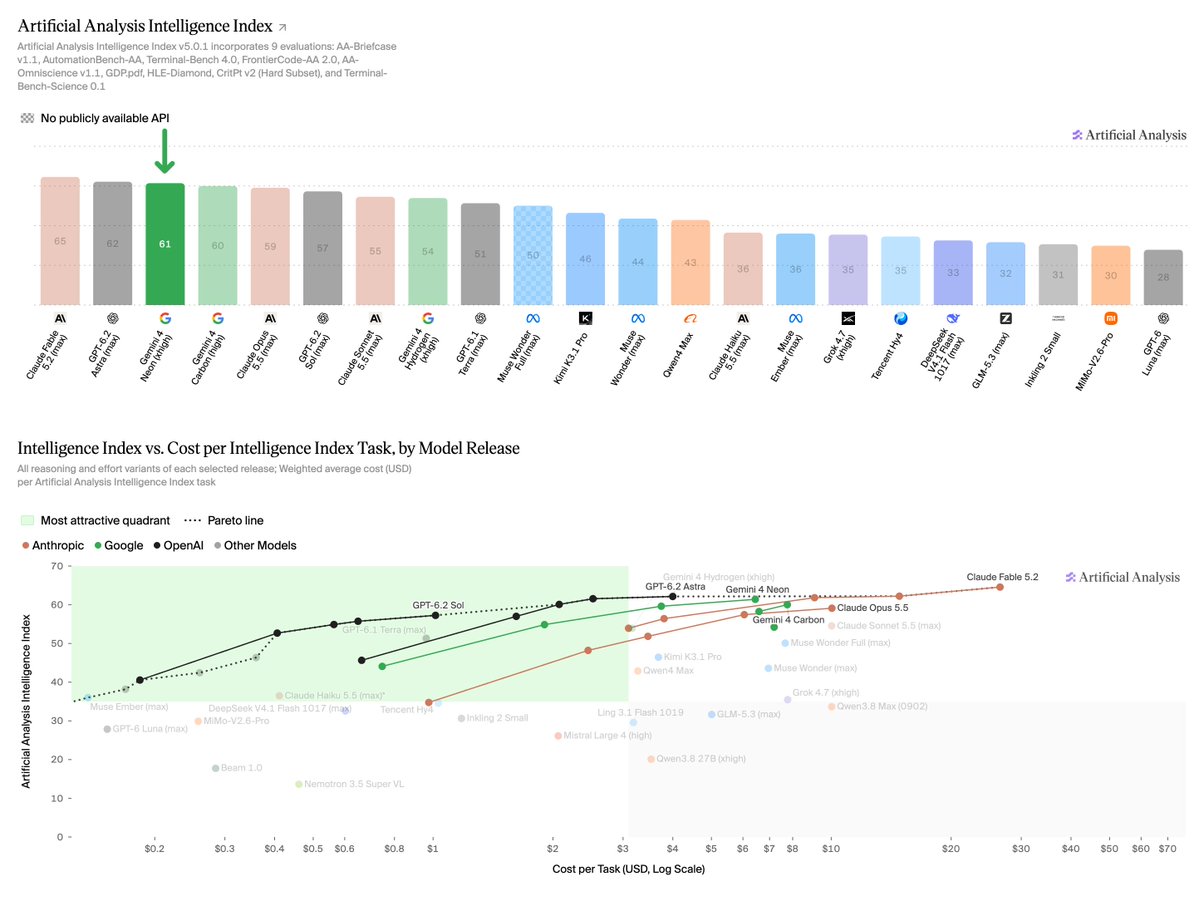
Artificial Analysis Intelligence Index (as of November 21, 2026)
| Artificial Analysis (index v5.0.1) | Carbon (high) | Neon (xhigh) | Hydrogen (xhigh) |
|---|---|---|---|
| Intelligence Index | 60, #8 of 95 | 61, #6 of 95 | 54, #26 of 95 |
| Cost per Intelligence Index task | $7.76 | $6.44 | $3.16 |
| Output tokens used on the index | 205M | 283M | 304M |
| Time per task | 37.0 min | 21.5 min | 15.5 min |
| Output speed | 55 tokens/s | 110 tokens/s | 166 tokens/s |
| Time to first answer token | 68.81 s | 56.51 s | 49.43 s |
| Page verdict | Notably slow, very verbose, somewhat expensive | Notably slow, very verbose, somewhat expensive | Slower than average per task, very verbose, reasonably priced |
On Artificial Analysis the ordering by score is Neon, Carbon, Hydrogen, and by cost per task it is Hydrogen, Neon, Carbon, the reverse. Artificial Analysis publishes every effort level, which lets us fix the mismatch above; the next table lines the three up at the same settings. Carbon’s score also moved: Artificial Analysis published 59 on October 28 and lists 60 now, while Google’s October table still shows 59. Carbon’s time per task on the page is now 37.0 minutes, up from the 25.6 we recorded on November 11, and Hydrogen’s is 15.5 minutes, up from 13.0 at launch. Those drifts are why every figure in this post carries a date.
Same effort level, same index
Artificial Analysis lists every effort level for all three, so the effort mismatch can be removed. Reading its pages at identical settings gives a cleaner head-to-head than any single row above.
| Artificial Analysis, Nov 21, 2026 | Carbon | Neon | Hydrogen |
|---|---|---|---|
| Index at high | 60 | 60 | 51 |
| Time per task at high | 37.0 min | 14.8 min | 9.2 min |
| Output tokens at high | 205M | 123M | 110M |
| Time to first answer token at high | 68.81 s | 40.64 s | 22.33 s |
| Index at medium | 58 | 55 | 41 |
| Time per task at medium | 26.0 min | 8.3 min | 4.1 min |
| Index at low | 54 | 44 | 27 |
| Index at xhigh | Not offered | 61 | 54 |
At high, Carbon and Neon tie at 60, and Neon gets there in 40% of Carbon’s time with 60% of its output tokens. That is the strongest independent argument for Neon as the default. It also shows the xhigh-versus-high mismatch in the first table did not flatter Neon: at the same setting the two still tie. Carbon scores higher only at medium (58 against 55) and low (54 against 44), and it takes far longer at the same label (26.0 minutes at medium against Neon’s 8.3). Hydrogen at high is nine points behind the other two but finishes in 9.2 minutes. Its xhigh run (54) closes some of that gap, at 15.5 minutes, about the same time as Neon at high (14.8).
Speed, verbosity and cost per task
Speed is where the three models separate most cleanly, and it is also where the vendor claims and the independent readings disagree most. Google says Hydrogen finishes tasks 2.5 times faster than Gemini 3.8 Flash, and a customer quote in Neon’s launch coverage says Neon matched Carbon’s quality at three times the speed. The Neon quote is from Glean’s Thai Tran, who said Neon matched or exceeded Carbon on quality at 3x the speed and 60% of the cost. Neither claim is a matched benchmark, so use Artificial Analysis’s own readings as the baseline.
| Speed reading (Artificial Analysis, Nov 21, 2026) | Carbon (high) | Neon (xhigh) | Hydrogen (xhigh) |
|---|---|---|---|
| Output speed | 55 tokens/s | 110 tokens/s | 166 tokens/s |
| Speed vs Carbon | baseline | 2.0x | 3.0x |
| Time per Intelligence Index task | 37.0 min | 21.5 min | 15.5 min |
| Time to first answer token | 68.81 s | 56.51 s | 49.43 s |
| Output tokens for the full index | 205M | 283M | 304M |
| Output tokens vs median of comparable models (65.4M) | 3.1x | 4.3x | 4.6x |
| Cost per task | $7.76 | $6.44 | $3.16 |
Three readings matter. First, Neon is about twice as fast as Carbon in tokens per second and takes about 58% of Carbon’s time per task, so the customer’s “3x” is generous on this data, though it was probably measured on a different task mix and effort level. Second, Hydrogen is about three times as fast as Carbon by token rate and takes about 42% of its time per task. Third, all three are very verbose by the page’s own wording, and the cheaper two are the more verbose: Hydrogen generated 304M output tokens on the index against Carbon’s 205M. The extra tokens come largely from the xhigh setting that Artificial Analysis used for Neon and Hydrogen. Carbon at high is a lighter setting, which is why the comparison flatters Carbon on tokens and punishes it on wall time.
Time to first answer token tells you what an interactive user feels. At 49 to 69 seconds at the settings Artificial Analysis headlines, none of these is a snappy chat model. They think before they speak, and the first-token wait scales with the thinking level. Dropping the level is the first lever for a chat product.
| Time to first answer token (Artificial Analysis) | Carbon | Neon | Hydrogen |
|---|---|---|---|
| xhigh | Not offered | 56.51 s | 49.43 s |
| high | 68.81 s | 40.64 s | 22.33 s |
| medium | 35.54 s | 20.14 s | 12.98 s |
| low | 7.03 s | 13.93 s | 7.74 s |
Carbon’s low setting answers first in about 7 seconds, faster than either cheaper model, but it also scores 54 on the index there against Neon’s 44 and Hydrogen’s 27 at low. If a short first-token wait matters more than depth, Hydrogen at medium (13 seconds) or Carbon at low are the two readings worth testing first.
Cost per task beats cost per token
Put the pricing and speed together and the ranking by cost per task on Artificial Analysis is Hydrogen ($3.16), Neon ($6.44), Carbon ($7.76) at the standard rates that Artificial Analysis charts. Artificial Analysis and Vals both price Carbon at the $4 / $20 rate. If token counts hold, a Carbon task run before November 30 would cost roughly half the charted figure, about $3.88 on Artificial Analysis, which would put it under Neon’s $6.44; that is our arithmetic, not a published number. From December 1 the charted figure is the real one. On Vals the picture differs: Neon $7.40, Hydrogen $9.84, Carbon $10.51 per test. The two sites disagree on whether Hydrogen is cheaper than Neon per task, and that disagreement is the honest summary: Hydrogen is cheaper per token, but whether it is cheaper per finished task depends on how many thinking tokens your workload burns.
Antigravity: Orchestrator and /swarm
Google Antigravity is where the three models are meant to work together rather than compete, and Google built two features around that. Our Carbon guide covers /swarm and the Hydrogen guide covers Orchestrator in more depth. Here is how they map to the comparison.
Orchestrator: planner plus executor in one session
Orchestrator is a model dropdown option that moves a single trajectory between a planning model and Hydrogen. In the Carbon pairing, per the Antigravity post of November 12, Carbon starts in a read-only phase to explore dependencies, resolve ambiguities and build a plan with explicit re-planning triggers. Hydrogen then writes the edits, updates packages and runs tests. If Hydrogen hits friction it hands back to Carbon to inspect state, repair the plan and resume. Google reports that on Terminal-Bench 4.1 this reached near-Carbon task success with 24% less quota and 19% faster completion on average. The Antigravity post on Neon, published on November 18, adds the second pairing: Neon as planner with Hydrogen as executor, with the same hand-back rule. Google published no matching quota or speed figure for that pair, so we cannot say how it compares with the Carbon pairing.
/swarm: pin different models to different roles
/swarm runs a coordinator, parallel workers and adversarial verifiers on a shared message board, and agents can be pinned to different models. Google’s guidance on Carbon is to put it on high-leverage roles, namely the coordinator, architecture, cybersecurity auditing and adversarial verification, while lighter, faster models handle parallel file edits and routine implementation. Its Carbon post shows workers running on Argon; Hydrogen is the cheaper, faster option for the same slot, but that pairing is our suggestion, not a Google example. Google’s Hydrogen post does show an open-source issue-triage system built with the Antigravity SDK where Hydrogen agents handle triage and coding alongside Carbon. The Neon post shows Neon running /swarm to scaffold a two-player game. A warning from Google applies to all of them: parallel multi-agent systems burn quota much faster than a standard chat.
| Pattern | Planner / coordinator | Workers | Source |
|---|---|---|---|
| Orchestrator, deep | Carbon | Hydrogen | Antigravity post, Nov 12 (24% less quota, 19% faster on Terminal-Bench 4.1) |
| Orchestrator, daily | Neon | Hydrogen | Antigravity post, Nov 18 (no quota figure published) |
| /swarm, high-stakes | Carbon coordinator and verifier | Hydrogen or Neon workers (our suggestion; Google’s example uses Argon) | Antigravity Carbon and Hydrogen posts |
| /swarm, routine migration | Neon coordinator | Hydrogen workers | Our suggestion, not a Google benchmark |
| Single session, no pairing | Neon | none | Neon post: sits between Carbon for the deepest work and Hydrogen for fast execution |
Plan access
| Surface | Carbon | Neon | Hydrogen |
|---|---|---|---|
| Antigravity App, CLI and IDE extensions | Google AI Ultra | Paid Google AI Pro and Ultra | Paid Google AI Pro and Ultra |
| Orchestrator | Planner, paired with Hydrogen; in the model selector for Pro and Ultra per the Hydrogen post | Planner, paired with Hydrogen (Neon post) | Executor in both pairings |
| /swarm | Launched in preview on the App and CLI with Carbon; agents can be pinned to any model | Neon can run it (Neon post) | Agents can be pinned to it |
| Enterprises | Gemini for business | Gemini for business | Gemini for business |
| Researchers | Free highest tier for 6 months on application, covers Argon and Carbon | Not stated | Not stated |
The rules above are as Google’s posts state them on their publication dates and may change, so check the model dropdown on your own plan before planning around a pairing.
API: one code path, three model IDs
All three use the Interactions API in the current Google GenAI SDK. The only changes between them are the model string and the supported thinking levels. The model IDs are gemini-4-carbon, gemini-4-neon and gemini-4-hydrogen. The loop below runs one prompt on all three at the same level, which is the quickest way to get your own side-by-side. We took the call shape from Google’s documented quickstarts; it follows the pattern in our single-model guides and we have not run this exact loop, so test it on your key.
from google import genai

client = genai.Client()

PROMPT = "Review this diff for race conditions and list the three riskiest lines."

for model in ("gemini-4-hydrogen", "gemini-4-neon", "gemini-4-carbon"):
    interaction = client.interactions.create(
        model=model,
        input=PROMPT,
        generation_config={"thinking_level": "high"},
    )
    print(model, "->", interaction.output_text[:200])
Thinking levels differ by model
| Setting | Carbon | Neon | Hydrogen |
|---|---|---|---|
| Levels | low, medium, high | low, medium, high, xhigh | low, medium, high, xhigh |
| Default | medium | high | high |
| minimal | Not documented | Rejected | Rejected |
| Artificial Analysis tested at | high | xhigh | xhigh |
| Vals tested at | high | xhigh | xhigh |
This is the part of the comparison most likely to bite in production. Moving from Carbon to Neon and keeping the Carbon default means going from medium to high, which uses more tokens and time. Sending xhigh to Carbon is not documented. And since two of the three independent boards ran Neon and Hydrogen at xhigh, an apples-to-apples test in your own stack should run all three at high, then add xhigh for the two that support it.
Route by tier, and hand off between models
Google says you can route planning turns to one model and execution turns to another in the same multi-turn session using previous_interaction_id. The router below sketches a three-tier setup from those documented fields. It is our assembly, not a Google sample, so treat it as a starting point and run it before relying on it.
from google import genai

client = genai.Client()

# thinking_level: Neon and Hydrogen accept low | medium | high (default) | xhigh.
# Carbon documents low | medium (default) | high, so we never send xhigh to it.
ROUTES = {
    "quick":  {"model": "gemini-4-hydrogen", "thinking_level": "medium"},
    "daily":  {"model": "gemini-4-neon",     "thinking_level": "high"},
    "deep":   {"model": "gemini-4-carbon",   "thinking_level": "high"},
}

def ask(tier, prompt, previous_id=None):
    route = ROUTES[tier]
    kwargs = {
        "model": route["model"],
        "input": prompt,
        "generation_config": {"thinking_level": route["thinking_level"]},
    }
    if previous_id:
        kwargs["previous_interaction_id"] = previous_id
    return client.interactions.create(**kwargs)

plan = ask("deep", "Read the billing module and write a step-by-step plan to add proration.")
build = ask("quick", "Implement steps 1 and 2 and list the tests you would run.", previous_id=plan.id)
print(build.output_text)
Long outputs
The three share one window of 1,048,576 tokens covering input, thinking and output, and a 65,536-token cap per synchronous call. For longer output, raise max_output_tokens above 65,536 and set background to true so Google’s servers continue in 64K hops. Google recommends background execution for long decode, and the same code works on any of the three.
import time
from google import genai

client = genai.Client()

interaction = client.interactions.create(
    model="gemini-4-neon",
    input="Write a complete migration specification and test suite for this service.",
    background=True,
    generation_config={
        "max_output_tokens": 262144,
        "thinking_level": "high",
    },
)

while interaction.status in ("in_progress", "queued"):
    time.sleep(5)
    interaction = client.interactions.get(id=interaction.id)

text = "".join(
    content.text
    for step in interaction.steps
    if step.type == "model_output"
    for content in step.content
    if content.type == "text"
)
print(text)
Shared quirks: sampling parameters are ignored or rejected, explicit caching (cachedContents) is not supported, and implicit caching applies to prompts of at least 4,096 tokens with a 95% discount on hits. If you are choosing an API gateway or an inference host for these, see our best LLM API gateways and best AI inference providers roundups, though all three models are hosted proprietary models, so Google’s API is the first-party route.
Which model for which job
| Job | Pick | Why | Catch |
|---|---|---|---|
| High-volume chat, support and classification | Hydrogen at medium | $1.50 / $7.50 and the fastest tokens per second; free API tier for prototypes | Test token use: Vals measured $9.84 per test, above Neon’s |
| Interactive coding assistant in an IDE | Neon at high, or Hydrogen at medium | Neon leads Vals Vibe Code Bench (93.70%); Hydrogen is faster per token | Neon at xhigh is slow and verbose |
| Coding agent loops in a custom harness | Neon, Hydrogen as workers | Neon has Google’s highest coding-agent numbers; Hydrogen cuts worker cost | Harness swings scores more than model gaps |
| Cross-subsystem debugging and architecture | Carbon | Google’s own positioning; strongest Vals Terminal-Bench 4.0 of the three (63.13%) | Slowest; $4 / $20 from Dec 1 |
| Security audits and adversarial verification | Carbon (verifier role) | Google puts Carbon on audit and verification seats; best-documented cyber results | Strongest cyber numbers need Fairwind access |
| Finance, tax and legal analysis | Neon | Vals #1 on Finance Index, Legal Index and Legal Research; #1 on Tax Agent | All three score under 20% on Harvey’s legal agent benchmark |
| Science and math reasoning | Neon, then Carbon | Neon leads Google’s Terminal-Bench-Science and RiemannBench rows | Vendor-reported; test on your problems |
| Long-document analysis in one 1M context | Neon | Mid-price with strong long-context claims (GraphWalks 95.2%) | Carbon scores 96.2% on the same row; it is cheaper until Nov 30 and dearer after |
| Spreadsheet and business-app automation | Neon | Zapier AutomationBench 56.3% vs Carbon 53.9% (both vendor-reported) | Hydrogen’s 76.1% is the AA variant and not comparable |
| Budget-capped agent fleets | Hydrogen | Half Neon’s per-token price; Orchestrator-style pairing keeps planner calls few | Hand back to a planner on stuck steps |
| One-off hard problem before Dec 1 | Carbon | Introductory $2 / $10 ends Nov 30 | Price is not the reason to choose it; capability is |
| Free experimentation and side projects | Hydrogen | Only one with a free API tier | Free-tier content may be used to improve Google products |
The pattern: Hydrogen where volume and latency dominate, Neon as the default where quality per dollar matters, and Carbon only on the few seats where a miss is costly. In a coding agent, that translates to Neon or Carbon planning and Hydrogen executing, which is Google’s own Orchestrator design.
Migration paths
Gemini 3.8 Flash to Hydrogen
Change the model string, set thinking_level on purpose, since the default is now high, remove explicit caching and sampling parameters, and raise hardcoded low output caps. Gemini 3.8 Flash costs $0.75 / $3.75 through December 31, 2026, so Hydrogen is double per token until Flash’s price rises to $1.50 / $7.50 on January 1, 2027. Google’s reported gains (2.5x faster, Terminal-Bench 4.1 at 57% against 18.2%) are the bet that makes that worthwhile. Our Hydrogen guide has the full checklist.
Carbon to Neon after November 30
This is the migration the price change invites. From December 1, Neon is 25% cheaper per token, scores level on the independent indexes, and ran faster. The risk is the hardest slice: keep Carbon for the verifier, auditor and root-cause seats and move everything else. Change the model string, move thinking_level from medium to a level you have tested (high is the Neon default), and rerun your evals at the December price before cutting over.
Carbon to Hydrogen for execution work
If Carbon is doing routine edits, test Hydrogen for those steps. After December 1 it is 62.5% cheaper per token. Keep the planner on Carbon or Neon and hand off with previous_interaction_id, or let Antigravity’s Orchestrator do it.
Argon to any of the three
Argon is priced the same as Carbon, so the December change hits it too. Google calls it the ideal choice for most advanced engineering and knowledge work. If you are on Argon today, Neon is the natural step up on price per token after December 1, and Hydrogen is the step down. See the Argon guide.
From a rival to Gemini 4
If you are coming from Anthropic, our Carbon vs Claude Fable 5.2 and Opus 5.5 vs Sonnet 5.5 comparisons cover that side. The rival prices and scores in the Neon and Hydrogen guides are labelled by source and date.
Caveats
- Vendor benchmarks. Every row in the Google columns is Google-reported, with Google’s choice of rivals, settings and harnesses. Where a model lacks a number we wrote “not reported”, not zero.
- Effort levels are not comparable. Artificial Analysis and Vals tested Carbon at high and Neon and Hydrogen at xhigh, and Google’s card figures use other settings. A one-point gap across settings is not a quality gap.
- Error bars. Vals’ Index margins are about ±1 point, so Carbon, Neon and Hydrogen sit close together at 70.45%, 70.87% and 68.49%.
- The Neon rank discrepancy. Google and Antigravity say Neon is #3 on Artificial Analysis at xhigh; the model page lists #6 of 95 on November 21. We could not reconcile the counts and the page-side explanation is our guess.
- Snapshot timing. Artificial Analysis times and ranks changed after launch (Carbon 25.6 to 37.0 minutes per task; Hydrogen 198 to 166 tokens per second between our guide and today). Prices on Google’s page can change too, and the Carbon change is scheduled for December 1.
- Cost per token is not cost per task. Vals and Artificial Analysis disagree on whether Hydrogen or Neon is cheaper per task.
- Cyber and safety numbers are Google-reported against different baselines, and Carbon’s strongest cyber results need Fairwind access.
- Orchestrator figures exist only for the Carbon plus Hydrogen pair (24% less quota, 19% faster on Terminal-Bench 4.1, per Google), and they are Google’s own.
- Our code samples are assembled from documented fields. Run them before relying on them.
Verdict
Start with Neon. On the independent numbers it is level with or ahead of Carbon, it is faster, and after November 30 it is 25% cheaper per token. Use Hydrogen where volume or latency rules, and as the worker model under a planner. Keep Carbon for the hardest and most expensive-to-get-wrong seats, and if you have a one-off hard job, run it before December 1 while the price is still halved. The numbers are close enough that your own task set should make the final call.
FAQ
Which Gemini 4 model is best?
None wins everywhere. Carbon is Google’s strongest model for the hardest long-horizon work and is the slowest and, from December 1, the most expensive. Neon scores level with or slightly above Carbon on the two independent indexes we checked (Artificial Analysis 61 at xhigh vs 60, Vals 70.87% vs 70.45%), runs faster and costs 25% less per token after November 30. Hydrogen is the cheapest and fastest and the only one with a free API tier, at a lower score (Vals 68.49%, Artificial Analysis 54 at xhigh).
What are the API model IDs?
gemini-4-carbon, gemini-4-neon and gemini-4-hydrogen. Each is the model code on Google’s docs and pricing pages, and we found no dated or preview alias for any of them. The Python call is the same for all three; only the model string and the supported thinking levels change.
How much do they cost and what changes on November 30?
Per million tokens on the paid tier: Hydrogen $1.50 input, $7.50 output; Neon $3 and $15; Carbon $2 and $10 through November 30, 2026, then $4 and $20 from December 1. As of November 21, Carbon is still on its introductory rate, which makes it 33% cheaper than Neon today. From December 1 Neon is 25% cheaper than Carbon, and Hydrogen is 62.5% cheaper than Carbon and 50% cheaper than Neon.
Is Gemini 4 Neon better than Carbon?
On the broad indexes it is level or one point ahead, but Neon is the cheaper model adapted from Carbon, not a replacement for it. Google’s own cards show Carbon ahead on GraphWalks (96.2% vs 95.2%) and Neon ahead on AutomationBench, RiemannBench and Terminal-Bench-Science, and the two cards use different rival sets and effort levels. Google still positions Carbon for the deepest long-horizon, security and architecture work.
Is Hydrogen free?
The Gemini API has a free, rate-limited tier for Hydrogen, and Google’s free-tier terms say content may be used to improve its products. Carbon and Neon have no free API tier. In the Gemini app, free users reach Hydrogen through auto model selection, and Hydrogen is live in Google Search for all users. Antigravity needs a paid Google AI Pro or Ultra plan for Neon and Hydrogen and Ultra for Carbon.
Which one is fastest?
Hydrogen. Artificial Analysis lists 166 output tokens per second for Hydrogen (xhigh), 110 for Neon (xhigh) and 55 for Carbon (high) as of November 21, 2026, with 15.5, 21.5 and 37.0 minutes per Intelligence Index task. Those readings moved after launch week, so check the live pages. Google’s claim of 2.5x faster than Gemini 3.8 Flash for Hydrogen is vendor-reported.
Which should I pick in Google Antigravity?
Start with Neon for everyday work if your plan includes it, use Hydrogen for quick edits and worker agents, and reserve Carbon for planning, audits and verification. The Orchestrator model option pairs Hydrogen with Carbon or with Neon in one session, and /swarm lets you pin different models to different agents. Plan access differs: Carbon is for Ultra subscribers, Neon and Hydrogen roll out to paid Pro and Ultra.
What is Orchestrator?
A model dropdown option in Google Antigravity that hands a single task between a planning model and Hydrogen. Carbon or Neon explores and plans, Hydrogen writes edits and runs tests, and control returns to the planner when Hydrogen hits friction. Google reports near-Carbon task success with 24% less quota and 19% faster completion for the Carbon and Hydrogen pair on Terminal-Bench; it published no matching figure for Neon with Hydrogen.
Do all three use the same API code?
Yes. They use the Interactions API with client.interactions.create and the same generation_config. Thinking levels differ: Neon and Hydrogen accept low, medium, high (default) and xhigh, while Carbon documents low, medium (default) and high. Sampling parameters are ignored on these models and explicit caching is not supported, so remove cachedContents calls when you move over.
Should I move from Carbon to Neon after November 30?
Test it first. After December 1 Neon saves 25% per token, and the independent per-task numbers favour it (Artificial Analysis $6.44 vs $7.76, Vals $7.40 vs $10.51 per test). Keep Carbon for the roles where a missed bug costs more than the token bill: security audits, coordinator and verifier agents, and the hardest debugging. Run your own evals, because the benchmark gaps are inside normal error margins.
Why does Artificial Analysis rank Neon sixth when Google says third?
Google and the Antigravity post say Neon is number 3 overall at xhigh. Its Artificial Analysis model page lists it at #6 of 95 entries on November 21, 2026, with Carbon at #8 and Hydrogen at #26. We could not reconcile the two counts from the page alone. A plausible cause is that the page ranks effort variants as separate entries, but that is our guess.
Can I compare the benchmark tables on each model card directly?
Only with care. The Carbon, Neon and Hydrogen cards each compare against different rivals (Astra and Opus 5.5, Opus 5.5 and Sol, Sonnet 5.5 and Terra), use different dates and effort settings, and sometimes name a benchmark differently, for example AutomationBench versus AutomationBench-AA. This page only puts numbers side by side when the benchmark name matches and marks the rest as not reported or not comparable.
Where does Gemini 4 Argon fit?
Argon is the fourth family member and the model Carbon is based on. Google prices it the same as Carbon, $2 and $10 through November 30 and $4 and $20 from December 1, and calls it an ideal choice for most advanced engineering and knowledge work. This page compares the three models people ask about most; see our Argon guide for the fourth.
Sources
Sources checked November 21, 2026.
- Gemini 4 Carbon now available: Google blog (Carbon GA, access, claims)
- Introducing Gemini 4 Neon and Introducing Gemini 4 Hydrogen: Google blog (launch claims, access)
- Model cards: Carbon, Neon and Hydrogen, Google DeepMind (benchmark tables, specs)
- Gemini API pricing: Google (Standard prices and the Dec 1 Carbon schedule)
- Antigravity blog: Carbon and /swarm (Nov 10), Hydrogen and Orchestrator (Nov 12), Neon (Nov 18)
- Artificial Analysis (independent): Carbon, Neon, Hydrogen
- Vals AI (independent): Carbon, Neon, Hydrogen
- VentureBeat: Carbon is publicly available and Neon launch (press; rival prices, cost math)
- X posts: Google AI, Sundar Pichai, Varun Mohan, Vals AI
- YouTube: Turing Machine 1936: Gemini 4 Neon, official, Google channel