Google announced the product on X on November 12, 2026. This is the post that started the pre-order window:
Introducing intelligent eyewear, built in partnership with Samsung and our iconic eyewear brands, Gentle Monster and Warby Parker. Now available for pre-order. Learn more at goo.gle/glasses_x
— @Android November 12, 2026
Video: "Google Gemini Glasses is coming for Meta Glasses" by AI Simplified on YouTube. The cover image above is this video's thumbnail.
Get the latest on AI, LLMs & developer tools
New MCP servers, model updates, and guides like this one — delivered weekly.
The Short Answer
Intelligent Eyewear is Google's Android XR answer to Ray-Ban Meta: ordinary-looking glasses with a 12 MP camera, open-ear speakers, four microphones and Gemini, but no display. Warby Parker versions start at $395 and Gentle Monster versions cost $449 to $489 (prices as of Nov 12, 2026). They are on sale December 10, 2026 in the United States and South Korea, with pre-orders open now.
- Price: from $395 (Warby Parker) and $449 to $489 (Gentle Monster); prescription lenses are an add-on.
- Release: pre-orders November 12; in stores and online December 10, 2026.
- Hardware: about 41 g, Snapdragon AR1 Gen 1, 12 MP camera, up to 9 hours of battery (up to 72 hours with the case), IPX4.
- Phones: Pixel 7 and later, recent Galaxy S and Z models on One UI 9.0, and iPhones with at least 6 GB RAM.
- Catch: US and South Korea Google accounts only, 18+ only, and no display until a later product.
Google's own sneak-peek video shows the pitch in about a minute: ask Gemini about what you see, translate, navigate and capture, all without taking out a phone.
Official Google video: Sneak Peek: Intelligent Eyewear.
What Google and Samsung Announced
Four companies split the work. Google leads Android XR and Gemini, Samsung engineered the hardware, and Warby Parker and Gentle Monster designed the frames. Shahram Izadi, Google's VP and GM of XR, wrote in the launch post that the glasses give you “hands-free help from Gemini when you're on the go”, covering directions, translation and visual assistance, plus photos, music and scheduling.
The announcement on November 12 was the commercial step, not the first reveal. Google previewed two designs at Google I/O in May and Samsung showed two more at its July Galaxy Unpacked event, both promising a fall launch (per Shahram Izadi's posts on X). On November 12 Google opened pre-orders, Samsung published the full specification table and Warby Parker revealed all three of its styles.
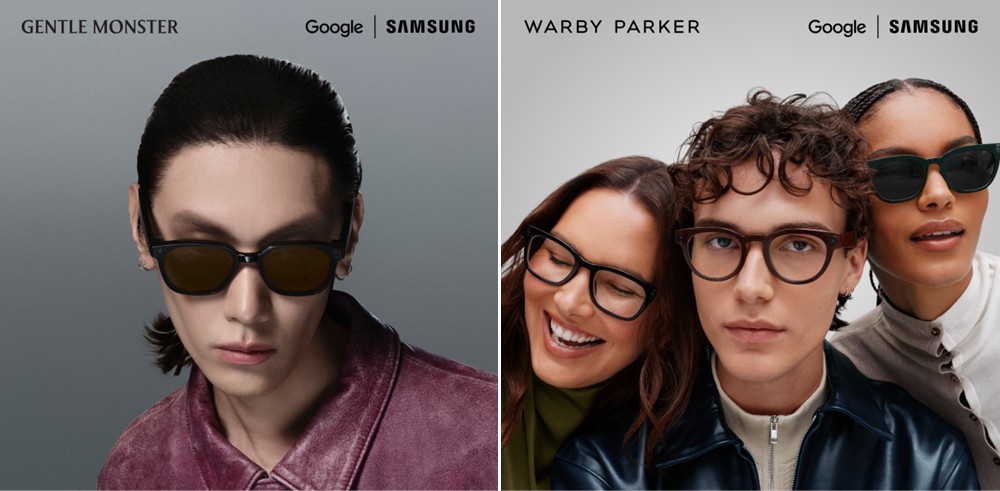
Samsung describes the shared hardware platform as “split computing”: the glasses run the Snapdragon AR1 Gen 1 platform but offload part of the processing to the connected phone. 9to5Google adds that the phone handles the HDR pipeline and video stabilization. That is why the glasses can stay light, and also why they are not a standalone device.
Collections, Prices and Where to Buy
There are 30 designs in total: 16 variations across six Gentle Monster frame styles and 14 variations across three Warby Parker frame designs, according to Samsung. Prices below are US launch prices as of November 12, 2026, before prescription or specialty lenses.
| Brand | Styles | Finishes and lenses | Price | Markets |
|---|---|---|---|---|
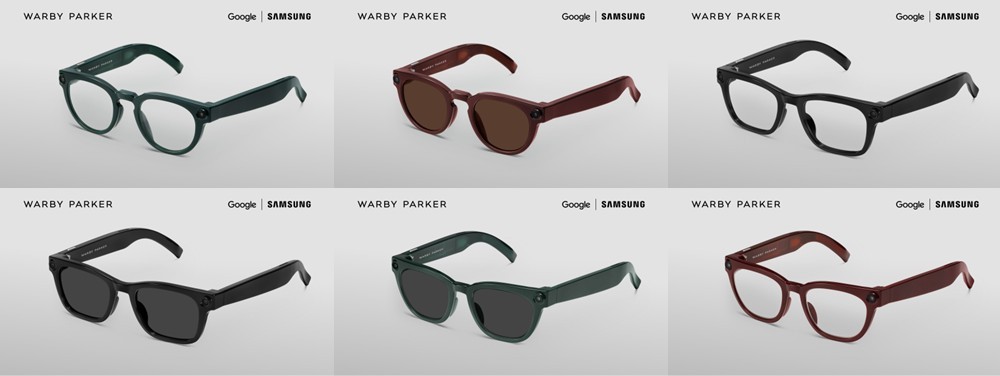
| Warby Parker | Alden, Reid, Wren (3 styles, 14 variations) | Optical or sun; Pine, Saddle, Jet Black | From $395 | United States |
| Gentle Monster | 6 designs (16 variations) | Dark red, pink, gray, yellow frames; tinted, clear, blue or brown lenses | $449 to $489 | United States and South Korea |
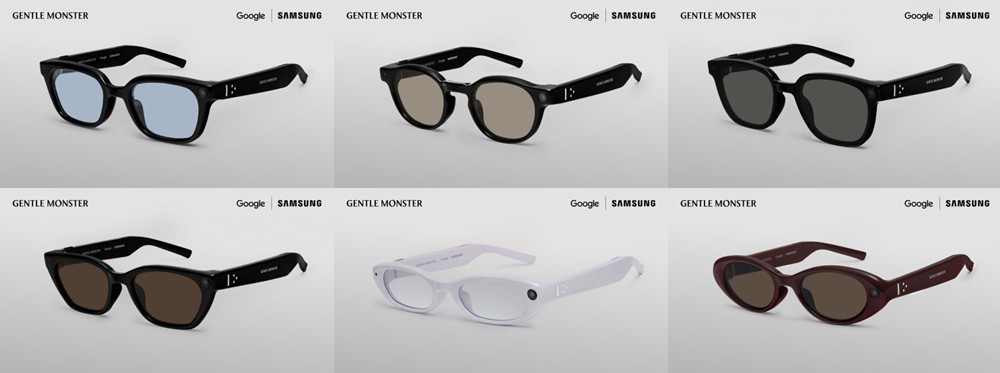
Gentle Monster takes the bold route. Google describes six designs in dark red, pink, gray and yellow paired with tinted, clear, blue or brown lenses, with prescription options on most frames. The collection is sold in the United States and South Korea.
Warby Parker offers Alden, Reid and Wren, inspired by its best-known silhouettes, in Pine, Saddle and Jet Black, in optical or sun versions. In its Business Wire release, Warby Parker says pre-orders are open now, deliveries are expected from mid-December, and customers can try the frames in more than 60 US stores starting November 12, with demos expanding to its full fleet of more than 360 locations the following week.
Where it is sold. Samsung lists Warby Parker's retail and online channels and Gentle Monster's official online store, with demos at select Samsung retail locations from December 10. Google also lists demos at select Gentle Monster, Warby Parker and Google Store locations. Both brands also run month-long New York City pop-up demo spaces, according to SiliconReport (a secondary source we did not confirm against a brand page).
Regional limits. Intelligent Eyewear only works with Google accounts from the United States and South Korea, and the account must be a compatible 18+ account. SamMobile reports that more markets are planned for next year, but neither Google nor Samsung gave a market list in the material we checked.
Full Spec Table
Samsung published the specification table, and Google's page and FAQ agree with it on battery, water resistance and phone support. Weight figures are Samsung's, based on its manufacturer specifications as of July 2026 and the GGS002 model.
| Spec | Detail | Source |
|---|---|---|
| Type | Display-free smart glasses (camera, speakers, microphones; nothing is projected on the lenses) | Samsung, Google |
| Weight (glasses) | About 41 g; 39.6 to 43.9 g (Gentle Monster), 40.4 to 42.6 g (Warby Parker), standard lenses, no prescription | Samsung |
| Weight (charging case) | Gentle Monster 194.5 g; Warby Parker 166.8 g | Samsung |
| Processor | Snapdragon AR1 Gen 1; part of the processing is offloaded to the paired phone (split computing) | Samsung |
| Camera | 12 MP HDR; photos 3:4 portrait (3,024 x 4,032); video 3K at 30 fps or 2K (video HDR up to 2K) | Samsung |
| Audio | 2 open-ear speakers, 4 microphones | Samsung, Warby Parker |
| Memory and storage | 2 GB memory, 64 GB storage (available storage is lower after preloaded software) | Samsung |
| Battery | Up to 9 hours on one charge, up to 72 hours with a charged case (mixed-use scenario); case recharges the glasses up to 7 times; 60% in about 30 minutes | Samsung, Google |
| Controls | Touch (right stem) and voice; physical power switch; capture button | Samsung, Google, Android Authority |
| Assistant | Google Gemini ("Hey Gemini" or "Hey Google"); Bixby on Galaxy phones only | Samsung, 9to5Google |
| Water resistance | IPX4 (glasses only) | Samsung, Google |
| Connectivity | Wi-Fi 6E, Bluetooth 5.4 | Samsung |
| Software platform | Android XR with Gemini | Samsung, SamMobile |
Both battery numbers come from a mixed-use scenario that may include Gemini conversations, music, video capture, messages and notifications, and both vendors say actual life varies. The camera spec differs a little by source: Samsung lists 3K at 30 fps or 2K video with HDR up to 2K, Android Authority reports a long press records 2K HDR video with spatial audio, and 9to5Google reports a 90-second clip limit in its demo. Treat video limits as something to confirm on retail units.
What Gemini Can Do on the Glasses
You wake the assistant with “Hey Gemini” (or the older “Hey Google”), and conversation runs through Gemini Live. 9to5Google reports that Google customized the Gemini Live model for glasses to reduce latency, shorten responses and tightly integrate the camera. Google organizes the features into a handful of groups, each with example prompts on glasses.google:
- Look and Ask. Look at something and ask about it: “what kind of plant is this and why are its leaf tips turning yellow?”, “what architectural style is this?”, or “what other candy bar does this taste like?”. Google also pitches landmark and business lookups, price comparison, and adding an item to a shopping list.
- Capture. “Take a picture” or “record a video of this” by voice or a tap, and share your view live in a Google Meet video call (requires the Meet app).
- Navigate. Turn-by-turn Google Maps audio directions (requires the Maps app), plus questions such as “do any of these bus lines go to Chelsea Market?”.
- Translate. Live translation across 70+ languages, including Spanish, Mandarin, Japanese, Farsi and Cantonese, plus translating signs and menus you look at. Live translation requires the Google Translate app.
- Messages and calls. Notifications read aloud, voice replies, summaries of group chats or unread email, and hands-free calls with beamforming microphones.
- Organize. Reminders, calendar questions such as “what's my next meeting?”, and adding events.
- Music and media. Spotify, YouTube Music and Audible by voice.
Samsung adds one productivity example worth noting: capture a whiteboard during a meeting, ask Gemini to summarize the key takeaways and save them to Samsung Notes. Samsung also says notifications can be prioritized, grouped and summarized by context.
Guided Vision. For blind and low-vision users, Guided Vision gives conversational audio descriptions: reading text, mail and labels, finding items such as keys, describing a room's layout, and reading appliance displays. Google is explicit that it is AI, can make mistakes, is not a medical device, clinical vision aid or mobility aid (it is not a white cane replacement) and is not intended for navigation or obstacle detection. At launch, Guided Vision and the Aira integration (which streams the camera feed to a human interpreter, per Android Authority) work only with a compatible Android phone, and may require a subscription or membership.
If you want the model side of this story, our guides to Gemini 3.8 Live and the Gemini 3.5 Live Translate API cover Gemini's real-time voice and translation features on the API side. Google has not said which Gemini model version powers the glasses, so we do not link the two.
Controls and Hands-On Impressions
9to5Google wore Samsung hardware for about an hour and Android Authority had a 30-minute session with final retail units in New York, both before launch. The hardware layout is the same across every brand and frame, per Android Authority: a slide switch inside the left stem powers the glasses, the right stem has a capture button near the top and a touch-sensitive outer surface, and the single 12 MP camera sits on one side of the front. The matching cutout on the other side is not a second lens but the outward-facing LED indicator.
Android Authority lists these touch gestures on the right stem:
- Long-press the touchpad (or say “Hey Gemini”) to summon Gemini.
- Tap, hold and swipe backward to stop Gemini.
- Single tap to play or pause media.
- Two-finger swipe forward or backward for volume.
9to5Google adds that you can also play or pause audio and invoke Gemini from a Pixel Watch or Galaxy Watch using double-pinch and wrist gestures, with Fitbit Air gesture support promised for next year. Pressing the top button once takes a photo and a long press records video.
The two reviewers disagree on the verdict. Abner Li of 9to5Google calls the design and software “solid” and the privacy thinking well considered, and praises the 41 g weight and translucent stems that show internal components. C. Scott Brown of Android Authority calls the glasses polished and comfortable (they stayed cool in a 30-minute session) but writes that he could not name one task they handle that a phone, smartwatch and earbuds cannot, citing the lack of a display, narrow phone support and the price. He also notes the stems cannot be bent by an optician, so a poor fit means returning the pair for a different size or frame.
Two behavior details matter for how you will use them. Gemini does not touch the camera unless you ask it to look: Android Authority reports that “what is this thing?” failed, while “look at this thing and tell me what it is” worked. And both reviewers had short sessions, so neither tested battery over a full day. Android Authority heard Gemini clearly over Manhattan traffic through the open-ear speakers, while 9to5Google says it still wants to test the glasses as always-available headphones.
Phone Compatibility
The glasses need a Bluetooth connection to a phone for tasks like asking Gemini about your surroundings or streaming media. Some functions, such as volume, battery checks and taking a photo, do not need a connection, per Google's FAQ. A companion app handles setup: 9to5Google describes a Google “Glasses” app with a near-identical Samsung version for Galaxy phones, used for settings rather than as a full chatbot app.
| Phone family | Models | Minimum software |
|---|---|---|
| Google Pixel | Pixel 7 series and later | Android 17 September 2026 update or later |
| Samsung Galaxy | Galaxy S, S FE, Z Fold, Z Flip and Fold Ultra series | One UI 9.0 or higher |
| Apple iPhone | iPhone 13 and later with at least 6 GB RAM (Samsung, glasses.google); "iPhone 13 Pro and above" (Google blog) | iOS 26.6 or later (Samsung, glasses.google) |
The iPhone wording differs between Google and Samsung. Google's blog footnote says “iPhone 13 Pro and above”. Samsung's newsroom and the glasses.google FAQ say “iPhone 13 and later (min. 6GB RAM)” running iOS 26.6 or later. The 6 GB RAM requirement is what probably reconciles the two, since the standard iPhone 13 is generally listed with 4 GB, but that mapping is our inference and not stated by Google or Samsung. Check your exact model before ordering.
Also note the feature asymmetry. Bixby works only with Galaxy phones, and Guided Vision and Aira work only with a compatible Android phone at launch. iPhone owners get the core Gemini experience but not every extra.
Privacy and Safety
Smart glasses with cameras raise obvious questions, and Google's materials answer them in several layers. Everything below is Google's or Samsung's own description, so it is a design claim until independent testing says otherwise. Android Authority makes the same caution: people found workarounds for Meta's indicator, and time will tell how well Google's holds up.
- Indicator lights. A photo flashes the inner and outer lights with a capture sound. Video recording pulses both lights continuously with start and stop tones. The wearer sees the inner light and hears a tone too.
- Tamper handling. The glasses are designed to stop recording or taking pictures if the outer light is covered or blocked, or if internal components are compromised. 9to5Google adds that hardware verification happens when the glasses sit in the charging case.
- Standby by default. Gemini waits in standby until it detects “Hey Gemini”. In standby it does not send your speech to Google. After activation, the request goes to Google servers, which can also happen if a sound resembles the hotword.
- Hardware off switch. A physical toggle turns off the camera, microphones and Gemini completely, so the glasses can work as plain eyewear. While on, you control which apps can use the camera and mic.
- Visual data. Camera visuals sent to Gemini are not saved to Gemini History and are not used to train models or target ads. Data stored on the glasses is encrypted, and data that leaves them is encrypted in transit.
- Bystanders. Gemini is designed to redact bystanders' faces before responding, and to filter surrounding voices in Gemini Live conversations. 9to5Google says this happens on the phone before upload.
- Age and responsibility. The glasses are for users 18 and over, with age verification for activation and app downloads. Android Authority adds that setup requires agreeing to policies that prohibit recording in sensitive places.
One subtlety: images captured for Gemini questions are not stored, so the external LED is not active while you ask Gemini something. The LED is reserved for photos and videos saved to your gallery, per 9to5Google. By that design, the light alone does not tell a bystander whether the wearer is asking Gemini about what the camera sees.
If you build voice products, our roundups of voice AI agent platforms and speech-to-text APIs cover the same always-listening, standby-first problem from the developer side.
Versus Ray-Ban Meta (Gen 3)
The nearest comparison is Meta's Ray-Ban Meta (Gen 3), announced at Meta Connect 2026. Both are camera glasses without a display, so they compete on assistant, battery, price and ecosystem. Figures below are vendor or press-reported and dated as of November 12, 2026. We list only what we could confirm.
| Item | Google and Samsung Intelligent Eyewear | Ray-Ban Meta (Gen 3) |
|---|---|---|
| Price (US, as of Nov 12, 2026) | From $395 (Warby Parker), $449 to $489 (Gentle Monster) | From $449 (Gen 3) |
| Display | None | None on the Gen 3 |
| Camera | 12 MP, 3K 30 fps video | 12 MP, 3K video |
| Microphones | 4 | 6 (Meta) |
| Battery | Up to 9 h; up to 72 h with case (Samsung) | Up to 9 h; up to 50 h with case (Meta, via Engadget) |
| Weight | About 41 g | 51.5 g for the standard Wayfarer (Engadget) |
| Assistant | Gemini | Meta AI |
| Phones | Pixel, Galaxy, iPhone 13 Pro and later | Android 10+ and iOS 17+ (Notebookcheck) |
| Regions | US and South Korea at launch | Not verified here |
Meta's Gen 3 starts at $449 in the US (Notebookcheck, PCMag), up from $379 for the second generation. So Warby Parker's $395 starting price undercuts it, while Gentle Monster ($449 to $489) matches or exceeds it. Weight is a real difference: Engadget lists 51.5 g for the standard Wayfarer Gen 3, versus about 41 g for Intelligent Eyewear, though the two weights are from different vendors and different frame designs. Road to VR also mentions a cheaper Meta glasses model around $300 without Ray-Ban branding, which we did not verify against Meta.
Meta also sells models with a display. Android Authority names the Meta Ray-Ban Display as the display-equipped comparison, and Google says its own display glasses are not shipping this year. We did not verify the Meta Ray-Ban Display price or specs for this post, so we leave them out instead of guessing.
9to5Google argues Google's approach is deliberately different: no full chatbot app, a heavier emphasis on privacy protections, and frames meant to replace everyday glasses rather than only sunglasses. That is a reviewer's framing, not a measured advantage. For Google's latest Gemini model release (the glasses' model version is not stated), see our Gemini 4 Carbon guide, and for Gemini's video understanding on the API side, see Gemini agentic video understanding.
What It Means for Developers and AI Agents
Android's developer documentation describes how apps reach audio glasses and display glasses. Unlike XR headsets that run a full APK on the device, these glasses use a dedicated activity that runs within your phone's existing app and is projected to the glasses. You extend your phone app with a new projected Activity, which lets you share business logic between phone and glasses. The documentation page was last updated on November 10, 2026.
The documented building blocks:
- Manifest declaration. The projected activity sets
android:requiredDisplayCategory="android.hardware.display.category.XR_PROJECTED". Adding theandroid.intent.category.XR_PROJECTED_LAUNCHERcategory makes the activity discoverable by Gemini voice commands such as “Open the AI catalog sample”. If several projected activities use the category, Gemini picks the first in the manifest. - Libraries. The first-activity guide lists
androidx.xr.projected,androidx.xr.runtime,androidx.xr.glimmer(Jetpack Compose Glimmer for display UI) andandroidx.xr.arcore, all alpha versions at the time of writing. - Capability checks. Because not every pair has a display, the sample checks capabilities through
ProjectedDeviceControllerand starts the activity withProjectedContext.createProjectedActivityOptions. - Voice in and out. The docs offer a speech-recognition path and a text-to-speech path, or the Gemini Live API through Firebase AI Logic.
The Gemini Live guidance is the part most relevant to agent builders. It lets you build conversational and agentic experiences by instantiating a LiveGenerativeModel, opening a LiveSession and defining custom FunctionDeclaration instances so your app can handle requests from Gemini. The docs warn that Gemini Live needs a persistent internet connection, incurs cost, supports a limited number of concurrent connections per project, and may be a poor fit for error conditions or other critical user communication, especially on audio glasses because they have no display.
Gaps in the docs. The pages are written for audio glasses and display glasses in general. They do not say that third-party projected activities are enabled on the retail Intelligent Eyewear on December 10, and they flag preview caveats, such as a known brief white flash on a display when a projected activity starts, and that launching an activity does not yet turn on the glasses' display. We also did not find a statement of which parts of Gemini run on the glasses, on the phone or in the cloud beyond the vendor descriptions above: part of the processing runs on the phone, faces are redacted on the phone, and Gemini requests go to Google servers after activation. Plan for a phone-centered, cloud-assisted app, not an on-glasses one.
For agent builders, the practical takeaways follow from those docs: the interface is voice-first, the app logic lives in the phone, and a display-free device cannot show an error message. Keep each tool call short, idempotent and easy to describe aloud.
Buy Now or Wait?
Nobody has published a long-term review yet; the hands-on sessions were 30 to 60 minutes. Use this as a decision aid, not a verdict.
| If you are... | Our suggestion | Why |
|---|---|---|
| You use Gemini, Google Maps and Google Calendar daily and own a supported phone | Pre-order, but try a pair in a store first | Fit cannot be adjusted afterward; Android Authority notes you cannot bend the stems. |
| You mainly want a camera for photos and video | Compare against Ray-Ban Meta (Gen 3) first | Photo and video are phone-processed and portrait only per Android Authority. |
| You need a display or want AR overlays | Wait | Google says display glasses are in the works but not shipping this year (Android Authority). |
| You live outside the US and South Korea | Wait | Google accounts from the US and South Korea only at launch. |
| You want audio glasses to replace earbuds all day | Wait for independent battery tests | 9 hours is a mixed-use vendor figure, not a measured result. |
| You are building apps for Android XR | Read the projected-activity docs now | Documented SDK pieces are alpha; third-party app availability on the retail glasses is not stated in the docs. |
The strongest case for buying early is that the frames can be your everyday glasses, with prescription lenses, so the question is whether you want an assistant and a camera in them at roughly $395 or more. The strongest case for waiting is that fit is not adjustable, battery and noise performance are unproven outside demos, and the real-world task list is still short.
FAQ
How much do Google and Samsung's Intelligent Eyewear glasses cost?
As of November 12, 2026, Warby Parker frames start at $395 and Gentle Monster frames cost $449 to $489 depending on the model, per Samsung's newsroom and Google's blog. Prescription lens options for most frames cost extra on the brand's product page, so the final price depends on your lenses.
When is the release date for Google's Android XR glasses?
Pre-orders opened on November 12, 2026 and the glasses go on sale in stores and online on December 10, 2026. Warby Parker says deliveries are expected from mid-December for pre-orders placed with it.
Where can I buy them?
At launch they are sold in the United States and South Korea only. Warby Parker Intelligent Eyewear is US-only and is sold at warbyparker.com and in Warby Parker stores. Gentle Monster Intelligent Eyewear is sold through Gentle Monster's online store and stores in the US and South Korea. Samsung says hands-on demos are available at select Samsung retail locations from December 10, and Google lists select Google Store locations for demos too.
Do the glasses have a display?
No. They are audio-and-camera glasses: a 12 MP camera, two open-ear speakers and four microphones, with no screen on the lenses. Android Authority reports that Google confirmed display glasses are still in development but will not ship this year and have no firm launch window.
Which phones work with Intelligent Eyewear?
Google Pixel 7 series and later (Android 17 September 2026 update or later), Samsung Galaxy S, S FE, Z Fold, Flip and Fold Ultra series (One UI 9.0 or higher), and iPhones. Samsung and glasses.google list iPhone 13 and later with at least 6 GB RAM on iOS 26.6 or later, while Google's blog says iPhone 13 Pro and above. Guided Vision and Aira are only available with a compatible Android phone at launch.
How long does the battery last?
Up to 9 hours on a single charge and up to 72 hours with a fully charged case, measured by Samsung and Google in a mixed-use scenario (notifications, calls, AI conversations, messages, music, photos and video). Google says the case recharges the glasses up to seven times and reaches 60% in about 30 minutes. These are vendor figures, so real battery life will vary.
Are the glasses always recording?
No. Google says Gemini on the glasses waits in standby until it detects an activation such as "Hey Gemini", and in standby it does not send what you say to Google. A physical slide switch turns off the camera, microphones and Gemini entirely. Google also notes that a sound similar to "Hey Gemini" can trigger activation.
Does the camera warn people around me?
Yes. When you take a photo or record video for your gallery, inner and outer indicator lights flash or pulse and a tone plays. Google says the glasses are designed to stop capturing if the outer indicator light is covered or blocked. Camera queries to Gemini are handled differently: those visuals are not saved to Gemini History, and Gemini is designed to redact bystanders' faces before responding.
Can I use prescription lenses?
Yes for most frames. Google's FAQ says you add prescription lenses on the manufacturer's product page, where you enter your prescription to see the available options. Gentle Monster says prescription options are available for most of its frames, and Warby Parker lists a wide range of prescription, width and lens options.
Can developers build apps for the glasses?
Android's Jetpack XR SDK documents a projected Activity model for audio glasses and display glasses: a dedicated activity inside your existing phone app is projected to the glasses and can be launched by Gemini voice commands. The Gemini Live API is available through Firebase AI Logic. The docs do not say which third-party features are open on the retail Intelligent Eyewear at launch, and the libraries are still alpha, so treat this as a preview path.
Sources
Prices, specifications and dates were checked against these pages on November 12, 2026.
- Google: Intelligent Eyewear with Gemini (product page and FAQ), accessed Nov 12, 2026
- Google blog (Shahram Izadi): See our intelligent eyewear lineup and pre-order your pair, Nov 12, 2026
- Samsung Global Newsroom: December release, availability and product specifications, Nov 12, 2026
- Warby Parker via Business Wire: Opens preorders for first Intelligent Eyewear collection, Nov 12, 2026
- 9to5Google (Abner Li): Hands-on, Nov 12, 2026
- Android Authority (C. Scott Brown): Hands-on, Nov 12, 2026
- SamMobile: Official price and availability details, Nov 12, 2026
- Road to VR: Pre-orders and December 10 release, Nov 2026
- Android Developers: Create your first activity for audio glasses and display glasses (last updated 2026-11-10)
- Android Developers: Integrate with the Gemini Live API for audio glasses and display glasses (last updated 2026-05-19)
- Engadget: Ray-Ban Meta Gen 3 vs Gen 2 comparison
- Notebookcheck: Ray-Ban Meta (Gen 3) specs and US/EU/UK pricing
- @Android on X: announcement post, Nov 12, 2026
- Google on YouTube: Sneak Peek: Intelligent Eyewear | Gemini is Coming to Your Glasses