
The short answer
Muse Wonder is Meta’s first model family that Meta itself places at the frontier, and its launch is unusually concrete about price and access. The standard model, Muse Wonder, is callable today through the Meta Model API at $4.00 per million input tokens and $20.00 per million output tokens. The larger model, Muse Wonder Full, is not sold per token at all: it is included in Muse Code subscriptions on the $50 and $200 monthly plans. Meta’s own scorecard puts Muse models first on seven of fourteen benchmark rows and behind Claude Opus 5.5 on six, including the Artificial Analysis Intelligence Index (Opus 58, Wonder Full 56, Wonder 52).
This guide is built from first-party sources: the launch thread by Mark Zuckerberg, the Meta research blog post, the model card, the Superintelligence Scaling Framework, and the Meta for Developers model page, plus one independent source, Artificial Analysis. Every figure was checked on October 12, 2026. Where a number comes from Meta it is labeled vendor-reported, and nothing below is an independent reproduction by this site.
The launch thread
Zuckerberg’s announcement arrived at 16:55 UTC on October 12 as a five-post thread. The lead post is a single sentence over a benchmark table: “Introducing Muse Wonder, our new family of frontier models with state of the art performance for personal and professional agentic work.” At capture it had roughly 11,000 likes and 557,000 views.
Introducing Muse Wonder, our new family of frontier models with state of the art performance for personal and professional agentic work.
— @finkd October 12, 2026
The second post carries a video and sets out the lineage: it has been “just over a year since we started Meta Superintelligence Labs,” Muse Spark “was our first family of models,” and Muse Wonder is “a much larger and more advanced class of models that brings us to the frontier.” It also names the pair: Muse Wonder “for fast frontier performance” and Muse Wonder Full “for the full version of the model.”
It’s been just over a year since we started Meta Superintelligence Labs. Muse Spark was our first family of models, and now Muse Wonder is a much larger and more advanced class of models that brings us to the frontier.
— @finkd October 12, 2026
The remaining posts cover distribution and framing. One says you can use Muse Wonder “to power your Muse by subscribing today” and that Meta will “work to bring this level of intelligence to everyone over time.” Another says it is also available through Muse Code and the Meta Model API and is “rolling into other products soon,” with a link to the blog. The last calls Muse Wonder “a major leap towards delivering personal superintelligence for everyone.” The @AIatMeta account followed seven minutes later with its own thread, and Alexandr Wang added a stronger claim from his account: “muse wonder is the best model in the world for personal agents and professional agents.” Treat that as a launch-team claim; the table does not support “best in the world” across the board, as the benchmark section shows.
Meta’s research account thread on Muse Wonder, repeating the availability split between Muse Wonder and Muse Wonder Full.
— @AIatMeta October 12, 2026
The launch video, whose captions are published alongside Meta’s blog post, is closer to a product pitch than a technical walkthrough. A researcher says the team put “a tremendous amount of effort into making sure that our model can remember what’s important to you over days, weeks, months, and beyond,” and another describes using the model to “research all the new listings from multiple sources every day, and then the model will just contact the owner on behalf of me.” Those two sentences are the product thesis: an assistant that remembers you and acts for you. The rest of this guide tests how much of that thesis the published evidence supports.
Two models, three ways in
Meta’s materials describe the family in three tiers of availability, and the wording differs across the thread, the blog and the developer page. This table separates what each source says.
| Model | Available today | Coming soon | Source |
|---|---|---|---|
| Muse Wonder (muse-wonder-1.0) | Meta Model API; Muse Code | Muse consumer product, subscribers first; other Meta products | Meta blog; developer.meta.com |
| Muse Wonder Full (muse-wonder-full-1.0) | Muse Code subscription, Power Usage and Maximum Usage plans | Not stated | Meta blog; developer.meta.com |
| Both models | 1M-token context window per the developer page | Rolling into other Meta products | Zuckerberg thread; developer.meta.com |
One inconsistency is worth flagging. The thread says you can use Muse Wonder to power your Muse “by subscribing today,” while the blog says Muse Wonder “will soon power experiences in Muse.” Both are compatible if “subscribing” refers to the Muse Code subscription, but the thread does not say that, and no consumer-app subscription price was published. If you are planning around the consumer Muse app, the blog’s “soon” is the safer reading.
Two facts are absent from every Meta source read for this guide. There is no statement that the weights will be released, and the model card says use is governed by Meta’s terms and acceptable use policy, so treat both models as proprietary. And there is no regional availability list. Several early replies asked about both; Meta had not answered at the time of writing.
Pricing and cost math
The Meta for Developers model page lists these Model API prices for muse-wonder-1.0, and Artificial Analysis independently lists the same $4.00 input and $20.00 output figures. The page also says a quick start exists for pointing “your existing OpenAI SDK compatible client at Meta Model API,” which lowers the switching cost for anything already built on that interface.
| Model | Input / 1M tokens | Cached input / 1M | Output / 1M | Context |
|---|---|---|---|---|
| Muse Wonder (muse-wonder-1.0) | $4.00 | $0.20 | $20.00 | 1M tokens |
| Muse Spark 1.3 (for comparison) | $1.25 | $0.15 | $4.25 | See developer page |
| Muse Wonder Full | No per-token price | n/a | n/a | 1M tokens |
Muse Wonder Full is reached through Muse Code, which the developer page describes as “multi-agent coding in your terminal” that “plans long tasks and delegates to sub-agents.” The plans listed are below. Usage is expressed as a multiple of the entry tier; the absolute usage limits were not published on the pages read.
| Muse Code plan | Monthly price | Usage vs Everyday | Wonder Full access |
|---|---|---|---|
| Everyday Usage | $5.00 | 1x | Not listed |
| High Usage | $15.00 | 5x | Not listed |
| Power Usage | $50.00 | 20x | Yes |
| Maximum Usage | $200.00 | 80x | Yes |
Worked example: one agent session at list price
The arithmetic below uses only the list prices above and an assumed session shape, so it is an illustration, not a measurement. Take an agent session that sends 500,000 input tokens, 400,000 of which are served from cache, and produces 50,000 output tokens.
| Line | Muse Wonder | Muse Spark 1.3 |
|---|---|---|
| 100,000 uncached input tokens | $0.40 | $0.125 |
| 400,000 cached input tokens | $0.08 | $0.06 |
| 50,000 output tokens | $1.00 | $0.2125 |
| Session total with caching | $1.48 | $0.3975 |
| Same session with no caching (500,000 input) | $3.00 | $0.8375 |
Two things follow. First, caching halves the Wonder bill in this shape, which is why long, repetitive agent loops should be designed for cache hits. Second, output tokens dominate: at $20 per million they are two-thirds of the cached session’s cost. Artificial Analysis’s measured numbers point the same way. It reports about 54,000 output tokens per Intelligence Index task and a cost of $4.52 per task for Muse Wonder, against $7.63 for Claude Fable 5.1, $5.98 for Claude Opus 5.5 and $3.26 for GPT-6 Astra. It calls Wonder’s cost “higher than most similarly intelligent models,” driven by 7.69 million input tokens per task.
Muse Wonder Full has no API price, and Artificial Analysis lists it as having “No publicly available API.” Any per-token or per-task cost attached to it elsewhere is invented. The cheapest documented route to Meta’s strongest model is the $50-a-month Power Usage plan.
Benchmarks, labeled
Meta’s evaluation table compares Muse Wonder Full and Muse Wonder with Claude Fable 5.1, GPT-6 Astra and Claude Opus 5.5, all at maximum reasoning effort. Every cell below is vendor-reported; Meta’s model card says it uses a comparable third-party or provider-reported result where one exists and otherwise “the highest of our internally validated run, self-reported score, or official leaderboard score.” That convention raises every cell, competitors included, and mixes sources across rows.
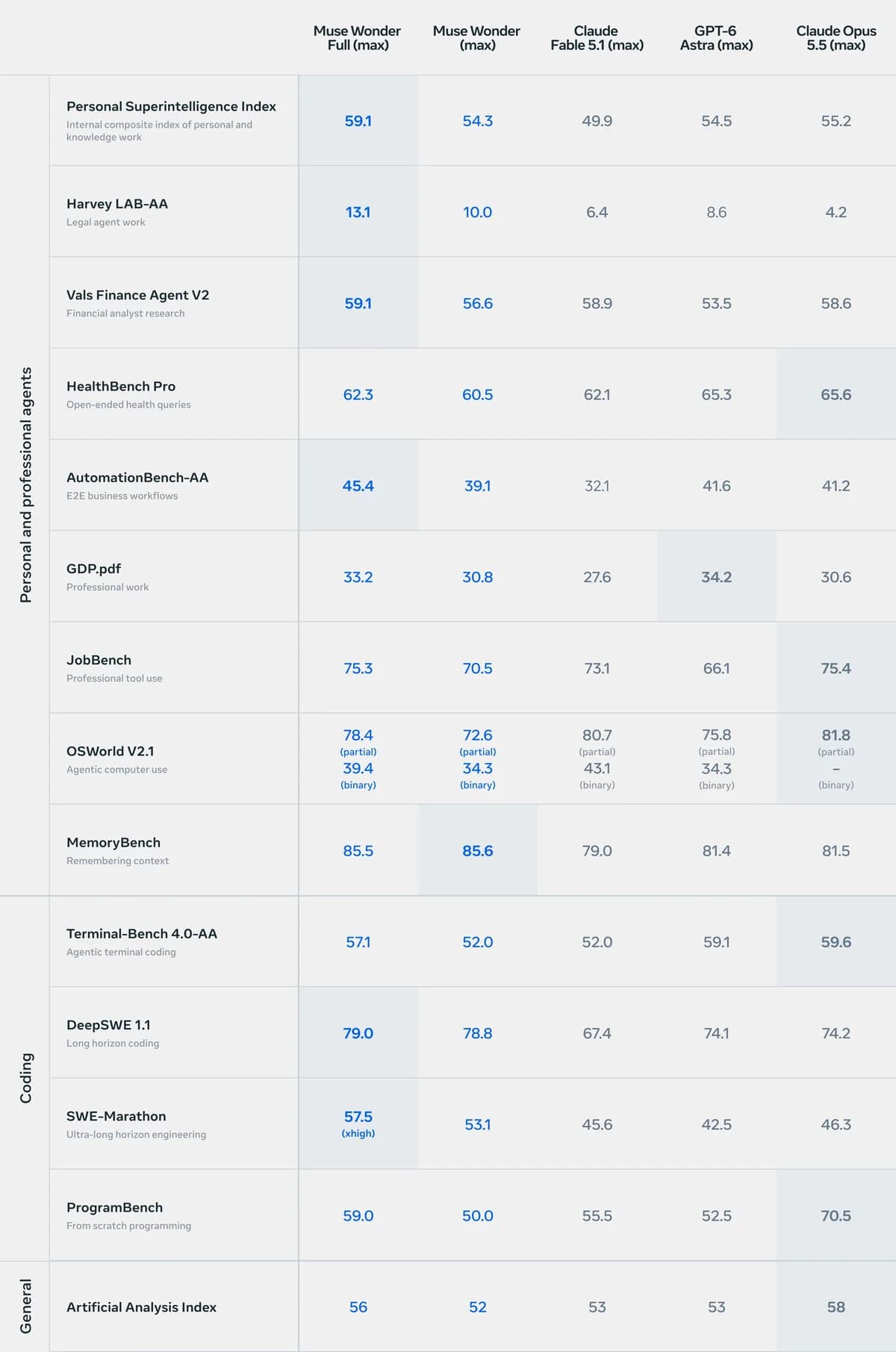
The table is transcribed below. The Muse Wonder Full column is first, then Muse Wonder, Fable 5.1, GPT-6 Astra and Opus 5.5. I read the posted image and cross-checked it against the developer page text; the developer page omits the OSWorld cells for Fable 5.1 and GPT-6 Astra, so those four values come from the image alone.
| Benchmark (vendor-reported) | Wonder Full | Wonder | Fable 5.1 | GPT-6 Astra | Opus 5.5 |
|---|---|---|---|---|---|
| Personal Superintelligence Index (internal) | 59.1 | 54.3 | 49.9 | 54.5 | 55.2 |
| Harvey LAB-AA | 13.1 | 10.0 | 6.4 | 8.6 | 4.2 |
| Vals Finance Agent V2 | 59.1 | 56.6 | 58.9 | 53.5 | 58.6 |
| HealthBench Pro | 62.3 | 60.5 | 62.1 | 65.3 | 65.6 |
| AutomationBench-AA | 45.4 | 39.1 | 32.1 | 41.6 | 41.2 |
| GDP.pdf | 33.2 | 30.8 | 27.6 | 34.2 | 30.6 |
| JobBench | 75.3 | 70.5 | 73.1 | 66.1 | 75.4 |
| OSWorld V2.1 (partial) | 78.4 | 72.6 | 80.7 | 75.8 | 81.8 |
| OSWorld V2.1 (binary) | 39.4 | 34.3 | 43.1 | 34.3 | none reported |
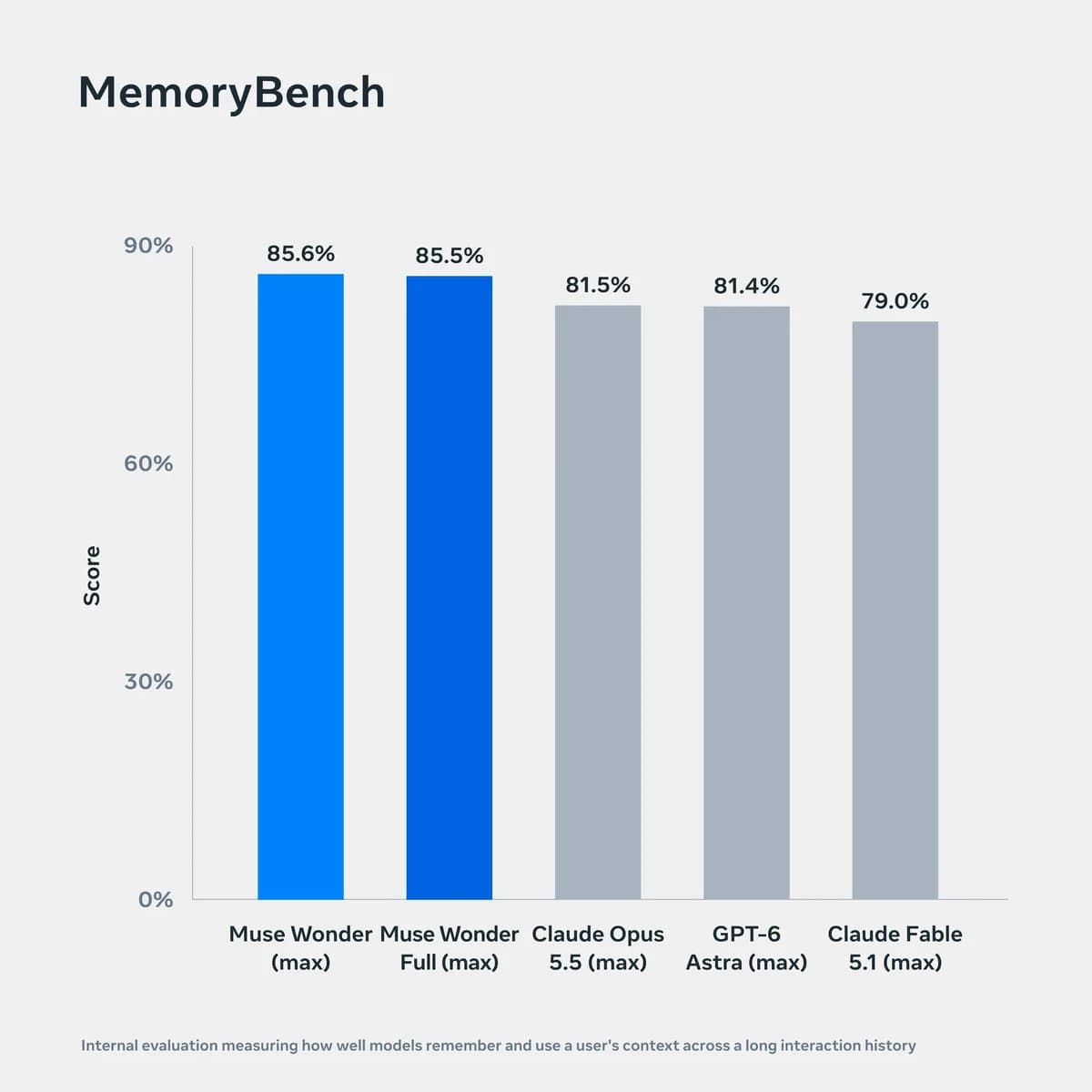
| MemoryBench (internal) | 85.5 | 85.6 | 79.0 | 81.4 | 81.5 |
| Terminal-Bench 4.0-AA | 57.1 | 52.0 | 52.0 | 59.1 | 59.6 |
| DeepSWE 1.1 | 79.0 | 78.8 | 67.4 | 74.1 | 74.2 |
| SWE-Marathon | 57.5 (xhigh) | 53.1 | 45.6 | 42.5 | 46.3 |
| ProgramBench | 59.0 | 50.0 | 55.5 | 52.5 | 70.5 |
| Artificial Analysis Index | 56 | 52 | 53 | 53 | 58 |
Where Muse leads: long-horizon software (DeepSWE and SWE-Marathon), legal agent work (Harvey LAB-AA), AutomationBench-AA, the finance agent test by a hair, and the two Meta-built rows, the Personal Superintelligence Index and MemoryBench. Where it trails: Opus 5.5 leads the Artificial Analysis Index, Terminal-Bench, ProgramBench, HealthBench Pro, JobBench and OSWorld partial credit; GPT-6 Astra leads GDP.pdf; Fable 5.1 leads OSWorld binary. Counting OSWorld as one row, that is seven Muse leads and six Opus leads out of fourteen.
Three margins are too small to call: JobBench is 75.4 for Opus against 75.3 for Wonder Full, Vals Finance Agent V2 is 59.1 against 58.9, and the two Muse models are within a tenth of a point on MemoryBench. The model card says JobBench contains 65 tasks, so one task moves raw accuracy by roughly 1.5 points before rubric averaging.
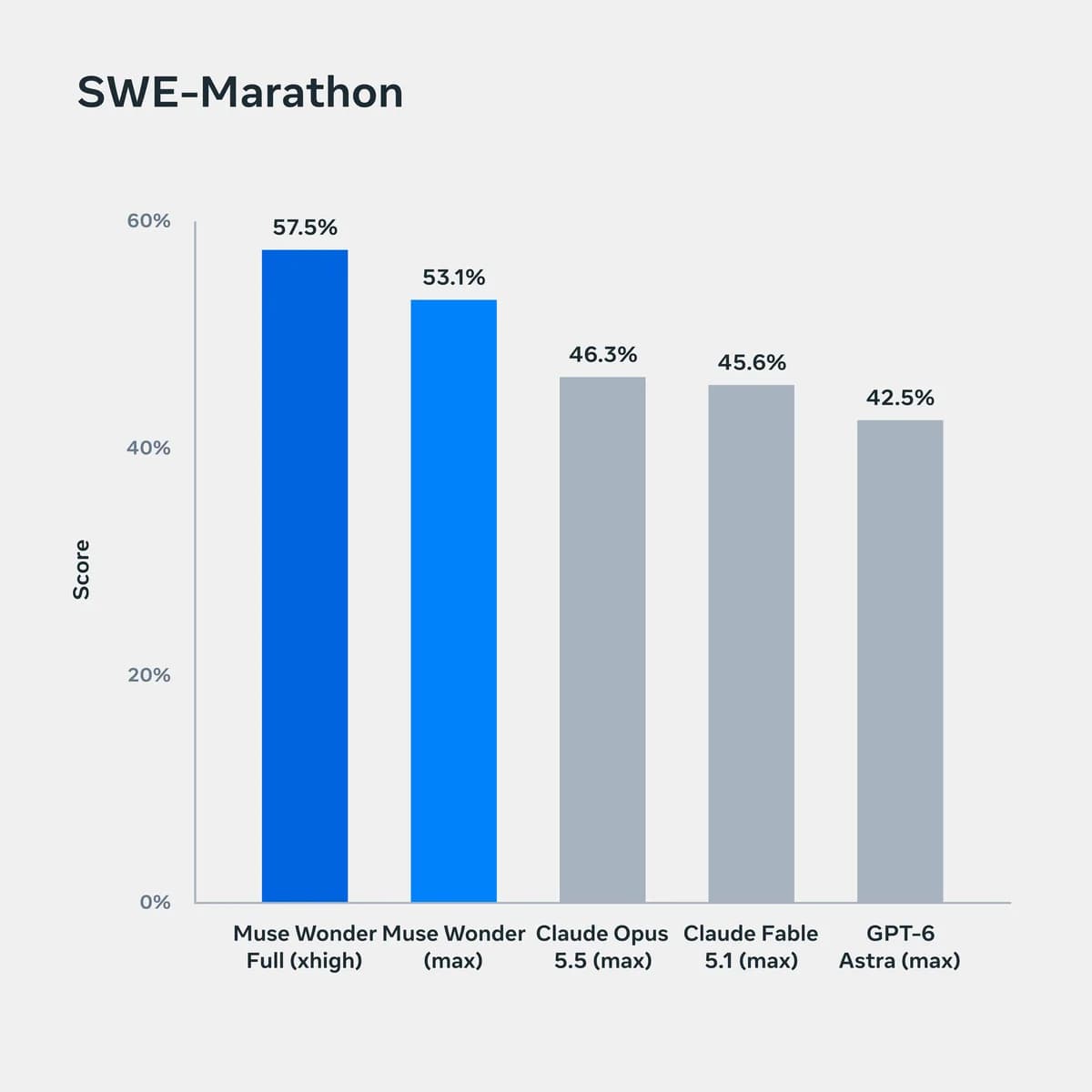
That caption carries the most important methodological caveat in the release. The model card states that for external coding results “the harness or agent product used by the reporting vendor or model provider” is retained, so SWE-Marathon compares products as much as models. ProgramBench, by contrast, used the same mini-swe-agent harness for every model, and it is the row where Opus 5.5 leads Wonder Full by 11.5 points. If you read only one row to judge raw coding ability under controlled conditions, that is the cleaner one, and it does not favor Muse.
Independent evidence
Artificial Analysis published its own Muse Wonder results about thirty minutes after the thread, and its numbers are the closest thing to an independent check in the launch week. This is a third-party post, not a Meta source.
Artificial Analysis on Muse Wonder: Intelligence Index results for Muse Wonder Full and Muse Wonder against Muse Spark 1.3.
— @ArtificialAnlys October 12, 2026
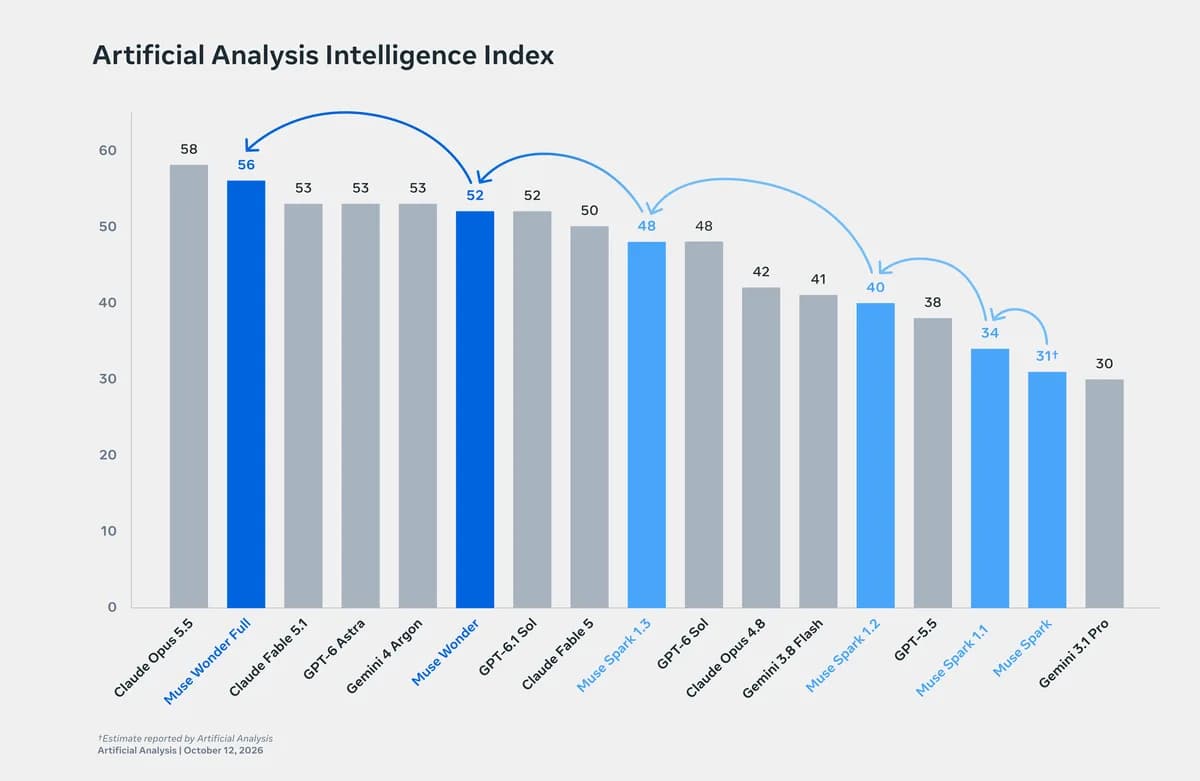
The independent measurements, as posted: Muse Wonder Full scores 56 and Muse Wonder 52 on Intelligence Index v4.3, against 48 for Muse Spark 1.3, “with a release gap of only 6 weeks.” Terminal-Bench 4.0 rose from 33% to 57% for Wonder Full. Wonder Full is in the top three on six of ten index evaluations and tops the CritPt leaderboard at 33%. Both models use about 54,000 output tokens per task, roughly 10% fewer than Muse Spark 1.3. In Muse Code at max effort, Wonder Full scores 68 on Artificial Analysis’s Coding Agents Index, level with Claude Code running Sonnet 5.5 and ahead of Claude Code with Opus 5.5 at 66.
Two limits apply. Because Wonder Full has no public API, its Artificial Analysis numbers come from the Muse Code product, so they measure a model plus an agent harness. And one discrepancy is unresolved: for AutomationBench-AA, Meta’s table shows 45.4 for Wonder Full while Artificial Analysis’s post quotes 71%; the sources define the metric differently or use different variants, and neither explains the gap. Cite the source and its definition, not a mixed number.
No independent hands-on test of Muse Wonder against Opus 5.5 or GPT-6 Astra on real codebases was found in the hours after launch. That is expected for a same-day release, and it is the main hole in the evidence. Everything labeled vendor-reported above remains unreplicated.
Active Memory and Active Focus
Meta names two ideas as the thread running through the series. Active Memory is “carrying important context about you across conversations and actively retrieving the details relevant to the task at hand.” Active Focus is how the model “continues working toward a challenging goal: trying alternative approaches, working through blockers, and adapting to new information,” asking for clarification when needed and checking in before important actions.
Neither is documented as a separate API feature. The evidence is benchmarks. For memory, it is MemoryBench, which per the model card tests recall of facts across conversations of 64K to 100K tokens with distractors and conflicting updates. That is a long-context skill inside one conversation, not proof of persistence across weeks, and the developer pages read show a 1M-token context window but no memory API. If you build persistent memory yourself, the architecture questions are unchanged: what you store, how you retrieve it, and how you let a user correct it.
For focus, the evidence is FocusBench (internal; multi-step personal tasks across areas such as housing, travel, IT and finance) and SWE-Marathon. FocusBench splits the family: Wonder Full scores 54.2%, GPT-6 Astra 47.7%, Opus 5.5 45.8%, Wonder 44.9% and Fable 5.1 36.6%, so the standard model ranks fourth. Whatever Active Focus is, the Full model carries most of it.
The generalization claim
Meta addresses the obvious objection directly, writing that complaints of “benchmaxxing” and praise for “big model smell” both point to “a breadth of capability that popular benchmarks in a few domains can’t fully capture.” Its test plots performance on tasks that post-training targeted (in-distribution) against tasks it did not (out-of-distribution) across reasoning-effort settings, for Muse Spark 1.3 and Muse Wonder Full.
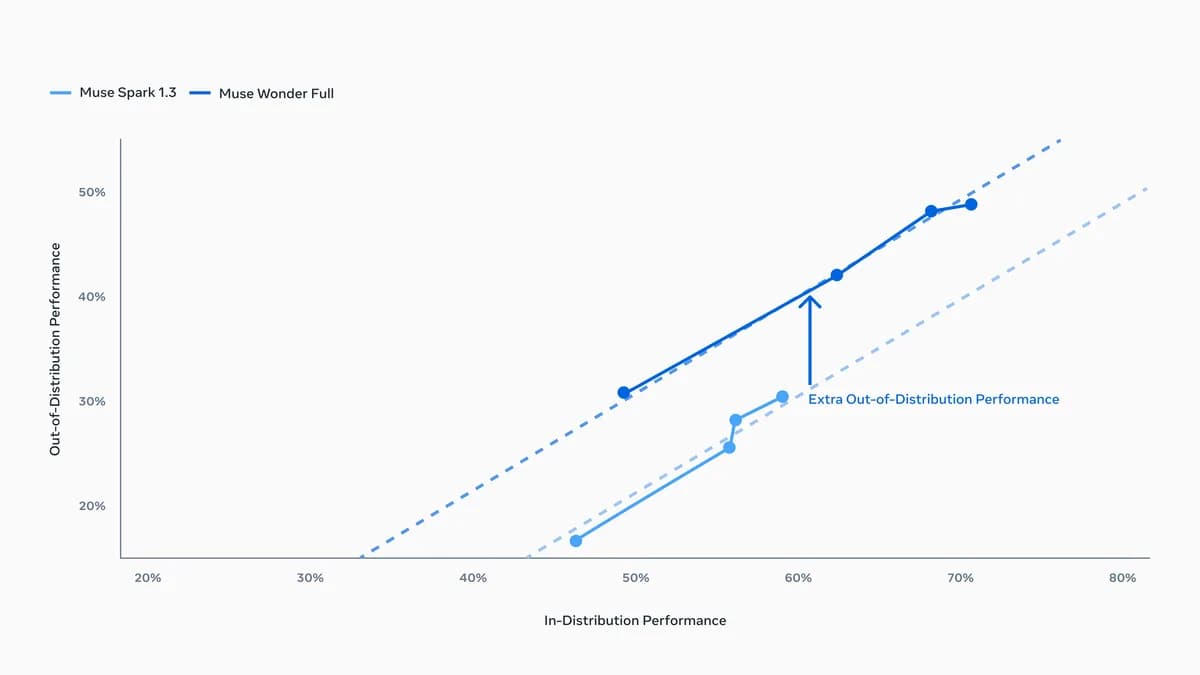
The claim is modest and specific: both models improve similarly as compute rises, but at the same in-distribution score Wonder Full does better on unfamiliar tasks than the Spark trend predicts, which Meta attributes to larger base models. Four points per model is a small sample for a trend, and the out-of-distribution task set is not named, so no outsider can inspect what counts as unfamiliar. The practical reading is a prediction you can test: if the claim holds, your own off-benchmark tasks should improve more than the headline scores suggest.
Safety and risk documentation
Meta published a model card and the Superintelligence Scaling Framework, and says a fuller safety report will follow “soon.” It was not available at the time of writing. What the card says about Muse Wonder Full is more candid than most launch documents.
| Topic | What the model card says (vendor-reported) |
|---|---|
| Chemical and biological risk | Without mitigations, Meta does not rule out the model reaching the high-risk threshold. With safety post-training and system-level classifiers, assessed risk is moderate or lower. |
| Cybersecurity and loss of control | Unmitigated model assessed at moderate or lower. |
| Deployment decision | Meta says the mitigated assessment supports its decision to deploy. This is Meta’s own assessment, not an independent audit. |
| ExploitGym | 92 flags captured, but a verification pass found only 21 used the intended vulnerability; the published ranking counts the 21. |
| Intended use | Not intended for individuals under 18. |
| Known limitations | Errors in multi-step reasoning in novel scenarios; spatial and 3D reasoning; not evaluated on all pre-training languages. |
| Meta’s own advice | Add guardrails such as human-in-the-loop confirmation for irreversible actions when the model can take real-world actions. |
Meta’s launch charts also compare safety behavior against other vendors’ models. On unauthorized code execution (attack success rate, lower is better) the figures are Muse Wonder 10.5%, Wonder Full 10.7%, Fable 5.1 11.3% and GPT-6 Astra 19.7%. On cyber defense compliance (higher is better) they are Wonder 94.5%, Wonder Full 93.3%, Astra 81.3% and Fable 5.1 15.7%. On mishandling personal information (violation rate, lower is better) they are Wonder Full 2.2%, Wonder 3.4%, Astra 4.6% and Fable 6.8%.
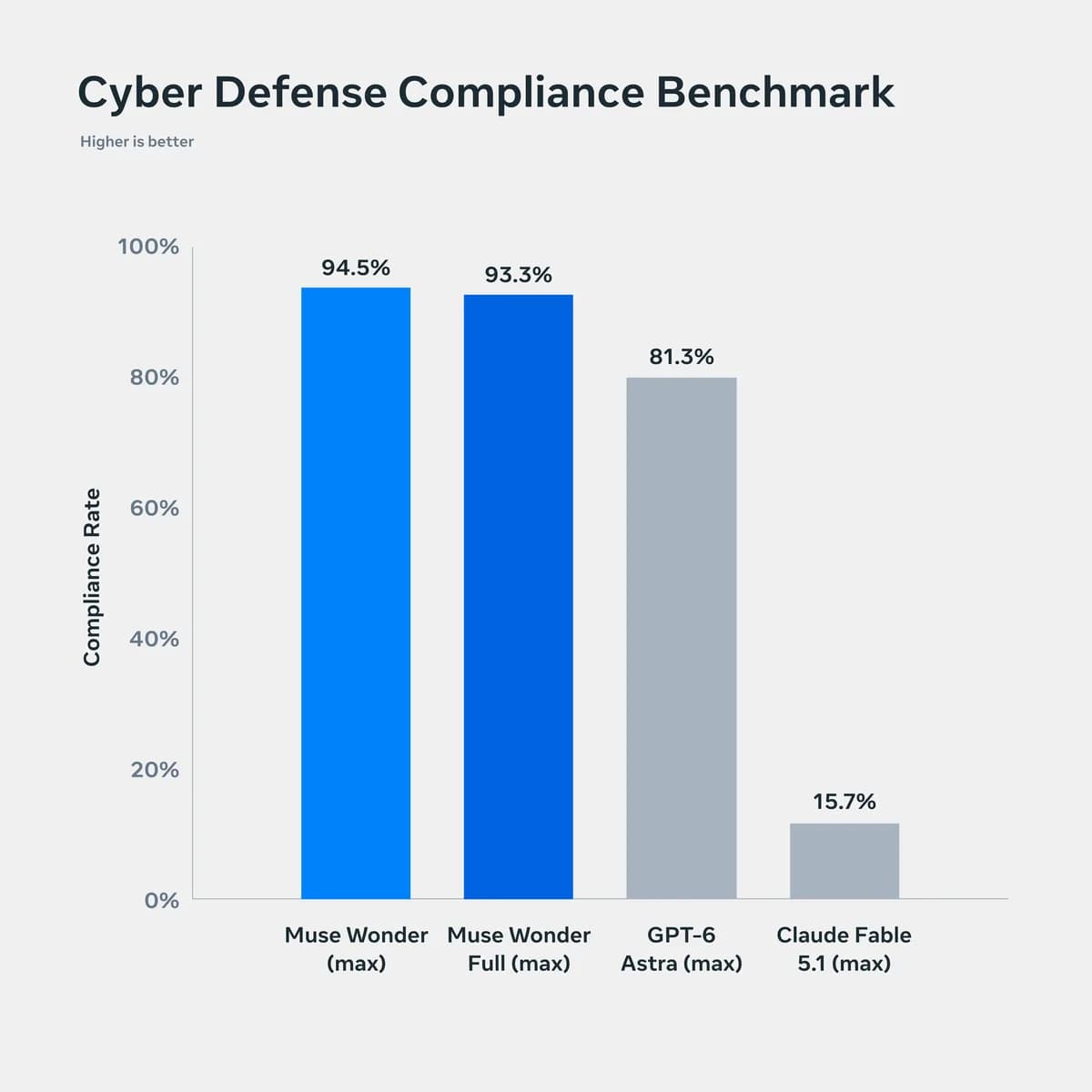
Read that last caption carefully: the compliance chart rewards a model for helping with defensive security work, so a low score is not “less safe,” it is “refuses more.” The comparison set is not uniformly flattering to Meta either; on the BioTIER refusal rate Fable 5.1 (99.7%) is ahead of Wonder Full (98.7%) and Wonder (98.0%). Still, every number here is from Meta’s own evaluations.
What the community said
The lead post had 783 replies when captured shortly after launch. These are reactions, not evidence, and the sample here is small and hand-picked from replies that could be retrieved; it is not a poll.
Enthusiasm focused on coding. @rohanpaul_ai wrote “Beats opus 5.5. wow,” and @daniel_mac8 wrote “That DeepSWE score though? You guys cooked.” Both point at the rows where the table is strongest.
Skepticism focused on the benchmarks. @repojournal wrote that “Opus 5.5 is so good I am find this hard to believe but if it’s true then wow congratulations.” @manish_fp wrote: “At this point you guys are inventing new benchmarks because you’ve run out of existing ones to beat.” That lands on a real feature of the scorecard: several rows where Muse leads most clearly are Meta-designed.
Access questions. @notjazii asked Meta “please don’t region block models,” and @cryptgreg asked “Will this be open sourced as well?” Meta’s materials answer neither. @VictorTaelin posted a joke scenario ending “idk but I want to believe,” which captures a mood of surprise that is not corroboration.
Alexandr Wang also reposted a run of unnamed endorsements, including one saying the model was “neck and neck or better” than Astra, Fable and Opus on every technical benchmark run. Those are curated testimonials from the launching side and are not counted as community evidence here.
A test plan before you switch
The scorecard tells you where to look; it does not tell you whether to move. A proportionate evaluation, using only the facts above, would run in five steps.
- Split your backlog by the scorecard’s shape. Pick tasks resembling the rows where Muse leads (long-running multi-file software work, legal or finance document tasks, memory-heavy conversations) and tasks resembling where it trails (terminal-driven coding, from-scratch builds, health-adjacent questions, GUI automation). Run both groups; a result in only one group is not a verdict.
- Fix the harness. Run every model in the same agent harness. If you test Wonder Full inside Muse Code and Opus 5.5 inside Claude Code, you are comparing products, which is a legitimate question but a different one.
- Set effort and budget explicitly. Meta’s numbers are at max effort, and Wonder Full’s SWE-Marathon is at xhigh. Measure cost per completed task, not price per million tokens, and track cache hit rate, since the cached input rate is $0.20 against $4.00 uncached.
- Test the generalization claim. Include tasks that look nothing like public benchmarks. If Meta’s out-of-distribution argument is right, this is where Wonder Full should beat Spark 1.3 by more than the leaderboards suggest.
- Gate real-world actions. Meta’s own card recommends human-in-the-loop confirmation for irreversible actions. For any agent holding private context, messages or calendars, make that a design rule, not an afterthought.
Limitations
- Every benchmark and safety number from Meta is vendor-reported. This guide read the images and cross-checked the table against the developer page; it did not rerun a benchmark.
- The only independent numbers are Artificial Analysis’s index results and the third-party result sources Meta names (Artificial Analysis, Datacurve, Abundant AI, Vals AI, Surge). Artificial Analysis’s Wonder Full figures come through Muse Code.
- The four OSWorld cells for Fable 5.1 and GPT-6 Astra, and all chart values on the safety figures, come from reading rendered images; the generalization plot values are approximate.
- No consumer Muse subscription price, no Wonder Full per-token price, no absolute Muse Code usage limits, no open-weights statement and no regional availability list were found. None is guessed here.
- Meta’s full safety report was not yet public when this was written. The comparison set is Meta’s own; a different set of rivals could change the picture.
FAQ
What is Muse Wonder?
Muse Wonder is a family of two models from Meta Superintelligence Labs, announced October 12, 2026: Muse Wonder and Muse Wonder Full. Meta describes them as the next step on its scaling ladder after Muse Spark, built for personal and professional agentic work.
What is the difference between Muse Wonder and Muse Wonder Full?
Muse Wonder is the faster model, available through the Meta Model API and Muse Code. Muse Wonder Full is the full version, available only by subscription in Muse Code on the Power Usage ($50 per month) and Maximum Usage ($200 per month) plans. Full scores higher on most rows of Meta’s table.
How much does the Muse Wonder API cost?
The Meta for Developers page lists muse-wonder-1.0 at $4.00 per million input tokens, $0.20 per million cached input tokens and $20.00 per million output tokens, with a 1M-token context window. Muse Wonder Full has no per-token price.
Is Muse Wonder better than Claude Opus 5.5?
On Meta’s own table it leads on seven of fourteen rows and trails Opus 5.5 on six, including the Artificial Analysis Intelligence Index (Opus 58, Wonder Full 56, Wonder 52). It leads on long-horizon coding and several agent tasks and trails on terminal coding, from-scratch programming, health and computer use. Which is better depends on your workload.
Are the benchmark results independent?
Only in part. Meta assembled the table, took the highest available score per row, ran competitor models on a best-effort basis and designed several benchmarks itself. Artificial Analysis separately published its own index results, which are independent but cover only part of the table.
What are Active Memory and Active Focus?
They are Meta’s names for two behaviors: carrying important context about the user across conversations, and persisting through blockers on a hard task while asking for clarification and checking in before important actions. The evidence is MemoryBench, FocusBench and SWE-Marathon; the first two are Meta-internal.
Is Muse Wonder open source?
No statement that weights will be released was found. Artificial Analysis lists it as proprietary, and the model card says use is governed by Meta’s terms. Treat it as closed unless Meta says otherwise.
Can I use Muse Wonder in the Muse app today?
Meta’s blog says Muse Wonder will soon power experiences in Muse, with subscribers first. Zuckerberg’s thread says you can use it to power your Muse by subscribing today. The statements differ, and the blog is the more specific one; no consumer subscription price was published.
Is it safe to deploy as an agent?
Meta’s model card says that without mitigations it cannot rule out the high-risk threshold in chemical and biological domains, and that with mitigations assessed risk is moderate or lower across all domains. It recommends human confirmation for irreversible actions. The assessment is Meta’s own and has not been independently audited.
What modalities and context length does it support?
Per the model card and developer page: text, image, video and audio input, text output, and a 1M-token context window. The card also says the model has not been evaluated on all languages in its pre-training data and that spatial and 3D reasoning remain known limitations.
Sources
Sources checked October 12, 2026.
- Mark Zuckerberg on X — launch thread (lead post and table; video post embedded above)
- AI at Meta on X and Alexandr Wang on X
- Muse Wonder — Meta AI Research blog (announcement, availability, Active Memory and Active Focus, generalization chart, launch charts)
- Muse Wonder model card (modalities, benchmark methodology, per-benchmark notes, risk assessment, limitations)
- Meta Superintelligence Scaling Framework
- Muse Wonder on Meta for Developers and Muse Code (API prices, plan tiers, access)
- Artificial Analysis on X and its Muse Wonder model page (independent index, cost and token measurements)
- Community replies on the launch thread, linked inline above; quoted as attributed reactions, not as verified facts.
Related reading: Gemini 4 Argon complete guide, GPT-6.1 Sol guide, Tavus Griffin Human Interaction Model guide, and OpenAI DevDay 2026 recap.