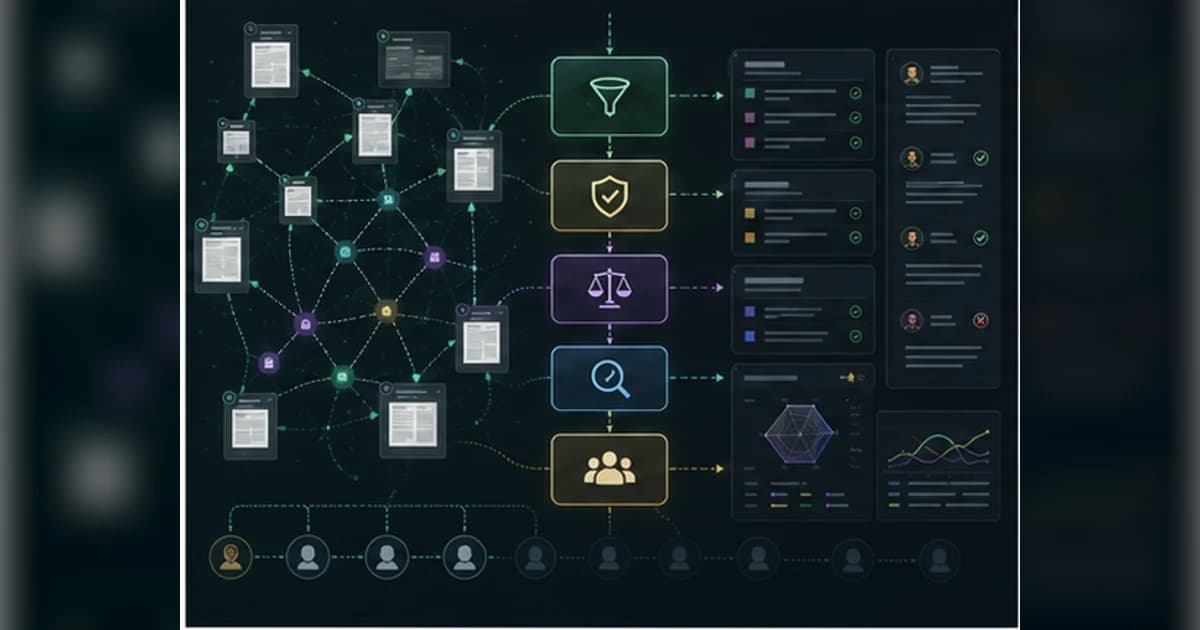
The central distinction is important: the repo is built around human-in-the-loop research, not fully automated paper generation. It aims to make citation handling, review discipline, integrity gates, and process records stronger while keeping research judgment with the author.
Get the latest on AI, LLMs & developer tools
New MCP servers, model updates, and guides like this one — delivered weekly.
Editorial note
This article uses the GitHub repo, README, plugin manifest, architecture/setup/performance docs, mode registry, license, current issues and PRs, marketplace mirrors, Reddit, X search, and an independent codebase read gathered on June 2, 2026.
1. academic-research-skills in One Sentence
Academic Research Skills is a noncommercial Claude Code skill suite that orchestrates research, writing, reviewing, revision, formatting, and citation-integrity workflows through staged skills, agents, commands, gates, and source-provenance artifacts.
| Area | Detail | Why it matters |
|---|---|---|
| Repository | Imbad0202/academic-research-skills | https://github.com/Imbad0202/academic-research-skills |
| Primary language | Python | Primary GitHub language at research time. |
| License | CC BY-NC 4.0 | Check bundled or binary licenses separately where relevant. |
| Created | February 26, 2026 | Latest release checked: v3.10.0 on June 1, 2026. |
2. Why It Matters
Academic writing is high-stakes because errors are often subtle: a real paper can be cited for a claim it does not support, a methodology critique can be softened too early, or an AI-generated summary can collapse different concepts into one confident paragraph.
The repo's useful contribution is workflow discipline. It packages roles, checkpoints, material passports, citation checks, reviewer perspectives, and revision traceability into repeatable Claude Code skills.
The noncommercial license and explicit copilot framing matter. This is not a repo to wrap into a paper mill. It is better understood as a research assistant harness for people who still own the question, method, evidence, claims, and final prose.
3. Architecture and Mental Model
ARS is organized as multiple Claude Code skills plus command aliases, shared protocols, evaluation helpers, and docs. The main skills cover research, paper writing, reviewer simulation, and a pipeline orchestrator that joins the stages.
| Area | Detail | Why it matters |
|---|---|---|
| Plugin | `.claude-plugin/plugin.json` | Declares the Claude Code plugin package and noncommercial license metadata. |
| Deep Research | `deep-research/` | Research team skill with quick, full, fact-check, lit-review, review, Socratic, and systematic-review modes. |
| Academic Paper | `academic-paper/` | Writing, planning, outline, revision, citation, disclosure, abstract, and format-conversion skill. |
| Paper Reviewer | `academic-paper-reviewer/` | Multi-perspective peer-review skill with EIC, field, methodology, domain, and Devil's Advocate roles. |
| Pipeline | `academic-pipeline/` | Ten-stage orchestrator with human checkpoints and integrity gates. |
| Commands | `commands/ars-*.md` | Slash command aliases such as `/ars-plan`, `/ars-lit-review`, `/ars-reviewer`, and `/ars-citation-check`. |
| Shared protocols | `shared/`, `docs/`, `MODE_REGISTRY.md` | Handoffs, verification, data access, reproducibility, mode selection, and performance docs. |
| Evaluation | `evals/`, scripts, GitHub workflows | Gold sets, lints, release gates, freshness checks, and post-ship review automation. |
4. Smallest End-to-End Setup
The commands below are copied from the repository documentation and checked against the current research snapshot. Treat them as a starting point, then read the linked README before installing into a production environment.
# Claude Code plugin path
/plugin marketplace add Imbad0202/academic-research-skills
/plugin install academic-research-skills

# Minimum runtime
export ANTHROPIC_API_KEY="..."

# Optional document output tools
# - Pandoc for DOCX
# - tectonic plus fonts for PDF/APA output
# - optional cross-model verification settings when appropriate
A small first task should prove the integration before you attach it to critical data or large workspaces.
# Plan a paper through guided Socratic mode
/ars-plan

# Research a topic
/ars-lit-review "AI feedback in higher education"

# Review a draft
/ars-reviewer

# Check citations and claim support
/ars-citation-check

# Run a full staged pipeline when the project is ready
/ars-full
5. Technical Deep Dive
5.1 The repo is a workflow suite, not one prompt
The file tree shows separate skills for deep research, academic paper writing, academic paper review, and the full pipeline. That separation matters because research, drafting, reviewing, and revision need different authority boundaries.
A literature search agent should be skeptical about source quality. A writer should preserve the author's thesis and voice. A reviewer should be adversarial enough to find weaknesses. A pipeline orchestrator should stop at checkpoints instead of silently plowing forward.
5.2 Integrity gates are the product's strongest idea
ARS repeatedly emphasizes citation and claim integrity. It treats citation existence, locator anchors, source support, data provenance, and final verification as workflow gates instead of cleanup tasks.
That does not eliminate hallucinations. It creates places where hallucinations are more likely to be caught. The repo's active roadmap and issues show that citation faithfulness remains an ongoing engineering problem.
research plan
  -> source matrix
  -> draft
  -> integrity gate
  -> peer-style review
  -> revision
  -> final integrity gate
  -> formatted output and process summary
5.3 Material Passport turns provenance into state
The Material Passport pattern is a useful concept for any research-agent workflow. Instead of passing vague memory from one stage to another, the pipeline carries structured provenance: what sources were used, what claims were made, what evidence supports them, and what still needs verification.
That is especially useful across sessions because academic work rarely happens in one conversation. The handoff artifact is a guard against context loss and quiet source drift.
5.4 The reviewer is deliberately uncomfortable
The paper-reviewer skill includes roles such as methodology reviewer, field analyst, perspective reviewer, and Devil's Advocate. This is a practical response to sycophancy: a helpful assistant often concedes too quickly unless the workflow protects critique.
The best use is pre-submission stress testing. It should not be mistaken for actual peer review, and it should not override advisor, coauthor, ethics, or venue-specific review.
5.5 Noncommercial licensing affects adoption
The repo is visible and useful, but the license is CC BY-NC 4.0, not MIT or Apache. That makes it friendlier for individual researchers and educational use than for commercial SaaS packaging.
Teams planning paid products, consulting bundles, commercial internal workflows, or redistribution should review the license carefully before building on it.
6. Real-World Wrong vs Right Patterns
| Wrong | Right | Reason |
|---|---|---|
| Use ARS to hide AI involvement. | Use ARS to improve quality, provenance, disclosure, and revision discipline. | The README explicitly rejects humanizer-style evasion. |
| Treat citation existence as proof of claim support. | Check whether the source actually supports the sentence being written. | Claim faithfulness is harder than reference lookup. |
| Turn on cross-model verification for private manuscripts without review. | Decide provider, privacy, and consent boundaries first. | Cross-model checks may send sensitive text to another service. |
| Run a full pipeline for every small writing task. | Use lighter modes for briefs, outlines, citation checks, or reviewer comments. | Full academic pipelines are token- and attention-heavy. |
7. Common Mistakes and Current Issues
The issue tracker matters because these are young, fast-moving repos. The article uses issues as risk signals, not as proof that a project is unusable.
| Area | Detail | Why it matters |
|---|---|---|
| Citation integrity scope | Issue #299 tracks a v3.11 citation-integrity release. | The project itself treats citation support as active work, not solved. |
| Security boundary | Issue #300 tracks hardening around cross-model and Codex sibling boundaries. | Private manuscript handling deserves explicit consent. |
| Scoped write guard | Issue #302 and PR #304 fixed a sibling worktree write-guard problem. | Hook and guard behavior can affect unusual workspace layouts. |
| Cowork setup | PR #307 updated setup docs for enabling skills in Customize. | Desktop/Cowork users can miss an enablement step. |
| Fast release cadence | Recent PRs include roadmap, version lint, docs, and boundary fixes. | Read current docs before relying on older tutorials. |
| Noncommercial license | The repo license is CC BY-NC 4.0. | Commercial use is not the same as open-source code reuse under MIT. |
8. Performance, Scaling, and Cost Notes
The performance docs discuss token budgets and cost estimates for full-paper workflows. The exact dollars change with model prices, but the architectural point does not: a 10-stage academic pipeline is not a cheap one-shot prompt.
Use the narrowest mode that matches the task. A citation check, abstract, outline, or reviewer-comment parser should not require the same context as a full paper pipeline.
Cross-model verification can add useful diversity, but it also adds cost, latency, and privacy considerations. It is best used intentionally for high-risk checkpoints rather than left on by habit.
9. Who It Is For
| Use it if | Skip it if |
|---|---|
| You are a researcher who wants structured help with literature review, drafting, review, revision, and citation checks. | You want an automated paper writer. |
| You value human checkpoints, provenance, and integrity gates. | You want a lightweight general writing assistant. |
| You work in Claude Code and can manage optional tooling such as Pandoc or tectonic. | You need a one-click hosted web app. |
| Your use is compatible with CC BY-NC 4.0. | You need permissive commercial redistribution rights. |
10. Community Signal
Public discussion frames ARS as one of the more serious Claude Code academic skill suites because it covers the full pipeline instead of only writing prose.
The community signal is strongest around workflow packaging: people notice the research to write to review to revise shape, the citation-integrity posture, and the explicit copilot-not-pilot stance.
The issue tracker is unusually process-oriented. Many issues are not ordinary bugs; they are release scopes, post-ship reviews, integrity policies, and boundary hardening items.
11. The Verdict: Is It Worth Using?
Our Take
Use Academic Research Skills if you want a serious Claude Code workflow for research discipline, citation integrity, review pressure, and revision traceability. Skip it if your goal is ghostwriting, commercial resale, or a frictionless hosted writing app.
12. The Bigger Picture
ARS is a preview of where academic AI tooling is going: less emphasis on one impressive answer, more emphasis on provenance, review roles, citation support, reproducibility notes, and process records.
The challenge is cultural as much as technical. Better tools can catch errors, but only researchers can decide what question matters, what evidence counts, what claims are fair, and how AI use should be disclosed.
13. Frequently Asked Questions
Q: Does Academic Research Skills write a paper automatically?
No. It can help research, plan, draft, review, revise, and format, but the repo explicitly frames AI as copilot rather than pilot.
Q: How do I install it?
Use Claude Code plugin commands: `/plugin marketplace add Imbad0202/academic-research-skills` and `/plugin install academic-research-skills`.
Q: Does it prevent hallucinated citations?
It reduces risk through verification and integrity gates, but it cannot guarantee perfect citation faithfulness. Human source checking remains required.
Q: What is a Material Passport?
It is a structured provenance and handoff artifact that carries source, claim, evidence, and workflow state across stages.
Q: Can I use it commercially?
The repo uses CC BY-NC 4.0, so commercial use, redistribution, or product wrapping needs careful license review.
Q: Is it safe for unpublished manuscripts?
Only if you understand where text is sent, which models are used, whether cross-model verification is enabled, and what your institution permits.
14. Glossary
| Area | Detail | Why it matters |
|---|---|---|
| ARS | Academic Research Skills. | The repo's common shorthand. |
| Material Passport | Structured provenance and handoff record. | Used across stages. |
| Integrity gate | A required verification checkpoint. | Designed to catch citation, claim, or methodology problems. |
| Claim faithfulness | Whether a cited source actually supports the claim. | Harder than checking reference existence. |
| R&R matrix | Revision and response traceability matrix. | Tracks reviewer comments and author responses. |
| Cross-model verification | Using a second model for review or checks. | Adds diversity, cost, and privacy considerations. |
| Devil's Advocate | Reviewer role that preserves critique pressure. | Counteracts sycophancy. |
15. All Sources and Links
Primary Sources
Issues and PRs
Community and Web
Internal Links
16. Source Attribution Table
| Area | Detail | Why it matters |
|---|---|---|
| README | Copilot-not-pilot stance, install command, features, examples. | Primary source. |
| Architecture and setup docs | Stages, roles, optional tools, installation caveats. | Primary source. |
| Performance docs | Cost and token-budget posture. | Primary source. |
| Issues and PRs | Citation integrity, security boundaries, setup and guard caveats. | Freshness signal. |
| Marketplace/web/community | Outside framing and adoption signal. | Secondary source. |
Get the Ultimate Antigravity Cheat Sheet
Join 5,000+ developers and get our exclusive PDF guide to mastering Gemini 3 shortcuts and agent workflows.
Related Guides
Humanizer Skill Guide
blader/humanizer: 29 AI-writing patterns, voice calibration, and a two-pass audit, all in one Claude Code skill.
Guides & FeaturesMastering Agent Skills
The open standard for portable AI agent expertise.
Guides & FeaturesAntigravity Workflows Guide
Create automation recipes with Turbo Mode and AgentKit 2.0.
Guides & FeaturesHow to Change Antigravity Themes
Customize themes, dark mode, icons, and color schemes.
Guides & FeaturesHow to Change Language
Switch Antigravity to Spanish, German, Japanese, and more.
Guides & FeaturesAntigravity Security Guide
Known vulnerabilities, safe settings, and hardening steps.