Get the latest on AI, LLMs & developer tools
New MCP servers, model updates, and guides like this one — delivered weekly.
Two years ago a coding subscription meant one chat plan with a code tab. Now there are ten families of plans, each with its own unit of usage: messages, requests, credits, dollars or multiples of another tier. Anthropic renamed Max 20x to Ultra. OpenAI added a $500 Pro tier on Sept 29. GitHub moved Copilot to credits. Cursor now sells through the X Subscription. Z.ai shipped GLM-5.4 on Nov 23. This guide puts all of it side by side, using vendor pages first and flagging every number we could not confirm.
Video by AICodeKing (YouTube). We did not make or test this video; it is a third-party comparison of the same agents.
The Short Answer
For the best coding subscription, match the plan to how you work, not to the headline price. Heavy daily work in one repo points to Claude Max or Ultra. Cloud tasks and PR review point to ChatGPT Pro with Codex. A cheap second plan behind a harness you already use points to GLM Lite or OpenCode Go. Editor users should look at Copilot or Cursor.
| If you want | Start with | Why |
|---|---|---|
| Long, hard sessions in one big repo | Claude Max or Ultra | First-party harness, Fable included up to 50% of weekly limit, no 5-hour wall on verified Ultra. |
| Background cloud tasks and PR review | ChatGPT Pro (Codex) | Cloud tasks, GitHub review and Slack are part of the bundle; Pro has no 5-hour limit. |
| Cheapest serious second plan | GLM Lite or OpenCode Go | $18 and $10 respectively, both usable behind tools you already know. |
| Planning around real numbers | Alibaba Pro or OpenCode Go | Both publish per-window or per-model figures, which most vendors do not. |
| Editor-first work | Cursor or GitHub Copilot | Both live inside the editor. Copilot is cheaper to enter; Cursor bills third-party models separately. |
| Coding plus research and slides | Kimi membership | Coding is one feature in a general membership. |
| Coding plus video, image and speech | MiniMax M Plan | Media generation is part of the same bill. |
| A free trial before paying | Google Antigravity, ChatGPT Free, Copilot Free | All three have a free path; Claude's Free plan excludes Claude Code. |
Already researching the models rather than the plans? Our cheapest AI coding models guide covers API pricing, and best AI coding agents covers the tools themselves.
How We Evaluated
We read each vendor's own pricing page, docs or help center on Nov 25, 2026, and used the live page in a browser where a plain fetch lost the prices (Kimi, MiniMax and Google). We did not run hands-on tests of any plan, benchmark any model or measure real usage, so nothing here claims one plan produces better code than another. The ranking order is neutral: it follows how much each plan targets daily coding, not a quality score.
- Verified on a vendor page: every price in the pricing tables except those marked as third party.
- Third party, unverified on the vendor site: GLM Pro ($80) and Max ($168), because z.ai/subscribe did not render for us, and the Codex multipliers (10X, 20X, 50X), which come from one post.
- Contradictions we found: Z.ai's FAQ and usage policy give different cancellation windows (24 hours versus 3 days). GitHub's plans page lists third-party agents in the Pro bullets but not in the Pro table.
- Prices are US dollars, before tax. Mobile app prices may differ, as Anthropic notes for Ultra.
Master Comparison Table
| Product | Plans (monthly) | Main strength | Main catch | Best for |
|---|---|---|---|---|
 Claude | Pro $20, Max $100, Ultra $200 | Claude Code on first-party Claude models; Fable on Max and Ultra | One shared pool for chat and coding; Claude models only | Heavy daily Claude Code |
 ChatGPT Codex | Go $8, Plus $20, Pro $100 / $200 / $500 | Codex bundled with ChatGPT; no 5-hour limit on Pro | Plus limits are wide estimates; OpenAI models only | Background cloud tasks and PR review |
 Z.ai GLM | Lite $18; Pro $80 and Max $168 (third party) | Plugs into Claude Code, Codex, OpenCode and 20+ tools | Officially supported tools only; no refunds | A cheap second model behind your harness |
 Kimi Code | Plus $19, Pro $39, Max $99, Ultra $199 | Kimi Code inside a general membership; open-weight K3.1 Pro | Launch queueing warning; coding is one feature of many | Coding plus research and docs |
 MiniMax | Go $22, Explore $55, Build $132 | MiniMax Code app plus API key and media generation | Usage given as multiples, not counts | Coding plus video, image and speech |
 GitHub Copilot | Free, Pro $10, Pro+ $39, Max $100 | Unlimited completions plus a credit pool for agents | Small credit pool on Pro | Editor-first teams on GitHub |
 Cursor | Plus $8, Premium $30, Super $100, Ultra $200 | AI editor plus Grok in one bundle | Third-party models billed separately | AI-native IDE users happy with Grok |
 Google Antigravity | AI Plus $4.99, Pro $19.99, Ultra from $99.99 | Antigravity with Gemini and Claude models; storage included | Quotas described in words; model list changes | A free trial and Gemini fans |
 Alibaba Coding Plan | Pro $50 | Published caps: 6,000 per 5 hours, 45,000 per week | Limited slots; non-refundable; interactive use only | Planning with real numbers |
 OpenCode Go | Go $10, Go Plus $40, Teams $20 per member | 32 models, shared allowance, works in Claude Code and Codex | Limits and catalog change; promos are temporary | Cheapest experimentation |
1. Claude Pro, Max and Ultra
Anthropic's own plans, with Claude Code included on every paid tier.
Anthropic sells Claude to individuals as Free, Pro, Max and Ultra. Claude Code, its terminal, desktop and web coding agent, is included on every paid tier, and it draws from the same usage pool as the chat apps. That shared pool is the single most important fact about this plan: a long Claude Code session spends the allowance you would otherwise use for chat, and Anthropic says there is no fixed message count because usage depends on the model, the length of the conversation and the features you use.
Anthropic recently renamed the top of the lineup. Its help center says the Max 20x plan is now called Ultra, existing Max 20x subscribers move over automatically, and there is no price change. Ultra costs $200 a month and Max costs $100. Ultra's main change is that verified accounts no longer have a rolling five-hour limit, only a weekly one. Anthropic's help center says unverified accounts keep a temporary limit until its automatic verification clears them.
Who it is for. Developers who want Anthropic's strongest models inside Claude Code every day and can justify $100 or $200 a month for it, plus anyone already using Claude for writing and research who wants coding on the same bill.
Key features
- Claude Code in the terminal, desktop app, web and mobile, with GitHub and IDE integrations (VS Code and JetBrains, per Anthropic's Cowork page).
- Opus on Pro, Max and Ultra. Fable, Anthropic's top model line, is included on Max and Ultra up to 50% of your weekly limit, and runs on pay-as-you-go usage credits on Pro.
- Usage credits that let you keep working at API rates after you hit a limit (paid plans only).
- A monthly API credit for building on the Claude Platform: $100 on Max, $200 on Ultra. Anthropic's help center says these credits cannot be spent inside Claude Code or the Claude apps.
- Priority access at high-traffic times on Max and Ultra, and context windows up to 1M tokens depending on the model.
Pros
- Claude Code is first-party, so new Claude models and features land there first.
- Max and Ultra include Fable without paying per token, up to the 50% weekly cap.
- You can pay past a limit with usage credits instead of stopping.
- Ultra removes the five-hour wall for verified accounts, which matters for long agent runs.
Cons
- Claude models only. If you want to try GLM, Kimi or GPT models you need a second plan.
- Chat and Claude Code share one pool, so a busy week of conversations shrinks your coding budget.
- The jump from Pro at $20 to Max at $100 is five times the price for five times the usage, with nothing in between.
- Max and Ultra bill monthly only, per Anthropic's comparison table, so there is no annual discount on the expensive tiers.
- Fable draws down the weekly limit faster than other Claude models, per the help center.
Benefits for your workflow
- One subscription covers chat, Claude Code and Cowork, so you stop juggling tools.
- Weekly and five-hour meters are visible in Settings, so you can plan the week instead of guessing.
- If you already bill your employer for Claude, the monthly API credit on Max and Ultra offsets some API spend elsewhere.
Pricing (as of November 25, 2026)
| Plan | Price (as of November 25, 2026) | What you get |
|---|---|---|
| Free | $0 | No Claude Code |
| Pro | $20 monthly, or $17/mo billed annually ($200 up front) | Claude Code included, 1x usage baseline, Opus included, Fable on usage credits |
| Max | $100 per month | 5x Pro usage every 5 hours and every week, Fable up to 50% of weekly limit, $100/mo API credits |
| Ultra | $200 per month | No 5-hour limit for verified accounts, 10x Pro weekly usage, $200/mo API credits |
Free tier. The Free plan exists, but Anthropic's comparison table lists Claude Code as not included.
Limits. Rolling five-hour window on Pro and Max, a weekly limit on all paid plans, and a separate weekly limit for Fable on Max and Ultra. No published message counts.
Standout use case. Long, hard sessions in a large repo where you want the top Claude model and a first-party agent harness.
Skip it if. You want to mix model vendors, you only code a few hours a week (Pro or a cheaper plan is enough), or you mostly run unattended automation (check the terms for your use case first).
Source: Claude pricing
2. ChatGPT Plus and Pro (Codex)
Codex comes bundled with ChatGPT, and Pro now has three sizes.
OpenAI does not sell a separate Codex subscription. According to its Codex pricing page, ChatGPT Work and Codex are included in Free, Go, Plus, Pro, Business, Edu and Enterprise plans, and they share pricing, credits and usage limits. Plus covers Codex on the web, in the CLI, in the IDE extension and on iOS, plus cloud features such as automatic code review and Slack integration.
Pro is where the heavy use lives. OpenAI's pages list Pro at $100, $200 or $500 a month, and a post from @thsottiaux on Nov 8, 2026 (embedded below) says all Pro plans have no five-hour limits and give 10X, 20X and 50X the usage of Plus. That multiplier comes from that post only, so treat it as a claim to check in your own usage dashboard. A ChatGPT help article also says that starting in December, usage will be shared across ChatGPT and Codex in token terms, so check how your plan counts before you rely on old numbers.
Who it is for. Developers who want a cloud coding agent that runs tasks in the background and reviews pull requests, and who are happy with OpenAI models.
Key features
- Codex on the web, CLI, IDE extension and iOS on Plus and above, with GitHub code review and Slack integration.
- Local message estimates per five hours on Plus: 6 to 50 on GPT-6.2 Astra, 17 to 180 on GPT-6.2 Sol and 350 to 3,000 on GPT-6 Luna, per OpenAI. These are estimates, not fixed limits.
- Pro plans currently have no five-hour limit, per the same page. Weekly limits may still apply.
- Speed tiers: Fast mode uses 2x to 2.5x your allowance depending on model, and Ultrafast uses up to 6x to 8x. OpenAI says Ultrafast delivers up to 8x faster generation in Codex.
- Extend usage with credits or usage-based billing once you pass the included allowance.
Pros
- No separate Codex bill. If you already pay for ChatGPT, you already have it.
- Three Pro sizes let you pick $100, $200 or $500 instead of one big jump.
- No five-hour limit on Pro means long sessions are limited by weekly usage only.
- Cheap on-ramp: Go is $8 and Plus is $20, and Free gets a taste of Codex with GPT-6 Luna.
Cons
- The Plus estimates are wide ranges (6 to 50), so it is hard to know in advance how far $20 goes.
- OpenAI models only. There is no way to bring GLM or Claude into Codex through this plan.
- Ultrafast is only on Pro $500, per OpenAI's Pro tiers help article, and it burns your allowance at 8x the Standard rate. Buying credits on Pro $100 or $200 does not unlock it.
- Cloud tasks can use more allowance than local messages, per OpenAI.
- chatgpt.com/pricing blocked our automated fetch, so the Go, Plus and Pro prices below come from OpenAI help center articles and the Codex pricing page.
Benefits for your workflow
- You get a general assistant, image tools and a coding agent on one invoice.
- Background cloud tasks let you queue work and review diffs later.
- Credits mean a busy week does not hard-stop you if you set that up.
Pricing (as of November 25, 2026)
| Plan | Price (as of November 25, 2026) | What you get |
|---|---|---|
| Free | $0 | Codex with GPT-6 Luna at Standard speed in the desktop app, subject to rollout |
| Go | $8 per month | Lightweight Codex use, GPT-6 Luna |
| Plus | $20 per month | Codex on web, CLI, IDE, iOS; GPT-6.1 Sol and GPT-6 Luna listed on the Codex page |
| Pro 100 | $100 per month | No 5-hour limit; 10X Plus per @thsottiaux (single source) |
| Pro 200 | $200 per month | No 5-hour limit; 20X Plus per @thsottiaux (single source) |
| Pro 500 | $500 per month | No 5-hour limit; 50X Plus per @thsottiaux; Ultrafast listed on the Codex pricing page |
Free tier. Free and Go include limited Codex access with GPT-6 Luna in the desktop app, subject to rollout.
Limits. Plus has local message estimates per five hours plus possible weekly limits. Pro has no five-hour limit right now. Cloud tasks and Fast or Ultrafast modes burn allowance faster.
Standout use case. Teams of one who want background tasks and PR review from the same account as their chat assistant.
Skip it if. You want non-OpenAI models, or you need a predictable per-day message count on a $20 plan.
Source: Codex pricing (OpenAI)
Saw some confusions, but all Pro plans have no 5-hour limits, and give the following usage compared to Plus. Pro 100 = 10X, Pro 200 = 20X, Pro 500 = 50X, access to ultrafast.
— @thsottiaux November 8, 2026
3. Z.ai GLM Coding Plan
A low-priced plan built to be plugged into other people's coding agents.
Z.ai (Zhipu) sells the GLM Coding Plan as a subscription meant to run inside supported coding tools. Its docs list Claude Code, Codex, OpenCode, Cline, ZCode, OpenClaw, AutoClaw and more, and say 20 or more tools are supported. For Claude Code you point the base URL at https://api.z.ai/api/anthropic, and other tools use https://api.z.ai/api/coding/paas/v4, per Z.ai's docs.
All plans support GLM-5.4, GLM-5.3 and GLM-5.3-Flash. GLM-5.4 launched on Nov 23, 2026, and posts from the Z.ai account and a Z.ai team member say it is available to all Coding Plan users with 50% more weekly quota than GLM-5.3 for users with weekly quotas. We did not benchmark it ourselves.
Who it is for. Cost-sensitive developers who already use Claude Code, Codex or OpenCode and want a cheap second model behind the same harness.
Key features
- Three tiers: Lite, Pro and Max. Z.ai's docs list 5-hour credit quotas of 2,000, 12,000 and 28,000, and weekly quotas of 10,000, 60,000 and 140,000.
- A weekly quota that starts counting from your order time and resets on a 7-day cycle, per the FAQ. Occasional quota reset cards are handed out during campaigns.
- MCP tools for vision, web search, web reader and zread included on all plans, per the docs.
- A peak window (Mon to Fri, 14:00 to 18:00 UTC+8) with different consumption rates than off-peak, per the docs. Read the usage page for the exact multiplier before you plan around it.
- A limited offer from Nov 24 to Dec 24, 2026 that halves consumption for GLM-5.3-Flash, per the docs.
Pros
- Lite starts at $18 a month according to Z.ai's own docs, making it one of the cheapest ways to run a real agent.
- Works with the harnesses you probably already use, including Claude Code.
- Published credit quotas let you compare tiers by number, not by marketing words.
- Vision and web MCP tools are included, not extra.
Cons
- The plan is strictly limited to officially supported tools. Using it elsewhere violates the usage policy.
- No refunds, and account sharing is prohibited, per the usage policy.
- The docs disagree on the cancellation window: the FAQ says 24 hours before the next billing date, the usage policy says 3 days. Plan for the longer one.
- Pro and Max prices are not confirmed on an official page we could load (see below).
- Peak-hour pricing and weekly quotas make heavy daytime use in Asian business hours cost more of your allowance.
Benefits for your workflow
- A cheap fallback when your main plan runs out mid-week.
- Tool flexibility: change harness without changing subscription.
- A cheaper way to test open-ish models inside agent workflows you already know.
Pricing (as of November 25, 2026)
| Plan | Price (as of November 25, 2026) | What you get |
|---|---|---|
| Lite | From $18 per month (Z.ai docs: 'starting at 18 USD') | 2,000 credits per 5 hours, 10,000 per week |
| Pro | $80 per month (third-party sources, unverified on z.ai) | 12,000 credits per 5 hours, 60,000 per week (6x Lite) |
| Max | $168 per month (third-party sources, unverified on z.ai) | 28,000 credits per 5 hours, 140,000 per week (14x Lite) |
Free tier. No free tier on the Coding Plan itself.
Limits. A rolling 5-hour credit quota plus a weekly quota on a 7-day cycle. Peak-hour consumption differs. Check the docs for the current Pro and Max multipliers.
Standout use case. The cheapest sensible 'second plan' to put behind Claude Code or OpenCode.
Skip it if. You want to use the plan in an unsupported or custom-built tool, or you need refunds and flexible cancellation.
Source: Z.ai Coding Plan docs
Introducing GLM-5.4: Generalized Coding with Our First Loop Transformer. Loops existing layers in the GLM-5 base model for deeper reasoning, adds vision capabilities for stronger visual coding.
— @Zai_org November 23, 2026
4. Kimi Code (Moonshot)
Kimi Code is bundled into Kimi's four membership tiers rather than sold alone.
Moonshot AI's Kimi Code is an agent for desktop, CLI and IDE plugins. You get it through the regular Kimi membership: Kimi's own pricing page lists 'Kimi Code available' on Plus, Pro, Max and Ultra. That means you are buying a general AI membership (with Deep Research, slides, 3D and website tools) and getting coding as one feature, not a coding-only plan.
The current coding model is Kimi K3.1 Pro, announced on Oct 23, 2026 as an open-weight model with 1M-token context and 2.8T total parameters, 104B active (Moonshot's post). Kimi's pricing page carried a notice on Nov 25 that K3.1 Pro requests may queue or fail at launch, and that wait times vary with overall load.
Who it is for. Developers who want one membership that covers coding, research and document work, and who like the idea of an open-weight flagship.
Key features
- Kimi Code on desktop, CLI and IDE plugins, per the Kimi Code page.
- Credits-based tiers: Plus is the baseline, Pro is 2x agent credits, Max 5x, Ultra 10x, per the pricing page.
- K3.1 Pro Highspeed on Pro, Max and Ultra. Up to 1M tokens of context on Max and Ultra, per the page.
- Concurrent agent tasks scale from 2 on Plus and Pro to 4 on higher tiers in the comparison table.
- Other membership features: scheduled tasks, Swarm (multiple agents), Goal mode on Pro and above, website deployment.
Pros
- Open-weight flagship model, which matters if you care about not being locked to one vendor's weights.
- Generous agent features beyond coding in the same price.
- Annual billing cuts the monthly price by roughly 20% on every tier.
- Clear 1x, 2x, 5x, 10x credit ladder.
Cons
- It is a general membership. If you only want coding, some of what you pay for goes unused.
- The launch notice about queued or failed K3.1 Pro requests is a reliability warning in the vendor's own words.
- A Kimi help center article we captured on Oct 19, 2026 describes a rolling 5-hour limit with a shared monthly credit pool and no weekly limit. We could not re-confirm that on Nov 25, so check the live terms.
- Prices on the monthly toggle are higher than annual ($19 versus $15 on Plus).
Benefits for your workflow
- One bill for coding assistant, research agent and slides.
- Annual billing makes the heavy tiers cheaper per month than most competitors' monthly plans.
- The open-weight model gives you a path to self-hosting if the plan stops fitting.
Pricing (as of November 25, 2026)
| Plan | Price (as of November 25, 2026) | What you get |
|---|---|---|
| Free | $0 | Limited, 1 concurrent agent task |
| Plus | $19 per month, or $15/mo billed annually ($180) | Baseline agent credits, Kimi Code available |
| Pro | $39 per month, or $31/mo billed annually ($372) | 2x agent credits, K3.1 Pro Highspeed |
| Max | $99 per month, or $79/mo billed annually ($948) | 5x agent credits, up to 1M tokens context |
| Ultra | $199 per month, or $159/mo billed annually ($1,908) | 10x agent credits |
Free tier. A Free tier exists with limited usage, per Kimi's pricing page.
Limits. Agent-credit pools by tier plus concurrency caps. The exact rolling-window rules should be read from Kimi's current terms.
Standout use case. People who want coding plus research and document agents without stitching three subscriptions together.
Skip it if. You want a coding-only plan, or you cannot tolerate queueing during model launches.
Source: Kimi membership pricing
Introducing Kimi K3.1 Pro: our most capable 3T-class open-weight model. 1M-token context, 2.8T total / 104B active params (MoE), Multimodal.
— @Kimi_Moonshot October 23, 2026
5. MiniMax M Plan
Three tiers from $22 a month, with an app, TUI and API key included.
MiniMax's M Plan is a subscription for its models and its own agent app, MiniMax Code, which runs on web, desktop, TUI, iOS and Android. The pricing page says the app is included with the plan with no separate API key setup, and the plan cards also list an API key for AI agents and coding tools, so you can wire the plan into other agents.
There are three tiers: Go, Explore and Build. Explore is 3x Go's usage and Build is 7.5x, per MiniMax's page. A third-party site (iadecider) says the plans were renamed from Token Plan on Sept 30, 2026. We could not confirm that on an official page, so treat it as unconfirmed.
Who it is for. Developers who want a cheap monthly plan with video, image and speech generation bundled in, and who are happy to use MiniMax's own models and app.
Key features
- MiniMax Code on web, desktop, TUI, iOS and Android.
- Text models such as M3.1 Flash, plus image and speech generation on Go and video on Explore and Build.
- Web search and multimodal understanding on every tier.
- Build adds priority access during peak hours and early access to new features.
- Separate credit packs ($5 for 5,000, $25 for 25,000, $100 for 100,000, valid for a year) if you want to top up.
Pros
- Entry price of $22 a month is among the lowest here with an official app included.
- Yearly billing is two months free ($220 a year on Go).
- Priority during peak hours on the top tier, which matters for shared capacity.
- Creative tools (video, image, speech) are in the same bill if you ship products with media.
Cons
- The page gives multipliers (3x, 7.5x) but no absolute request counts, so you cannot plan a week from it.
- Model strength on hard coding tasks is not something we tested.
- Pricing page text lacked clear plan names in static extraction. We read prices from the live page.
- Credits expire after one year.
Benefits for your workflow
- A predictable flat fee for a model family that also offers cheap API rates.
- Same account covers coding and media generation.
- Easy upgrade path: Go to Explore to Build.
Pricing (as of November 25, 2026)
| Plan | Price (as of November 25, 2026) | What you get |
|---|---|---|
| Go | $22 per month, or $220 per year | Light use; image and speech generation, MiniMax Code, API key for coding tools |
| Explore | $55 per month, or $550 per year | 3x Go usage; adds video generation |
| Build | $132 per month, or $1,320 per year | 7.5x Go usage; priority access at peak, early features |
Free tier. A Free tier lists limited text and speech models.
Limits. Usage is expressed as multiples of Go. MiniMax does not publish per-window request counts on the pricing page.
Standout use case. Builders who want coding and media generation from one cheap plan.
Skip it if. You need documented request quotas, or you want a model family other than MiniMax's.
Source: MiniMax M Plan
6. GitHub Copilot
Now a credit-based plan: the dollar price buys a pool of AI credits.
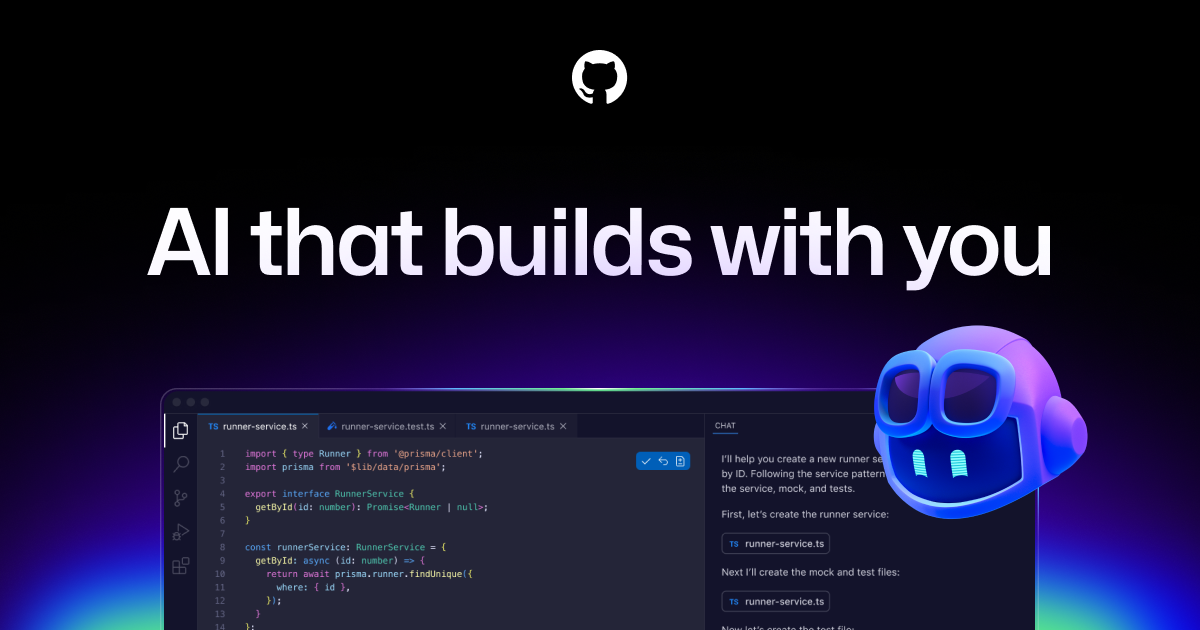
GitHub Copilot has four individual plans: Free, Pro, Pro+ and Max. Each includes a monthly pool of GitHub AI Credits, where one credit equals $0.01, per GitHub's plans page. Agent mode, code review, the cloud agent, Copilot CLI and the Copilot app consume those credits. Inline suggestions are unlimited on paid plans and do not draw from the pool.
That is a real change from the old premium-request model, and it is the reason Copilot now belongs in a subscription comparison with Claude and Codex. We cover the mechanics in our GitHub Copilot AI credits guide linked below.
Who it is for. Developers who live in VS Code, JetBrains or GitHub and want inline completion plus an agent, billed through the same GitHub account as their repos.
Key features
- Unlimited inline suggestions on Pro, Pro+ and Max. Free gets 2,000 completions a month.
- Monthly AI credits: Pro $15 total ($10 base plus $5 flex), Pro+ $70 ($39 plus $31 flex), Max $200 ($100 plus $100 flex), per GitHub's plans page. Flex allotments may change over time, GitHub says.
- Delegating tasks to third-party agents (Claude by Anthropic and OpenAI Codex, in preview) is listed as included on Pro+ and Max.
- A dollar budget for extra usage: a $10 budget covers 1,000 credits, per GitHub.
- Code review, the cloud agent and Copilot CLI inside the same pool.
Pros
- Cheapest paid entry here from a big vendor: $10 a month for Pro.
- Works inside the editor and on github.com, not only in a terminal.
- You can multiply a plan with a metered budget instead of upgrading a tier.
- Pro+ and Max can hand tasks to Claude and Codex agents, so one plan reaches several vendors.
Cons
- The credit pool is small on Pro. $15 of credits is not a day-long agent budget on a top model.
- Credit costs vary by model, so the same $39 goes further or shorter depending on what you pick.
- GitHub's plans page is inconsistent on Pro: a bullet list mentions third-party agents while the comparison table says they are not included on Pro. We followed the table and flag it here.
- OpenCode's docs list Copilot Chat as problematic with its Go endpoint, which is a niche but real compatibility note.
Benefits for your workflow
- If your team already pays GitHub, procurement is trivial.
- Completion is free of credits, so the pool is spent only on agent work.
- A hard budget protects you from surprise bills.
Pricing (as of November 25, 2026)
| Plan | Price (as of November 25, 2026) | What you get |
|---|---|---|
| Free | $0 | 2,000 completions per month, limited chat and agent usage |
| Pro | $10 per month | Unlimited suggestions; $15 total monthly credits ($10 base + $5 flex) |
| Pro+ | $39 per month | $70 total monthly credits ($39 + $31 flex); third-party agents included |
| Max | $100 per month | $200 total monthly credits ($100 + $100 flex); third-party agents included |
Free tier. Free plan: 2,000 completions and limited chat and agent usage per month.
Limits. Credit pool per plan; flex credits can change. Extra usage needs a budget you set.
Standout use case. Editor-first teams that want agents plus inline completion on one GitHub bill.
Skip it if. You live in the terminal and want a big, flat agent allowance. A credit pool with $0.01 credits rewards careful use, not marathon sessions.
Source: GitHub Copilot plans
7. Cursor
Cursor is now sold through the X Subscription, with Grok models in the bundle.
Cursor's pricing page now shows the plans of the X Subscription: Free, Plus, Premium, Super and Ultra, plus Teams and Enterprise. The page states that subscriptions are only sold directly through X Subscription Corp, and that no resellers are authorized. Every tier includes a pool of AI usage shared across Cursor and Grok, and the allowance refreshes weekly.
This is a big shift from the older Pro, Pro+ and Ultra structure. We walk through the change in our Cursor pricing guide. This section only covers what Cursor's own page says today.
Who it is for. Developers who want an AI editor plus Grok chat and image tools in one bundle, and who are comfortable with Grok models doing most of the work.
Key features
- A shared weekly usage pool for Cursor and Grok. Premium is 4x Plus, Super is 15x Plus and Ultra is 50x Plus, per the page.
- Plus includes Grok models only. Premium and above include generous Grok usage but no allowance for third-party models.
- Third-party models stay available in Cursor at API list price. You pay for what you use and can set spending caps.
- Cloud agents and automations, code hosting and AI code reviews from Premium up.
- Priority model access at peak times on Super, earliest access to new models on Ultra.
Pros
- The best editor experience in this list if you want an AI-native IDE.
- Spending caps for third-party models give you control.
- Weekly refresh means one heavy day does not drain the month.
- Entry price of $8 for Plus is low if Grok models are enough.
Cons
- Claude and GPT models are not covered by the plan allowance. Premium and above bill them separately at API list price, so the headline $30, $100 or $200 does not include them.
- The page mixes X features (premium checkmark, fewer ads, creator tools) into the same cards, which makes it harder to read as a coding purchase.
- Usage pool amounts are described as multiples (4x, 15x, 50x), not absolute numbers.
- Sold only through X Subscription Corp, so you cannot buy through a reseller or an app store you trust more.
Benefits for your workflow
- One account for editor, chat, image and agent tools.
- Cloud agents run work without your laptop awake.
- A route to Cursor if you already pay for X.
Pricing (as of November 25, 2026)
| Plan | Price (as of November 25, 2026) | What you get |
|---|---|---|
| Free | $0 | Limited agent and chat requests |
| Plus | $8 per month | Shared usage pool; Grok models only |
| Premium | $30 per month | 4x Plus usage; cloud agents; third-party models at API list price |
| Super | $100 per month | 15x Plus usage; priority access at peak times |
| Ultra | $200 per month | 50x Plus usage; earliest access to new models |
| Teams | $30+ per user per month | Team plan listed on the same page |
Free tier. Free tier with limited agent and chat requests.
Limits. A weekly-refreshing shared pool; top-offs available; third-party model usage billed separately.
Standout use case. Editor-first developers who accept Grok models as the default and pay for others as they go.
Skip it if. Your workflow depends on Claude or GPT models being covered by the flat fee.
Source: Cursor pricing
8. Google AI Pro and Ultra (Antigravity)
Google bundles Antigravity access into its consumer AI plans.
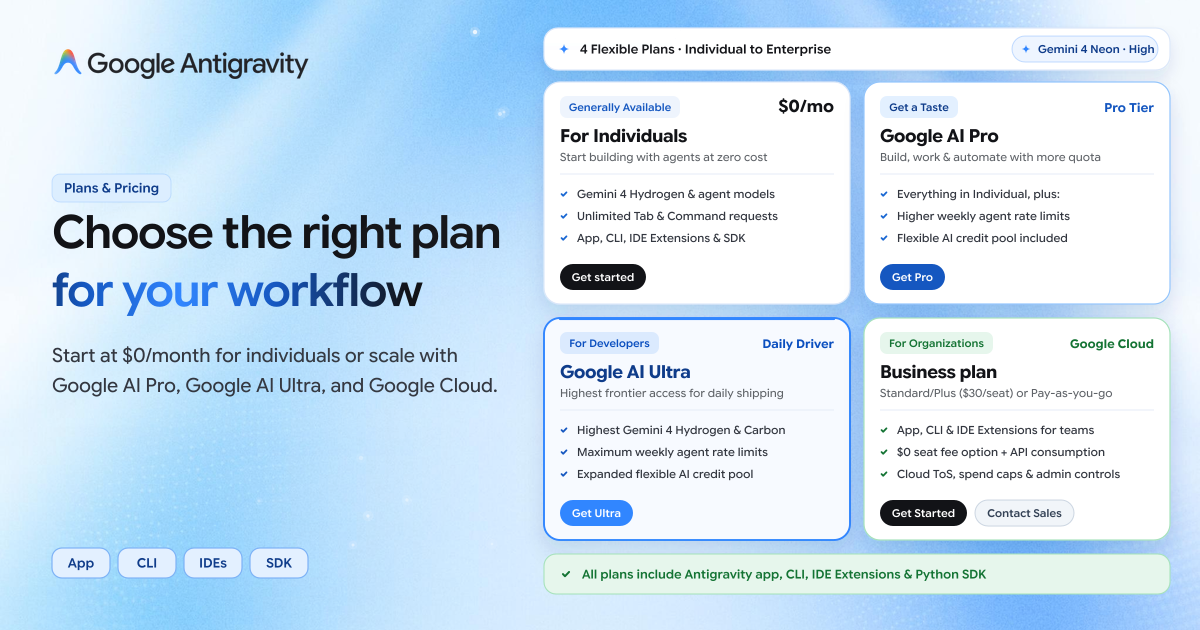
Google Antigravity is Google's agent-first coding product, with an app, CLI, IDE extensions and a Python SDK. You can start free, and the paid tiers are the same Google AI plans sold through Google One: AI Plus at $4.99 a month, AI Pro at $19.99 and AI Ultra from $99.99 (Google One's plan page). Google's own Antigravity pricing page says Pro gets a generous agent quota refreshed every 5 hours and higher weekly limits, and Ultra gets the highest quotas and maximum weekly limits.
Google AI Pro and Ultra need a personal Google account. Google's page says Workspace accounts should use a personal account, pay as you go with their own Cloud project, or set up Gemini Enterprise.
Who it is for. Developers who want Gemini models and Antigravity plus extras like cloud storage, and who want one consumer bill for AI and storage.
Key features
- The Antigravity app, CLI, IDE extensions and SDK on every tier, with parallel background agents, subagents and browser use.
- Free: baseline agent quota refreshed weekly. Pro: a 5-hour refreshed quota plus a higher weekly limit, with deep reasoning via /boost and optional AI credit overages.
- Models on Pro include Gemini 4 Neon, Carbon, Argon and Hydrogen, plus Claude Sonnet 5.5 and Opus 5.5 in thinking mode, per Google's page.
- Ultra adds the highest quotas and full access to third-party partner models. Google's page also says Ultra has 5x higher usage limits in Gemini than Pro.
- Google flags some models (Gemini 3.8 Flash, older Claude 4.6 and GPT-OSS) for removal on Nov 30, 2026. Check the pricing page footnotes if you depend on them.
Pros
- Third-party Claude models on a Google plan without a separate Anthropic bill.
- AI Pro bundles 5 TB of storage and other Google perks, per Google One.
- A free tier to try the whole product.
- Credit overages let you pay to continue instead of stopping.
Cons
- Quotas are described in words, not numbers, so there is no published request count.
- Model lineups change quickly, including removals on Nov 30.
- Workspace accounts cannot buy the consumer plans.
- A third-party source (fastero, Nov 12) said Antigravity does not support bringing your own key. We did not confirm that with Google.
Benefits for your workflow
- Storage, assistant and coding agent under one subscription.
- Easy to try on the free tier first.
Pricing (as of November 25, 2026)
| Plan | Price (as of November 25, 2026) | What you get |
|---|---|---|
| Free (Antigravity) | $0 | Baseline agent quota refreshed weekly |
| AI Plus | $4.99 per month | Google One plan; see Google's page for what it covers in Antigravity |
| AI Pro | $19.99 per month | 5-hour refreshed quota, higher weekly limits, Claude Sonnet 5.5 and Opus 5.5 (thinking) |
| AI Ultra | From $99.99 per month | Highest quotas; 5x Pro usage limits in Gemini; third-party partner models |
| Business | From $30 per seat per month, or pay as you go | Via Google Cloud and Gemini Enterprise |
Free tier. Free tier with a baseline agent quota that refreshes weekly.
Limits. 5-hour refreshed quota plus weekly limits on paid plans; AI credits cover overages.
Standout use case. Developers who want a free trial, Gemini models and Claude models behind one consumer subscription.
Skip it if. You need exact request numbers up front, or you work from a Workspace account.
Source: Antigravity pricing
9. Alibaba Cloud Coding Plan
A single $50 plan with explicit request numbers, but limited stock.
Alibaba Cloud Model Studio sells a Coding Plan that gives you Qwen, GLM, Kimi and MiniMax models inside popular coding tools for a fixed monthly fee. The doc, last updated Nov 4, 2026, says Lite stopped taking new subscriptions on March 20, 2026 and renewals ended April 13, 2026, so Pro is the only plan to buy.
Pro is $50 a month with up to 6,000 requests per 5 hours, 45,000 per week and 90,000 per month. The three caps apply at once, and whichever hits first pauses calls.
Who it is for. Developers who want a lot of requests across several open and Chinese frontier models, and who can use an international Alibaba Cloud account.
Key features
- Models listed on the doc: qwen3.7-plus, qwen3.6-plus, kimi-k2.5, glm-5 and MiniMax-M2.5, plus qwen3.5-plus as an extra.
- Works with OpenClaw, Hermes Agent, Claude Code, OpenCode, Cursor, Codex, Qwen Code, Cline and others, per the doc.
- A plan-specific API key (sk-sp-...) and a dedicated base URL; Anthropic-compatible and OpenAI-compatible endpoints.
- The 5-hour quota rolls minute by minute; weekly resets Monday 00:00 UTC+8.
- A quota counted in model calls: simple tasks use 5 to 10 calls, complex ones 10 to 30 or more, per the doc.
Pros
- Published numbers for 5-hour, weekly and monthly caps. This is the most transparent plan in the list.
- One price covers several model families.
- Anthropic-compatible endpoint means it works in Claude Code.
Cons
- Slots are limited and first-come, first-served, with restocks daily at 00:00 UTC+8. You may not be able to buy it when you want to.
- Non-refundable.
- Interactive use only. Automated scripts and backends violate the terms and can lead to suspension.
- The model versions listed are not the newest on other plans (for example kimi-k2.5 and glm-5), and the doc says unlisted versions are not supported.
- Using the general API key instead of the plan key leads to pay-as-you-go charges.
Benefits for your workflow
- A clear request budget you can plan against.
- Multi-vendor model access without juggling accounts.
- A single base URL to configure across tools.
Pricing (as of November 25, 2026)
| Plan | Price (as of November 25, 2026) | What you get |
|---|---|---|
| Pro | $50 per month | 6,000 requests per 5 hours; 45,000 per week; 90,000 per month |
| Lite | Closed to new subscribers since Mar 20, 2026 | Existing subscribers can use it until expiry |
Free tier. No free tier on the Coding Plan.
Limits. Three simultaneous caps (5-hour, weekly, monthly) plus concurrency and rate limits that Alibaba does not publish.
Standout use case. High-volume interactive use across several models when you can get a slot.
Skip it if. You need the newest Kimi or GLM versions, refunds, or any automated usage.
Source: Alibaba Cloud Coding Plan doc
10. OpenCode Go
A $10 subscription to a rotating catalog of open-weight and low-cost models.
OpenCode Go is a subscription from the team behind the OpenCode terminal agent. Its docs say it gives access to popular open coding models for a fixed monthly price, and it works in OpenCode, Claude Code, Codex and Pi. It is optional: you do not need it to use OpenCode itself.
There are three plans: Go at $10 a month, Go Plus at $40 and Go Teams at $20 per member with a 2-member minimum. The model list on the Go page showed 32 models on Nov 25, including Kimi K3.1 Pro, GLM-5.3, MiniMax-M3, Qwen4 Max and DeepSeek V4 Pro.
Who it is for. Developers who want the cheapest possible way to try many open models inside real agent harnesses, or small teams that want flat per-seat access.
Key features
- One shared allowance across all paid models. The 5-hour limit is 20% of the monthly allowance and the weekly limit is 50%, resetting Monday 00:00 UTC.
- Per-model monthly limits and estimated requests per 5 hours listed on the Go page. For example, GLM-5.3 shows a monthly limit of $200 on Go and $400 on Go Plus, while Kimi K3.1 Pro shows $15 and $60.
- Free models to fall back on when you hit a limit, or Extra Usage with console credit.
- Go Teams gives each member their own limits and one company bill, and the docs have pages for SSO and SCIM.
- Works with validated clients Claude Code, Codex, Hermes and Pi, per the Go page.
Pros
- Lowest entry price in this guide at $10.
- Works with Claude Code and Codex, so you keep your tools.
- Per-model numbers on the Go page are published, which is rare in this category.
- Cancel any time, per the Go page.
Cons
- The catalog and allowances change: OpenCode says usage limits may change as it learns from early usage.
- Some tools are listed as problematic, including GitHub Copilot Chat, Kimi Code and MiMo Code, per the docs.
- No Anthropic or OpenAI flagship models in the paid allowance. Claude Haiku 5.5 and GPT-6 Luna are the closest.
- Some entries are marked Limited time or Limited regions on the Go page, and OpenCode lists free models as limited-time too. Do not assume they stay.
- Go Teams has a 2-member minimum, so the smallest team bill is $40 a month.
Benefits for your workflow
- A low-risk way to evaluate GLM, Kimi, MiniMax, Qwen and DeepSeek without five separate subscriptions.
- Predictable cost with a safety net of free models.
- A good second plan next to a Claude or ChatGPT subscription.
Pricing (as of November 25, 2026)
| Plan | Price (as of November 25, 2026) | What you get |
|---|---|---|
| Go | $10 per month | Shared allowance across 32 models; 5-hour limit 20%, weekly 50% of monthly |
| Go Plus | $40 per month | Higher usage limits across the same models |
| Go Teams | $20 per member per month (2 members minimum, $40) | Each member gets their own limits, $5/month higher than Go on every model |
Free tier. Free models with a daily request limit are available even without Go.
Limits. Monthly dollar allowance per model, with 5-hour and weekly windows derived from it. Extra Usage can use console credit.
Standout use case. A cheap experimentation plan for open models inside Claude Code, Codex or OpenCode.
Skip it if. You need Claude Opus or GPT flagship quality included in a flat fee.
Source: OpenCode Go
we're bored we're just gonna do phase 2 now. $200 of GLM 5.3 usage for $10. have fun
— @opencode November 17, 2026
Pricing Table: Every Plan, Nov 25, 2026
Monthly prices unless noted. Annual discounts exist on some plans and are listed in the product sections.
| Product | Entry | Middle | Top |
|---|---|---|---|
| Claude | Pro $20 ($17 annual) | Max $100 | Ultra $200 |
| ChatGPT Codex | Go $8, Plus $20 | Pro $100 / $200 | Pro $500 |
| Z.ai GLM | Lite $18 | Pro $80 (third party) | Max $168 (third party) |
| Kimi Code | Plus $19 ($15 annual) | Pro $39 / Max $99 | Ultra $199 ($159 annual) |
| MiniMax | Go $22 ($220 a year) | Explore $55 | Build $132 |
| GitHub Copilot | Pro $10 | Pro+ $39 | Max $100 |
| Cursor | Plus $8 | Premium $30 / Super $100 | Ultra $200 |
| Google Antigravity | AI Plus $4.99, AI Pro $19.99 | n/a | AI Ultra from $99.99 |
| Alibaba Coding Plan | Pro $50 (only plan) | n/a | n/a |
| OpenCode Go | Go $10 | n/a | Go Plus $40 |
Feature Matrix
"No" means we found no vendor documentation saying yes. "Unverified" means we could not confirm either way on Nov 25.
| Product | Free tier | Native agent or app | Published numeric quotas | Overage option | Key works in other harnesses |
|---|---|---|---|---|---|
| Claude | Partial | Yes | No | Yes | No |
| ChatGPT Codex | Yes | Yes | Partial | Yes | No |
| Z.ai GLM | No | No | Yes | Unverified | Yes |
| Kimi Code | Yes | Yes | No | Unverified | Unverified |
| MiniMax | Yes | Yes | No | Partial | Yes |
| GitHub Copilot | Yes | Yes | Yes | Yes | Partial |
| Cursor | Yes | Yes | No | Yes | No |
| Google Antigravity | Yes | Yes | No | Yes | No |
| Alibaba Coding Plan | No | No | Yes | No | Yes |
| OpenCode Go | Partial | Yes | Yes | Yes | Yes |
Best For X: Decision Table
| Your situation | Look at | Reason |
|---|---|---|
| Long, hard sessions in one big repo | Claude Max or Ultra | First-party harness, Fable included up to 50% of weekly limit, no 5-hour wall on verified Ultra. |
| Background cloud tasks and PR review | ChatGPT Pro (Codex) | Cloud tasks, GitHub review and Slack are part of the bundle; Pro has no 5-hour limit. |
| Cheapest serious second plan | GLM Lite or OpenCode Go | $18 and $10 respectively, both usable behind tools you already know. |
| Planning around real numbers | Alibaba Pro or OpenCode Go | Both publish per-window or per-model figures, which most vendors do not. |
| Editor-first work | Cursor or GitHub Copilot | Both live inside the editor. Copilot is cheaper to enter; Cursor bills third-party models separately. |
| Coding plus research and slides | Kimi membership | Coding is one feature in a general membership. |
| Coding plus video, image and speech | MiniMax M Plan | Media generation is part of the same bill. |
| A free trial before paying | Google Antigravity, ChatGPT Free, Copilot Free | All three have a free path; Claude's Free plan excludes Claude Code. |
Buying Checklist
- Write down your real weekly hours with an agent. A Pro or Plus plan is enough for ten focused hours; sustained daily use is where $100 tiers earn their price.
- Check whether chat and coding share a pool. On Claude and ChatGPT they do, so count both.
- Look for the unit: messages, requests, credits or dollars. You cannot compare tiers until you convert to one unit.
- Find out what happens at the limit: pause, free models, credits at API rates, or a bill.
- Check which tools are allowed. GLM and Alibaba restrict you to supported tools, and Alibaba bans automated use.
- Read the cancellation and refund terms before paying annually. Alibaba is non-refundable and GLM gives no refunds.
- Start monthly. Several vendors changed plans, names and limits in the last two months, so annual prepay is a bet on stability.
- Re-read the pricing page on the day you buy. Everything here is dated Nov 25, 2026.
Common Mistakes
- Comparing sticker prices instead of usage. A $10 plan with a tiny credit pool can cost more per task than a $100 plan you actually finish.
- Assuming a plan works in any tool. GLM and Alibaba state supported-tool rules, and OpenCode lists tools it has trouble with.
- Forgetting the shared pool. Claude Code spends the same allowance as chat; ChatGPT and Codex are moving to shared token usage in December.
- Treating promotions as the price. OpenCode's $200 GLM allowance and GLM-5.3-Flash's half-consumption offer are time-limited.
- Buying through a third party. Cursor says subscriptions are sold only by X Subscription Corp, and any other seller is unauthorized.
- Trusting launch-week capacity. Kimi's own page warned that K3.1 Pro requests may queue or fail at launch.
- Ignoring that model lists change. Google flags several models for removal on Nov 30, 2026.
FAQ
What is the best coding subscription in 2026?
There is no single winner. For heavy daily work in one repo, Claude Max or Ultra is the straightforward pick because Claude Code is first-party and Fable is included up to half your weekly limit. For background cloud tasks, ChatGPT Pro with Codex is the strongest bundle. For the cheapest second plan, GLM Lite at $18 or OpenCode Go at $10 are the usual choices. Pick by workflow, then by price.
Is Claude Max worth $100 a month for Claude Code?
It is worth it if you regularly hit Pro's limits. Max gives 5x Pro usage every five hours and every week, and includes Fable up to 50% of your weekly limit. If you code a few hours a week, Pro at $20 is enough. If you hit limits daily, Max or Ultra stops the interruptions. We did not benchmark outputs, so this is about limits, not model quality.
What changed with Claude's Max and Ultra plans?
Anthropic now sells Max at $100 and Ultra at $200. Its help center says the old Max 20x plan is now called Ultra, with no price change. Ultra gives 10x Pro weekly usage and, for verified accounts, no five-hour limit. Existing Max 20x subscribers moved to Ultra automatically.
How much do ChatGPT Pro plans cost, and which one includes Ultrafast?
OpenAI lists Pro at $100, $200 or $500 a month. Its Pro tiers help article says Ultrafast is available only on Pro 500, and that buying credits on Pro 100 or Pro 200 does not unlock it. Ultrafast uses your included usage at 8x the Standard rate.
Does the GLM Coding Plan work with Claude Code?
Yes. Z.ai's docs list Claude Code among supported tools, and for Claude Code you set the base URL to https://api.z.ai/api/anthropic. The plan is limited to officially supported tools, so using it in an unsupported tool breaks the usage policy.
How much is the GLM Coding Plan?
Z.ai's docs say plans start at $18 a month for Lite. Pro at $80 and Max at $168 come from third-party price trackers, because we could not load the official subscribe page. Credit quotas from the docs are 2,000, 12,000 and 28,000 per five hours, and 10,000, 60,000 and 140,000 per week.
Is Kimi Code sold separately from the Kimi membership?
On Kimi's pricing page it appears as a feature of the Plus, Pro, Max and Ultra memberships, at $19, $39, $99 and $199 a month, or $15, $31, $79 and $159 a month billed annually. We did not find a coding-only plan.
What does the MiniMax M Plan cost?
Go is $22 a month ($220 a year), Explore is $55 ($550 a year) and Build is $132 ($1,320 a year), per MiniMax's page. Explore is 3x Go's usage and Build is 7.5x.
Is GitHub Copilot still worth it next to Claude and Codex?
Pro at $10 is the cheapest paid on-ramp here and includes unlimited inline suggestions. The agent features draw from a small credit pool ($15 on Pro), so heavy agent use favors Pro+ ($70 in credits for $39) or Max ($200 in credits for $100). Pro+ and Max can also delegate tasks to Claude and Codex agents.
Why is Cursor priced through the X Subscription?
Cursor's pricing page now shows Free, Plus ($8), Premium ($30), Super ($100) and Ultra ($200) tiers sold by X Subscription Corp, with a usage pool shared across Cursor and Grok. Third-party models are billed at API list price on top. Our Cursor pricing guide covers the change in more detail.
Can I use Google AI Pro for Claude models in Antigravity?
Google's pricing page says paid Google AI Pro subscriptions include Claude Sonnet 5.5 and Claude Opus 5.5 in thinking mode, while trial subscriptions get older Claude 4.6 models. Several older models are flagged for removal on Nov 30, 2026.
Is the Alibaba Coding Plan still available?
Only the Pro plan at $50 a month. Lite closed to new subscriptions on March 20, 2026. Slots are limited and restocked daily at 00:00 UTC+8, and the service is non-refundable.
What is OpenCode Go and does it work with Claude Code?
OpenCode Go is a $10 monthly subscription (Go Plus is $40) to a catalog of open-weight and low-cost models. Its page says it works in OpenCode, Claude Code, Codex and Pi. Its docs also list some tools as problematic, including GitHub Copilot Chat, Kimi Code and MiMo Code.
Should I buy an annual plan?
Probably not yet. Claude, ChatGPT, Kimi, MiniMax, Copilot, Cursor, Alibaba and OpenCode all changed names, limits or catalogs in the past two months. Kimi, MiniMax and Claude Pro offer annual discounts, but Claude Max and Ultra bill monthly only, and Alibaba and GLM are non-refundable.
Sources
All prices and limits were read from these pages on Nov 25, 2026 unless a section says otherwise.
- Claude plans and pricing
- Claude help: What is the Ultra plan?
- Claude help: Use Claude Code with your Pro, Max, or Ultra plan
- Claude help: Claude Fable models on your plan
- OpenAI Codex pricing
- ChatGPT release notes (OpenAI Help Center)
- Z.ai GLM Coding Plan docs
- Z.ai GLM Coding Plan FAQ
- Z.ai GLM Coding Plan usage policy
- Kimi membership pricing
- Kimi Code
- MiniMax M Plan
- GitHub Copilot plans
- Cursor pricing
- Google Antigravity pricing
- Google AI plans (Google One)
- Alibaba Cloud Model Studio Coding Plan
- OpenCode Go
- OpenCode Go docs
- OpenCode changelog: Go Teams
Further reading on this site