Get the latest on AI, LLMs & developer tools
New MCP servers, model updates, and guides like this one — delivered weekly.
The Short Answer
Start with OpenCode. It is MIT licensed, has the most GitHub stars in this comparison (229,411 on Nov 27, 2026), works with free models without an account, and has the most detailed permission rules. Choose Pi if you want a minimal harness you extend yourself, Qwen Code if you want plan mode, sub-agents, skills and SDKs documented in an Apache-2.0 CLI, Goose if you want one agent for code and non-code work, and Aider if you want every change as a git commit and accept a slow release cadence. That ranking is our editorial judgment from documentation and GitHub data, not a benchmark.
The category moves fast and the labels are confusing. OpenCode and Goose have both moved GitHub organizations, Pi has moved to a new GitHub organization, Kilo CLI is a fork of OpenCode, and Open Interpreter is now a fork of OpenAI's Codex. One popular name, Crush, is not open source under the OSI definition. This guide sorts that out, gives each tool a full section with pros, cons and pricing, and says plainly where a claim could not be verified. If you want vendor-built agents instead, read our Claude Code, Codex, Gemini CLI and Copilot CLI comparison, and for a wider market view see Best AI Coding Agents in 2026.
A third-party video comparing OpenCode with Claude Code on cost and quality, by Rob Shocks. We did not produce it and have not verified its conclusions, and details such as prices may have changed since it was recorded.
Quick Picks
| Category | Pick | Why |
|---|---|---|
| Best overall open-source terminal agent |  OpenCode | MIT license, 229,411 stars, free models with no account, fine-grained permissions, and desktop, mobile and SDK surfaces around one core. |
| Best if you want to build your own harness |  Pi | Deliberately minimal: extensions, skills, prompt templates and tree-structured sessions, with sub-agents, plan mode and permission popups left to you. |
| Best polished terminal UI |  Crush | Charm's TUI with LSP context, MCP, Agent Skills and permission prompts. Source-available under FSL-1.1-MIT, not OSI open source. |
| Best general-purpose agent beyond code |  Goose | Apache-2.0, Linux Foundation project, desktop app plus CLI, 85+ providers, local models loaded in-process. |
| Best with a bundled model subscription |  Qwen Code | Apache-2.0 CLI with plan mode, sub-agents, skills, headless mode and SDKs; sign in with a Qwen subscription or an API key. |
| Best if you already use Cline in VS Code |  Cline CLI | Same agent core as the extension, with a plan/act TUI, one-shot mode and JSON output for scripts. |
| Best for git-centric pair programming |  Aider | Auto-commits every change, architect and ask modes, 100+ languages. Last GitHub release was Aug 9, 2025, so expect slow change. |
| Best Rust agent with sandboxing and receipts |  CodeWhale | MIT Rust agent that started as DeepSeek TUI, with sub-agents, fleets, OS sandboxing and an undo/receipts trail. |
| Best for a team with IDE plus CLI |  Kilo CLI | OpenCode fork inside Kilo's VS Code, JetBrains and CLI platform. Owned by Anaconda since July 2026. |
| Best for self-hosted agent automation |  OpenHands | 94,421 stars, MIT, now framed as Agent Canvas, a self-hosted control center rather than a pure terminal tool. |
| Best for cheap models in a Codex-style harness |  Open Interpreter | Rust rewrite based on OpenAI Codex, tuned for low-cost models, Codex SDK compatible. |
“Best budget” is not a single answer here. Every agent in this list is free to install, so the real cost is the model behind it. See the pricing table and the model bill section below.
What Counts as Open Source Here
Ten of the eleven tools use an OSI-approved license, according to the GitHub API on Nov 27, 2026. OpenCode, Pi, Kilo, OpenHands and CodeWhale are MIT. Goose, Qwen Code, Cline, Aider and Open Interpreter are Apache-2.0. The exception is Crush.
Crush ships under the Functional Source License, FSL-1.1-MIT. GitHub shows it as “Other”. The license permits any purpose except Competing Use, and each version converts to the MIT license on the second anniversary of that version's release date. That is a source-available license, not an OSI open-source one. For an individual developer the practical difference is small. For a company that sells a competing coding product, or one whose policy only allows OSI licenses, it is the deciding factor. We include Crush because readers search for it, and we label it throughout.
We also checked three vendor-built reference points. OpenAI's Codex CLI (136,584 stars) and Google's Gemini CLI (109,197 stars) are Apache-2.0. Anthropic's anthropics/claude-code repository (157,221 stars) shows no license in the GitHub API, so we do not call it open source. Open source also does not mean the model is free or local: all of these tools send your code to whichever model provider you configure.
Master Comparison Table
Stars, license, language and latest release come from the GitHub API on Nov 27, 2026. For monorepos, the star count covers the whole repository, which is flagged in the table. Install commands appear as published in each README.
| Tool | License | GitHub stars | Latest release | Language |
|---|---|---|---|---|
| OpenCode | MIT | 229,411 | v1.19.6 (Nov 17, 2026) | TypeScript |
| Pi | MIT | 124,073 | v1.6.1 (Nov 25, 2026) | TypeScript |
| Crush | FSL-1.1-MIT (source-available) | 29,214 | v0.103.0 (Nov 26, 2026) | Go |
| Goose | Apache-2.0 | 57,041 | v1.61.1 (Nov 26, 2026) | Rust |
| Qwen Code | Apache-2.0 | 30,964 | v0.28.7 (Nov 26, 2026) | TypeScript |
| Cline CLI | Apache-2.0 | 71,928 (whole Cline repo) | v4.1.28 (Nov 26, 2026) | TypeScript |
| Aider | Apache-2.0 | 50,276 | v0.86.0 (Aug 9, 2025) | Python |
| CodeWhale | MIT | 41,219 | v0.10.4 (Nov 23, 2026) | Rust |
| Kilo CLI | MIT | 28,140 (whole Kilo repo) | v7.8.32 (Nov 20, 2026) | TypeScript |
| OpenHands | MIT | 94,421 | v1.46.0 (Nov 25, 2026) | TypeScript |
| Open Interpreter | Apache-2.0 | 68,973 (includes the old Python project) | rust-v0.0.64 (Nov 26, 2026) | Rust |
Install commands
| Tool | Install (from the README) |
|---|---|
| OpenCode | curl -fsSL https://opencode.ai/v2/install | bash |
| Pi | curl -fsSL https://pi.dev/install.sh | sh |
| Crush | brew install charmbracelet/tap/crush |
| Goose | curl -fsSL https://github.com/aaif-goose/goose/releases/download/stable/download_cli.sh | bash |
| Qwen Code | npm install -g @qwen-code/qwen-code@latest |
| Cline CLI | npm install -g cline |
| Aider | python -m pip install aider-install && aider-install |
| CodeWhale | curl -fsSL https://codewhale.net/install.sh | sh |
| Kilo CLI | npm install -g @kilocode/cli |
| OpenHands | Docker (see README for Agent Canvas) |
| Open Interpreter | curl -fsSL https://www.openinterpreter.com/install | sh |
Several of these install scripts pipe a remote file into a shell. That is normal in this category, but read the script first on a machine you care about, or use the npm or Homebrew route where one is offered.
Pricing Table
The agents are free. What you pay for is model access, and a few vendors sell it. Figures below are as of Nov 27, 2026 and come from the vendor pages named in the last column. Where a price was not captured, we say so instead of guessing.
| Tool | Software cost | Model and plan costs | Source |
|---|---|---|---|
| OpenCode | Free (MIT) | Free models need no account (list rotates). Go $10/mo, Go Plus $40/mo. Zen pay-per-token, for example Claude Opus 5.5 at $4 in / $20 out per 1M tokens (Zen price table). | opencode.ai/go, /zen |
| Pi | Free (MIT) | Pay your model provider. No hosted plan found on pi.dev. | pi.dev |
| Crush | Free (FSL-1.1-MIT) | Bring your own key or use Charm Hyper (subscription and prepaid). Hyper prices not captured. | charm.land, README |
| Goose | Free (Apache-2.0) | Pay your model provider, or run a local model. No hosted plan found in the README or quickstart. | goose-docs.ai |
| Qwen Code | Free (Apache-2.0) | Sign in with a Qwen Plus or Pro subscription, or use an API key. Subscription prices not captured. | README |
| Cline CLI | Free for individuals (Apache-2.0) | Inference at cost or bring your own key. Enterprise is custom pricing. | cline.bot/pricing |
| Aider | Free (Apache-2.0) | Pay your model provider. | aider.chat |
| CodeWhale | Free (MIT) | Pay your model provider, or run local models (the README screenshot uses Ollama). | README |
| Kilo CLI | Free platform plan ($0) | Teams $15/user/month. Kilo Pass $19, $49 or $199/mo. Gateway at provider rates, with a 5% credit purchase fee. | kilo.ai/pricing |
| OpenHands | Free to self-host (MIT) | Teams $500/month for 10 users (+$50/mo per extra seat, 30-day trial, 5,000 sessions/month cap). Enterprise custom. | openhands.dev/pricing |
| Open Interpreter | Free (Apache-2.0) | Pay your model provider. No hosted plan found in the README. | README |
Feature Matrix
“Yes” means the README or official docs we read state it. “n/s” means not stated in those pages, which is not the same as unsupported. “No (by design)” for Pi is the project's own stated choice.
| Tool | MCP | Sub-agents | Plan or read-only mode | Permission prompts | AGENTS.md | Skills | Headless or SDK |
|---|---|---|---|---|---|---|---|
| OpenCode | Yes | Yes | Yes | Yes | Yes | Yes | SDK yes |
| Pi | Yes | No (by design) | No (by design) | No (by design) | Yes | Yes | Yes |
| Crush | Yes | n/s | n/s | Yes | Yes | Yes | n/s |
| Goose | Yes | n/s | n/s | n/s | n/s | n/s | ACP yes |
| Qwen Code | Yes | Yes | Yes | Yes | Yes | Yes | Yes |
| Cline CLI | Yes | Yes | Yes | Yes | n/s | n/s | Yes |
| Aider | n/s | n/s | Partial (ask, architect) | n/s | n/s | n/s | n/s |
| CodeWhale | Yes | Yes | Yes | Yes | Yes | Yes | Yes |
| Kilo CLI | Yes | n/s | Yes (Plan agent) | n/s | n/s | Yes | n/s |
| OpenHands | n/s | n/s | n/s | Docker sandbox | n/s | n/s | Agent Server |
| Open Interpreter | Yes | n/s | n/s | Yes | Yes | Yes | Yes (exec, ACP) |
If MCP is central to your workflow, our guide to MCP servers lists servers worth adding to any agent that supports the protocol.
1. OpenCode: the default pick
OpenCode is an MIT-licensed coding agent with a terminal interface at its core and a desktop app (beta), a mobile app and an SDK around it. The GitHub repository now lives at anomalyco/opencode and was previously sst/opencode; GitHub redirects the old name. On Nov 27, 2026 it had 229,411 stars, about 31,240 forks and a push the day before, which makes it the most-starred project in this comparison. Its site says the current version is OpenCode v2, while the latest GitHub release tag we saw was v1.19.6 from Nov 17, 2026, so confirm which line you are installing.
The README describes two built-in agents: build, a full-access agent for development work, and plan, a read-only agent for analysis and code exploration. The docs describe MCP servers you can add with opencode mcp add, with OAuth for remote servers, and an ordered permissions system where each rule has an action, a resource and an effect of allow, deny or ask. The last matching rule wins, and if nothing matches OpenCode asks. A policy layer can hard-deny commands for a whole organization.
Cost is where OpenCode stands out. The site says you can start with free models and no account, bring any of 200+ providers, or use its own plans. The home page lists Big Pickle and DeepSeek V4.1 Flash Free as today's free models, while the Zen docs list more (for example MiMo-V2.6-Flash Free and two NVIDIA Nemotron free endpoints). The docs say several of them are free for a limited time. Their privacy section says Big Pickle, Tidepool Alpha Free, Iceman Free and Flint 40B Free may use collected data to improve the model during the free period, and that the NVIDIA Nemotron free endpoints are for trial use only, log usage and should not receive personal or confidential data. You can also log in with a ChatGPT Plus or Pro plan or GitHub Copilot instead of paying for API keys, per the site.
| License / language | MIT; TypeScript |
| Stars / latest release | 229,411 stars; v1.19.6 (Nov 17, 2026) on GitHub, site says v2 is current |
| Install | curl -fsSL https://opencode.ai/v2/install | bash; npm i -g @opencode/cli@latest; brew install anomalyco/tap/opencode-v2 |
| Surfaces | Terminal, desktop app (beta; macOS, Windows, Linux), mobile app (public beta), SDK |
| Vendor claim (unverified) | "Trusted by 22M+ developers" on opencode.ai; we could not check it |
Key features
- Build and plan agents, custom Markdown agents, and sub-agents that run in child sessions with their own permissions
- MCP servers added from the CLI, OAuth for remote servers, /mcps panel
- Ordered allow, deny and ask permission rules plus organization policies
- Free models, OpenCode Go subscription and OpenCode Zen pay-per-token gateway
- Works with 200+ providers per the site; Go also works with Claude Code, Codex, Hermes and Pi
Pros
- MIT license and the largest community here, so fixes and plugins appear quickly
- Granular, documented permission rules instead of one yolo switch
- Free models mean you can try it with no account and no card
- One project covers terminal, desktop, mobile and SDK use
Cons
- Fast-moving: V1 and V2 use different config names (the permissions docs say V2 uses permissions, shell and subagent instead of permission, bash and task)
- Free model lists rotate, and some free endpoints log your data or use it to improve the model
- Mixed version signals between the site (v2) and the latest GitHub release tag (v1.19.6)
- Headline user numbers come from the vendor, not an independent source
Benefits for you. You get a capable agent without being tied to one model company: swap providers, use a flat plan or free models, and keep strict control over what the agent may run. The same project powers several other tools here, so skills you learn carry over.
Pricing. The agent is free. OpenCode Go is $10 per month and Go Plus is $40 per month, both with per-model allowances counted over five-hour, weekly and monthly windows (as of Nov 27, 2026). Zen is pay-per-token, for example Claude Opus 5.5 at $4 input and $20 output per 1M tokens. We did not record other Zen prices.
Standout use case. A team that wants one agent for the terminal, the desktop and CI, with free models for experiments and a flat plan for daily work.
Skip it if. Skip it if you need a frozen, slow-changing tool, or if you only want a small agent you assemble yourself (see Pi).
MiniMax M3.1 Flash is now free in OpenCode
— @opencode November 10, 2026
Operation GLM Phase 1 $100 of GLM 5.3 usage for $10 available to all OpenCode Go subscribers
— @opencode November 17, 2026
we're bored we're just gonna do phase 2 now $200 of GLM 5.3 usage for $10 have fun
— @opencode November 17, 2026
2. Pi: the minimal harness you extend
Pi describes itself as a minimal agent harness: adapt Pi to your workflows, not the other way around. The repository is earendil-works/pi (GitHub shows it was previously badlogic/pi-mono), MIT licensed, with 124,073 stars on Nov 27, 2026 and v1.6.1 released Nov 25. The product site is pi.dev and the npm package is @earendil-works/pi-coding-agent. It needs Node.js 22.19 or newer, though the installers can fetch it.
The philosophy is explicit on the site. Pi ships with strong defaults but skips features that other tools bake in. Its "what we didn't build" list names sub-agents, permission popups, plan mode, built-in to-dos and background bash, and suggests tmux, files like TODO.md, containers, extensions or installable packages instead. MCP used to be on that list; the page now says MCP is built in, along with a Codemode feature that lets agents compose tool calls in a JavaScript sandbox.
Customization is the point. Extensions, skills, prompt templates and themes can be bundled as Pi packages and shared through npm or git. Sessions are stored as trees you can navigate with /tree, export to HTML with /export, or upload to a GitHub gist with /share. It loads AGENTS.md and an optional SYSTEM.md, auto-compacts older messages, and has four modes: interactive, print/JSON, RPC and SDK. The maintainers announced Pi 1.0 on X on Oct 1, 2026.
| License / language | MIT; TypeScript |
| Stars / latest release | 124,073 stars; v1.6.1 (Nov 25, 2026) |
| Install | curl -fsSL https://pi.dev/install.sh | sh; npm install -g --ignore-scripts @earendil-works/pi-coding-agent |
| Providers | 15+ listed, including Anthropic, OpenAI, Google, Bedrock, OpenRouter and Ollama; API keys or OAuth |
Key features
- Tree-structured sessions with /tree, /export and /share
- AGENTS.md, SYSTEM.md, skills, prompt templates and automatic compaction
- Extensions and packages that can change tools, providers and UI, with /reload to apply them live
- Four modes: interactive, print/JSON, RPC and SDK
- Sandbox patterns documented: Gondolin micro-VM extension and OpenShell
Pros
- Small core you can understand, with features added only when you want them
- Model switching mid-session with /model or Ctrl+L
- Strong fit for scripting and embedding through RPC and SDK modes
- MIT license and a very large star count for a new project
Cons
- No sub-agents, plan mode or permission popups by default; you must build or install them
- Running without approval prompts is risky unless you contain it in a container or sandbox
- Less hand-holding than OpenCode or Qwen Code for people who just want to start coding
- Created Aug 2025, so the ecosystem of packages is young
Benefits for you. If you like understanding your tools, Pi lets you decide exactly what enters the context window and which behaviors exist. That makes it a good base for personal workflows and for embedding an agent in your own product.
Pricing. Free and open source. You pay only your model provider. We found no hosted plan on pi.dev as of Nov 27, 2026.
Standout use case. A developer who wants a custom agent, for example one that mimics a plan mode or sub-agent flow the way they like it, without forking a large codebase.
Skip it if. Skip it if you want guardrails out of the box. If you want a terminal agent with subagents, LSP and memory already built in, see our separate Oh My Pi guide.
People of Pi: We've shipped Pi 1.0 with Pi Durable. Go make them yours.
— @pidotdev October 1, 2026
For a terminal agent with more built in, see our Oh My Pi guide.
3. Crush: the polished TUI, with a license caveat
Crush is the terminal coding agent from Charm; its README says it is built on the Charm ecosystem of terminal libraries. It had 29,214 stars on Nov 27, 2026, is written in Go, and was at v0.103.0 (Nov 26, 2026). The license matters: LICENSE.md is the Functional Source License, FSL-1.1-MIT, and GitHub reports it as Other. FSL allows any purpose except Competing Use, and each version converts to the MIT license on the second anniversary of its release date. That is source-available, not OSI open source.
In practice, a developer using Crush to write their own software is unaffected. The restriction matters to companies building a competing product, and to anyone whose policy requires an OSI-approved license. If that is you, prefer OpenCode, Goose, Qwen Code or Aider.
On features, the README lists multi-model support, LSP-enhanced context, MCP servers, Agent Skills, session management and project instructions via AGENTS.md. Crush asks permission before tool calls by default; you can allowlist specific tools with the permissions command, or start with --yolo to skip prompts (use it with care, as the README itself says). Read-only shell commands such as ls and git status run without a prompt. Experimental Claude Channels let MCP servers push events such as CI failures or webhooks into your session. Charm also runs Hyper, its model provider built on open-weight models, with subscription and prepaid options and zero data retention; we could not capture Hyper's prices from the vendor page, so we do not quote them.
| License / language | FSL-1.1-MIT (source-available); Go |
| Stars / latest release | 29,214 stars; v0.103.0 (Nov 26, 2026); created May 21, 2025 |
| Install | brew install charmbracelet/tap/crush; npm i -g @charmland/crush |
| Models | Bring your own API key, or use Charm Hyper |
Key features
- LSP integration for extra code context
- MCP servers and experimental Claude Channels
- Agent Skills and AGENTS.md instructions (global file at ~/.config/AGENTS.md)
- Permission prompts, tool allowlists and a --yolo flag
- Charm Hyper model provider with zero data retention options
Pros
- Probably the best-looking terminal interface in this list
- Permission prompts on by default, with a tool allowlist and a parser that only auto-runs provably read-only shell commands
- Active release cadence from an established terminal-tools company
- Works with your own keys, so you are not forced to use Hyper
Cons
- Source-available FSL license, not OSI open source
- Version 0.x, so behavior and config can still shift
- Hyper prices were not captured when we checked, so cost is harder to estimate
- Smaller community than OpenCode or Pi (29k versus 229k and 124k stars)
Benefits for you. You get a fast, attractive TUI with sensible default safety and LSP context, and a vendor that ships often. For individual developers the license is rarely a practical obstacle.
Pricing. Crush itself is free to use. Model costs depend on the provider you choose; Hyper has subscription and prepaid options per the README, but we could not capture its prices as of Nov 27, 2026.
Standout use case. A developer who lives in the terminal, values a polished UI and wants MCP and skills without much setup.
Skip it if. Skip it if your legal team requires an OSI-approved license, or if you build tools that compete with Charm's.
Crush now supports SSH passphrase prompts and GPG Pinentry, right in the terminal.
— @charmcli November 20, 2026
Meet Prism, a specialized 8B model trained to route coding tasks to the right model in real time. Prism chooses fast cost-efficient models for the easy stuff and bigger, smarter models for the hard stuff. We're seeing upwards 45% lower inference costs. Now live on Charm Hyper.
— @charmcli October 27, 2026
4. Goose: a general agent under the Linux Foundation
Goose started at Block and the repository is now aaif-goose/goose (GitHub shows block/goose as the earlier name). The README says goose is part of the Agentic AI Foundation (AAIF) at the Linux Foundation. It is Apache-2.0, written in Rust, had 57,041 stars on Nov 27, 2026 and v1.61.1 on Nov 26.
The README now leads with oi-kit, an Open Intelligence Kit of reusable Rust components for building your own agents, which it marks as alpha. Goose itself is described as a complete agent built with oi-kit: a general-purpose agent for coding, research, writing, automation and data analysis, with a native desktop app for macOS, Linux and Windows and a CLI. It connects tools through MCP, offers 85+ providers including Anthropic, OpenAI, Gemini, OpenRouter and Amazon Bedrock, and can load supported local models directly inside goose without Ollama or a separate inference server.
Goose can also be the agent behind your own application over the Agent Client Protocol (ACP), started as a subprocess. The quickstart walks through installing, configuring an LLM, building a small app and adding an MCP server. Compared with OpenCode or Qwen Code, Goose is less obviously a coding-first terminal tool, so check that its scope matches how you work.
| License / language | Apache-2.0; Rust |
| Stars / latest release | 57,041 stars; v1.61.1 (Nov 26, 2026); created Aug 23, 2024 |
| Install (CLI) | curl -fsSL https://github.com/aaif-goose/goose/releases/download/stable/download_cli.sh | bash |
| Providers | 85+ per the README, plus in-process local models |
Key features
- Desktop app and CLI from the same project
- MCP for tools and data, ACP for embedding as an agent backend
- In-process local models, no separate server needed
- oi-kit Rust toolkit (alpha) for building custom agents
- Foundation governance through AAIF at the Linux Foundation
Pros
- Apache-2.0 with neutral foundation stewardship
- Handles non-coding tasks such as research and automation as well as code
- Desktop app lowers the barrier for teammates who avoid terminals
- Local-model path that does not depend on Ollama
Cons
- Broader scope means less terminal-coding polish than a dedicated tool
- README emphasis has shifted to oi-kit (alpha), so docs and examples may be in transition
- We did not find plan mode, sub-agent or permission documentation in the pages we fetched, so those cells are marked not stated
- One goose docs page returned a server error during our check
Benefits for you. If your work mixes coding with research, data tasks and automations, you get one agent for all of it, with a real foundation behind the project and a desktop app for non-terminal users.
Pricing. Free and open source (Apache-2.0). You pay your model provider, or run local models. No hosted plan appeared in the README or quickstart as of Nov 27, 2026.
Standout use case. A team that wants one open agent for code and non-code tasks, or an embeddable ACP backend for an internal tool.
Skip it if. Skip it if you only want a lean coding agent with documented plan and sub-agent modes.
5. Qwen Code: the feature-dense Apache-2.0 CLI
Qwen Code comes from the Qwen team at Alibaba. The repository QwenLM/qwen-code is Apache-2.0, TypeScript, created Jun 26, 2025, with 30,964 stars and v0.28.7 released Nov 26, 2026. It is the most thoroughly documented tool in this list for agent features: the README calls out Auto-Memory, Skills, SubAgents and MCP as working from the first session, with Agent Teams, Agent Arena and Dynamic Workflows built in but experimental or opt-in.
Safety and control are covered too. The README lists plan mode and approval modes (plan read-only before touching files, then choose per-call confirmation, auto-edit or a classifier-driven Auto Mode), a sandbox and Git worktrees. It loads QWEN.md and AGENTS.md briefings. The README also says the project was originally based on Google's Gemini CLI v0.8.2, though it stopped syncing with upstream from v0.1. Beyond the interactive terminal, it offers headless runs with qwen -p, SDKs for TypeScript, Python and Java, and an experimental daemon (qwen serve) that exposes an HTTP and SSE interface over ACP.
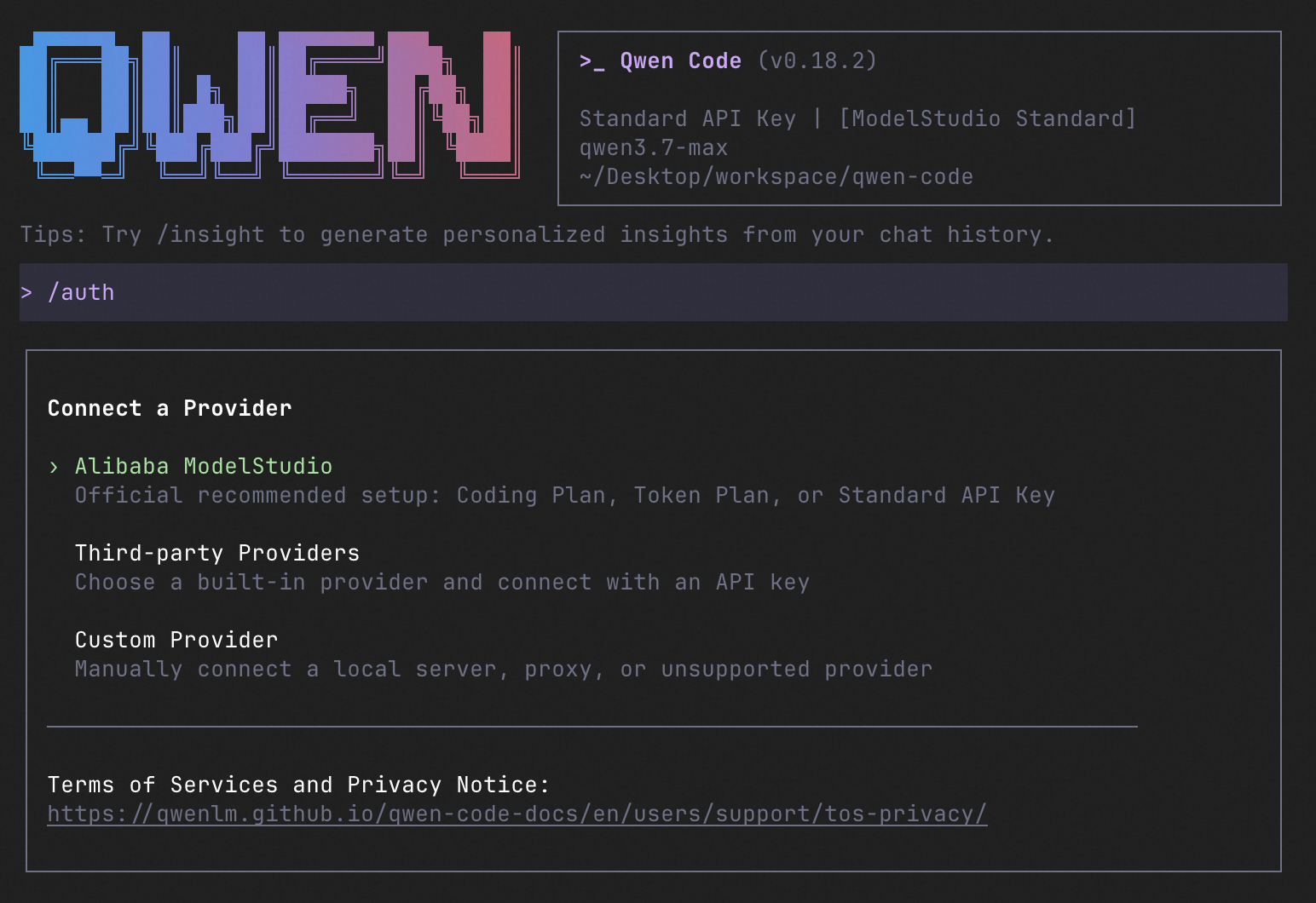
One warning from the README itself: by default the daemon listens on loopback without bearer authentication, so any local process that can reach it can use the full API, including code execution. On shared or untrusted hosts, set QWEN_SERVER_TOKEN and use --require-auth. For sign-in, run /auth and choose Qwen Account with Subscription (Plus or Pro) or configure a provider API key. We did not capture subscription prices.
| License / language | Apache-2.0; TypeScript |
| Stars / latest release | 30,964 stars; v0.28.7 (Nov 26, 2026) |
| Install | npm install -g @qwen-code/qwen-code@latest (Node 22+); brew install qwen-code; curl installer hosted on Alibaba OSS |
| Modes | Interactive, headless (qwen -p), SDKs, experimental web UI and daemon |
Key features
- Plan mode, approval modes, sandbox and Git worktrees
- SubAgents, Skills, Auto-Memory and MCP
- Dynamic Workflows (opt-in) where the model writes JavaScript to orchestrate agents
- TypeScript, Python and Java SDKs, plus headless mode for CI
- Reads QWEN.md and AGENTS.md
Pros
- Broadest documented feature set among the pure open-source CLIs here
- Apache-2.0 with frequent releases
- SDKs in three languages make automation straightforward
- Sign in with a Qwen subscription or use your own API key
Cons
- Version 0.x, and several headline features are experimental or opt-in
- Tightly associated with the Qwen ecosystem, though API keys are supported
- The experimental daemon needs authentication configured on shared hosts
- One recommended install script is hosted on an Alibaba OSS bucket, which some security teams will want to review
Benefits for you. You get plan mode, sub-agents, skills, sandboxing and SDKs in one open CLI, so you can move from interactive use to CI automation without changing tools.
Pricing. The CLI is free. You pay for a Qwen subscription (prices not captured) or for your own provider's API usage, as of Nov 27, 2026.
Standout use case. A developer who wants documented plan mode, sub-agents and SDK automation in an Apache-2.0 tool.
Skip it if. Skip it if you want a mature 1.0 release line, or if you distrust running an installer from a vendor-hosted bucket (use npm or Homebrew instead).
6. Cline CLI: the extension's agent in the terminal
Cline is best known as a VS Code extension, and its CLI shares the same agent core. The cline/cline repository is Apache-2.0, TypeScript, created Jul 6, 2024, with 71,928 stars and v4.1.28 on Nov 26, 2026. Note that the star count covers the whole repository, including the extension, not just the CLI.
The CLI README shows installation with npm install -g cline (platform binaries for macOS, Linux and Windows on arm64 and x64, so no Node runtime is needed at install time). Running cline opens an interactive TUI with a plan/act toggle, slash commands, file mentions and live tool approvals. A single prompt can be run with cline "...", piped input is supported, and cline --json streams NDJSON events for other tools. One-shot mode runs in yolo mode unless you pass --auto-approve false, which is easy to miss.
Provider options include signing in to Cline, using a ChatGPT subscription through the openai-codex provider, or your own key for Anthropic, OpenAI, Gemini, OpenRouter, Bedrock, Vertex and others. The CLI README also documents checkpoints with /undo to rewind workspace state, sub-agent spawning and agent teams for parallel work, and MCP support. On JetBrains the vendor's own pages differ: the README describes a JetBrains plugin but says Cline is not open-sourcing it, while the pricing page lists a JetBrains extension among the Enterprise features. Check before you plan around it.
| License / language | Apache-2.0; TypeScript |
| Stars / latest release | 71,928 (whole repo); v4.1.28 (Nov 26, 2026) |
| Install | npm install -g cline; nightly with cline@nightly |
| Auth | cline auth: Cline sign-in, ChatGPT subscription via openai-codex, OCA, or API keys |
Key features
- Plan and Act modes with live approvals in a TUI
- One-shot, piped and NDJSON output modes for scripts and CI
- Same agent core as the VS Code extension
- Sub-agent spawning and agent teams (cline --team-name)
- Checkpoints with /undo, plus MCP server support
Pros
- Familiar for anyone already using Cline in an editor
- Good scripting story with JSON output and headless use
- Apache-2.0 and free for individual developers
- Plan and act separation encourages review before edits
Cons
- One-shot mode defaults to yolo, so scripts can edit files without prompts
- Star count is shared with the extension, which inflates comparisons
- JetBrains plugin is not open source and is listed under Enterprise on the pricing page
- Sub-agents and teams are disabled in yolo one-shot mode unless you pass --act
Benefits for you. If your team already uses Cline in the editor, the CLI lets you reuse the same agent behavior in terminals, servers and pipelines.
Pricing. Free for individual developers (Open Source plan); inference is billed at cost or with your own key. Enterprise is custom-priced with SSO, SLA and centralized billing (cline.bot/pricing, as of Nov 27, 2026).
Standout use case. A VS Code user who wants the same agent in CI scripts and over SSH.
Skip it if. Skip it if you will script it without checking the yolo default, or if you need an open-source JetBrains plugin.
7. Aider: the git-first veteran, now slow-moving
Aider is the original open-source AI pair programmer in the terminal. Aider-AI/aider is Apache-2.0, Python, created May 9, 2023, with 50,276 stars and about 5,191 forks on Nov 27, 2026. Its README badges claim 6.8M installs and 15B tokens processed per week, which are vendor-reported numbers we could not verify.
The workflow is git-centric: Aider automatically commits changes with sensible messages, so you can diff and undo with ordinary git tools. It has chat modes you can switch between: code (edit files), ask (discuss but never change), architect (an architect model proposes changes and an editor model applies them) and help. The README lists support for 100+ languages, images and web pages as context, and linting and testing. The README also lists voice-to-code and a public LLM leaderboard on its site.
The maintenance picture needs honesty. The last GitHub release is v0.86.0 on Aug 9, 2025. PyPI lists aider-chat 0.86.2 uploaded Feb 12, 2026, and GitHub shows a push on May 22, 2026. The README quickstart still shows model examples such as Claude 3.7 Sonnet and o3-mini, which date it. The README we fetched does not mention MCP, sub-agents or AGENTS.md. Aider still works for its core job, but it is the slowest-moving project in this comparison apart from Plandex.

| License / language | Apache-2.0; Python |
| Stars / latest release | 50,276 stars; GitHub release v0.86.0 (Aug 9, 2025); PyPI 0.86.2 (Feb 12, 2026) |
| Install | python -m pip install aider-install, then aider-install |
| Modes | code, ask, architect, help (switch with /chat-mode) |
Key features
- Automatic git commits for every change
- Architect and editor model split
- 100+ programming languages
- Images and web pages as context
- Lint and test integration
Pros
- Simple, predictable and easy to review thanks to per-change commits
- Architect mode can pair a strong planner with a cheaper editor model
- Long track record and an active public LLM leaderboard on its site
- Permissive license
Cons
- Slow release cadence; last tagged release was over a year before this article
- No documented MCP, sub-agent, skills or AGENTS.md support in the README
- Less autonomous than modern agents: it edits files but does not orchestrate long tool-driven tasks
- README examples reference older models
Benefits for you. You get clean, reviewable git history and a small mental model. It suits developers who want to stay in control and read every diff rather than hand off a long task.
Pricing. Free and open source. You pay your model provider (as of Nov 27, 2026).
Standout use case. Careful, review-heavy edits on an existing repo where each AI change should be one commit.
Skip it if. Skip it if you need MCP tools, sub-agents or fully autonomous multi-step runs, or if release velocity matters to you.
8. CodeWhale: the DeepSeek TUI that grew up
CodeWhale is the new name of what began as deepseek-tui; the README says it started as deepseek-tui and stays backward compatible. The repository is codewhale-hq/Codewhale (GitHub redirects Hmbown/DeepSeek-TUI), MIT licensed, written in Rust, created Jan 19, 2026, with 41,219 stars and v0.10.4 on Nov 23, 2026. This is the topic record's "DeepSeek TUI" item, so we cover it under the current name.
The README calls it an open-source Rust coding agent for terminal, web and desktop, with any model, multi-agent fleets, OS sandboxing and verifiable receipts. It has an approval ladder, Ask, Accept Edits, Plan, Auto-Review and Full Access, where mutating shell commands prompt for approval. It offers /undo to revert the last turn, /receipts to review what happened, sub-agents, model-specific Fleets, MCP servers, skills, plugins and hooks, and it reads AGENTS.md automatically. It also loads Claude Code plugins, per the README.
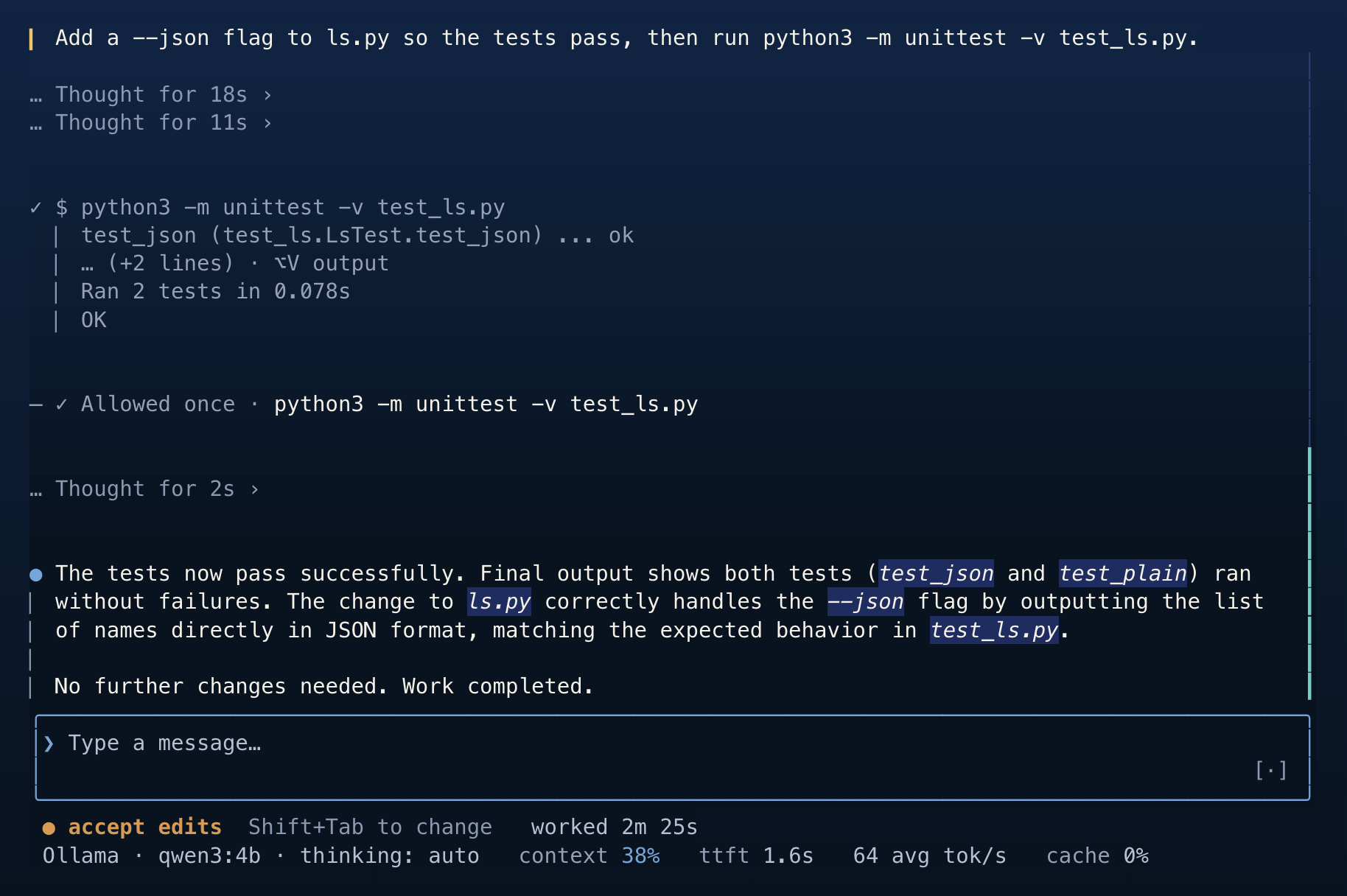
The README includes a screenshot captioned as a real session on published v0.10.4 running a local Ollama model (qwen3:4b) in Accept Edits mode, which shows the tool working with a small local model. It also lists /import-claude to bring over Claude Code settings and MCP servers, and a headless codewhale exec runner for scripts and CI. We covered the DeepSeek-focused origins in more depth in our CodeWhale guide.
| License / language | MIT; Rust |
| Stars / latest release | 41,219 stars; v0.10.4 (Nov 23, 2026) |
| Install | curl -fsSL https://codewhale.net/install.sh | sh; npm install -g codewhale; winget; cargo install codewhale-cli --locked |
| Modes | Ask, Accept Edits, Plan, Auto-Review, Full Access |
Key features
- Sub-agents, Fleets and workflow automation
- OS-level sandboxing and an approval ladder
- /undo and /receipts for rollback and audit
- MCP, skills, plugins and hooks
- Reads AGENTS.md; loads Claude Code plugins
Pros
- Rich safety features for an MIT-licensed tool
- Rust single binary with several install routes
- Works with local models as well as hosted ones
- Rapid iteration from a still-small team
Cons
- Version 0.x and rebranded, so docs and names may lag behind each other
- Smaller ecosystem than OpenCode, Pi or Cline
- A newer project (created January 2026) with a short track record
- cargo installs can trail GitHub releases, per the README
Benefits for you. You get a safety-conscious Rust agent that can be audited after the fact, which suits people who run agents on real repositories and want receipts and rollback.
Pricing. Free and open source. You pay your model provider or run a local model (as of Nov 27, 2026).
Standout use case. A DeepSeek or local-model user who wants sandboxing, undo and a clear permission ladder.
Skip it if. Skip it if you need a stable 1.x project or a large community of plugins.
Read the longer write-up in our CodeWhale DeepSeek terminal agent guide.
9. Kilo CLI: an OpenCode fork inside a platform
Kilo Code is an open-source agent for VS Code, JetBrains and the CLI. The New Stack reports it began as a fork of Roo Code and has since rebuilt its CLI and VS Code extension on OpenCode. Its README states that Kilo CLI is a fork of OpenCode, enhanced to work within the Kilo agentic engineering platform. The repository Kilo-Org/kilocode is MIT licensed, created Mar 10, 2025, with 28,140 stars (covering the extensions and the CLI) and v7.8.32 as the latest release on Nov 20, 2026. A banner on the README says main is not accepting new features and that feature pull requests should target the v2 branch.
On Jul 15, 2026 Anaconda announced it had acquired Kilo Code; The New Stack reported it the same day, and Kilo's pricing page now says Kilo has been acquired by Anaconda. Anaconda says Kilo remains available with no changes to existing products, plans or support, and that deeper integration is a direction, not a current capability. The press release cites more than 3 million developers, which is a vendor figure.
Pricing is more layered than the other tools here. The pricing page separates platform access ($0 for individuals, $15 per user per month for Teams, Enterprise custom), AI inference (provider rates, no markup through Kilo Gateway, with a 5% credit purchase fee) and an optional Kilo Pass. Kilo Pass tiers are Starter $19 per month (up to $26.60 in credits), Pro $49 (up to $68.60) and Expert $199 (up to $278.60), with bonus credits of up to 50% on top of the subscribed amount, per the page.
| License / language | MIT; TypeScript |
| Stars / latest release | 28,140 (whole repo); v7.8.32 (Nov 20, 2026) |
| Install (CLI) | npm install -g @kilocode/cli |
| Ownership | Acquired by Anaconda, announced Jul 15, 2026 |
Key features
- VS Code, JetBrains and CLI from one platform
- Plan agent that designs architecture before any code is written
- Kilo Marketplace for agents, skills, MCP servers and plugins
- Auto Model routing across Frontier, Efficient and Free tiers
- Gateway with 500+ models across 60+ providers, at provider rates
Pros
- Same editor and CLI experience across tools, useful for mixed teams
- Free platform tier and free-model routing for experiments
- Transparent split between platform, inference and credits
- Backed by a company with enterprise distribution
Cons
- A fork of OpenCode, so you are choosing a platform wrapper more than a different engine
- Pricing has several moving parts, plus a 5% credit purchase fee
- Repo in transition: main is not accepting new features while v2 is developed
- Ownership change means the roadmap may follow Anaconda's priorities
Benefits for you. If your team splits time between VS Code, JetBrains and the terminal, Kilo gives one account, one gateway and one set of agents across all three.
Pricing. Free platform plan; Teams $15 per user per month; Kilo Pass from $19 per month; inference at provider rates with a 5% credit purchase fee (kilo.ai/pricing, as of Nov 27, 2026).
Standout use case. A mixed IDE-and-terminal team that wants centralized billing and model access.
Skip it if. Skip it if you want the upstream OpenCode directly, or you are uneasy about a vendor in the middle of your model spend.
10. OpenHands: self-hosted agent control center
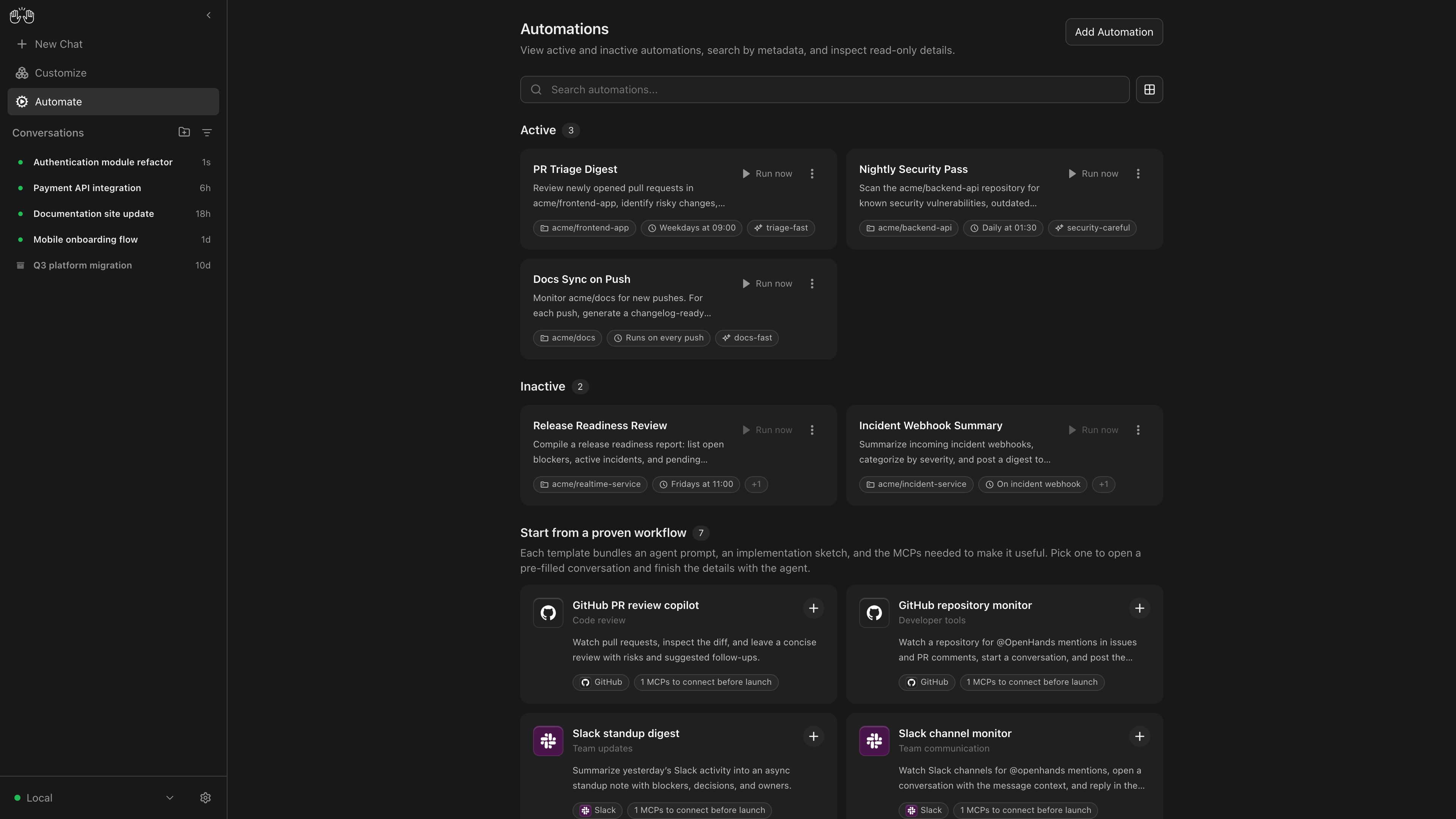
OpenHands is the largest project here after OpenCode and Pi: OpenHands/OpenHands is MIT licensed, TypeScript, created Mar 13, 2024, with 94,421 stars and v1.46.0 on Nov 25, 2026. It is also the least terminal-first. The README now presents Agent Canvas, described as a self-hosted developer control center for coding agents and automations, rather than a single command-line tool.
Agent Canvas runs locally by default, can connect to agent backends running in Docker containers, on VMs or in company infrastructure, and can optionally use OpenHands Cloud or Enterprise. It runs the open-source OpenHands agent out of the box but can also drive third-party agents such as Claude Code, Codex, Gemini CLI, Pi and OpenCode through the Agent Client Protocol (ACP). Automations, such as reports published to Slack, run on schedules or triggers.
We include it because many readers searching for an open-source coding agent will land on it, and because it solves a different problem: orchestrating and hosting agents for a team. If you want a quick terminal session, pick one of the tools above. If you want to run agents in sandboxes with an operations view, OpenHands is the open-source option with the most traction.
| License / language | MIT; TypeScript |
| Stars / latest release | 94,421 stars; v1.46.0 (Nov 25, 2026) |
| Run | Docker-based setup described in the README (Agent Canvas) |
| Backends | Local, Docker, VMs, OpenHands Cloud or Enterprise; ACP agents |
Key features
- Agent Canvas web control center with conversations and automations
- Backends: local, Docker sandbox, VM, remote
- ACP support for Claude Code, Codex, Gemini CLI, Pi, OpenCode
- Agent Server backend that a team can share
- Teams and Enterprise tiers for shared use
Pros
- Large community and MIT license
- Works as a layer over other agents, not only its own
- Sandboxed execution options suit untrusted repositories
- Clear path from self-hosting to a managed team plan
Cons
- Not a lightweight terminal tool; setup involves Docker
- The product emphasis has moved toward orchestration, so older tutorials may not match
- Teams plan is priced at $500 per month, which is steep for individuals
- Terminal and CLI usage is not the headline in the current README
Benefits for you. You can host agents on your own machines, watch several at once, automate recurring tasks and keep code inside your own infrastructure.
Pricing. Open source is free to self-host. Teams is $500 per month with 10 users included and $50 per month per extra seat, a 30-day trial and a cap of 5,000 sessions per month; Enterprise is custom (openhands.dev/pricing, as of Nov 27, 2026).
Standout use case. An engineering team that wants self-hosted, always-on agents with automations and a shared control center.
Skip it if. Skip it if you just want a terminal session today.
11. Open Interpreter: a Codex fork for cheap models
Open Interpreter used to be a Python project that let language models run code locally. The current repository, openinterpreter/openinterpreter, is a new Rust version: its README says it is based on Codex and is a fork of OpenAI's Codex, with a focus on emulating the agent harness that gets the best performance out of low-cost models. The original Python project lives on as a community-maintained fork (endolith/open-interpreter). The repository is Apache-2.0, with rust-v0.0.64 released Nov 26, 2026.
The star count of 68,973 includes the history of the original project, created Jul 14, 2023, so it overstates adoption of the new Rust agent. The README advertises ACP compatibility and Codex compatibility: if you build with the Codex SDK, a one-line codexPathOverride switch points it at the interpreter binary. It lists native sandboxing on macOS, Linux and Windows, MCP, skills, hooks, permissions and AGENTS.md, and it reuses shared .agents/skills directories. A /harness command switches between emulated harnesses; the README's list includes claude-code, kimi-code, qwen-code and deepseek-tui. It also ships a QA skill for driving web apps in a real browser.
A version number of 0.0.64 signals an early product. The pitch is specific: if you want to use cheaper open models and still get a competent harness, this is built for that. If you want maximum feature breadth today, one of the more established projects above is a safer bet.
| License / language | Apache-2.0; Rust |
| Stars / latest release | 68,973 (includes original project); rust-v0.0.64 (Nov 26, 2026) |
| Install | curl -fsSL https://www.openinterpreter.com/install | sh |
| Compatibility | ACP, Codex exec protocol, MCP, AGENTS.md, .agents/skills |
Key features
- Harness tuned for low-cost models
- Codex SDK compatibility with a one-line override
- Native sandboxing on macOS, Linux and Windows
- MCP, skills, hooks, permissions and AGENTS.md
- ACP support for editor integrations
Pros
- Targets the cheapest viable path: cheaper models in a mature harness design
- Compatible with Codex SDK workflows
- Cross-platform native sandboxing
- Apache-2.0
Cons
- Version 0.0.x and a recent rewrite, so expect rough edges
- Star count mixes the old and new projects
- Users of the original Python Open Interpreter need to read the migration note
- Fewer independent reviews than the older tools
Benefits for you. If your costs are driven by premium models, a harness designed around cheaper ones may cut your bill without abandoning agent features.
Pricing. Free and open source. You pay your model provider. We found no hosted plan in the README as of Nov 27, 2026.
Standout use case. Teams already on the Codex SDK who want to point it at a different, cheaper backend.
Skip it if. Skip it if you want a long-established tool, or if you were looking for the original Python Open Interpreter.
Also Checked, Not Ranked
Plandex
Plandex (plandex-ai/plandex, MIT, Go, 15,930 stars) was a long-running terminal agent for large tasks. Its README says Plandex Cloud was winding down as of Oct 3, 2025 and no longer accepting new users. The last release is cli/v2.2.1 from Jul 16, 2025 and the last push to the repository was Oct 3, 2025, so we left it out of the ranking. You can still self-host it, but we would not start a new project on it without checking the repository first.
Codex CLI and Gemini CLI
OpenAI's Codex CLI (openai/codex, Apache-2.0, 136,584 stars) and Google's Gemini CLI (google-gemini/gemini-cli, Apache-2.0, 109,197 stars) are open-source repositories from model vendors, which is why they sit outside this community-agent list. Two entries in this guide build on them: Open Interpreter is a fork of Codex, and Qwen Code says it was originally based on Gemini CLI. Our vendor CLI comparison covers them directly.
Claude Code
Claude Code is the tool many readers want an alternative to. The anthropics/claude-code repository had 157,221 stars on Nov 27, 2026 but no license in the GitHub API, so we treat it as a proprietary product with a public repository. If your reason for leaving is cost rather than licensing, start with our guide to AI coding plans, and see the free Claude Code guide for what “free” really means there. Several tools above can also point at the same models Claude Code uses, which is the real reason people search for an open-source alternative.
Where the Model Bill Comes From
With every agent free, your spend depends on four choices. First, the provider: a flat plan, pay-per-token API keys, a free model or a local one. Second, the agent's habits: tools that send your whole repository map or run long loops consume more tokens. Third, the model tier: using a frontier model for every small edit costs far more than routing easy work to a cheaper model. Fourth, the data trade: free hosted models are often free because they collect feedback.
Three vendors in this list sell routing or bundled access. OpenCode sells Zen (pay-per-token) and Go (flat monthly plans with limits counted over five-hour, weekly and monthly windows). Kilo sells a gateway at provider rates with a 5% credit purchase fee, plus Kilo Pass. Charm sells Hyper for Crush. Qwen Code lets you sign in with a Qwen Plus or Pro subscription. In each case the vendor that sells the agent also sells the model access, so compare the all-in price, not just the agent. Aider and Pi take the opposite position and leave the bill entirely to you.
Charm's own posts show the routing idea in practice. It describes Prism as an 8B model that routes coding tasks to cheaper or stronger models and says it sees up to 45% lower inference costs. That is the vendor's claim about its own product, and we did not measure it.
Best For X: Decision Table
| If you... | Pick | Why |
|---|---|---|
| You want the biggest community and the most surfaces | OpenCode | 229,411 stars; terminal, desktop (beta), mobile and SDK. |
| You want to shape the agent yourself | Pi | Extensions, skills, prompt templates and packages; core stays small. |
| You care most about terminal polish and LSP context | Crush | Charm's TUI; check the FSL license first. |
| You need a strict OSI license for legal reasons | OpenCode, Goose, Qwen Code, Aider or CodeWhale | MIT or Apache-2.0 repos. Crush is source-available. |
| You want an agent for research and automation as well as code | Goose | Described as general-purpose in its README; desktop app and CLI. |
| You want plan mode, sub-agents, skills and SDKs in one open CLI | Qwen Code | All listed in its README. |
| You already use Cline in VS Code | Cline CLI | Same agent core, plus JSON output for CI. |
| You want every edit as a git commit | Aider | Auto-commit is the core workflow. |
| You want local models and an undo trail | CodeWhale | README shows a local Ollama run, /undo and receipts. |
| You run an engineering org that wants to self-host agents | OpenHands | Agent Canvas with Docker backends and ACP support. |
| You want Codex SDK compatibility with cheaper models | Open Interpreter | One-line codexPathOverride switch documented in its README. |
Checklist and Common Mistakes
Before you pick
- Check the license file, not the badge. Crush looks open source on a quick read and is not under the OSI definition.
- Look at the latest release date and the last push, not just the stars. Aider's last tagged release is from Aug 2025.
- Decide how much autonomy you accept. Write down whether the agent may run shell commands without asking.
- Work out the model bill for a typical week of use before committing to a plan with monthly limits.
- Confirm that your provider allows third-party tools to use your subscription. Terms change, and the provider decides.
- Test on a throwaway branch or repository first, with the agent's undo or git workflow in view.
Mistakes we see often
- Treating stars as quality. The Cline, Kilo and Open Interpreter counts include more than the CLI, and Pi and OpenCode are much younger than Aider.
- Running yolo modes on a real machine. Crush has --yolo, Cline's one-shot mode defaults to it, and Pi has no popups at all. Use a container or VM for untrusted code.
- Missing the version split. OpenCode's site talks about V2 while the latest GitHub release tag we saw is v1.19.6, and V1 and V2 config names differ.
- Exposing the Qwen daemon. qwen serve listens on loopback without bearer authentication by default, per its README.
- Sending sensitive code to free endpoints. OpenCode's docs say some free models collect data and that NVIDIA free endpoints log usage.
- Forgetting the forks. Kilo CLI is an OpenCode fork and Open Interpreter is a Codex fork, so bugs and behavior can follow the parent.
- Expecting fixed names. Check the current repository owner before you script against a GitHub URL; GitHub redirects old names, but you should update.
How We Evaluated
Stars, licenses, languages, creation dates, forks and release tags come from the GitHub API on Nov 27, 2026. Install and feature claims come from each project's README and official documentation, fetched the same day or the day before. Pricing comes from the vendor pricing pages named in the table. Tweets were each checked against the X syndication endpoint for author, date and text, and the YouTube video was checked with YouTube's oEmbed endpoint. Images were checked for a 200 response and an image content type.
We did not install and benchmark all eleven agents, so nothing here is a hands-on test result and we do not publish quality scores. Pros and cons reflect documented capabilities and vendor statements, plus our own editorial reading. Vendor-reported user numbers (OpenCode's 22M developers, Aider's install and token badges, Kilo's 3 million developers) are attributed and not independently confirmed. A few vendor pages returned errors when we fetched them, and those cases are called out in the relevant sections. There are no affiliate links or paid placements in this ranking. Everything is dated to Nov 27, 2026 and will drift, especially version numbers and free-model lists.
FAQ
What is the best open-source coding agent in 2026?
There is no single winner, but OpenCode is the safest default: MIT license, the most GitHub stars in this comparison (229,411 on Nov 27, 2026), regular releases, free models and granular permissions. Pick Pi if you want a minimal harness you extend yourself, Goose if you want a general-purpose agent with a desktop app, and Qwen Code if you want plan mode, sub-agents, skills and SDKs documented in one Apache-2.0 CLI. This ranking is our editorial judgment from documentation and GitHub data, not a benchmark.
Is Crush open source?
Not under the OSI definition. Crush is licensed FSL-1.1-MIT, the Functional Source License. It allows use for any purpose except Competing Use, and each version converts to MIT on the second anniversary of its release date. GitHub shows the license as Other. For most developers using it as a coding tool the restriction does not matter, but if your company or product competes with Charm's offerings, read LICENSE.md first.
OpenCode vs Claude Code: which should I use?
They are not the same kind of product. OpenCode is an MIT-licensed agent that works with many providers. Claude Code is Anthropic's agent tied to Anthropic's models and plans, and the anthropics/claude-code repository shows no license in the GitHub API. If you want model choice, open source and free models, use OpenCode. If you want Anthropic's first-party experience, use Claude Code. Our comparison of Claude Code, Codex CLI, Gemini CLI and Copilot CLI covers the vendor-built side.
Aider vs OpenCode: is Aider still maintained?
Aider's last GitHub release is v0.86.0 from Aug 9, 2025. PyPI lists aider-chat 0.86.2 uploaded Feb 12, 2026, and the repository was last pushed on May 22, 2026. So it is not abandoned, but it moves slowly compared with OpenCode, which pushed code on Nov 26, 2026. Aider is simpler and git-centric, and its README does not mention MCP, sub-agents or AGENTS.md. OpenCode offers more surfaces and more agent features.
Goose vs OpenCode: what is the difference?
Goose (now under the Linux Foundation's Agentic AI Foundation) describes itself as a general-purpose agent for coding, research, writing, automation and data analysis, with a desktop app and CLI, and its repo also ships oi-kit, an alpha toolkit for building agents. OpenCode is positioned as a coding agent with terminal, desktop, mobile and SDK surfaces. If your work is mostly code, OpenCode is the closer fit. If you want one agent for broader tasks and local in-process models, try Goose.
What is a coding agent harness?
A harness is the program around the model: the loop that sends context to the model, runs tools such as file edits and shell commands, asks for approval, and manages sessions and memory. Pi describes itself as a minimal agent harness, and Open Interpreter says its harness is tuned to get the best results from low-cost models. Swapping the harness can change results even when the model stays the same.
Can I use these agents with local models?
Several can. Goose says it can load supported local models directly, without Ollama or a separate server. Pi lists Ollama among its providers. CodeWhale's README screenshot shows a task finished on a local Ollama model (qwen3:4b). Crush, OpenCode and Cline support many providers, so an OpenAI-compatible local endpoint is usually possible, but check each project's docs for your exact runtime. Small local models are far less reliable at multi-file edits than frontier models.
Can I use a ChatGPT or Qwen subscription instead of API keys?
Some tools document it. Cline's CLI README says you can use your ChatGPT subscription through the openai-codex provider, and OpenCode's site says you can log in with ChatGPT Plus or Pro or GitHub Copilot. Qwen Code lets you sign in with a Qwen Plus or Pro subscription via /auth. Terms change often and providers decide what third-party tools may do, so read the current policy of the subscription you plan to use before relying on it.
Which terminal coding agent is the safest to run?
Safety depends on configuration more than on the tool. OpenCode lets you write ordered allow, deny and ask rules, and its docs say the last matching rule wins. Crush asks before tool calls by default and has a --yolo flag that skips prompts, and the README tells you to use it with care. Cline's one-shot mode runs in yolo mode unless you pass --auto-approve false. Pi intentionally has no permission popups and recommends running it in a container. For any agent, use a container or VM for untrusted repositories.
What is the cheapest way to run a coding agent?
The cheapest path is a free model or a local one. OpenCode lists free models that need no account, though the list rotates and some free endpoints log data. Next is a fixed plan such as OpenCode Go at $10 per month, which has per-model monthly limits. Pay-per-token routes (OpenCode Zen, Kilo Gateway, your own provider key) cost what you use. Compare plans with our guide to AI coding subscriptions before committing.
Did Anaconda really buy Kilo Code?
Yes. Anaconda announced on July 15, 2026 that it had acquired Kilo Code, and The New Stack reported the same. Anaconda says Kilo remains available with no changes to existing products, plans or support. Kilo's own README says Kilo CLI is a fork of OpenCode, so it is a sibling of the first pick in this list rather than an independent codebase.
Why are Plandex and Claude Code not in the ranking?
Plandex's README says Plandex Cloud was winding down as of Oct 3, 2025 and no longer accepting new users, its last release was cli/v2.2.1 on Jul 16, 2025, and its last push was Oct 3, 2025, so we list it only as a footnote. Claude Code is excluded because the anthropics/claude-code repository shows no license in the GitHub API, so we could not call it open source. OpenAI's Codex CLI and Google's Gemini CLI are Apache-2.0 and are covered in the Also Checked section.
Are GitHub stars a good way to choose?
Stars measure attention, not quality. Repos of different ages are not comparable, and some counts include more than the CLI: the Cline repo includes the VS Code extension, the Kilo repo includes its extensions, and Open Interpreter's count includes the original Python project. Release recency, license, permission model and how well the tool fits your model provider matter more.
Sources
All fetched on Nov 27, 2026 unless noted.
- GitHub REST API: stars, licenses, languages, creation dates and releases for every repository named
- OpenCode README, opencode.ai, Go, Zen and agents docs
- Pi README and pi.dev
- Crush README and LICENSE.md
- Goose README and quickstart
- Qwen Code README
- Cline README, CLI README and pricing
- Aider README, aider.chat and aider-chat on PyPI
- CodeWhale README
- Kilo README, Kilo pricing, Anaconda press release (Jul 15, 2026) and The New Stack
- OpenHands README and pricing
- Open Interpreter README
- Plandex README, Codex CLI, Gemini CLI and Claude Code repositories (GitHub API only)
- YouTube: OpenCode vs Claude Code: The Truth About Cost vs Quality (Rob Shocks)