Get the latest on AI, LLMs & developer tools
New MCP servers, model updates, and guides like this one — delivered weekly.
Who Wins for What
You want a CRM that does some of the work, and you do not want to pay for AI you will not use. HubSpot is the broadest all-round pick, with a free CRM and agents that run on credits. Attio is the pick for a startup that wants an agent-ready CRM, with Ask Attio and an MCP server on every plan. Salesforce Agentforce Sales is the pick if you already live in Sales Cloud. If budget decides, Zoho CRM, Pipedrive and Freshsales start at $14, $14 and $9 per seat. Clay and Apollo are not CRMs: they are the data and prospecting layer you put in front of one.
Three things decide most choices in late 2026. The first is whether the AI is an assistant that answers questions or an agent that takes actions. The second is how it is metered: per seat, per credit, per session or per agent. The third is whether an outside AI client can reach your CRM through MCP. We did not run hands-on tests. Everything here comes from vendor pricing pages, help centers, public posts and announcements, dated Nov 24, 2026.
Attio's own introduction to Ask Attio, from its official channel. It is a vendor demo of one product in this list, included to show what an in-CRM agent looks like, not as a ranking signal.
Quick Picks
| Need | Pick | Why |
|---|---|---|
| Best all-round AI CRM with native agents | HubSpot | Free CRM, Breeze agents run on HubSpot Credits, 2,000+ integrations. Costs climb fast at Professional. |
| Best AI CRM for a modern startup team | Attio | Ask Attio and an MCP server on every plan including Free. Workspace-based pricing. |
| Best AI CRM for Salesforce shops | Salesforce | Agentforce Sales agents live inside Sales Cloud. Pricing is edition and add-on based, so budget with your account team. |
| Best AI CRM for small business on a budget | Zoho CRM, Pipedrive or Freshsales | Annual per-seat prices from $14, $14 and $9 per month, with AI that rises by plan. |
| Best for calling-heavy outbound teams | Close | Calling, SMS and email are built in, with Chloe, AI Agents and a Call Assistant. |
| Best for relationship-driven small teams | Folk | Light CRM with enrichment, AI fields and an MCP server on every plan, from $24 per user per month. |
| Best agent-first alternative to a classic CRM | Day AI | Priced per agent, from a free tier up to $800 per month. |
| Best AI lead generation tool | Clay or Apollo | Clay for custom enrichment workflows, Apollo for a database plus sequencing in one seat price. |
| Best AI agent for sales inside an existing CRM | HubSpot or Salesforce | Native agents read CRM history directly, so there is no separate sync to maintain. |
Master Comparison Table
Prices come from each vendor's pages as fetched on Nov 24, 2026, with the billing period given where the page gives one. Several pages show two numbers for one tier, which we flag in the product sections. CRMs lead the list. Clay and Apollo come last because they sit beside a CRM rather than replace it.
| Tool | Pricing | Free plan | AI | Standout |
|---|---|---|---|---|
 HubSpot | Free; Starter from $7 per seat; Professional from $90; Enterprise from $150 (per seat per month) | Yes (2 users) | Breeze agents on HubSpot Credits | Broadest suite; one-time onboarding fees at higher tiers |
 Attio | Free; Plus $40 or $50; Pro $100 or $125; Ultra $1,000 (per workspace per month, annual or monthly) | Yes (3 users) | Ask Attio, workflows, MCP on all plans | Workspace pricing with 1 to 5 seats included |
 Salesforce | Free Suite $0; Starter Suite $25; Pro Suite $100; Core $195; Advanced $395; Max $550 (per user per month) | Yes (Free Suite) | Agentforce Sales agents | Deepest enterprise stack; pricing is layered |
 Pipedrive | Lite $14; Growth $39; Premium $59; Ultimate $79 (per seat per month, annual) | 14-day trial | Sales Assistant (beta), AI email from Premium | Pipeline-first and simple |
 Zoho CRM | Free; Standard $14; Professional $23; Enterprise $40 (per user per month) | Yes (3 users) | Ask Zia, Zia Agents, Agent Studio | Low per-seat prices; free onboarding |
 Close | Solo $9; Essentials $35; Growth $99; Scale $139 (per user per month, annual) | Free trial | Chloe, AI Agents, Call Assistant | Built-in calling and SMS |
 Freshsales | Growth $9; Pro $39; Enterprise $59 (per user per month, annual) | 14-day trial | Freddy AI; Freddy AI Agent add-on $49 per 100 sessions | Cheap entry price |
 monday CRM | Basic $18; Standard $25; Pro $41 (as displayed with a 5-seat selector; billing toggle not confirmed); yearly saves 33% per the page | 14-day trial | AI Agents, AI Notetaker | Work-management heritage; plans start at 3 seats |
 Folk | Standard $24; Premium $48; Enterprise from $80 (per user per month) | 2-week trial | AI fields, enrichment, assistants, MCP | Simple relationship CRM |
 Day AI | Free; Turbo $24; Professional $60; Executive $200; Super $800 (per agent per month) | Yes | Agents with skills and a context graph | Agent-first; positions itself as life after CRM |
 Clay | Free; Launch $167 annual or $185 monthly; Growth $446 annual (per month) | Yes (500 actions) | Claygent, waterfalls, Clay MCP for Reps | Not a CRM; a data and workflow layer |
 Apollo | Free; Basic $49; Professional $79 per seat per month, annual; Organization custom | Yes (900 credits) | AI Assistant, Apollo MCP, Builder Studio | Database plus sequencing; credit metered |
Three Kinds of AI Inside a CRM
"AI CRM" covers three different things, and vendors use the same word for all of them.
- Assistants. A chat box that answers questions about your data, writes an email or summarizes a thread. Ask Zia, Pipedrive's Sales Assistant and Close's Chloe are in this group. They help a person work.
- Agents. Software that takes a multi-step job and does it on a schedule or trigger: research a lead, qualify it, draft the outreach, update a field. HubSpot's Prospecting and Data agents, Salesforce's Agentforce Sales agents, Zoho's Zia Agents and Day AI's whole product belong here.
- Data and enrichment. A supply of contacts, firmographics and signals. Clay and Apollo are mainly this, and several CRMs now build it in: Attio's automatic enrichment, HubSpot's Data agent, Folk's email lookups.
The practical test is whether the product can change your records or contact a customer without a person in the loop. Ask each vendor for the answer in writing. For the outbound-specific side of the market, our roundup of AI SDR agents covers stand-alone agents that do not replace a CRM, and for support-side agents see AI customer support agents.
# A simple stack for a five-person outbound team (illustrative, not a recommendation)
1. Clay or Apollo   -> build and enrich the target list
2. CRM (HubSpot, Attio, Pipedrive...) -> store accounts, deals, activity
3. Agent in the CRM -> draft follow-ups, update fields, prep meetings
4. Human review      -> approve anything that reaches a customer
HubSpot
hubspot.com
HubSpot is the default answer for a team that wants one platform for CRM, marketing, sales and service, and its AI story is Breeze: an assistant plus agents that do work inside the platform. The Sales Hub page frames agents as features you pay for through HubSpot Credits, used when a feature takes action. The page names three agents on the credits menu: Customer Agent, Prospecting Agent and Data Agent.
At its UNBOUND 2026 event, HubSpot announced a self-updating CRM and a brand-new Breeze Assistant, according to its own post on X on Oct 2, 2026. A separate post on Sep 16, 2026 describes Breeze Assistant pulling in agents to build campaigns, create content and nurture leads. We did not test any of these, so treat the capabilities as HubSpot's description.
HubSpot suits teams that value breadth and a large ecosystem. The Sales Hub page lists 2,000+ integrations. The trade-off is that cost is layered: seats, hub tiers, one-time onboarding at the upper tiers, and credits on top.
Key features
- Free CRM for up to 2 users, with no credit card required.
- Three agents on the credits menu: Customer Agent, Prospecting Agent and Data Agent. The Data Agent is listed at 10 credits per enriched record.
- Breeze Assistant, which HubSpot says can bring in agents for campaigns, content and lead nurturing.
- Credit packs or pay-as-you-go, with per-feature spend limits and a view of every action taken.
- Customer Agent answers across chat, email, forms and calling, and escalates to your team when needed. HubSpot's page shows resolution figures of 65%+ and 78% of conversations resolved automatically in different places, and 39% faster ticket resolution than teams not using the agent. These are vendor figures and the page does not reconcile them, so we did not verify any of them.
- 2,000+ integrations listed on the pricing page.
Pricing: As of Nov 24, 2026, Sales Hub: Free $0 for up to 2 users. Starter starts at $7 per seat per month; the page also shows $20 per seat depending on the billing period toggle, and we did not confirm which maps to which. Professional starts at $90 per seat (also shows $100) plus a required one-time onboarding fee of $1,500. Enterprise starts at $150 per seat plus a required one-time onboarding fee of $3,500. Included credits are 500 on Starter, 3,000 on Professional and 5,000 on Enterprise. A banner offers Revenue Hub Professional at $57 per seat (was $95) or Enterprise at $98 (was $140) billed annually, for new customers only.
Free tier: Yes: free CRM, up to 2 users, no card.
Limits: Credits meter the agents. The price shown excludes the onboarding fee on Professional and Enterprise. Discounts are for new customers only.
Pros
- Free entry point with a path to a full suite.
- Agents priced by work done, with visible spend controls.
- Very wide integration ecosystem.
- One vendor for sales, marketing and service data.
Cons
- Total cost is hard to predict: seats, hubs, onboarding and credits.
- The pricing page shows two numbers for several tiers, which makes budgeting error-prone.
- Professional and Enterprise have mandatory onboarding fees.
- Agent credit rates beyond the Data Agent were not captured in our sources.
Benefit for you: If marketing and sales share data, the Data Agent and Breeze Assistant work from one record set, so you avoid syncing a separate enrichment tool.
Standout use case: A marketing-led team that already runs HubSpot and wants agents to prospect and qualify inside the same CRM.
Skip it if: Skip it if you want a flat, predictable price or you are a very small team that will outgrow the free tier into the $90 per seat band.

HubSpot's own Spring 2026 Spotlight video, published on its channel. It is a vendor presentation, so read it as a product tour, not an evaluation.
Our customers don't need more tools. They need the tools they have to do the work. That's the idea Duncan Lennox, HubSpot's Chief Product & Technology Officer, brought to the UNBOUND 2026 stage. We announced a self-updating CRM, brand-new Breeze Assistant and Marketing Studio,
— @HubSpot October 2, 2026
Marketing moves faster when your team doesn't have to coordinate a million tools. Just tell Breeze Assistant what you want to do, and it pulls in the right agents you need to build campaigns, create content, and nurture leads.
— @HubSpot September 16, 2026
Attio
attio.com
Attio is a newer CRM built around a flexible data model, and in 2026 it bet the product on agents. Nicolas Sharp wrote on X on Feb 4, 2026 that the company was launching Ask Attio, adding that when Attio was founded it made a big bet that CRM needed rebuilding around unstructured data. Alexander Christie posted the same day that it is a reimagining of CRM that puts agentic workloads at the heart of the platform.
The pricing page puts Ask Attio on every plan, including Free, alongside automatic enrichment, agents and workflows. Attio also says every plan includes its MCP server, which connects Claude and ChatGPT to your workspace.
Pricing is per workspace, not per seat, with a small number of users included. That structure is cheap for tiny teams and then steps up as you add people.
Key features
- Ask Attio, a personal agent, on all plans including Free.
- Automatic enrichment plus email and calendar sync on every plan.
- Agents and workflows on every plan; Pro adds call intelligence, sequences and data rules for reps and agents.
- An MCP server on every plan; Ultra adds SQL access.
- Credits: each seat gets credits for Ask Attio, and a shared workspace pool covers workflows and AI features.
- Governance add-on for SSO, SCIM, audit logs and advanced data controls on Pro, included in Ultra.
Pricing: As of Nov 24, 2026: Free for up to 3 users, with 50,000 records and 3 objects. Plus $40 per month per workspace billed annually, or $50 monthly, with 1 user included, 250,000 records and 5 objects. Pro $100 annually or $125 monthly, 1 user included, 1M records and 12 objects. Ultra $1,000 per month per workspace, annual only, 5 users included. Extra users: Plus $35 annual or $44 monthly; Pro $79 or $99; Ultra $189. Governance add-on $30 per user per month, billed annually. Credit packs: 5,000 for $70 annual or $85 monthly; 10,000 for $120 or $150; 25,000 for $260 or $330; 50,000 for $475 or $595.
Free tier: Yes: 3 users, 50,000 records, 3 objects, with Ask Attio, enrichment and workflows.
Limits: Record and object caps by tier. Credits can run out; an admin can cap workspace credit use. Paying annually saves about 20% on Plus and Pro, and Ultra is annual only.
Pros
- Ask Attio and MCP are on the free plan, not locked to a top tier.
- Workspace pricing is attractive for small teams.
- Flexible objects and a data model built for agents.
- Clear credit pack prices.
Cons
- Per-user cost rises quickly: Pro adds seats at $79 each.
- Ultra's $1,000 floor is a jump from Pro.
- SSO and audit logs on Pro need a paid add-on.
- We did not test agent accuracy or enrichment quality.
Benefit for you: A startup can wire Claude or ChatGPT to its CRM through MCP without paying for a top tier, and keep the cost near $40 to $100 per month for the first seat.
Standout use case: An AI-native startup that wants to query and update its CRM from an agent client.
Skip it if: Skip it if you need a deep third-party app marketplace, or a long list of enterprise features without paying for Ultra.

Today we're launching Ask Attio, and it's one of the biggest moments in our company's history. When we founded Attio, we made a big bet that CRM needed to be rebuilt around unstructured data. Not structured fields or rigid schemas, but the messy reality of how GTM works.
— @nicolasosharp February 4, 2026
Today we're launching Ask Attio, our most powerful product update ever. It's a reimagining of CRM that puts agentic workloads at the heart of the platform.
— @byteofbits February 4, 2026
A third-party walkthrough of Attio workflows by Kayla Campos. We did not verify its claims against Attio's docs, so use it to see the interface.
Salesforce
salesforce.com
Salesforce is the incumbent, and Agentforce Sales is its answer to the agent wave. A Salesforce announcement dated March 16, 2026 says the Engagement agent, Pipeline Management agent, Account Research and Meeting Prep agent, Quoting agent and Partner Success agent were generally available, with a new Prospecting agent available March 30. It describes the Prospecting agent as handling high-volume research and initial outreach from an ideal customer profile.
Salesforce's pricing page lists a ladder from a Free Suite to a Max edition, with Flex Credits attached to the upper editions. The page also says Agentforce 1 Sales customers can move to Max at no additional cost, and says Max delivers nearly 60% more value than Agentforce 1 Edition at the same price. That is Salesforce's own claim.
If you already run Sales Cloud, this is the path of least resistance: the agents sit in the system of record. If you do not, the layered editions and credits make Salesforce the hardest product here to price without a conversation.
Key features
- Agentforce Sales agents: Engagement, Pipeline Management, Account Research and Meeting Prep, Quoting, Partner Success, and a Prospecting agent.
- Flex Credits: 500K per org on Core, 1M on Advanced, 2.75M on Max.
- Agentforce for Sales listed as available for purchase on Core and Advanced.
- A Free Suite and a Starter Suite for small businesses, with AI that automatically syncs emails, events and contacts on the Starter tier list.
- Deep platform scope: forecasting, quoting, pipeline inspection and a large partner ecosystem.
Pricing: As of Nov 24, 2026, per user per month in USD: Free Suite $0; Starter Suite $25; Pro Suite $100; Core $195; Advanced $395; Max $550. The Core and Max rows on the page read per user per month, billed annually; we did not confirm the period on the other rows. Flex Credits come with the upper editions; Salesforce's published examples work out to $0.005 per credit, for example 2,000 credits equal $10 (our arithmetic from its examples, so confirm current rates).
Free tier: Yes: Free Suite at $0 per user per month.
Limits: Agents are sold as add-ons or higher editions, and credits are a separate meter. Several price points on the page depend on edition and region.
Pros
- The deepest enterprise feature set in this roundup.
- Agents live inside the CRM data and permissions you already have.
- A free tier and a $25 starter edition for small teams.
- Credit examples published, so you can model agent cost.
Cons
- Complex ladder of editions, add-ons and credits.
- Top editions cost 5 to 10 times the cheapest paid CRMs here.
- Smaller teams may not use the depth they pay for.
- We did not verify any customer outcome claims.
Benefit for you: Enterprise teams get agents under existing governance, which shortens security review compared with bolting on a separate agent product.
Standout use case: A Sales Cloud shop that wants prospecting, quoting and meeting prep agents under one admin model.
Skip it if: Skip it if you have under ten sellers and no admin, or you cannot get a clear quote before you commit.

Pipedrive
pipedrive.com
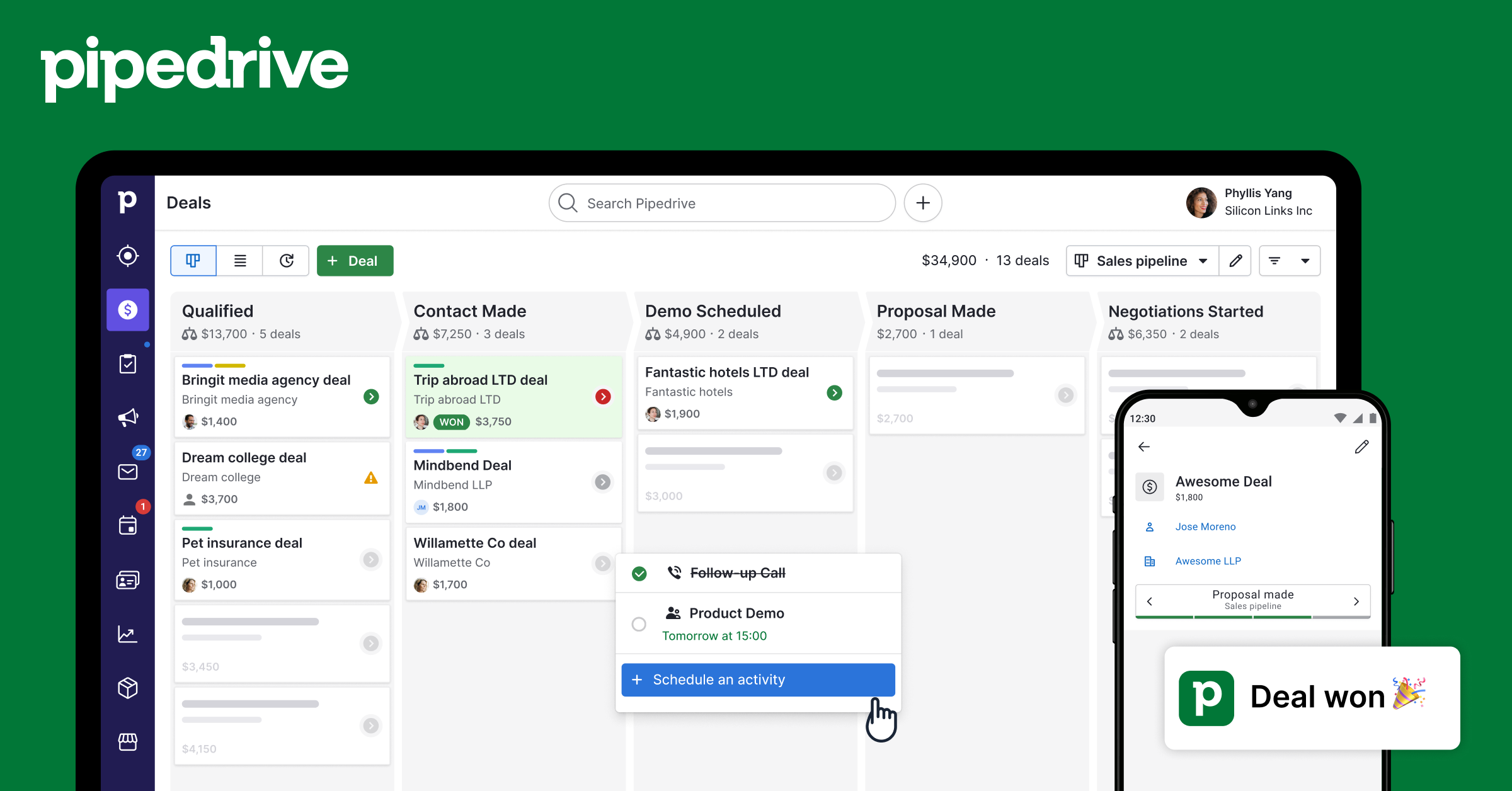
Pipedrive is a pipeline-first CRM for small sales teams, with an AI layer that is more assistive than agentic. Pipedrive's help center, updated Sep 3, 2026, lists AI features by plan and marks several as beta: a Sales Assistant that answers questions about your data and creates notes, email summarization with a sentiment and readiness-to-buy score, and suggested replies.
Compared with Attio, HubSpot or Salesforce, Pipedrive does not market autonomous agents on the pages we read. We did not confirm any, so the matrix marks it Not confirmed. What it does offer is clear pricing and AI that starts on Lite.
Key features
- AI import assistant, AI-assisted report creation, AI Marketplace search and smart-app recommendations on all plans.
- Sales Assistant, in beta, on all plans.
- AI email creation, AI-powered notifications, email summarization (beta) and suggested replies (beta) on Premium and Ultimate.
- Custom scoring models and company data enrichment (industry, size, revenue), which the pricing page lists on higher plans.
- 500+ integrations listed on the Lite plan page.
Pricing: As of Nov 24, 2026, per seat per month billed annually: Lite $14 (US$168 per seat per year); Growth $39 ($468); Premium $59 ($708); Ultimate $79 ($948). The pricing page offers a 14-day free trial with no card. Add-ons include Campaigns from $13.33, LeadBooster from $32.50 and Smart Docs from $32.50. The page also says implementation is free on plans over $400 a year.
Free tier: No free plan; 14-day free trial, no credit card required.
Limits: Some AI features are beta and limited to selected users. Email AI needs Premium or higher. Check the plan page for usage limits on higher-tier features.
Pros
- Simple, published pricing with annual totals.
- AI features start on the cheapest plan.
- Straightforward kanban pipeline for small teams.
- Clear AI availability table by plan.
Cons
- No native autonomous agents confirmed in our sources.
- Sales Assistant and email summaries are beta.
- No free plan.
- Add-ons for campaigns and lead capture increase the real cost.
Benefit for you: A five-person team gets a clean pipeline and AI email drafting for about $295 per month on Premium, without needing an admin.
Standout use case: A small team that wants fast deal tracking and AI email help, not an agent platform.
Skip it if: Skip it if you want autonomous prospecting agents or MCP access inside the CRM.
Zoho CRM
zoho.com
Zoho CRM is the low-price alternative with a surprisingly full AI stack. Ask Zia, its conversational assistant, supports Insights, Help and Action intents, and Zoho's help center says it is available to orgs on Professional and above. Zia Agents add a layer on top: Zoho's agents page lists seven pre-built sales agents, including an SDR, sales coach, follow-up scheduler, deal analyzer and quote generator.
Zoho's agent platform lists 100+ pre-built agents for 60+ apps, an Agent Studio for custom agents, Zoho-hosted LLMs and Zoho MCP for connecting ChatGPT or Claude. An unusual detail from the agents page: you can deploy an agent into the CRM as a connection that acts with your identity and permissions, or onboard it as a digital employee with its own identity in Zoho CRM.
Key features
- Ask Zia: Insights, Help and Action modes, text and voice input, report co-creation, available on Professional and above.
- Zia Agents: SDR, sales coach, follow-up scheduler, deal analyzer, quote generator, revenue growth specialist, deal closure reminder.
- Agent Studio for custom agents; Zia Agents Store with 100+ prebuilt agents across 60+ apps.
- Two deployment modes: Connections (the agent uses your identity, permissions and configuration) or Digital Employees (the agent gets its own identity in Zoho CRM).
- Zoho MCP to connect ChatGPT or Claude.
Pricing: As of Nov 24, 2026, per user per month in USD: Free $0 for up to 3 users (no card); Standard $14; Professional $23; Enterprise $40. The page has a billing toggle and says yearly plans save up to 34%; we did not confirm which toggle state our captured prices reflect, so treat the figures as the page's default display. The page also lists free onboarding.
Free tier: Yes: Free edition with no credit card.
Limits: Ask Zia needs Professional or above. Zoho's help center says each question can relate to one module and one aggregate function, and Ask Zia supports English only.
Pros
- Lowest price per seat of the full CRMs here.
- Agents can be onboarded as digital employees with their own identity.
- Large agent store and a low-code studio.
- Free edition and free onboarding.
Cons
- Ask Zia has documented limits on multi-module questions.
- Agent behavior depends on how you deploy it, as a connection or a digital employee, so permissions need design.
- The interface and ecosystem feel less modern than Attio to some teams (our judgement, untested).
- Pricing depends on the billing toggle, which we could not pin down.
Benefit for you: A budget-conscious small business gets Ask Zia from $23 per seat on Professional, plus a store of pre-built agents.
Standout use case: A team that wants agents deployed either under a rep's identity or as their own digital employees.
Skip it if: Skip it if you want the most polished UX or if you need Ask Zia on the cheapest paid plan.
Close
close.com
Close is a CRM built for teams that sell by phone, SMS and email, and its AI is aimed at the same work. Its pricing page lists Chloe, an assistant you can ask about leads, pipeline or last call and have take action, and AI Agents that work on ongoing jobs such as calling and qualifying new leads.
Growth and Scale add AI Playbooks and Auto Updates, according to the page. Every plan includes monthly AI credits, and Close says you can try Chloe and AI Agents with real leads before paying.
Key features
- Chloe assistant that answers questions and acts in Close.
- AI Agents for ongoing jobs such as calling and qualifying new leads.
- AI Enrichment, lead and email thread summaries, an AI Notetaker, AI Rewrite and suggested actions.
- Call Assistant that transcribes and summarizes phone calls.
- Built-in calling, SMS and email, billed by usage, plus AI connections via MCP for ChatGPT, Claude and other compatible tools on every plan.
Pricing: As of Nov 24, 2026, billed annually per user per month: Solo $9 (one user, up to 10,000 leads); Essentials $35; Growth $99; Scale $139. Billed monthly: $19, $49, $109 and $149. Calling and SMS are billed separately by usage; most outbound destinations are around $0.02 per minute. Call Assistant is $50 per month per account plus $0.02 per recorded minute. Additional organizations are $50 per month, with one included on Growth and Scale.
Free tier: Free trial on every plan; no permanent free plan.
Limits: AI Agents, Auto Updates and Chloe chats beyond the weekly allowance use monthly AI credits. Calling, SMS and numbers are metered separately.
Pros
- Calling, SMS and email in one tool.
- AI Agents aimed at calling and qualifying.
- AI credits included on every plan.
- Clear annual and monthly prices.
Cons
- No free plan.
- Usage-based calling costs on top of seats.
- Growth is $99 per user, which is high for small teams.
- We did not test Chloe or the agents.
Benefit for you: A phone-heavy sales team keeps dialing, call transcription and CRM updates in one system instead of stitching three tools together.
Standout use case: An inside sales team where calls are the main channel.
Skip it if: Skip it if your selling is mostly marketing-led or you want a free CRM.
Freshsales
freshworks.com
Freshsales, from Freshworks, is a cheap-entry CRM with a Freddy AI layer. The pricing page shows Growth at $9 per user per month billed annually, which is the lowest annual per-seat price among the full CRMs in this list (tied with Close's single-seat Solo).
One detail worth knowing: the Freddy AI Agent is an add-on at $49 per 100 sessions on every plan, not a bundled feature. That makes the headline seat price a poor guide to what an agent-heavy deployment costs.
Key features
- Growth: Kanban view, lifecycle stages, chat, email and phone, templates, custom fields and basic workflows.
- Pro: contact scoring, deal insights, custom sales activities, territory management and sales sequences.
- Enterprise: forecasting insights, field-level permissions, custom modules, sandbox and audit logs.
- Freddy AI Agent add-on at $49 per 100 sessions.
- Branded documents add-on at $19 per user per month.
Pricing: As of Nov 24, 2026, per user per month billed annually: Growth $9; Pro $39; Enterprise $59. The page says "SAVE 20% annually" against monthly billing. Add-ons: Freddy AI Agent $49 per 100 sessions; branded documents $19 per user per month. The page lists a 14-day trial of the fully loaded CRM, and says Freshsales is trusted by 74,000+ businesses (a vendor figure).
Free tier: 14-day trial; no permanent free plan on the page we read.
Limits: AI Agent capacity is bought in session blocks on top of the seat price.
Pros
- Lowest entry price here at $9 per user.
- Clear feature steps between tiers.
- Agent capacity is priced in a transparent block.
- Enterprise tier includes audit logs and sandbox.
Cons
- Autonomous agent is a paid add-on.
- No permanent free plan.
- We did not review MCP or data enrichment.
- Session-based pricing is hard to forecast.
Benefit for you: A small team can start on $9 per seat and add agent capacity only if it proves useful.
Standout use case: A startup that wants a low seat price and will meter AI separately.
Skip it if: Skip it if you want agents included or need a free plan.
monday CRM
monday.com
monday CRM grows out of a work-management platform, and its pricing page calls it the AI-first CRM. The navigation lists AI Agents, an AI Notetaker and AI campaigns. We captured plan names and monthly prices, but not the per-feature detail of its AI tiers, so this section is shorter than the others.
Ultimate is a new name for monday's Enterprise tier, according to a note on the page. Plans start at 3 users, and the page invites a quote above 40.
Key features
- AI Agents, AI Notetaker and AI campaigns listed in the product navigation.
- Four plans: Basic, Standard, Pro and Ultimate.
- Templates, integrations and comparison pages against HubSpot, Salesforce, Pipedrive and Zoho.
- Mobile apps for iOS and Android.
- ISO/IEC 27001 and ISO/IEC 27018 listed in the security FAQ.
Pricing: As of Nov 24, 2026, the prices in our rendered capture are $18, $25 and $41 for Basic, Standard and Pro, shown with a 5-seat selector and a yearly toggle. We could not confirm whether the figures are per seat or per month, or which billing toggle state they reflect, so confirm both before you budget. Ultimate is the new name for the Enterprise tier, and we did not capture its price. Yearly billing saves 33% according to the FAQ. Plans start at 3 users, with a quote above 40 users. A 14-day free trial is the only free option.
Free tier: 14-day trial; nonprofits may qualify for free or discounted access.
Limits: Plans start at 3 users, with a quote suggested above 40. The FAQ describes a prorated refund for yearly plans cancelled within 30 days.
Pros
- Familiar interface for teams already on monday.
- A 33% discount for yearly billing.
- AI Agents and Notetaker listed.
- Nonprofit pricing.
Cons
- Plans start at 3 seats.
- We could not capture AI feature limits by tier.
- Displayed prices depend on the seat selector and billing toggle.
- No permanent free plan.
Benefit for you: If your team already runs projects in monday, the CRM shares boards and users with it.
Standout use case: A team that wants its sales pipeline and project delivery in one workspace.
Skip it if: Skip it if you need a single-seat CRM or exact AI limits before buying.
Folk
folk.app
Folk is a light CRM for people and relationships, aimed at small teams, agencies and consultants. Its feature table puts an Intelligence group at the center: phone call recording, email and phone lookup, AI fields, a Research Assistant, Workflow Assistant, Follow-up Assistant and Recap Assistant.
It also lists MCP on all three plans, so tools like Claude and ChatGPT can search and update a folk workspace, and the pricing page says every workspace starts with a 2-week trial of all premium features.
Key features
- Find emails (enrichment): 500 per month on Standard, 1,000 on Premium.
- AI fields: 2,000 per month on Standard, 5,000 on Premium.
- Research Assistant, Follow-up Assistant and Recap Assistant included on every plan.
- Workflow Assistant: 1,500 runs per month on Standard, 10,000 on Premium.
- MCP on every plan; REST API, Zapier and Make from Premium.
- Sequences from Premium; messages 2,000 per member per month on Standard, 5,000 on Premium.
Pricing: As of Nov 24, 2026, per user per month: Standard $24; Premium $48; Enterprise from $80. A 2-week trial of all premium features starts automatically on signup. Standard has no deals, dashboards or sequences; Premium adds them.
Free tier: 2-week trial; no permanent free plan on the page.
Limits: Objects (deals), dashboards and sequences need Premium. Monthly caps apply to enrichment, AI fields, workflows and messages.
Pros
- MCP on every plan.
- Clear numeric allowances for each AI feature.
- Low cost for relationship-style CRM.
- Includes call recording and business-card scanning in the mobile app.
Cons
- Standard has no deals or dashboards.
- Sequences are Premium only.
- Not built for large pipelines or complex permissions.
- No autonomous agents confirmed.
Benefit for you: A consultant gets enrichment, AI summaries and an MCP connection for about $24 per month without managing a complex CRM.
Standout use case: An agency or founder who manages relationships rather than a formal sales pipeline.
Skip it if: Skip it if you need forecasting, custom objects at scale or a deep admin model.
Day AI
day.ai
Day AI pitches itself as life after CRM. Its pricing page sells agents rather than seats: you deploy an agent workforce with different skills, and the cost depends on those skills and the jobs they can take off your plate. Free teammates can capture meetings, emails and interactions and can search, view and share.
That makes it the most structurally different product in this list. It is also the youngest, so evidence for fit at scale is thin. We read pricing and plan copy, and did not run it.
Key features
- Professional agent: runs pipeline, builds customer lists, generates reports and works on schedules and events; 5 automated skill slots.
- Example agents: Business Development Representative, Account Executive, Sales Operator, CRM Data Entry Specialist, Sales Coach, Marketing Director.
- Executive and Super tiers add more capability; Super lists Prospecting as a Service, where the agent finds, enriches and qualifies net-new accounts and loads them into campaigns.
- 20 custom smart properties on Super, kept current from the web and customer memory.
- Free users can search, view and share.
Pricing: As of Nov 24, 2026, per agent per month: Free $0; Turbo $24; Professional $60; Executive $200; Super $800 (annual plans only). Volume tiers for 1 to 20 agents are $24, $60 and $200; at 21 to 50 agents they fall to $22, $54 and $180; at 51 to 100 to $19, $48 and $144; at 101 to 300 to $17, $42 and $130; at 301 and above to $12, $30 and $117. Annual billing gives a 20% discount.
Free tier: Yes: Free for teammates who capture meetings and emails.
Limits: Super agents are sold on annual plans only. Workspaces with a Professional agent or higher can add colleagues at no cost.
Pros
- A different pricing model: pay for agent jobs, not for every human seat.
- Free tier for passive teammates.
- Published volume discounts.
- Super tier includes prospecting as a service.
Cons
- Young product with little public track record.
- Agent-based pricing is unfamiliar and needs modelling.
- Super is annual only.
- We did not test it.
Benefit for you: A small team with many occasional users can add them free and pay only for the agents that do work.
Standout use case: A founder-led team that wants agents to handle CRM data entry, reports and campaigns.
Skip it if: Skip it if you need a proven, widely supported CRM with a large partner ecosystem.
Clay
clay.com
Clay is not a CRM. It is a data and workflow layer that sits in front of one: you build tables, enrich rows from many data providers, run an AI research agent called Claygent, and push results to your CRM or sequencer. Clay's Kareem Amin posted on X on Oct 8, 2026 about showing 2,500 people from 30 countries the future of Clay, which he called the self-learning revenue engine.
Clay says its data credits buy emails, phone numbers and company data from 150+ data partners. Its Free plan already includes multi-provider waterfalls, Claygent enrichment, Clay Sequencer for email and up to 200 rows per table, according to its pricing page. We did not verify the partner count.
Key features
- Multi-provider waterfall enrichment for emails, phones and company data.
- Claygent, Clay's AI agent with web research, for custom data points.
- Clay Sequencer for email, plus integrations with other email providers.
- Clay MCP for Reps, to search, enrich and reach out from an AI chat tool.
- Two meters: actions and data credits, sold in separate ladders.
Pricing: As of Nov 24, 2026: Free includes 500 actions and 100 data credits per month. Launch is $167 per month billed annually, from $185 monthly. Growth is $446 per month billed annually. A toggle says annual billing saves 10%. Launch includes up to one month of rollover credits, 15% of annual credits, and Free has none. Extra actions and data credits are sold in ladders that scale to thousands of dollars per month.
Free tier: Yes: 500 actions and 100 data credits per month.
Limits: Free tables are capped at 200 rows. Credits and actions are separate meters, and rollover is limited.
Pros
- Powerful enrichment from many providers in one workflow.
- Meaningful free plan.
- MCP for Reps for chat-based prospecting.
- Volume discounts on data credits.
Cons
- Not a CRM; you still need a system of record.
- Two meters make cost hard to forecast.
- Learning curve for workflow building.
- Costs scale quickly at high volumes.
Benefit for you: An outbound team can build a custom list and enrichment recipe once and rerun it, then push clean rows into HubSpot, Attio or Salesforce.
Standout use case: A growth team that wants to build a custom prospecting workflow across many data sources.
Skip it if: Skip it if you want one tool for CRM and outreach, or a flat per-seat price.

Today at Sculpt, we showed 2,500 people from 30 countries the future of @Clay, the self-learning revenue engine. These are the building blocks for that engine:
— @kareemamin October 8, 2026
Apollo
apollo.io
Apollo is a data and engagement platform that many small teams use as a light CRM. Its navigation lists Apollo Data (it says 240M contacts and 30M companies), a Workspace, Apollo Anywhere, Builder Studio and an Apollo MCP. Features include an AI Assistant, Waterfall Enrichment, a Parallel Dialer and a Chrome extension.
Pricing is per seat plus credits, and credits do the real metering: a verified email costs 1 credit, a phone number 8, and AI research 1 credit per run. The page calls its prices introductory and says features and pricing may change.
Key features
- AI Assistant and AI Research on all plans; Free has a 5-chat limit on the assistant.
- Contact and account data, sequences, form builder and enrichment.
- Apollo MCP and waterfall enrichment, both listed in the product navigation.
- Parallel Dialer, with US dialing metered at 1 credit per 30 seconds; Advanced Dialer add-on.
- Free plan includes 2 sequences, website visitor identification for 20 companies monthly and CRM enrichment of 100 per month.
Pricing: As of Nov 24, 2026: Free $0 with 900 credits. Basic $49 per seat per month billed annually with 30,000 credits and a 14-day trial. Professional $79 per seat per month with 48,000 credits. Organization has custom credits. A monthly-billing toggle shows a 24% saving on annual. Advanced Dialer add-on is $119 per team per month billed annually. Credits: email 1, phone 8, enrichment 1 to 8, AI research 1 per run, US dialer 1 per 30 seconds.
Free tier: Yes: 900 credits per month plus 2 sequences, with feature limits.
Limits: Credits are pooled and used by every action; the dialer, enrichment and AI research all draw from them. Free caps the AI Assistant at 5 chats.
Pros
- Database, sequencing and dialer in one seat price.
- Free plan with real credits.
- Apollo MCP for agent clients.
- Clear per-action credit costs.
Cons
- Credit-metered, so heavy phone lookup burns credits quickly.
- Prices described as introductory and subject to change.
- Data coverage and accuracy claims are the vendor's.
- Weaker as a full CRM than HubSpot or Attio.
Benefit for you: A small outbound team gets contact data, email sequences and calling without buying three tools.
Standout use case: A sales team that wants a database plus outreach in one login.
Skip it if: Skip it if you need a deep CRM with permissions and reporting, or if you cannot forecast credit use.

Clay vs Apollo
These two get compared constantly, so here is the direct version. Both help you find and contact prospects. They solve the problem from opposite ends.
| Question | Clay | Apollo |
|---|---|---|
| What it is | A table and workflow builder that enriches rows from many data providers | A database plus sequencing, dialer and workspace in one platform |
| Pricing shape | Actions and data credits; Launch $167 per month annual, Growth $446 | Per seat plus credits; Basic $49, Professional $79 per seat per month annual |
| Free plan | 500 actions and 100 data credits per month | 900 credits, 2 sequences, limited features |
| Data source | 150+ partners via waterfalls (vendor claim) | Its own database, 240M contacts and 30M companies (vendor claim) |
| AI | Claygent research agent, MCP for Reps | AI Assistant, AI research, Apollo MCP, Builder Studio |
| Sending email | Clay Sequencer, or push to your own tool | Built-in sequences and a dialer |
| Best fit | Custom, multi-source enrichment and list building | One seat price for data and outreach |
The decision is about how much logic you want to own. If you need to chain several data sources, branch on what you find and run a research agent per row, Clay gives you that control, and you pay in actions and credits. If you want to log in, search a database, drop leads into a sequence and dial, Apollo is closer to a finished tool. Many teams use both: Clay to build the list, Apollo or a CRM to work it. We did not test either, and the numbers for database size and partner count are the vendors' own.
A third-party comparison by George Vlasyev. We did not verify its claims against either vendor's pricing pages, so check the figures in this article instead.
Pricing Table
All figures are USD unless marked, as of Nov 24, 2026. Where a vendor shows two numbers for one tier, both are given.
| Tool | Free | Paid | Top tier | Notes |
|---|---|---|---|---|
| HubSpot | Free CRM: $0 for up to 2 users | Starter from $7 per seat (the page also shows $20); Professional from $90 (also shows $100) | Enterprise from $150 per seat | Required one-time onboarding: $1,500 Professional, $3,500 Enterprise. Credits included: 500, 3,000, 5,000 |
| Attio | Free: 3 users, 50,000 records, 3 objects | Plus $40 annual or $50 monthly per workspace; Pro $100 or $125 | Ultra $1,000 per workspace, annual only, 5 users included | Extra users: Plus $35 or $44, Pro $79 or $99, Ultra $189. Governance add-on $30 per user per month |
| Salesforce | Free Suite $0 | Starter Suite $25; Pro Suite $100 per user per month | Core $195; Advanced $395; Max $550 per user per month | Agentforce for Sales listed as available for purchase on Core and Advanced. Flex Credits 500K, 1M, 2.75M per org on Core, Advanced, Max |
| Pipedrive | 14-day trial, no card | Lite $14; Growth $39; Premium $59 per seat per month, annual | Ultimate $79 per seat per month, annual | Add-ons: Campaigns from $13.33, LeadBooster from $32.50, Smart Docs from $32.50 |
| Zoho CRM | Free: $0 for up to 3 users, no card | Standard $14; Professional $23 per user per month | Enterprise $40 per user per month | Page offers a billing toggle with up to 34% saved on yearly plans; free onboarding |
| Close | Free trial | Solo $9 (one user); Essentials $35 per user per month, annual | Growth $99; Scale $139 per user per month, annual | Monthly billing: $19, $49, $109, $149. Calling and SMS are billed by usage. Call Assistant $50 per month plus $0.02 per minute |
| Freshsales | 14-day trial | Growth $9; Pro $39 per user per month, annual | Enterprise $59 per user per month, annual | Freddy AI Agent $49 per 100 sessions; branded documents $19 per user per month |
| monday CRM | 14-day trial | Basic $18; Standard $25 (as displayed, unit and billing toggle not confirmed) | Pro $41 (same caveat); Ultimate is the new name for the Enterprise tier | Page says yearly saves 33%, plans start at 3 users, quote above 40 users |
| Folk | 2-week trial on all premium features | Standard $24; Premium $48 per user per month | Enterprise from $80 per user per month | Standard: 500 email lookups, 2,000 AI fields, 1,500 workflow runs per month |
| Day AI | Free: $0 for teammates | Turbo $24; Professional $60 per agent per month | Executive $200; Super $800 (annual plans only) | Volume tiers: Professional $54 at 21 to 50 agents, $48 at 51 to 100. Annual billing is 20% off |
| Clay | Free: 500 actions and 100 data credits per month | Launch $167 per month annual, or from $185 monthly | Growth $446 per month annual | Actions and data credits are sold in separate ladders above the base plan |
| Apollo | Free: 900 credits | Basic $49 per seat per month annual, 30,000 credits; Professional $79, 48,000 credits | Organization: custom credits | Advanced Dialer add-on $119 per team per month, annual. Page notes introductory pricing |
A Five-Seat Worked Example
Headline prices are not comparable because the units differ. As a rough guide, here is what five users cost per month on a mid-range paid plan, using the listed figures. It is our arithmetic, not a vendor quote, and it excludes credits, add-ons, calling, taxes and any one-time fees except where noted.
| Plan | Five-seat monthly cost | Caveat |
|---|---|---|
| HubSpot Sales Hub Professional | 5 x $90 = $450 per month | Plus $1,500 one-time onboarding; 3,000 credits included. The page also shows $100, so this is the low end |
| Attio Pro | $100 + 4 x $79 = $416 per month | Annual billing; the workspace price includes one user |
| Salesforce Pro Suite | 5 x $100 = $500 per month | Annual billing is shown on the Core and Max rows; confirm for Pro Suite. Agents are extra |
| Pipedrive Premium | 5 x $59 = $295 per month | Annual billing |
| Zoho CRM Enterprise | 5 x $40 = $200 per month | Default toggle display; confirm the billing period on the page |
| Close Growth | 5 x $99 = $495 per month | Annual billing; calling and SMS extra |
| Freshsales Pro | 5 x $39 = $195 per month | Annual billing; AI agent add-on extra |
| monday CRM Pro | 5 x $41 = $205 per month | Assumes $41 is per seat; the page defaulted to a 5-seat selector and says yearly saves 33% |
| Folk Premium | 5 x $48 = $240 per month | Billing period not stated in our capture |
| Apollo Professional | 5 x $79 = $395 per month | Annual billing; extra credits cost more |
| Clay Launch | $167 per month flat | Not per seat; assumes a CRM or sequencer elsewhere |
Two lessons. First, the cheap per-seat tools stay cheap: Freshsales Pro, Zoho Enterprise and monday Pro all land under $210 a month for five people. Second, the credit meters can outweigh the seats once agents do real volume, which is the subject of the next section.
The New Meter: AI Credits
In 2026 the interesting cost in an AI CRM is not the seat. It is the credit, session or agent that meters the AI. Vendors use different units, which makes comparison hard, so this table lists them side by side.
| Product | Meter | What is included or priced | Notes |
|---|---|---|---|
| HubSpot | HubSpot Credits | 500 / 3,000 / 5,000 included on Starter / Professional / Enterprise | Data agent: 10 credits per enriched record. Prospecting agent: uses credits; see the credits page for the rate |
| Attio | Seat credits plus workspace credits | Per-plan allowances; 5,000 credits for $70 annual or $85 monthly, 10,000 for $120 or $150, 25,000 for $260 or $330, 50,000 for $475 or $595 | Ask Attio draws on seat credits, then workspace credits unless an admin sets a limit |
| Salesforce | Flex Credits | 500K, 1M or 2.75M per org on Core, Advanced and Max | Salesforce's own examples work out to $0.005 per credit, for instance 2,000 credits as $10 (our arithmetic) |
| Clay | Actions and data credits | Free: 500 actions and 100 data credits per month | Data credits buy emails, phones and company data from 150+ partners |
| Apollo | Credits | 900 on Free; 30,000 on Basic; 48,000 on Professional | Email 1 credit, phone number 8, enrichment 1 to 8, AI research 1 per run, US dialer 1 per 30 seconds |
| Close | Monthly AI credits | Included on every plan | Chloe chats, AI Agents and Auto Updates beyond the weekly allowance draw credits |
| Folk | Monthly allowances | Standard: 500 email lookups, 2,000 AI fields, 1,500 workflow runs, 2,000 messages per member | Premium: 1,000 lookups, 5,000 AI fields, 10,000 workflow runs, 5,000 messages |
| Freshsales | Sessions | Freddy AI Agent add-on $49 per 100 sessions | Sold separately from seats |
A few patterns. HubSpot, Attio and Close bundle a monthly allowance, then sell more. Salesforce attaches Flex Credits to the upper editions and publishes worked examples. Freshsales sells agent capacity as a block per 100 sessions. Day AI prices the agent itself. Whatever the unit, set a spending limit before turning an agent on, and ask the vendor for the rate card.
# Questions worth asking any vendor before you turn an agent on
- Which actions can the agent take without approval?
- What does one agent action cost in credits, and can I cap it?
- Where do agent edits show up in the audit log?
- Can I export agent-written fields and notes if I leave?
Feature Matrix
Yes means the vendor lists it. Partial means beta or limited. Not reviewed means our sources did not cover it, which is different from no.
| Product | Free plan | Native AI assistant | Autonomous agents | Built-in data enrichment | MCP or agent API |
|---|---|---|---|---|---|
| HubSpot | Yes | Yes (Breeze Assistant) | Yes (Prospecting, Customer, Data) | Yes (Data agent) | Not reviewed |
| Attio | Yes | Yes (Ask Attio) | Yes (agents and workflows) | Yes (automatic enrichment) | Yes (MCP on every plan) |
| Salesforce | Yes (Free Suite) | Yes | Yes (Agentforce Sales) | Not reviewed | Not reviewed |
| Pipedrive | No (trial) | Beta (Sales Assistant) | Not confirmed | Partial (company data enrichment on higher plans) | Not reviewed |
| Zoho CRM | Yes | Yes (Ask Zia, Professional and up) | Yes (Zia Agents) | Not reviewed | Yes (Zoho MCP) |
| Close | No (trial) | Yes (Chloe) | Yes (AI Agents) | Yes (AI Enrichment) | Yes (AI connections via MCP, all plans) |
| Freshsales | No (trial) | Yes (Freddy AI) | Partial (paid AI Agent add-on) | Not reviewed | Not reviewed |
| monday CRM | No (trial) | Yes | Yes (AI Agents listed) | Not reviewed | Not reviewed |
| Folk | No (trial) | Yes (assistants and AI fields) | Not confirmed | Yes (find emails, enrichment) | Yes (MCP on every plan) |
| Day AI | Yes | Yes | Yes (core product) | Yes (Prospecting as a Service on Super) | Not reviewed |
| Clay | Yes | Partial (Claygent) | Yes (Claygent, workflows) | Yes (core product) | Yes (Clay MCP for Reps) |
| Apollo | Yes | Yes (AI Assistant) | Yes (agents in the background) | Yes (core product) | Yes (Apollo MCP) |
MCP is the column to watch. It lets Claude, ChatGPT or another client search and update your CRM through a standard connector. Attio and Folk list it on every plan, which is rare. Read the scopes before you connect anything, and see our guides to MCP servers for Claude Code and MCP integration platforms for the wider setup. If your agents need memory beyond the CRM, see memory layers for AI agents, and if you also record sales calls, our AI meeting notetakers roundup covers consent and retention.
Best For: Decision Table
| Your situation | Start with | Why |
|---|---|---|
| A two to ten person startup that wants an agent-ready CRM | Attio | Free tier, Ask Attio and MCP on every plan, workspace pricing. |
| A small business that wants one cheap, simple CRM | Zoho CRM, Pipedrive or Freshsales | Entry prices of $14, $14 and $9 per seat on annual billing. |
| A marketing-led team that wants CRM, email and service in one place | HubSpot | Free CRM, then hubs, with credits for agents. |
| An enterprise already running Sales Cloud | Salesforce Agentforce Sales | Agents sit inside the system of record you already pay for. |
| A team that lives on the phone | Close | Calling, SMS and email are native. |
| A consultant or agency managing relationships | Folk | Lightweight, with enrichment, AI fields and MCP. |
| Outbound teams that need data plus a custom workflow | Clay, then your CRM | Clay builds lists and enrichment logic; a CRM stores the result. |
| Outbound teams that want data, sequencing and a dialer in one seat price | Apollo | Database and engagement bundled per seat. |
| A team willing to rethink the CRM as agents plus a context graph | Day AI | Priced per agent, with a free tier. |
Common Mistakes and a Buying Checklist
- Comparing seat prices only. Credits, sessions, onboarding and calling can exceed the seat cost.
- Assuming AI is on every plan. Ask Zia needs Professional; Pipedrive's email AI needs Premium; Freshsales' agent is an add-on.
- Reading the wrong price. HubSpot's page shows two numbers per tier; Attio shows annual and monthly. Confirm the billing period.
- Treating enrichment tools as a CRM. Clay and Apollo need a system of record behind them, or a lot of discipline.
- Trusting vendor numbers. Database sizes, resolution rates and customer outcomes on these pages are vendor claims.
- Letting an agent send unreviewed. Start with draft-and-approve, then widen scope.
Before you buy, run through this list:
- Write down your seat count and your agent volume, then price both. Seats and credits are separate meters on most platforms here.
- Check which plan unlocks the AI feature you want. Pipedrive's AI email tools start at Premium; Ask Zia needs Zoho Professional or higher.
- Ask for the credit rate sheet for anything usage based, and set spend limits before you switch an agent on.
- Confirm whether the agent acts alone or whether a human approves each send. Attio's site says agents draft plays for you to approve and run.
- Test your real data. Import a few hundred records and see whether enrichment and agent suggestions match your market.
- List required add-ons: onboarding, governance, calling, SMS, branded documents, dialers, extra workspaces.
- Verify data residency, SSO and audit log needs against the plan that includes them.
- Plan the exit. Check whether you can export records, activity history and AI-generated fields in a usable format.
How We Evaluated
We fetched each vendor's pricing and product pages, and in several cases rendered the page in a browser to read prices that plain text extraction missed. We read the vendor help-center and announcement pages cited in the sources, and checked each embedded post and video: every X post was fetched from X's public syndication endpoint and matched against its text, and every video returned a valid oEmbed record. We did not run these tools on real pipelines, so the pros and cons come from documentation and pricing, not measured accuracy. There are no affiliate links or paid placements, and vendors did not review the page. Rankings are by fit, not by score. Plans change often. If a figure here differs from the vendor page, trust the vendor page.
FAQ
What is the best AI CRM in 2026?
There is no single winner. HubSpot is the broadest all-round choice, with a free CRM and credit-priced Breeze agents. Attio is the strongest fit for startups that want an agent-ready data model. Salesforce Agentforce Sales suits teams already on Sales Cloud. Zoho CRM, Pipedrive and Freshsales are the cheaper per-seat options. We did not run hands-on tests, so this reflects public pricing, documentation and vendor announcements as of Nov 24, 2026.
What is the best AI CRM for small business?
For tiny teams, Attio's Free plan (3 users) and HubSpot's free CRM (2 users) cost nothing. On paid plans, Zoho CRM Standard is $14 per user per month, Pipedrive Lite is $14, Freshsales Growth is $9, Close Solo is $9 for one seller, and Folk Standard is $24. Check which plan includes the AI feature you want, because many assistants start at the middle tier.
What is the best AI CRM software for agents that act on their own?
Native agents exist at HubSpot (Prospecting, Customer and Data agents on credits), Salesforce (Agentforce Sales), Zoho (Zia Agents), Close (AI Agents), Attio (agents and workflows alongside Ask Attio) and Day AI, where agents are the product. Each needs oversight. Ask who approves outbound messages, and what the agent is allowed to change in your records.
Clay vs Apollo: which should I pick?
Apollo bundles a contact database, sequencing, a dialer and an AI assistant into a per-seat price from $49 per month on annual billing, with credits. Clay is a workflow and enrichment layer sold by actions and data credits, from $167 per month on Launch (annual), and it does not replace your CRM. Pick Apollo if you want one tool for prospecting and outreach. Pick Clay if you need custom enrichment logic across many data sources.
What is the best AI agent for sales?
It depends on where the data lives. On HubSpot, the Breeze Prospecting agent and Data agent run on credits. On Salesforce, Agentforce Sales lists prospecting, engagement, pipeline management, account research and meeting prep, and quoting agents. For standalone outbound agents, see our roundup of AI SDR agents. Vendor-reported results are unverified here.
What is the best AI lead generation tool?
Apollo and Clay are the two most common choices. Apollo says its data covers 240M contacts and 30M companies, a vendor figure we did not verify. Clay says it sources data from 150+ partners inside one workflow, also unverified. HubSpot's Data agent and Salesforce's prospecting agent work from inside the CRM, and Day AI's Super tier lists Prospecting as a Service.
What is the best AI agent for Salesforce?
Salesforce's own Agentforce Sales is the native option. A Salesforce announcement dated March 16, 2026 lists an Engagement agent, Pipeline Management agent, Account Research and Meeting Prep agent, Quoting agent and Partner Success agent as generally available, and a Prospecting agent as available March 30. The pricing page lists Agentforce for Sales as available for purchase on the Core and Advanced editions. Confirm current terms with your account team.
How much do AI CRMs cost?
As of Nov 24, 2026, listed annual per-seat prices run from $9 (Freshsales Growth, Close Solo) through $14 (Zoho Standard, Pipedrive Lite) and $24 (Folk) up to $90 or more for HubSpot Professional, while Salesforce's ladder runs from $25 (Starter Suite) to $550 (Max). Attio charges per workspace, from $40 on Plus. Clay is $167 per month on Launch. Credits for agents are extra on several platforms, so total cost depends on usage.
Do AI CRM agents replace SDRs?
The vendors position them as assistants, and the human review step varies by product. Salesforce frames agents as working alongside reps. Most teams use agents to research, prepare and draft, then add review before anything reaches a customer. We did not measure any vendor's reported results.
Is HubSpot Breeze free?
Not entirely. HubSpot's Sales Hub page says agents and features run on HubSpot Credits, with 500 credits included on Starter, 3,000 on Professional and 5,000 on Enterprise. The page lets you buy credit packs or pay as you go, and set spend limits. Our captured text lists the Data agent at 10 credits per enriched record.
What is Ask Attio?
Ask Attio is the conversational agent built into Attio. Attio's pricing page lists it on the Free plan along with automatic enrichment and workflows, and says it draws on seat credits, then workspace credits. Attio's Nicolas Sharp and Alexander Christie announced the launch on X on Feb 4, 2026. Attio's site says agents draft plays for you to approve and run.
Which AI CRMs offer MCP access for Claude or ChatGPT?
Attio says every plan includes its MCP server, with Claude and ChatGPT named as examples. Close lists AI connections via MCP on all four plans, and Folk lists MCP on all three. Apollo lists Apollo MCP in its navigation, Zoho lists Zoho MCP on its agents page, and Clay lists Clay MCP for Reps. We did not test any of them, so read each vendor's current docs for scopes and plan requirements. Our guides to MCP servers and MCP integration platforms cover the wider setup.
Can I use Clay or Apollo as my CRM?
Apollo's pricing page lists lead management, CRM enrichment and a workspace, so small outbound teams do use it as a light system of record. Clay's pages describe enrichment, Claygent research, a sequencer and tables, and its customers on the page pair it with a CRM. Neither is a like-for-like replacement for a full CRM with permissions and reporting.
Sources
All fetched on Nov 24, 2026 unless noted.
- HubSpot: Sales Hub pricing, HubSpot on X, Oct 2, 2026
- Attio: pricing, Nicolas Sharp on X, Feb 4, 2026
- Salesforce: Sales Cloud pricing, Salesforce news announcement of Mar 16, 2026 on Agentforce Sales
- Pipedrive: pricing, Pipedrive AI help article
- Zoho CRM: pricing, Zia Agents, Ask Zia help, Zoho agents platform
- Close: pricing
- Freshsales: pricing
- monday CRM: pricing
- Folk: pricing
- Day AI: pricing
- Clay: pricing, Kareem Amin on X, Oct 8, 2026
- Apollo: pricing
- YouTube: Introduction to Ask Attio (Attio), HubSpot Spring 2026 Spotlight, Attio workflows (Kayla Campos), Apollo.io vs Clay 2026 (George Vlasyev)