Get the latest on AI, LLMs & developer tools
New MCP servers, model updates, and guides like this one — delivered weekly.
Who Wins for What
You want to know whether ChatGPT, Perplexity, Gemini and Google's AI answers mention your brand, and which tool is worth paying for. The category moves quickly, and one of its best-known names, Profound, retired its self-serve plans in September 2026. Here is the short version. Profound is the enterprise pick, with custom pricing only. Peec AI and Otterly.AI are the most direct trackers for marketing teams, and Otterly has the lowest entry price at EUR 29 a month. Semrush and Ahrefs suit teams already inside those suites. Rankscale gives the most engines per euro, AthenaHQ is the only one with a free plan, and Writesonic, Gauge and Goodie bundle content or optimization work with tracking.
Almost every performance claim in this market comes from the vendor. We attribute those claims, date every price as of Nov 21, 2026, and say plainly when a price is not public or when a figure was unclear on the page we fetched.
A third-party comparison from the channel Jay's AI SEO Tips. It covers Semrush, Profound, Peec, Otterly, Scrunch and RadarKit, so it overlaps with this list but is one creator's view, not our testing.
What GEO Tools Measure
A GEO or AI search visibility tool runs a list of prompts through AI engines on a schedule, stores the answers, and reports on them. The common outputs are mentions (is your brand named), citations (is your site linked as a source), position, sentiment, share of voice against competitors and the sources AI relied on. Better tools add prompt research, crawler analytics and recommended actions.
Three details change what you are really buying. First, how answers are collected. Rankscale distinguishes app interfaces from direct API calls, and Gauge says Claude and Grok run on your own API keys. Second, how volume is priced. Prompts, credits, AI answers and checks are different units, and they do not convert cleanly between vendors. Third, noise. A single AI answer can change from run to run, so a score based on a handful of prompts can swing without any real change. That is why Otterly recommends 50 to 100 prompts per topic and Evertune markets heavy sampling.
If you build your own agents, the same fanout idea shows up on the other side of the glass. Our guide to the best web search APIs for AI agents covers the retrieval layer that decides which pages AI answers cite.
Master Comparison Table
Everything below comes from each vendor's own page as fetched on Nov 21, 2026. Where a page showed different figures in different places, we say so in the tool section.
| Tool | Pricing (as of Nov 21, 2026) | Engines | Standout | Best for |
|---|---|---|---|---|
 Profound | Enterprise only, custom. Starter and Growth plans retired Sep 2026 | Up to 10 answer engines tracked, including ChatGPT, Perplexity, AI Mode, Gemini, DeepSeek, Claude, AI Overviews | AI Marketer, Agents, Agent Analytics | Large brands, global teams |
 Peec AI | $95, $245 or $495 a month; Enterprise custom | 3 active models on self-serve plans, chosen from 8 available; up to 26 on Enterprise | Unlimited users, MCP on all plans, source analytics | In-house SEO and marketing teams |
 Otterly.AI | EUR 29, EUR 189 or EUR 489 a month | 4 of 7 engines on plan cards, switchable; credits per answer | Cheapest entry, free trial, agency partner program | Solo marketers, small teams, agencies |
 Semrush AI Visibility Toolkit | $99 a month per domain | Mentions from ChatGPT, Google AI, Gemini, Perplexity | Prompt Research, sits inside the Semrush account | Teams already on Semrush |
 Ahrefs Brand Radar | Custom Prompts from $50 a month; Index from $199; some prompts included in paid Ahrefs plans | AI Overviews, AI Mode, ChatGPT, Copilot, Gemini, Perplexity; Claude on Custom Prompts | 581 million+ prompt index, AI Analytics | Teams already on Ahrefs |
 Scrunch AI | Core $250 a month; Enterprise custom | 8 LLMs on Core; Claude is an Enterprise add-on | Optimization pages, Agent Pages on Enterprise | Brands that want tracking plus page work |
 AthenaHQ | Free Essential; Starter $295 a month; Enterprise custom | 11 models on Starter | Content optimization agent, Athena Citation Engine | Self-serve SMBs, enterprises |
 Rankscale | EUR 99, 229, 385 or 780 a month | 17+ engines on every plan | Credits model, unlimited prompts, REST API on Pro+ | Multi-brand teams and agencies |
 Writesonic GEO | $79, $199 or $399 a month billed annually; Custom | ChatGPT, Gemini, AI Overviews on listed plans; 8 platforms on Custom | SEO, GEO and AI articles in one plan | Content teams that also need a writer |
 Goodie AI | Core $295, Pro $999 a month; Enterprise custom | 5, 8 or up to 14 models by plan | Full-loop optimization, SKU-level commerce visibility | Teams that want a strategist included |
 Evertune | Starter $60, Pro $800 a month billed annually; Enterprise custom | Up to 5 models on Starter, all major models on Pro | 100 samples per prompt, Ads Agent, EverPanel | Advertisers and brands |
 Gauge | Growth $599 a month; Enterprise custom | 3 platforms on Growth; 6 core on Enterprise | 600 daily prompts and 18 articles a month | Teams that want volume plus content |
Profound
Profound is the enterprise name most buyers hear first, and it no longer describes itself as only a tracker. Its pricing page opens with "Meet your AI Marketer" and pitches a teammate that can research, write, report and collaborate. Its own FAQ answers the question "Is Profound only for AI search?" with a flat no. Visibility data is the foundation, and the product now stacks research, campaign planning and recurring work, built as Agents, on top of it.
On measurement, Profound says it runs structured prompts across AI platforms and analyzes where and how your brand appears, tracking citations, sentiment, ranking and competitive presence. The Enterprise plan includes ongoing daily tracking. The pricing page says up to 10 answer engines can be tracked and names ChatGPT, Perplexity, Google AI Mode, Gemini, DeepSeek, Claude, Google AI Overviews, Exa Search, Muse Spark and Qwen. It also lists ChatGPT Shopping, Prompt Volumes, and Agent Analytics for AI-sourced traffic, with integrations for Akamai, AWS, Cloudflare, Fastly, Google Analytics, Google Cloud Platform, Netlify, Vercel and WordPress. Data leaves the platform as CSV or JSON, and there is an API.
The company has been loud about direction. On Sep 15, 2026, Dylan Babbs, who posts regularly about Profound's product news, wrote that Profound raised a $180M Series D co-led by Sequoia and Kleiner Perkins, framing the product as an AI platform for marketers. On Nov 18, 2026 he announced a new generation of Agents powered by Aim, described as your AI Marketer: you describe an objective and Aim builds the Agent. The posts are embedded below. We could only confirm the funding from that post, so treat valuation and customer-count figures you see elsewhere as unverified unless you can trace them to the company.
Pricing: As of Nov 21, 2026 the pricing page shows one plan, Enterprise, with custom tailored packages. Its FAQ (last updated Nov 16, 2026) says the Starter and Growth plans for brands were retired in September 2026 and that the older $399 and $499 prices are no longer available for new subscriptions. AI Marketer and Agents run on credits, and the page says the account can be set to continue with overage billing or to pause when credits run out.
Free tier or trial: No self-serve trial or free tier. The route in is a demo request.
Limits: Credit-based Agent usage. The prompt tracking plan is described as tailored, so the number of prompts is set in the contract and not published.
Pros
- The longest engine list on any pricing page we read, with up to 10 answer engines tracked, including DeepSeek, Exa Search and Qwen.
- Agent Analytics covers AI-sourced traffic and bot activity, tied to CDN and analytics integrations.
- Unlimited seats, a dedicated Slack channel and a dedicated specialist with a 24 hour response SLA are listed in the plan.
- SSO/SAML and SOC 2 compliance are on the plan, which is what security reviews ask for first.
Cons
- No public price. You cannot budget before a sales call, and the old $399 and $499 entry points are gone.
- The platform is wider than tracking, so a team that only wants a dashboard pays for scope it may not use.
- Agent work is consumption based, so cost depends on how many Agents you run.
- Most claims about results come from Profound itself, and we could not check them independently.
Benefits for you
- One vendor for monitoring, research, drafting and reporting if you want agents to do the recurring work.
- Visibility changes can be wired to Agents, which shortens the gap between a drop and a response.
- A procurement-friendly package for global brands that need legal and security sign-off.
Standout use case: A recurring visibility report built as an Agent that gathers data, drafts the summary and delivers it to the team, the kind of Monday-morning workflow the Nov 18 launch post describes.
Skip it if: You need a published price, a self-serve plan, or only a lightweight tracker for a few dozen prompts.
Excited to share @profound has raised a $180M Series D, co-led by @sequoia and @kleinerperkins.
— @dbabbs Sep 15, 2026
Today we're launching a new generation of Agents in @profound, now powered by Aim, your AI Marketer.
— @dbabbs Nov 18, 2026
Peec AI
Peec AI keeps the interface simple. You set up prompts, then read visibility, position, sentiment and share of voice against competitors, and follow the cited sources to see where to act. The pricing page says it is trusted by 4000+ brands and agencies, which is the vendor's own count, and shows customer logos such as Zalando, Attio, Squarespace, Brevo, Hugo Boss and n8n.
Every plan has unlimited team users, competitors and languages. What changes between plans is prompts, projects, countries and extras. The comparison table lists an ads library, Local GEO, AI Shopping with SKU-level tracking, domain and URL source analytics, a crawlability audit across 40+ bots, AI referrals, brand perception facts you set and check answers against (5, 20 or 50 facts per brand on the three self-serve plans), and agent actions with included agent credits.
Peec moved early on MCP. A Peec post on Apr 15, 2026 said the product is now available via MCP, so you can connect it to Claude and ask what happened to your visibility instead of copying numbers into Slack. The plan table lists MCP as included on every plan. If MCP matters to you, our guide to the best MCP servers for Claude Code covers what else plugs into that workflow.
If you wire visibility data into Claude through MCP, our list of the best MCP servers for Claude Code and the wider top MCP servers list show what else fits that setup.
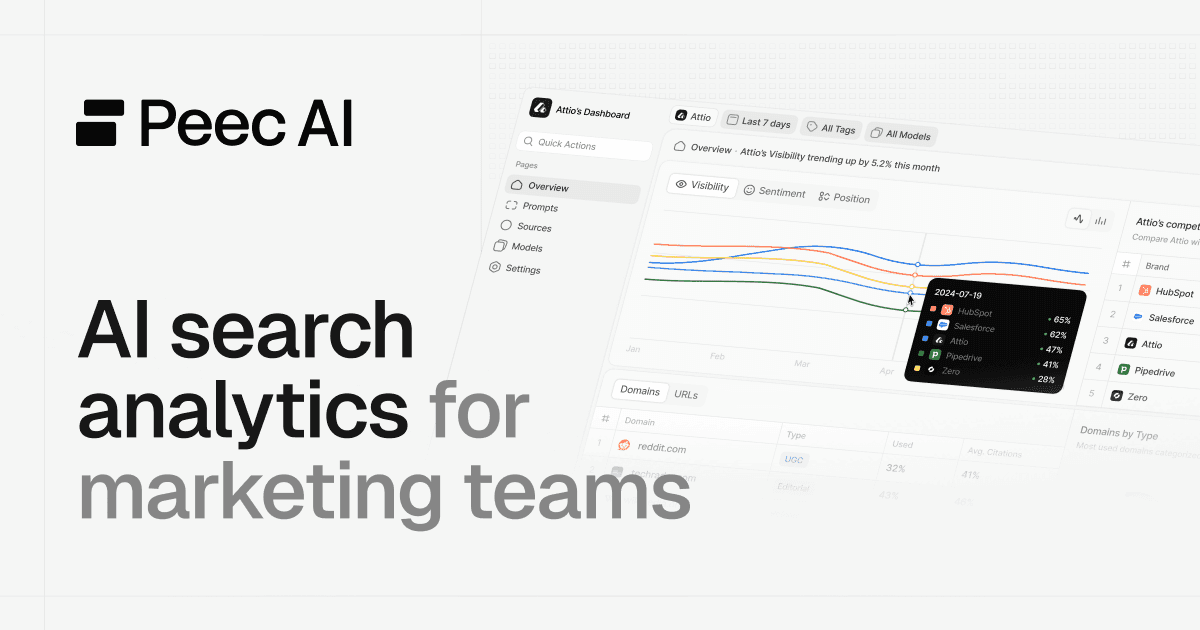
Pricing: As of Nov 21, 2026: Starter $95 a month (50 prompts, 3 active models, 1 project, 1 country, 4,500 AI answers a month). Pro $245 (150 prompts, 2 projects, 3 countries, 13,500 answers). Advanced $495 (350 prompts, 5 projects, 3 countries, 31,500 answers, Looker Studio integration). Enterprise is custom and annual, with unlimited prompts and projects, API, SSO and up to 26 models. The page shows a 15% discount for annual billing.
Free tier or trial: The pricing page we fetched shows get-started buttons and does not mention a free trial. Check at sign-up.
Limits: 3 active models on all three self-serve plans, picked from the 8 listed (ChatGPT, Perplexity, AI Overview, AI Mode, Gemini, Naver AI Briefing, ERNIE and Bing AI Mode). Countries are 1, 3 and 3. API is not included on Starter. SSO is Enterprise only. Agent credits are 500, 750 and 1,000.
Pros
- Public pricing with unlimited users and competitors, so adding a colleague never costs more.
- MCP on every plan, which suits teams that report through Claude or an automation tool.
- Deep source analysis: domain and URL views, subdomains, fanouts and shopping source visibility.
- Daily tracking on every self-serve plan, with a clear count of monthly AI answers per plan.
Cons
- Only 3 active models on self-serve plans, which is limiting if you care about Claude, Copilot or Grok.
- Starter is limited to 1 project and 1 country, which is tight for agencies.
- No SSO below Enterprise, and API access starts at Pro.
- A free trial is not stated on the pricing page.
Benefits for you
- A predictable monthly cost that scales with prompts, not seats, languages or competitors.
- A shorter path from data to reporting, because MCP lets an assistant answer questions about your project data.
- Source and gap views point at pages and domains to pursue, not just a score.
Standout use case: Source analytics that show which domains and URLs AI retrieves for your prompts, so outreach and content work starts from evidence.
Skip it if: You need more than three engines on a small budget, or you need a free trial before talking to anyone.
Peec AI is now available via MCP. Connect it to Claude and ask:
— @peec_ai Apr 15, 2026
Otterly.AI
Otterly.AI is the budget-friendly tracker with the most distinctive pricing model, which is credits. Its pricing page says every plan includes unlimited brands, competitors, countries, languages and team members. The FAQ defines one credit as one prompt checked once on one AI engine, and says a prompt tracked daily on one engine uses 31 credits a month.
That makes the arithmetic checkable. The Lite plan lists 16 prompts and 2,000 credits. By our arithmetic, 16 prompts on 4 engines tracked daily comes to 1,984 credits, which fits. Standard lists 120 prompts and 15,000 credits, and 120 prompts on 4 engines daily comes to 14,880. The plan cards say 4 of 7 AI engines, and the page says every plan can track every engine, with each engine using credits. Claude counts as 3 credits per answer because Otterly says analyzing it is three times as expensive.
Pricing: As of Nov 21, 2026: Lite EUR 29 a month (16 prompts, 2,000 credits), Standard EUR 189 (120 prompts, 15,000 credits), Premium EUR 489. The comparison table lists 403 and 1,000+ prompts in the two columns after Standard, which most likely map to Premium and Enterprise, and our extraction did not label them cleanly, so confirm on the live page. Monthly and annual subscriptions both exist.
Free tier or trial: Yes. The FAQ says new users get a free trial with no commitment.
Limits: Lite cannot buy extra credits. Credits stay assigned to a workspace until you reassign them. Weekly tracking appears in the higher tiers, and single sign-on and enterprise compliance sit in the top tier.
Pros
- The lowest public entry price in this list at EUR 29, plus a free trial.
- Unlimited brands, competitors, countries, languages and team members on every plan.
- Transparent credit math, so you can compute how many prompt and engine pairs a plan covers.
- A real agency program with pitch workspaces, branded reporting and consolidated billing.
Cons
- Credits make cost modeling harder than a flat prompt count, and Claude triples the cost per answer.
- Lite has 16 prompts, well below the 50 to 100 per topic that Otterly itself recommends.
- The plan cards and comparison table did not line up cleanly in our extraction.
- Daily tracking across many engines drains credits quickly.
Benefits for you
- A cheap way to prove the category to a boss or client before committing to a larger tool.
- Agency teams can run pitch audits and send branded reports without per-client seat charges.
- Weekly tracking on higher tiers trades freshness for coverage when you need many prompts.
Standout use case: Pitch Workspaces, which let an agency run a custom audit for a prospect before they sign.
Skip it if: You want one flat number of prompts and engines with no credit arithmetic, or you need daily data on hundreds of prompts without buying credit packs.
Semrush AI Visibility Toolkit
Semrush sells AI visibility as a toolkit you add to an account, not as a standalone product. Its help article says the toolkit is built with SMBs, agencies and mid-market companies in mind. It includes a Visibility Overview with an AI Visibility Score, Competitor Research, Prompt Research (described as keyword research for AI, with topic-level volume, difficulty and intent), Brand Performance for share of voice and sentiment, Prompt Tracking, and an AI Search Site Audit that checks for technical issues that could block AI crawlers.
The AI Visibility Score reflects how often your brand is mentioned in AI answers compared with the median mentions of your top industry competitors, which Semrush identifies automatically. Brand Performance runs a large collection of common queries through LLMs such as ChatGPT and Google's AI Mode and analyzes how your brand is described. Prompt Tracking is daily, Brand Performance updates weekly, and the overview and research reports update daily on a rolling basis. The pricing page lists mentions from ChatGPT, Google AI, Gemini and Perplexity.
Pricing: As of Nov 21, 2026: the Base toolkit is $99 a month per domain. It includes 1 project, 1 domain for Brand Performance, 300 daily queries in AI Analysis reports, 1,000 daily queries in Prompt Research, 25 prompts for Prompt Tracking, AI Search Checks in Site Audit for up to 100 pages and 10 CSV exports a day. Add-ons listed: 50 more prompts for $60 a month, extra domains for $99 each per month, and an extra license at $99 per subuser.
Free tier or trial: No. The help article says the AI Visibility Toolkit does not currently offer a free trial and that a paid subscription is required.
Limits: 25 prompts on Base. CSV export is capped at 1,000 rows per export and 10 exports a day per user. A corporate account needs a license for each subuser.
Pros
- Sits next to the keyword, backlink and site audit data you may already use, so AI visibility is not a separate login.
- Very wide geography, with 220+ countries and territories in Prompt Tracking.
- Prompt Research gives topic-level volume, difficulty and intent, which most trackers lack.
- The AI Search Site Audit flags technical blockers for AI crawlers inside Site Audit.
Cons
- 25 tracked prompts is the smallest included allowance among the paid tools here, and extra prompts cost $60 per 50.
- No free trial, so you pay before you see your data.
- Per-user licenses at $99 and extra domains at $99 add up for teams.
- The pricing page lists four engines, with no Claude or Copilot named.
Benefits for you
- Existing Semrush users keep reporting, exports and client workflows in one place.
- Prompt Research helps you choose what to track instead of guessing.
- A fast way to add an AI visibility section to an SEO audit for a client.
Standout use case: Prompt Research, a keyword-research style view of AI topics with volume, difficulty and intent, paired with the AI crawler check in Site Audit.
Skip it if: You need hundreds of prompts, broad engine coverage including Claude, or you do not already use Semrush.
Ahrefs Brand Radar
Ahrefs Brand Radar tracks AI visibility two ways. The AI Visibility Index lets you look up any brand across 581 million+ prompts with no setup, and Ahrefs says it works best if your brand already shows up in AI answers. Custom Prompts monitor the exact questions you define, refreshed daily, which Ahrefs pitches for niches too specific to appear in any database.
The index is built from Ahrefs' own keyword database. Real queries are expanded into natural questions through People Also Ask and semantic fanout, run through each platform, and stored. The prompt-based indexes cover AI Overviews, AI Mode, ChatGPT, Copilot, Gemini and Perplexity, with question sets re-tested monthly on a 90-day reporting window, and Custom Prompts add Claude. Metrics include Mentions, Citations, AI Share of Voice and Estimated Impressions weighted by real search volume. For scale, an Ahrefs post on Aug 31, 2026 cited 473M+ prompts, and the page now says 581 million+.

Pricing: As of Nov 21, 2026: the plans page shows Lite $129, Standard $249 and Advanced $449 a month, with annual billing saving up to 17%. The Lite plan lists 150 checks on AI prompts and API and MCP access. The Brand Radar page says every paid plan includes a daily Custom Prompts quota, with 5 prompts on Lite and 20 prompts (600 checks) on Advanced. Standalone Custom Prompts are shown from $50 a month up to $199 a month (83 prompts a day, plus 2,500 checks a month, overage $0.020 per check). The AI Visibility Index shows "Starts at $199/mo". Claude consumes 8 checks per update.
Free tier or trial: No free trial is stated for Brand Radar. The included prompt quota comes with paid Ahrefs plans.
Limits: Each prompt is checked daily on every selected platform, so 5 prompts on 1 platform is 150 checks a month. Index question sets refresh monthly on a 90-day window.
Pros
- If you already pay for Ahrefs, tracking starts with a quota included in your plan.
- An index grounded in real search demand, so you can connect AI mentions to keyword topics.
- A funnel-stage view that shows where in the journey you win or lose prompts.
- API and MCP access are listed in the Lite plan features.
Cons
- Included quotas are small, so serious tracking means buying checks.
- Pricing is spread across two pages with different framing, which slows budgeting.
- The Index is built for established brands and may be thin for small or new ones.
- Claude costs 8 checks per update, so it burns the quota quickly.
Benefits for you
- Joins AI visibility to keyword and backlink data in one account.
- Pay-per-check overage lets you scale without a plan jump.
- Off-site signals from YouTube, TikTok and Reddit sit alongside AI answers during the beta.
Standout use case: The AI Visibility Index, which lets you benchmark any brand or category instantly across 581 million+ prompts with no setup.
Skip it if: You do not use Ahrefs for anything else and want a tracker with a single clear price for a small prompt set.
NEW in Brand Radar: See your AI visibility in the customer journey. The new By intent chart in Prompts report splits Mentions, Citations and AI Share of Voice by funnel stage.
— @ahrefs Nov 15, 2026
Scrunch AI
Scrunch AI pairs observation with action. Its pricing page groups features as Observe, Optimize and Deliver: track responses across AI platforms, optimize and generate pages, and on Enterprise serve pages to AI agents through Agent Pages. The page says it is trusted by 500+ leading brands and agencies, which is the vendor's own number.
The self-serve Core plan is $250 a month with a 7-day free trial and 15,000 AI responses a month, collected daily across 8 LLMs: ChatGPT, Perplexity, Gemini, Google AIO, Google AI Mode, Microsoft Copilot, Grok and Meta AI. It covers 1 brand with 5 seats, 5 competitors, 3 AI search trend topics, funnel stages, AI referrals, signals and AI agent traffic for one domain.
Pricing: As of Nov 21, 2026: Core $250 a month, billed monthly, with a 7-day free trial. Enterprise is custom, billed yearly. The Agencies tab exists but its figures were not captured in our fetch.
Free tier or trial: 7-day free trial on Core.
Limits: 15,000 AI responses a month, 1 brand, 5 seats, 5 competitors and 3 trend topics on Core. API, SSO and Agent Pages wait for Enterprise. Claude is an Enterprise add-on, not on Core.
Pros
- A published price and a trial, with the response allowance stated up front.
- Eight engines on the entry plan, including Grok and Meta AI that some rivals skip.
- Optimization and page generation are part of the plan, not a separate product.
- A fact-check allowance helps catch wrong claims AI makes about you.
Cons
- Claude is not on Core, and it is an add-on even on Enterprise.
- One brand only on Core, which rules out agencies and portfolio owners without upgrading.
- Optimization allowances of 10 pages are small for large sites.
- API keys wait for Enterprise.
Benefits for you
- One plan that observes and acts, so you are not stitching a tracker to a content tool.
- Funnel stage and AI referral views connect visibility to the customer journey.
- Agent Pages on Enterprise address AI bots reading pages designed for humans.
Standout use case: Agent Pages, which serve pages shaped for AI agents, available on the Enterprise plan.
Skip it if: You need Claude coverage on a self-serve plan, multiple brands on one plan, or API access below Enterprise.
AthenaHQ
AthenaHQ is the only tool here with a genuinely free entry plan. Essential is free, comes with a $25 credit and includes unlimited users, prompt and response analysis, sources and competitor insights, content recommendations and the Athena AI agent. It is a way to see your own data before anyone asks for a card.
The paid Starter plan is $295 a month and adds visibility across 11 models, unlimited topics, prompts and competitors, country-level support, CSV export, on-page and off-page actions, a content optimization agent and self-learning content improvement. Credits work as 1 credit per AI response, with 3,600 credits a month on Starter and a $300 monthly free credit line plus one-month rollover shown on the plan card. Read that credit wording carefully on the live page, because the plan card and the table describe it in different places.
Pricing: As of Nov 21, 2026: Essential free with a $25 credit. Starter $295 a month (3,600 credits, 11 models). Enterprise custom, with credits, API and Athena Citation Engine in the negotiated package. API access and extra credits are listed as paid add-ons on Starter, with pricing on request.
Free tier or trial: Free Essential plan with $25 credit.
Limits: 3,600 credits a month on Starter, where one credit is one AI response. API and extra credits cost extra. API access is a paid add-on on Starter. The comparison table also lists an advanced content optimization agent, multiple countries and the Athena Citation Engine, and we could not tell from our extraction which plan columns include them, so check before you buy.
Pros
- The only real free tier in this list, with unlimited users on it.
- 11 models on Starter and a monitoring list that includes Claude, Copilot and Grok.
- Unlimited topics, prompts and competitors on Starter, so the credit pool is the only ceiling.
- Crawler controls (robots.txt and llms.txt management) sit next to the tracking.
Cons
- The $295 Starter price is a big step up from free, with nothing in between.
- Credit math (1 credit per response) needs planning to avoid running dry.
- API access costs extra on top of Starter.
- The plan card and comparison table present credit figures in different places, which is easy to misread.
Benefits for you
- You can validate the category on real data before committing budget.
- Unlimited prompts mean you decide how to spend credits, not a cap.
- Content actions are part of the same agent, so tracking leads to a to-do list.
Standout use case: A free plan with unlimited users and an AI agent, which no other tool in this roundup offers.
Skip it if: You want a flat price that does not depend on credits, or you need API access without add-on fees.
Rankscale
Rankscale competes on breadth per euro. Its pricing page headline is that every AI engine is on every plan, with 17+ engines, all countries and all languages. It splits engines into three access modes: apps (ChatGPT, Google AI Mode, Google AI Overviews, Bing AI Mode and Gemini), direct API calls to model families including Claude, Perplexity Sonar, DeepSeek and Mistral, and API calls with web search. Prompts are unlimited on every plan, and the constraint is credits.
The plans scale by credits and brand dashboards. Pro is EUR 99 a month for up to 4,800 AI answers (1,200 credits) and 10 brand dashboards, with MCP, a sentiment radar, 50 page audits and shared dashboards. Pro+ at EUR 229 adds a REST API and 25 dashboards. Growth at EUR 385 adds white-label links, a dedicated success manager and 50 dashboards. Enterprise at EUR 780 gives up to 48,000 answers a month and 100 dashboards. Credits roll over up to 2x on Pro and Pro+ and up to 3x on Growth and Enterprise, and top-ups are available at any time.
Pricing: As of Nov 21, 2026: Pro EUR 99 a month (or EUR 84.15 billed yearly), Pro+ EUR 229 (EUR 194.65 yearly), Growth EUR 385 (EUR 327.25 yearly), Enterprise EUR 780 (EUR 663 yearly). A custom plan adds individual credits, SSO and custom API. A Black Friday offer of 50% off the first 2 months was displayed.
Free tier or trial: 7-day trial on Pro.
Limits: Credits: 1,200, 3,000, 5,500 and 12,000 a month, equal to 4,800, 12,000, 22,000 and 48,000 AI answers. REST API starts at Pro+. SSO is in the custom plan.
Pros
- 17+ engines on every plan with unlimited prompts, regions and languages.
- Low entry price at EUR 99 and a 7-day trial.
- MCP is on the entry plan, and REST API arrives at EUR 229.
- Agency-ready: white-label dashboards and a success manager from Growth.
Cons
- Credit budgeting is required, because every engine and every check consumes credits.
- Heavy multi-engine daily tracking can hit the monthly answer ceiling quickly.
- SSO is only in the custom plan.
- Page audits are capped per plan (50 to 200 a month), so large sites may need more.
Benefits for you
- You can compare how Claude, Gemini, Perplexity and ChatGPT treat your brand without paying per engine.
- Rollover credits soften slow months.
- Page audits are included in the price, so technical checks do not need another tool.
Standout use case: Every engine on every plan, with hourly to bi-monthly scheduling and unlimited prompts, controlled only by credits.
Skip it if: You need SSO below the custom tier, or you prefer a flat prompt count to credit math.
Writesonic GEO
Writesonic comes from the AI writing world, and its search visibility platform shows it. Each plan bundles tracking with content: AI articles and site audits to fix the gaps the tracker finds. The pricing header promises to find which prompts recommend your competitors instead of you, fix it with AI agents and prove the ROI, and says you can start free with no credit card.
The three listed plans, billed annually, are $79, $199 and $399 a month. All three track ChatGPT, Gemini and Google AI Overviews. The $79 plan covers 50 prompts (150 answers tracked daily), 15 AI articles a month, 10 site audits of 100 pages each, ads monitoring, and 1 user and 1 project. The $199 plan covers 100 prompts, 25 articles, 20 site audits and 2 users. The $399 plan covers 200 prompts, 50 articles, 50 site audits and 3 users with 2 projects, and it is the first plan with sentiment analysis included.
Pricing: As of Nov 21, 2026: $79, $199 and $399 a month, all billed annually (the page says saving $240, $600 and $1,200 a year versus monthly). Custom is tailored to scale. The page toggles between monthly and annual billing, so confirm the monthly price you will actually pay.
Free tier or trial: The page says start free with no credit card needed. Check what the free start includes.
Limits: Three engines on listed plans. Agentic workflows are limited trial runs (10, 50 and 100) on the three listed plans. Action Center is Enterprise only, with a trial of 5 off-page and 5 on-page actions a month on the $399 plan.
Pros
- Content is part of the price: 15 to 50 AI articles a month on listed plans.
- Ads monitoring is included on every plan.
- A free start without a card.
- A full compliance set (SSO/SAML, SOC 2 Type II, HIPAA, GDPR) on Custom.
Cons
- Only three engines on the listed plans, with all 8 platforms reserved for Custom.
- Sentiment analysis and the Action Center are held back for higher plans.
- Agentic workflows are limited trial runs below Custom.
- Article generation makes it easy to publish thin pages, so editing discipline matters.
Benefits for you
- One bill for tracking and the writing that follows it.
- Site audits are included, which helps with crawlability issues AI bots hit.
- A lower-priced route into GEO for content teams that already need a writer.
Standout use case: AI articles and site audits inside the same plan as the tracker.
Skip it if: You need more than three engines on a listed plan, or you already have a content workflow you trust.
Goodie AI
Goodie positions itself as full-stack answer engine optimization that drives revenue. Its pricing page says every plan runs the full loop, with no upsell traps or teaser pricing, and admits that some AEO platforms start lower than its Core plan. That honesty is the pitch: it is priced above the cheapest trackers on purpose.
Core is $295 a month with 5 core models, 110 prompts, MCP and 50 optimizations a month, unlimited seats and AEO strategist support. Pro is $999 a month with 8 models, 250 prompts, MCP and 100 optimizations, and SKU-level agentic commerce visibility on 5+ models. Enterprise supports up to 14 models, tailored prompt volume, complete revenue attribution, centralized multi-brand performance, MCP and API access, white-glove implementation and SOC 2 compliance. The comparison shows 2, 5 and 8+ countries and languages across the three tiers.
Beyond tracking, the page lists a Brand Command feature that checks every claim AI makes about you against pillars and facts you set, Agent Analytics for how AI bots interact with your site, traffic attribution, and a Site 360 view that connects Google Analytics, Search Console, Bing Webmaster Tools, Vercel, WordPress, Cloudflare, Shopify, HubSpot, Salesforce and more depending on tier.
Pricing: As of Nov 21, 2026: Core $295 a month, Pro $999 a month, Enterprise custom. The page offers a monthly or annual toggle with annual described as 2 months free. Confirm the billing period shown when you check out.
Free tier or trial: No trial stated on the pricing page.
Limits: 110 prompts on Core, 250 on Pro, 500+ on Enterprise, all tracked daily. Core covers 1 brand. Revenue attribution and API sit in Enterprise.
Pros
- Unlimited seats on every plan, with strategist support included.
- MCP on Core and Pro, plus optimization volume built into the price.
- SKU-level commerce visibility on Pro for product catalogs.
- Brand Command checks claims against facts you define.
Cons
- A $295 entry price, above Peec, Otterly and Scrunch, and a steep jump from there to $999.
- One brand on Core and Pro, which does not suit agencies.
- Revenue attribution is an Enterprise feature.
- No trial stated.
Benefits for you
- A strategist and optimizations are bundled, which suits a team without GEO expertise.
- Ecommerce teams get product-level views, not just brand-level.
- Data connects to analytics, CMS and CRM tools through Site 360.
Standout use case: SKU-level agentic commerce visibility on the Pro plan.
Skip it if: You want the cheapest possible tracker, or you manage many brands on one plan.
Evertune
Evertune is aimed at advertisers and brands that care about measurement quality. Its home page says it is trusted by over 700 advertisers and agencies, a vendor claim, and builds its argument on sampling. It says it samples each prompt 100 times across every AI model to capture the full range of model behavior, and its own graphic contrasts a margin of error of plus or minus 2 points with plus or minus 31 for typical competitors. Treat that comparison as marketing until you test it, but the underlying point is real: single answers from a language model are noisy.
Its prompt strategy is grounded in EverPanel, which it describes as a proprietary panel of over 150 million user prompts. Agents sit on top: a Prompt Agent that clusters category questions into topics, an Insights Agent that prioritizes moves, a Content Agent, and an Ads Agent for running and optimizing ChatGPT ads. The home page calls it the only GEO platform helping advertisers own the customer journey inside and outside the AI conversation, a claim we cannot verify.
Pricing: As of Nov 21, 2026: Starter $60 (5,000 prompt credits a month, up to 5 models). Pro $800 a month billed annually (100,000 prompt credits). Enterprise custom. The page lists an Ads Agent line of "10% of media waived first 7 days" on Starter and "8% of media" on Pro, which we read as a fee on media spend, so confirm the ad fee terms with Evertune.
Free tier or trial: No trial stated. Starter waives the Ads Agent media fee for the first 7 days.
Limits: Prompt credits cap monthly volume. Starter is limited to 5 models, and the all-models tracking and Content Agent start at Pro. Exports, SSO and the fact checker sit in Enterprise.
Pros
- A $60 entry point, the lowest dollar price in the list, with a stated credit allowance (Otterly's EUR 29 is lower in euros).
- Sampling-heavy methodology aimed at reducing noise (vendor claim).
- Ads Agent for ChatGPT ads is unique among these tools.
- A Data MCP connection to Claude or ChatGPT is listed.
Cons
- Credit-based pricing makes true cost depend on how many prompts and models you track.
- The ad management fee is a percentage of media on top of the subscription.
- The accuracy claims are the vendor's, and we did not test them.
- Statistical significance from day one is a Pro feature, not Starter.
Benefits for you
- A tracker built around measurement confidence, which suits boards and finance teams that ask how reliable the score is.
- Advertisers can connect visibility work to paid placements inside AI answers.
- Panel-based prompt discovery helps pick questions real users ask.
Standout use case: 100 samples per prompt per model, plus an agent that can run and optimize ChatGPT ads.
Skip it if: You have no paid media plans, or you want a flat price that does not scale with credits.
Gauge
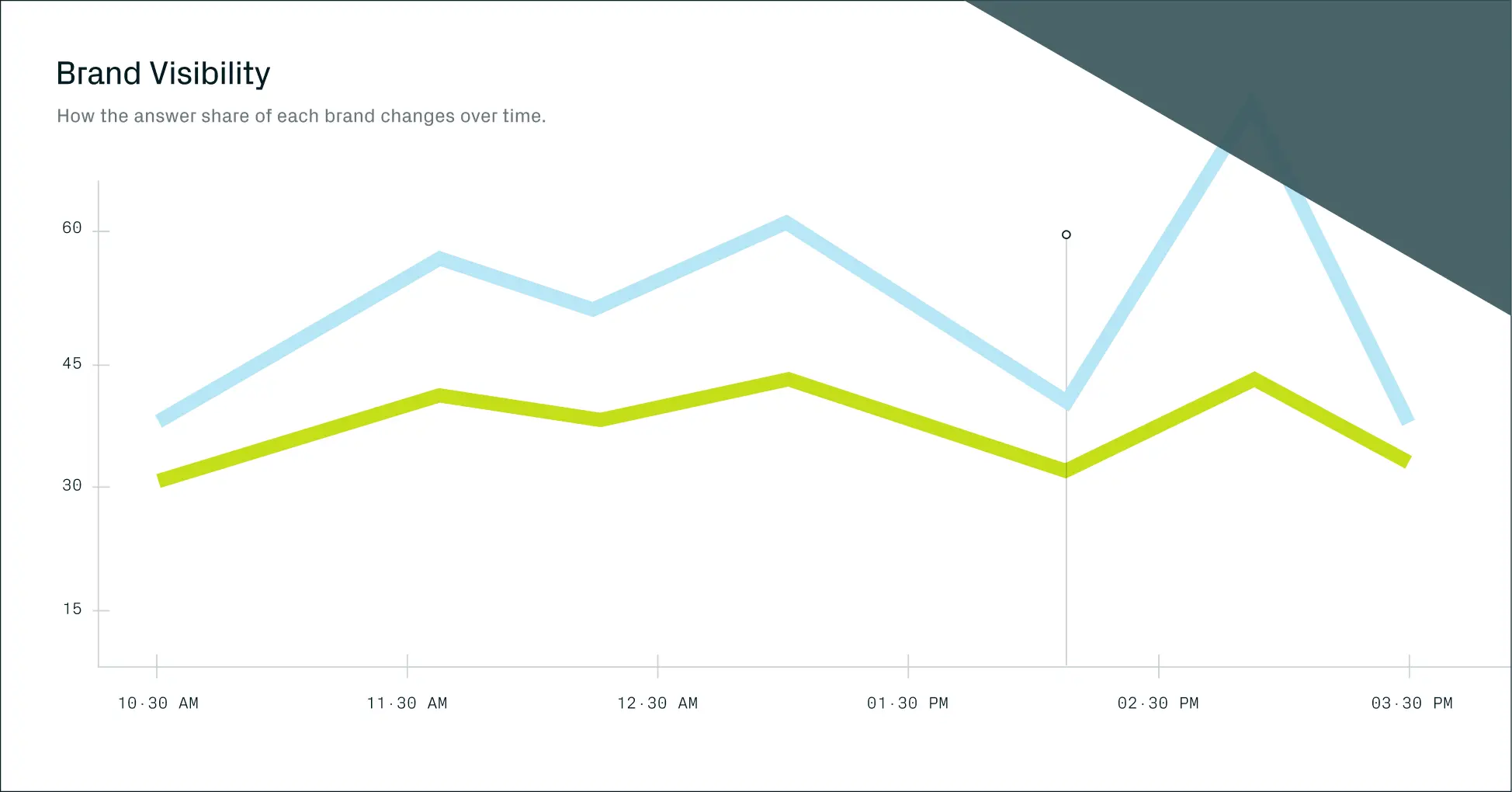
Gauge sells volume. Its Gauge Chat pricing page has one self-serve plan and one custom plan. Growth is $599 a month for 600 prompts run daily, which the page says is 54,000 AI answers tracked a month, on three platforms: ChatGPT, Google AI Mode and Microsoft Copilot. It also includes 18 publish-ready articles a month, 3 seats, unlimited domains and competitors, an Ask Gauge agent with unlimited chats, Action Center recommendations, and email plus Slack support.
Enterprise adds the other three core platforms (Google AI Overviews, Gemini and Perplexity), sentiment analysis, exports, custom prompts, articles, seats and locations, and recurring implementation and strategy sessions. Claude and Grok are optional on either plan using your own API keys. Integrations include GA4, Search Console, DataForSEO, CMS publishing to Webflow, Framer, Sanity and GitHub, Slack and MCP access.
Pricing: As of Nov 21, 2026: Growth $599 a month (no sales call required). Enterprise custom. The same pricing page also lists Gauge Agents (coding-agent evaluations) with a free hosted plan and paid plans from $499 a month, which is a separate product.
Free tier or trial: No trial is stated for Gauge Chat. The free plan on the page belongs to Gauge Agents.
Limits: 600 prompts, 3 platforms, 1 location, 3 seats and no exports or sentiment analysis on Growth.
Pros
- 600 daily prompts and 54,000 answers a month in the single self-serve price.
- 18 articles and an Ask Gauge agent included, plus MCP access.
- Unlimited domains and competitors.
- CMS publishing integrations (Webflow, Framer, Sanity, GitHub) shorten the content step.
Cons
- Only three platforms on Growth, with Perplexity, Gemini and AI Overviews held for Enterprise.
- No exports or sentiment analysis on the self-serve plan.
- A $599 floor is the highest self-serve entry price in this list.
- Single location on Growth.
Benefits for you
- A predictable price for a high-volume workload.
- Tracking and article production share one budget and one workflow.
- Optional bring-your-own-key tracking for Claude and Grok.
Standout use case: The ratio of tracked answers to price, with a content engine included.
Skip it if: You need Perplexity or Gemini coverage on a self-serve plan, exports, or a budget under $500.
Pricing Table
All figures are from the vendors' pages on Nov 21, 2026. Currency is as shown on each page (Otterly and Rankscale price in euros), and taxes are not included unless a page says so.
| Tool | Plans and prices | Free tier or trial | Limits to read first |
|---|---|---|---|
| Profound | Enterprise: custom | No self-serve trial | Agent credits; overage or pause is configurable |
| Peec AI | Starter $95, Pro $245, Advanced $495 a month; Enterprise custom (15% annual discount) | Not stated on the pricing page | 3 active models, 50 / 150 / 350 prompts, 1 / 3 / 3 countries |
| Otterly.AI | Lite EUR 29, Standard EUR 189, Premium EUR 489 a month | Free trial | Credits: 2,000 and 15,000 on the first two plans; Claude costs 3 credits per answer |
| Semrush AI Visibility Toolkit | Base $99 a month per domain; +$60 for 50 prompts; +$99 per extra domain or license | No free trial | 25 prompts; 10 CSV exports a day |
| Ahrefs Brand Radar | Custom Prompts $50 to $199 a month; Index from $199; Lite $129, Standard $249, Advanced $449 headline plans | Not stated | Daily Custom Prompts quota 5, 10, 20 by plan; overage $0.020 per check on the Brand Radar page |
| Scrunch AI | Core $250 a month; Enterprise custom | 7-day free trial on Core | 15,000 responses a month, 1 brand, 5 seats |
| AthenaHQ | Essential free; Starter $295 a month; Enterprise custom | Free Essential with $25 credit | 3,600 credits a month on Starter; 1 credit is 1 AI response |
| Rankscale | Pro EUR 99, Pro+ EUR 229, Growth EUR 385, Enterprise EUR 780 a month | 7-day trial on Pro | Credits: 1,200 / 3,000 / 5,500 / 12,000 a month |
| Writesonic GEO | $79, $199, $399 a month billed annually; Custom | Page says start free, no credit card | 50 / 100 / 200 prompts; 1 / 2 / 3 users |
| Goodie AI | Core $295, Pro $999 a month; Enterprise custom | Not stated | 110 / 250 / 500+ prompts |
| Evertune | Starter $60, Pro $800 a month billed annually; Enterprise custom | Not stated | 5,000 / 100,000 prompt credits a month; Ads Agent fee on media spend |
| Gauge | Growth $599 a month; Enterprise custom | No trial for Gauge Chat stated | 600 prompts on 3 platforms; 3 seats |
Feature Matrix
Yes, partial or not listed refers to what appeared on the pages we fetched, not to what a vendor may offer in a sales conversation. Not listed does not mean absent.
| Tool | Broad engine coverage | MCP | API | Content or optimization agent | AI bot or crawler analytics | Trial |
|---|---|---|---|---|---|---|
| Profound | Yes | Not listed | Enterprise | Yes (AI Marketer) | Yes | No |
| Peec AI | Partial (3 of 8) | Yes, all plans | Pro and up | No | Yes (crawlability, referrals) | Not stated |
| Otterly.AI | Partial (4 of 7) | Not listed | Not listed | No | No | Yes |
| Semrush AI Visibility Toolkit | Partial (4) | Not listed | Not listed | No | Partial (AI crawler audit) | No |
| Ahrefs Brand Radar | Yes | Yes | Yes | No | Yes (AI Analytics) | Not stated |
| Scrunch AI | Yes (8) | Yes | Enterprise | Yes | Yes (agent traffic) | Yes (7 days) |
| AthenaHQ | Yes (11) | Not listed | Paid add-on | Yes | Partial (robots.txt, llms.txt) | Free tier |
| Rankscale | Yes (17+) | Yes | Pro+ (REST) | Partial (page audits) | Not listed | Yes (7 days) |
| Writesonic GEO | Partial (3) | Not listed | Not listed | Yes | Yes (AI Bot Analytics) | Free start |
| Goodie AI | Yes (5 to 14) | Yes | Enterprise | Yes (optimizations) | Yes | Not stated |
| Evertune | Yes | Yes | Data export and APIs | Yes (Content Agent) | Yes | Not stated |
| Gauge | Partial (3) | Yes | Not listed | Yes (18 articles) | Not listed | No |
Best For, by Situation
| Your situation | Start with | Why |
|---|---|---|
| Procurement needs SSO, SOC 2 and a named specialist | Profound | Lists SSO/SAML, SOC 2, a dedicated Slack channel and a 24 hour specialist SLA. |
| You want a clean tracker and nothing else | Peec AI or Otterly.AI | Both focus on tracking, with public prices and unlimited users or team members. |
| You are testing whether GEO matters for your brand | Otterly.AI, Rankscale or AthenaHQ | Trial or free entry points exist on all three. |
| You already pay for a big SEO suite | Semrush or Ahrefs | AI visibility sits next to the keyword and backlink data you already use. |
| You run many client brands | Rankscale, Otterly.AI, Peec AI | Brand dashboards, partner program or multiple projects are part of the plans. |
| You need Claude coverage on a small plan | Rankscale, Athena or Ahrefs Custom Prompts | Claude is listed on these self-serve routes; Scrunch sells it as an Enterprise add-on. |
| You want articles written from visibility gaps | Writesonic GEO or Gauge | Both put article volume inside the plan price. |
| You buy ads and care about statistical noise | Evertune | 100 samples per prompt and an ads agent on the same platform. |
| You sell physical products | Peec AI, Goodie AI or Writesonic Custom | SKU-level or shopping visibility appears on these plans. |
If you are weighing the observability side of the same problem, for your own AI products rather than your brand, see our comparison of LLM observability and evaluation tools. And if you build agents that use these tools through connectors, the MCP integration platforms roundup is the companion.
Buying Checklist and Common Mistakes
Before you pay
- Write your prompt list first. Draft 50 to 100 prompts per topic, split into category, comparison and branded questions, and see which plan actually covers them.
- Count units, not plans. Convert every quote into prompts times engines times days. Otterly, Rankscale, AthenaHQ and Peec each use a different unit.
- Check the engines you care about. Claude, Copilot, Grok and Perplexity are gated differently on different plans.
- Ask about exports and the API. If you will build reports, check whether API or CSV export is included at your tier.
- Check seats and projects. Peec has unlimited users but limited projects, Gauge has 3 seats, and Semrush charges per subuser license.
- Test on your own brand. Use a trial where one exists, and compare two tools on the same 30 prompts.
Common mistakes
- Buying on sticker price. A EUR 29 plan with 16 prompts can cost more per prompt than a bigger plan.
- Trusting one answer. AI answers vary between runs, so judge trends over many prompts.
- Comparing scores across tools. Each vendor scores differently, so keep one tool and one prompt set for trend work.
- Skipping the crawl check. If AI bots are blocked by your robots.txt, tracking will only show you the damage.
- Publishing generated content unedited. Content engines speed up drafts, not judgement.
- Assuming prices stay put. Profound retired its plans within the same year this page was written.
How We Evaluated
We fetched each vendor's pricing and product pages on Nov 21, 2026 and recorded what they say. For Profound, Peec AI, Ahrefs, Semrush and Scrunch we also read help or feature pages where available. We did not run campaigns, subscribe to any plan, or test the accuracy of any tool's measurements, so every strength and weakness reflects published documentation and our reading of the trade-offs, not measured performance. Claims of customer counts, accuracy and results come from the vendors and are labeled that way. There is no paid placement and no affiliate link in this ranking, and vendors did not review it. The images are the vendors' own Open Graph or hero images, each checked to return an image file, and the X posts and YouTube video were checked for existence and text before embedding.
We did not include tools whose pricing or product we could not verify. RadarKit appears in the video above but was not part of our verified set. Prices and plan names change often. If a figure here no longer matches the vendor page, trust the vendor page.
The pattern of dated pricing and labeled vendor claims is the same one used in our roundups of AI coding agents and AI SDR agents.
FAQ
What is GEO, and how is it different from SEO?
GEO stands for generative engine optimization. It is the work of getting your brand mentioned and cited inside AI answers from tools such as ChatGPT, Perplexity, Gemini and Google's AI Overviews and AI Mode. SEO measures where a page ranks in a list of links. GEO tools instead run a set of prompts repeatedly, read the answers, and report how often your brand is mentioned, cited, described positively and compared with competitors. Several vendors in this list (Semrush, Ahrefs) bolt this onto an SEO suite, and others (Peec AI, Otterly.AI) are standalone trackers.
Which GEO tool is best overall?
There is no single winner, because the tools target different buyers. Profound is built for enterprises that want agents and compliance features and is quote-only. Peec AI and Otterly.AI are the most direct trackers for marketing teams. Semrush and Ahrefs make sense if you already use them. Rankscale gives the most engines per euro. Pick by the situation table above, then run a trial on your own prompts.
Profound vs Semrush: which should I choose?
Semrush's AI Visibility Toolkit is $99 a month per domain with 25 tracked prompts and works as an add-on to a general SEO suite. Profound is an enterprise platform with custom pricing, up to 10 answer engines tracked, Agents and SSO. If you need a quick, low-cost AI visibility line inside an existing Semrush account, start with Semrush. If you need broad engine coverage, agents and a contract with security terms, Profound is the more relevant comparison, but you will need a sales call to get a price.
What is a good Peec AI alternative?
Otterly.AI is the closest in spirit, with unlimited team members and a EUR 29 entry plan plus a free trial. Rankscale offers 17+ engines on every plan from EUR 99 and a 7-day trial. Scrunch AI is $250 a month with a 7-day trial and 8 engines, and adds page optimization. AthenaHQ has a free Essential plan. Choose based on which limit you hit with Peec: three active models, one country on Starter, or no stated trial.
What is the cheapest way to start tracking AI visibility?
AthenaHQ's Essential plan is free with a $25 credit. Otterly.AI starts at EUR 29 a month and offers a free trial. Evertune's Starter is $60 a month. Rankscale starts at EUR 99 a month with a 7-day trial and a promotion was displayed when we checked. Cheaper plans carry small prompt or credit allowances, so check that the allowance covers a realistic prompt set before treating the price as the whole cost.
Which of these tools have a free trial or free tier?
As of Nov 21, 2026: AthenaHQ has a free Essential plan, Otterly.AI says it provides a free trial, Scrunch AI lists a 7-day free trial on Core, Rankscale lists a 7-day trial on Pro, and Writesonic's page says you can start free with no credit card. Semrush says its AI Visibility Toolkit has no free trial. Profound has no self-serve trial. We did not find a trial stated for Peec AI, Ahrefs Brand Radar, Goodie AI, Evertune or Gauge Chat.
How many prompts should I track?
Otterly.AI's own guidance is 50 to 100 prompts per topic or market, because a single AI answer is noisy, and it says its stability study showed tracking 100 prompts daily for 30 days cut variation in brand coverage by about 73% compared with 10 prompts. That is a vendor result, but the principle of tracking enough prompts to average out noise applies to every tool. By that guide, plans with 16 or 25 tracked prompts are for pilots, not full monitoring.
Do these tools track Claude, Grok and Copilot?
It varies a lot. Profound lists Claude among up to 10 engines. Scrunch AI covers Grok, Meta AI and Copilot on Core but sells Claude as an Enterprise add-on. Rankscale lists Claude models among its API engines on every plan. Ahrefs adds Claude on Custom Prompts at 8 checks per update. Peec AI lets you pick 3 active models from 8 on self-serve plans. Gauge lists Claude and Grok as optional with your own API keys. AthenaHQ names Claude in its monitoring list. Check the exact engine list for your plan, because it changes the real price.
Which tools support MCP or an API?
Peec AI lists MCP on every plan and API from Pro. Rankscale lists MCP on Pro and a REST API from Pro+. Goodie AI lists MCP on Core and Pro and API on Enterprise. Gauge lists MCP access on both plans. Ahrefs lists API and MCP access in the Lite plan features. Scrunch lists MCP and exports on Core and API on Enterprise. Evertune lists a Data MCP and data export APIs. AthenaHQ sells API access as an add-on, and Profound lists an API on its Enterprise plan.
Which tool is best for agencies?
Otterly.AI has a partner program with pitch workspaces, branded Looker Studio reporting and consolidated billing. Rankscale includes white-label links, a success manager and an agency programme from its Growth plan at EUR 385. Scrunch AI has a separate Agencies tab on its pricing page, whose prices we did not capture. Peec AI mentions tracking multiple brands for GEO agencies, with projects limited to 1, 2 and 5 on the self-serve plans.
Sources
All fetched on Nov 21, 2026 unless noted.
- Profound: pricing and FAQ
- Peec AI: pricing
- Otterly.AI: pricing
- Semrush: AI Visibility Toolkit pricing and help article
- Ahrefs: Brand Radar and plans
- Scrunch AI: pricing
- AthenaHQ: plans and pricing
- Rankscale: pricing
- Writesonic: AI search visibility pricing
- Goodie: pricing
- Evertune: pricing
- Gauge: Gauge Chat pricing
- X: Series D post (Sep 15, 2026) and Agents launch post (Nov 18, 2026)
- X: Peec AI MCP post (Apr 15, 2026)
- X: Ahrefs Brand Radar By intent post (Nov 15, 2026)
- YouTube: Top 6 GEO Tools Compared 2026 (Jay's AI SEO Tips)