Get the latest on AI, LLMs & developer tools
New MCP servers, model updates, and guides like this one — delivered weekly.
An AI voice clone is a synthetic copy of a specific person’s voice. You give a tool a recording, and it returns speech in that voice from any text you type. The technology works from seconds of audio on several tools now, which is exactly why the interesting question in 2026 is no longer whether a clone sounds right. It is whether the person whose voice you cloned agreed to it, whether the vendor checked, and whether the vendor will still exist next year.
This guide is for creators, developers, studios and small teams choosing a cloning tool in late November 2026. Our answer as of November 26, 2026: ElevenLabs is the best overall pick when you want a clone of your own voice with a real verification step, Fish Audio is the cheapest hosted route if you will do your own rights checking, Cartesia fits voice agents, and Descript fits editing your own podcast or video. Open models such as Qwen3-TTS give you control and no consent tooling at all. Ten tools, with prices, pros, cons and consent notes, follow.
A walkthrough from ElevenLabs itself, so read it as a vendor demo. It says a Professional clone needs at least 10 minutes of audio, while the ElevenLabs docs say 30 to 180 minutes; we flag that mismatch in the ElevenLabs section.
The Short Answer
If you are cloning your own voice for narration, start with an ElevenLabs Creator plan and a Professional clone, or with a Descript custom speaker if you edit in Descript anyway. If you are building an app that needs thousands of minutes at low latency, compare Cartesia and Fish Audio on your own audio. If you only need cheap per-voice cloning inside a product, MiniMax lists $1.50 per voice. If you want to run the model yourself, Qwen3-TTS is the permissively licensed option that is still being developed; Chatterbox is a frozen snapshot.
Three facts shape this guide. First, consent checks differ more than quality does. ElevenLabs verifies Professional clones and limits them to your own voice, Descript records a consent statement, and the other tools mostly rely on you. Second, vendors came and went in 2026: LOVO’s site is disabled and the company is in Chapter 7 according to Bloomberg Law, Resemble AI stopped selling voice AI to new customers, and a Hume staff member said its voice API retired on November 13. Third, law is catching up: a New York court held in 2025 that state publicity law can cover voice clones, Tennessee’s ELVIS Act reaches tool providers, and a federal NO FAKES Act cleared a Senate committee in June 2026 but is not law.
Quick Picks by Use Case
| Use case | Pick | Why |
|---|---|---|
| Best overall for cloning | ElevenLabs | Instant and Professional clones, a voice-verification step for Professional clones, 32+ cloning languages and the widest plan ladder. Also the priciest per character. |
| Best for cheap, fast, multilingual clones | Fish Audio | A 10 second sample is enough, Plus costs $11 a month billed yearly, and S2 weights are downloadable. Its consent record needs reading first. |
| Best for voice agents and latency | Cartesia | Instant clones from 10 to 60 seconds, Pro Voice Clones with free training, and published overage rates from $38 per million characters. |
| Best consent flow for your own voice in an editor | Descript | Recorded consent statement before a custom speaker is created, plus the editor and dubbing around it. |
| Best pay per clone API | MiniMax Speech | Rapid Voice Cloning at $1.50 per voice, charged when the voice is first used. |
| Best for a team that wants one vendor and sales support | Murf AI | Instant and Professional cloning, a pay as you go API from $0.01 per 1,000 characters, Professional cloning on Enterprise. |
| Best for film, games and speech-to-speech | Respeecher | Studio speech-to-speech conversion with credits in film and games, sold through sales with no public price list. |
| Best open weights for self-hosting today | Qwen3-TTS | Apache 2.0, 0.6B and 1.7B models, 10 languages and voice cloning, created January 2026. |
| Best free option with a watermark | Chatterbox | MIT licensed with Perth watermarking, but the README says it is retired research and no longer maintained. |
| Best old reference model | OpenVoice | MIT licensed, V2 from April 2024, six native languages. Use it to learn, not to bet a product on. |
Introducing Eleven v4 and Eleven v4 Turbo, our fastest and most emotive voice models yet.
Ranked #1 by Artificial Analysis.
— @ElevenLabs September 28, 2026
The Artificial Analysis ranking is the vendor’s own claim in this post; we did not check the live leaderboard.
Consent Checks Compared
Every vendor in this list tells you to clone only voices you have the right to clone. Few of them check. The table separates what the vendor says from what the product enforces, using the vendor pages and docs we read on November 26, 2026. Where we found nothing, we say so; that is not proof that nothing exists.
| Tool | Technical or recorded check | What else we found | Gap or quote |
|---|---|---|---|
| ElevenLabs | Professional: voice verification (voice captcha). Own voice only, even with permission for others. | Instant: attestation in the 2024 to 2025 Consumer Reports test. | Docs quote: 'You can only create a PVC of your own voice. Even with their consent, you cannot clone someone else's voice. All PVCs require verification.' |
| Descript | Recorded consent statement, English only, before the speaker is built. | Blocks deceased people, non-consenting people and AI-generated source audio (help center). | You can upload a recording for someone else, so the statement proves a recording, not an identity. |
| Fish Audio | Verified Professional clone in the web app; ownership dispute flow with voice verification (company blog, July 2026). | Instant clones: private by default, you choose private, unlisted or public. | FAQ: you are responsible for rights; Fish does not pre-clear use cases. TechCrunch reported creators alleging uploads without consent. |
| Cartesia | Cookbook line: only clone a voice with the speaker's explicit consent. Delete-voice endpoint. | No technical check documented in the pages we read. | Policy sits with the developer who calls the API. |
| MiniMax Speech | None mentioned in the voice clone guide we fetched. | Rapid cloning is charged on first use. | Check the terms of service yourself; we did not read them. |
| Murf AI | Not documented on the voice cloning page. | FAQ says celebrity cloning is possible but can be deemed unethical. | Professional cloning is an Enterprise feature, which implies a sales conversation. |
| Respeecher | Ethics statement on the site; studio engagements. | No public documentation of the checks. | Ask for the contract language, not the marketing. |
| Open weights (Qwen3-TTS, Chatterbox, OpenVoice) | None enforced. Chatterbox adds a Perth watermark. | A licence cannot stop a user from cloning a voice. | You carry the whole consent process: release form, storage, labelling. |
The 2025 Consumer Reports study is the only independent comparison we found. It tested products between September 2024 and January 2025 and reported that several vendors, including ElevenLabs, Speechify, PlayHT and LOVO, relied on a checkbox, while Descript required a read-aloud consent statement and Resemble took some steps. It is more than a year old, vendors have changed, and two of those companies no longer sell the products it tested, so use it as a baseline, not a current ranking.
A recorded statement is better than a checkbox, but it is still weak against someone who records a victim saying the words, or who plays back a synthetic recording. ElevenLabs’ Professional flow is stricter because it uses a live verification step and refuses to build a clone of anyone but the account holder. That strictness has a cost: legitimate licensing, such as an agency cloning a client with a contract, has to go through other channels.
Master Comparison Table
| Tool | Type | Paid price (as of November 26, 2026) | Free tier | Consent step |
|---|---|---|---|---|
 ElevenLabs | Hosted TTS and cloning platform | Starter $6/mo ($60/yr), Creator $22, Pro $99, Scale $299, Business $990 | 10,000 credits per month | Professional clones: voice verification step. Instant clones: attestation (older third-party finding) |
 Fish Audio | Hosted app and API, source-available weights | Plus $11/mo billed yearly ($15 monthly), Pro $75/mo billed yearly ($100 monthly) | 8,000 credits per month | Verified Professional clones, community library with takedown flow; no pre-clearing of uploads |
 Cartesia | Developer API and voice agent platform | Pro $5, Startup $49, Scale $299 | 20,000 credits per month | Cookbook asks for explicit consent; no documented technical check found |
 Descript | Editor with AI Speech | Hobbyist $16, Creator $24, Business $50 per person per month, billed yearly | 60 media minutes | Recorded consent statement before a custom speaker is built |
 MiniMax Speech | Developer API | $100 per 1M characters (speech-2.8-hd), Rapid Voice Cloning $1.50 per voice | None found on the pricing page | No consent step in the clone guide we read |
 Murf AI | Studio plus API | API pay as you go from $0.01 per 1,000 characters (Falcon), Professional cloning on Enterprise | Not confirmed (plan cards did not render) | FAQ says celebrity cloning is possible but may be unethical |
 Respeecher | Speech-to-speech for studios | No public price list | Not public | Ethics statement; sold through sales |
 Qwen3-TTS | Open weights (Apache 2.0) plus DashScope API | $0 for weights, your own compute | Open weights | None built in; your responsibility |
 Chatterbox | Open weights (MIT), retired | $0, your own compute | Open weights | Perth watermark; project no longer maintained |
 OpenVoice | Open weights (MIT), older | $0, your own compute | Open weights | None built in; your responsibility |
What a Clone Costs: Worked Out
Cloning prices come in four shapes: a monthly plan that unlocks the feature (ElevenLabs, Descript), a slot you pay for in a higher tier (Cartesia, Fish Audio), a fee per voice (MiniMax) or no fee at all but your own compute (open weights). The table below is our own arithmetic from vendor pages as of November 26, 2026. It uses list prices, ignores promotions and retries, and is a planning aid, not a quote.
| Plan | Plan price and units | Approximate cost | Note |
|---|---|---|---|
| ElevenLabs Pro | $99 per month for 600,000 credits, 1 credit per character | about $0.165 per 1,000 characters | Our arithmetic. Scale ($299 for 1.8M) and Business ($990 for 6M) work out to the same rate. |
| Cartesia Pro | $5 per month for 100,000 credits, 1 credit per character | about $0.05 per 1,000 characters | Overage listed at $65 per 1M credits (about $0.065 per 1,000). |
| Cartesia Startup | $49 per month for 1.25M credits | about $0.039 per 1,000 characters | Includes 2 Pro Voice Clone slots, training free. Overage $45 per 1M. |
| Cartesia Scale | $299 per month for 8M credits | about $0.037 per 1,000 characters | Includes 4 Pro Voice Clone slots. Overage $38 per 1M. |
| Fish Audio Plus (annual) | $11 per month for up to 200 minutes | about $0.055 per generated minute | Our arithmetic from the plan card; monthly billing is $15, about $0.075 per minute. |
| Fish Audio Pro (annual) | $75 per month for up to 1,620 minutes | about $0.046 per generated minute | Includes 5 professional voice slots and 3 seats. |
| MiniMax speech-2.8-hd | $100 per 1M characters | $0.10 per 1,000 characters | speech-2.8-turbo is $60 per 1M ($0.06 per 1,000). Plus $1.50 per cloned voice. |
| Murf Falcon API | $0.01 per 1,000 characters | $0.01 per 1,000 characters | Gen2 is $0.03 per 1,000. Voice Changer is $0.10 per minute. Cloning terms are separate. |
| Descript Hobbyist | $16 per person per month, 400 AI credits | Credit rate not read | We did not record how many credits a minute of AI Speech uses. |
Two patterns stand out. The entry paid plans (Cartesia Pro at $5, ElevenLabs Starter at $6) are cheap ways to get an instant clone, but Professional clones sit higher: ElevenLabs Creator at $22, Cartesia Startup at $49 and Fish Audio Plus at $11 a month with one slot. And per-character prices differ by more than four times between ElevenLabs Pro and Cartesia Scale, so a cheap clone on an expensive generation rate can cost more than an expensive clone on a cheap rate.
1. ElevenLabs
What it is. ElevenLabs is the broadest hosted voice platform in this list: text to speech, a voice changer, dubbing, a voice library and two cloning products. Instant Voice Cloning (IVC) conditions the model on a short sample and does not train anything, and the docs say so directly. Professional Voice Cloning (PVC) trains a dedicated model on much more audio.
Who it is for. Creators, publishers and companies that want the most mature consent flow for a hosted clone, and the widest range of plans from $6 a month to $990.
How much audio. The docs recommend 1 to 2 minutes for IVC (minimum 10 seconds total in the app) and 30 to 180 minutes for PVC, with 3 to 6 hours of training. The voice cloning page is less consistent: it mentions a 10-second recording in one place and 1 to 5 minutes in another. An official ElevenLabs video says PVC needs at least 10 minutes and recommends more than an hour. Eleven v4, launched September 28, 2026, says IVC can capture a voice from 10 seconds of audio (company blog and TechCrunch). Pick the longest clean sample you can get.
Consent in practice. PVC requires you to pass a verification step and is limited to your own voice, even if someone else consents. Voice sharing in the library works for PVC only. A 2025 Consumer Reports study, which tested products between September 2024 and January 2025, found checkbox-style attestation for IVC at ElevenLabs and described its additional safeguards: no-go voices, a voice CAPTCHA for PVC, C2PA provenance and an AI speech classifier. That study is now older than a year, so treat it as history, not a current audit.
Where the pages disagree. The voice library is 10,000+ voices in the docs and 17,000+ on the voice cloning page. The cloning page cites 32 languages for creating a voice, while v4 speech is advertised in 90+ languages; the pages do not say whether those two numbers describe the same thing.
ALS had taken Monica’s voice. But at her daughter’s wedding, she was able to give a speech in her own voice.
ElevenLabs recreated her voice from an old home video, and she now uses it to talk with her family.
— @ElevenLabs October 26, 2026
This is the use case consent frameworks exist to protect: voice banking and voice restoration for people who lose speech. The same technique, applied to someone who did not agree, is the abuse case.
| Pricing (as of November 26, 2026) | Free $0 (10,000 credits). Starter $6 a month ($60 a year). Creator $22 ($220). Pro $99 ($990), 600,000 credits. Scale $299 ($2,990), 1.8M credits, 3 seats. Business $990 ($9,900), 6M credits, 10 Professional Voice Clones, 10 seats. Black Friday offer ends December 1, 2026. |
| Free tier or trial | 10,000 credits a month. Cloning and commercial rights are on paid plans. |
| Cloning: input and modes | IVC from Starter; PVC from Creator. IVC 10 seconds to 2 minutes; PVC 30 to 180 minutes. |
| Consent and safety | PVC verification required and own-voice only. Voice sharing for PVC only. |
| Limits to know | 1 credit per character on the web. Credits roll over 2 months up to 2x. Default library voices listed as expiring December 31, 2026. |
Pros
- Strongest documented consent step for Professional clones.
- Both instant and professional options, plus the widest plan ladder.
- Cloned voices can be shared and monetised from the library (company says it has paid out $14M to voice sharers).
- v4 improves cloning from short samples and multilingual accent handling, according to the company.
Cons
- Highest per-character price of the hosted APIs we compared (about $0.165 per 1,000 characters on Pro).
- Professional clones are locked to your own voice, which blocks legitimate agency and licensing workflows unless the voice owner records the verification.
- Vendor pages disagree on sample length and voice library size.
Benefits for you
- If you want a publishable clone of your own voice with a clear audit trail, this is the shortest path.
- One account covers cloning, dubbing and voice changing, so you do not stitch tools together.
- Enterprise plans include multiple PVC slots for teams.
Skip it if. Skip it if you need to clone a client's or an actor's voice under a licence in a self-serve flow, or if cost per million characters is the main constraint.
2. Fish Audio
What it is. Fish Audio runs a hosted studio and API around its S2 family of models. The company says S2.1 Pro is available only through its paid API, while earlier models are open-sourced. On July 28, 2026 TechCrunch reported a $52 million seed round, $21 million in annual recurring revenue and more than 8 million users; those are company figures. Its blog says the community library holds 2 million+ voice models.
Who it is for. Creators, game developers and anyone who wants cheap minutes and expressive control, and who will do their own rights checking.
Cloning options. Instant cloning takes a sample of at least 10 seconds per clip in wav, mp3, m4a or opus. Persistent voices can be private (default), unlisted or public. The Professional Voice Clone is a web app flow marketed as a verified, studio-quality clone you can release and earn from. The docs list models s2.1-pro, s2.1-pro-free (no latency or data-processing guarantees), s2-pro and the older s1, which retires December 31, 2026.
Where the pages disagree. The plan page shows commercial use on the Free row while its own FAQ says the free plan is personal and non-commercial. The voice clone page claims 13 languages for zero-shot cloning, while other pages talk about 50 and 80+ languages. We would trust the stricter reading for the licence question.
Consent in practice. The clone page has a marketing line about having a sitting president narrate your dating app, and its FAQ says you are responsible for confirming rights and that Fish Audio does not pre-clear individual use cases. TechCrunch reported creators alleging their voices were uploaded without consent, the UK performers' union Equity said on June 3, 2026 that it had written to Fish Audio on behalf of 22 members, demanding removal of unauthorised cloned voices, and the company says takedowns are now automated within three minutes if you supply a voice sample or contract. TechCrunch's own caveat: that does not stop someone uploading a voice without the owner knowing.
Open weights licence. The fish-speech repository carries a Fish Audio Community License: free for research and non-commercial use, commercial use allowed while annual revenue is below USD 500,000, and a separate licence needed to offer a hosted service. That is source-available, not open source in the OSI sense.
Today we launch Fish Audio S2, a new generation of expressive TTS with absurdly controllable emotion.
- open-source
— @FishAudio March 10, 2026
- sub 150ms latency
- multi-speaker in one pass
“Open-source” here means the S2 weights under the Fish Audio Community License described above, not an OSI-approved licence. The latency figure is the company’s claim.
| Pricing (as of November 26, 2026) | Free $0. Plus $11 a month billed yearly ($132) or $15 monthly. Pro $75 a month billed yearly ($900) or $100 monthly. API is pay as you go. |
| Free tier or trial | 8,000 credits a month, up to 7 minutes, 500 characters per generation, 3 public voice slots. |
| Cloning: input and modes | Instant: 10 seconds or more per clip. Professional: web app, 1 slot on Plus, 5 on Pro. |
| Consent and safety | Verified Professional clones; ownership dispute flow; no pre-clearing of uploads. |
| Limits to know | Plus: 250,000 credits, up to 200 minutes, 15,000 characters per generation, 10 private voice slots. Pro: 2,000,000 credits, up to 1,620 minutes, 30,000 characters, 3 seats. |
Pros
- Among the cheapest hosted minutes we found (about $0.046 to $0.055 by our arithmetic on yearly plans).
- Instant clone from a 10 second sample, with voices private by default.
- Weights downloadable for research and small commercial use.
- Expressive controls and a large language claim.
Cons
- Community library moderation relies on takedown after upload.
- The plan page contradicts its own FAQ on free-tier commercial use.
- Licence for the open weights blocks hosted services and larger commercial users.
- Credit and minute figures are shown on separate pages, so you must calculate your own rate.
Benefits for you
- Good fit for character voices where you own or license every source recording.
- Cheap enough to test several voices before committing.
- Enterprise pages talk about zero data retention and on-premise options for regulated users (company press release).
Skip it if. Skip it if your legal team needs a technical gate against cloning third parties on the instant path, or if you want a plain free tier you can use commercially.
3. Cartesia
What it is. Cartesia is a developer-first speech platform. Its Sonic 3.6 model reached general availability on August 27, 2026 according to its own announcement on X. The docs list 44 languages while the blog mentions 61 locales, so the headline count depends on which page you read.
Who it is for. Teams building voice agents, games or apps who want predictable credits, SOC 2 Type II and cloning in the same API.
Cloning options. Instant cloning needs about 10 seconds and works up to 60 seconds on Sonic 3.6 and later, with a 16 MB file cap. Pro Voice Clones need 30 minutes or more and training is free. A clone is built from one language, and an accents endpoint adds more at 225 credits per added accent.
Consent in practice. The official cookbook tells developers to clone a voice only with the speaker's explicit consent and shows how to delete a voice. We found no documented technical verification in the docs we read, so the control is policy plus whatever you build around the API.
Sonic-3.6 is now generally available.
In January we made a bet: stop tuning the existing paradigm, rebuild from the architecture up.
— @cartesia August 27, 2026
| Pricing (as of November 26, 2026) | Free $0 (20,000 credits). Pro $5 (100,000 credits). Startup $49 (1.25M credits). Scale $299 (8M credits). Enterprise custom. Overage: $65, $45, $38 per 1M credits on Pro, Startup, Scale. |
| Free tier or trial | 20,000 credits a month (about 27 minutes by the pricing page). |
| Cloning: input and modes | Instant: 10 to 60 seconds. Pro Voice Clone: 30+ minutes, 2 slots on Startup, 4 on Scale, none on Free or Pro. |
| Consent and safety | Cookbook asks for explicit consent; delete-voice endpoint; no technical check documented. |
| Limits to know | 1 credit per character of speech. Credits roll over up to 2x. Free and Pro have no Pro Voice Clone slots. |
Pros
- Transparent credits with published overage rates.
- Pro Voice Clone training is free.
- Entry paid plan at $5 includes instant cloning and a commercial licence.
- SOC 2 Type II listed on the pricing page.
Cons
- Language count differs between docs and blog.
- Pro Voice Clones only from the $49 tier.
- No documented consent verification step.
Benefits for you
- Low published per-character rate at higher tiers (about $0.037 per 1,000 on Scale by our arithmetic; Murf's Falcon API is listed lower at $0.01).
- Fits an agent stack where the same vendor handles the voice and its clone.
Skip it if. Skip it if you want a point-and-click studio for editing audiobooks, or if you need a built-in identity check.
4. Descript
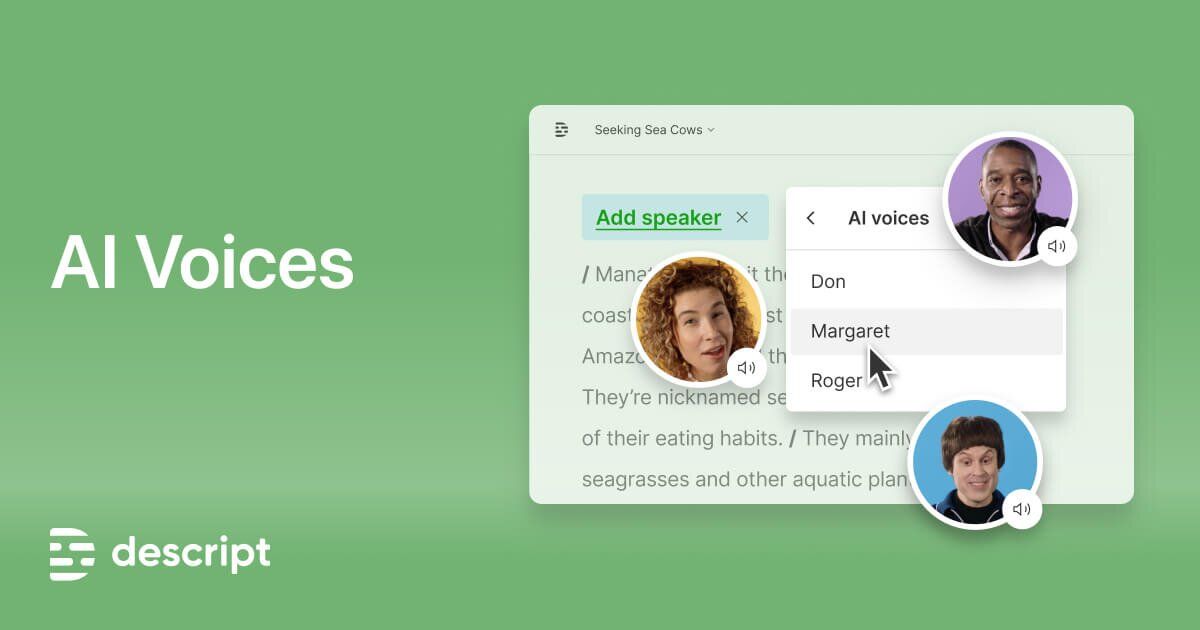
What it is. Descript is an audio and video editor that edits media by editing a transcript. Its AI Speech feature lets you create a custom speaker from your own voice and generate or fix lines inside the editor. The help center says voice generation options include ElevenLabs v2, v3 and v4 models selectable in App Settings.
Who it is for. Podcasters, course creators and video teams that want a cloned voice inside the editing tool, not a separate TTS site.
Consent in practice. Descript's custom speaker flow asks you to record a consent statement before it builds the voice. The statement must be in English even for other languages. The help center blocks cloning deceased people, non-consenting people and AI-generated source audio. It also says you can upload a recording for someone else, so the flow proves that a recording exists, not who is speaking. A 2023 Stripe interview describes fingerprint matching and human review of the statements, but that is older than the help center, so we treat it as background.
Where the pages disagree. The help center says the clone is based on US English pronunciation and that you cannot add samples to an existing clone. A Descript blog post dated July 29, 2026 still says Overdub needs 10 minutes of training audio, which does not match the current help center flow. We note the contradiction and did not test the minimum ourselves.
| Pricing (as of November 26, 2026) | Free $0 (60 media minutes). Hobbyist $16 per person a month billed yearly (10 media hours, 400 AI credits, custom voice clones). Creator $24 (30 hours, 800 credits). Business $50 (40 hours, 1,500 credits, dubbing in 30+ languages). Enterprise custom. |
| Free tier or trial | 60 media minutes. Custom voice clone is listed from Hobbyist. |
| Cloning: input and modes | Custom speaker from a recorded sample plus consent statement; no adding samples afterwards. |
| Consent and safety | Recorded consent statement (English), blocks deceased and AI-source audio. |
| Limits to know | Per-person pricing. US English pronunciation base. |
Pros
- Consent statement is built into the flow, not an afterthought.
- Clone lives inside the editor with transcripts, captions and dubbing.
- Clear public ban on deceased or non-consenting voices.
Cons
- No API for cloning that we found.
- Cannot extend an existing clone with more samples.
- Documentation is inconsistent about training length.
Benefits for you
- If you already edit in Descript, fixing a flubbed word in your own voice takes seconds.
- The consent statement leaves a record you can show a client or platform.
Skip it if. Skip it if you need a voice API for an app, high-volume generation, or non-English-pronunciation clones.
5. MiniMax Speech
What it is. MiniMax sells speech models through its developer platform. Its pricing page lists speech-2.8-hd at $100 per 1M characters and speech-2.8-turbo at $60 per 1M, plus voice products priced per voice.
Who it is for. Developers building apps where each end user gets a cloned or designed voice and the cost must be predictable per voice.
Cloning options. Rapid Voice Cloning costs $1.50 per voice, charged when the voice is first used for synthesis. Voice Design costs $3 per voice. The clone guide accepts mp3, m4a or wav audio from 10 seconds to 5 minutes up to 20 MB, with an optional prompt audio under 8 seconds. Audio packages (Starter, Standard, Pro, Scale, Business) include 10, 100, 250, 500 and 800 voice slots.
Consent in practice. The clone guide we fetched does not mention a consent mechanism. That does not prove none exists in the terms of service, but it means the developer integrating the API carries the consent process.
| Pricing (as of November 26, 2026) | speech-2.8-hd $100 per 1M characters. speech-2.8-turbo $60 per 1M. Rapid Voice Cloning $1.50 per voice. Voice Design $3 per voice. Packages with 10 to 800 voice slots. |
| Free tier or trial | None found on the pricing page. |
| Cloning: input and modes | Rapid: 10 seconds to 5 minutes of mp3, m4a or wav, up to 20 MB. |
| Consent and safety | Not mentioned in the clone guide. |
| Limits to know | Clone fee charged at first synthesis use. Music API closed to new users on August 20, 2026 per the pricing page. |
Pros
- Only per-voice price we found in a public price list.
- Slots scale to hundreds of voices on packages.
- Longer source audio allowed than most instant tools.
Cons
- No documented consent step.
- Higher per-character rate than Cartesia or Fish Audio at volume.
- Fewer public tutorials in English.
Benefits for you
- A marketplace or app that clones one voice per user can budget cost per voice.
Skip it if. Skip it if consent evidence is a compliance requirement and you cannot build your own gate.
6. Murf AI
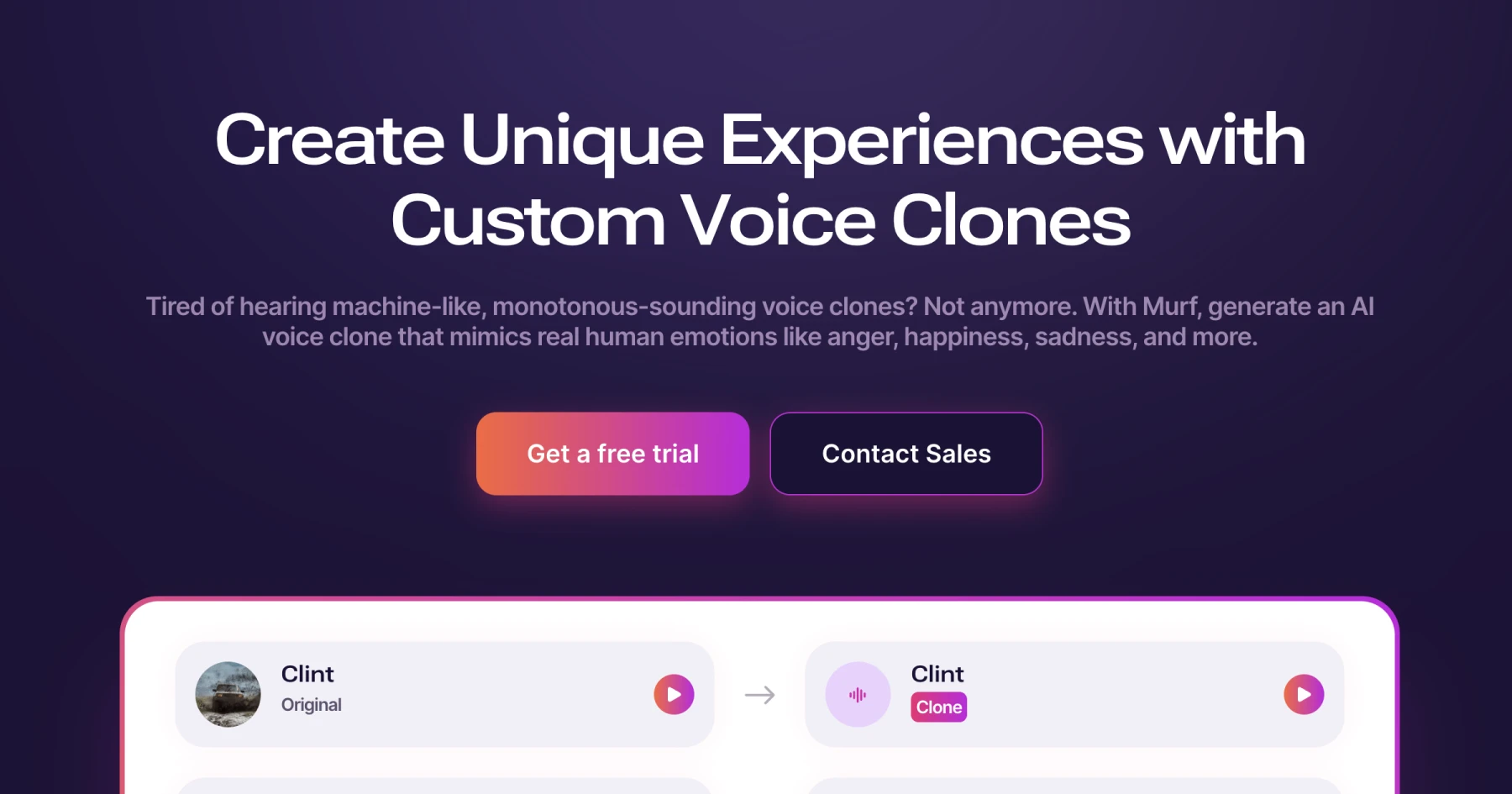
What it is. Murf is a studio-style voice-over product with an API. Its voice cloning page describes an instant clone it calls quick but low quality, and a professional clone it describes as high quality, in 20+ languages.
Who it is for. Marketing and training teams that need voiceovers with a managed vendor and sales support.
Pricing we could read. The API tab lists Falcon at $0.01 per 1,000 characters, Gen2 at $0.03 per 1,000 and Voice Changer at $0.10 per minute. Studio plan prices did not render in our fetch, so we leave them out. Professional Voice Cloning is included with Enterprise.
Consent in practice. The page's FAQ answers 'Can I clone a celebrity voice?' with yes, adding that it can be deemed unethical. We found no technical consent gate on the page.
| Pricing (as of November 26, 2026) | API pay as you go: Falcon $0.01 per 1,000 characters, Gen2 $0.03 per 1,000, Voice Changer $0.10 per minute. Studio plans not read. Enterprise includes Professional Voice Cloning. |
| Free tier or trial | Not confirmed. |
| Cloning: input and modes | Instant (quick, low quality) and Professional (high quality); 20+ languages. |
| Consent and safety | No technical gate documented; FAQ warns about ethics. |
| Limits to know | Professional cloning needs Enterprise. |
Pros
- Very low published API rate for Falcon.
- Professional cloning for managed teams.
- Honest labelling of instant clone quality.
Cons
- Studio prices did not render, so we cannot compare plans.
- Celebrity cloning answer is permissive.
- Professional clone is a sales conversation.
Benefits for you
- A team with a procurement process gets a vendor to sign paper with.
Skip it if. Skip it if you want to self-serve a professional clone today, or need a visible consent check.
7. Respeecher
What it is. Respeecher is a speech-to-speech voice conversion company: a performer speaks, and the output sounds like a target voice. Its homepage lists film and game credits including the young Luke Skywalker voice in The Mandalorian, the Cyberpunk 2077 Phantom Liberty expansion, The Brutalist and Emilia Perez.
Who it is for. Film, game and advertising studios that have a licensed target voice and a performer, and need performance preserved.
Pricing and consent. There is no public price list; /pricing returned 404 on November 26, 2026. The site carries an ethics statement about making sure voices are not misused. We did not find public documentation of the checks, so ask for contract language.
| Pricing (as of November 26, 2026) | No public price list found. |
| Free tier or trial | Not public. |
| Cloning: input and modes | Speech-to-speech conversion with a target voice; studio engagements. |
| Consent and safety | Ethics statement; sold through sales. |
| Limits to know | Not a self-serve app. |
Pros
- Keeps the performer's timing and emotion because a human acts the line.
- Credits in recognisable productions.
- Contract-based, so rights are explicit.
Cons
- No public pricing.
- Not suited to quick text-to-speech jobs.
- Consent process not publicly documented.
Benefits for you
- For licensed voices in film and games, the speech-to-speech route keeps a human performance in the loop.
Skip it if. Skip it if you want text in and audio out at a few dollars a month.
8. Qwen3-TTS
What it is. Qwen3-TTS is Alibaba's Qwen team speech model family. The GitHub repository (created January 21, 2026) shows 14,647 stars on November 26, 2026 under the Apache 2.0 licence, with 0.6B and 1.7B parameter models, voice cloning, 10 languages and a 97 ms latency claim that comes from the project itself. A hosted route exists through DashScope.
Who it is for. Teams that want to self-host a cloning-capable model with a permissive licence.
Consent in practice. There is no verification built in. Apache 2.0 permits commercial use and says nothing about a speaker's rights, so your release forms, storage and labelling are on you.
| Pricing (as of November 26, 2026) | Weights free under Apache 2.0. DashScope API pricing not read. |
| Free tier or trial | Open weights. |
| Cloning: input and modes | Voice cloning from reference audio; 10 languages. |
| Consent and safety | None built in. |
| Limits to know | Needs a GPU; latency figure is the project's claim. |
Pros
- Permissive licence suits commercial products.
- Two model sizes.
- A vendor-hosted DashScope route exists as a fallback.
Cons
- Fewer languages than the hosted tools.
- You operate inference yourself.
- No safeguards against misuse.
Benefits for you
- Per-clone cost is just compute, which matters at high volume.
Skip it if. Skip it if you have no GPU and no ML ops capacity, or need a managed consent flow.
9. Chatterbox
What it is. Chatterbox is Resemble AI's open model family: Turbo (350M, English), Nano (110M, about 3x real time on 8 CPU cores) and Multilingual V3 (500M, 23+ languages), under the MIT licence with Perth watermarking. The GitHub repository shows 28,086 stars.
Status. The README now says: 'As of August 2026, Chatterbox is retired research and is no longer maintained.' Resemble AI's August 13, 2026 blog explains the company has moved to deepfake detection and is not selling voice AI to new customers.
Who it is for. Researchers and hobbyists who want a free baseline with a watermark, and who accept no fixes.
| Pricing (as of November 26, 2026) | Free (MIT). |
| Free tier or trial | Open weights. |
| Cloning: input and modes | Zero-shot cloning from reference audio; Multilingual V3 supports 23+ languages. |
| Consent and safety | Perth watermark; no verification. |
| Limits to know | Retired, 385 open issues at our check. |
Pros
- Permissive licence and watermarking by default.
- Small variants run on CPU.
- Large community footprint.
Cons
- Officially retired and unmaintained.
- Parent company no longer sells voice AI to new customers.
- No consent tooling.
Benefits for you
- A free, watermarked reference implementation to prototype with.
Skip it if. Skip it if you need security patches, support or a roadmap.
10. OpenVoice
What it is. OpenVoice, from MyShell, is an older open instant-cloning model. V2 shipped in April 2024, the repository shows 38,316 stars and an MIT licence, and it supports six native languages (English, Spanish, French, Chinese, Japanese, Korean).
Who it is for. Students and engineers who want to learn how tone colour conversion works, and projects that need a small, permissive baseline.
Consent in practice. None built in, like the other open models.
| Pricing (as of November 26, 2026) | Free (MIT). |
| Free tier or trial | Open weights. |
| Cloning: input and modes | Instant cloning from reference audio; 6 native languages. |
| Consent and safety | None built in. |
| Limits to know | V2 is from April 2024, so newer models likely beat it on quality. |
Pros
- Permissive licence and a large star count.
- Light enough to experiment with.
Cons
- Older than the other open options.
- Few languages.
- No safeguards.
Benefits for you
- A cheap way to understand cloning end to end before paying for a hosted product.
Skip it if. Skip it if quality matters more than learning, or you need ongoing releases.
An independent creator’s step-by-step ElevenLabs cloning tutorial. We did not check its publish date, so confirm any prices or menu names it shows against the current product.
Also Worth Knowing
Fliki. Its pricing page lists voice cloning on its Standard plan (180 credits a month) and multiple voice cloning on Premium (600 credits), with professional cloning on Enterprise. Prices did not render in our fetch, so we do not quote them. It is a text-to-video tool first.
Speechify Studio, VEED and HeyGen. We could not read their voice cloning details: Speechify’s cloning page rendered no clone detail, and the VEED and HeyGen cloning URLs we tried returned 404. HeyGen’s cloning is covered in our AI dubbing guide and its avatar side in the avatar video generator roundup. We left all three out of the ranking rather than guess.
Hosted TTS APIs with stock voices. If you do not need a clone, our text-to-speech API guide compares the developer APIs on price per character and latency. For agents that speak, see the voice AI agent platforms guide.
Vendors That Stopped: LOVO, Resemble AI and Hume
Our topic notes listed three vendor stories. We checked each one before using it, and we report what a primary or named source supports.
LOVO
On November 26, 2026, lovo.ai, genny.lovo.ai and lovo.ai/pricing all returned HTTP 402 with a DEPLOYMENT_DISABLED error when we requested them directly. Bloomberg Law reported on May 29, 2026 that a federal judge in the Southern District of New York stayed the voice actors’ case against LOVO after the company filed for Chapter 7 bankruptcy, ahead of a June 16 hearing on a motion to dismiss; the same report cites the petition as listing $245,224 in assets and $17,788 in liabilities. The court’s July 2025 opinion in Lehrman v. Lovo dismissed most copyright and trademark claims but let claims under New York Civil Rights Law sections 50 and 51, consumer protection and contract proceed. The disabled site is consistent with a shutdown, but we did not find LOVO announcing one, so we describe what we observed and what the press reported, not a cause.
Resemble AI
Resemble’s August 13, 2026 blog post says, “We’re not selling voice AI to new customers,” and describes supporting existing customers while focusing on deepfake detection. Its homepage is now a detection product. Its open models, including Chatterbox, remain on GitHub but Chatterbox is marked retired. If you need a vendor to sign a data processing agreement or support you for years, this is the wrong place to start.
Hume
A Hume staff member wrote on a public issue in the Vercel AI SDK repository that the voice API was retired on 2026-11-13, and the issue shows the 404 message. Hume’s own changelog URL redirected elsewhere when we tried it, so we cite the GitHub issue and mark the date as attributed, not independently confirmed on a Hume page.
The lesson is practical. Keep your source recordings, your signed releases and the exported audio in your own storage, so a vendor shutdown does not delete your evidence or your voice. Prefer tools that let you delete a voice on request, and record the model name you used so you can reproduce a voice elsewhere.
The Rules You Clone Under
This section is a summary of public legal developments as of November 26, 2026, not legal advice.
- United States, federal. The NO FAKES Act of 2026 (S. 4591) would create a federal right over digital replicas of a person’s voice and likeness with a notice and takedown process. Congress.gov shows it introduced May 20, 2026 and reported by the Judiciary Committee, then placed on the Senate calendar on June 24. An American Bar Association article dated November 13, 2026 says it has not been enacted and is unlikely to move before the election period ends.
- Tennessee. The ELVIS Act, effective July 1, 2024, protects voice including simulations and creates liability for distributing a tool whose primary purpose is producing unauthorised voice simulations, according to the same ABA article.
- New York. In Lehrman v. Lovo, the Southern District of New York held that Civil Rights Law sections 50 and 51, which require written consent for commercial use of a living person’s voice, can apply to AI voice clones.
- Elsewhere. The Equity letter to Fish Audio relies on UK data protection law. Whether a voice is personal data in your jurisdiction is a question for a lawyer.
Our Consent Rules
These are editorial recommendations, not legal requirements. We would apply them to any tool in this guide.
- Written, specific, revocable. Get a signed release that names the voice, the uses, the length of time and how to withdraw.
- Record the consent statement. Even when the tool does not ask, have the speaker say a short consent sentence on the same recording you clone from.
- Own source audio only. Use recordings you made or licensed. Do not clone from video platforms, calls or leaked audio.
- No living public figures, no deceased people without an estate agreement. Descript blocks the deceased; we apply that rule everywhere.
- Keep voices private by default. Fish Audio’s private default is the right setting; only publish a voice if the owner asked you to.
- Label the output. Say the audio is AI generated whenever a listener could mistake it for a recording.
- Keep records. Store the release, the source file and the model version for as long as the voice is in use.
- Delete on request. Use the vendor’s delete endpoint (Cartesia documents one) and confirm.
Pricing Table
Prices as read from each vendor’s page on November 26, 2026. Plans and promotions change often.
| Tool | Plans and prices | Offers and extras | Cloning note |
|---|---|---|---|
| ElevenLabs | Free $0 (10,000 credits). Starter $6/mo ($60/yr). Creator $22/mo ($220/yr). Pro $99/mo ($990/yr). Scale $299/mo ($2,990/yr). Business $990/mo ($9,900/yr). | Black Friday: Creator $99 first year, Pro about $37.13 a month first year then $82.50, ends December 1, 2026. | Professional clones need Creator or above. |
| Fish Audio | Free $0. Plus $11/mo billed annually ($132) or $15 monthly. Pro $75/mo billed annually ($900) or $100 monthly. | API is pay as you go and separate from the plans. | Free row shows commercial use but the FAQ says free is personal use only. |
| Cartesia | Free $0. Pro $5. Startup $49. Scale $299. Enterprise custom. | Overage $65, $45 and $38 per 1M credits on Pro, Startup and Scale. | Pro Voice Clones start at Startup (2 slots), Scale has 4. |
| Descript | Free $0. Hobbyist $16. Creator $24. Business $50 per person per month, billed annually. Enterprise custom. | Page advertises up to 35% saving over monthly billing. | Custom voice clones listed from Hobbyist. |
| MiniMax Speech | speech-2.8-hd $100 per 1M characters. speech-2.8-turbo $60 per 1M. Rapid Voice Cloning $1.50 per voice. Voice Design $3 per voice. | Audio packages with 10, 100, 250, 500 and 800 voice slots (Starter to Business). | Clone fee is charged at first synthesis use. |
| Murf AI | API: Falcon $0.01 per 1,000 characters, Gen2 $0.03 per 1,000, Voice Changer $0.10 per minute. | Studio plan prices did not render in our fetch. | Professional Voice Cloning is included with Enterprise. |
| Respeecher | No public price list. /pricing returned 404. | Quotes through sales. | Studio focus. |
| Qwen3-TTS | Weights free (Apache 2.0). DashScope API pricing not read. | Compute is the cost. | 0.6B and 1.7B models. |
| Chatterbox | Free (MIT). | Compute is the cost. | Retired, no maintenance. |
| OpenVoice | Free (MIT). | Compute is the cost. | V2 released April 2024. |
Feature Matrix
| Tool | Instant clone | Professional clone | Pro clone audio needed | Multilingual cloning | API | Self-host | Commercial use on paid plan |
|---|---|---|---|---|---|---|---|
| ElevenLabs | Yes | Yes (Creator+) | 30 to 180 min (docs) | Yes | Yes | No | Yes (Starter+) |
| Fish Audio | Yes | Yes (web app) | Not stated on pages we read | Yes | Yes | Partial (weights, licence limits) | Yes (paid, for voices you own) |
| Cartesia | Yes | Yes (Startup+) | 30+ min | Yes (accents API) | Yes | No | Yes (Pro+) |
| Descript | No (single custom speaker flow) | Custom speaker with consent statement | Not stated | Partial (US English pronunciation base) | No | No | Check terms |
| MiniMax Speech | Yes (Rapid) | Not seen | No | Yes | Yes | No | Check terms |
| Murf AI | Yes | Yes (Enterprise) | Not stated | Yes (20+ languages) | Yes | No | Check terms |
| Respeecher | Not stated | Studio conversion | Not stated | Not stated | Not stated | No | By contract |
| Qwen3-TTS | Yes | No | No | Yes (10 languages) | Yes (DashScope) | Yes | Yes (Apache 2.0) |
| Chatterbox | Yes | No | No | Yes (23+ languages, Multilingual V3) | No | Yes | Yes (MIT) |
| OpenVoice | Yes | No | No | Partial (6 native languages) | No | Yes | Yes (MIT) |
“Not stated” means we did not find it on the pages we read, not that the feature is missing.
Best For X: Decision Table
| If you need | Pick | Why |
|---|---|---|
| Audiobook or YouTube narration in your own voice | ElevenLabs Professional clone or Descript custom speaker | Both tie the clone to your own recorded voice. |
| Cheapest hosted clone for a hobby project | Cartesia Pro at $5 or ElevenLabs Starter at $6 | Both list instant cloning and commercial use at the entry paid tier. |
| Character voices for games and animation | Fish Audio | Cheap per minute and expressive controls, but check each voice's rights. |
| Real-time voice agent with a cloned brand voice | Cartesia or ElevenLabs Business | Both sell low-latency streaming, benchmark on your own network. |
| Pay per clone inside an app | MiniMax Rapid Voice Cloning at $1.50 per voice | Only vendor we found with a per-voice price on its pricing page. |
| Film or game studio replacing an actor's voice with consent | Respeecher | Speech-to-speech and credits in film and games. |
| Run it on your own GPU, commercial product | Qwen3-TTS (Apache 2.0) | Permissive licence, created in January 2026, hosted API as a fallback. |
| Experiment with a watermarked free model | Chatterbox | Frozen snapshot with Perth watermark. |
| A podcast edit where you fix words in your own voice | Descript | Editor-first flow. |
| You need a lawyer-friendly paper trail | ElevenLabs Professional or Descript, plus your own release form | Vendor checks help, but a signed release is what protects you. |
Common Mistakes and Buying Checklist
- Treating a checkbox as consent. A box that says you own the voice proves nothing to the speaker. Get a signed release that names the use, the duration and the territories.
- Cloning from the wrong audio. Music, room echo, a second speaker and compressed phone audio all show up in the clone. Descript also refuses AI-generated source audio.
- Comparing price per month instead of price per finished minute. Credits are characters at ElevenLabs and Cartesia, credits and minutes at Fish Audio and per voice at MiniMax.
- Buying a plan that does not include the tier you need. ElevenLabs Professional clones start at Creator, Cartesia Pro Voice Clones start at Startup, Fish Audio Professional slots start at Plus with one.
- Assuming a free plan is safe for commercial work. Fish Audio's plan page contradicts itself on this; ElevenLabs and Cartesia list commercial licences from their entry paid tiers.
- Using an open model as if its licence were a permission slip. MIT and Apache 2.0 cover the code, not the person whose voice you cloned. The Fish Audio Community License is stricter again.
- Building on a vendor that is winding down. See the vendor safety section: LOVO, Resemble AI's voice products and Hume's voice API all stopped selling, closed or retired in 2026.
- Skipping disclosure. If a listener could think the person recorded it, say it is AI generated.
A short checklist before you pay:
- Write down whose voice you are cloning and where the signed release is.
- Check which tier includes the clone type you need (instant or professional) and the commercial licence.
- Clone a 30 to 60 second clean sample on a free or entry plan and listen on the speakers your audience uses.
- Compute dollars per 1,000 characters or per finished minute at your volume.
- Check how to delete a voice and what the vendor does with your audio.
- Ask whether the vendor has funding, a security report (Cartesia lists SOC 2 Type II) and a deprecation policy; model versions retire, such as Fish Audio s1 on December 31, 2026.
- If you also need to transcribe your source audio, compare options in our speech-to-text API roundup.
How We Evaluated
This is an editorial roundup built from primary and public sources, not a hands-on audio test. On November 26, 2026 we read each vendor’s pricing page, product page, docs and help center where available, using direct page fetches, and we recorded every price, number and date in a claim ledger. Where a vendor’s own pages disagreed (ElevenLabs on sample length and library size, Fish Audio on free-tier commercial use and language counts, Cartesia on language counts, Descript on training audio), we say so.
What we did not do. We did not clone a voice on each tool and compare the audio, so we make no claim about quality. We did not test whether any consent check can be bypassed. We did not read terms of service for MiniMax, Murf, Respeecher or the open models. We did not obtain Respeecher pricing, Murf Studio plan prices, Fliki prices or Descript’s credit consumption for AI Speech. The Hume retirement date comes from a GitHub issue, and Fish Audio’s funding and user numbers come from its own announcements as reported by TechCrunch. We include no affiliate links and received no payment for placement. Ranking reflects consent controls, pricing clarity, cloning options and vendor risk, and it is our judgment.
Changes from the topic list. Our starting list also named Speechify Studio, Fliki, VEED and HeyGen voice clone, Hume and LOVO. Speechify, VEED and HeyGen could not be verified from their pages and are mentioned briefly; Fliki is covered in a short paragraph; LOVO, Resemble AI and Hume moved to the vendor safety section. Qwen3-TTS, MiniMax Speech and Respeecher are covered in full.
Frequently Asked Questions
What is the best AI voice cloning tool in 2026?
For most people ElevenLabs is the safest first pick: it offers both Instant Voice Cloning and Professional Voice Cloning, requires verification for Professional clones, and has a plan ladder from $6 a month. Fish Audio is cheaper per minute and clones from a 10 second sample, Cartesia is the better fit for real-time voice agents, and Descript is the better fit if you edit podcasts or video and want a recorded consent statement built into the flow. We did not run a hands-on audio shootout, so the order reflects features, consent controls, pricing clarity and vendor risk, not a listening test.
What is the best free AI voice cloning option?
There are two kinds of free. Hosted free plans exist at ElevenLabs (10,000 credits), Cartesia (20,000 credits), Fish Audio (8,000 credits a month, with the plan page contradicting itself on commercial use) and Descript (60 minutes of media). Open weights are free to run but need a GPU or a patient CPU: Qwen3-TTS (Apache 2.0), OpenVoice (MIT) and Chatterbox (MIT, retired). Free hosted plans usually exclude Professional clones and commercial rights, so read the licence before you publish.
Is it legal to clone someone else's voice?
Not without their permission in many places, and the rules are moving. In the United States there is no federal voice right yet: the NO FAKES Act of 2026 (S. 4591) was reported out of the Senate Judiciary Committee in June 2026 but had not been enacted as of an American Bar Association article dated November 13, 2026. Tennessee's ELVIS Act protects voice and reaches tool providers, and a New York federal court held in 2025 that New York Civil Rights Law sections 50 and 51 can cover voice clones in Lehrman v. Lovo. Outside the US, voice can be personal data under rules such as the UK GDPR. This is not legal advice; get a written release.
Which tools check consent technically rather than with a checkbox?
ElevenLabs says all Professional Voice Clones require a verification step to confirm the voice belongs to you, and it will not let you create a Professional clone of someone else even with their permission. Descript asks for a recorded consent statement before it builds a custom speaker. For Instant clones at ElevenLabs, the 2025 Consumer Reports study found only attestation. For Fish Audio, Cartesia, MiniMax, Murf and the open models we found documentation that asks you to have consent but no documented technical check on instant cloning. A 2025 Consumer Reports study reached a similar picture for several vendors, though it is now older than a year.
How much audio do I need to clone a voice?
It depends on the tool and the vendor pages sometimes disagree. ElevenLabs docs recommend 1 to 2 minutes for an Instant clone and 30 to 180 minutes for a Professional clone, while its voice-cloning page says both '10-second' and '1-5 minutes' and an official ElevenLabs video says a Professional clone needs at least 10 minutes. Cartesia says 10 seconds is enough and up to 60 seconds helps on Sonic 3.6. Fish Audio asks for at least 10 seconds per clip. MiniMax accepts 10 seconds to 5 minutes. Longer, cleaner, single-speaker audio beats a larger pile of noisy clips.
What is the difference between an instant clone and a professional clone?
An instant clone (ElevenLabs IVC, Cartesia IVC, Fish Audio inline references) takes a short sample and conditions a general model on it, with no training run. ElevenLabs says explicitly that creating an Instant clone does not train a custom model. A professional clone (ElevenLabs PVC, Cartesia Pro Voice Clone, Fish Audio Professional Voice Clone) trains or fine-tunes on 30 minutes or more of audio, takes hours (ElevenLabs says 3 to 6) and handles unusual accents and characters better. Professional clones are also where vendors put their identity checks.
Which AI voice cloning companies have shut down or stopped selling?
LOVO's website returned HTTP 402 with a DEPLOYMENT_DISABLED error on November 26, 2026, and Bloomberg Law reported on May 29, 2026 that a voice actors' lawsuit against LOVO was paused after the company filed for Chapter 7 bankruptcy. Resemble AI wrote on August 13, 2026 that it is not selling voice AI to new customers and now focuses on deepfake detection. A Hume staff member said on a public Vercel AI SDK issue that Hume's voice API was retired on November 13, 2026. We did not read Hume's own announcement page, so that last item is attributed.
Is Chatterbox still maintained?
No. As of our check on November 26, 2026 the Chatterbox GitHub README says, 'As of August 2026, Chatterbox is retired research and is no longer maintained.' The code stays available under the MIT licence, with 28,086 stars, and Resemble AI says its voice research models remain free to use. Treat it as a frozen snapshot: fine for experiments, risky as a production dependency.
What is the cheapest way to clone a voice?
Per clone, MiniMax lists Rapid Voice Cloning at $1.50 per voice, charged when the voice is first used. Per month, Cartesia Pro is $5 and ElevenLabs Starter is $6, both with instant cloning, and Fish Audio Plus is $11 a month billed yearly. Open weights cost $0 in licence fees plus your own compute. The cheapest hosted route depends on how much audio you generate afterwards, so use the per-character table in this guide before you pick.
Can I clone a celebrity or a deceased person?
We recommend you do not. Descript's help center says you cannot create a custom speaker from a deceased person, a non-consenting person or audio that is itself AI generated. ElevenLabs refuses to let anyone make a Professional clone of another person. Murf's own FAQ says cloning a celebrity is possible but can be deemed unethical, and Fish Audio's clone page puts the responsibility for rights and disclosures on you. Public-figure clones are where most legal and platform trouble starts.
Which tool is best for voice agents and real-time use?
Cartesia and Fish Audio both pitch streaming latency, and ElevenLabs sells low-latency TTS on its Business plan from 5 cents per minute. Cartesia lists Sonic 3.6 with 44 languages in its docs, Fish Audio's S2 launch post claims sub 150 ms latency and Qwen3-TTS claims 97 ms. These are vendor claims, we did not benchmark them. For a deeper comparison see our voice AI agent platforms guide.
Can I use a cloned voice commercially?
Usually only on paid plans, and only for voices you have the rights to. ElevenLabs lists a commercial licence from Starter, Cartesia lists commercial use on Pro, Fish Audio says paid plans include commercial rights and that verified voices you own can be used commercially, and Descript, Murf and Fliki have their own licence terms. The Fish Audio open weights are under a Community License that allows commercial use only below USD 500,000 of annual revenue and forbids hosted services without a separate licence. Check the plan, the voice and the licence together.
Do I need to disclose that a voice is AI generated?
Often yes, by platform rules or by law, and always as a matter of trust. Platform rules and client contracts often ask for it, and laws on disclosure vary by place. Our practical rule: disclose in the description or credits whenever a listener could reasonably think the person recorded the audio. This is general guidance, not legal advice.
Where do text-to-speech APIs fit in?
Most cloning tools are text-to-speech engines with a voice-creation step. If you only need stock voices and developer APIs, start with our best text-to-speech APIs guide. For transcribing the audio you clone from, see the speech-to-text APIs guide, and for translating a cloned voice into other languages see the AI dubbing guide.
Sources
- ElevenLabs pricing
- ElevenLabs voice cloning
- ElevenLabs docs: voice cloning
- ElevenLabs Eleven v4 post on X (Sept 28, 2026)
- TechCrunch: ElevenLabs v4 (Sept 28, 2026)
- Fish Audio pricing and plans
- Fish Audio voice clone page
- Fish Audio docs: voice cloning
- Fish Audio blog: open-sourcing S2 (Mar 9, 2026)
- Fish Audio blog: how to submit a DMCA request
- Fish Audio Community License (fish-speech repository)
- TechCrunch: Fish Audio raises $52M seed (July 28, 2026)
- PR Newswire: Fish Audio $52M seed (July 28, 2026)
- Equity (UK): Equity demands Fish Audio removes unauthorised AI voices (June 3, 2026)
- Cartesia pricing
- Cartesia docs: Sonic 3.6
- Cartesia cookbook: clone a voice in Python
- Cartesia blog: Introducing Sonic-3.6 (Aug 27, 2026)
- Descript pricing
- Descript help center: custom speaker
- MiniMax API pay-as-you-go pricing
- MiniMax voice clone guide
- Murf voice cloning
- Respeecher
- Qwen3-TTS on GitHub
- Chatterbox on GitHub
- OpenVoice on GitHub
- Resemble AI: why a former voice AI company went all in on deepfake detection (Aug 13, 2026)
- Bloomberg Law: voice actors' suit against Lovo paused amid bankruptcy (May 29, 2026)
- Lehrman v. Lovo opinion and order, S.D.N.Y. (2025)
- Congress.gov: S.4591 NO FAKES Act of 2026
- American Bar Association: The Voice as Property (Nov 13, 2026)
- Consumer Reports: AI voice cloning report (tests Sept 2024 to Jan 2025)
- Vercel AI SDK issue 25331 (Hume API retirement, per Hume staff)
- Fliki pricing
- Speechify
Prices and plans change often. Always confirm on the vendor page before you buy. Related reading: best text-to-speech APIs 2026, best speech-to-text APIs 2026, best AI dubbing tools 2026, best AI avatar video generators 2026 and best voice AI agent platforms 2026.